French expatriate wives sign up as museum guides to satiate their fascination with local history and culture, writes Aneeta Sundararaj
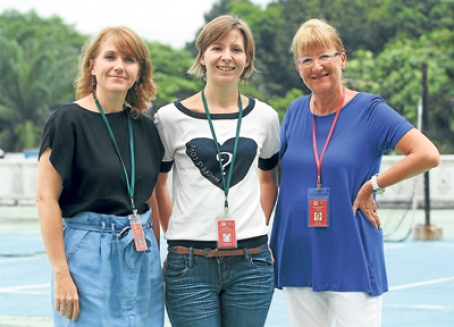
(From left) Nathalie, Marie-Clarisse and Dany have their personal favourite exhibit at the National Museum.
LIKE most Malaysians, you’ve probably visited the National Museum twice in your life — as a child with your parents and as an adult with your children.
“I’ve heard many Malaysians say that,” says 60-year-old Dany Pico, a French-speaking volunteer at the museum.
While Dany leads the way to Gallery A, another volunteer, Marie-Clarisse Le Heron, 35, says: “When I first arrived, I thought there was no history in this country. I couldn’t see it. In Europe, you see it immediately. We have castles and buildings. In France, we have Versailles, of course. Here, when you get off the plane, buildings are new. Roads are new. Even the palace is new. Everything is new.”
The mother of two rolls her eyes and adds: “And everyone in Malaysia is interested in makan and shopping.”
According to 44-year-old Nathalie Moulin, another problem for French-speaking visitors is that many of the books on Malaysian history are in English. Reading in English can be painful for the French.
She says the scarcity of French books on Malaysian history is partly because the country was never a French colony. “We know more about Vietnam than we do about Malaysia,” she says.
Despite the challenges, all three expatriate wives were determined to find out something about local history. With time on their hands, they became members of a non-profit, non-political and non-religious group of volunteers at the museum.
Laurence Maille, who joins the group at the entrance of the first gallery, explains that volunteers come under the auspices of the Department Of Museums. They aim to promote public awareness of museums, thereby, building an understanding of the history and culture of the country.
“We undergo training, you know,” says Dany. After about six months, new “graduates” become volunteer guides at the museum. “If you look in Lonely Planet, you’ll see this service is listed there,” she adds.
For French-speaking families and visitors, this group of volunteers conducts free one-hour guided tours every Tuesday and Thursday, at 10am.
Relating to history
Once the tour of the museum is underway, it soon becomes obvious that each one’s favourite exhibit somehow relates to their personal histories. For instance, Nathalie, a former banker, says her favourite section is the spice trade, the emergence of Malacca as a leading entrepot and the commentary about the commercial value of spices such as cinnamon, cardamom and turmeric.
Having studied anthropology, it is no surprise that Marie-Clarisse has a penchant for the star of the museum, Perak Man. Believed to be more than 10,000 years old, this exhibit is the intact remains of a man, discovered in Perak. Dany explains: “I think he was an old man. Scientists have also discovered that he was crippled. Still, he was well looked after and that tells me that, even then, people cared for their elders.”
She hurries along and points to a jar that contains ash. “I love this,” she says. “Can you believe this is ash from a volcano?”
The volcano she speaks of is Toba in Sumatra, which last erupted some 70,000-75,000 years ago. The ash fell as far as the Lenggong Valley.
All four women are drawn to the Baba Nyonya exhibits and show enormous interest in the history of the Peranakan people. “I believe that the period of the Baba Nyonya was the highest point of expansion when everyone was open-minded,” says Laurence. “There was inter-marriage without religious restrictions. It was probably after the English arrived, when they needed to carry out a census, that the people were put into various groups.”
Another of Dany’s favourites is a bronze statue of Avalokitesvara. A National Heritage artefact, it weighs 63kg. “It was found in a tin mine in Perak,” she says. “People ask why it has so many hands. I used to say that it was because Avalokitesvara had so much work to do.”
Now, however, she understands that each hand represents a mudra, a gesture from Buddha. “I learnt this from one of the visitors. See the one with the hand pointing down?” That, she says, depicts Buddha seeking the grace of Mother Earth to bear witness to the truth of his words and the moment of his enlightenment.
Marie Clarisse adds: “Yes, I used to think that everyone wore the tengkolok. But, someone told me it’s worn maybe just at weddings.”
One practice that fascinates Dany is that some Malaysians still chew betelnut, which is why she loves the collection of betelnut boxes in the museum.
As the tour ends, Laurence points out two exhibits on agriculture which brings the tour a full circle to the locals’ passion for food — an enormous depiction of a farmer planting paddy and a gigantic coconut tree. Smiling, she says: “With rice and coconut, you can make a basic nasi lemak.”
The Star newspaper interviewed 4 museum volunteers guides and the interview was published as a center-spread on 4 Feb 2013. This article is copied below. You can also read the article at the following.
They come from different backgrounds and nationalities, but their love for history, culture and heritage brings them together for a good cause.
LAST year, the National Museum in Kuala Lumpur received over 500,000 visitors comprising Malaysians and tourists from all over the world.
With the constant stream of visitors, the presence of docents or volunteers who help out at the museum is a welcome sight.
These volunteers provide an hour’s guided tour for free in English, French, Japanese, Malay and Mandarin on selected days of the week, while tours in other languages are available on request.
Among the crowd, you can spot a volunteer from their black vest with the National Museum logo, guiding a tour or manning the front desk at the entrance of the museum.
The museum volunteers are made up of a group of Malaysians and expatriates from various countries. These history enthusiasts have been working relentlessly behind the scenes and in the front line to ensure that visitors enjoy their outing.
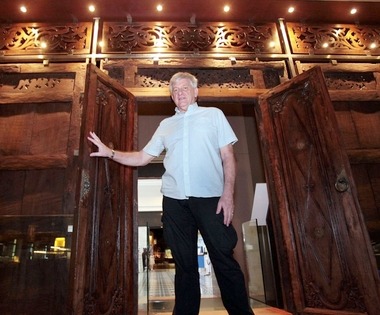
Stuart Wakefield, who has made Malaysia his temporary home, has been a museum volunteer for the past two years.
When retiree Stuart Wakefield arrived in Kuala Lumpur with his wife under the MM2H (Malaysia My Second Home) programme in 2010, he had plenty of time on his hands. Wakefield, who made a living managing contracts for the operation of helicopters, met an expat who volunteered at the National Museum.
“She told me that the best thing she had done in Malaysia was to get involved as a museum volunteer, so I got involved, too!” says Wakefield, 69.
Wakefield, who hails from Tetbury in England, had lived in various cities around the world before he decided to settle down in Malaysia.
Asked if he had done volunteer work previously, he quips: “I’m not a serial volunteer, if that’s what you mean!”
Back home in England, Wakefield had served as a volunteer for several years, looking after children who were going to be sent to prison. His job was to ensure that these children, aged 16 and below, received fair treatment.
Wakefield, who serves as secretary and sits on the National Museum volunteers committee, is one of the few male volunteers.
“It is very interesting working with so many women. If men led, it would be a very formal setting where it is all about rules. These women will disagree, then debate and without taking a vote, they seem to come to a consensus easily,” he points out.
Apart from guiding a tour once a month, Wakefield does just about everything: answer e-mail messages, handle visits from schoolchildren, and organise talks and training for volunteers, check captions (in English) for artifacts in the museum.
“The challenge lies in finding ways to get visitors interested and involved during a tour. It’s about understanding what the visitor wants and giving them something that matters,” Wakefield explains.
So, how does a tour begin?
“Before I start, I usually find out if there is a historian among the visitors. If there is, I will ask him or her to leave!” he says in jest. “Seriously, if I know there is a Malaysian among the visitors, I am kept on my toes as they are likely to know if I have gotten my facts wrong!”
Wakefield had the honour of leading a tour for the Fijian President in 2010.
“When I turned up that day, I had no idea that I was about to take the President of Fiji around the museum and it was amusing to see how flustered everyone at the museum was. I managed to engage the President during the 90-minute tour,” he recalls.
Wakefield is accustomed to working with heads of states and dignitaries, prior to his retirement. “They just want to be treated like normal people; you cannot afford to be over-awed.”
As a trainer, Wakefield basically provides volunteer trainees with tips gleaned from his experience.
“People are entitled to the best possible tour and we are here to enhance their experience. Whilst I do give a list of tips to the trainees, I often find that I break these rules!” he says with a laugh.
Each group that he leads requires a different type of tour and script. Wakefield fondly remembers a delegation of Danish students who were studying the export market and trade.
“I gave them a full tour of the history of trade and that provided them with a vital link of the countries some 3,000 years ago,” he says.
“Anyone who would like to come in as a volunteer needs to find out as much as possible what the commitment entails, and what they need to do. If leading a guided tour is not for you, you can always discuss with the committee and they can recommend something that you’ll enjoy doing,” he says.
Unfortunately for the museum, Wakefield will be leaving Malaysia soon to return to England to spend more time with his grandchildren.
“I will miss my role as a museum volunteer when I leave,” says Wakefield who has committed his two years in Malaysia to volunteering at the museum.
All abuzz over the past
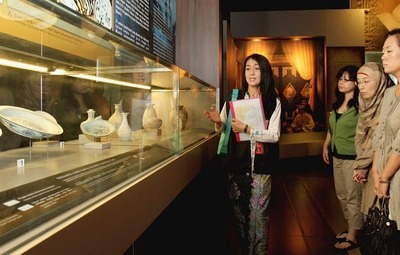
Fully involved: Museum volunteer Reiko Sato (left) does a lot of research to prepare for the guided tours that she gives visitors
When Reiko Sato, 44, shows up as volunteer guide for Japanese tourists, she is always well received.
“Japanese tourists love the fact that a fellow native is leading the tour as they appreciate having a guide who speaks their language,” says Sato, in perfect English.
“Most of the Japanese tourists are amazed that the history of Malaysia goes back a long way and there is a connection between our two countries from as early as the 15th century,” says the homemaker and mother of two teenage girls.
Sato, who was born in Osaka, used to live in Johor Baru. In 2010, Sato and her husband – who works for a Japanese company in KL – returned to Malaysia for the second time.
Like Wakefield, Sato had a Japanese friend who was a museum volunteer; she was introduced to the group during a coffee session in June 2010.
“I’m fond of meeting and talking with people, and I’m interested in history, so becoming a museum volunteer really appealed to me,” says Sato.
According to Sato, some volunteers prefer a fixed script when they are guiding a tour, but she prefers to improvise along the way.
“I research on various topics and read books to keep improving. Also, it depends on the group of tourists, whether they are elderly, residents or couples with young kids. I customise the tour according to their interests,” Sato says.
Aside from meeting people, Sato says the nicest thing about volunteering is when visitors tell her that they found the tour interesting and informative.
“There are 26 Japanese volunteer guides. This year, we have 18 trainees so there will be a total of 44 members under the Japanese group,” says Sato.
Therapeutic
Mariana Isa is an architect on weekdays and a museum volunteer on weekends.
“Volunteering is really good therapy for me!” says Mariana Isa, 32, who volunteers at the National Museum on Saturdays.
“There is so much negativity in the news. Leading a tour gives me a chance to say good things about my country. It’s my way of contributing to society. At the same time, it reminds me about the good things that we have,” says Mariana, an architect.
“Since young I’ve always wanted to be a guide at a museum, so when I saw the ad in the papers, I signed up in 2008,” says Mariana who returned to KL in 2008 after studying in the United States and England.
“The challenge in guiding is to present Malaysian history and culture in a more interesting format so that visitors will have a memorable experience,” says Marina, who majored in historic buildings and holds a masters in conservation of historic buildings.
Through talks by experts, the volunteers learn new things all the time. Marina says the tours are never stagnant and the script evolves along the way.
“Volunteering as a guide has helped build my confidence in talking with people. It’s great meeting tourists from around the world who are interested in Malaysia; their feedback helps open up my mind,” says Marina, who is on the Malaysian Institute of Architects heritage committee.
“I was telling a group about our nine kings who each take turns to be the King of Malaysia and how they make decisions through a council. This Arab visitor commented that it’s such a good system and pointed out that they only have one king and they cannot get rid of him!” she recalls with a laugh.
Mariana fondly remembers a group of elderly Italian women who were so impressed and grateful for her guiding that they offered her tips. It is the policy of the museum volunteers to decline tips, so Mariana refused and thanked them.
“They are so used to tipping in their country so they were shocked that I wouldn’t accept their tip! They all hugged me and asked me to visit them in Italy,” she says.
In another incident, Mariana was taking a group of Japanese tourists around when she felt awkward at the gallery that displayed the colonial period.
“I didn’t want to offend the Japanese visitors so I didn’t use my usual story about the Japanese Occupation during WWII. Sensing that they weren’t keen on hearing about this, I sped things up and moved on to the independence period!” she says.
Being a volunteer also gives them access to unusual opportunities such as a visit to the House of Parliament that Mariana proposed for the volunteers in 2009.
“It was a fascinating experience because we have foreigners and locals among the volunteers. The foreigners could follow the session through headphones which translated what was going on,” she says.
Through researching for her volunteer work, Mariana has enjoyed discovering things like why the kijang (barking deer) is included in the Malaysian currency; she has learned that there is a reason and history behind it.
According to Mariana, the legendary Kelantanese Queen Cik Siti Wan Kembang, who ruled during the 14th century, had her favourite pet, a barking deer, immortalised on her royal gold coins.
The “Kijang Emas” motif from these ancient Kelantan gold coins became the official logo of Bank Negara Malaysia.
“In the olden days, the Malays believed that every metal has its own spirit so the spirit of gold is the deer, and so the barking deer appears on our currency until today,” she says with delight.
Her parting advice for interested parties?
“Be prepared to read a lot and do a lot of research. Being a guide helps build up your knowledge, and you learn to appreciate your country more,” adds Mariana.
A Passion for Artifacts
Karen Loh, president of the museum volunteers at the National Museum in Kuala Lumpur.
SHIPWRECK antiques are things that Karen Loh is not only familiar with, they have become her life’s pursuit. Her interest in these artifacts and wreckage has led her to an unexpected path in volunteer work.
Noting that the National Museum in Kuala Lumpur had a gallery that featured shipwreck artifacts, Loh decided to get involved in some way.
“I wanted to share my knowledge about shipwrecks and artifacts, and decided to become a museum volunteer. As soon as I became a trainee volunteer, the museum closed the shipwreck antiques gallery!” says Loh, 43. Today, she is president of the museum volunteers under the Department of Museums Malaysia.
Loh’s interest in shipwreck anti-ques grew into a passion over time.
“In 2006, a French woman, together with a few Malaysians, approached Janet Tee, the then deputy director of the National Museum, to start a museum volunteers group,” says Loh, a director with Nanhai Marine Archaeology, a company which specialises in the search for historical shipwrecks, underwater excavations and research into the ships and cargo.
The group started with just 15 members; Loh joined in 2008 under the second batch of volunteers.
“Today we have 180 volunteers – half are Malaysians and the rest are expats from Canada, France, Germany, Holland, Italy, Japan, Poland, Switzerland and Britain,” she says.
“The Malaysian volunteers are made up of retired civil servants, history teachers and college students, while homemakers make up the majority of the expat volunteers. Besides making good use of their free time, these expats get to learn more about Malaysia,” Loh explains.
She adds that they hold “coffee mornings” in English, French and Japanese to create awareness of museum volunteers and to rope in new ones.
Volunteers are also recruited through advertisements in international schools and clubs, the local media and radio, as well as their blog and Facebook page.
“There is more awareness now compared to the early days, and we are happy that more Malaysians are stepping up. When we started, I was one of only two Malaysian volunteers!” Loh points out.
Museum volunteers are not confined to giving guided tours, says Loh. “A volunteer can be involved in library duties, secretarial work, proof-reading, translation work, or even research and conservation, which has a new team that we started last year.”
Those who work full-time but would like to get involved, can also work from home.
On her own volunteering experience, Loh recalls handling a group of 350 low-performing students a year ago. They came for a tour under the Educational, Welfare and Research Foundation which was set up to improve the social, educational and economic welfare of marginalised Indians, particularly students from poor homes.
The students were introduced to the history of Malacca through a creative presentation and participated through worksheets to answer questions.
Loh dressed up as Hang Li Po, the fourth wife of Malaccan Sultan Mansur Shah, while other volunteers came as Hang Jebat and other popular historical figures.
“We were expecting a challenging bunch but to our surprise, they were very attentive and interested. I felt a big sense of accomplishment to see such positive response,” says Loh. “The joy on the children’s faces was really rewarding to see and I just got sucked into the spirit of volunteerism. If anyone is thinking of joining as a volunteer, please come and see us!”
As Malaysians we think we know a lot about food. Whether they are Malay, Indian or Chinese dishes, we know them all and love them all. We are even a little arrogant as a lot of concoctions are truly Malaysian; a fusion of food from different cultures.
Harith Jamaludin giving a talk to museum volunteers
On 26th Jan 2013, Harith Jamaludin gave a talk to the museum volunteers on Malaysian food and it was a humbling experience to learn that there is a lot about Malaysian cuisine we don’t know. For example, nasi pattaya does not come from Pattaya, Thailand. Possibly a local invention?
Harith Jamaludin is the Program Manager for the School of Hospitality & Culinary Arts, Kolej PTPL Sungai Petani. He obtained a Diploma in Food Service Management and Bachelor of Science in Food Service Management from Universiti Teknologi Mara (UiTM). Currently based in Sungai Petani, Harith is undergoing his Masters Degree in Gastronomy at the same University.
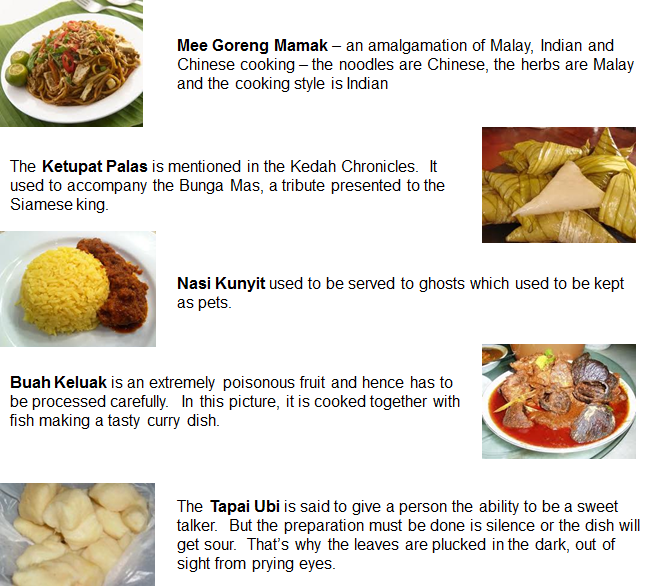
Harith started the talk by explaining how history influenced Malaysian cuisine. It was interesting to know that the Malay words ‘ubi’ (potato), ‘keladi’ (yam) and ‘babi’ (pig) are the only food related words not linguistically influenced from elsewhere. With 143 mouth watering pictures of heritage food and drinks, Harith went through the cooking of the Malays, Indian, Chinese, Orang Asli, natives of Sabah & Sarawak as well as Peranakan and Eurasian cooking. He also talked about European influenced cooking. Laksa Johor, for example, uses spaghetti.
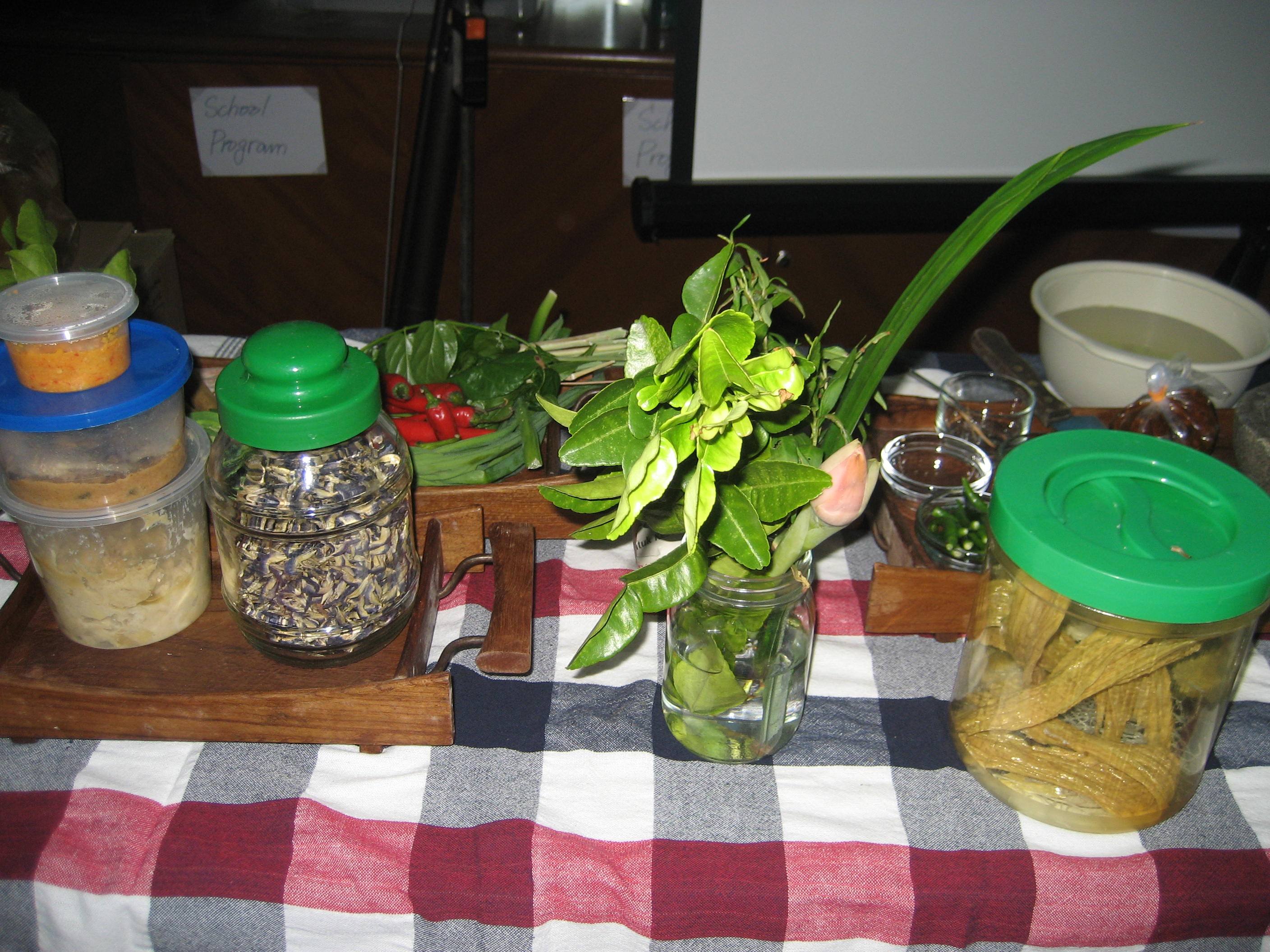
Sample herbs, plants and food brought by Harith
Harith also brought along herbs, spices as well as cooked and uncooked food in a show-and-tell.
We got the feel of texture and smells of herbs and plants which we usually only taste in the finished product.
The volunteers also had hands-on experience in making sambal belacan and many tried this with relish.
Lawrence having a go at making sambal belacan with the other volunteers waiting their turn.
The talk was a good prelude to the New Year potluck. Appetites whetted by sights and smells of Harith’s presentation, the sumptuous lunch that followed was a good end to the morning.


 Museum Volunteers, JMM