On 17 April, 24 students from the Special Needs School in Puchong participated in a school trip to Muzium Negara and ten museum volunteers were at hand to make this a fun trip for them.
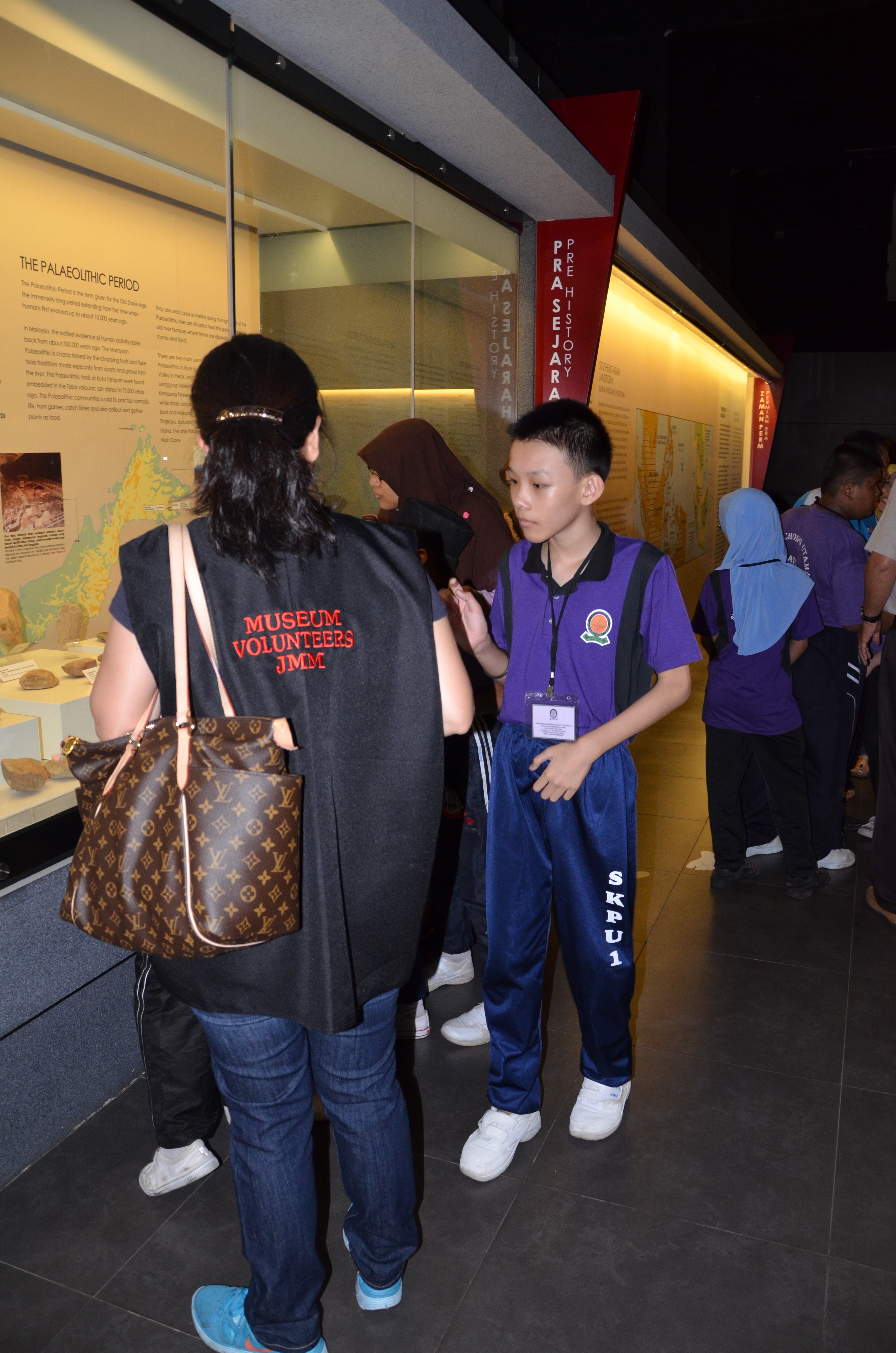
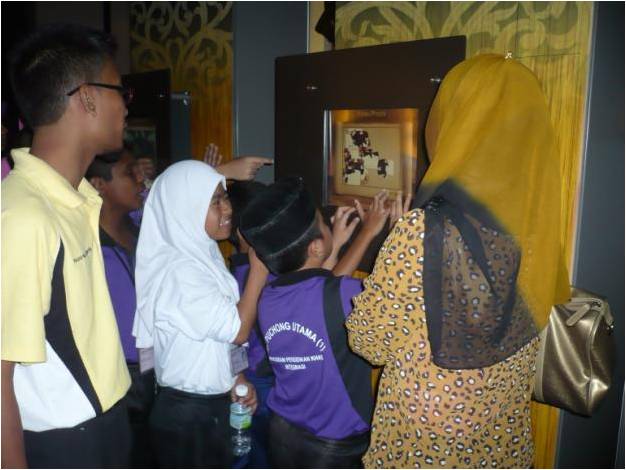
The students, aged between 7 and 12, were divided into three groups and were led through Galleries A, B and C by the volunteers. The students were engaged throughout and gave the volunteers their focused attention. Upon completing the tour of the galleries, they assembled at Dataran Muzium and took part in a few traditional games, namely the baling tin, gerek buluh and sepak buluh ayam.
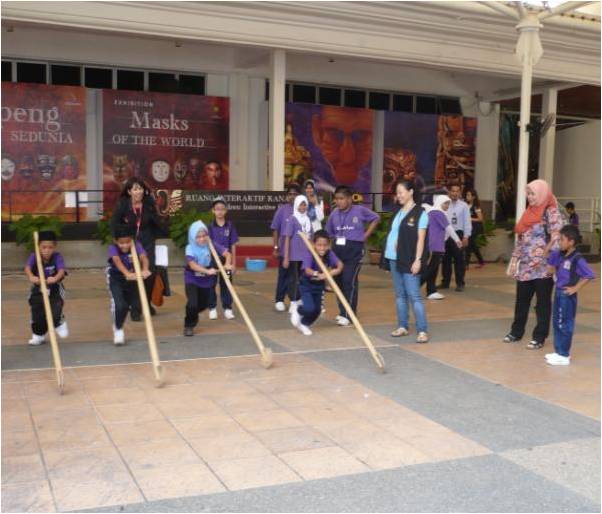
Playing the Gerek Buluh
This picture shows the children playing the Gerek Buluh. In this game, a wheel is attached to a long bamboo handle and the participants are required to roll the wheel to the opposite side and hand it over to their partners who will then take over in a relay. The winner is, and no marks for guessing, the team that is first to reach the finish line.
The children had the most fun in this game. Although some of them had difficulty controlling the wheel and went zig-zag instead of going in a straight line, they all managed to hold on to the bamboo and finish the game.
Below are pictures of the children touring the galleries. Kudos to volunteers Cay, Mique, Karen, Fafa, Miju, Vallie, Zakaria, Sarah, Serena and Colin for taking the time out and making it a fun day for the students.
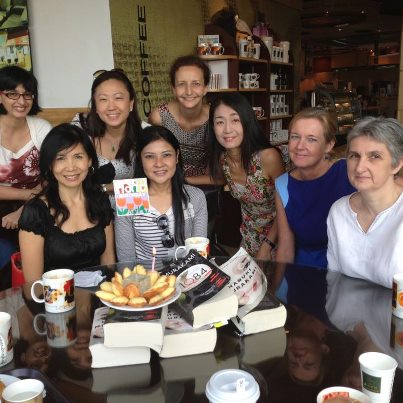
The MV Book Club turned one last month (March) and we celebrated it by discussing IQ84 by Haruki Murakami.
This is a long novel divided into three parts with 1,318 pages but most of us managed to finish reading it before the meeting and came prepared with our opinions, prejudices and interpretations.
The discussion was led by Reiko who cleverly counteracted the various viewpoints with alternative opinions thus providing us with a perspective of the book that had more shades than what we envisioned in the first read.
Personally, I was disappointed with the book chiefly because the hype around it had raised my expectations. Fully expecting to love the book, I started reading it with high hopes and I did enjoy the beginning but the story fizzled out in the end and so did my interest in Murakami. I like books with a supernatural bent but will pick a Clive Barker over a Murakami.
Our birthday ‘buffet’ was made up of freshly baked madeleines, courtesy of Marie who liked the reference to Proust in IQ84 and Dutch cookies from Kokkie. Add a card and candles from Lena and we were ready for our birthday song. Ironically, the first book we read was Shantaram which is close to a 1,000 pages and we started our 2nd year with another long book. Maybe we should make this our tradition thus reading only one long book a year.
We are reading two books this coming Thursday (18th April): “First They Killed My Father” by Loung Ung and “The Female Cell” by Rumaizah Abu Bakar, a fellow volunteer with MV. I have read both books but will save my comments for the meeting.
The 3,000 year old Zoroastrian festival of Nowruz is the Iranian New Year and though it is celebrated worldwide, it is relatively unknown in Malaysia. Hence, we learned a lot when museum volunteer Jaleh Chegini gave a presentation on this festival on March 26; just a few days after this year’s Nowruz.
Nowruz, which is steeped in tradition, is celebrated at the time of the vernal equinox or the first day of spring which falls around 21 March. This is the time when sunlight is evenly divided between the northern and southern hemispheres. The start of the New Year is very precisely timed and Iranians celebrate Nowruz at the precise time of the arrival of spring, regardless if this is at midnight, 10am or 4am!
Jaleh in traditional Iranian costume
Preparations start a few weeks before the festival. Iranians start by ‘shaking the house’ during which they literally clean every spot in their homes. The phrase ‘spring cleaning’ is believed to have originated in this Iranian tradition. During this time, Iranians would also buy new clothes and furniture as well as make donations to charity.
Fire Jumping, is celebrated on the night of the last Wednesday of the old year. Small bonfires are lit in the streets and people jump over the flames while shouting “May my sickly pallor be yours and your red glow be mine.” The flames symbolically take away all the unpleasantness of the previous year.
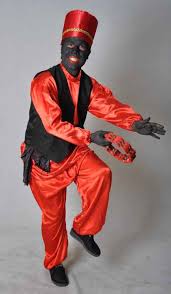
Haji Firuz
Before the arrival of Nowruz, a man dressed in red with face covered in soot takes to the streets dancing and singing and proclaiming that Nowruz is approaching. This is Haji Firuz, the herald of Nowruz. Haji Firuz has a side-kick, Uncle Nowruz, who is the Iranian version of Santa Claus. Similar to Santa, Uncle Nowruz is also an old man with a white beard who brings gifts and good luck to people.
Another interesting tradition carried out before the arrival of Nowruz is similar to Halloween. Kids in the neighbourhood would drop by in disguise and announce their presence by hitting a metal pot with a metal spoon. This is called ‘pot hitting‘ and would earn them a treat from the house owner.
Preparing the Haft-Seen table is, perhaps, the most important tradition of Nowruz. Iranians will sit around the table with friends and family while waiting for Nowruz to arrive. Jaleh prepared a table for us which is shown on the right. Nowruz has its traditions in Zoroastrianism, a religion that was prevalent in present day Iran around 3,000 years ago. The table was called Haft-Chin and it had seven items on it symbolising seven elements in the universe. Since the advent of Islam, the table is now known as Haft-Seen, or the seven ‘S’s and there are seven key items on it each starting with the letter ‘S’. One of the items, sabzeh (wheat, barley or lentil sprouts growing in a dish), is perhaps the only item that is common to both tables.
Nowruz is celebrated for 12 days during which time, schools and many offices are closed. Visiting friends and family is the main activity. The 13th day of Nowruz is considered to be bad luck as it is associated with the number 13. To avoid the bad luck, people go outdoors on picnics and this day is called Sizdah Bedar meaning ‘getting rid of the 13‘. On this day, some girls would tie the leaves of their sabzeh dish before throwing it away. While doing so, they express their wish to get married before the next Sizdah Bedar.
Jaleh had also arranged for us to try out some Iranian food which she had ordered from an Iranian restaurant.
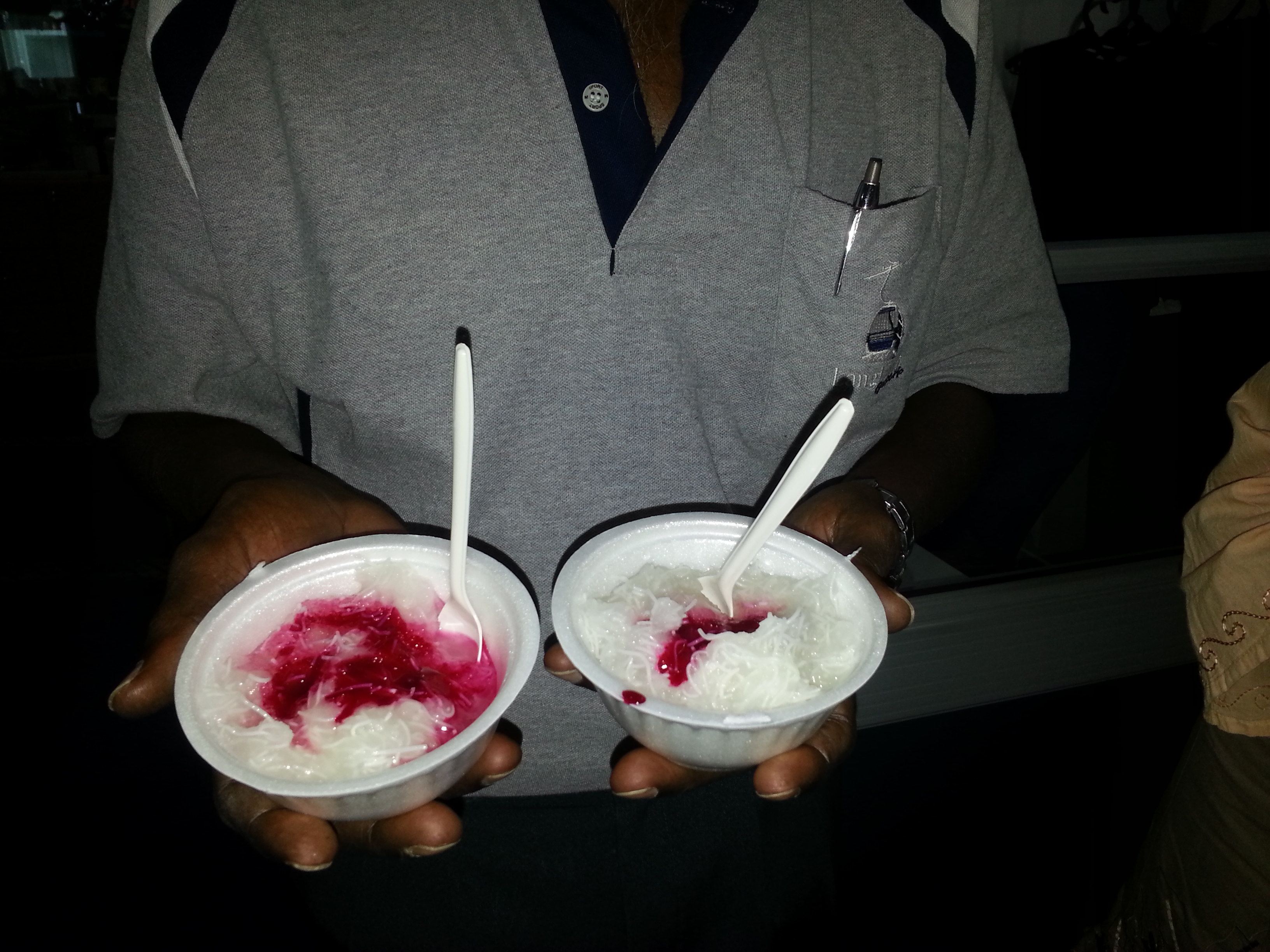
From far, this dish looks familiar and Malaysians may be forgiven for dismissing it as ice-kacang. But this dessert, called faloodeh, is not made from shaved ice but from frozen vermicelli topped with rose syrup. A tinge of lime juice is added giving it a zesty taste. Apart from faloodeh, we also tried out an aubergine dish which was served with flat bread. Only one word, ‘yummy’. Wish all focus events would end with a treat!





 Museum Volunteers, JMM