By Sharifah Seri Lailah (Sherry)
Gaya Street, Kota Kinabalu’s most famous tourist destination, lies in the commercial district of the city. It was known as Bond Street during the British colonial era when Sabah was known as North Borneo. Bond Street started as a railway track in 1902 for the transportation of rubber all the way from Sapong and Melalap rubber estates in Tenom and ended at the wharf. The Jesselton Harbour was then the gateway to the rest of the world until the arrival of passenger planes.
In 1887, Mat Salleh, a local chieftain who rebelled against the British, burned the original settlement at Gaya Island. It was from that incident, the capital was named “Api-Api” (Fire-Fire). It was renamed as Jesselton in 1899 after Charles Jessel, a Director of the British North Borneo Company. Jesselton suffered severe destruction when it was razed by the British on retreat from the Japanese and suffered more destruction when the Allied Forces bombed it in 1945.
After the war, the British North Borneo Company returned to administer Jesselton. However, as the costs of reconstruction was colossal; the Company then was on the fringe of bankruptcy, gave control of North Borneo to the British Crown on 15 July 1946.
When North Borneo together with Sarawak, Singapore and the Federation of Malaya formed the Federation of Malaysia in 1963, it became known as Sabah, and Jesselton remained its capital. On 22 December 1967, State Legislative Assembly under Chief Minister Tun Mustapha bin Datu Harun, passed a bill renaming Jesselton to Kota Kinabalu. The city was upgraded to city status on 2 February 2000.
Sunday Market (Tamu)
In the early 20th century, farmers from the highlands and fishermen from coastal areas met once a week at Bond Street to barter their local products with the immigrant Chinese, Indonesian and Filipino traders. The locals traded fruits, vegetables, rattan, poultry, deer and wild boar meat, and local handicrafts for cotton and silk, spices, medicinal ointment, jewellery and kitchen utensils. This weekly Sunday Market is known locally as Tamu (Fair). The word Tamu is derived from the word ‘temu’ which means “to meet”.
 Strolling along Gaya Street is like walking down memory lane as we can still see some evidence of the bygone era. The old Jesselton Post Office which has now been converted into the main office of Sabah Tourism Corporation (STC) is located at this street and it still maintains its colonial architecture. This building was originally built by the British to house the Government Printing House. Another remnant of the colonial era is the Jesselton Hotel established in 1954, where a genuine London Taxi cab is available for the exclusive use of hotel guests. The Atkinson Clock Tower, a landmark of the city, was built on the slope of a hill in 1903 where at one time it had a view overlooking Bond Street. It survived the World War 2 bomb raids though riddled with bullets.
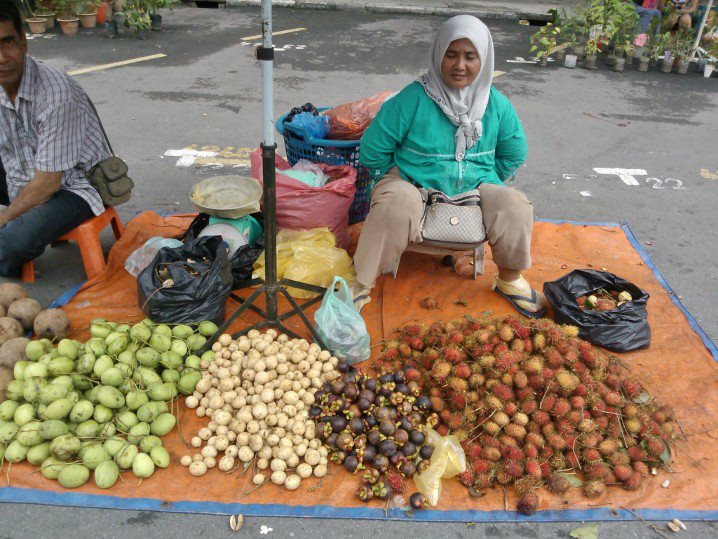
Today, Gaya Street has become a favourite hang-out for both locals and tourists alike due to its vibrant and bustling commercial activities. The Gaya Street Tamu (Gaya Street Fair) starts as early as 5.30 am until 1.00 pm in the afternoon every Sunday. You can get anything and everything from pets to souvenirs, herbs, medicinal roots, antiques and brass wares, coins and collectibles, local beads and cultured pearls, crystals and accessories as well as clothes, food, vegetables, fruits and plants. For orchid enthusiasts, wild orchids as well as hybrid orchids are also available.
Tourists are awed by local exotic fruits such as Bambangan, Tarap, Belunu, Rambai which are found only in Borneo. It’s interesting to watch local vendors cajoling the foreign tourists to taste the local fruits and be amazed that language is not a problem as they would simply communicate via gestures or signs. During festive seasons, one can watch local entertainers singing and performing traditional dances. Tired with walking, one can get a foot reflexology massage right at the pavement of Gaya Street.
 The fun is in the mingling of people moving at a snail’s pace along the narrow stretch of Gaya Street. The aroma of Tenom coffee freshly grinded and the local delicacies fried on the spot, is simply tantalizing and irresistible for one’s taste buds. The competing human sounds, colours and smells are just awesome; making Gaya Street Fair… a must visit place of interest for tourists. Even if it rained, the fair would still go on. It is simply packed with people either to shop, to meet friends or just to be there and savour the “tamu” experience.
Gaya Street is Kota Kinabalu’s own cultural heritage of keeping up and maintaining the local trademark of a bustling Sunday weekly market where trades go on since historic past.
 Museum Volunteers, JMM