by Jean-Marie Metzger
“From Angkor to Bujang Valley”. That was the title of the conference which took place at Alliance Française of Kuala Lumpur on Jan 25th. And as you all know, when MVs hear the words “Bujang Valley”, they tend to flock like birds on a wire. And indeed a large audience, comprising quite a few MV docents, trainees, and trainers, gathered to listen to Dr Daniel Perret, researcher from the French School for Asian Studies. The talk was mostly oriented towards the program of research in South-east Asia and the archaeological methods employed by this unit.

The French School for Asian Studies (Ecole française d’Extrème-Orient) is a public institution under the Ministry for Higher Education and Research. It was founded in 1898 in Saigon and, therefore, started its activities mostly in what was French Indochina. Today it is established in twelve countries, with eighteen research centers, from India to Japan. In Malaysia, the Center is hosted by the Department of History, Faculty of Arts and Social Sciences, University of Malaya. It conducts research in cooperation with the University of Malaya, UKM, JMM…
A lot of research has been devoted to Indochina: it included, from 1992, the rehabilitation of many Angkor Temples, but the center has also been active in countries such as Laos (Vat Phu Temple -11th-13th century CE), Vietnam (Quang Ngai wall, a 19th century fortified wall extending for 127 km in the Champa region), and Myanmar (inventory of 2,800 monuments in Pagan (Bagan) -1044-1287 CE-).

Dr Perret himself has devoted a lot of his activities in Indonesia, mainly Sumatra, and in Malaysia, including in the Bujang Valley.
In Sumatra, research, which has now turned away from the exclusive study of temples and monuments, has been devoted to the evolution of three settlements, Barus (on the west coast), Padang Lawas (central Sumatra) and Kota Cina (on the north-east coast).
All research on human settlements, in the absence of temples, must be correlated with other types of data (archaeological findings – Chinese ceramics being often important for dating, local epigraphy, local literature and traditions, foreign written sources).
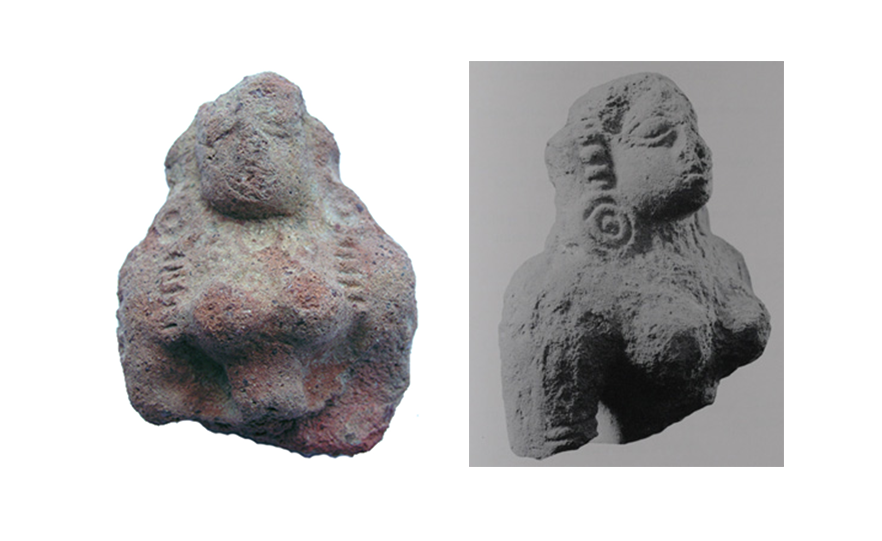
In the case of Barus, a Tamil inscription (1088 CE) indicates that the earliest known inhabitants were Tamils, a fact in accordance with local literature and tradition. Other sources include the “Sejarah Raja Raja Barus” (late text from 19th century), an Armenian maritime chart (12th century), the Archives Cairo Geniza (11th-13th century), Marco Polo’s writings (13th century), many Chinese and a few Portuguese and VOC sources. One of the difficulties conducting archaeological research in Indonesia is the concentration of layers which do not exceed 30 cm in depth and, hence, chronology is often difficult to establish between the different artifacts found. Nevertheless, interesting findings could relate the settlements to Indian presence and trading activities with many parts of Asia: for example pottery, analogous to Cambay Ghee pots still used in Southern India. A figurine, dated between 12th and 16th century, analogous to an Old Bahrein figurine (12th-14th century) was also unearthed. Stoneware was also found originating from China, and also Vietnam, Thailand, Myanmar, Japan (in particular originating from Hizen kiln active in the first half of the 17th century).
In Padang Lawas, archaeological research had been very active in the past, about 30 Hindu-Buddhist monuments and some 1,039 inscriptions (in Malay, old Sanskrit, paleo-Sumatran) had been catalogued, but nobody was interested, until recent years, in the settlements themselves. One of the astonishing findings, related again to trade activities, was a Bukhara Dirham, dated 1003-1004 CE, from the Qarakhamid/Ilek Khan Dynasty.

In Kota Cina, where some Hindu-Buddhist images were found in the 1970’s, the site for digging had a particularity: there was a lot of water infiltrating the soil. That was a big problem because water had to be pumped out regularly, but also a big benefit as water better preserves organic remains. Hence, wooden construction pillars, animal remains (mostly turtles) and also human skeletons were found. The site also yielded some 160,000 pieces of earthenware (around 1,5 t), making it the biggest site in Sumatra, but also more than 1,000 coins, mostly Chinese. The dating of all these findings ranges from the end of the 11th century till the beginning of 14th century, but analysis is just beginning.

Dr Perret’s research in Malaysia was devoted first to the cataloguing of Batu Aceh tombstones: 450 of them were studied in Johor. In Bujang Valley, Dr Perret studied glassware. Some 6,000 shards were categorized, many of them (about 95%) coming from jarlets (a small type of vessel, about 3 cm for the rim and the base, 6 cm for the height). A recent book has been edited by Dr Perret (together with Zulkifli Jaafar) and published by JMM, “Ancient glassware in Malaysia – The Pengkalan Bujang Collection”.
Finally, Dr Perret explained how external interference can bring some kind of perturbation to academic work and spice it up a little. When he and his team found a human skeleton at Kota Cina, although it seemed clearly to be dated a few hundred years before the discovery, it appeared it could make a criminal “cold case” as the skeleton had both hands and feet bound together…so the local police claimed the skeleton for forensic investigation! Fortunately, when a second skeleton was found the police considered they had enough with one and left it to the archaeologists…
We, MVs, are very lucky to know that the Perak Man died from a tooth infection, otherwise we could have been caught in another episode of “NCIS Lenggong Valley”!!





 Museum Volunteers, JMM