The Practical Side of Melaka’s “Golden Age”
by Muhammad Adib bin Mohd Faiz
Although other ports on the Malayan Peninsula and in Sumatra existed along the Straits of Malacca, none of these ports could rival Melaka itself in its heyday, with the entrepôt attracting traders from all over the world.[1] Those who look back upon this period often express nostalgia for a “Golden Age”, with Melaka’s power, wealth, and cultural refinement evoking the image of a distant kingdom, imbibed with majesty and magic. But nostalgia can often cast too strong a spell, and Melaka’s legendary status can obscure the actual reasons for the empire’s success. Though Melaka’s success was partly due to its strategic location, it was largely Melaka’s efficient administration that was central to its success as an international trading hub. The term “administration” does not merely refer to a group of officials, but to “the process or activity of running a business, organization, etc.”.[2] Melaka’s efficient administration was the result of two things: a clear system of law and an efficient system of governance. The region also benefited from effective communication and mutual cooperation, points that will be touched on toward the end of this article.

Melaka had an effective legal justice system, which provided a clear framework for the facilitation of trade. Melaka has a clear legal system, with the region having two important legal codes that governed the affairs of the region. The first was the “Laws of Melaka” (Undang-Undang Melaka), a combination of customary and Islamic law that covered the special rights of the ruling family, dignitaries’ duties, government protocol, and both criminal and civil offences. This meant that there was a clear system that determined the state’s internal affairs, providing a stable basis for the day-to-day activities that took place in the area. But Melaka’s system also encompassed matters of trade, with the “Maritime Laws of Melaka” (Undang-Undang Laut Melaka) providing “rules for the proper conduct of trade, rules governing accidents at sea and regulations for boats and ships”. A clear system of taxation, import duties, customs duties, and gifts was outlined, with the details “varying according to the trader’s country of origin”. These laws provided a clear framework for the functioning of trade, minimizing the potential for large disputes with regards to transactions. The laws also applied the same principles governing affairs on land to those at sea, with captains “possessing power and authority akin to that of the ruler on land”.[3] In a world where so much human activity took place aboard ships, these laws greatly reduced the potential for chaos that could disrupt trade. The laws also covered safety regulations, covering “regulations for the safety of a prahu while at sea”. The law even detailed how sailors should deal with cargo in the midst of “a violent storm”, stating that the nakhodah must hold “a general consultation” of the crewmembers and not “indiscriminately” dispose of the cargo.[4] The clarity and detail of these codes meant that traders “understood what kinds of laws governed their trade”, with the “element of arbitrariness” being “removed” from commercial activity.[5] This provided a sense of security that encouraged traders from all over the world to bring their merchandise to Melaka.
However, a legal system is useless without an executive body to implement it, and Melaka possessed a clear system of governance to implement the region’s laws. Melaka had a clear bureaucratic system that managed the affairs of the region. Authority was centred on the sultan, whose sovereignty was not to be challenged. This notion of sovereignty or daulat was the cornerstone of Melaka’s social order: “without a king there could be no kingdom; without a kingdom there could not be ordered social life”. However, the king was at the summit of a larger governmental system, with the task of managing the country being regulated by a larger bureaucratic structure. Beneath the king were four principal officials:
- The Bendahara – The Prime Minister or vizier
- The Penghulu Bendahari – The state treasurer
- The Temenggong – Head of Security and Law and Order
- The Laksamana – Admiral of the Navy and chief emissary of the Sultan[6]
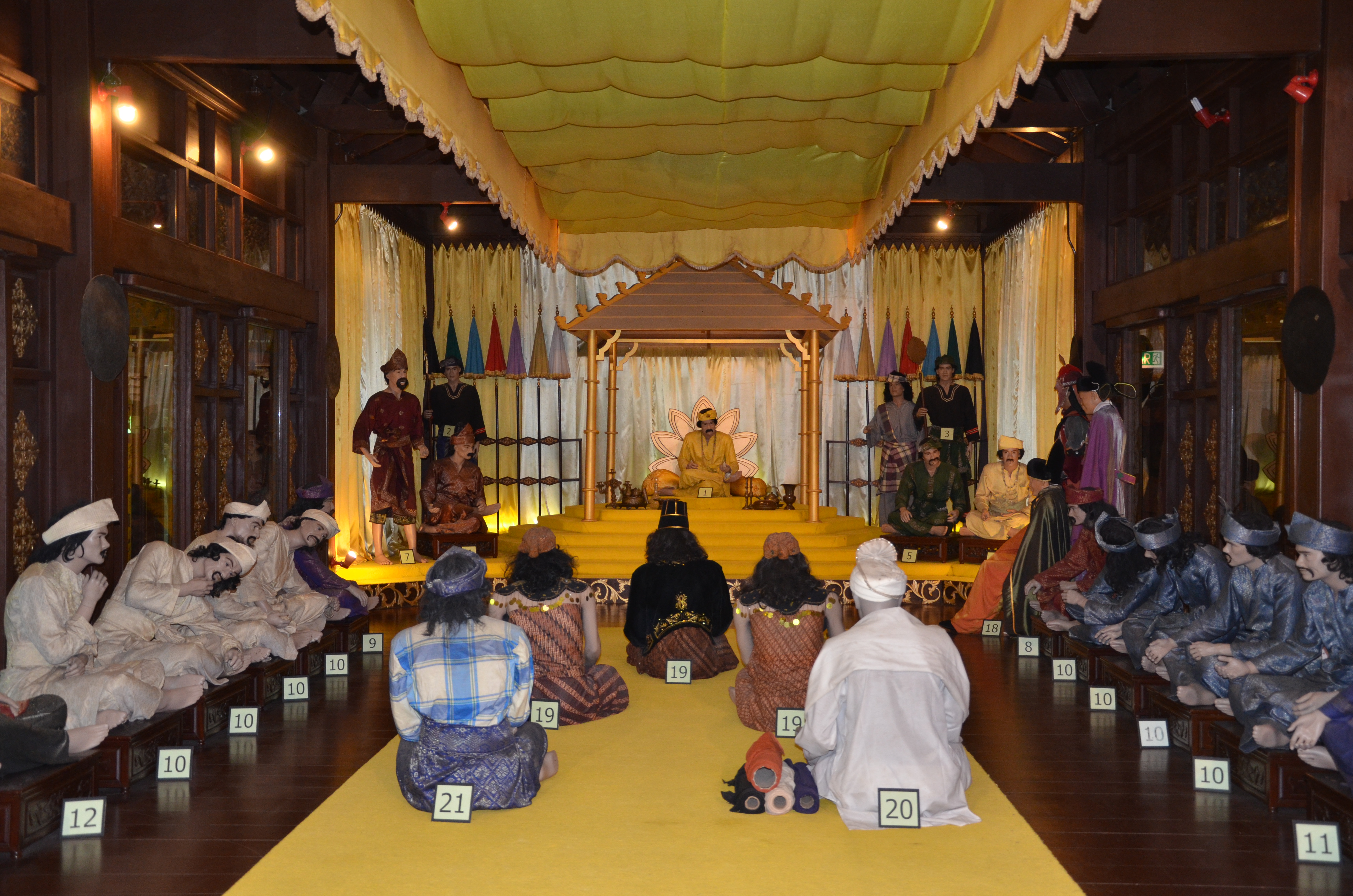
These officials existed with the framework of a larger governmental system called “The Fourfold System of Officials” (Sistem Pembesar Empat Lipatan). Beneath the four principal officials were eight lower-ranking officials, beneath these eight were another sixteen officials, and beneath these sixteen another thirty-two. This created a chain of command for the execution of orders, distributing power across a system akin to a civil service.[7]
The regulation of the traders themselves fell to four harbour masters (shahbandars), each of whom regulated the traders from a particular region such as Gujerat or the Malay Archipelago. The shahbandar was “often a foreign merchant who had acquired the trust of the ruler” who would “mediate between merchants of his home area and the ruler”. They also were responsible for many tasks, such as managing transport and making sure that the weights and measures were accurate. But the Malay rulers along the Straits of Malacca also understood the need for cooperation with the more nomadic elements in the society, who possessed skills important to the region as a whole. For instance, the Malay rulers established an alliance with the Orang Laut, “nomadic boat dwellers” that were a large percentage of the population. By establishing alliances with this group, the Malay rulers were able to maintain the safety of Melaka, with the Orang Laut using their seafaring skills to help “keep piracy within limits”. Similarly, the Malay rulers formed alliances with the hinterland dwellers, “gatherers of forest products” who were the “ancestors of the … Orang Asli”. The “bonds of personal loyalty” forged between these two groups resulted in “commercial and military benefits”.[8]
Justice, efficiency, and a willingness to work with others: these three components were ultimately the underlying factors that determined the overall administration of Melaka. It was this form of administration that ultimately brought about Melaka’s success as an entrepôt, making it a meeting place between cultures and civilizations. As we look back upon this “Golden Age”, the centrality of these principles in the proper functioning of Melaka are worth bearing in mind. For after visiting the kingdoms of the past, we must ultimately return to the shores of the present. And what good is a journey if you don’t return home with something useful?

[1] Osman, 114.
[2] Oxford Living Dictionaries, s.v. “administration,” accessed November 3, 2017, https://en.oxforddictionaries.com/definition/administration.
[3] Osman, 115.
[4] Raffles’ translation, as quoted in Reddie, 483 & 486.
[5] Syed Farid Al-Attas. “Prof Farid Alatas on Islam and Democracy.” Lecture, Liber TV, Malaysia, July 18, 2014, 2:57, https://www.youtube.com/watch?v=fe6mEbKnMRs (accessed November 3, 2017).
[6] Osman, 115; Velupillay, 106.
[7] Ismail, 8.
[8] Osman, 114-5; Miksic, 116.
REFERENCE LIST:
Al-Attas, Syed Farid. “Prof Farid Alatas on Islam and Democracy.” Lecture, Liber TV, Malaysia, July 18, 2014. https://www.youtube.com/watch?v=fe6mEbKnMRs (accessed November 3, 2017).
Ismail, Akashah. Visual Pelangi Sejarah Tingkatan Lima. Bangi: Pelangi ePublishing, 2010. https://books.google.com.my/books?id=TPkGCgAAQBAJ&pg=PA8&dq=melaka+lipatan&hl=en&sa=X&ved=0ahUKEwjW_u-90ZzXAhVKpY8KHXWOB6AQ6AEIMDAB#v=onepage&q=melaka%20lipatan&f=false
Miksic, John. “Entrepôts along the Melaka Strait.” In The Encyclopedia of Malaysia: Early History, edited by Prof. Dato’ Dr Nik Hassan Shuhaimi Nik Abdul Rahman, 116–7. Singapore: Editions Didier Millet, 1998.
Osman, Mohd Taib. “Trade and administration.” In The Encyclopedia of Malaysia: The Rulers of Malaysia, editorial advisory board chaired by Tun Ahmad Sarji bin Abdul Hamid, 114–5. Singapore: Editions Didier Millet, 2011.
Oxford Living Dictionaries, s.v. “administration,” accessed November 3, 2017, https://en.oxforddictionaries.com/definition/administration.
Raffles, Stamford. As quoted in James Reddie, An historical view of the law of maritime commerce. Edinburgh: William Blackwood and Sons, 1935. https://books.google.com.my/books?id=3CE1AAAAIAAJ&printsec=frontcover&source=gbs_ge_summary_r&redir_esc=y#v=onepage&q&f=false
Velupillay, Jegatheesan. “The Golden Age of Melaka.” In A Malaysian Tapestry: Rich Heritage at the National Museum, edited by Rose Gan and Maganjeet Kaur, 99–109. Kuala Lumpur: Department of Museums Malaysia, 2015.


