MV Trainees in Melaka (Jan 2019)

by Ilani Binti Mohammad Jamin

A morning visit to Stadthuys, St. Paul’s Hill, Dutch Cemetery, Porta de Santiago

On the fine Saturday morning of 12 January 2019, a group of 22 including MV trainers and trainees set off from Muzium Negara and arrived in Melaka at approximately 9.45 am. An experienced local guide, En Shaukani Abbas, from Friends of Melaka Museums, led our day’s itinerary. Upon introducing himself, he shared some tips and techniques on tour guiding: 1 – Understand the history; 2 – Say the facts in your own words; 3 – Tell the story from your heart using your imagination; and finally 4 – Have humour in your presentation.
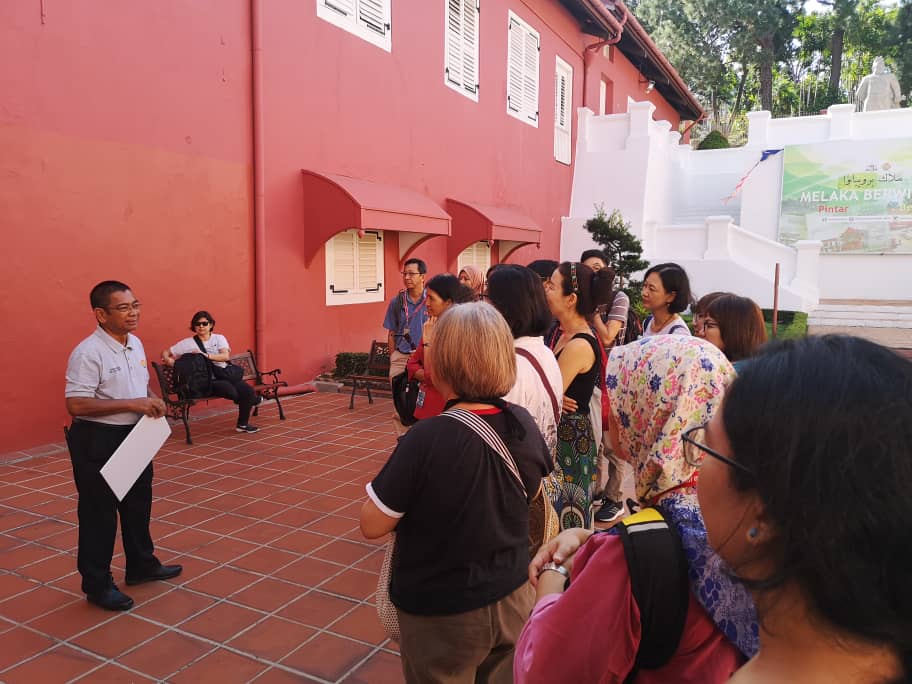
Our first stop was the Stadthuys, a prominent red building believed to be the oldest surviving structure of the Dutch in the East; if a modern Dutch visitor wishes to see a historical Dutch building, Melaka is where it can be found. The Stadthuys was built in 1641 on top of a Portuguese building as evidenced by Portuguese wells found below the ground. It was the official administration centre and dwelling of Dutch governors and officers. In 1982, it was converted into a museum displaying the rich history of Melaka’s colonial past and local customs and traditions. Its Dutch-style architecture can be clearly seen in its steep and high roofing as well as its wide doors and windows.

One of the rooms has ornate engravings on its ceiling; this room is believed to have been the living room of the governor. Also on display are items traded during the Dutch period in this region under the Dutch East-India Company (VOC) and portrait paintings of the Directors of the company are hung at one corner of the room. Just outside of the building but connected by a walkway is the kitchen, also known as the Big Toaster. In the olden days, servants would bake bread overnight in order to serve it fresh to their masters the next morning. The original brick flooring and massive ovens give the space a rustic feel.

Photo taken from http://aislim.blogspot.com/2012/08/stadthuys-museum.html

Moving deeper into the museum, dioramas on traditional wedding and ceremonial events are displayed and they provide an overall glimpse of the various cultures and customs practiced by the multi-racial people of Melaka. It was especially interesting to learn about the Chitty ceremony of shaving a baby’s head and the Baba Nyonya wedding bed for newlyweds. The remaining tour in the museum was regarding the Melaka sultanate, Portuguese and foreign invasion and miniature models of the A Famosa fortress.

After an information-packed session at the museum, we walked up St. Paul’s Hill to visit ruins of the church. Propped up against a wall are headstones, which were well preserved and have beautiful patterns carved onto the stone. It is believed that the headstones were brought from overseas, as the material is not found locally. We also came across St. Francis Xavier’s statue, which was given by the Archbishop of Melaka. The statue is missing a right arm and En. Shaukani told the story of a nearby tree that fell onto the statue during a storm, hence the missing limb.
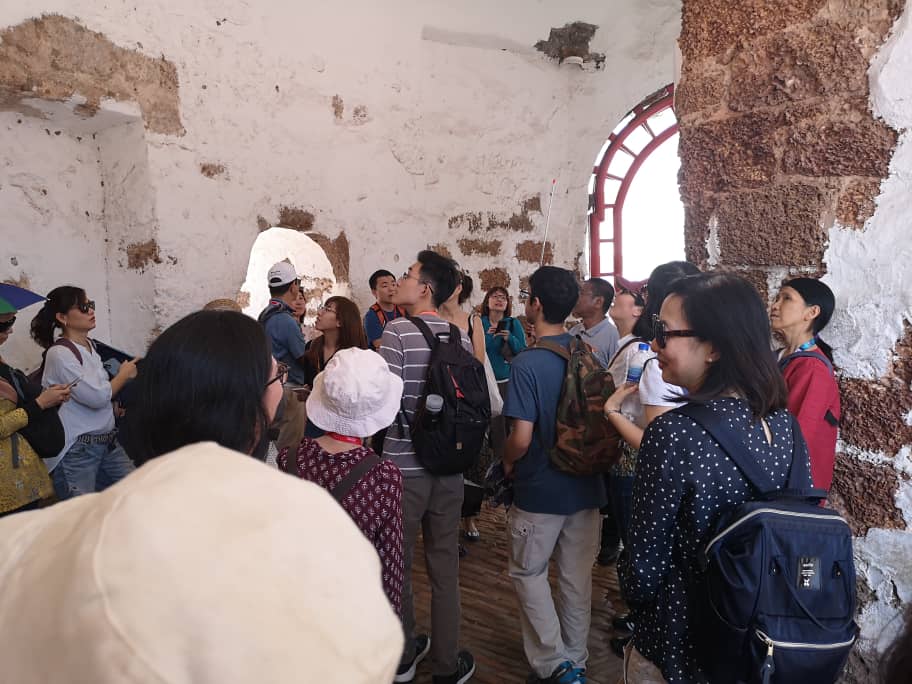
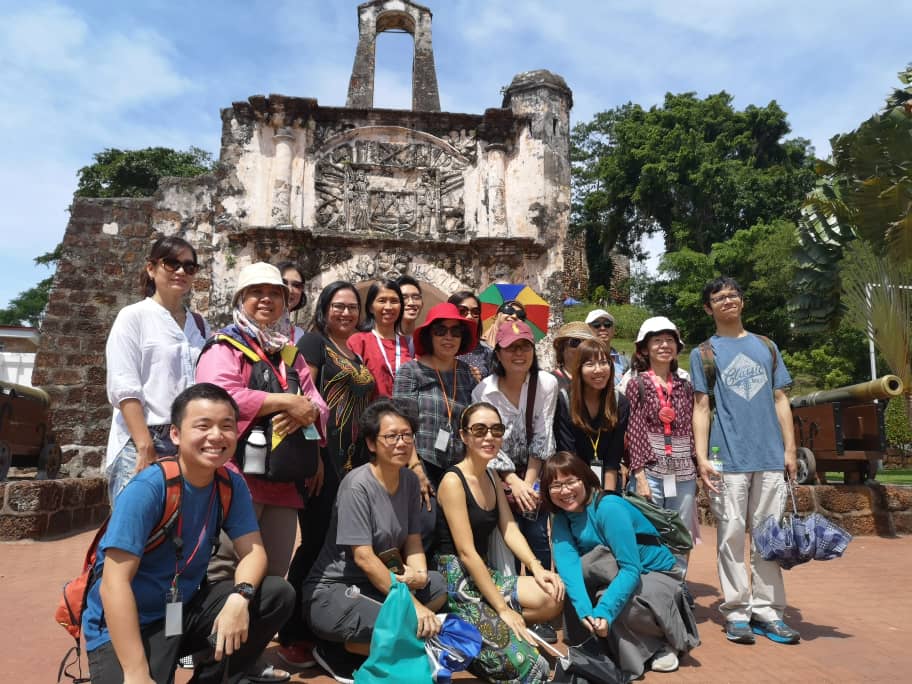
As we descended the hill, we saw an old Dutch cemetery and we learnt that despite its name, only seven Dutch graves are found there while the rest of about 30 plus graves are those of British military personnel and their wives. We continued walking towards Porta de Santiago, the only gate that survived the destruction of A Famosa. We took a happy group photo there under the scorching sun. By this time, we were ready for a lunch break to fuel ourselves for the rest of the afternoon in the historical city of Melaka.
For Part 2, click here.

Eunos Abdullah – An Early Malay Nationalist

by Hani Kamal

Mohammad Eunos Abdullah (1876-1933) was a campaigner for the Malay cause in Singapore. He was also known as the father of modern Malay journalism. Eunos fought hard for Malay rights especially in education. He died at the age of 57; he was a journalist, a politician and founder of the Singapura Malay Union (Kesatuan Melayu Singapura,KMS). His passion in championing Malay rights in Singapore went on to inspire future Malay nationalists in Malaya.

Eunos was born in Singapore to a successful Minangkabau trader from Sumatera, Indonesia. He had his early education in a Malay school in Kampong Glam and he was among the very few Malays who studied at Raffles Institution. Upon graduation, he joined the government service. His early career in Singapore was that of an attendant at the Harbour Master’s office; he was later promoted as Harbour Master in Muar, Johore.

A portrait of Mohammad Eunos Abdullah. Photograph from the display boards of National Museum of Singapore

In the early 19th century, Munshi Abdullah, the father of modern Malay literature, was also a renowned Islamic scholar with his modernistic interpretation of Islam in the region. Eunos was inspired by his writings. At the age of 31, Eunos was offered a job as an Editor for the Utusan Malayu, a Malay language version of the English newspaper in Singapore. Thus, was the beginning of his opinionated voice on racial nationalism of “bumiputra” son of the soil issues. He also spoke up against the Muslim Arab descendants who were monopolizing the social and economic environment in Singapore. From literary work, he instantly became a political activist representing the Malay voice during the colonial era.

In 1922, he was appointed as Justice of Peace and subsequently appointed as a member to the municipal commission. He was the first Malay given this position in Singapore. Following the British’s administration policy to increase local representation in the Legislative Council of the Straits Settlement, Eunos was made a Legislative Councillor in 1924. He was the first Malay councillor. In his first public appearance, Eunos stood up to condemn the government’s education policy that side lined the Malay youth. Eunos concluded:

“Being unable to swim, he sinks and is lost in the swelling sea of unemployment. Surely, Sir, this is not a thing to be desired among the original son of the soil? I am confident, Sir, ways and means can be found which will enhance the prospects of boys of the soil and remove forever the penalization which oust them from their own markets simply because they happen to be the imperfect products of an imperfect system of education”.

The minutes of this Legislative Council’s proceedings recorded that there was an immediate applause from his friends and Asian councillors in the audience.

Empress Place. Meetings of the Legislative Council were held here. Eunos Abdullah became an unofficial member of the Council on 14 April 1924 and delivered his first speech at the following meeting on 30 June. Photograph from the display boards of National Museum of Singapore

In 1926, Eunos and his associates formed the Kesatuan Melayu Singapura (KMS) or the Singapore Malay Union; he was made its President. KMS was the first political organisation set up to champion Malay rights such as increasing Malay representation in the government service, upholding Malay interests, and promoting higher education for the Malays. 

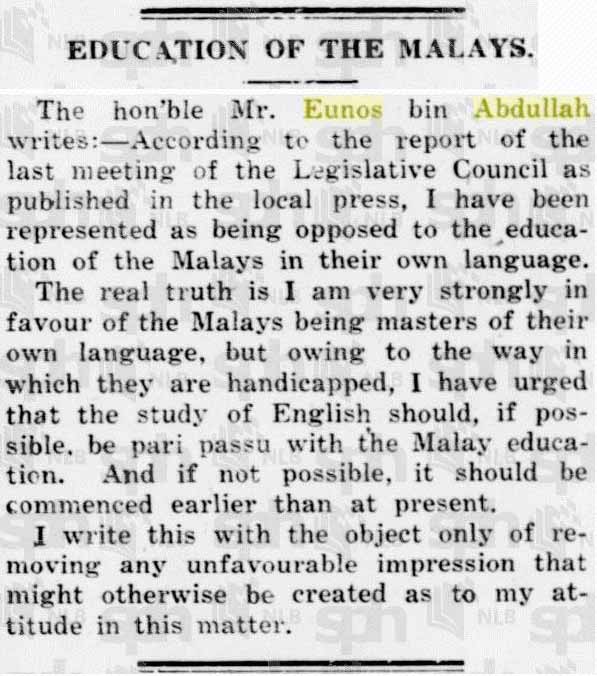
A letter from Eunos Abdullah to The Straits Times. During the legislative meetings, Eunos Abdullah also pushed for Malay children to be taught English from a younger age so they would not be handicapped when transiting from vernacular to English schools. From The Singapore Free Press and Mercantile Advertiser, 7 November 1924, Page 6.

He wanted a strong sense of Malay nationalism and called for the preservation of its culture or roots to be known and recognised. Eunos pushed to increase the education budget so that Malays could enter into the medical college and attend Malay vernacular or trade schools. He also advocated for better living conditions and sanitation for the Malay community. He proposed to build a settlement of Kampung Melayu to uphold the Malay values. Eunos was eventually given a grant to purchase and build the settlement. It was named Kampung Melayu or Kampung Eunos. In 1981, the settlement paved way for the construction of Pan Island Expressway and development of housing estates. To commemorate Eunos’s legacy, one of the local residential districts near Kampung Eunos was named EUNOS.

A procession at Jalan Eunos Malay Settlement in the 1930s. Photograph from the display boards of National Museum of Singapore

Eunos retired in early 1933 and passed away in December 1933. He was laid to rest in the Bidadari Cemetery, Singapore.

References:

  1. eresources.nib.gov.sg
  2. National Museum Singapore- Board Captions
  3. Marx Ravinder Frost & Yu-Mei Balasingamchow (2009) Singapore: A Biography, Singapore: EDM & National Museum of Singapore