I was reading a local daily when I was attracted by something at the corner of my eye – “Want to be a Museum Volunteer”. It was December 2016 and I was recently made redundant in the workforce and the saying “the grass is always greener on the other side” may not ring true this time. I may have reached the end of the lawn.
Then drawing inspiration from the late John F. Kennedy who once said “ask not what your country can do for you, ask what you can do for your country”, it was time for my humble self to make a little contribution to my beloved country by becoming a Museum Volunteer. A total of 30 newbies registered for the training programme that was conducted from February to June of 2017. Right after, to continue the learning development, we were put through the mentorship programme. Another few more months went by and l finally completed the programme in November 2017.
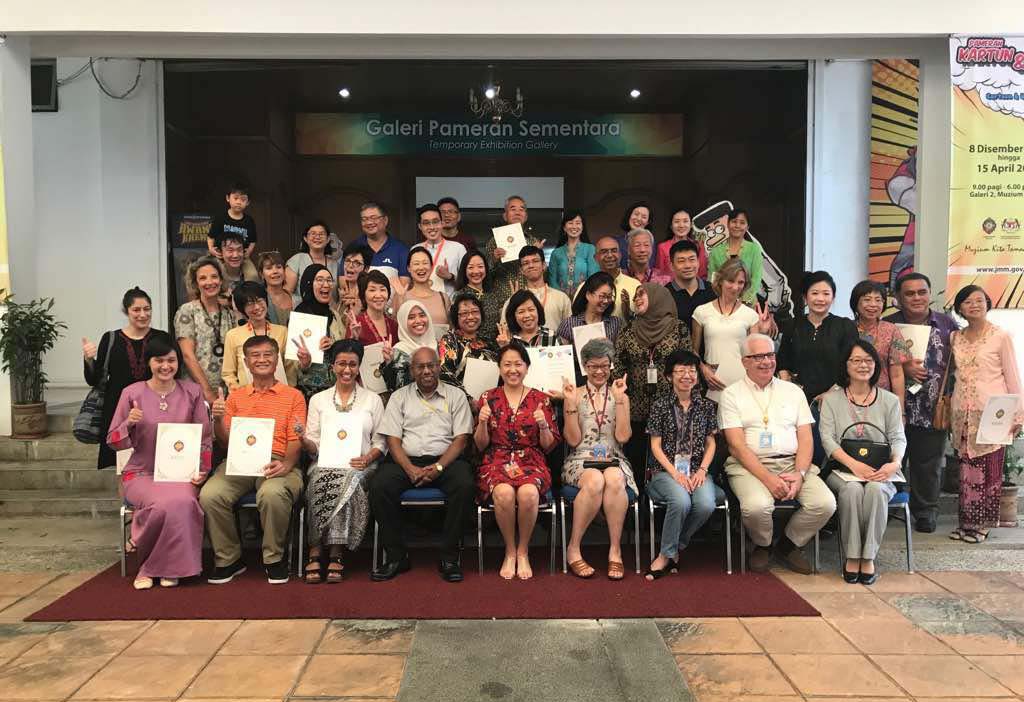
Graduation Day
I can still remember vividly that at the end of my last tour with my mentor, I said “With that, I have come to the end of the tour” and my mentor immediately replied “ With that, you have completed the mentorship programme”. Yes, I have completed the full programme and now eagerly looking forward to taking my first tour.
The day of reckoning came soon enough, it was on Tuesday 19 December 2017. I had arrived early and managed to assemble a small group of visitors for the tour. And at exactly 10.00 am, I started my maiden tour. In keeping with the time limit, I had brought the group to the end of Gallery D and it was time for my signature line “With that, it’s the end of the tour”. I was very satisfied with the result and truly happy seeing the smiling faces as they head toward the exit. I took another three tours the very same month to wrap up for the year 2017.
For 2018, I had planned to take in more tours to coincide with my motto in life. When the Portuguese captured Melaka, it can be summed up in 3G – Glory, Gold and God. For me, it is 3D – Determination, Dedication and Discipline, plus the expression “the harder you practice, the luckier you get”.
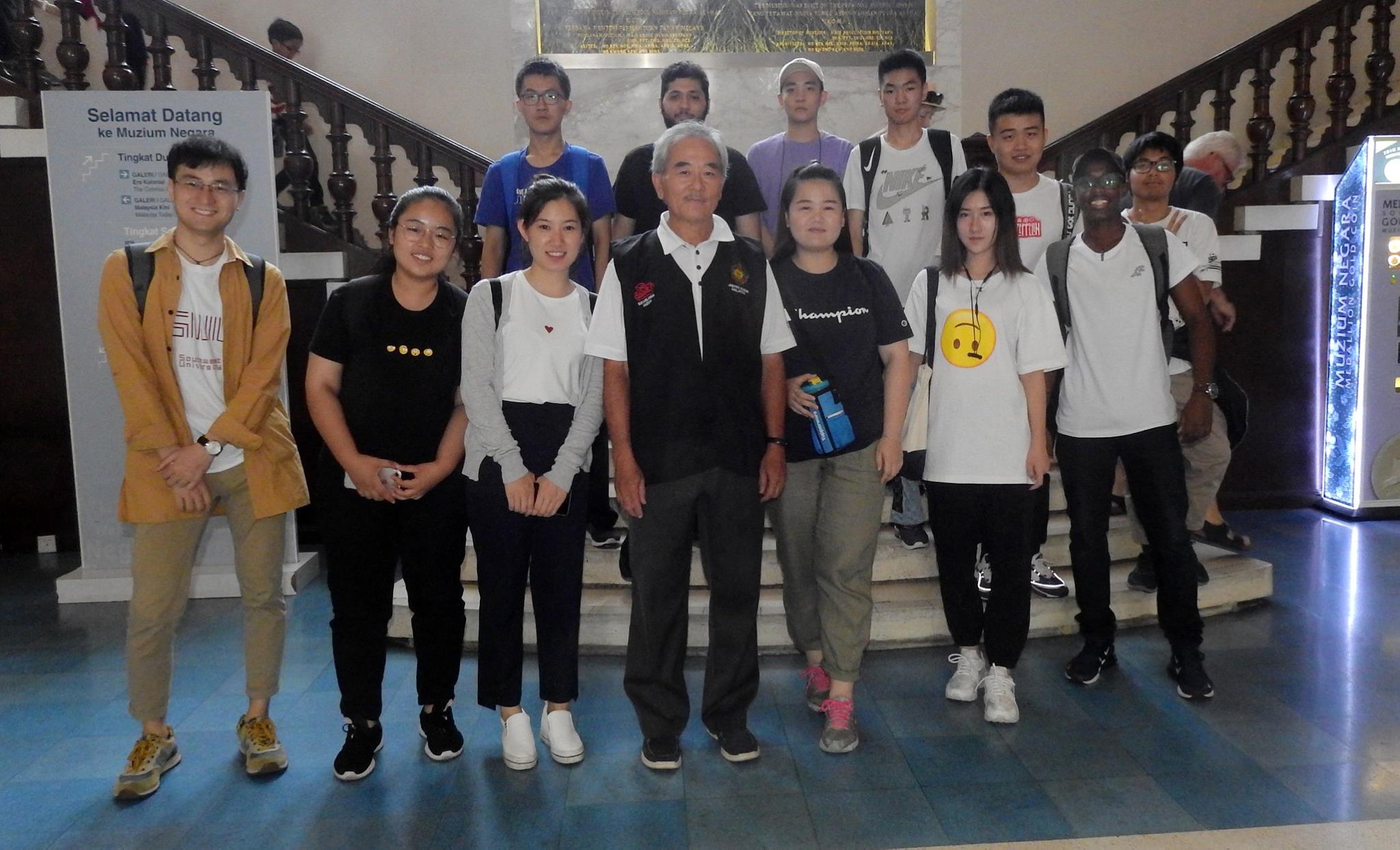
School Visit on Tues 28/8/18 – University Malaya, Centre for Continuing Education, 25 pax The group showed up unexpectedly and requested for guides. Since no tourists showed up, Josianne together with Eric helped to guide this group. The actual group was more than 40, but we only took on 25.
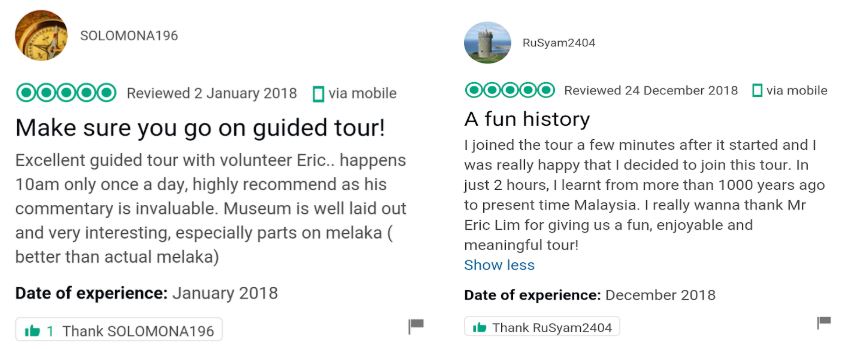
So the numbers just added up. I recall taking the morning and afternoon tours on a Thursday; and numerous occasions where I took tours on consecutive days. For the record, I took a total of 55 tours in 2018. And for that, I was recently awarded by JMM for my outstanding service as a Museum Volunteer. Also, getting compliments from the TripAdvisor website really made it all worthwhile and special.
Moving forward to 2019, the figures for the first quarter are still very much intact, averaging one tour per week. Here’s looking forward to my next tour tomorrow, wanna join my tour?
On 9 April 2019, the MV Focus Team organised a tour to the Batu Caves complex, one of the most revered Hindu pilgrimage locations outside of India and also one of the most cherished Hindu shrines for the Thaipusam festival in Malaysia.
By 9am, 18 MVs had gathered in front of the staircase (ground level) leading to the main cave right behind the tallest Lord Murugan statue. Our guide for this visit was the knowledgeable Mr Rasianthiran Menayah (Mr Rajan) who took the group through the temples and imparted his knowledge on Hinduism. The sketch below summaries the order of places we visited.
Mr Rajan informed us that the Hindu deities take on myriad forms; they are sometimes attended by their Shakti (spouse in common parlance). They are usually identified by their specific animal mount (referred to as vahana). They can also be identified by physical characteristics and symbolic implements or weapons they hold or wear.
1. Vishnu Temple (next to KTM Komuter side exit) 2. Hanuman Statue 3. Ganesh, Siva, Shakti Temples 4. Main Temple, Lord Murugan Temple 5. Navagraha Sannathi (Temple of Nine Planets)
In Hinduism, the worship of the different gods is not mutually exclusive but in fact is complementary though often devotees would identify with one as their supreme God. The common sects are Vaishnavism (Vishnu), Saivism (Siva), and Shaktism. The most popularly worshipped by Hindus in Malaysia are Vishnu, Shiva, and the Goddess Shakti in her various aspects, and Shiva’s two sons, Ganesha and Murugan.
Mr Rajan told the MVs that one can tell exactly which school of theology a devotee is coming from by the colour and shape of the tilaka marks that is placed on their foreheads. Shaktas, followers of Shakti wear a large red dot on their foreheads.
Left: A Vaishnav Hindu with a long vertical tilaka intercepted by an elongated ‘U’. Right: A Shaiva Hindu with a tilaka of 3 horizontal bands and one vertical band in the centre Photo credit: https://en.wikipedia.org/wiki/Tilaka
The temples visited are described below in the order visited:
1. Vishnu Temple
This temple is known as Sri Venkatachalapathy Swamy Sannadhi. It is dedicated to Lord Vishnu, who is distinguished by a discus (chakra) and a conch-shell trumpet (shankha). In the picture below, we see the chakra and conch at the top of the shrine. Vishnu’s vahana (vehicle) is the eagle-like Garuda, placed in a separate niche in front of the main sanctum.
Vishnu is the deity that preserves and protects the universe and he has appeared on the earth many times through his avatars (incarnations) to save humankind from natural disasters or from tyranny. Some of Vishnu’s well-known avatars are Rama (as in the Ramayana epic)’ Krishna, who destroyed the wicked and established a new order; and Buddha, the founder of Buddhism.
Vishnu’s consort is Lakshmi, the goddess of wealth and good fortune, who is offered special worship during Deepavali. She is also represented as the wife of each of Vishnu’s incarnations, including Sita, wife of Prince Rama, and Rukmini, wife of Krishna. Vishnu is also represented in sculpture and paintings in human form, often painted blue. According to Mr Rajan, Lord Vishnu, the preserver, is considered by his worshippers to be the greatest among the gods.
At this temple, the MVs experienced their first pooja where the
priest:
offered a lighted flame and worshippers wave the flame towards their face,
next he put some scented water on our palms for us to sip and
he then placed a silver cap on our heads before putting pottu onto the forehead. Mr Rajan informed that the silver cap is called a shasthari and that is represents God’s feet; it is symbolically touched to the head of worshippers as a blessing. Although a red pottu is commonly worn and associated with a married woman, it can also be used to ward off bad luck.
The priest placing the shasthari on one of the volunteers’ head.
Located perpendicular to the Vishnu temple is a temple dedicated to Gajah Lakshmi, know as Sri Alarmelmanga Thayar Sannathi. In this aspect of Lakshmi, she is flanked by elephants.
2. Hanuman Statue
The second place we visited was where a large towering statue of Hanuman stood. Hanuman is a semi-god, he is regarded as the perfect symbol of selflessness and loyalty for his bravery, strength, perseverance, and devoted service to Lord Rama. During our visit, the place was undergoing major upgrading and plastic sheets were placed over the temple area.
An individual worships Hanuman to ward off /counter bad karma brought about by selfish actions and the believer seeks Hanuman to grant him/her with fortitude and strength in one’s journey through life.
3. Ganesh/Ganapathi, Sivan and Shakti Temples
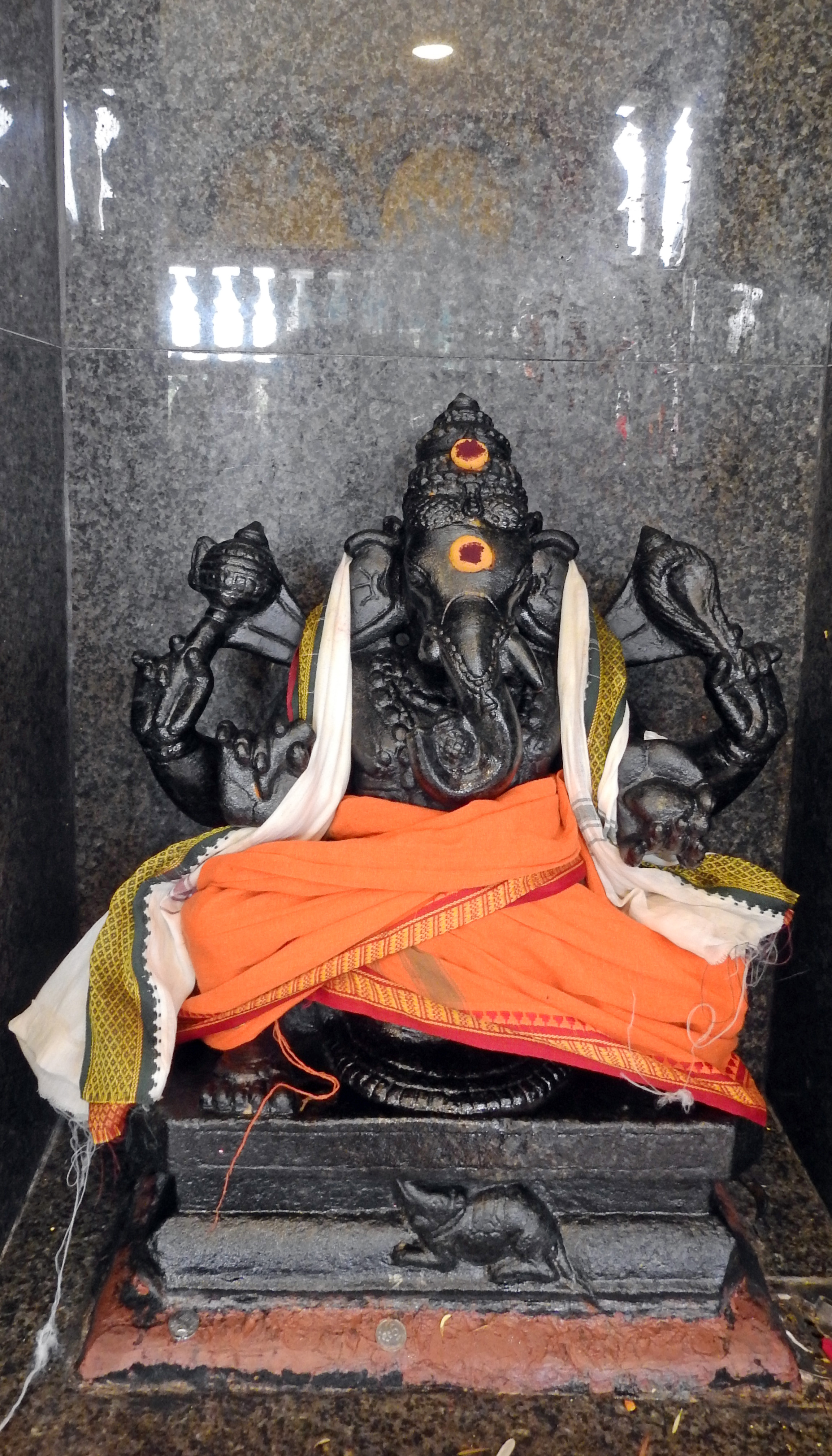
We next made our way to this colourful building. In it, we find Lord Ganesha or Ganapathi, who is also popularly accepted as the first son of Siva and Parvati.
Mr Rajan informed us that the elephant-headed Lord Ganesha is worshipped at the start of any undertaking; and his vahana is the mouse. The reason Lord Ganesha is the first deity worshipped is to help ward off obstacles that might get in our paths while worshipping other deities.
Mr Rajan highlighted that a daily ritual to Lord Ganesha should include the thoppu karanam. This requires the person to first cross their arms and holding the ear lobes between the tips of the fore and middle finger, then they bend their knees and get-up doing this three times before he/she sits down to meditate. This is now accepted as “super brain yoga” as the activity improves one’s focus and brain’s development.
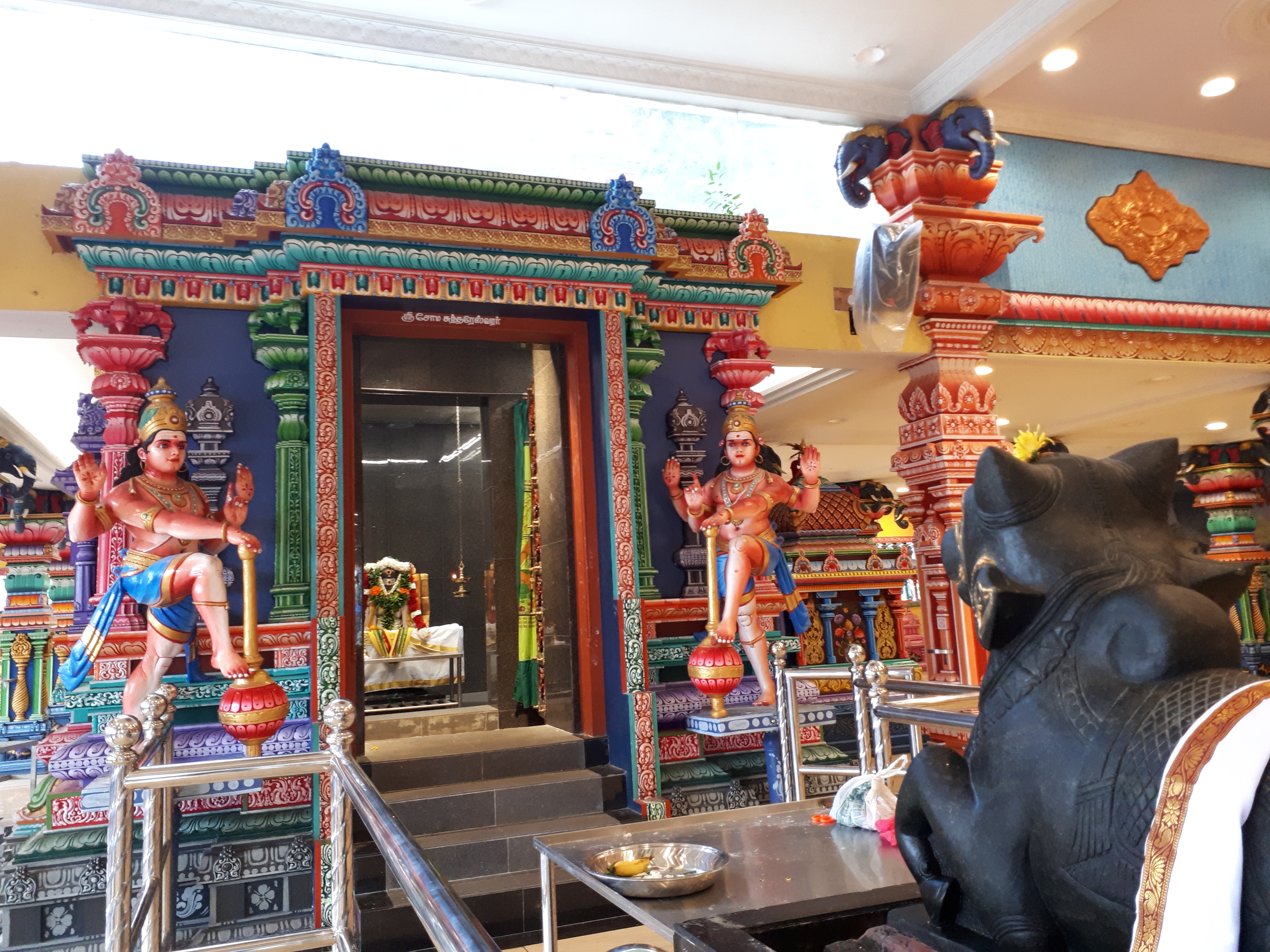
Next, the group moved upstairs to the Sri Sivan Temple where Lord Siva shrine is located and MV group were invited to another pooja by the priest. Here in this shrine, we see Siva’s vahana the bull.
As we circumbulate Lord Siva’s shrine clockwise, the first niche held an image of Ganesha and as we complete the circumbulation, we saw a deity that was garlanded with lime in the last niche. This Goddess Durga; she is worshipped to ward off evil spirits by her devotees. Lime is believed to help remove evil spirits, and thus the lime garland is associated to Durga and offered to her during worship. Durga is said to be able to slay demons that the other gods are unable to control. One of her most celebrated feats is the destruction of the buffalo demon Mahishasura. Her vahana is a lion and in the picture below, she is seen subduing the buffalo demon.
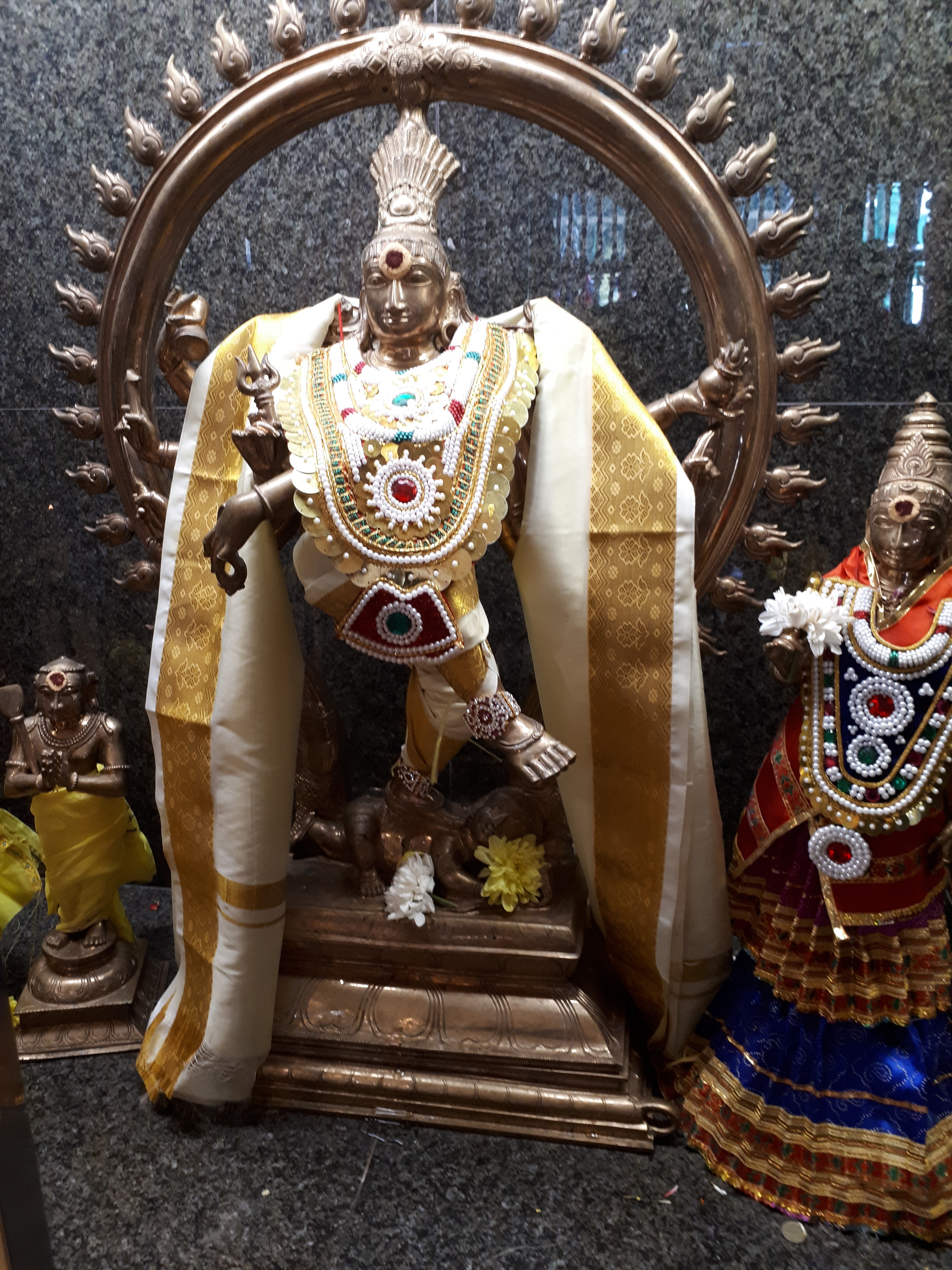
Next, Mr Rajan directed our attention to a Lord Nataraja (Lord of the Dance) image located in another corner of the upper floor. This particular statue shows Lord of the Dance lifting his right foot. Who is this Lord of the Dance? It is another representation of Siva and as Lord of the Dance he controls the movement of the universe. He is also associated with fertility. Sculptures of Lord Nataraja typically show him dancing in an aureole of flames, lifting his left leg and balancing on his right foot over a demon or dwarf who symbolises ignorance.
Nataraja is commonly depicted with his left leg raised; he dances while balancing on his right leg. This rare image showing his right leg raised comes from an incident when the Pandya King Rajasekhara requested him to raise his right leg as the King was afraid that Nataraja, balancing only on his right leg, may damage the said leg.
Earlier, one of the priest had reminded us that the Batu Caves temples would be closed for lunch break at 1 pm and as such, by 11.45 am, we quickly made our way to the base of the 43 metre Lord Murugan statue to ascent the steps.
4. Sri Velayuthar Temple (Main Temple) and Lord Murugan Temple
My initial thought of the 272 steps climb up was it would be challenging. In actuality, it was not very difficult and I was delighted to achieve the journey to the top in less than 5 minutes. Visitors are reminded to be mindful of the monkeys on the journey up as the monkeys are reported to snatch items and dangling plastic bags from visitors.
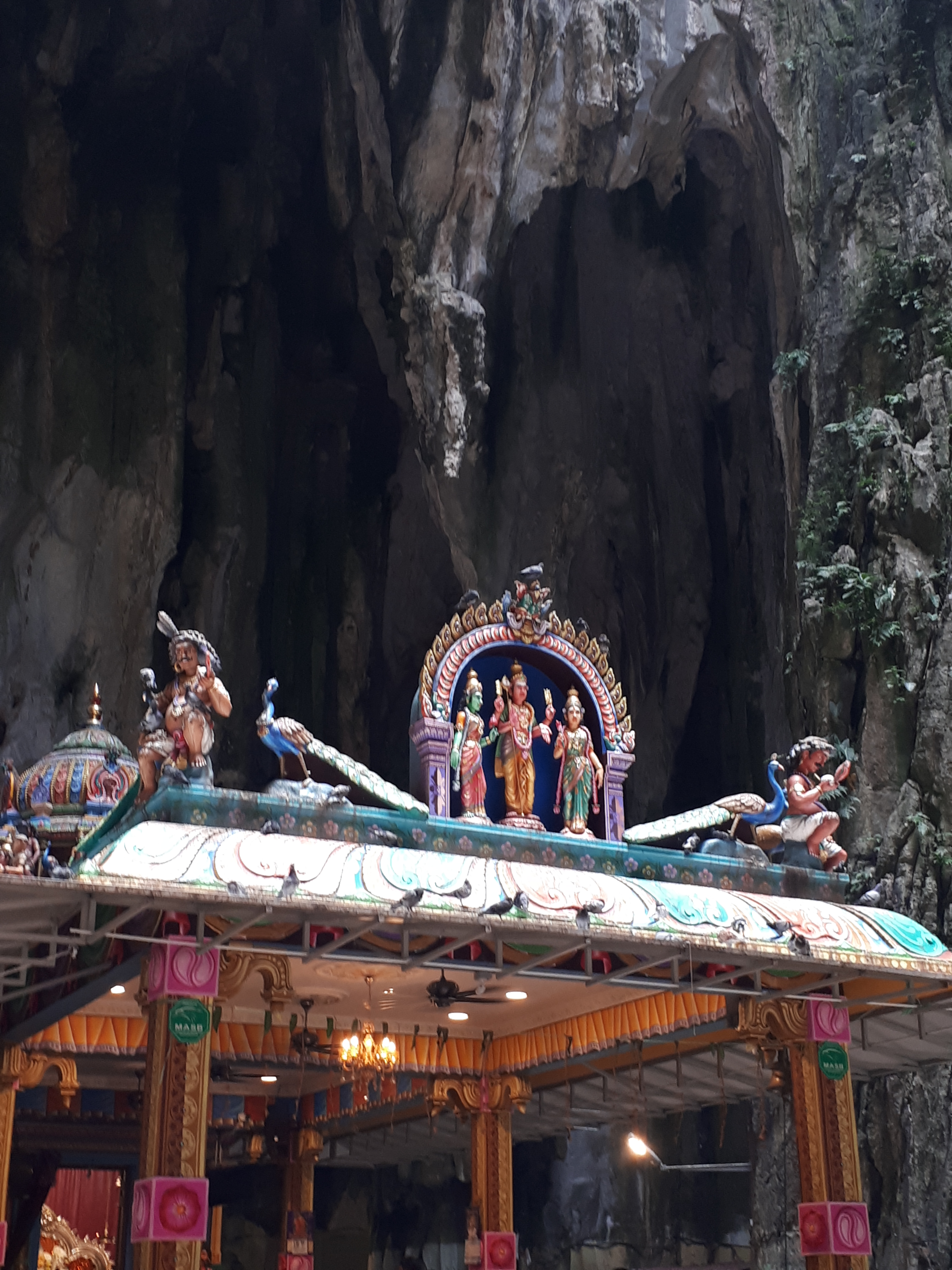
As I walked into the cave at the top, I found myself standing below a massive open area with a ceiling that is said to be over 100 meters in height. After descending some steps and just on the left of the cave before entering the Main Temple (Sri Velayuthar Temples) is the Temple Cave. It was in 1890 that K Thamboosamy Pillai installed the murti (consecrated statue) of Sri Murugan Swami in this cave.
After spending some time here observing the priests performed poojas for some devotees, we ascended the next short flight of steps, and arrived at the most sacred Lord Murugan Temple.
Lord Murugan Temple
This simple yet colourful Lord Murugan temple is illuminated with natural light from a big hole at the top. For a token fee, visitors can seek for a personalised pooja from the priest.
There were several other shrines in this temple including one of Lord Nataraja in the usual left foot raised in dance pose together with his consort, Parvati on his left.
By 12.45pm, we made our way down the 272 steps and rewarded ourselves with a sumptuous vegetarian set lunch at one of the many vegetarian restaurants in the complex.
5. Temple of the Nine Planets (Navagraha Sannathi)
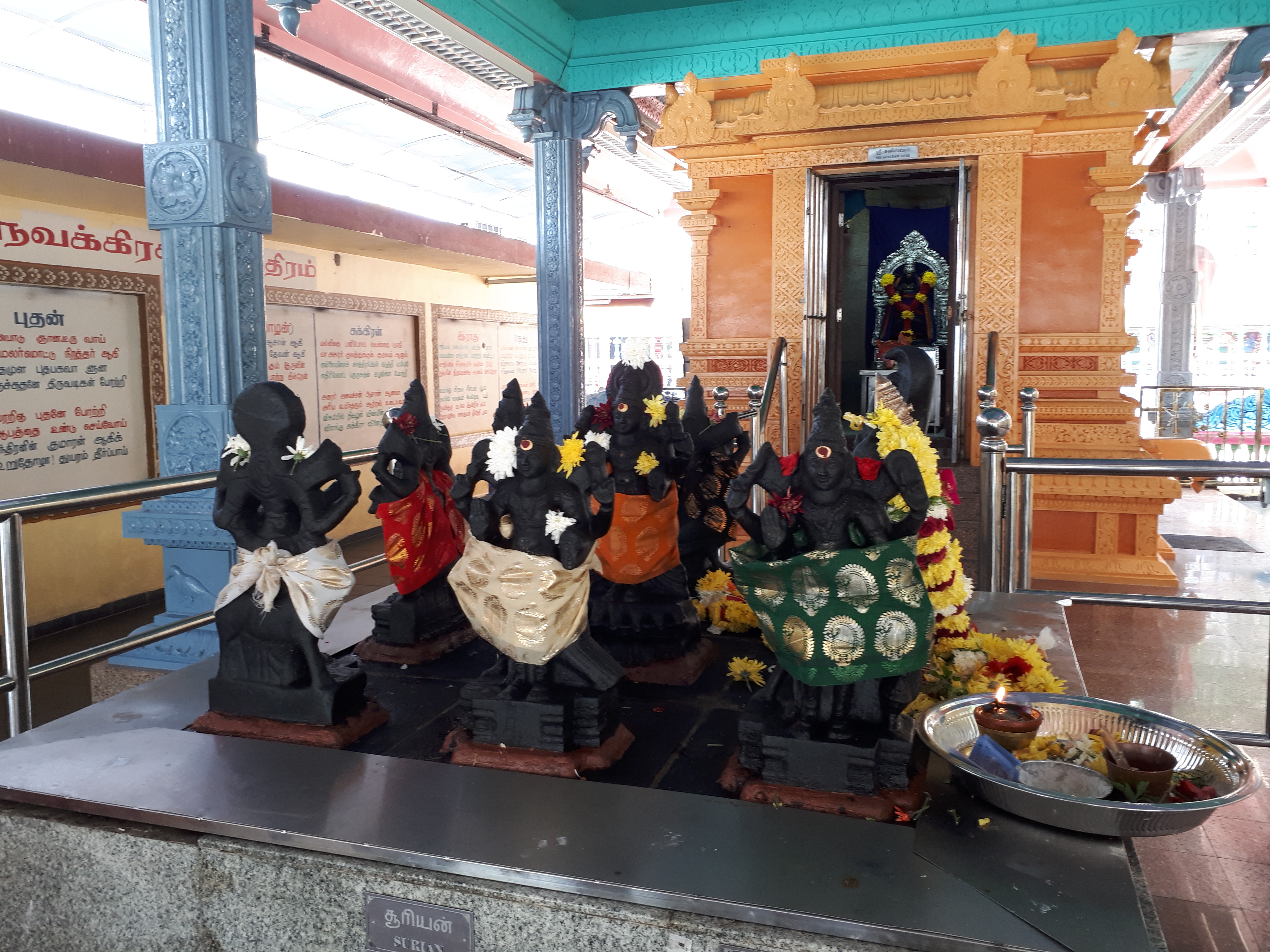
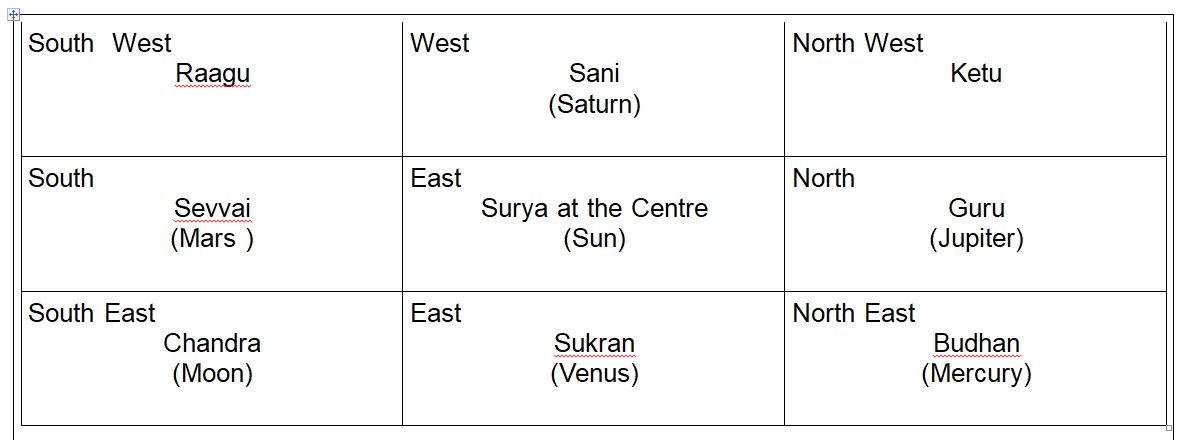
After lunch, we made our final stop at the Temple of the Nine Planets, located towards the left of the 43-metre Lord Murugan statue. Here we find nine colourfully clothed deities or Navagrahas. The Navagrahas comprise of five true planets that are visible to the naked eye (Venus, Mars, Jupiter, Saturn), the Sun, the Moon, Rahu (north lunar node) and Ketu (south lunar node). In this temple, Surya (Sun) is in the centre facing east; around him are the rest of the planets facing in different directions, but not towards each other.
Positions of the Navagraha and the directions they are facing
Astronomically, Rahu and Ketu denote the points of intersection of the Sun and the Moon as the Sun and Moon move on the celestial space. Eclipses occur when the Sun and the Moon are at one of these points, thus giving rise to the myth of the swallowing of the Sun by the Moon.
We were told Hindu astrology is based upon the configuration of the Navagrahas (nine planets) and their collective influence on the world in general and on each individual in particular during our birth. They are worshipped in Hinduism either to bring good luck or to overcome adversity, bad luck or misfortune arising from past karmas.
By 2.15 pm, we had come to the end of the tour. After a group photo, we thanked Mr Rajan for his enlightening tour providing us with finer-grained details about the oldest religion in the world. Bravo too to the MV Focus team, Mona Tan and Alwin Woon, for organising this hands-on educational tour.







 Museum Volunteers, JMM