by V. Jegatheesan
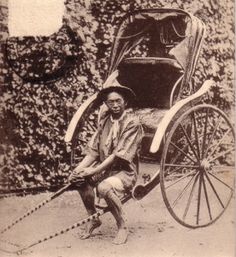
Jin – Man
Riki – Power
Sha – Vehicle
Man powered vehicle
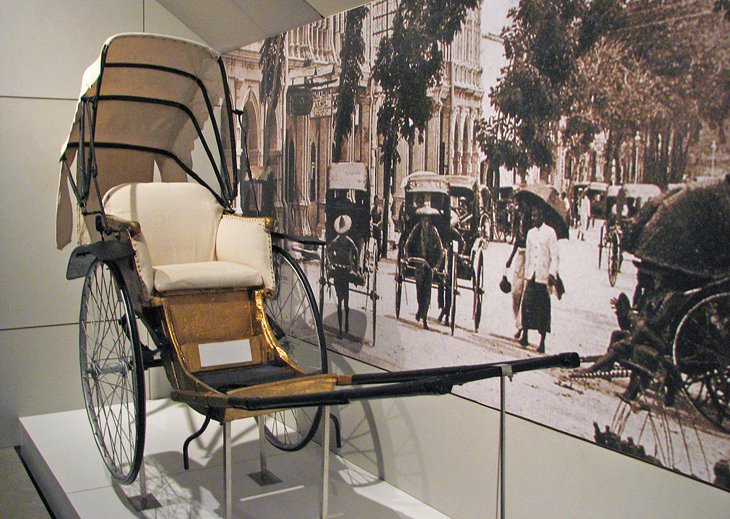
Nestled almost out of sight with attention diverted to the tin dredge in Gallery C, is a Jinrickshaw. Today, it may get passing mention during a guided tour but this solitary artefact used to be an institution in early Malaya. Known also as Jinricksha or simply as rickshaw, it was a key mode of transportation for many decades until it was literally ‘overtaken’ and ‘driven off the road’ by faster vehicles.
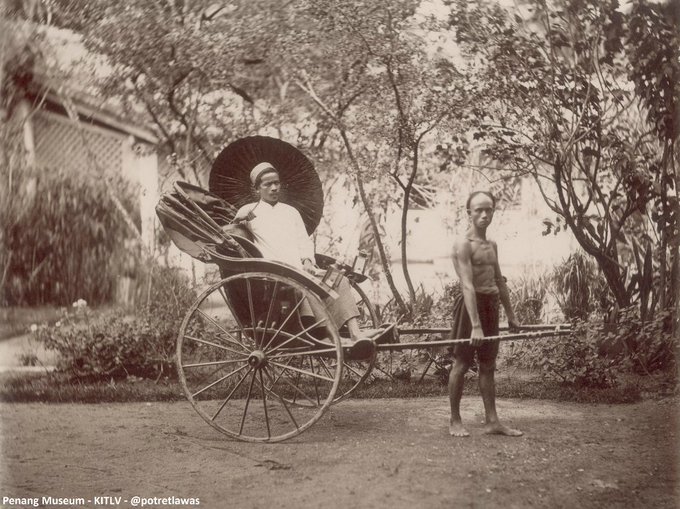
The rickshaw was a two-wheeled buggy-like cart pulled by a runner with the passenger seated in the cart. It was ubiquitous in Kuala Lumpur up to the late fifties, as it was cheap, easily available and comfortable. They could be seen plying the streets of old central Kuala Lumpur rain or shine, day and night catering to many users throughout the day.
It seems that a form of the rickshaw was actually developed in France as far back as the 17th century. However, it is generally accepted that around 1869, the Japanese developed the rickshaw, giving it the name through which we know it today. Others have also laid claim to having invented it. After all, it is not a complicated vehicle and specific needs would have led a simple handcart evolving to this type of vehicle. Nevertheless, the form that we know today is from Japan.
Outside of Japan, the rickshaw was used in many parts of the world including China and parts of Africa. It could be seen in India and it became iconic in Kolkata. Over the years, the rickshaw were either motorised or just phased out, with pockets remaining particularly for tourism. This article focuses on Kuala Lumpur although it was common in many of the other larger towns in Malaysia as well.

The rickshaw consists of a buggy-like cart with a seat resting on two thin wheels. Two long shafts, of around 1.5 metres, extended from the sides of the cart. The ends of the shafts were connected by a bar, used as a handle. The puller, or Rickshaw man, stood between the shafts and ran pushing the bar and therefore pulling the cart. The wheels were thin and made originally of iron; rubber-tyres came later.
The seat itself could have either been a simple wooden one or cushioned and it seated two at a time. It extended down to form a footrest, on which packages could also be placed. Some rickshaws had a cubbyhole under the seat that was used as storage. Attached to the back of the seat was an adjustable hood that could be lifted to provide protection against the scorching sun or rain; it lay collapsed otherwise. In addition, if it rained, a canvas sheet would be used to cover the front. Although simple and basic, some rickshaws were highly decorated with designs on the sides of the cart. They were generally clean and comfortable.
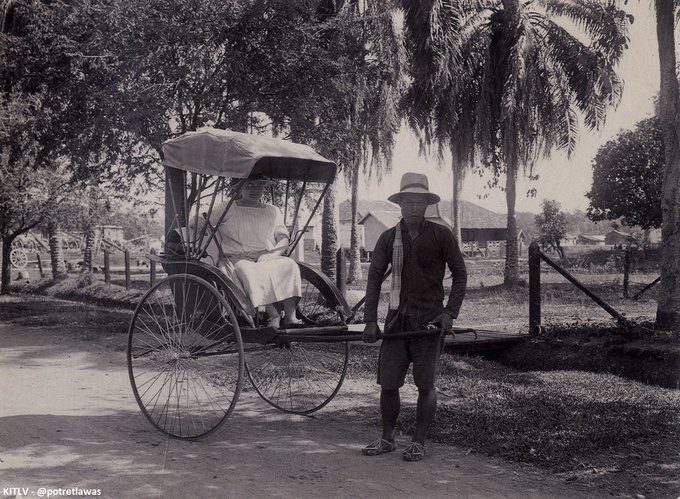
Before World War 1, the rickshaws were imported from Japan. After the war, with the advent of Depression, they were locally made. Cost of these rickshaws is not found. In most cases, an individual owned the rickshaws and hired them out to pullers. Rates of hire are available for Singapore – it was 35 cents per day in 1938. Well-to-do people are said to have owed their own rickshaws with hired pullers if they did not keep a carriage.
It is uncertain when the rickshaw was first imported into Malaya but by 1912, the rubber-tyre rickshaw was reported to be in use in Kuala Lumpur together with the iron-wheeled type. However, by the mid-1920s only the former was in common use. These operated in what was known as central Kuala Lumpur, which covered Petaling Street, Sultan Street, Central Market and extended around three kilometres outward. This is a flat area, easy for the puller to navigate. Many people lived within the city in those days.
Anyone and almost everyone used the rickshaw. Ladies and men used it to get around town. Children went to school on a contracted rickshaw, much like school buses today. Women went to the market and back in these. Even the British officers would use them, perhaps more as a novelty. Later in the evening, rickshaw pullers had certain ladies as customers who would sit in the rickshaw in certain parts of town, waiting for their own customers. In fact I was told that ladies and young girls never used the rickshaw alone at night. If they had to, they were accompanied by a male, even a young boy if need be.
The fare paid, of course, varied by distance but the figures for Kuala Lumpur are not known – it is simply stated as a few cents for short trips. A 1914 schedule of jinrikisha fares for the Straits Settlements, show fares of 3 cents for every half mile, 20 cents for an hour and detention (waiting) fee of 5 cents per hour. These fees are for the second class. First class fares were double. These first class rickshaws had superior ‘English wooden seating’ and rubber tyres. First class rickshaws also had a runner trotting behind the rickshaw for the safety of passengers. These runners were rare, if any, in Kuala Lumpur.
Fares of course went up in time. For comparison, the fare in 1920 in Singapore was set at 15 cents a mile (1.6 km.). The industry in Singapore was regulated – there was a Registrar of Rickshaws as well as a union.
The rickshaw pullers were a breed apart. They were mostly immigrants from China and they lived in lodging houses, which were popular then as many immigrants came alone. Most, if not all, smoked opium supplied by the lodging houses or in opium dens. Opium was made illegal after World War II but hard-core addicts still managed to get their supply. Some pullers only wore shorts while others wore dark shin-length shorts with, perhaps, a shirt. Almost all wore a hat made of matted straw or palm leaf. Some did not wear shoes. For those who did, old rubber tyres were cut to fit and tied to the feet with string. While waiting for fares, they would squat between the shafts or sit on the footrest.
In their day, rickshaws ruled the roads. They would weave in and out of traffic, pulling out to the centre of the road when they felt necessary; the passengers sat coolly in their seats, being used to this. When looking for passengers, they would dash from one side of the road to the other to grab the passenger before another rickshaw did. Other vehicles had to look out for them.
They faced many risks – being scolded by passengers, arguments on the fare, accidents, drunken night passengers and passengers running off without paying. Many suffered bad health; there are reported cases of some collapsing and dying on the road while pulling. Despite the rickshaw being looked back on as a novelty, the pullers led a hard life for meagre earnings. They did not seem to be able to break out of rickshaw pulling, unlike some Chinese mining coolies who managed to move out into starting small businesses.
In our younger days, it was common for parents or teachers to scold us when we sat sloppily “sit up straight, don’t sit like a rickshaw puller!” Or, “you better study hard or you will end up being a rickshaw puller.”
The rickshaw pullers drew some sympathy and attention from travellers to Malaya as can be seen with the below two references.
“The jinricksha, pulled by Chinese coolies, is the conveyance usually hired for short runs in and around the neighbourhood of the towns. They are comfortable, and usually fairly clean, but as the coolie who pulls it seldom understands any language but his own dialect, and is as a rule supremely ignorant of the rule of the road, it is well to keep a wary eye on his movements.”
The Handbook of the Federated Malay States, compiled by H. Conway Belfield
“Chinese coolies toiling in the shafts of jinrickshas occupied by fares sitting inside, and quite unconcerned at the efforts of these human horses, who are often sickly, and always striving to reach the end of their journey as quickly as possible, mopping their faces as they run along, and audibly panting from their exertions.”
Ambrose B. Rathborne in Camping and Tramping in Malaya

By the mid-1950s, trishaws started replacing the rickshaws. The trishaw is a tricycle with the passenger cart placed on its side. Some, particularly in Penang, had the passenger cart in front. The advent of buses, as well as growing affluence that afforded people cars and taxis sounded the death knell for both the rickshaw and the trishaw. By the mid-sixties, both had almost disappeared, although the Penang trishaws ruled the roads until the eighties.
While trishaws can still be seen on the streets today in places like Melaka, catering to the tourist industry, the jinrickshas are only found in museums. However, they are a part of our history and the stories they tell should not be forgotten.
References
https://en.wikipedia.org/wiki/Pulled_rickshaw
https://eresources.nlb.gov.sg/infopedia/articles/SIP_932_2005-01-24.html
Jan van der Putten and Mary Kilcline Cody (2009) Lost Times and Untold Tales from the Malay World, First Edition. Singapore: NUS Press.
https://great-railway-journeys-malaysia.weebly.com/jinrikisha-station.html
H. Conway Belfield. Handbook of the Federated Malay States. London. Edward Stanford, 12-14 Long Acre W. C.
Ambrose B. Rathborne F. R. G. S. (1898). Camping and Tramping in Malaya, Fifteen Years Pioneering in the Native States of the Malay Peninsula. London. Swan Sonnenschein and Co.
Jim Warren (1984) Living on the Razor’s Edge: The Rickshawmen Of Singapore Between Two Wars, 1919–1939. Bulletin of Concerned Asian Scholars, 16:4, 38-51, DOI: 10.1080/14672715.1984.10412623
Warren, James Francis. (2003/05). Rickshaw Coolie: A People’s History of Singapore 1880 -1940 [Paperback]. Singapore University Press (US).
Relatives and friends – too many to name individually

 Museum Volunteers, JMM