A Very Rough Guide to Banting, Tanjung Sepat and Sungai Pelek

by Eric Lim

Introduction

Still staying in the southern part of Selangor, this article will take us on a road trip to a combo of places –  first to Banting, followed by Tanjung Sepat, both in the Kuala Langat district, and then make a turn back to the Sepang district as we head on to Sungai Pelek. These towns are connected by Federal Route 5, which is one of the three north-south backbone federal highways in Peninsular Malaysia; Federal Route 1 and 3 are the other two highways. The Kilometre Zero of Federal Route 5 is located at Skudai, Johor in the south and it runs mostly along the west coast of the peninsular and ends at its northern terminus at Jelapang near Ipoh.

Image Credit: Dennis Ong. Base image: https://en.wikipedia.org/wiki/Tanjung_Sepat,Selangor#/media/File:A_visit_to_Tanjong_Sepat(14242827477).jpg

Banting – History and Places of Interest

While researching Banting, this name kept popping up on the screen but of a different nature. It was the name of Frederick Banting, who made one of the most influential discoveries in medical history. He discovered insulin, the first available medicine for the treatment of diabetes. Banting and his fellow researchers were awarded US patents on insulin in 1923 and later the same year, they were awarded the Nobel Prize in medicine for the discovery of insulin. He died in World War II, in a plane crash on 21 February 1941 during one of the transatlantic trips to Britain.
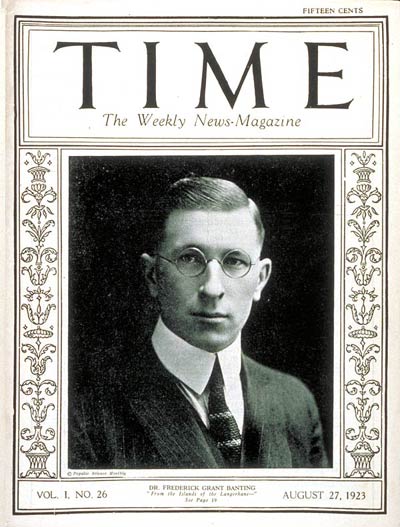
Frederick Banting on the cover of Time Magazine 27 August 1923 issue / Photo source : Wikimedia Commons

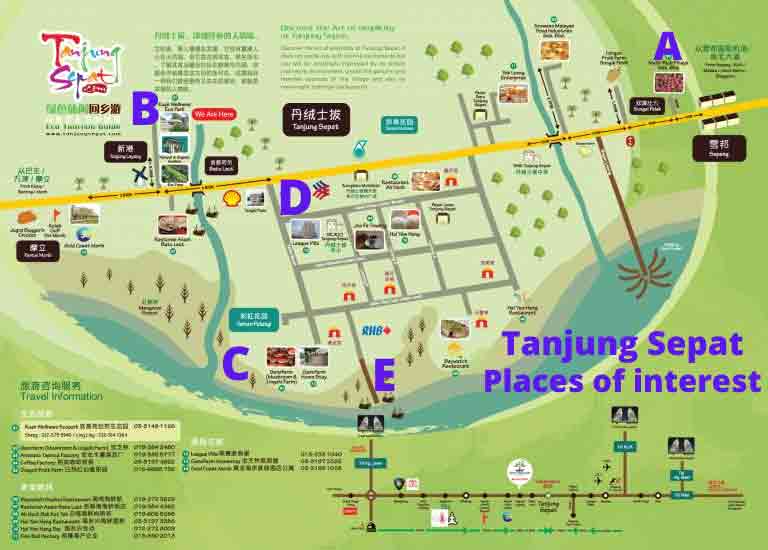
Banting originates from the Malay word ‘banteng’, which is buffalo in English. Banting’s moment in history also came during World War II at Morib beach, which lies to the southwest of Banting. On 9 September 1945, the 46th Indian Beach Group comprising 42,651 personnel and 3,968 vehicles landed at the beach in an operation to retake Malaya from the Japanese army. It was reported that one of the soldiers who came on that day was Muhammad Zia ul-had. He returned to India and joined the Pakistani army in 1947 after partition. On 5 July 1977, the military, headed by Zia, took over the government, imposed martial law and deposed Prime Minister Zulfikar Ali Bhutto in a bloodless coup. Zia was sworn in as the sixth President of Pakistan on 16 September 1978. He was killed in an air crash on 17 August 1988, possibly sabotage. Today, part of the beachfront has been converted into a recreational park called Dataran Pantai Morib [A] and it is becoming a popular destination during weekends and public holidays.

Dataran Pantai Morib / Photo source : Pantai Morib (Morib Beach) – Visit Selangor

Banting is the hometown of Malaysia’s most famous badminton siblings, the Sidek brothers. Misbun, Razif, Jailani, Rahman and Rashid began competing internationally from the early 1980’s. History was made in 1985 when all five of them were selected to represent the country in a competition in Hong Kong. On 16 May 1992, the final of the Thomas Cup that was held at Stadium Negara and Malaysia was pitted against arch rival and top favourite, Indonesia. Rashid gave us a winning start but it was all level when Razif and Jailani lost the first doubles match. Foo Kok Keong regained the lead and the second doubles match turned out to be a titanic battle and, finally, the pair Cheah Soon Kit and Soo Beng Kiang gave us the winning point. The Thomas Cup, which had eluded us for twenty-five years, was finally won. Razif, Jailni, Rashid and Rahman were in the winning team. Razif and Jailani went on to become the first Malaysians to win a medal at the Summer Olympics when they won the bronze medal at the 1992 Barcelona games. Four years later, Rashid brought home the bronze at the 1996 Atlanta Summer Olympics.

Image shows Sidek senior admiring the bronze medals won by Razif and Jailani at the 1992 Summer Olympic. Photo credit: The Star – 18/7/2021

A monument was erected at the Sidek Family Residence [B] in Kanchong Darat in 1992 when Malaysia recaptured the Thomas Cup. Last year, restoration work on the monument was carried out and a wall was added. Visitors can have photographs taken at the monument free of charge.
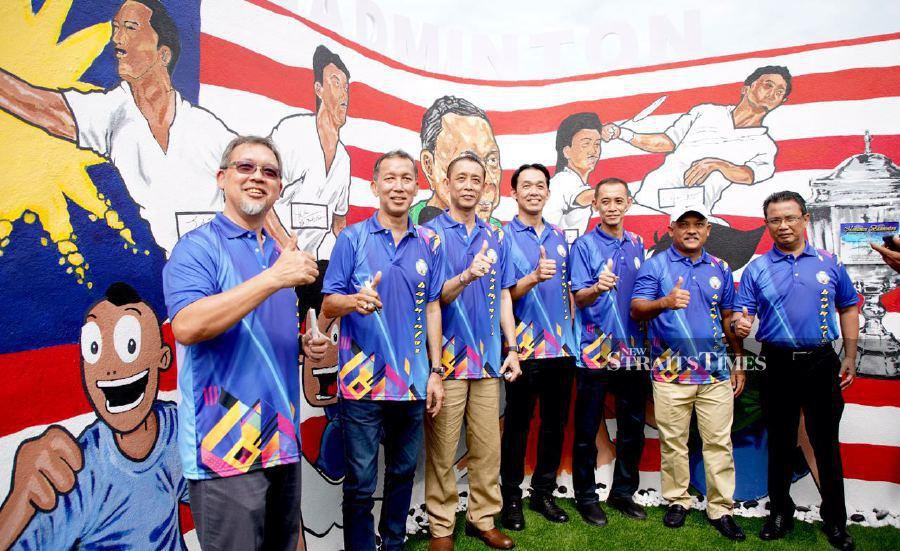
Monument at the Sidek family residence / Photo source : Badminton Monument to mentor restored

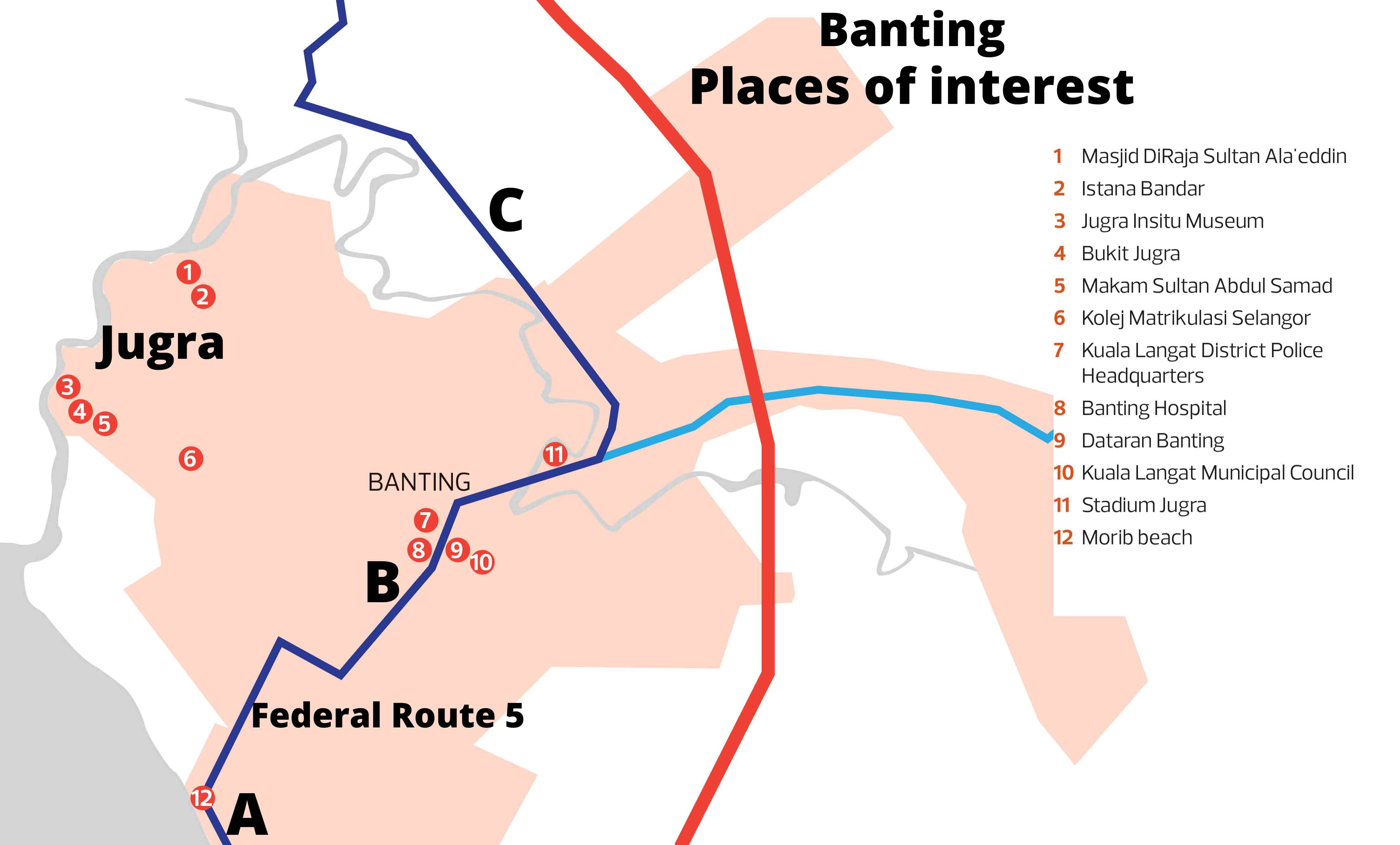
Today, Banting is the administrative-cum-commercial centre of the Kuala Langat district. Further growth in and around Banting can be expected when the long awaited West Coast Expressway (WCE) [C] is scheduled for full completion by the end of 2022. The 233 km highway that runs from Banting to Taiping, when completed, would be the third longest highway in the country, after North South Expressway and East Coast Expressway.
Tanjung Sepat – History and Places of Interest

Moving on to the next destination, Tanjung Sepat is about 29 km from Banting. Tanjung is cape in English and Sepat is the name of a freshwater fish from the Osphronemidae family, which is commonly found in tropical countries. It is predominantly a fishing town and the locals also engage in agriculture, initially planting coconut and rubber trees, but have since moved on to oil palm and dragon fruit. The latter is also known as pitaya, pitahaya, strawberry pear and thang. It is a member of the Cactaceae family and is native to the tropical forest regions of Mexico, Central and South America. There are many dragon fruit farms [A] located outside the town, along Federal Route 5, up to the Sepang district.

Tanjung Sepat is a popular tourist destination in the Kuala Langat district. The first site is Kuan Wellness Ecopark [B]. It is primarily a bird’s nest ecology park established by a local, Guan Jian Qi, in November 2010. In 2011, the company was awarded the international ISO 22000 food safety management system and in 2014, it was one of eight companies in Malaysia given approval to export bird’s nest to China. The eco park comprises an exhibition hall, natural organic pavilion, childhood pavilion, eco farm with bird park and aquarium and a restaurant. They are looking into adding a theme resort, durian orchard and outdoor team building area.
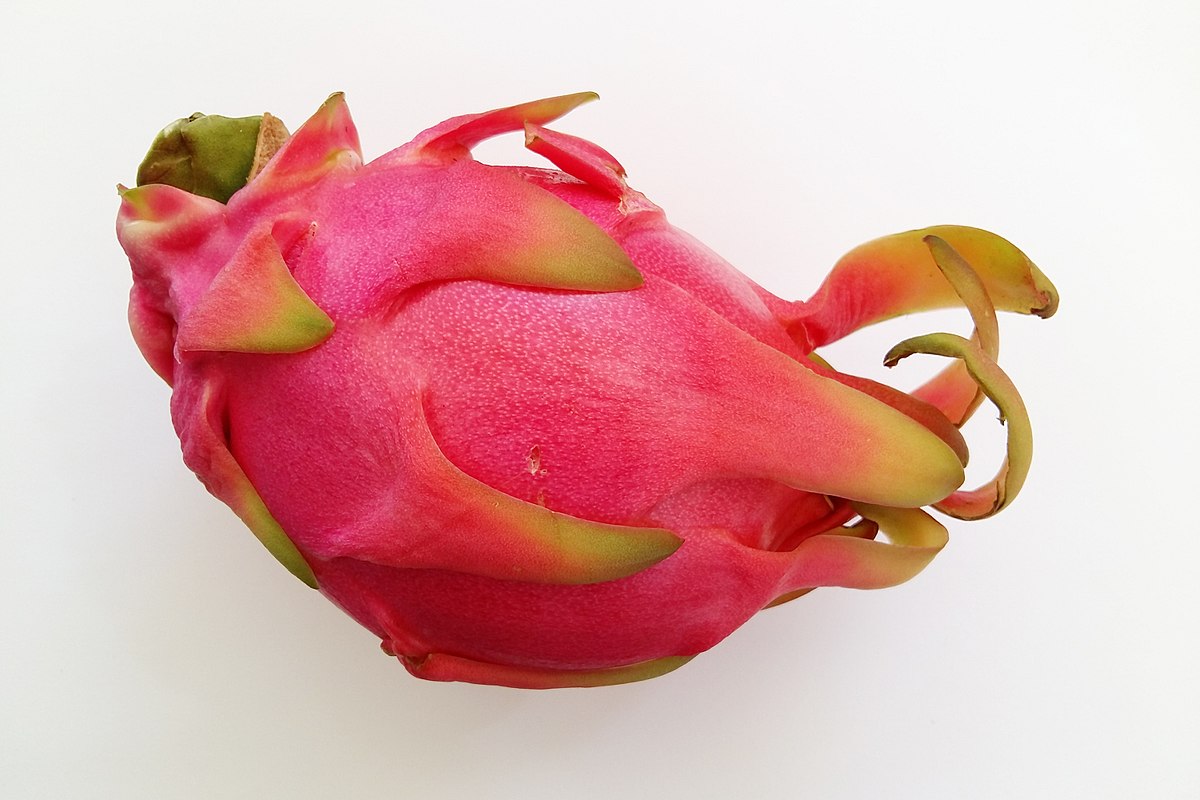
Left – Dragon fruit / Photo source : Wikimedia Commons
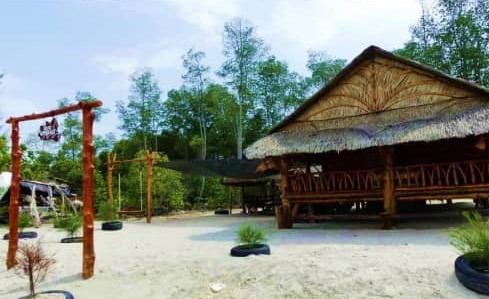
Right – Pantai Cunang / Photo source : Pantai Cunang wujud selepas tsunami, MDKL komited komersialkan

The next site is one that not many people know of. Pantai Cunang [C] is hidden behind a mangrove forest and is adjacent to a Mah Meri Orang Asli village. Pantai Cunang offers a stretch of white sandy beach and is an ideal spot to watch the sunset. It was once an isolated beach but the Mah Meri community and the district authorities transformed it into a tourist attraction. Cunang is in fact a Mah Meri word meaning calm and peaceful. It was first developed in 2010 and by the end of 2013, they had built 22 rest huts. In 2015, it won the best beach management and care title awarded by the state government. Kuala Langat District Council is committed to improving the economy of the Mah Meri community, and to making Pantai Cunang a major tourist destination in the state.

Kampung Baru Tanjung Sepat (today Tanjung Sepat Indah) [D] was established in 1950 and the settlers are composed of Chinese communities from neighbouring Tanjung Layang, Batu Laut, Kanchong Darat, Tumbuk and Sungai Belankan. It started with a population of 4,150 and reached 15,000 in 1995; today, the figure stands at 22,340. It has grown to become the commercial heartbeat of the town. SRJK (C) Tanjung Sepat, which was established in 1951, and most of the popular eateries and souvenir shops are located here.

Left – Outdoor dining / Photo source : Tanjung Sepat – Visit Selangor; Right – Lover’s Bridge / Photo source : Wikimedia Common

The star attraction of the town is the Lover’s Bridge/Qing Ren Qiao [E]. Originally, it was a long wooden jetty built before our country’s independence. It was a favourite haunt for couples to enjoy the scenery and sunset. In 2013, part of the bridge collapsed and it took the state government five years and RM 3.2 million to rebuild it. The new concrete jetty is 306 metres in length and it stretches into the Straits of Melaka. Besides the reconstruction, new amenities like food stalls, gazebos, kiosks, car park and toilets have been added to the site.
Sungai Pelek – History and Places of Interest

Selangor used to be covered by dense virgin jungle. The district of Sepang was notorious for tigers roaming the jungle. It was reported that 35 men, mostly Chinese rubber tappers from Chee Woh Estate, were killed by tigers. As a follow up action, the government raised the reward to catch/kill a tiger from 25 to 50 dollars. Still, the man-eater claimed another victim immediately after this announcement. On the other hand, it was reported that a resident of Salak, Lui Jing Tong, had killed a tiger with his bare hands!

Sungai Pelek is not the name of a river; it is the name of the town. ‘Sungai’ means river in English and ‘Pelek’ is strange/unusual/odd. There are two versions of how the name came about: 1) the unusual formation of a temporary river when the Sungai Sepang overflows its banks during high tide and disappears during low tide; 2) it happened during a flood where the water strangely flowed upstream rather than downstream! During the reign of Sultan Abdul Samad, Lukut (near Port Dickson) was part of Selangor but in 1880, it was ceded to Negri Sembilan in exchange for Semenyih. Since then, Sungai Sepang [A] serves as part of the boundary between the two states. Interestingly, there is a ferry service plying the route across Sungai Sepang, from Sungai Pelek to Bukit Pelandok on the Negri Sembilan side. It has been in service since 1930 and the ferry transports pedestrians, bicycles and motorcycles only. The Sungai Pelek Jetty [B] is located near the town.
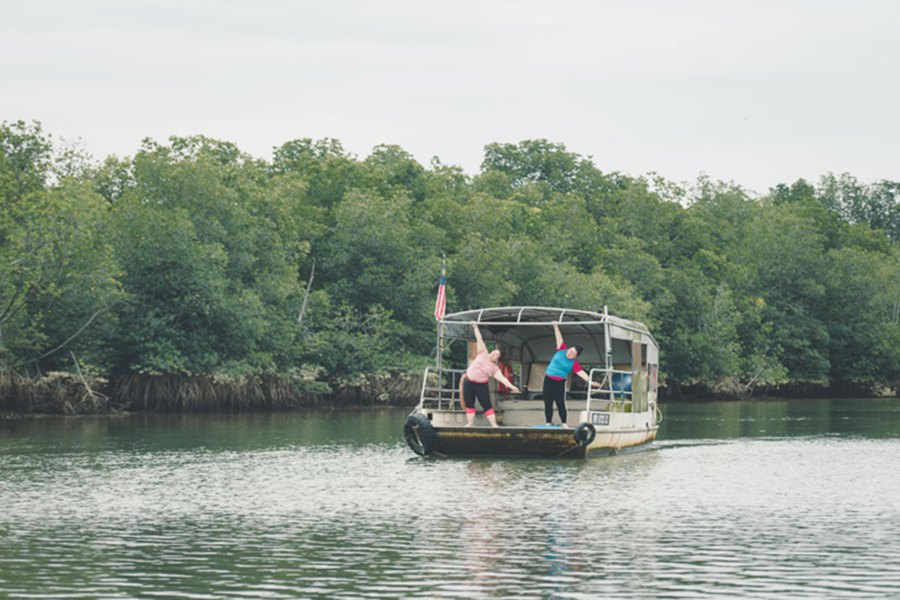
Ferry across Sungai Sepang / Photo source : Good to be home

Kampung Baru Sungai Pelek [C] was set up by the British in 1952, settling Chinese communities from Bukit Bangkong, Bagan Lalang, Jalan Lapis and Ladang Tai Long; and a few Indian families. It started with a population of 1,750. According to an estimate in 2012, the settlement has grown to more than 6,000 residents with 536 residences. Today, there are two Chinese primary schools in its immediate vicinity, namely SRJK (C) Wah Lian and SRJK (C) Tche Ming.

Trivia – Health Director-General Tan Sri Dr. Noor Hisham Abdullah spent his younger days in Sungai Pelek before moving to Kuala Lumpur with his mother and elder sister.
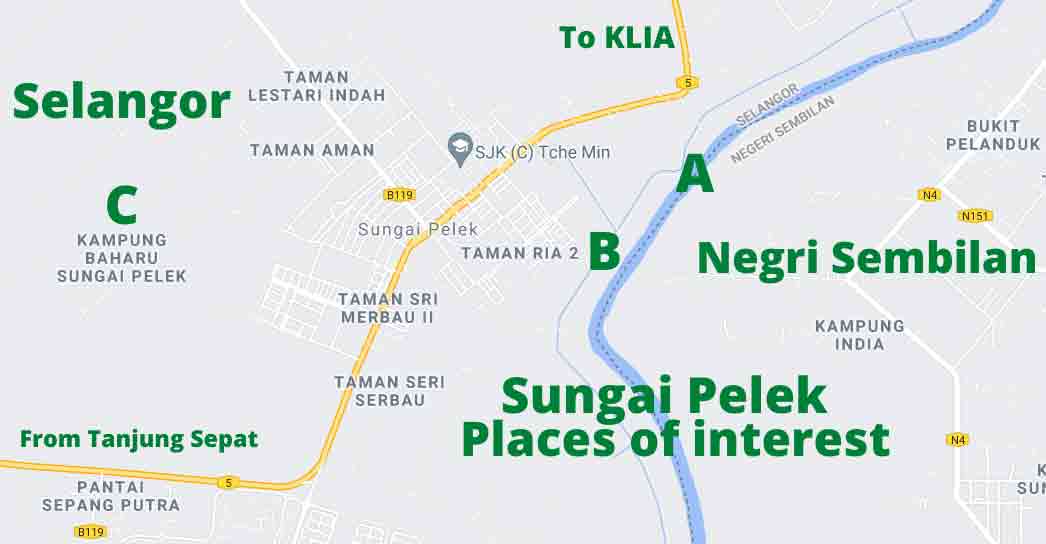
Photo source : Google Maps

Getting There

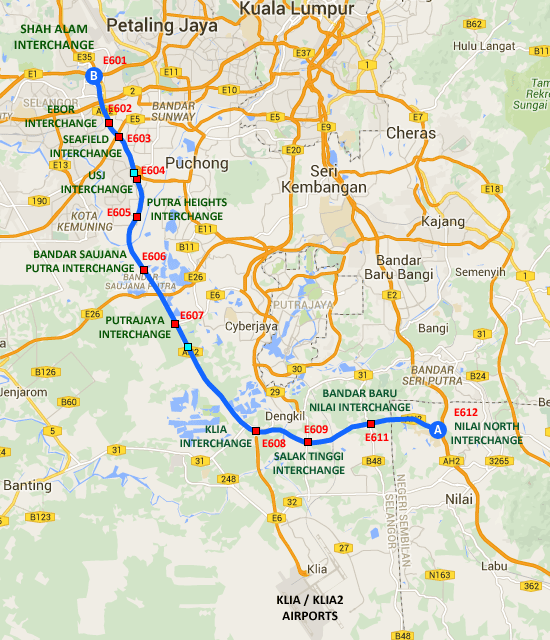
From Kuala Lumpur, use Plus Highway (E2) southbound. Exit at Exit 209 UPM to join Jalan Sungai Besi and continue on to join South Klang Valley Expressway (SKVE) at Ayer Hitam toll plaza. Continue on, and exit at Teluk Panglima Garang toll plaza and after the toll plaza, keep left to Jenjarom. Drive past Jenjarom and head towards Banting. Take Federal Route 5 to Tanjung Sepat and Sungai Pelek. From Sungai Pelek, continue using Federal Route 5 to Sepang, then head towards KLIA using B48 and turn to Jalan Kuarters KLIA and to Jalan Pekeliling. This will lead to E6 (Elite) and AH2 to Shah Alam or E608, E609, E611 to join E2 North South Highway.
In this Series

Please click HERE for a list of articles in the ‘A Very Rough Guide’ series.

References

Badminton Monument to mentor restored

Bumi Satu Kampung Dalam 2 Negeri – i Kampung Baru . Imbasan Sejarah Kampung Baru Cina Selangor – Published by Jawatankuasa Tetap Pembangunan Kampung Baru Kerajaan Selangor -First edition 2012 – pp 134 – 135 and 144 – 147.

Bygone Selangor; a souvenir(page 63 – 64)

Cover Story: WCE to spur growth in Banting

Malaysia Federal Route 5

Frederick Banting discovered insulin in 1921

Further Reading on Mohammad Zia ul-Haq

Good to be home

Nation NST175 Cup and away: Malaysia’s 1992 Thomas Cup win

New jetty paves way for development in Tg Sepat

Pantai Cunang wujud selepas tsunami, MDKL komited komersialkan
Pantai Morib (Morib Beach) – Visit Selangor

Tanjung Sepat – Visit Selangor

E is for Elephant

by Rose Gan

Image Credit: Dennis Ong

Elephants in the museum? Are you sure? Fascinating details are often hidden in plain sight in the galleries of any museum, frequently overlooked. The elephant, the largest animal of the Peninsula, turns up in some unexpected places at Muzium Negara, if you look carefully enough. This great beast, a vital part of the economy of the region since the earliest times, has had many functions: as a beast of burden, a method of transport through thick forest, a farm animal, a vehicle for the nobility, a valuable trade item, and even a war mount in battle. It also has a particular link to South East Asia’s Hindu-Buddhist past, representing Ganesha, the Remover of Obstacles, the particular deity of merchants and travellers for his connections with trade and travel.

So, let us take a quick tour of the galleries and look for elephants! Such quests can be a handy trick to keep in your back pocket when your tour includes children or bored teenagers. ‘How many elephants can you find? Let’s see if you can get more than four…’

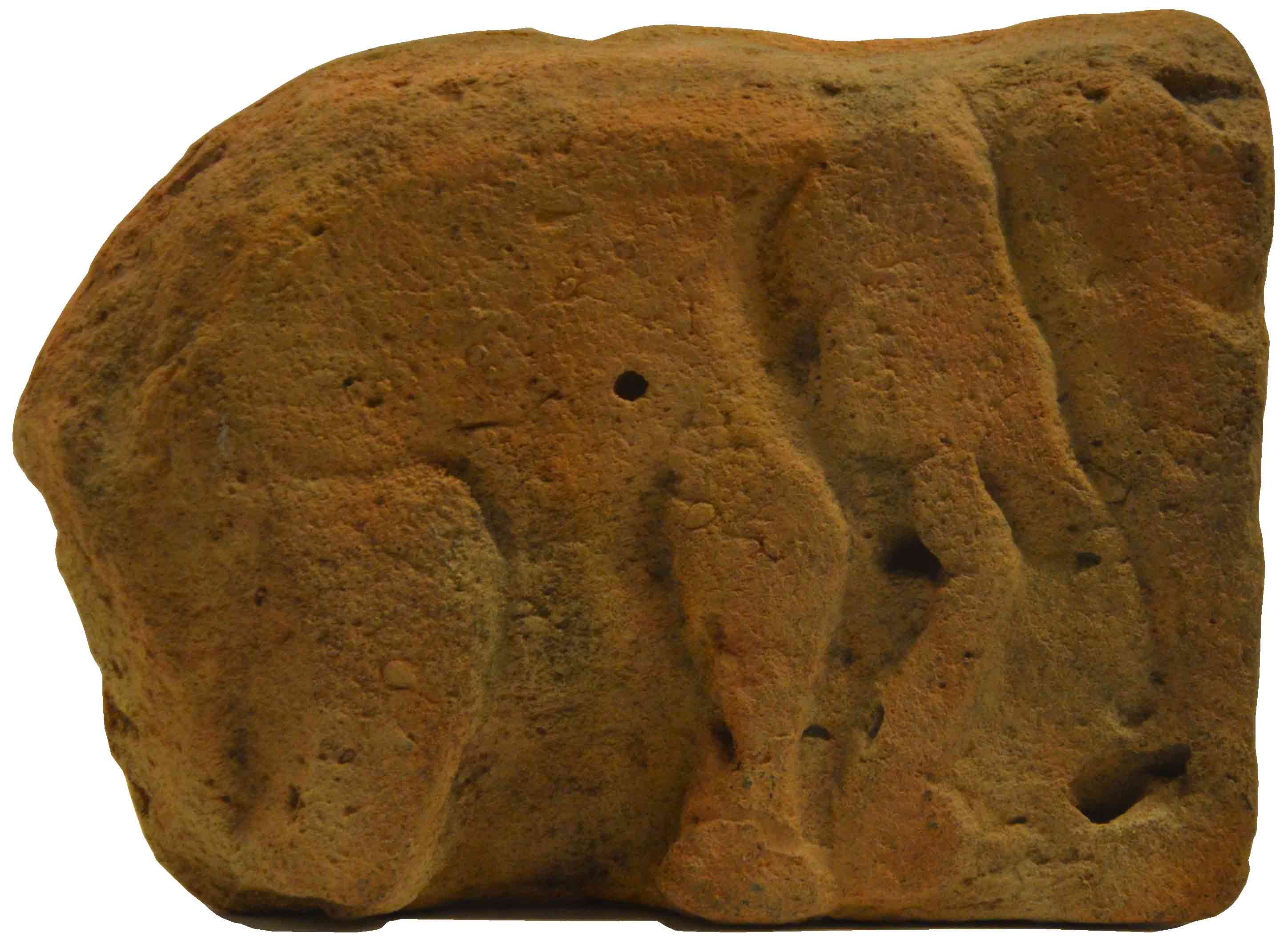
The most obvious elephant in Gallery A is a terracotta sculpture, part of the Bujang Valley collection. It may, of course, have a religious significance as a reference to Ganesha, but as it is in no way anthropomorphic, it may simply be a representation of an indigenous creature. Tigers and monkeys, snakes and crocodiles are often found on such pieces, just as on cave paintings, reflecting the animal world of the forest. The elephant was also, of course, important source of everyday labour and transport. This temple decoration came from Candi 21/22, which were Buddhist.

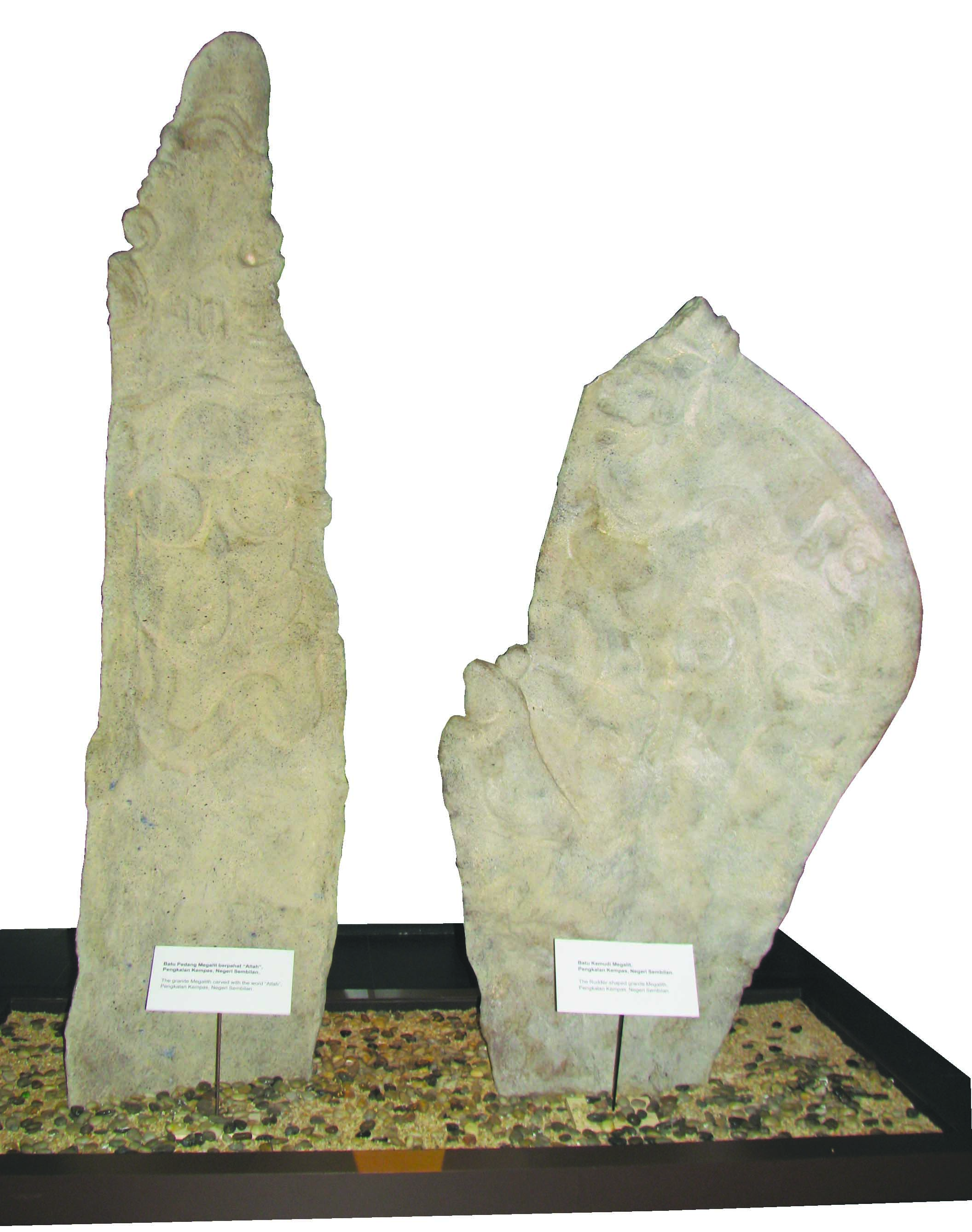
Another elephant example may be represented on the menhirs from Pengkalan Kempas, known colloquially as The Rudder and The Sword. Although there is little certainty about the many complex motifs on these megaliths, there have been suggestions that the animal on the mid left of ‘The Rudder’ is an elephant, whilst the ridge along the top of ‘The Sword’ that rises to a bulbous end may depict an elephant’s trunk. These megaliths are thought to represent several eras: the figures may have been carved at different times, explaining the unusual mix of animist, Hindu-Buddhist and Islamic elements. Pengkalan Kempas was probably a small jetty on a river where goods were exchanged. Ganesha would have been an important votive deity for the merchants who landed there in the hope of a good bargain.

left: sword; right: rudder

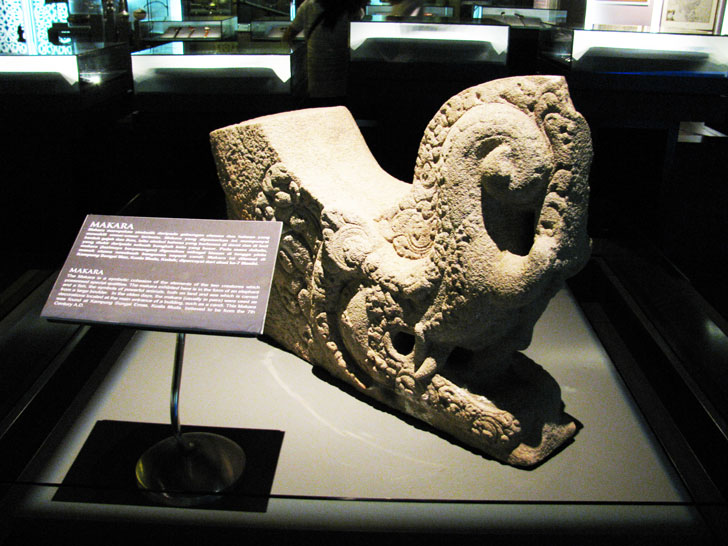
The Makara is an impressive sight at the entry of Gallery B. In Hindu-Buddhist iconography, the makara represents the two opposing forces of the earth, the land and the sea. This highly stylised figure noticeably has a fish tail but also displays a furled trunk as well as tusks, clearly elephant motifs. The makara originated in India where it has a completely different appearance: a hybrid of a dog, a crocodile and a fish. The unique makara of this region, however, draws upon the local elephant and a large fish. It is quite a different chimaera from its Indic origins.

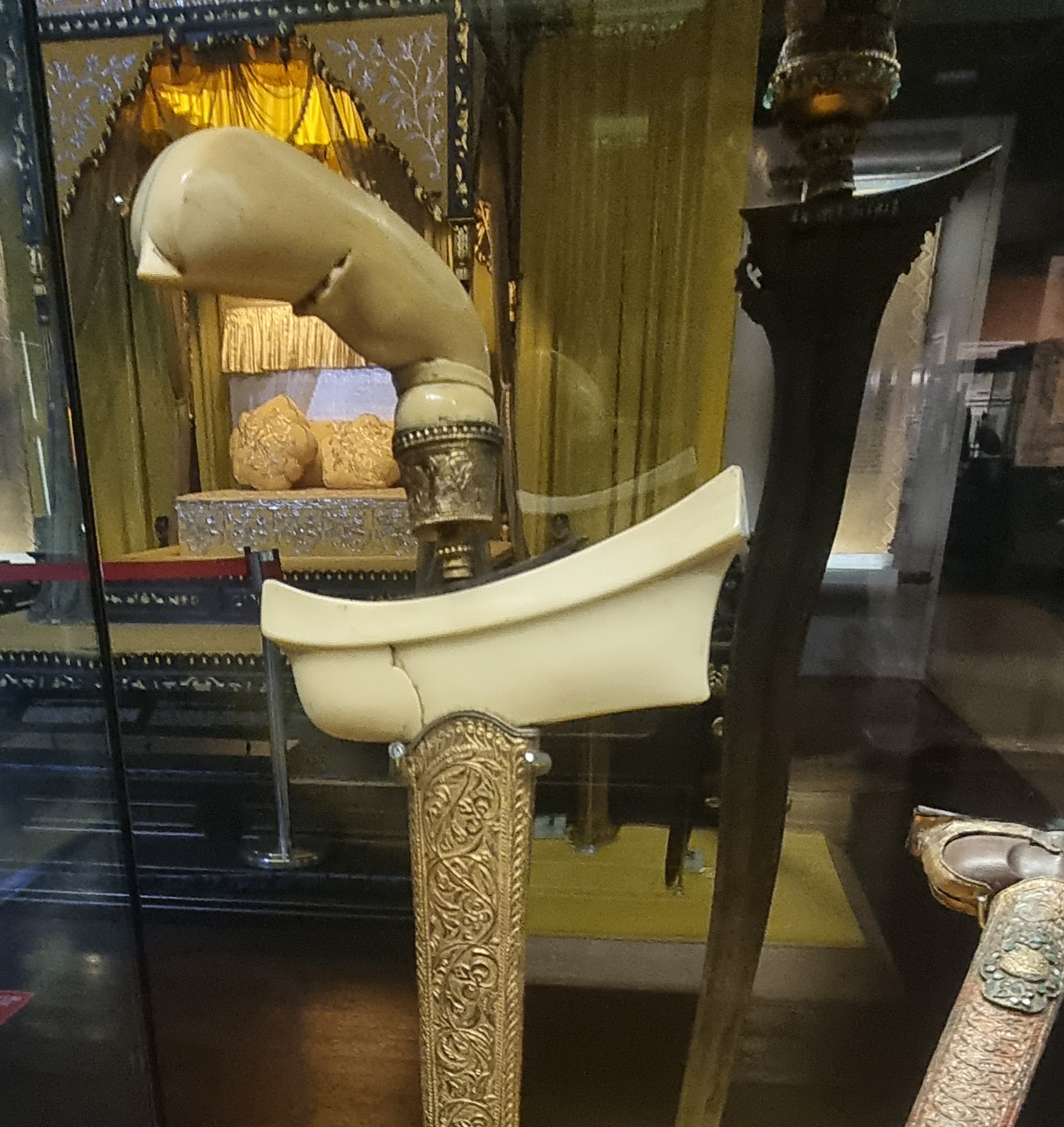
The most interesting elephant in Gallery B, however, is extremely hard to spot unless you are very observant. On the Riau Bugis keris in one of the central cases before the Perak throne, at the very top of the blade where it forms a triangular shape to meet the crosspiece, there is a finely wrought filigree feature. Careful scrutiny – and the help of a laser pointer or torch – reveals this to be a tiny unfurled Ganesha trunk, a trace of the Hindu-Buddhist origins of this archetypal Malay weapon.

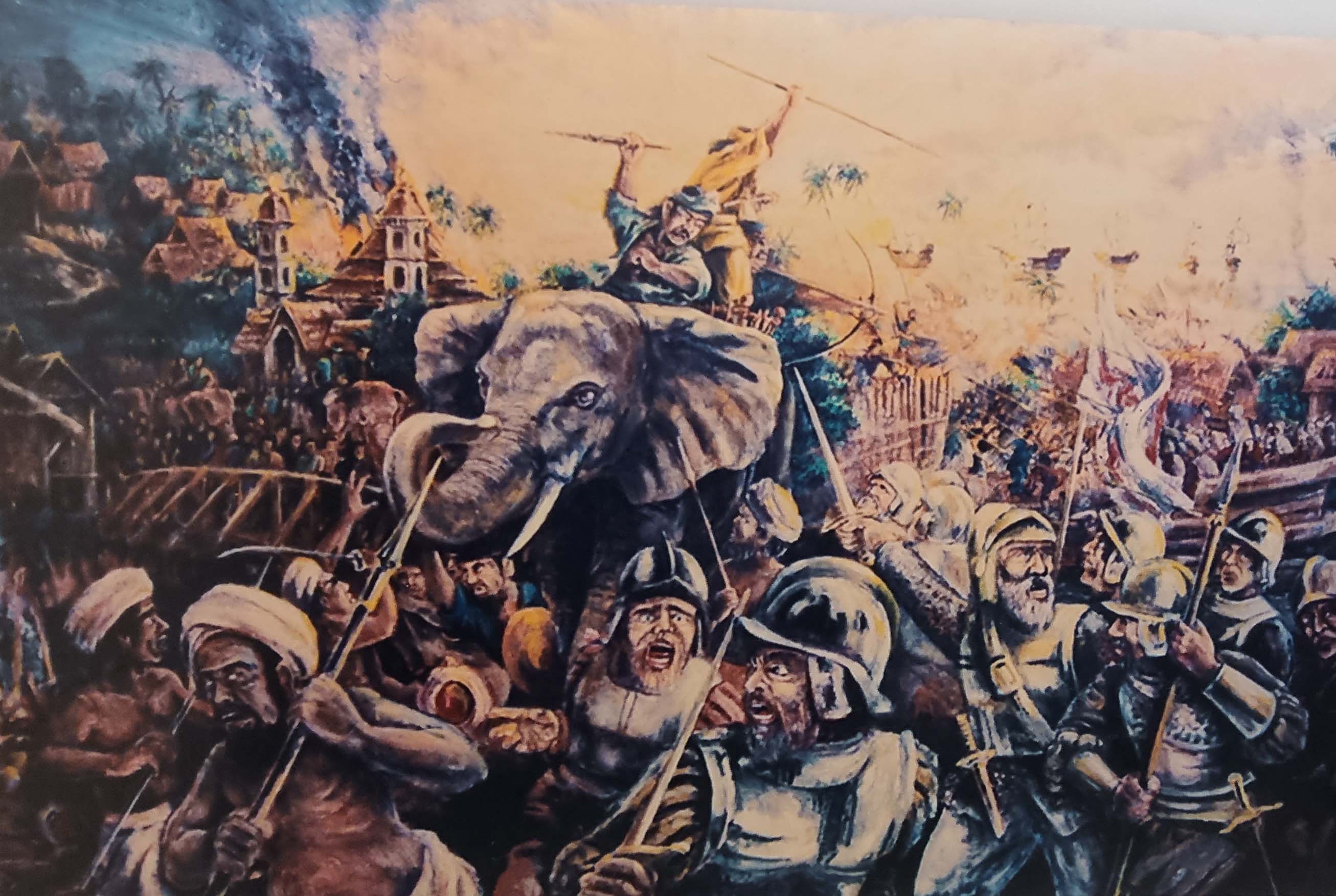
Gallery C contains a colourful reference to elephants in one of the pictures at the back of a vitrine in the Portuguese section. During the terrible fighting from June-July 1511 that culminated in the Portuguese capture of Melaka, Sultan Mahmud commanded a huge army of 20,000, gathered from the many vassal states of the Melakan Empire, including Pahang, Sumatra and Java. Amongst this host were 20 war elephants. The image in Gallery C depicts the thick of battle with Melaka town burning in the distance. Centre stage is a furious bull elephant, ridden by Malay warriors armed with spears, charging into a melee of Portuguese infantry and Indian troops, all fleeing in terror. Two other war-elephants bring up the rear. Sadly, despite the superior local forces – and the fearsome elephants – after a battle lasting 40 days, the Portuguese eventually triumphed. The rest is history.

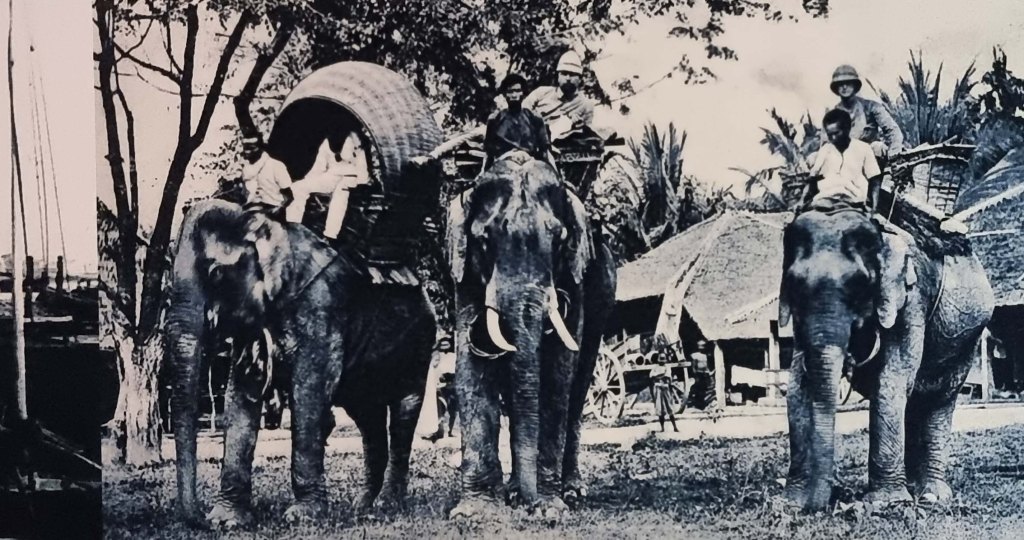
There is another elephant reference in the same gallery, in the pictorial display of Transportation towards the end of the room. Three working elephants, two with open rattan howdahs, the other with a woven covered canopy stand proudly facing the camera with their mahouts. They remind us of the vital role the elephant played in negotiating the narrow paths through the forest in an earlier time as transportation, beast of burden, and a valuable dragging and lifting machine before the invention of modern tractors and forklifts!

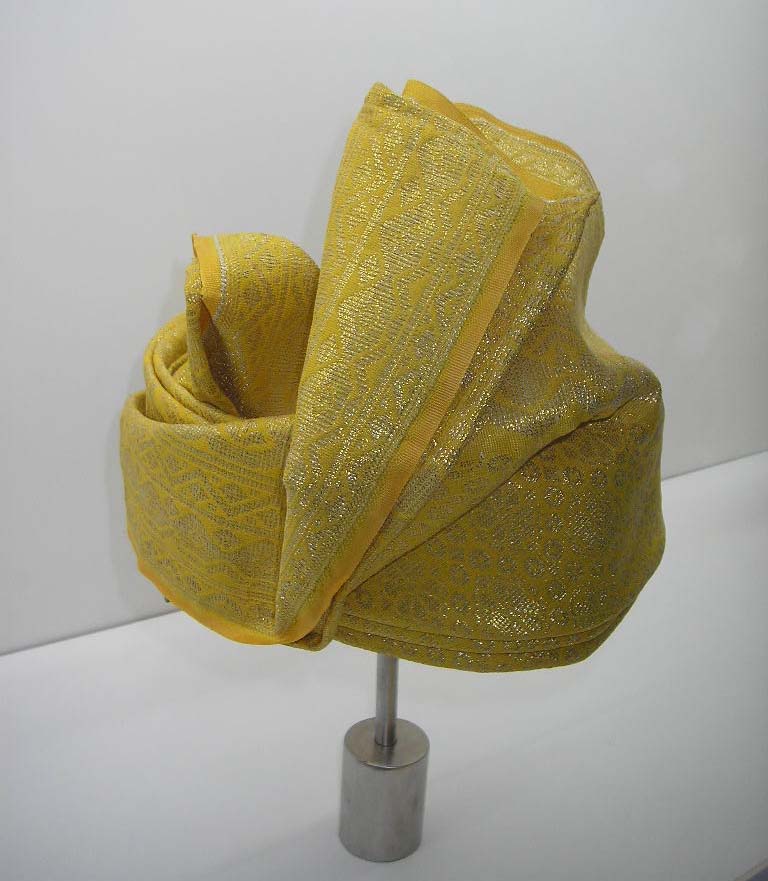
Even Gallery D has an elephant reference, although only those very well-informed about royal costume might notice it. Amongst the collection of the tengkoloks of the sultans of Malaysia, is the ceremonial Tanjak diRaja of the Sultans of Terengganu. It has a distinctive high folded front-piece that curves outwards, known as the tengolok belalai gajah (the elephant trunk).

I found seven elephants – have I missed any?

References

Ahmad Sarji bin Abdul Hamid (Chairman, Editorial Board). (2011) The Encyclopaedia of Malaysia: Vol. 16 – The Rulers of Malaysia. Editions Didier Millet.

Gan, Rose. & Maganjeet Kaur (Eds.). (2017). A Malaysian Tapestry: Rich Heritage at the National Museum. JMM. MPH Group Printing.

National Museum Curators. (2011). Muzium Negara Kuala Lumpur Gallery Guide. JMM.

Salina Abdul Manan, Hamdzun Haron, Mohammed Jamal Mat Isa, Daeng Haliza Daeng Jamal, Narimah Abd. Mutalib. (2020). Tengkolok as a Traditional Work of Art in Malaysia: An Analysis of Design. Journal of Critical Reviews, 7(19). http://www.jcreview.com/fulltext/197-1598175690.pdf

D is for Dennis

by Maganjeet Kaur

Image Credit: Dennis Ong

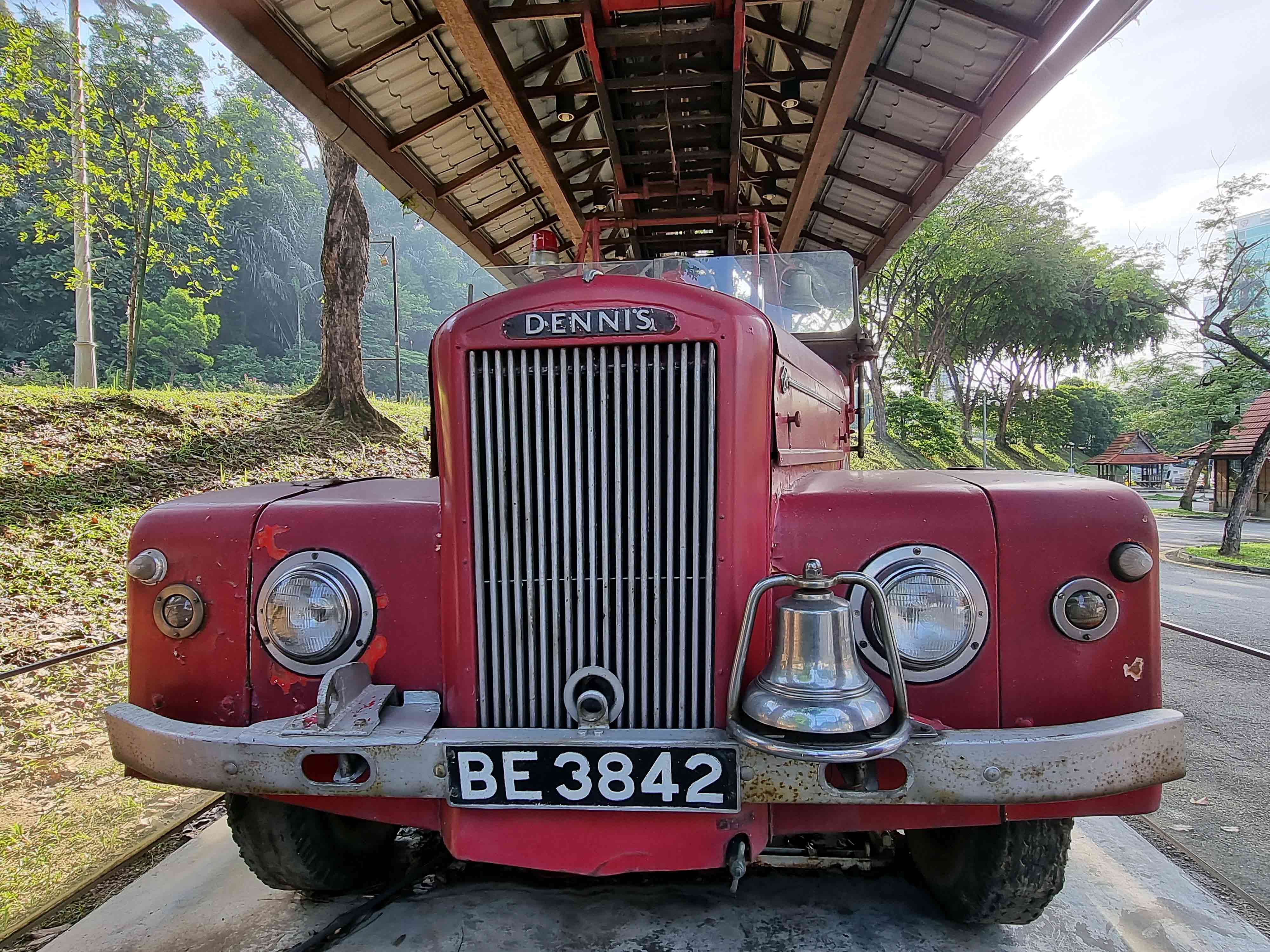
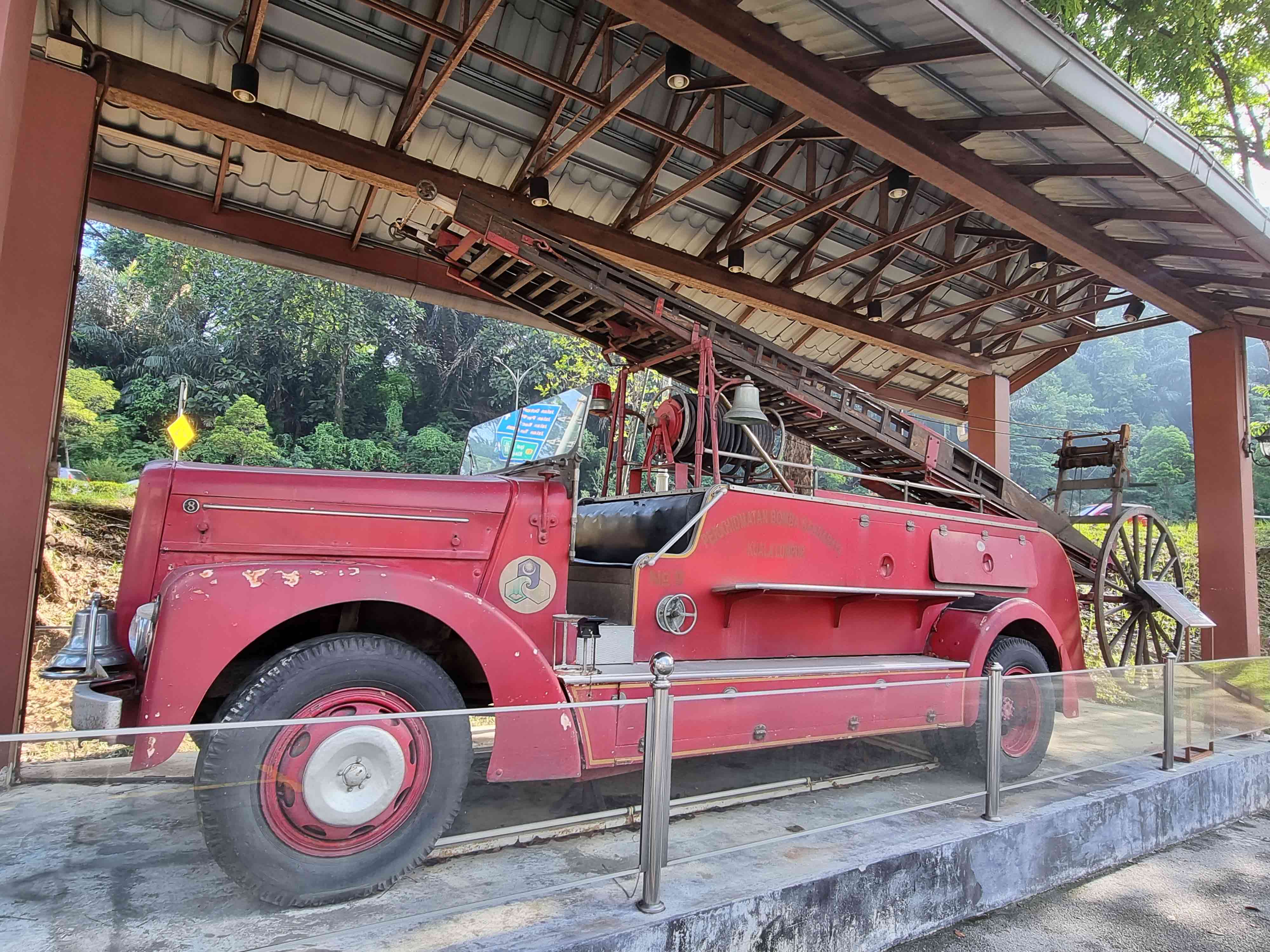
The Dennis Fire Engine on the grounds of Muzium Negara bearing registration BE 3842 was donated by the Fire Service Department of the Federal Territory on 6 January 1982.

The pleasure of digging through archival documents to get more information on BE 3842 will have to wait until the pandemic is over. However, one can picture this vehicle tearing down the streets of Kuala Lumpur, sirens wailing, in a race against time to save lives and properties. We do not know how many fire incidences it participated in but it was in service for a good 22 years and we do know that the Dennis engine is a good workhorse. Please do share with us any photos you may have of the BE 3842 in action at a fire site, racing down the streets or simply at rest.

The engine was purchased on 24 December 1958 from Dennis Brothers Limited, a manufacturer of commercial vehicles based in Guilford, Surrey, England. Established in 1895 by brothers John Cawsey Dennis and Herbert Raymond Dennis, they started the business producing bicycles and later made motorcars. They subsequently moved to manufacturing heavy-duty commercial vehicles including buses, trucks and dustcarts; fire engines were first produced in 1908. The commercial vehicles manufactured by the company were made-to-order based on customers’ requirements and were stronger than the mass-produced vehicles of their competitors. An example of their hardiness comes from Singapore where a Dennis fire engine is said to have worked non-stop for 87 hours to put out a huge fire at a copra godown on Havelock Road in February 1929; this surely must have been a record of sorts!

Loyal fans of Dennis vehicles have established their own society. Made up of owners and enthusiasts, they provide useful advice for anyone wanting to restore a Dennis vehicle. Their website has a page listing Dennis fire engines that are being preserved and Muzium Negara’s fire engine is on this list, specified as having an F2 body type with chassis number 4416. The museum’s display board identifies it as Dennis RR B80-50A, thus indicating it has a Rolls Royce (petrol) engine.

BE 3842 has a Rolls Royce petrol engine and F2 body type.

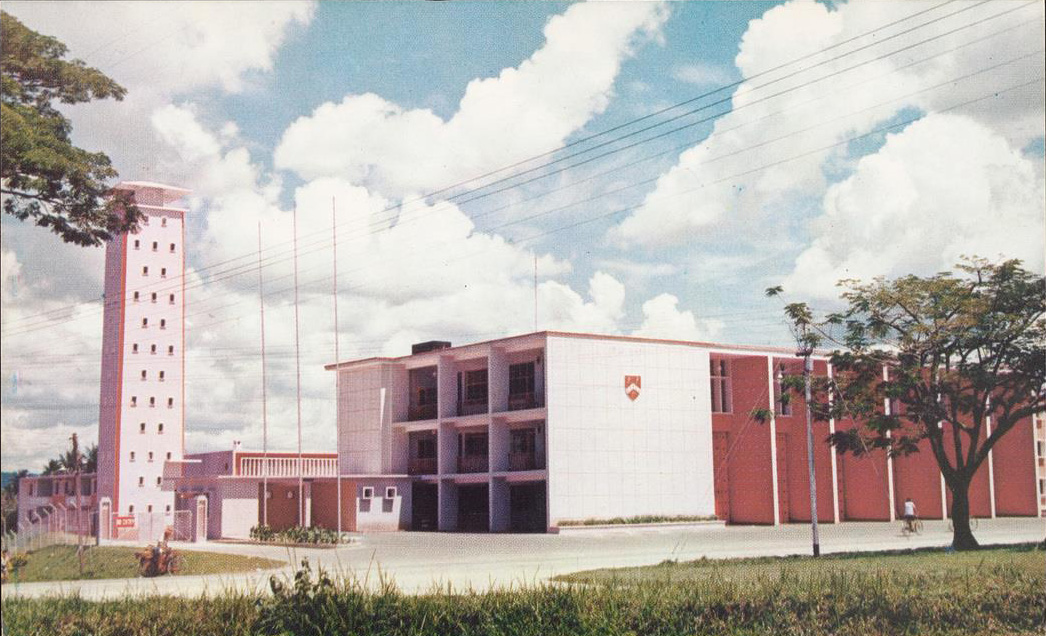
During the time it was in service, BE 3842 was likely housed at the Central Fire Station at Shaw Road (today Jalan Hang Tuah). This fire station was built in 1955 to the tune of $750,000 and it replaced the old fire station on Church Street (Jalan Gereja). Designed by Eric Taylor, Municipal architect, it had push-button doors that opened instantly. The new station accommodated married firemen in self-contained two-room flats. It was equipped with two Dennis engines, BE 3842 undoubtedly one of them.

The Central Fire Station on Shaw Road (Jalan Hang Tuah), home of BE 3842 when it was in service. This building has since been replaced with a new structure. Image credit: National Museum of Singapore

“Most Powerful in the East”

The first Dennis fire engine in Kuala Lumpur was purchased in 1911, arriving in October on the steamship Benavon. This petrol vehicle had a 500-gallon capacity, and, with a horsepower of 70, it was claimed to be the most powerful engine in the East. However, there is no pleasing everyone. Alexander Simpson, Engineer of the Selangor Fire Brigade, considered the horsepower “a little in excess of the needs of Kuala Lumpur and District under prevailing circumstances”.  Simpson had the task of putting the engine together, which was done at the Works of the Federated Engineering Company. He had other minor grouses as well, albeit valid. Nevertheless, a test done at half power on 30 October showed the engine worked well and was ready to be put in action.

It kind of saw action very soon. On the night of Saturday 11 November, a prankster, probably very eager to see the new fire engine, pulled the fire alarm on nearby Weld Hill (Bukit Kewangan). The fire brigade was out the door in their new Dennis fire engine in just five minutes (with one member of the team still in pyjamas). Although they saw no signs of fire, just a smashed fire alarm, the incident showed that the Dennis fire engine was quicker compared to the 15-20 minutes required to get the old steam engine ready.

Bellamy’s Brigade

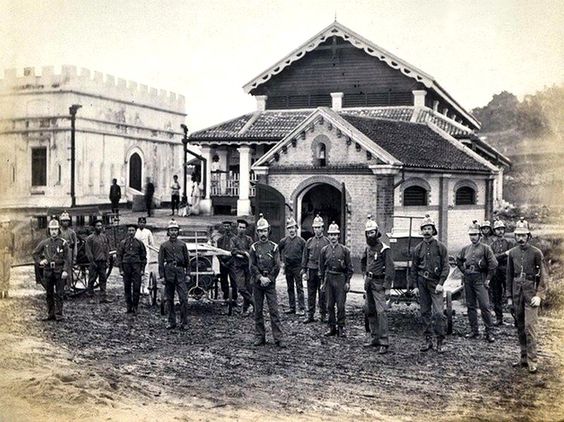
History of the Fire Brigade in Kuala Lumpur dates to 28 May 1884 when Captain Harry Syers was tasked by the British Resident to round up members for a Volunteer Fire Brigade. Thirty-odd people signed up and they became the founders of the brigade. The members comprised government officials and residents of Kuala Lumpur, Thamboosamy Pillai and Yap Ah Loy were among the prominent locals. H.F. Bellamy, the Superintendent of the Public Works Department, was appointed Chief Officer. His passion was the driving force behind the brigade, which came to be known as Bellamy’s Brigade.

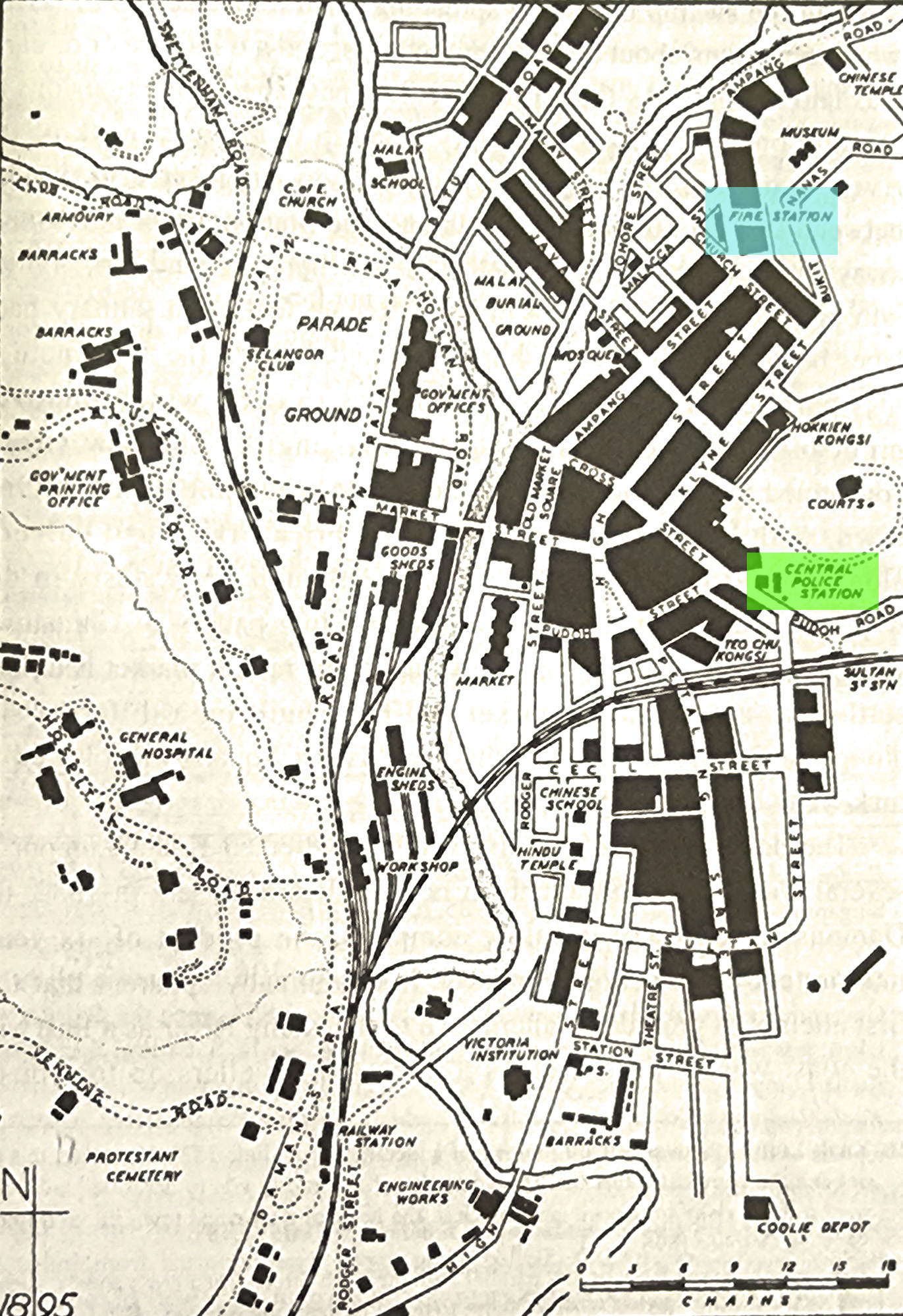
The Fire Brigade was headquartered at the Central Police Station, which at the time was located on Cross Street (Jalan Tun Tan Siew Sin). The Brigade only had a manual engine, which they dragged by hand. They later obtained Merryweather’s Greenwich Gum steam pump, also dragged by hand. It must have been quite a sight to see the pillars of society – brigade members included the likes of H. Conway Belfield, Magistrate & Revenue Collector; A.R. Venning, the State Treasurer; and A.C. Norman, the government architect – racing down the street, dragging a steam pump!

This image, sourced from Pinterest, purports to show the Volunteer Fire Brigade in front of the Police Station in the 1880s. If indeed in Kuala Lumpur, this Police Station would have been on Cross Street (Jalan Tun Tan Siew Sin), near where Mydin Sinar Kota is located today; the Police Station on High Street (Jalan Tun HS Lee) was only constructed in 1895. In any case, it shows a Volunteer Fire Brigade, together with their manually-dragged pump.

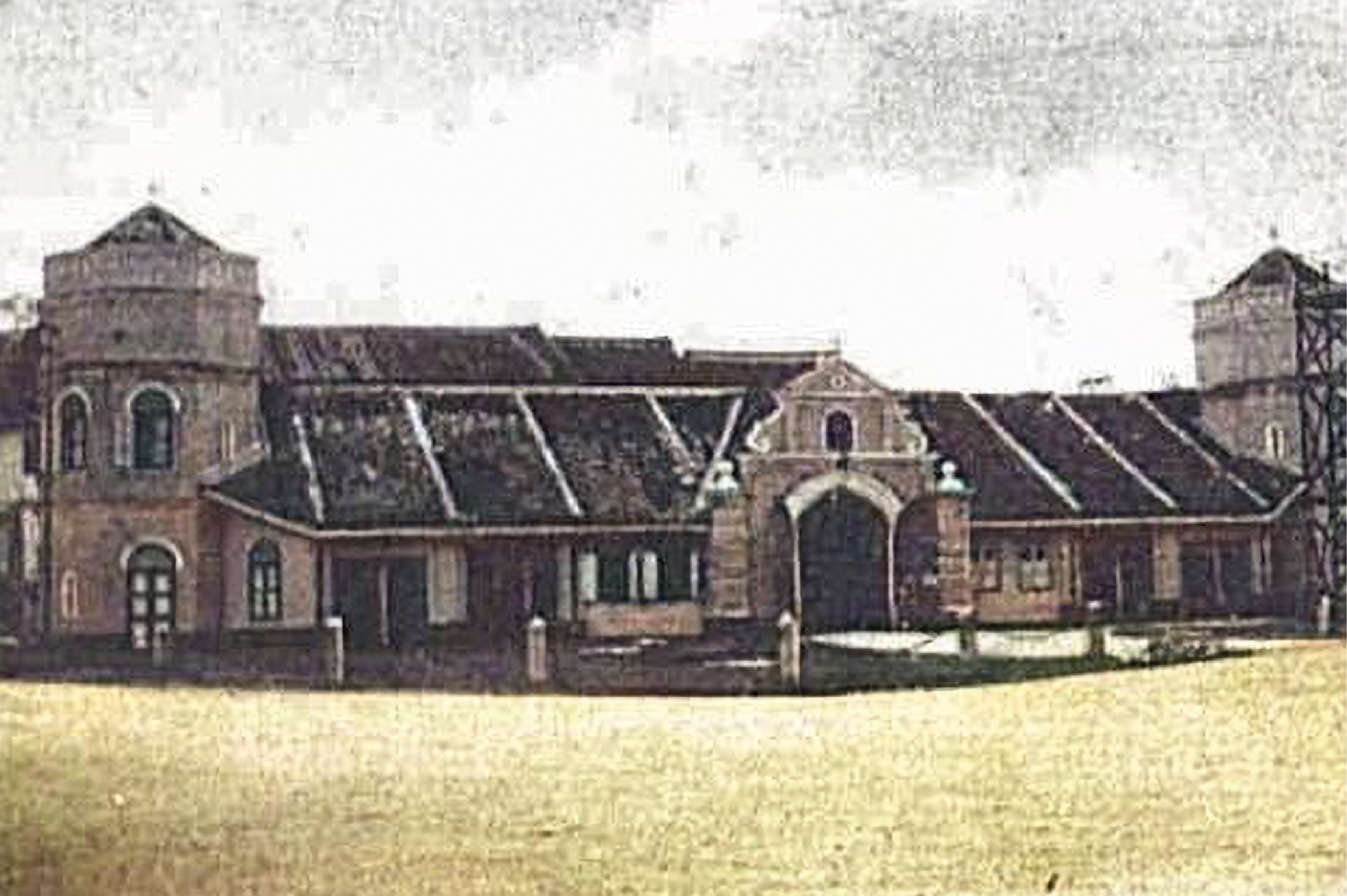
In 1893, Kuala Lumpur’s first fire station was built on Church Street (Jalan Gereja), and officiated on 30 November. In the same year, Shire horses were imported from Britain for the onerous task of pulling the steam pump. The horses were stabled in stalls on either side of the station’s central bay. They were trained to move to their place in front of the engine at the sound of the fire alarm. Bellamy himself drove the horses. In 1895, the Volunteer Fire Brigade was disbanded and the Fire Brigade became a paid unit.

Selangor Fire Brigade Station on Church Street (Jalan Gereja), date unknown. The building was demolished in 1956 after the Fire Brigade moved to Shaw Road (Jalan Hang Tuah).
1895 map of Kuala Lumpur. The Central Police Station, which initially headquartered the Volunteer Fire Brigade, is shown in green. The first Fire Station, built in 1893, is shown in blue; a bus stop marks its location today. Base map: Gullick (2017, 47).

By 1902, the Brigade had purchased their very first motor fire engine – the earliest model of Merryweather’s Fire King. They were the first in the East to have such an engine. When Penang purchased their Fire King in 1906, Kuala Lumpur showed off, “They move slowly in the northern settlement, and sometimes a good deal slower in the southern.” Perhaps they should have waited for the next model because their Fire King did not perform as well as the later model obtained by Singapore.

The Fire King was a steam engine and it was replaced by the Dennis petrol engine in 1911. By this time, Bellamy had returned to Britain (in around the mid-1910s).

References

Gullick, J.M. (2017). A History of Kuala Lumpur: 1856-1939. MBRAS.

Simpson, Alexander. (1911, December 14). Letter from Alexander Simpson to E.G. Broadrick. ‘Report on Dennis Motor Fire Engine, K. Lumpur’. Arkib Negara 1957/0159945.

Dennis Society. Preserved Dennis Fire Engines. https://www.dennissociety.org.uk/preserved/fire/index.html#anchorbe3842

Jabatan Bomba dan Penyelamat Malaysia. Latarbelakang. https://www.bomba.gov.my/index.php/pages/view/4?mid=165

(Untitled). (1906, 7 February). Eastern Daily Mail and Straits Morning Advertiser, 3.

Selangor’s Fire Engine: Most Powerful in the East. (1911, October 17). The Singapore Free Press and Mercantile Advertiser, 4.

(Untitled). (1911, November 16). The Straits Times, 8.

Selangor Fire Brigade. (1913, February 24). The Straits Times, 10.

A Record? (1929, February 13). Malaya Tribune, 10.

$750,000 Fire Station. (1955, May 16). The Straits Times, 4.

C is for Chulalongkorn

by Kon Cze Yan

Image credit: Dennis Ong

I write about King Chulalongkorn with some trepidation. Thailand’s Lese-Majeste Law prosecutes for slights against both living and dead royals. I do want to visit Thailand again after the pandemic!

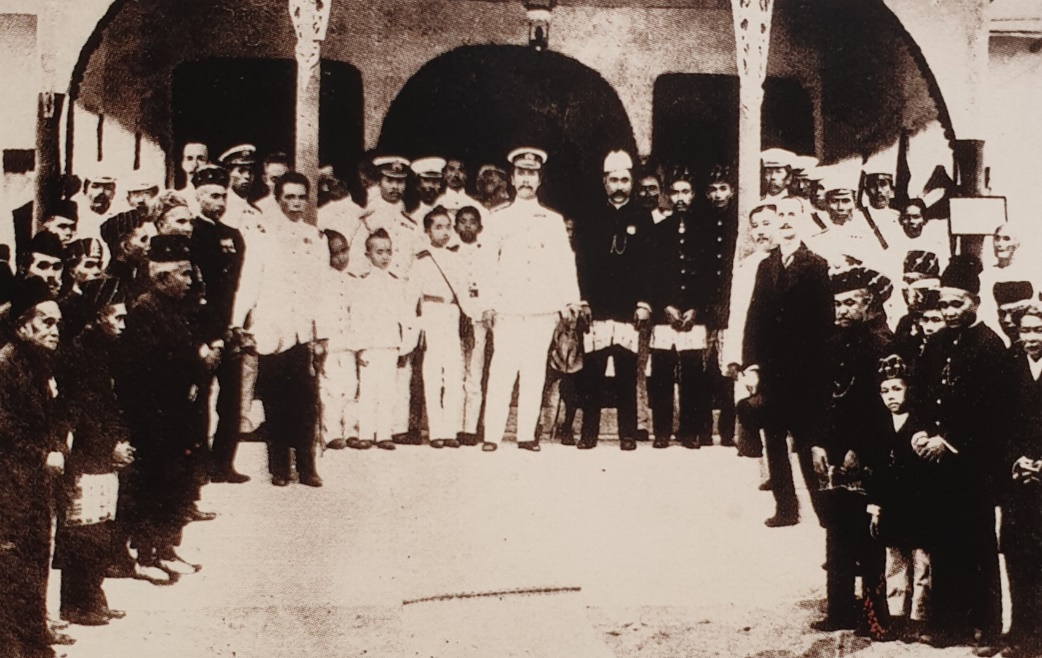
Chulalongkorn appears in Muzium Negara in the old photograph below.

This photograph was taken in June 1905 during the King’s visit to Kelantan. He stands in the centre, wearing white, with his sons on his right. To his left is the ruler of Kelantan, Raja Long Senik, who adopted the title Sultan Muhammad IV in 1911. H.W. Thomson, the Deputy Resident Commissioner, can be seen on the right-hand side of the photograph. They are posing in front of the Siamese Residency, home of W. A. Graham the Siamese Resident Commissioner. With the 1902 Siamese-Kelantan Treaty, although Siam had suzerainty over Kelantan, Siam had to appoint a British national as the Resident Adviser and Commissioner to Kelantan.

Chulalongkorn has the epithet “Phra Piya Maharat”, the Great Beloved King. He is Rama V, 5th monarch of the reigning Chakri dynasty of Siam (now Thailand). The Chakri dynasty has ruled since 1782. He is the great-grandfather of the current King of Thailand.

A Glimpse of Chulalongkorn’s family life

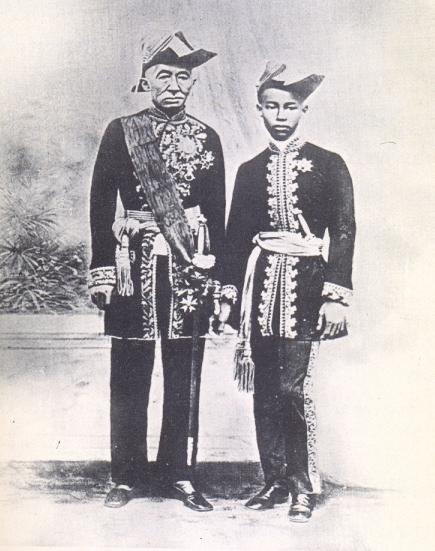
Chulalongkorn was the 9th son of King Mongkut (Rama IV), but since he was the first to be born to a royal queen, he was recognized as heir to the throne. His mother was Queen Debsirindra and she was Mongkut’s grandniece.

Chulalongkorn was only 15 years old when his father died in 1868. He succeeded the throne under the regency of Somdet Chao Phraya Si Suriyawong. Over the next 5 years, he prepared to assume duties by observing court business and by travels to British Malaya, Dutch East Indies, Burma and India.

King Mongkut & Prince Chulalongkorn. Image credit: Wikipedia

Chulalongkorn had at least five royal consorts who were his half-sisters (Mongkut’s daughters) and about 92 consorts and concubines in total. Nothing to raise your eyebrows about. Royal intermarriage used to be very prevalent in Europe and other parts of the world as well. (For Lese-Majeste reasons, note this is a statement and not a criticism!) Once when he visited Italy, he was asked by the Queen of Italy how many wives he had and his reply to her was, “Had I met you first perhaps I would have had only one.” The King of course knew how many he had because each wife was given a sum of money for personal expenses every year.

In theory, the King could make any of his wives a queen. However, in practice, his queens were the daughters of kings. They were called Somdet Phra Raja Devi. From these he promoted the mother of the Crown Prince who was the eldest son. The Crown Prince’s mother was called Somdet Phra Boroma Rajinee.

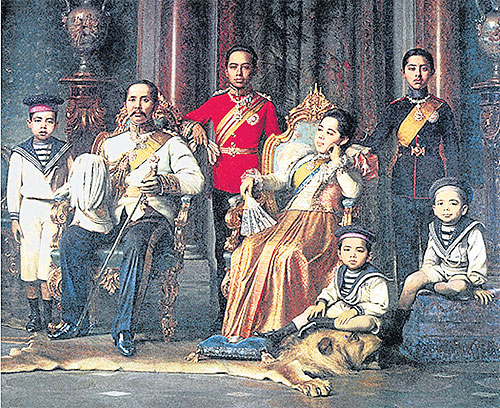
Chulalongkorn was a prolific producer of children. He had 77 children. Not as many as his father, King Mongkut, who had at least 82 children! (For Lese-Majeste reasons, note this is a statement and not a criticism!)

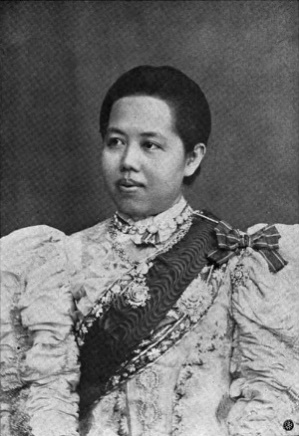
Saovabha Phongsri (1864-1919)
Queen Saovabha gave King Chulalongkorn 9 children; two sons would eventually become King of Siam. In 1897, she became the first female Regent of Siam when the King went on a tour of Europe. Image credit: Wikipedia
King Chulalongkorn & Queen Saovabha Phongsri with their children. The Royal family adopted Western-style attire as the monarch began to modernise the country. Image credit: Bangkok Post
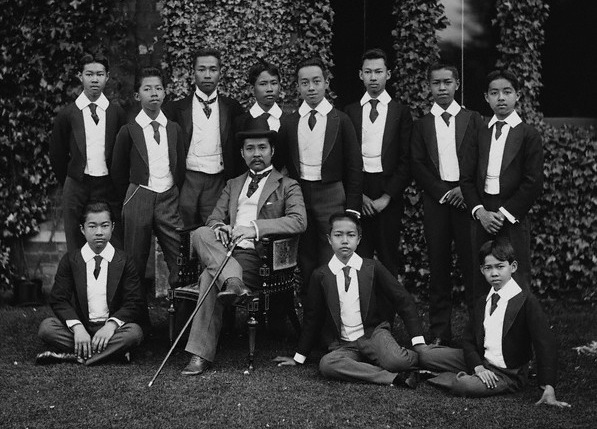
King Chulalongkorn with a few of his sons at Eton College, England, in 1907. Image credit: Wikipedia

Why is Chulalongkorn one of Thailand’s most loved and revered Kings?

King Chulalongkorn is considered one of the greatest kings of Thailand. His reign was characterized by extensive social and economic reforms and development.

Chulalongkorn matured into a shrewd politician and managed to fend off very skilfully the threat of European colonialism. Large tracts of Siam were ceded to the Europeans during the period, but Thailand remains the only country in Southeast Asia to have never been colonized.

His abolition of slavery made him the Beloved Great King of all people of Siam. In the beginning of his reign, more than a third of the population were slaves.

Chulalongkorn was the first Siamese King to send the Royal Princes to be educated in Europe. He nurtured a corps of bright Western-educated royal relatives who helped him carry out reforms and to conduct diplomacy.

Dummies’ Quick Guide to What Was Happening In and Around Siam during Chulalongkorn’s Reign

In 1782, Rama I, the first king of the Chakri dynasty, founded a new capital city across the Chao Phraya River in an area known as Rattanakosin Island, now called Bangkok.

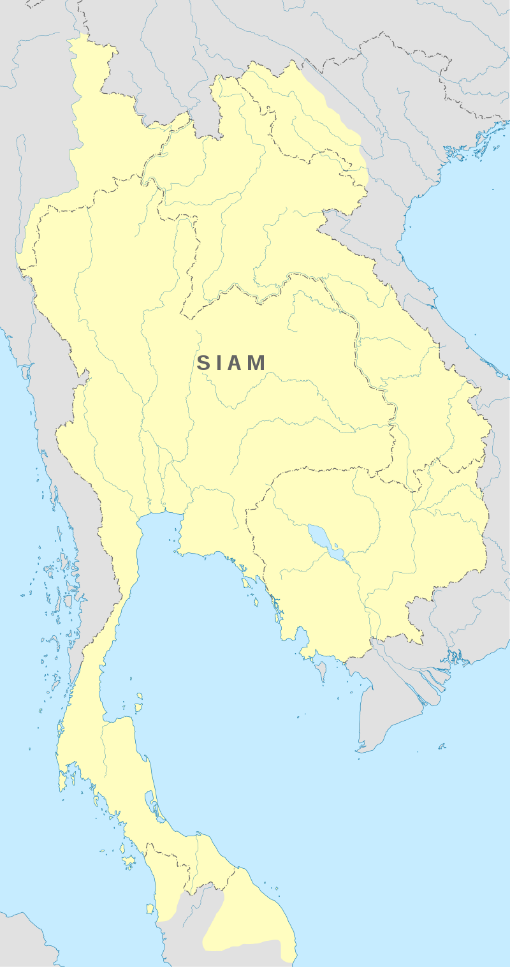
From the middle of the 16th century, there were many Burmese-Siamese wars and repeated attacks on Siam. In the 1790s, Burma was defeated and driven out and Siam reached its greatest extent around 1809.

Left: Greatest extent of Rattanakosin’s orbit (c. 1809). Image credit: Wikipedia
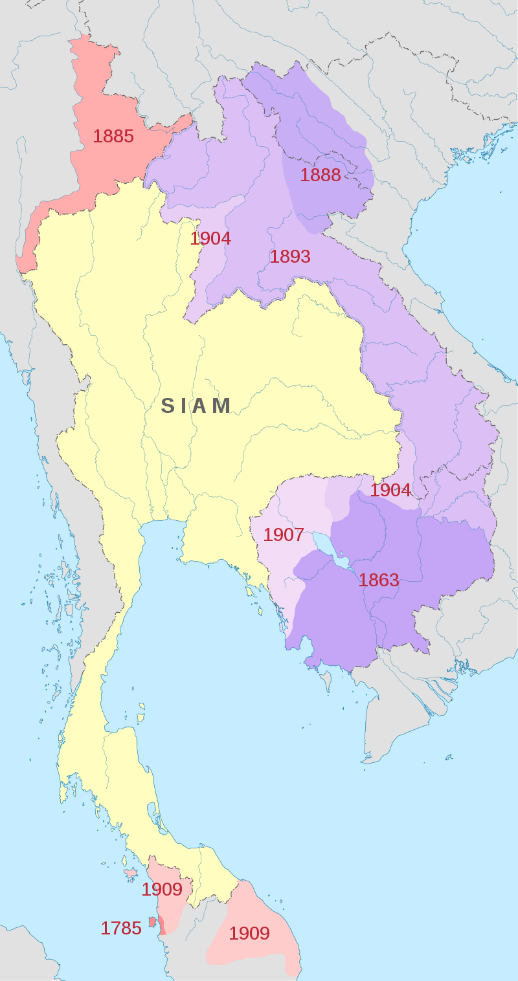
Right: Territorial cessation of Siamese protectorates in 19th to 20th centuries. Purple to France. Red to Britain. Image credit: Wikipedia

Two kings, Mongkut and Chulalongkorn, witnessed the expansion of both France and Britain to increase their colonial territories in Southeast Asia and encircle Siam. From the west, the British “conquered” India (mid-18th century), Burma (1826-1885) and Malaya (1874), and from the east, the French “conquered” Vietnam (1859), Cambodia (1863) and Laos (1893).

The French takeover of Cambodia and Vietnam led to keen French interest in the Lao territories. They saw (wrongly) the Mekong as a potentially major trade route with China. They feared Thai interests in the territories would be championed by their imperial rival, Britain (also wrong!). The loss of Laos to France in 1893 was a prime example of gunboat diplomacy practiced by western powers. With French gunboats menacing Bangkok, Siam reluctantly signed the Franco-Siamese treaty, which transferred to the French Lao territories east of the Mekong.

After the Franco-Siamese War of 1893, King Chulalongkorn realised the threat of western colonial powers, and accelerated extensive reforms in the administration, military, economy and society of Siam.

In 1896, British and French concluded the Anglo-French Declaration, which made a border between their colonies, with Siam defined as a buffer state. The negotiations for this started around 1887 and the exceedingly subtle and active role that Siamese diplomats played must be appreciated.

This was quickly followed by the Anglo-Siamese Secret Convention 1897 whereby, in return for a Siamese undertaking not to grant any concession or cede any part of the Malay Peninsula without prior British approval, Britain pledged itself to come to the defence of Siamese rights in that region if they were threatened by any third power.

The Entente Cordiale of 8 April 1904 ended the rivalry between Great Britain and France over Siam. As far as Siam was concerned, what the two Powers did in 1904 was nothing more than a reaffirmation of their previous agreement of 1896.

The Anglo-Siamese Treaty of 1909 defined the modern border between Siam and British Malaya. The treaty stated that Siam transfer all rights of suzerainty over its four Malay dependencies – Kelantan, Terengganu, Kedah and Perlis – to Britain. In return, Britain agreed to relinquish its extraterritorial rights over British subjects in Siam. Britain also agreed to abrogate the 1897 Secret Convention and loan Siam £4 million for the construction of a railway to the Malay Peninsula.

When King Chulalongkorn died in 1910, Siam had achieved the borders of today’s Thailand. In 1910, he was peacefully succeeded by his son Vajiravudh, who reigned as Rama VI.

Was Anna Leonowans real?

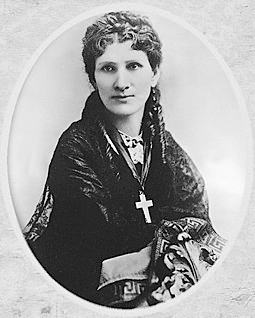
My first memory of the King of Siam was from the musical “The King & I”. The source material for this musical was a 1944 novel “Anna and the King of Siam” by Margaret Landon, a missionary to Thailand. Anna Leonowans herself did write her own commercially successful memoirs, “The English Governess at the Siamese Court” (1870) and “The Romance of the Harem”(1873), to which King Chulalongkorn responded with the statement that she “has supplied by her invention that which is deficient in her memory.”

Anna Leonowans, c. 1862 Image credit: Wikipedia

Many movie and musical versions have been made of Anna’s story – all highly sensationalized and fictionalized. One was even filmed in Malaysia – “Anna & the King” (1999) starring Jodie Foster & Chow Yun Fat. These movies are banned in Thailand and considered to be lèse majesté because of their disrespectful treatment of King Mongkut.

A World Without A Sun

King Chulalongkorn died in 1910 of kidney disease. He was nursed by Queen Saovabha and his favourites. Princess Chongchitra said, ”It was very sad in the Palace after King Chulalongkorn’s death because his successor was unmarried and would not live Inside. So for us Inside, it was like a world without a sun. Life was all monotony. No King’s meals to prepare; nothing to do for him. We, who had talked about what the King did, what he said, what he liked and what he disliked, now had nothing to talk about.”

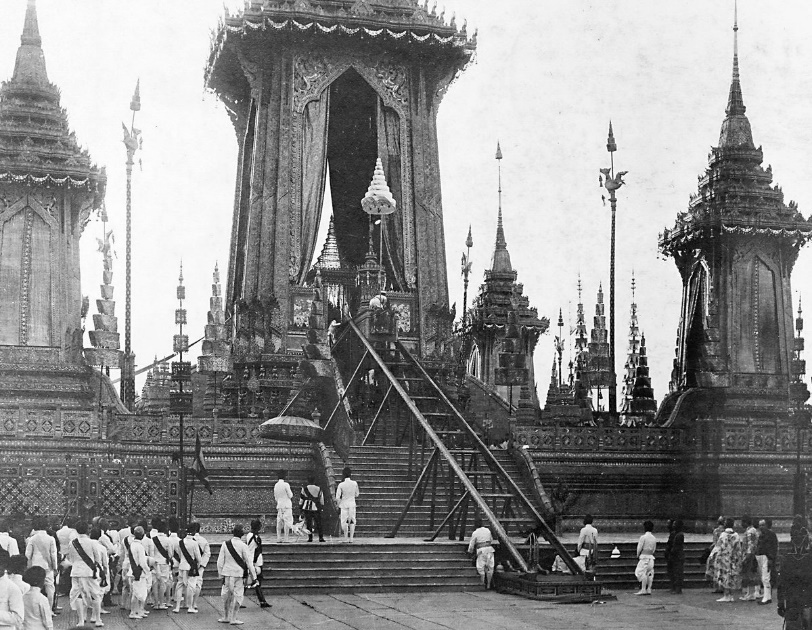
Royal funeral ceremony 1911. Image credit: Wikipedia

References

Aldrich, Robert (Ed.). (2007). The Age of Empires. Thames & Hudson.

Chandran Jeshurun. (1970). The Anglo-French Declaration of January 1896 and the Independence of Siam by Chandran Jeshurun.  Amended version of a paper presented to the Institute of Asian Studies, Chulalongkorn University. http://www.siamese-heritage.org/jsspdf/1961/JSS_058_2h_Jeshurun_AngloFrenchDeclarationJanuary1896.pdf

Chan Su-ming. (1965). Kelantan and Trengganu, 1909-1939. Journal of the Malaysian Branch of the Royal Asiatic Society, 38(1), 159-198.

Chulalongkorn: king of Siam. Encyclopaedia Britannica. https://www.britannica.com/biography/Chulalongkorn

Chulalongkorn. (2021, 3 July). In Wikipedia. https://en.wikipedia.org/w/index.php?title=Chulalongkorn&action=history

Church, Peter (Ed.). (2017). A Short History of South-East Asia. John Wiley & Sons.

Life in the grand palace: the story of Princess Chongchitra. (2012, January 3). Bangkok Post. https://www.bangkokpost.com/learning/advanced/273517/life-in-the-grand-palace

Mendonça, Amanda Francesca. (2018, June 27). The Real Story Of Anna Leonowens That Inspired ‘The King And I’. bookmyshow. https://in.bookmyshow.com/buzz/blog/Events/the-real-story-that-inspired-the-king-and-i

Moore, Wendy Khadijah. (2007). Malaysia: A Pictorial History 1400 – 2004. Editions Didier Millet.

Nik Mohd bin Nik Mohd Salleh. (2011). Kelantan Sultanate. In Ahmad Sarji bin Abdul Hamid (Chairman, Editorial Board), Encyclopedia of Malaysia: Vol 16 – The Rulers of Malaysia (pp. 97-107). Editions Didier Millet.

Royal Thai Embassy, Kuala Lumpur, Malaysia