Gamelan: A Cultural Trace in the Malay Archipelago

by Inge-Marie and Dr. Hans Peter Holst (phD)

On our travels around Sundanese Java to research about the art and life of Otto Djaya (1916-2002), the indigenous visual artist and folk painter from Banten, West Java[1], our growing awareness of the Gamelan[2] music[3] and the Wayang theatre[4] increased and the two art forms became peripheral research objectives on their own. It heightened our interest that in Malaysia, where we live, the two art forms are similarly traditional and wonderful.

Gamelan and, more so, Wayang theatre may be vanishing in Malaysia. However, visual evidence produced by YouTube search suggests that currently there is some Gamelan activity in all the states in Malaysia. In fact, Gamelan seems to be attracting a keen amount of interest among the people and the scholars in several States. On the other hand, the Wayang theatre in Malaysia is threatened with imminent extinction. We wanted to know more about the big picture.[5] [6] [7] [8] [9]

In this article, we focus on the music, the Gamelan, because recently we discovered and acquired two ink drawings by Otto Djaya of the Babar Lajar Gamelan ensemble visiting Paris. Both the Ensemble and Otto Djaya were based in Amsterdam at the time.
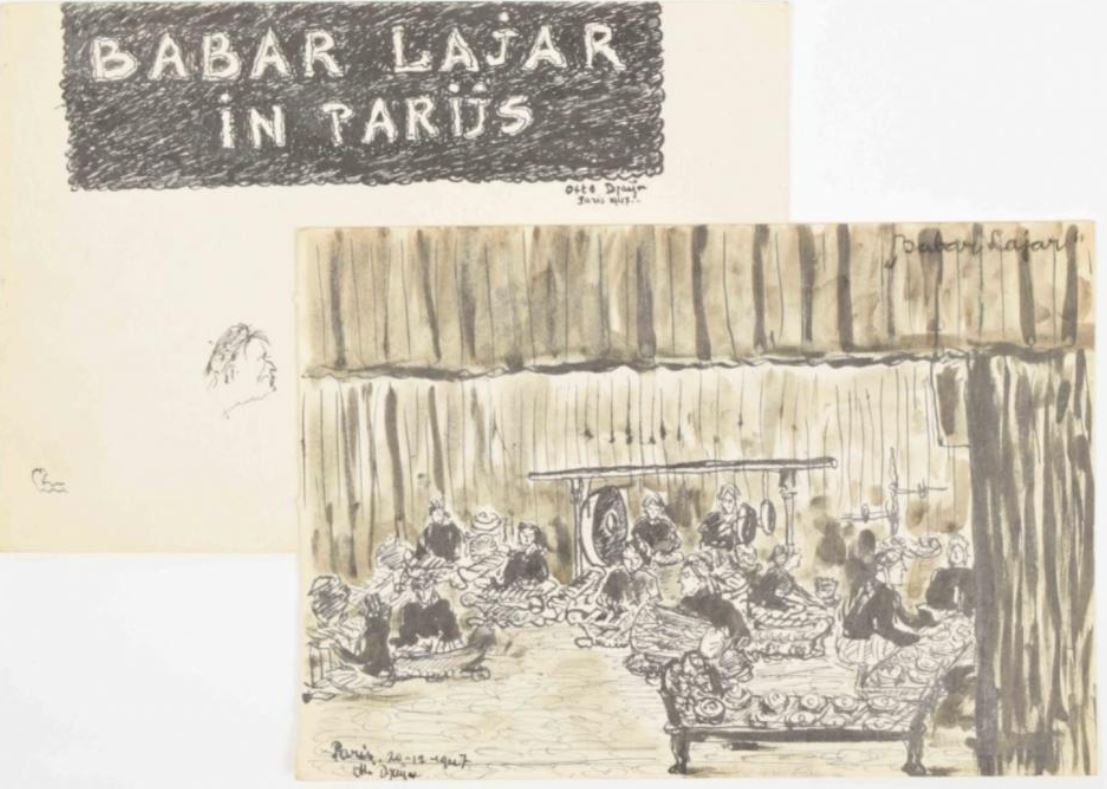
The signed drawings of Babar Lajar in “Parijs” enabled us to date Otto Djaya’s visit to Paris to exhibit his paintings to December 1947 and to anchor his interest in the Gamelan music[10].

The Gamelan would turn out to be an unparalleled Indonesian cultural treasure similar to the visual arts treasure, painting, contributed by Otto Djaya and his generation of peers. The Babar Lajar Gamelan ensemble was founded in Amsterdam in about 1943. The ensemble was unique by its founder[11], the local manufacture of its instruments during wartime, and its musicians, who were young and musically gifted, and none of whom were Indonesians[12], suggesting the almost hypnotic, cult-like, appeal of Gamelan in the aftermath of the horrors of World War II.  

Indonesian President Sukarno introduced government funded Gamelan schools during the 1950s and 1960s, same as what he did for the visual arts earlier on, in order to encourage and sustain national art forms. “Some Indonesians objected to this elevation of a musical style associated primarily with Java and Bali as a “national” art form – as in a multi-ethnic, multicultural country there are no universal cultural properties”[13].

The indigenous music as well as the visual arts became important propaganda for internationally showing Indonesian culture in the runup to the Netherlands handing over sovereignty to Indonesia in 1949; Indonesia was no longer a colony.

Otto Djaya. 1986. A people inspired by the sea. Serenading water, bliss and sunset; a Sundanese flute, one of the Gamelan instruments. 27×39 cm. Gouache on paper.
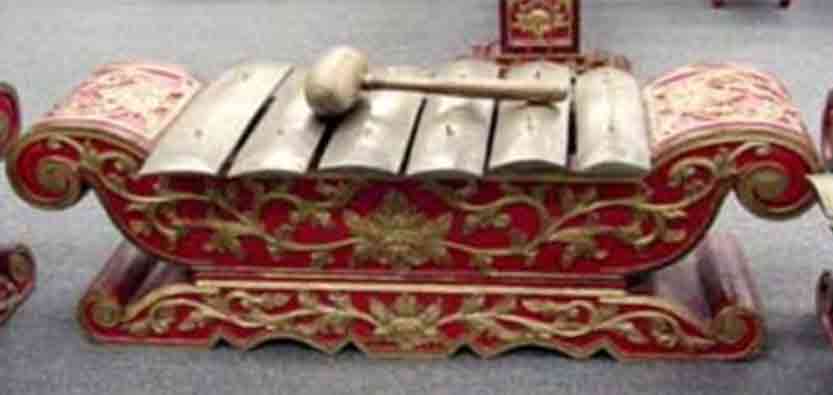
Demung, a Gamelan instrument. Note the likeness with the bow and stern of the boat above.
Otto Djaya. 1986.  Fishing boats and fish vendors by the flamboyant tree. 27×39 cm. Pastel on paper.
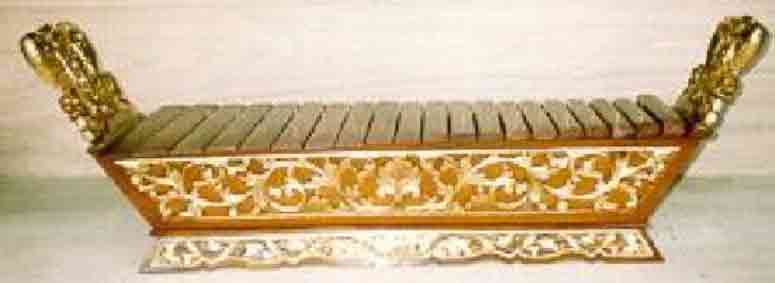
Gambang, a Gamelan instrument. Some Gamelan designs are inspired more or less by the boat shapes.

Otto Djaya was a Sundanese of West Java. Besides painting Gamelan ensembles into his many paintings of folk dancing and festivals, the boats in his paintings are Sundanese and show an unmistakable resemblance to Gamelan instrument architecture. The Sundanese were captivated by water: stream, lake, ocean. Otto Djaya’s paintings imparted a union of popular culture and music.

Gamelan, an Indonesian Institution
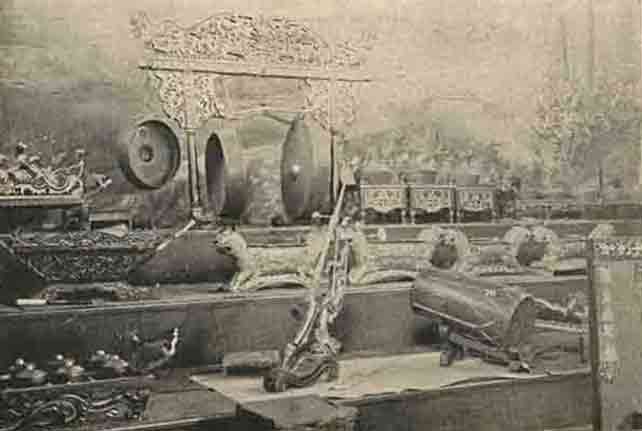
The ‘Gamelan Sari Oneng Parakansalak’ ensemble of Perakan Salak

The “Gamelan Sari Oneng Parakansalak[14] of Sumedang, West Java travelled far from its birth place, a tea plantation in Sukabumi to, first, The International Exposition in Amsterdam in 1883, second, The World Exposition in Paris in 1889 and, third, The World Columbian Exposition in Chicago in 1893.
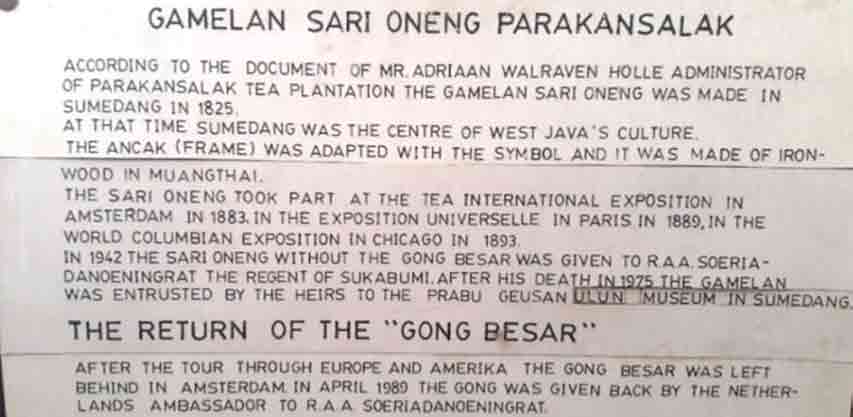
In a remarkable coincidence, sixty years after Chicago, at the end December 1945, a 29 years old Otto Djaya, the artist, now a company commander with the rank of Major in the revolutionary Indonesian forces, and his troops played a key role in stopping an advancing British/Dutch tank column at the Bojong Kokasan Ridge, Sukabumi, east of the Parakan Salak area and the tea plantations, the origin of the Gamelan Sari Oneng.   
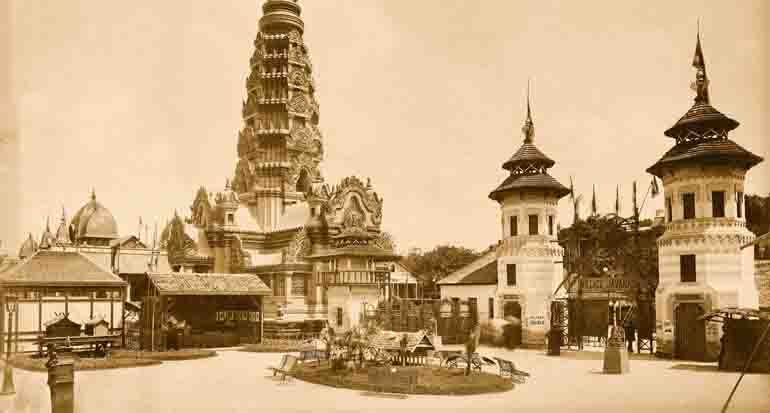
“Kampung Jawa”, the Javanese village on the Netherlands’ site at The World Exposition in Paris 1889. The Gamelan Sari Oneng performed there with Javanese musicians.

Gamelan music was formally staged in Europe at the 1889 Paris Exposition. Javanese musicians performed Gamelan in the East Indies section of the Netherlands’ pavilion[15] [16]. In 1993, Gamelan was introduced to USA at the Columbian Exposition in Chicago, Illinois[17]. Western composers and musicians were intrigued and interested to listen and to experiment with the new sound.

In 2021, Indonesian Gamelan was listed by UNESCO on its Representative List of Masterpieces of the Oral and Intangible Heritage of Humanity. In comparison, Wayang was listed in 2003, two decades earlier.

In Indonesia, particularly in Java and Bali, Gamelan is the most popular form of traditional music. A Gamelan ensemble typically consists of a variety of metal percussion instruments, usually made of bronze or brass, including gongs, xylophones, and drums. It may also be extended with bamboo flutes, stringed instruments, and vocalists, but the focus is on the percussion.  Metal instruments are expensive to make, compared with those of wood or bamboo. However, they will not deteriorate or change tune in a hot, humid climate. Some scholars suggest that this may be one of the reasons that gamelan developed, with its signature metallic sound.

Gamelan was a feature of court life among the Buddhist and Hindu kingdoms of Java, Sumatra, and Bali. The Buddhist monument of Borobudur in central Java has a bas-relief depicting a Gamelan ensemble from the time of the Srivijaya Empire, 600s-1200s; the musicians play stringed instruments, metal drums, and flutes.

The Majapahit Empire (1293-1597) had a government office in charge of supervising the performing arts, including Gamelan. The Gamelan ensemble was important to court life. Inscriptions and bas-reliefs from Bali, also under the control of the Majapahit emperors, show that the same types of musical ensembles and instruments were as prevalent there as in Java. The gong made its appearance in Indonesian Gamelan during this era as did the stitched-skin drums and bowed strings, at first probably imported as trade goods.

Islam came to Java during the 1400s by Muslim traders from Arabia and south Asia. The most influential strain of Islam then introduced was Sufism that values music as one of the pathways to experiencing the divine. Had a more conservative strain of Islam been introduced, Gamelan in Java and Sumatra might not have flourished.  

In keeping with Sufi teachings, Javanese Gamelan tended to be slower in tempo and more meditative or trance-like. Most of the rhythms are generally soft and reflect the harmony of life, the principles of life generally adopted by Javanese society. Gamelan has become inseparable from Javanese customs and human life and is almost always there in every Javanese ceremony, to accompany dances, dance dramas, theatre, puppets, rituals, events and festivals. In general, no two gamelan ensembles are the same, and those that originated in prestigious courts have their own style and tuning. Varieties of gamelan are distinguished by their complement of instruments and use of tunings, repertoire, style, voice, and cultural context.

There is a principal division between the styles favoured by the Javanese, Sundanese and Balinese. While Javanese Gamelan has soft and slow tones, Sundanese gamelan with its sound of flutes makes it both soft, mellow and romantic[18]. Balinese gamelan has strong and dynamic tones with fast rhythms. Perhaps it can be said that Javanese Gamelan is played for formal dancing and ceremony, Sundanese Gamelan is played for dreamers and lovers, and Balinese for rituals.

Bali is Different

Bali remained predominantly Hindu, wherefore Java and Bali developed different forms of gamelan. Balinese Gamelan emphasizes virtuosity and quick tempos, a trend encouraged by the Dutch colonists. Balinese instruments are built in pairs tuned slightly apart to produce interference beats, ideally at a consistent pace. This concept communicates the idea of repeating rising and falling waves of music.

Bali with its Kebyar[19] music broke away from the Javanese gamelan and the ceremonial gamelan. The Balinese refashioned their music and dance style by Kebyar, which originated in North Bali villages a century ago and spread rapidly over Bali’s music and dance landscape. Soon, ensembles in Central and South Bali were refashioning their ceremonial Gamelan orchestras of suspended gongs, bronze-keyed metallophones, tuned gong chimes, and drums to accommodate the new style[20], additional keys were added to extend ranges, some instruments were melted down and re-forged to respond to Kebyar requirements. Musicians wanted lighter bronze keys and more of them, and longer racks of gong chimes, to play the rapid melodies and sharp accents. Playing techniques and innovations in one realm led to innovations in the other. Kebyar dancing embodies the music’s restless energy and vice versa. It was popularly said that Kebyar is a modernist’s hallucinogenic dream, cast in bronze.[21]

Today most Indonesians have embraced the Gamelan as their national sound and it is heard frequently on the air. Even so, stand-alone gamelan concerts are unusual.  

Gamelan Melayu

Gamelan is said to have originated late in the Srivijaya Empire around the 900s and to have migrated to the Riau-Lingga Sultanate, a long stone throw from Johore. Gamelan[22] instruments were brought to Pahang in the 1800s making it one of the oldest musical instruments found in Peninsular Malaysia today. Gamelan music existed primarily amongst the ruling class at the Pahang, Terengganu, and Johor palaces, as an accompaniment to the traditional dance known as Joget[23], usually performed for guests of the palace, at elaborate ceremonies and festivals.

Since then, Gamelan has continued to be played among the people and has spread to other states[24]. Having little to no function in Malaysia outside of ceremonial performances, Gamelan Melayu is now largely entertainment music to practitioners, performers, and audiences/connoisseurs[25]. We noted that there are many enthusiastic Gamelan performers in Peninsular Malaysia.

Before 1982, Gamelan instruments in the UK existed only at the Indonesian Embassy. Today, the interest in Gamelan flourishes. Today, there are some 150 Javanese, Sundanese and Balinese Gamelans in the UK. Clearly, the British did not think as much of Gamelan during colonial times as the Dutch did.

Contemporary compositions of Adrian Lee for the Rhythm in Bronze ensemble[26], Ng Chong Lee [27], Marzelan Salleh [28], and Junita Batubara [29] are immensely interesting and uplifting.

Adrian Lee, Hakikat Air from Arus Gangsa, performed by Rhythm in Bronze

A Gamelan Symphony Festival was held in 2018 at the Sultan Alam Shah Islamic College as a showcase of Gamelan Melayu, with six local Gamelan groups from both secondary and tertiary education institutions participating. In 2019, the project called for a Gamelan competition, bringing in competitors from a total of eight secondary and tertiary education institutions, with the host emerging as the winner. In 2020, the Virtual Gamelan Symphony Festival (VGSF), aimed to make Gamelan Melayu accessible to the masses, through simple and easy-to-follow video lessons[30] .

Gamelan travelled from Indonesia and inspired others

When western composers presented music inspired by the Gamelan they were met with both derision and enduring admiration at the premiere as, typically, within days, the confusion among audiences and critics had turned into pleasure. 

Was it mere coincidence that the formation of vast stylistic ecosystems came into being simultaneously with modernists in Western music and the first Gamelan presenters coming together? The musical scale was different but the musical characteristics were similar. The Western composers and the Gamelan artists must have shared some deep cultural commonality and instinct of sounds, tuning, and timing. We shall not know, but ecosystems continue to grow. The attraction of Gamelan to Western composers and audiences resulted in both adaption and adoption [31].

The most significant characteristic of Asian music is the use of pentatonic scale and gong chimes, also used in western music along with other instruments. This describes the relationship between Asian and Western music[32] [33]. In Javanese Gamelan music, the slendro scale has five tones per octave, of which four are emphasized in classical music. The pelog scale has six or seven tones, and is generally played using one of three five-tone subsets in which certain notes are avoided while others are emphasized. [34]

We find in our travels that music is spanning the world across cultures. With music compositions of today, especially what suggests to be symphonic, it is difficult to tell if Eastern heritage instruments and tonal systems are inspiring Western heritage or the other way around. Either way, the output is typically capturing the ear and senses and does not give reason to reject classical Western music and/or music and composers of previous centuries and of antiquity. It is deeply satisfactory to witness by ear that music makers have tremendous ambitions and see few boundaries ahead of them.

The tonality and rhythm of Indonesian Gamelan contributed to the ‘atonal’ ideas and compositions by Western composers from around 1900 onward, for instance, Debussy, Erik Satie, Francis Poulenc, Benjamin Britten, Igor Stravinsky and Bela Bartok, and many others.  

Erik Satie (1866-1925). The composers Satie and Debussy were the earliest to use the exotic and highly dissonant Gamelan scales. Satie’s Gnossiennes compositions for piano are among his earliest compositions and evokes ‘another world’ by its “highly original modal harmonies, pure simplicity, and monotonous repetition”[35]. The originality and simplicity could possibly have been influenced by Debussy – or it was Satie who influenced Debussy; both were thinking in terms of Gamelan scales in the late 19th century.

Claude Debussy (1862-1918)[36], Pagodes[37], 1903.

Maurice Ravel (1875-1937), String Quartet in F by the Hagen Quartet.

Francis Poulenc (1899-1963), Concerto for Two Pianos and Orchestra[38], with Poulenc and Jacques Février on the pianos, 1932.

Colin McPhee (1900-1964)[39]. Returning to North America from Bali end of the 1930s,   he composed Tabuh Tabuhan for 2 pianos and orchestra, without a single Gamelan instrument in the orchestra.

Benjamin Britten (1913-1976)[40]

Lou Harrison (1917-2003)[41], Concerto for Violin with Percussion Orchestra and Varied Trio (1987).

The Otto Djaya images in the article are the property of the authors and may be copied for educational purposes. The authors borrowed the pictures of the Gamelan instruments from
https://lsa.umich.edu/content/dam/cseas-assets/cseas-documents/gamelan/JavaneseGamelanMusic.pdf


Footnotes

[1] We are currently writing on our final edition of a book about Otto Djaya (1916-2002):   http://archive.ivaa-online.org/files/uploads/texts/OTTO%20DJAYA,%20THE%20CHRONICLE,%2015-06-2019.pdf

[2] https://en.wikipedia.org/wiki/Gamelan

[3] https://lsa.umich.edu/content/dam/cseas-assets/cseas-documents/gamelan/JavaneseGamelanMusic.pdf

[4] https://en.wikipedia.org/wiki/Wayang

[5] https://en.wikipedia.org/wiki/Malay_gamelan

[6] https://www.esplanade.com/offstage/arts/joget-the-popular-ever-evolving-music-of-dance

[7] https://www.prestigeonline.com/my/people-events/people/made-in-malaysia-pak-dain-fusion-wayang-kulit/#:~:text=Malaysia%20has%20always%20identified%20with,200%20to%20250%20years%20ago.&text=The%20Ramayana%20and%20Mahabarata%20held,art%20from%20long%2C%20long%20ago.

[8] There are four types of wayang kulit in Malaysia, namely Wayang Kulit Jawa, Wayang Kulit Gedek, Wayang Kulit Melayu and Wayang Kulit Kelantan, http://mpunasilemak.blogspot.com/.   In Malaysia, the culture of wayang kulit is slowly dying out as the younger generations are less interested in this wonderfully expressive culture.

[9] “In Malaysia, Wayang Kulit Kelantan is the pre-eminent form of shadow puppet theatre. However, it is threatened with imminent extinction nowadays. There were more than 300 dalangs (shadow puppeteers and narrators) in the 1960s but the number decreased tremendously to 11 in 1999.” Khor, Khengia (2011). Segi University. The Use of CGI (Computer Generated Imagery) to Capture the Visual Styles of Wayang Kulit Kelantan, in International Journal of the Arts in Society, No. 4, pg 203-214.  Wayang was placed on UNESCO’s Representative List of Masterpieces of the Oral and Intangible Heritage of Humanity in 2003. In comparison, Gamelan was not listed until 2021.

[10] Gamelan musicians were to appear and accompany in many motifs of his paintings.

[11] https://heindegraaff-nl.translate.goog/babar-layar/?_x_tr_sl=nl&_x_tr_tl=en&_x_tr_hl=en&_x_tr_pto=sc

[12] http://www.indischmuziekleven.com/index.php?lang=14&dept=95&article=203

[13] Dr. Kallie Szczepanski, Ph.D. History, Boston University, is a history teacher specializing in Asian history and culture. She has taught at the high school and university levels in the U.S. and South Korea. https://www.thoughtco.com/history-of-gamelan-195131, updated on June 26, 2019.

[14] The pictures of the Gamelan Sari Oneng are borrowed from https://sukabumiupdate.com/posts/83123/sari-oneng-gamelan-sukabumi-yang-tampil-di-peresmian-menara-eiffel-paris

[15] https://en.wikipedia.org/wiki/Exposition_Universelle_(1889)

[16] The first appearing at the 1899 Paris World Exhibition when the Netherlands’ exhibited of its East Indies colony.  The British pavilion at the Exhibition did not have a similar Malaya element.

[17] On an area of approx. 700 acres at Jackson Park and Midway Plaisance. Pavilions were built by 46 countries; some 27 million people visited the expo. It was synonymous with a world’s fair celebrating the 400th anniversary of Christopher Columbus. The ‘Syndicate Java Chicago’, formed by two West Java tea plantations, arranged to send a Gamelan with musicians to the Expo. The Gamelan and the free servings of Java tea was enthusiastically received.

[18] Encyclopedia Jakarta. December 2020.

[19] Kebyar means “to flare up or burst open”, and refers to the explosive changes in tempo and dynamics characteristic of the style. It is the most popular form of gamelan in Bali.

[20] McPhee, Colin. Music in Bali. Yale University Press; First Printing (April 1, 1966).

[21] https://www.youtube.com/watch?v=ndnhbvBolH8

[22] https://gamelansymphonyfes.wixsite.com/vgsf

[23] https://en.wikipedia.org/wiki/Joget

[24] Kelantan:  https://www.youtube.com/watch?v=sfBn5oUMNio
Perlis: https://www.youtube.com/watch?v=GFXZm1JFxYs
    Perak: https://www.youtube.com/watch?v=PP9wZY_Yjjo
https://www.youtube.com/watch?v=VFKMRRNmhwk
    Malacca: https://www.youtube.com/watch?v=_F5j7QIHJLY
Negri Sembilan: https://www.youtube.com/watch?v=kfMBFuKQzLc

[25] https://www.youtube.com/watch?v=5Z7NxzTk2hI

[26] https://www.youtube.com/watch?v=bI9SU0jXkvQ

[27] Ng Chong Lim, Shadows,performed with the Gamelan trio of Kamrul, Shafic and Susan Sarah John at the ASEAN Chopin Competition 2014. https://www.youtube.com/watch?v=5rcfW5CH-2k
Dragonfly, piano by Celestine Yoong, ASEAN Chopin Competition 2014 https://www.youtube.com/watch?v=vM8IKJGRaBk
Ng Chong Lim, piano and Ion Mazur violin, 2020, performing Claude Debussy’s Violin Sonata in g minor https://www.youtube.com/watch?v=onI03ahJm10
A Distant Voice of Rain Forest, piano by Nicolas Ong https://www.youtube.com/watch?v=9yMcdpFJqBM

[28] Marzelan Salleh, Si Pencuri Epal (A poor boy with his stolen apple). Conducted by Tazul Izan Tajuddin. Performed by UITM Student Chamber Ensemble at the Kuala Lumpur Performing Arts Centre.  https://www.youtube.com/watch?v=lU4RBUHVb08
Puteri Gunung Ledang, Piano Solo performed by pianist Jamie Tan for the 7th Malaysian Composers Concert Series 2016, at Kuala Lumpur Performing Arts Centre. https://www.youtube.com/watch?v=C89D79HeNBQ

[29] https://www.youtube.com/watch?v=3q19x2U-vIM&t=229s

[30] https://gamelansymphonyfes.wixsite.com/vgsf/about-vgsf

[31] https://www.youtube.com/watch?v=P63CpTSy7_4&t=112s

[32] Batubara, Junita. Story of Tjong A Fie: Programmatic Music Composition Combining Chinese, Malay and Western Music Elements, in International Journal of Academic Research in Business and Social Sciences, Vol. 7, No. 9, 2017.

[33] https://latitudes.nu/the-influence-of-gamelan-on-western-modern-music/ 2017

[34] https://www.youtube.com/watch?v=sZG3b6aluBk.   

[35] https://en.wikipedia.org/wiki/Erik_Satie

[36] https://www.youtube.com/watch?v=e8TAVT-Fvas

[37] https://www.youtube.com/watch?v=SfYEkk9nir4   Insight!

[38] https://www.youtube.com/watch?v=V87wGyfUQiQ

[39] Colin McPhee and Benjamin Britten play Balinese Ceremonial Music for Two Pianos https://www.youtube.com/watch?v=J3PacNDMneE
[40] https://www.youtube.com/watch?v=usztkkF8gVI

[41] https://www.youtube.com/watch?v=Gn-GP8KUJB4

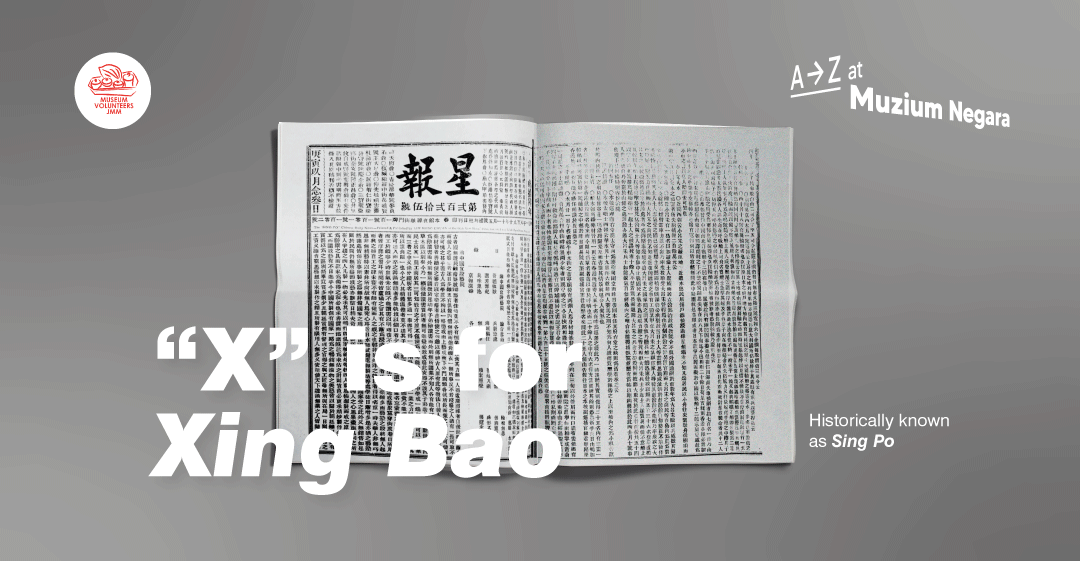
X is for Xing Bao

by Dennis Ong

A star was born on Saint Valentine’s feast day in 1890 – the Xing Bao (also Sing Pau, Sing Po or Sing Poh), literally Star Newspaper, or Xing Newspaper – “Xing” as in Xing Jia Po or Xing Zhou (variations of the word for Singapore in Chinese). The first issue of this eight-page spread came hot off the press at the Koh Yew Hean Press located at Nos. 100, 101 and 102 Teluk Ayer Street, Singapore.

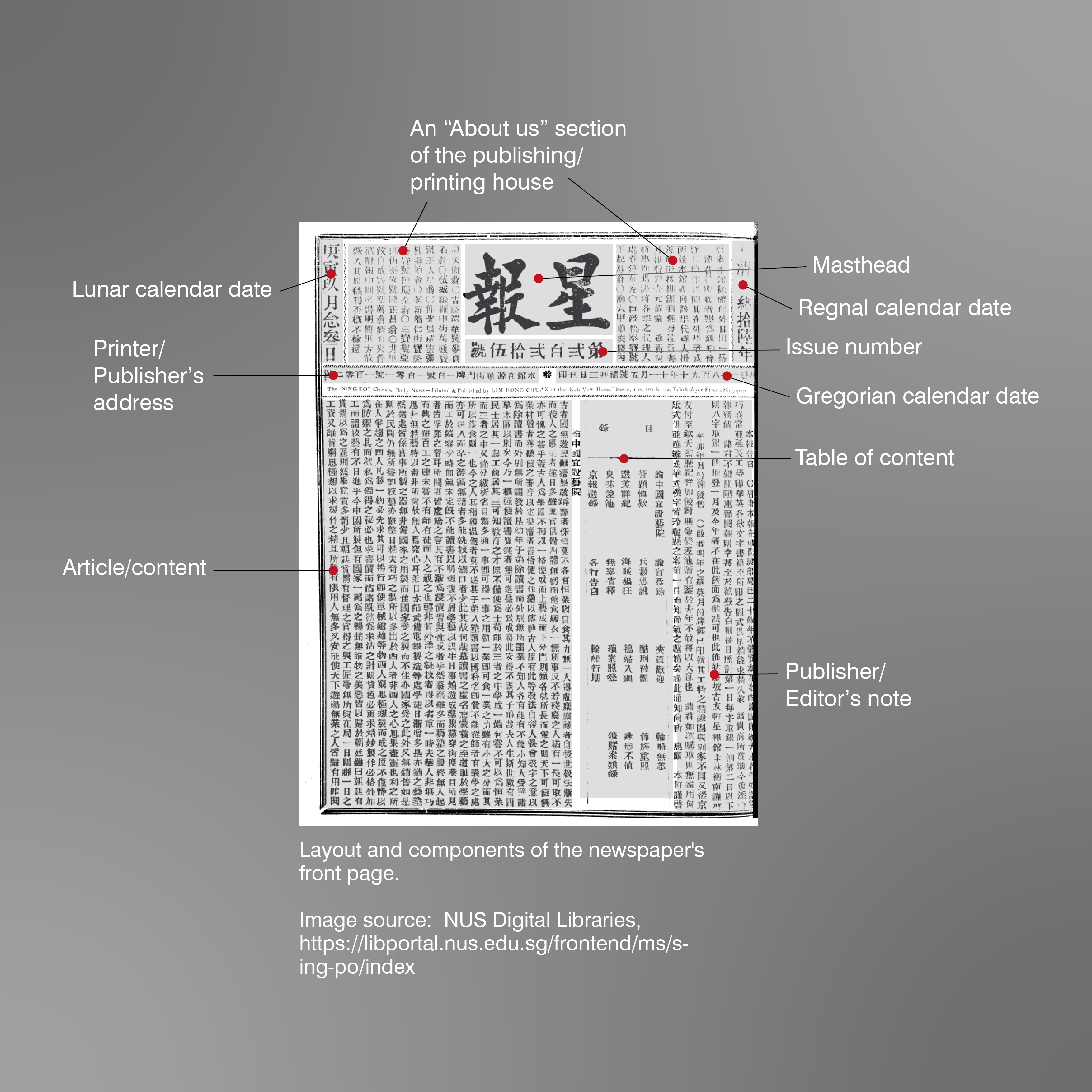
Published daily, except on Sundays and public holidays, the newspaper’s political agenda has been described as either vague or unclear, although it did take on a pro-China political stance while retaining its commercial interests as a business. Politically strategic and functional at the same time, it displayed three dating systems on its front page – the imperial calendar showing the regnal calendar of the Chinese emperor, the lunar calendar, and the Gregorian calendar. From this, we are able to take a learned guess of the composition of its target market and the general cosmopolitanism of the area in which the newspaper was circulated.

Layout and components of the newspaper’s front page.
Source: NUS Digital Libraries, https://libportal.nus.edu.sg/frontend/ms/sing-po/index

Through Huang Nai Siang’s contribution as chief writer of Xing Bao, readers had for themselves a medium through which they could be informed and ponder about the current affairs in China while better understand their civic roles within the local Chinese community. Alongside him was Lin Hengnan (a.k.a Lim Kong Chuan), founder and editor of the newspaper. Lin, who was also the father-in-law of Dr Wu Lien-Teh and Dr Lim Boon Keng, both distinguished personalities in Malaya-Singapore, likely envisioned Xing Bao to share the same entrepreneurial optimism he had for Koh Yew Hean Press. This press had been well known for its respected printing and publishing repertoire, such as the Tong Yi Xin Yu, a Chinese-Malay dictionary published in 1877, which secured a reprint in 1883 as Hua Yi Tong Yu; the first volume of the Straits Chinese Magazine in 1897; and the second edition of Hikayat Abdullah in 1880.

A spread of the Xing Bao newspaper dated 4 November 1890.
Source: NUS Digital Libraries, https://libportal.nus.edu.sg/frontend/ms/sing-po/index

From the song ti font of the individual Chinese characters and the meticulous, strict typesetting in the content, we can very certainly tell that Xing Bao was printed using the letterpress printing technique – a technique that although was mechanised still relied on the skilful and tedious attention of the printer to align the letterpresses, to say the least. On the other hand, a striking visual contrast is conjured in its branding where a thicker kai ti font is used for the newspaper’s masthead. Content wise, it was evidently written in relatively modern classical Chinese style. Characteristic of classical Chinese literature, Xing Bao’s contents boasted no punctuation marks albeit with sparring section breaks between titles and sections, with vertical and horizontal lines, white spaces or with advertising visuals. Helpful to one while navigating the pages, the newspaper came with a simple table of contents.

The story of Xing Bao cannot be disassociated from Koh Yew Hean Press, which remained in business for over a century until 2006. The last reported owner of the Koh Yew Hean Press was Zhang Gensong, who revealed that the 70-80 year-old business had been managed by his family – his father and grandfather. Over the course of over a century, the business had put up its book press, hand press, lithographing machines, cutting, perforating and rolling machines, and English and Chinese type for auction at least two to three times. By comparison, Xing Bao was short-lived, being in circulation for roughly nine years until 1898 and succeeded by Rixin Bao of the same Press, for just four years. While the peak of its daily circulation at 970 in 1896, beating Lat Pau, it was Lat Pau (founded in 1881 by See Ewe Lay) that fared better at the endurance category, having lasted in business for 52 years. Be it Xing Bao or Lat Pau, these newspapers played a crucial role as a source of information and a vehicle to transport ideas, not only for those in the past but also those in the present, in a way, they are our time-machines.

Koh Yew Hean Press when it was located at No. 18 North Bridge Road, Singapore. Source: PictureSG, https://eresources.nlb.gov.sg/pictures/Details/0f0f51b9-c15c-4ed4-9355-c097eaa4b711

You can access digitised copies of Xing Bao in the digital realm here: https://digitalgems.nus.edu.sg/collection/1524

References

Jaime Koh, Koh Yew Hean Press, https://eresources.nlb.gov.sg/infopedia/articles/SIP_2016-04-06_161840.html

Bonny Tan, Lat Pau (Le Bao), https://eresources.nlb.gov.sg/infopedia/articles/SIP_33_2005-01-11.html

In this Series

Click HERE for a list of articles in the ‘A-Z at Muzium Negara’ series.

Malay Architecture & Traditional Houses

On 22nd January 2022, Ar. Ahmad Najib Ariffin (Nadge) hosted a talk on “Malay Architecture and Traditional Houses” for MVJMM. Following the talk, he gave a detailed tour of Istana Satu, located on Muzium Negara’s grounds.

Below are writeups on the talk and the tour
Evocations of Serenity – by Annie Chuah
Istana Satu – by Aishah Nadirah

Attribution: K. Kamal, Lilawati Abdul Wahab, A. Ahmad. https://www.semanticscholar.org/paper/Climatic-design-of-the-traditional-Malay-house-to-Kamal-Wahab/7d2b00a22070e3090fa592dbc50bae8559c4454e

Evocations of Serenity

by Annie Chuah

In our haste to embrace the ‘modern’ and the ‘progressive’, Malay houses in rural areas have been and are being abandoned in favour of modern structures in the city. However, some scholars and traditionalists have come to appreciate the intrinsic philosophy and beauty of Malay houses not only in Malaysia, but also throughout Nusantara and the wider Malay World.

Elevated dwelling spaces built with organic materials, these examples of vernacular architecture are prone to the ravages of climate, and many have not survived the centuries. Conservation efforts are being undertaken to preserve some fine examples of built structures, which stand testimony to the architectural mastery and artistry of the peoples of the Malay World.

Ar. Ahmad Najib Ariffin (Nadge), Director, Nusantara Academy of Development, Geoculture & Ethnolinguistics, is at the forefront of preservation and conservation of some of the existing structures of traditional buildings in Malaysia. Historian, conservationist and educationist, this zealous architect is fervent in his mission to raise awareness of the value of Malay architecture and tradition.

In a talk to Museum Volunteers on 22 January 2022 titled Malay Architecture & Traditional Houses: history, traditions and transitions, he explained how architectural heritage plays an important role in providing a wealth of materials in comparative forms of styles and their applications in structures meant to be comfortable dwelling spaces in harmony with the natural environment.

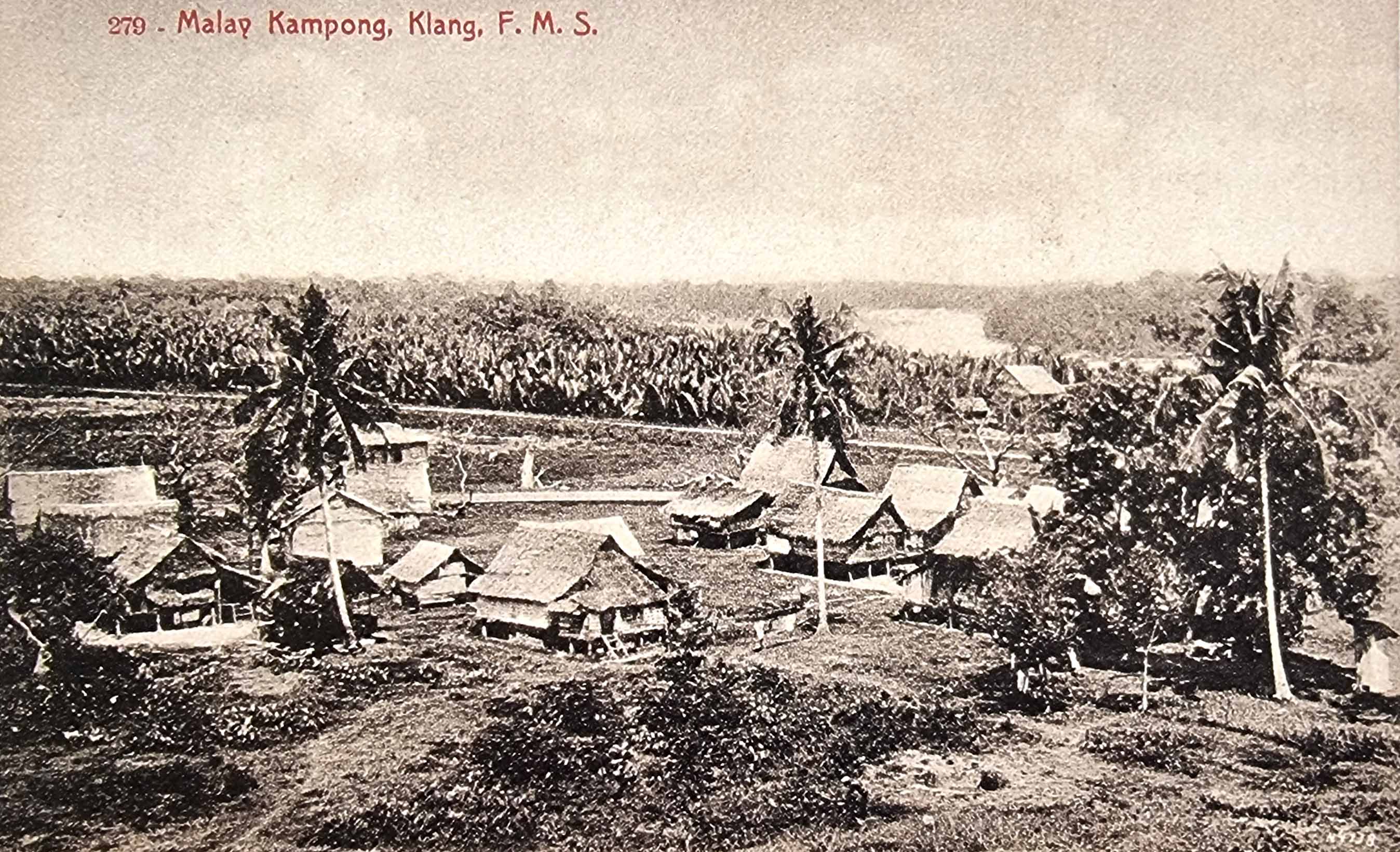
In his opening slide of a Malay Kampung in Klang, Nadge introduced the setting as ‘one of the most environment-friendly civilisations in the history of Earth’.

Attap houses close to the banks of the Klang River, circa 1920. Attribution: Cheah Jin Seng. (2011). Selangor 300 Early Postcards (p. 160). Editions Didier Millet.

In a virtual experience with Nadge, we heard five Malaysian stories spanning 15,000 years. He spoke on:

  • Sundaland, the submerged continent.
  • Sungai Batu in Kedah. Dating to the 8th century BCE, it is Southeast Asia’s oldest-known built site. It was an iron smelting and export complex made of brick structures.
  • The Melaka Empire, which was the centre of trade and religion in the region until the Portuguese conquest in 1511. 

Through these stories, Nadge shed light on the architectural origins of the Malay House. The layout of traditional Malay houses is seemingly random and gives a non-uniform look but the wisdom behind Malay architecture surprises the uninitiated. The well thought out design, use of natural resources and the overall functionality represents the identity of a people who have lived in harmony with nature since ancient times.

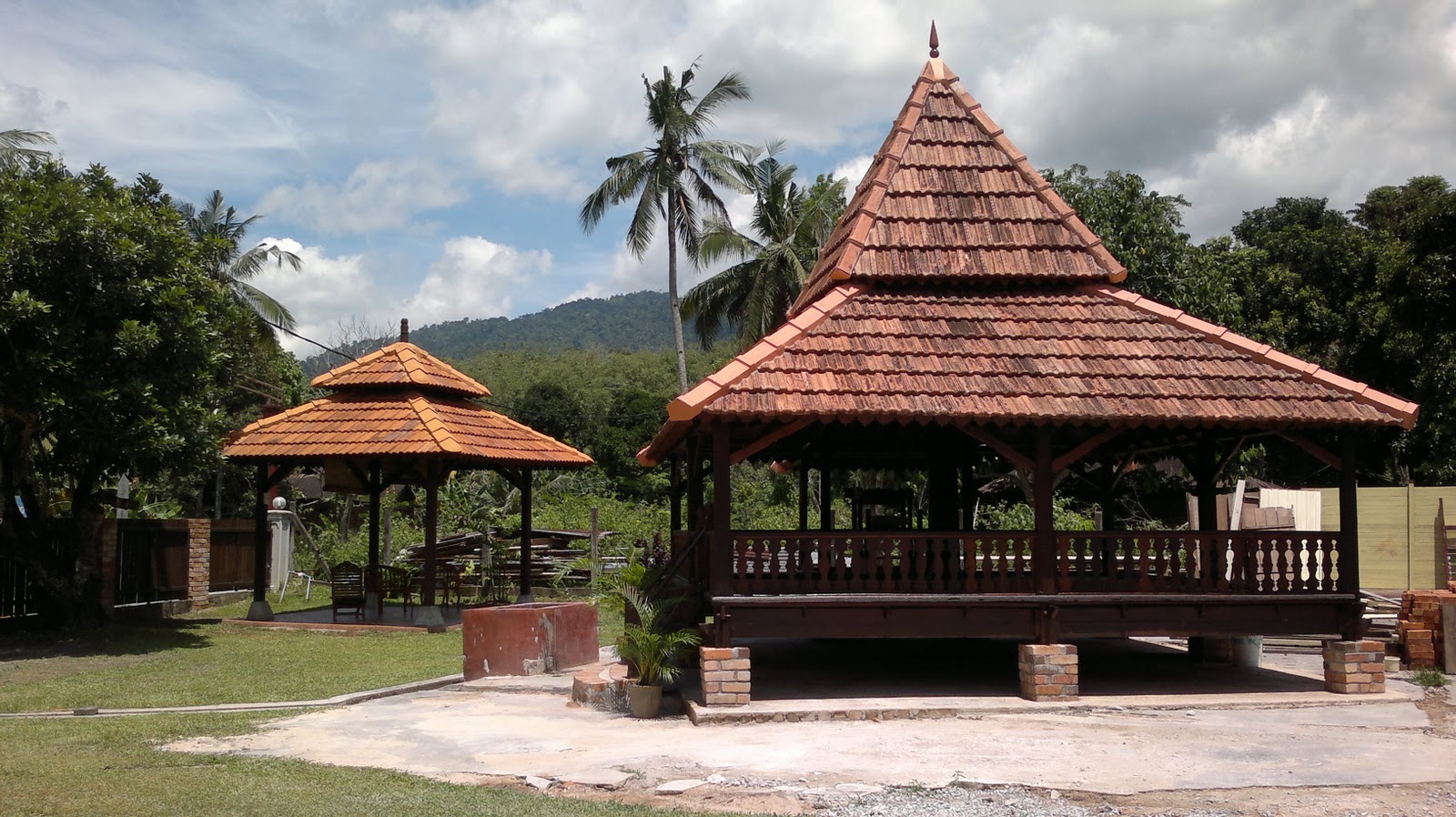
Raised on stilts, the post and lintel structure with wooden or bamboo walls, topped by sloping roofs of thatch with gables on both sides, the typical Malay houses are a fine example of sophisticated rural domestic architecture.

Stilts ensure minimal impact on the ground, the earth space they respect, to avoid human-animal conflict. The raised dwelling is also a safeguard from floods. Height of stilts of hard, durable wood such as cengal, vary according to location – inland or coastal. Being in the tropics with generally high daily temperatures, the earth-floor space allows temperature regulation, ventilation and unimpeded air circulation. A member of the audience commented that it also facilitates sweeping the floor with the dust and dirt passing through the gaps of the wooden floor to the ground beneath!

Of the three sections of the house, the main section is the Rumah Ibu where the family eats, relaxes and entertains guests. The length of this section is determined by the span (depa) of the mother’s/matriarch’s arms. Windows along the walls are long and the entrance is through a short flight of steps or stairs.

Rumah Dapur is the kitchen annexe. It is a separate building but linked to the main section by a passageway. It is an ingenious plan for when the kitchen catches fire – the stilts are cut off and thrown away from the house to be doused or into the river if there is one nearby.

Rumah Tengah is the area for sleeping. The rooms are partitioned off, usually by curtains. The lavatory and bathroom are not within the main house, but built some distance away. The outside of the house is usually shaded with trees and vegetation. A short flight of steps or stairs leads to the elevated main section. The steps may be plain or decorated with tiles.

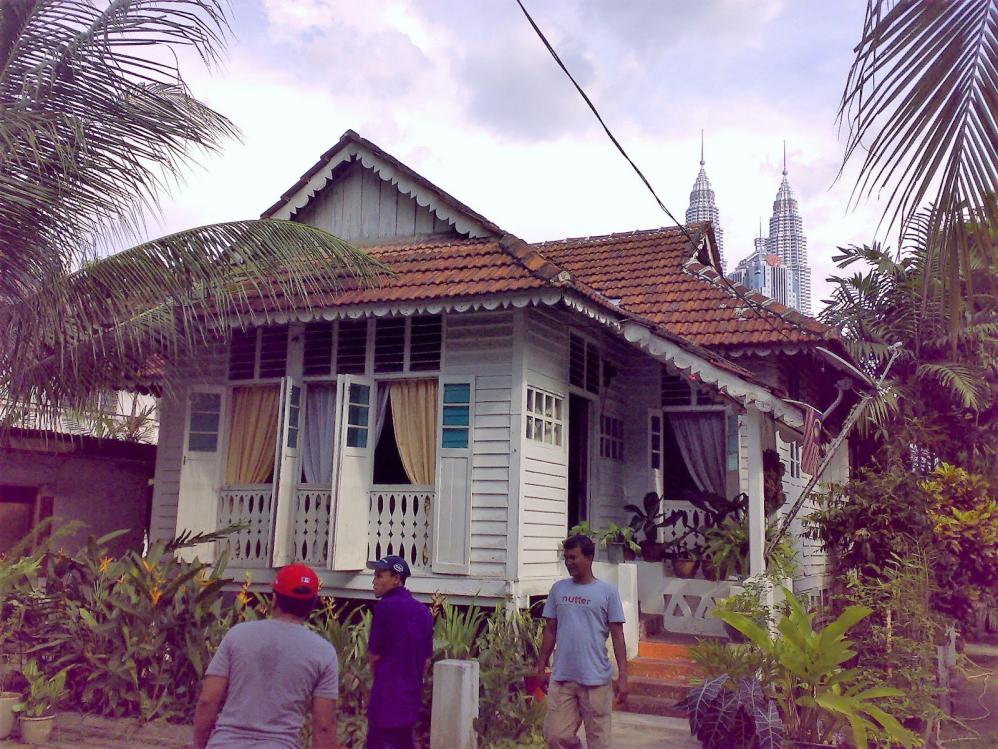
Example of a Malay house in Kampung Bharu

It can be observed here that the house is of a modular construction. As the family expands, additional units are added on, as in the longhouses of Sarawak.

Every region has its own style and this is most prominent in the style of the tropically suited roof – the long ridge roof with slopes for humble dwellings. Wealthier families have the five-ridge roof. Carved panels below the roof edges cut glare during the day while they adorn and add a touch of finesse to the home.

Sometimes a crossed frontal structure is used to anchor and stabilise the roof edges against strong monsoon winds and heavy rain as experienced in the east coast although this crossbeam is a feature on palaces and public/government buildings. Look out for this in Museum Negara’s front entrance.

Traditional Malay houses have their own form of geomancy. The ‘tiang seri’, a freestanding pillar without any joints, is the main pillar of the house and is in the main section.

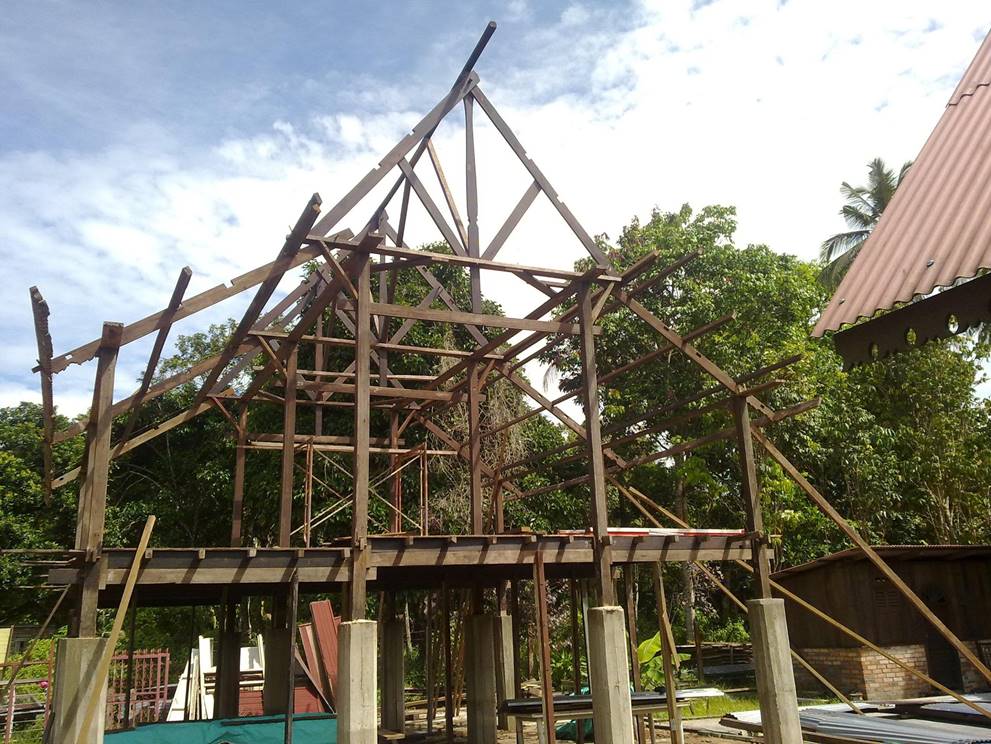
A defining characteristic of the traditional Malay house is its construction without nails or metal supports. Builder artisans are adept in the art of cutting wood in such a manner that pieces slide together and solidly interlock. Interlocking edges and ends of wood are tightened by wedges. What a genius of wooden carpentry! Such a construction can withstand earthquakes. Another advantage is that it can be easily dismantled and rebuilt in another location.

Traditional Malay construction methods have been applied in palace and mosque architecture, with details that are more intricate, scale and complexity. Nadge cited Istana Kenangan in Kuala Kangsar, Perak, and Istana Sri Menanti in Negeri Sembilan as buildings with great cultural aesthetic value.

Istana Lama Seri Menanti, an elegant five-storey timber palace, was built in the 20th century by expert Malay craftsmen and carvers. Designed by two skilful local master builders, no piece of iron nail or metal screw was used. It is recognised as the tallest wooden palace in Southeast Asia. Recently restored, this architectural gem was opened as a Royal Museum in July 1992. A visit by Museum Volunteers with Nadge as guide is scheduled on 2 March 2022 for an on-site study of the elements of Malay architecture incorporated in its construction.

Istana Kenangan was once a royal residence, but now the Royal Museum of Perak. This 2-storey building was built in 1925 without a single nail. Its facade is beautified in its state colours of yellow, white and black. The elements of Malay architecture – the stilts, long windows for ventilation, multiple roof ridges and carved overhangs – are plainly  evident.

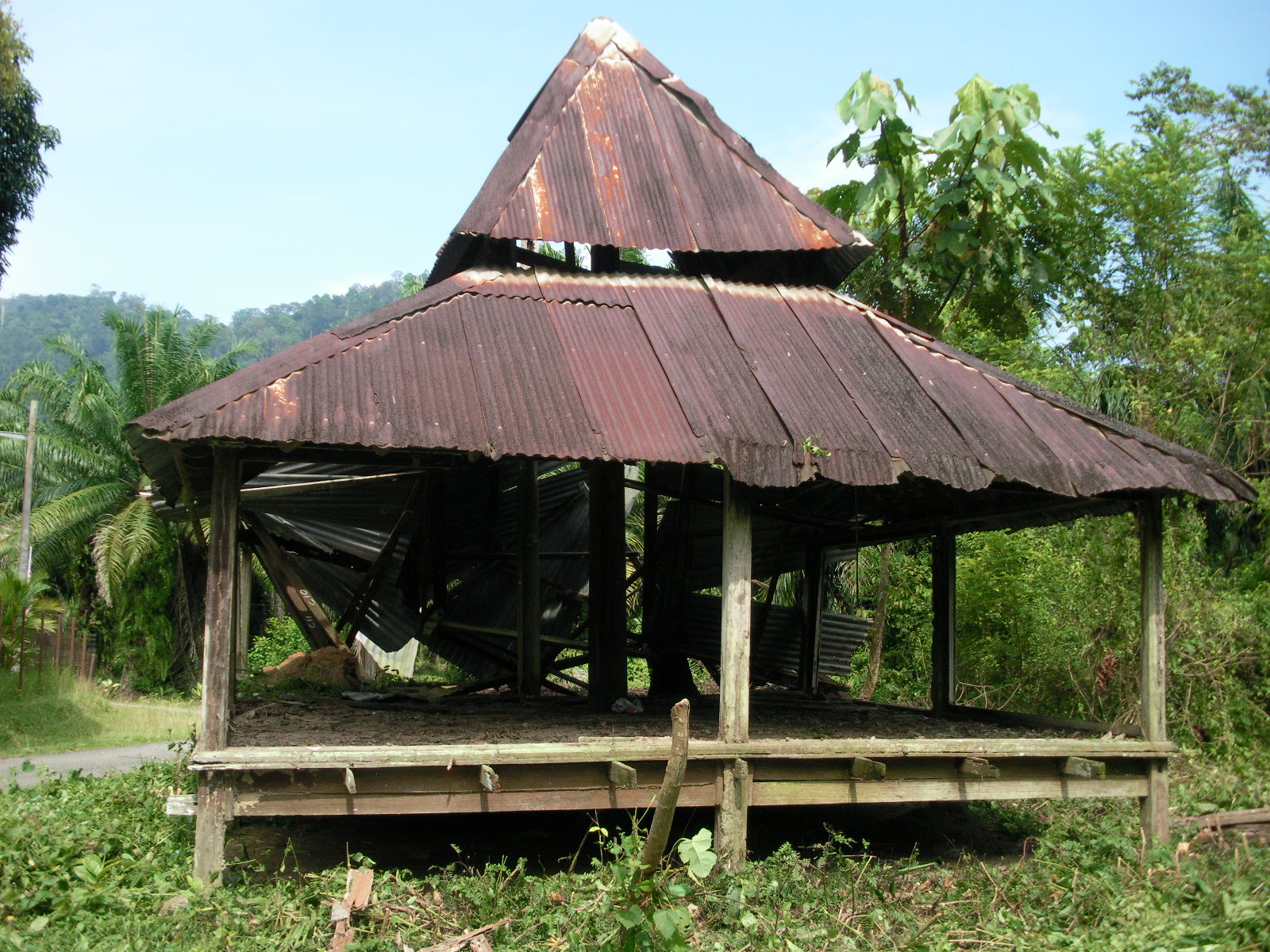
The flexibility of Malay architectural designs in traditional mosques is another fascinating area of observation and study. Built of wood, old traditional mosques are in need of conservation. Among these are Masjid Lama Kampung Kuala Dal in Kuala Kangsar, Perak and Masjid Tanjung Sembeling Lama Seri Siantan in Negeri Sembilan.

Masjid Tanjung Sembeling Lama Seri Siantan before and after conservation. Image credits: http://seriesiantan.blogspot.com/2011/01/masjid-lama-tanjung-sembeling-dalam_18.html

Other extant examples of palaces, mosques and houses with designs and range of Malay craftsmanship can still be seen in Malaysia. With increased awareness in the value of these buildings comes renewed interest in their conservation.

Restoration of Rumah Empang Batu, Negeri Sembilan. Images taken from Nadge’s presentation slides.

Internationalisation and mechanisation leading to shorter building time have led to rejection of traditional architecture. Ardent architects such as Nadge and those of like mind draw attention to the Malay contribution to the technology of architecture. The Malays were among the pioneers in the art of modular construction and prefabrication long before these ideas re-surfaced in architectural journals.

Let us not forget and discard previous knowledge of principles of building construction that were very suitable in the circumstances where people lived. Although some may appear outdated, it is only because we have forgotten the wisdom that came with traditions. Have modern designs and technologies that replaced those solved present living problems while creating new unsustainable ones?

Next: Istana Satu

References

Presentation Slides – Malay Architectural Houses History Tradition Transitions Najib Nadge Ariffin.pptx 2022. https://openarchive.icomos.org/id/eprint/2475/

https://www.researchgate.net/publication/266285891_Architectural_Heritage_Conservation_in_Malaysia_Recognition_and_Challenges

https://books.google.com.my/books?id=fCtFff2veXYC&pg=PA68&redir_esc=y#v=onepage&q&f=false

W is for Wickham

by Fazlin Azrimi Abu Hassan and Dennis Ong

The history of planting rubber trees or Hevea brasiliensis in the Malay Peninsula does not date back very far. We think of rubber when we talk about British botanist Sir Henry Wickham. There was a time when demand for rubber was elevated by industrialisation and the rubber business boomed when British inventors Charles Macintosh and Thomas Hancock figured out how to make good raincoats from rubberized fabric.

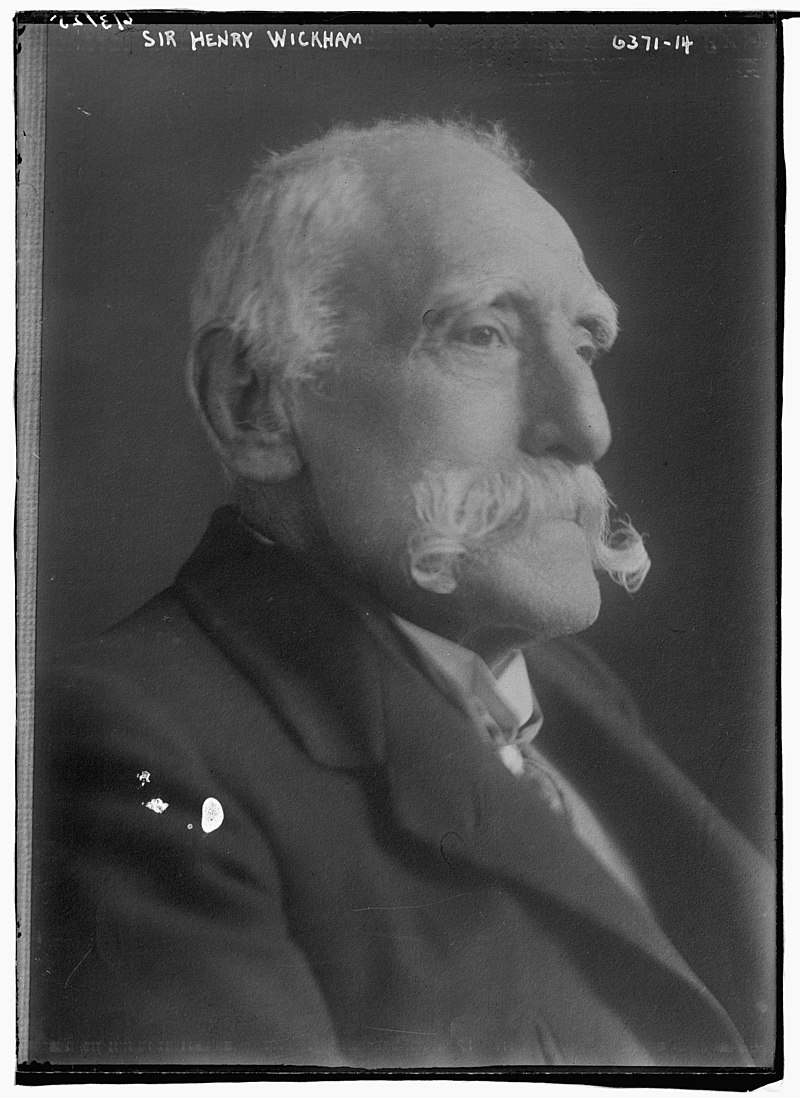
A photograph of Sir Henry Wickham.
Source: Library of Congress, USA

Later, due to the properties of rubber, which melted in hot weather and was stiff in the cold, an American inventor named Charles Goodyear invented the vulcanisation process by accident in 1839 after dropping some latex in sulphur. The vulcanisation process essentially allowed rubber to become more durable and elastic, thus making it more attractive for commercial use. While capitalists and inventors saw great potential, the biggest problem with rubber, however, was that there was still a scarcity of the material. At the time, the world’s rubber was mainly harvested in South America and Africa.

That was about to change in 1876 when about 70,000 rubber seeds wrapped in banana leaves arrived in the Royal Botanic Gardens at Kew in London. Collected by locals at its source in the hills and plateau in Boim, Brazil, the seeds were purchased at a price of £10 per 100. The expedition was financed by the government of (British) India, and led by Wickham who was then 30 years old.

A sketch of Wickham as a young man.
Source: http://www.bouncing-balls.com/timeline/people/nr_wickham1.htm

Bearing the responsibility to re-establish his family’s fortune after his father’s death due to a cholera epidemic, the option to become a planter during that time was one of few viable options to get rich. Finding rubber trees in the Amazon for Britain proved to be promising. Wickham had experience in the Amazon prior to Boim. At 20 years old, he embarked on an exploration in Central America and spent nine months collecting exotic birds whose feathers had been sold and appropriated for millinery use. Subsequently, he returned home and revisited the Amazon where he tapped wild rubber trees as part of his adventure. One can very much see that Wickham had an appetite for thrill and exploration.

Life happened and he married a woman named Violet. It is commonly believed that the publishing business Violet’s family ran helped make Wickham’s travels possible. Wickham’s interest in the Amazon evinced in the first book he published, which has a rather long title: Rough Notes of a Journey Through the Wilderness from Trinidad to Pará, Brazil, by way of the Great Cataracts of the Orinoco, Atabapo, and Rio Negro.

A back profile of a woman believed to be Violet, whom Wickham had sketched in some of his journals. She was in Wickham’s company to Boim whence the rubber seeds were collected. Source: http://www.bouncing-balls.com/timeline/people/nr_wickham1.htm

Britain’s intention was simple – to germinate the seeds and plant them for rubber. Soon enough, botanists at Kew successfully germinated some 2,800 seeds. Most of the lot was sent to Ceylon, Singapore, and Java. Then came H.N. Ridley (aka “Mad Ridley”), a botanist at the Singapore Botanic Gardens who zealously propounded the idea of planting rubber as a cash crop. Although there were supplies of seeds, no planters took up cultivation with the exception of Thomas Heslop Hill in Negeri Sembilan. In 1897, the price of rubber shot up. This coupled with recommendations by experts in Ceylon and elsewhere led many planters to begin planting rubber trees. Convinced by Ridley’s proposal, Tan Chay Yan started the first rubber plantation in Malaya with seven million seeds.

Despite the thriving industry in the Far East, Wickham suffered significant drawbacks in his life. This included having to pay his debts from loss of possession during his period in Queensland where he planted tobacco and coffee. He then clinched a position as a civil servant in British Honduras. Wickham’s constantly wandering mind yet again got the better of him when he was slapped with a legal problem, which forced him to sell his property, upon which, he returned to Britain. Undeterred, he ventured into other prospects but failed. During these times, Wickham continued to suggest recommendations cultivating rubber trees and even proposed several tools for rubber tapping. However, his ideas were deemed either unsuitable or as impractical failures.

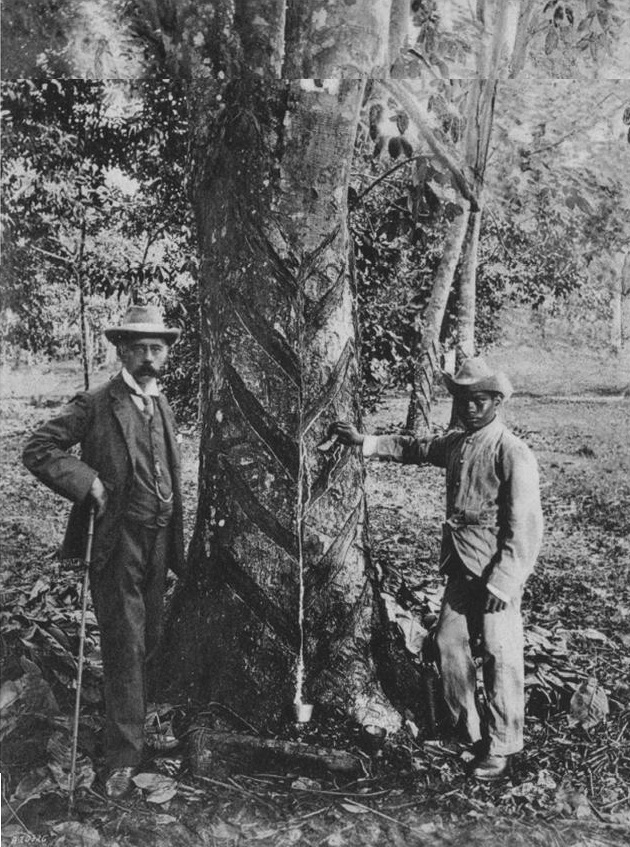
H.N.Ridley with an assistant posing next to a rubber tree tapped using the herringbone method. Source: https://www.wikiwand.com/en/Henry_Nicholas_Ridley

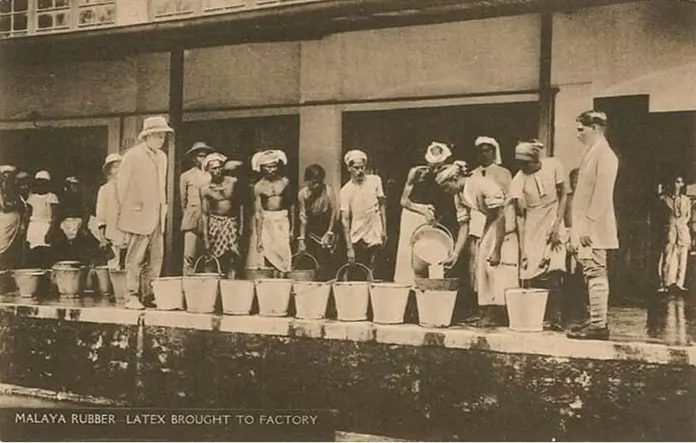
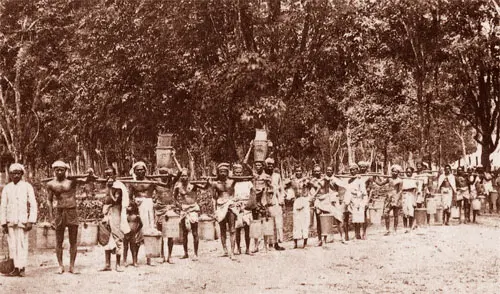
Necessity is the mother of invention. The herringbone method for tapping rubber trees was introduced by H.N. Ridley. It left V-shaped channels on the trunk, removing only a thin layer of bark each time, thus allowing a smooth flow of latex. The methods became so efficient that latex can be collected three times a day. On the flip side, this also meant that labourers in the industry were at the mercy of ensuring efficiency and productivity. They were also subject to potential risks at the workplace. To say the least, the industry was reliant on a constant stream of labour to maintain its processes.

Three photographs depicting Indian labourers who made up the majority of the manpower of the rubber industry in Malaya. These labourers were recruited based on the Kangani system and were largely subject to unfair exploitation. The subject of class and employment power structure often form the crux of the historical debate in topics relating to colonial economy.
Source: https://aliran.com/thinking-allowed-online/the-real-story-behind-those-faded-photos-of-tamil-plantation-workers-in-malaya/

At the end of 1905, there were 40,000 acres of planted rubber trees in the Federated Malay States and more than 85,000 at the close of 1906. By January 1907, there were 10,000,000 trees planted. The output of dry rubber was about 130 tons in 1905 and three times as much in 1906.

By 1910, Malaya was one of the biggest producers of rubber. Expectedly, the combined production of rubber across Britain’s colonies exceeded that of Brazil’s, causing it to lose its monopoly in the rubber industry.

A fun fact about the rubber tree cultivated for latex.
Source: Wonder Book of Rubber, 1947.

However, there has been a debate about whether Wickham’s actions qualify as an unethical act of smuggling or an act of formal exchange between governments. Laying out the facts, sources have described that Wickham had misrepresented his cargo as ‘exceedingly delicate botanical specimens specially designated for delivery to Her Britannic Majesty’s own Royal Gardens at Kew’ in order to be granted permission to export.

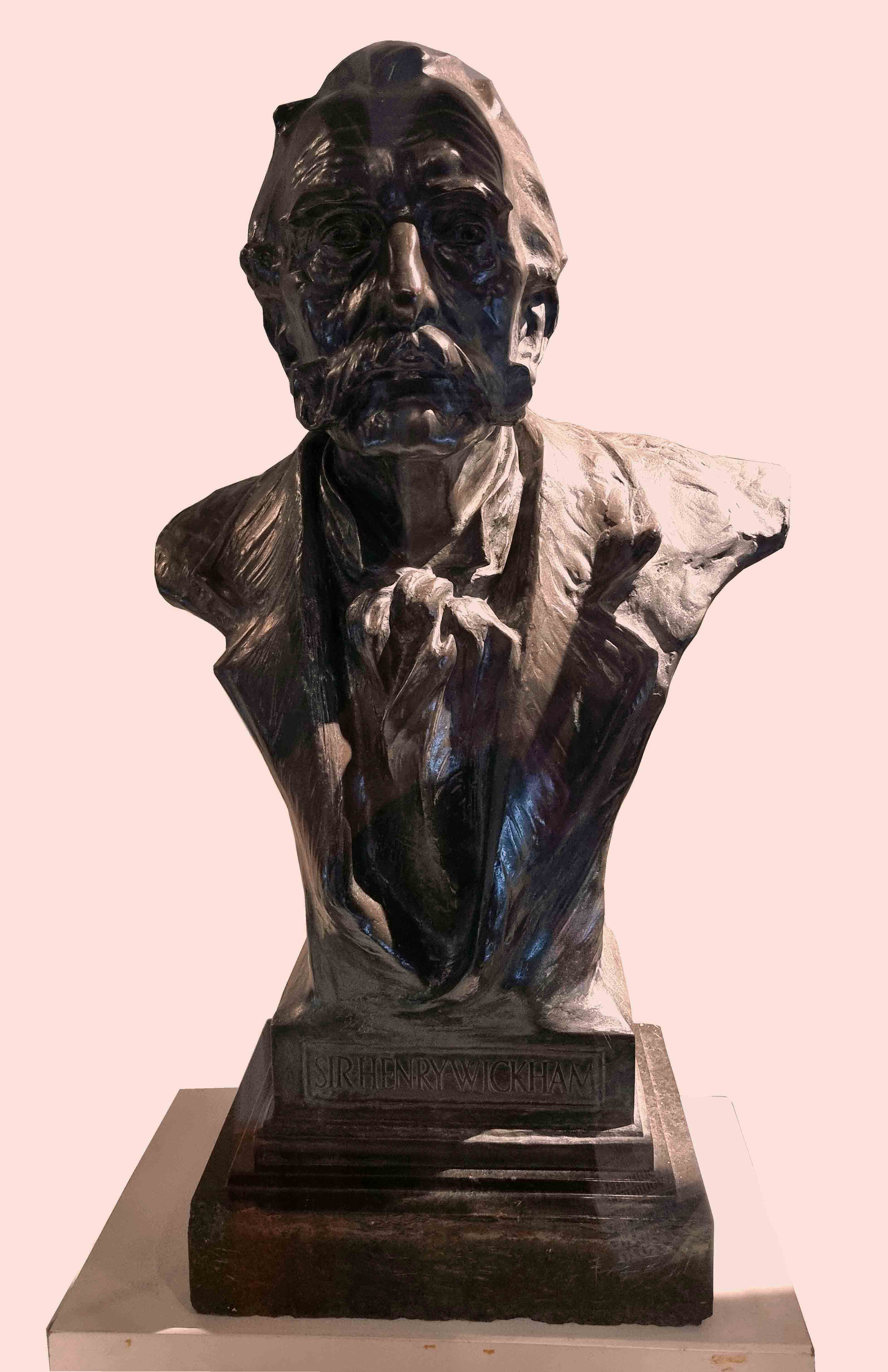
Notwithstanding the trials and tribulations in Wickham’s life, he was knighted for “Services in connection with the rubber plantation industry in the Far East”. Wickham passed away in 1928, regretfully perhaps, with an unfulfilled dream for enterprise.

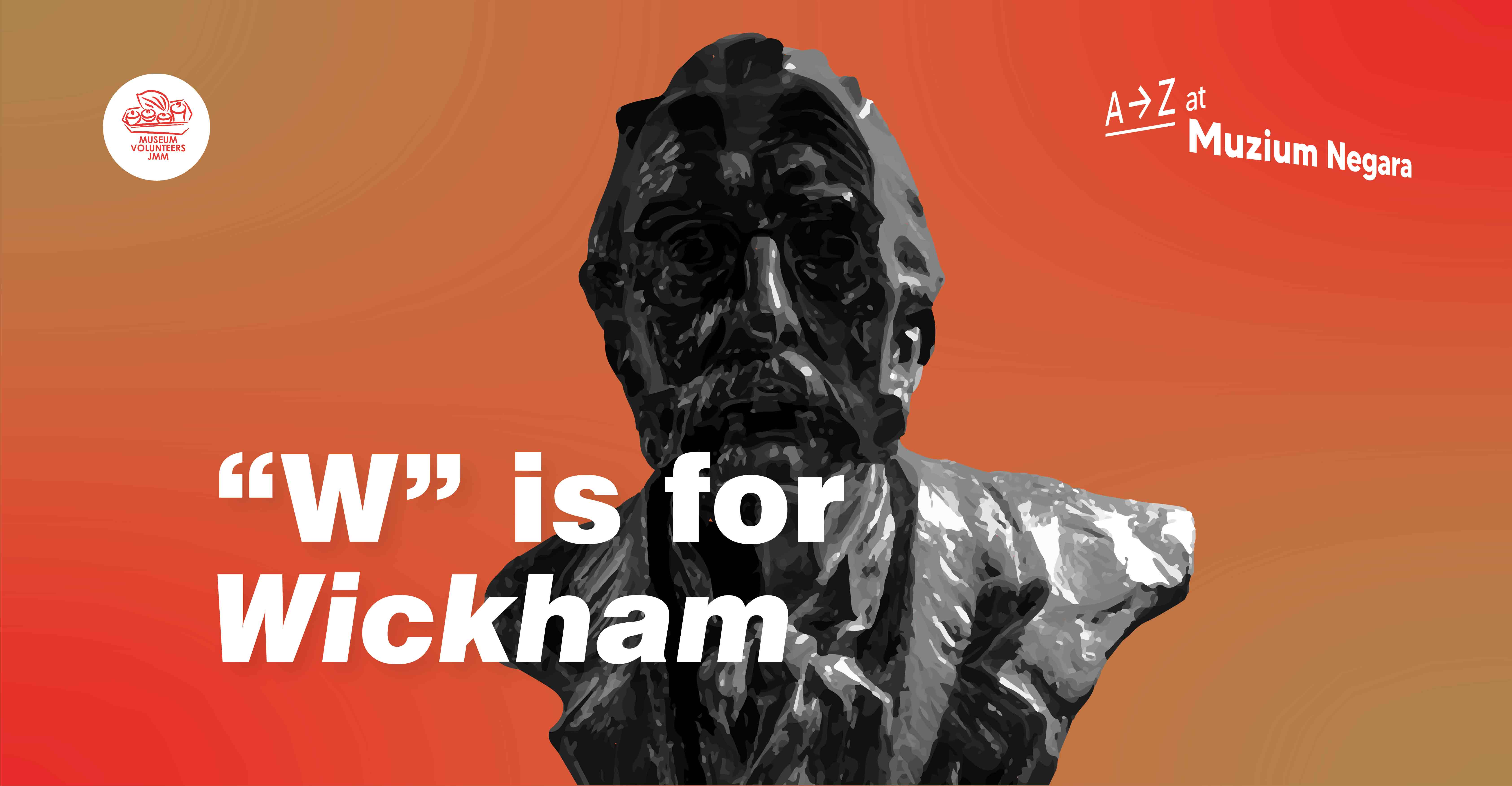
Bust of Wickham at Muzium Negara.

References

Bouncing Balls. (n.d.). Sir Henry Alexander Wickham. Bouncing Balls. http://www.bouncing-balls.com/timeline/people/nr_wickham1.htm

Schurz, William Lytle; Hargis, O.D.; Manifold, Courtland Brenneman & Marbut, Curtis Fletcher. (1925). Rubber Production in the Amazon Valley (p. 169). Washington, Govt. Print. Office.

Sims, Shannon. (2015). The Rubber Thief of Brazil. OXY. https://www.ozy.com/true-and-stories/the-rubber-thief-of-brazil/60424/

Veloo Saminathan. (2020). The real story behind those faded photos of Tamil plantation workers in Malaya. Aliran. https://aliran.com/thinking-allowed-online/the-real-story-behind-those-faded-photos-of-tamil-plantation-workers-in-malaya/

Wright, ArnoldCartwright, H. A. (1908). Twentieth century impressions of British Malaya: its history, people, commerce, industries, and resources. Lloyd’s Greater Britain Publishing Company, Limited.

In this Series

Click HERE for a list of articles in the ‘A-Z at Muzium Negara’ series.