By Ilani Jamin
Lenggong Valley in Perak was listed as a UNESCO World Heritage site in June 2012 for its significance in archaeological value. It is where the most complete skeleton in Southeast Asia, the 11,000-year-old Perak Man, was found along with other important discoveries.
Bukit Bunuh
Our second day of the Lenggong trip started off at a special place called Bukit Bunuh. Upon being driven into an oil palm plantation, we were surprised to witness a large area strewn with extraordinary rocks of various shapes and sizes. Ranging from 1-3m blocks of combined smooth and rough surfaces, these are suevite rocks, which are remnants of impactite rocks that resulted from a meteorite crashing in the area about 1.83 million years ago. These special rocks were exposed by land terracing works several years ago, thus affording us today a direct experience of the terrain.
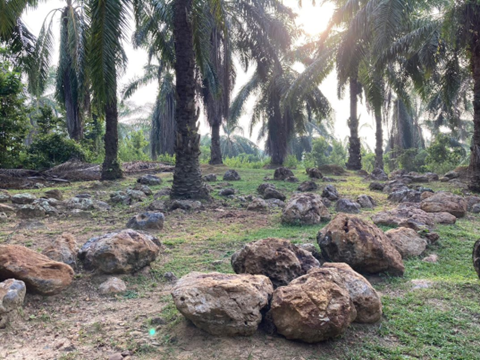
Scattered suevite rocks at Bukit Bunuh, Lenggong.
Bukit Bunuh, the oldest palaeolithic open site in Malaysia, is the centre of a meteorite impact with an approximately 5 km-diameter complex crater. During the impact, a central uplift was formed at Bukit Bunuh where impact temperature and pressure were high enough to immediately melt the surrounding land, producing partly melted and resolidified rocks as well as impact rocks known as suevites. From a larger perspective, the crater at Bukit Bunuh is located between Peninsular Malaysia’s main mountainous ranges – Bintang Range to its left and Titiwangsa Range to its right.
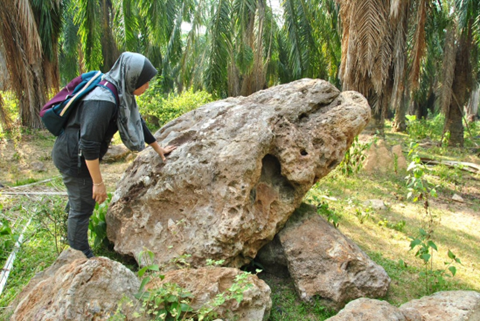
Our archaeological researcher leaning against a sizable suevite rock.
Image courtesy of MV Yun Teng.
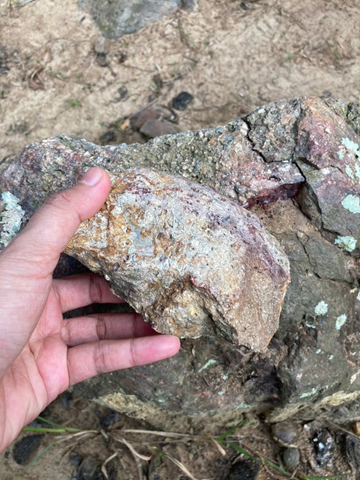
A suevite rock picked up from the ground.
A 1.83-million-year-old hand axe found buried in one of the suevites was among thousands of pebble and flake tools excavated at Bukit Bunuh, which provided evidence that its Palaeolithic community had several options for raw materials as their stone tools were made of suevite, quartzite, cherty metasediment and quartz. Physical remnants of the meteorite have not been found and it is considered that most of it would have been burnt upon entry leaving only evidence of temperature and pressure on the ground.
Bukit Sapi
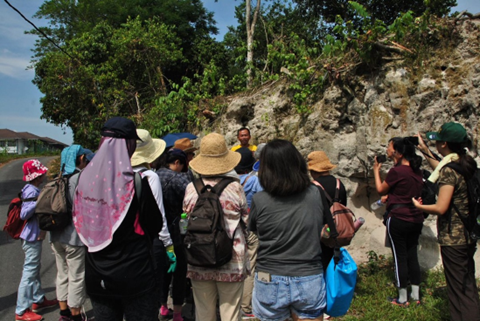
Participants listening to a brief about Bukit Sapi.
Image courtesy of MV Yun Teng.
Our next stop was Bukit Sapi, located a few minutes’ drive from Bukit Bunuh, which is a big rock of whitish colour located at the corner of a main road. Smaller rocks around its vicinity were also found covered with a loose, powdery texture of white ash. Here lies evidence of deposition from Sumatra’s Toba volcanic ash, occurring as a result of a massive volcanic eruption around 74,000 years ago.
This super-volcano eruption was the largest volcanic eruption in the past 28 million years. Its aftermath was believed to have brought on a two-week period of darkness due to lack of visibility in affected areas, including India and the Indian Ocean which were covered by 15cm-thick debris. Of all the ash deposit sites in Malaysia, Bukit Sapi had the most amount of Toba ash. Initially, the soil at Bukit Sapi was unsuitable for agriculture due to the high amount of volcanic ash in its soil and therefore, extra work had to be done to make the soil more fertile.
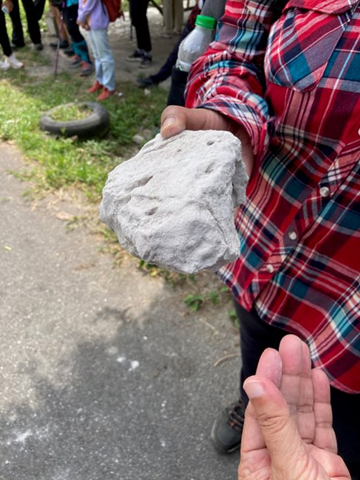
A small rock covered with deposits of Toba ash
found on the ground at Bukit Sapi.
Bukit Badak
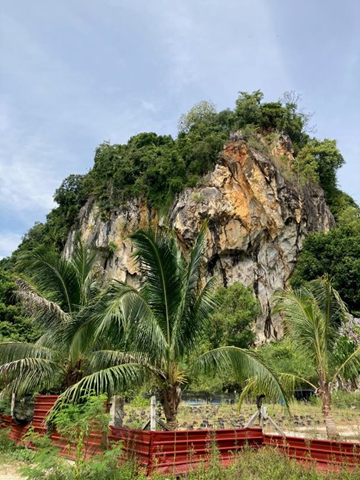
View of Gua Badak as we approached its base
to climb up to the site of cave drawings.
Our next stop of interest was Gua Badak, home to some interesting modern rock art. Getting up close to see the drawings meant we had to carefully tread some steep and uneven rocky patches.
The charcoal drawings found at different parts of the cave were made by Negrito aborigines, probably just over 100 years ago. During their hunting trips, they took shelter in the caves and made sketches depicting objects, both natural (people, animals, trees) and man-made items (bicycles, cars). Due to years of exposure to wind and other natural elements, many of these drawings have now faded.
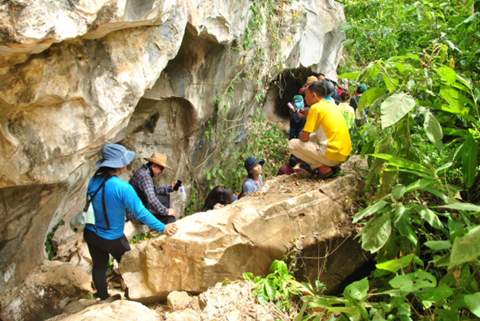
Our archaeological researcher giving a brief of the cave drawings.
Image courtesy of MV Yun Teng.
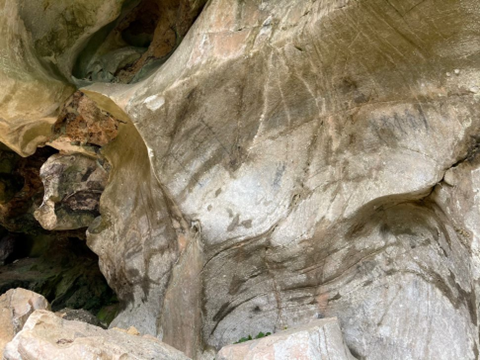
A drawing of matchstick men can be seen at the
upper right corner of this cave image.
Sungai Temelong
After descending Gua Badak, we were brought for snail hunting to Sungai Temelong, a shallow stream that passes through Temelong village. Going down the muddy bank was quite slippery but the real challenge was digging underwater along the riverbank to extract edible snails. These were the same species of snails cooked in coconut cream and chilli which we had enjoyed at dinner the night before.
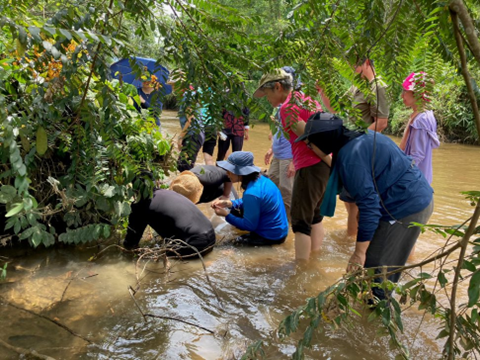
Our guide, Pak Rosli, demonstrating the art of scavenging snails which naturally embed themselves within the riverbank soil.
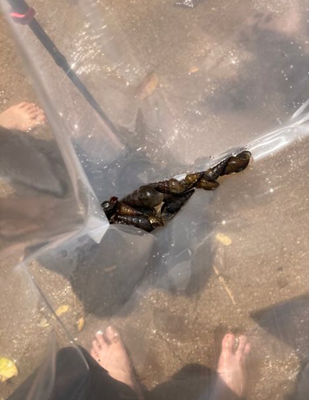
Our catch of the day after some 20 minutes of hunting for these black snails.
Overall, the second and final day of the Lenggong trip was filled with exciting and memorable activities, serving as useful pointers to move us, as museum volunteers, toward further exploration in our shared interests of archaeology, geology and the history of this region.
References
- https://highlanderimagesphotography.com/2022/10/29/meteorite-impact-site-bukit-bunuh-lenggong-valley/
- Abdullah, Lyn & Talib, Nor & Saidin, Mokhtar. (2020). CATATAN GEOLOGI GEOLOGICAL NOTES Mineralogical evidence from Bukit Bunuh impact crater and its contribution to prehistoric lithic raw materials.
- https://www.forbes.com/sites/davidbressan/2021/07/12/study-shows-how-humanity-survived-the-toba-supervolcano-eruption/?sh=414c54f23c81
- http://cavinglizsea.blogspot.com/2012/09/gua-badak-drawings-lenggong.html

 Museum Volunteers, JMM