Tanjung Tualang Tin Dredge No. 5 (TT5) – A Refurbished Dredge in All its Glory

By V. Jegatheesan

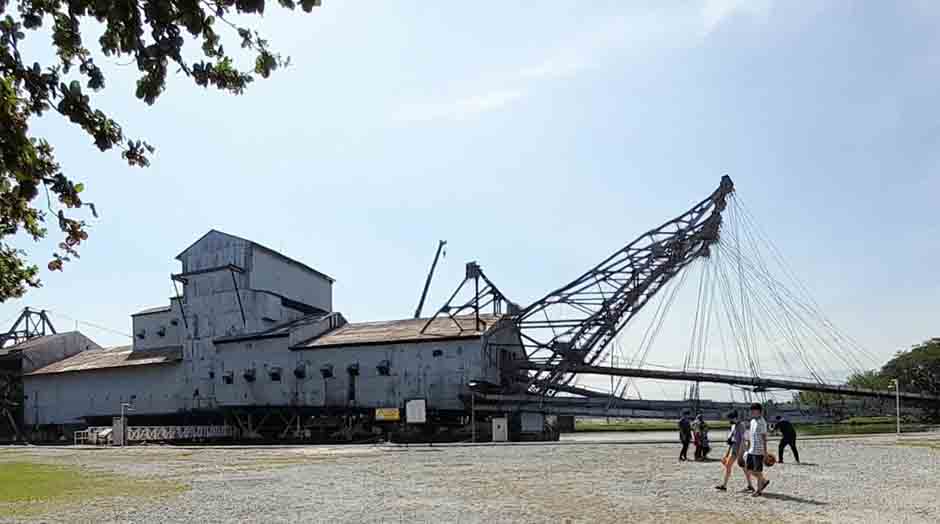
Tanjung Tualang Dredge No. 5. Image credit: V. Jegatheesan.

The Tanjung Tualang tin dredge, also popularly referred to as TT5, is an old dredge that went out of use as the tin industry faded away in the 1980s, with tin giving way mainly to aluminium. Nostalgia and a keen interest in preserving this machinery, led to its refurbishment, so as to give the populace a chance to see how it worked and how it helped the tin mining industry. It is now located on the 9th Km, Jln Tanjung Tualang, 31000 Batu Gajah.

Tin has been a lucrative product in Malaya for a long time. The Dutch of the 18th century were well known to have negotiated agreements for tin supplies from the areas around Pulau Pangkor and Kuala Selangor. However, mining methods, such as panning, were very basic. A large tray or dulang, was used to scoop water and sand in the rivers. The sand and earth would be filtered out and the heavy ore would remain. This would be further processed to make ingots and then sold, ending up ultimately as tin products. Tin has had many uses. Its main usage was in the canning industry, making bullets and, nowadays, in the electronic industry in solder. Interestingly, while many think a tin can is all tin, it is actually a tinned can – a steel can, which gives it strength, plated with tin, which prevents corrosion!

Dulang washing was of course an arduous process and not very productive. Subsequently, better technology emerged including opencast tin mining in which pumps shoot water at high pressure onto the sloping ground. The loosened earth or slurry is conveyed to the top of a sluice – palong – andwater pushes it down trellises; the heavier ore is held back by wooden slats while the rest of the earth and sand flows into a large lake. The recovered ore is then sent to a smelter for further processing and export. This was still labour-intensive. These methods were used until the end of the large-scale tin-producing era. Dulang washing is back in practice with the current rise in demand for tin.
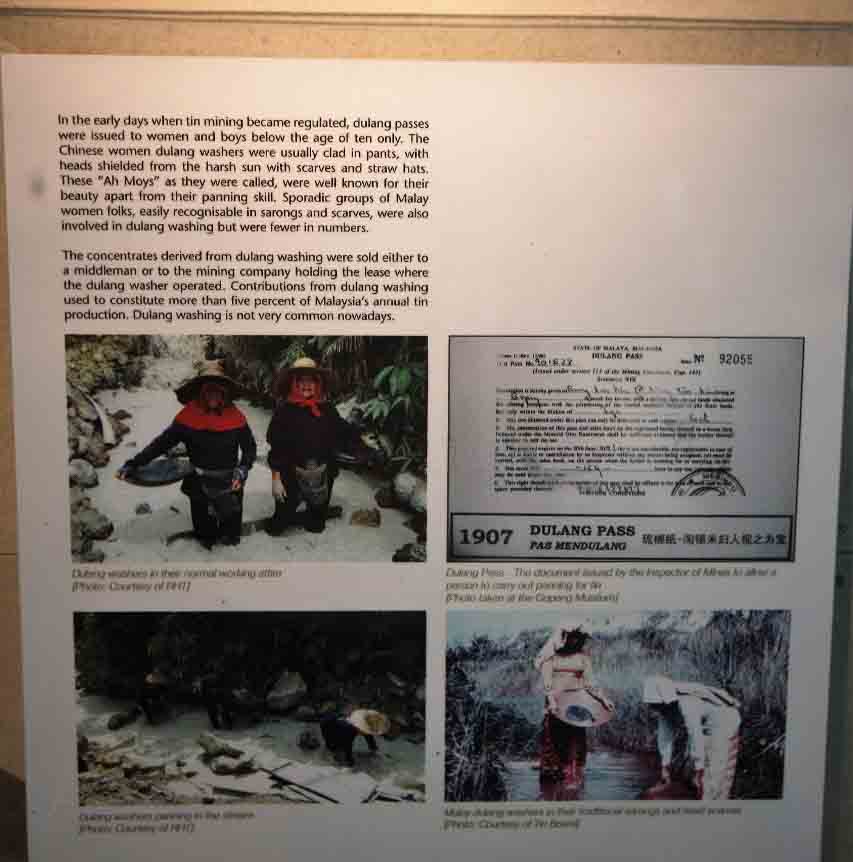
Image credit: A poster in the TT5 Visitor Centre

The dredge evolved from a simple ‘spoon dredge’ in 1862 through to the bucket dredge of the 1880s used in New Zealand and Australia. Since 1891, attempts were made to construct a dredge in Kinta, but all failed. In January 1913, Malayan Tin Dredging Ltd. initiated the first operational dredge in Batu Gajah; it later owned six of them. These were steam-operated. The TT5 is one of the five owned by its sister company, Southern Malayan Tin Dredging Ltd. It was built in 1938 by F. W. Payne and Company. Upgraded and electrified in 1963, it ceased operations in August 1982. In 1997, the Malaysian Mining Corporation (MMC), which subsequently owned the dredge, donated TT5 to the Perak State Government, which, since 2017, has spent almost Rm 10 million on its repair and maintenance.

A dredge in those days typically cost Rm 40 million to build. At today’s prices, a dredge would cost Rm 200 million. This behemoth could scrap up tin-bearing earth, 24/7, as is said nowadays. In very large quantities too. However, the cost was prohibitive so only companies with the ability to lay out large capital could afford the dredge. These were usually European companies, mainly British. This is why, other tin-mining methods continued. In due course, 123 dredges produced 60% of the tin, while other methods produced the remaining 40%. In 1912 some 80 per cent of Malaya’s tin production was under Chinese management, by 1931 British firms accounted for more than 60 per cent of total tin production.

Those who travelled along the Penang Singapore trunk road would remember seeing these dredges. But we all drove past assuming they would always be there. But not so. Over the years, greater use of aluminium, falling tin prices as well as increased production in Indonesia and China adversely affected the production in Malaysia. It was simply not economically viable.

TT5 is now restored to showcase how these mighty machines worked to contribute to the economy of Malaysia. Its actual operation area was not far off from where it is now located. A guided tour is provided and takes about 30 minutes. In fact this article transcribes the tour by Volunteer Guide, Encik Hafizal Arif. Note that this article describes TT5 only as other dredges will differ in size and equipment.

The process in its elements is very simple. Large quantities of tin-bearing earth were continuously scrapped from the ground by a conveyor made up of large metal buckets, processed mechanically to separate the tin from the earth, collect the tin and discharge the rest back into the lake on which it floats. A more detailed description, avoiding technicalities, is transcribed from the guided tour.

The dredge weighs 4500 tons and is 75m in length, 19.5m in width and four floors in height. A NO ADMITANCE signage at the entrance is in English, Chinese, Punjabi, Jawi and Tamil, reflecting the various groups of people working on this dredge.
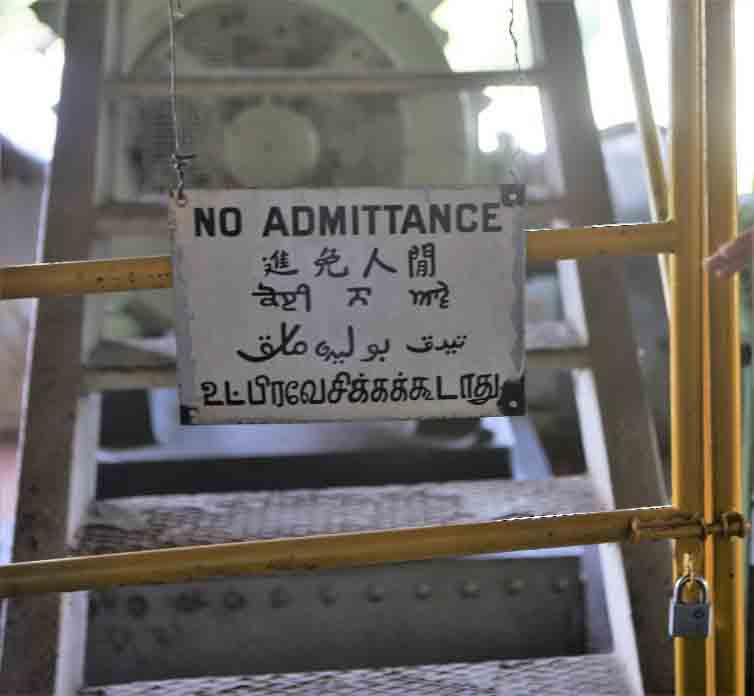
Signage reflecting the various groups working on the dredge.
Image credit: V. Jegatheesan.

The entire structure floats on 47 pontoons. These are hollow tanks which keep the dredge afloat in the water. In this dredge, the pontoons are 3.1m deep and are accessible for maintenance, mainly patching leaks.
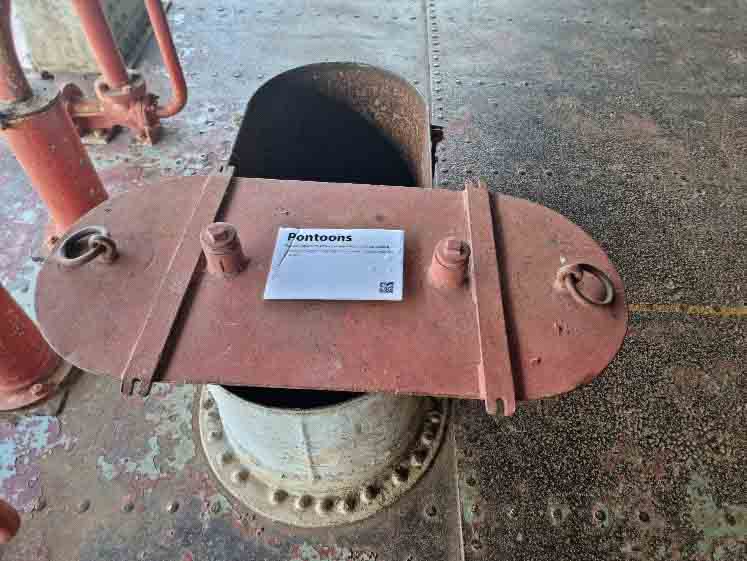
           Pontoon top with the cover off. Image credit: Maganjeet Kaur.

TT5 has 115 buckets. These two-ton buckets are set on a looping chain, or ladder, in the front of the dredge. The ladder continuously circulates and can be lowered for the buckets to scrape the lake bed or the earth face on the lakesides beneath the water. Being a moderately-sized dredge, TT5 can scrape down to 33m. Other dredges can go down to even 100m.
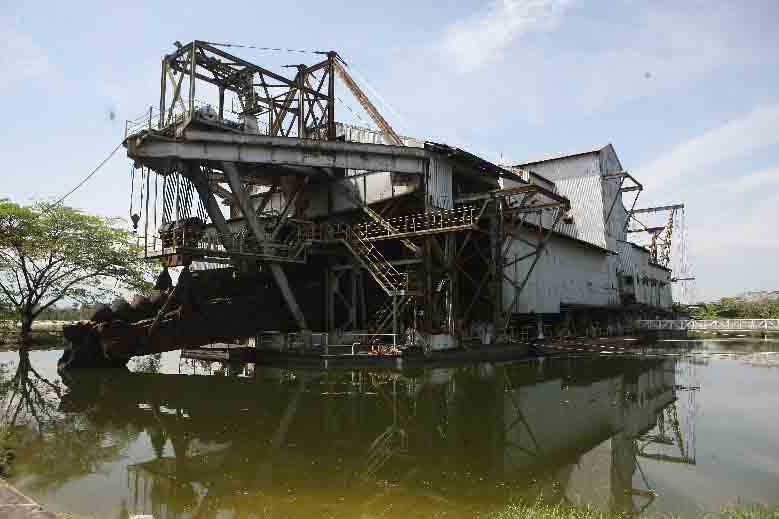
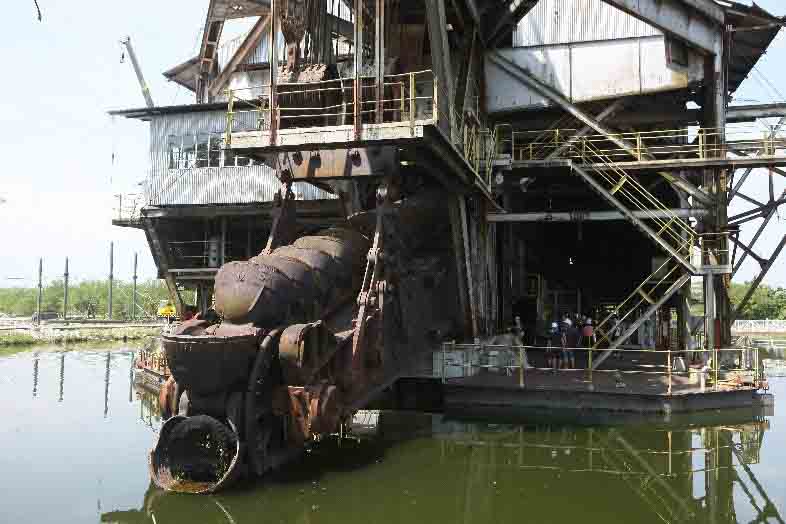
Buckets on the looping chain. Image credit: V. Jegatheesan.

As the now three-ton buckets move up the ladder, they carry the scooped earth to the top of the dredge into trommel screens. These screens are cylindrical and perforated.

Jets of water wash through the earth in the trommel screen to separate the heavier tin ore. The ore is passed into vibrating jigs to further filter the ore. The jig is equipped with a screen or sieve that allows smaller particles to pass through while retaining the larger, denser particles. After a second jig, the purer ore (Cassiterite Concentrate) is channelled to be stored in tanks. We were restricted from visiting this area. The water used in the screen and jigs is pumped up from the lake itself. The sand and unwanted material after these processes, called tailings, are discharged through the chutes out at the back of the dredge into the lake.

The tank can hold one ton and one day’s dredging produced 30 tons. A crane on either side will carry the tanks out to the lakeside. It is later sent to the smelting plant in Penang. The resulting ingots are then exported.

A rough estimate values a day’s production at 30,000 to 35,000 USD of the time. It seems that a year’s production could recover the cost of the dredge! This is the reason that the tank area access is limited only to authorized personnel to prevent theft by stuffing ore into pockets or helmets. Even the discharge chutes for the tailings have a spider web netting to prevent anyone from climbing in.
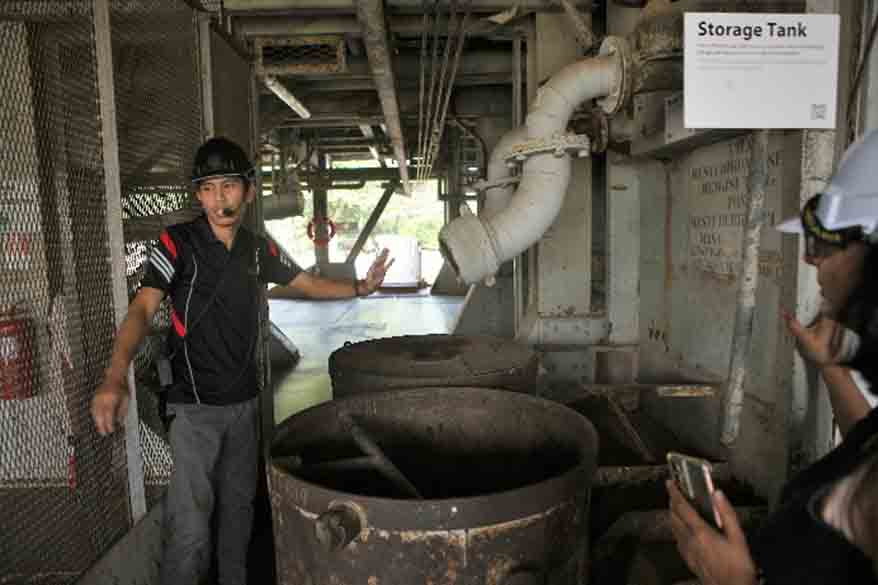
Hafizal Arif explaining the storage tank for the ore. Image credit: V. Jegatheesan
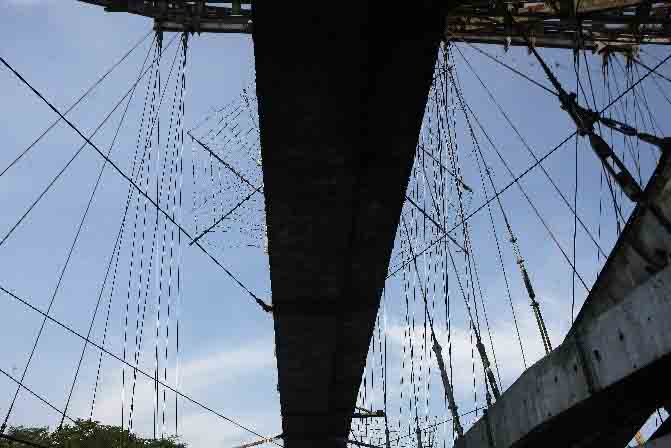
Spider netting encircling the discharge chutes. Image credit: V. Jegatheesan.
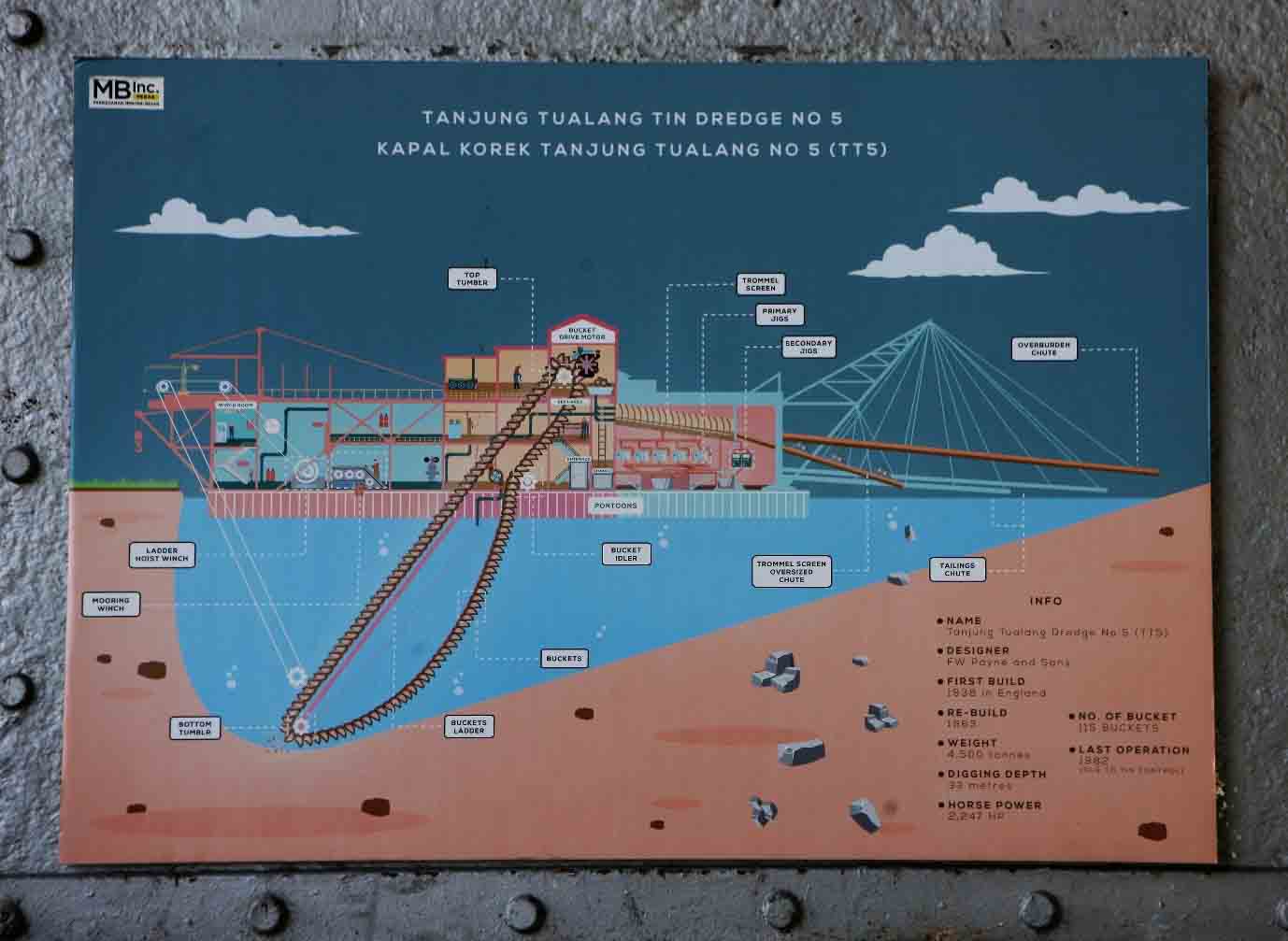
A description of the dredging process. Image credit: Maganjeet Kaur
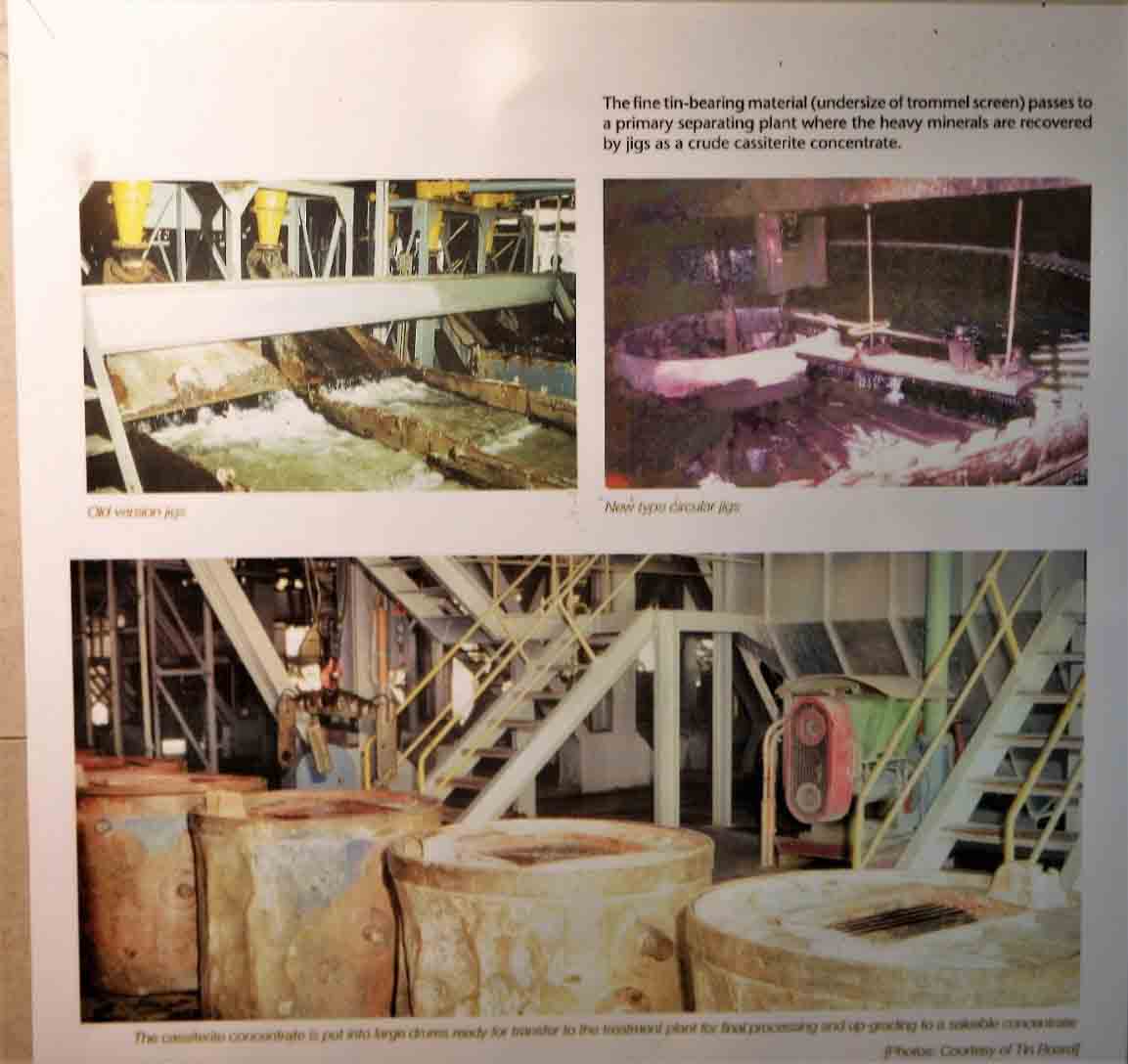
              Poster in the Visitor Centre. Image credit The Tin Board.

The operation is managed by a Dredge master. Employees work in three shifts and do not live on board. They are ferried by a small boat. Each shift has 20 people. There is a pantry area for them to rest and have their meals, which are brought by them as there are no cooking facilities. There is a toilet at the back, over the lake.
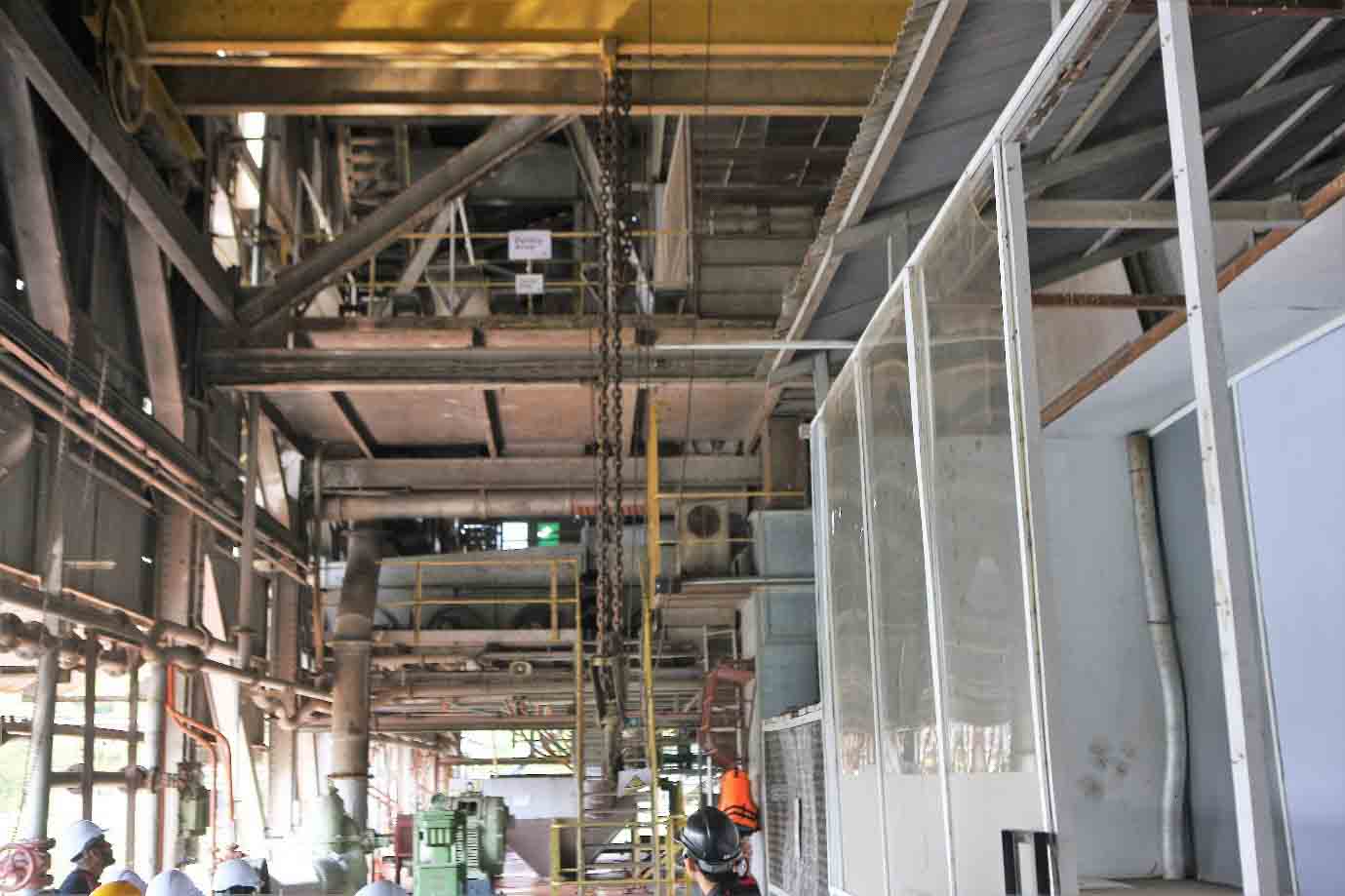
Pantry at the top. Image credit: Maganjeet Kaur.

Though TT5 is tethered to the lakeside by ropes today, the dredge had cables in front and sides. The cables were attached to a mooring winch. The dredge could be moved by winching in or out.
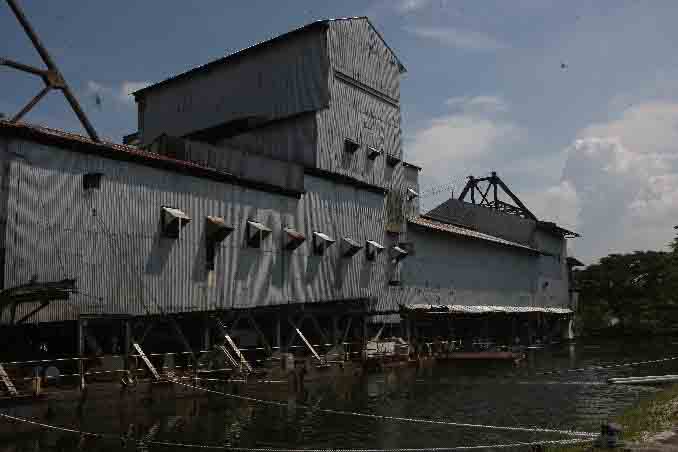
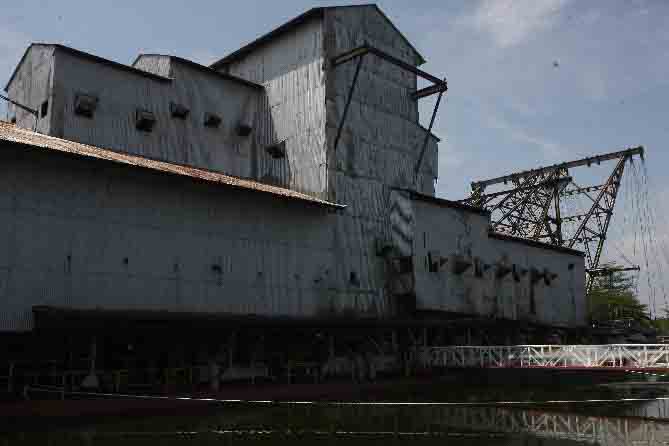
Tethering of dredge to the side. Right image shows the gangway to the dredge. Image credit: V. Jegatheesan.
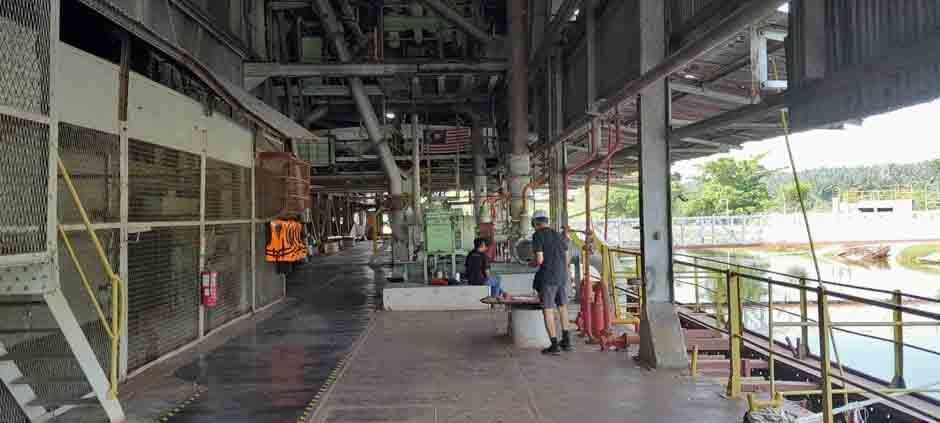
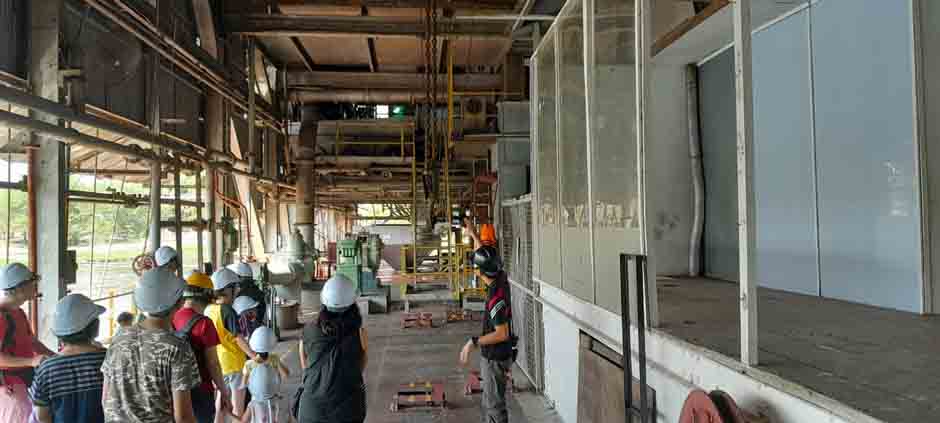
Views of either side of the dredge decks. Image credit: V. Jegatheesan.
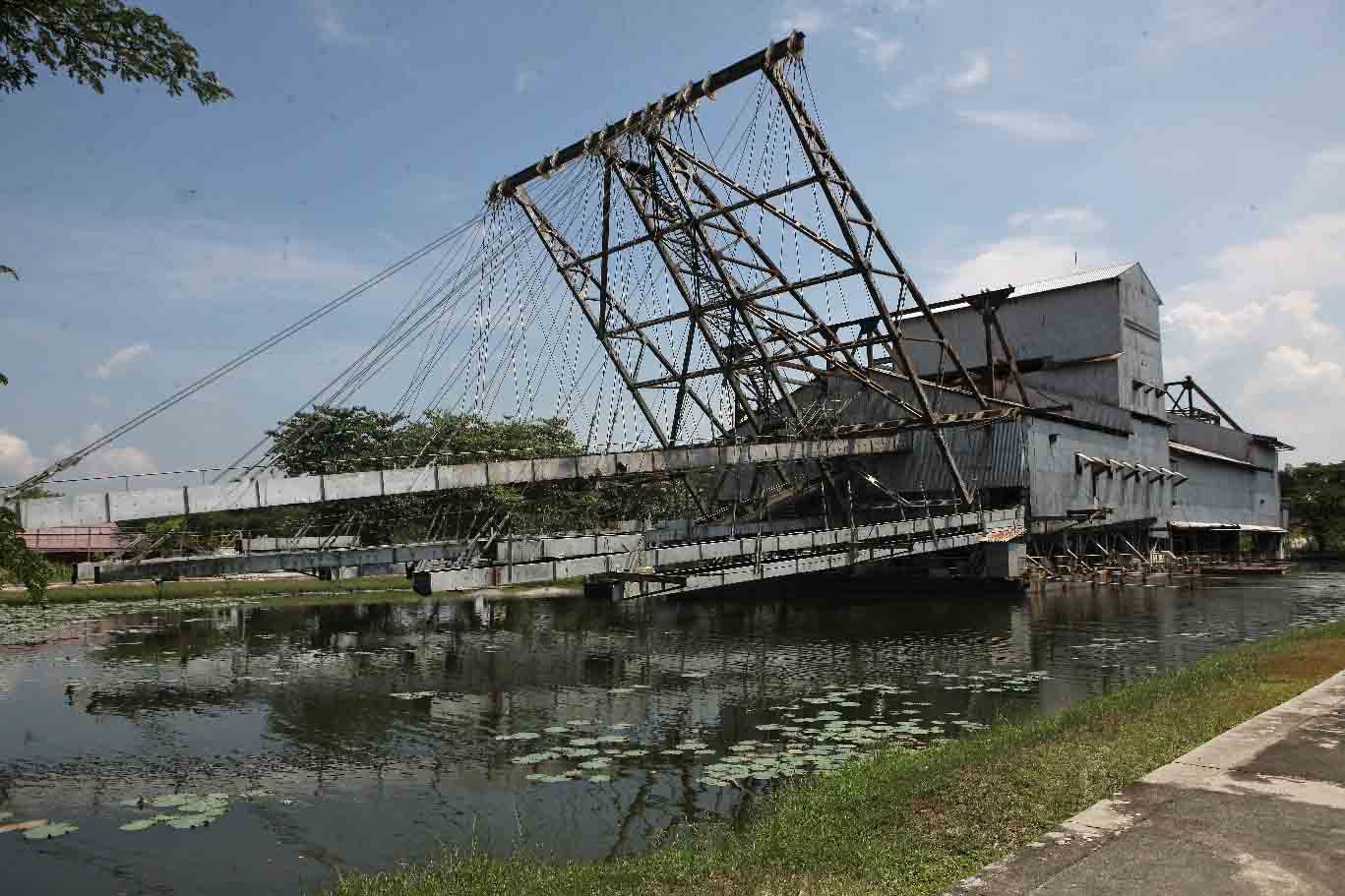
Over the years, dredges have been sold to Thailand or Indonesia, while some have even been scrapped.In 2015, the Perak State Government mandated the Menteri Besar Incorporated (MB Inc.) to conserve the TT5. Visitors can go onto the dredge and its workings are explained by guides. Visits can be made by calling ahead and specifying a time slot or walking in to join the next group.
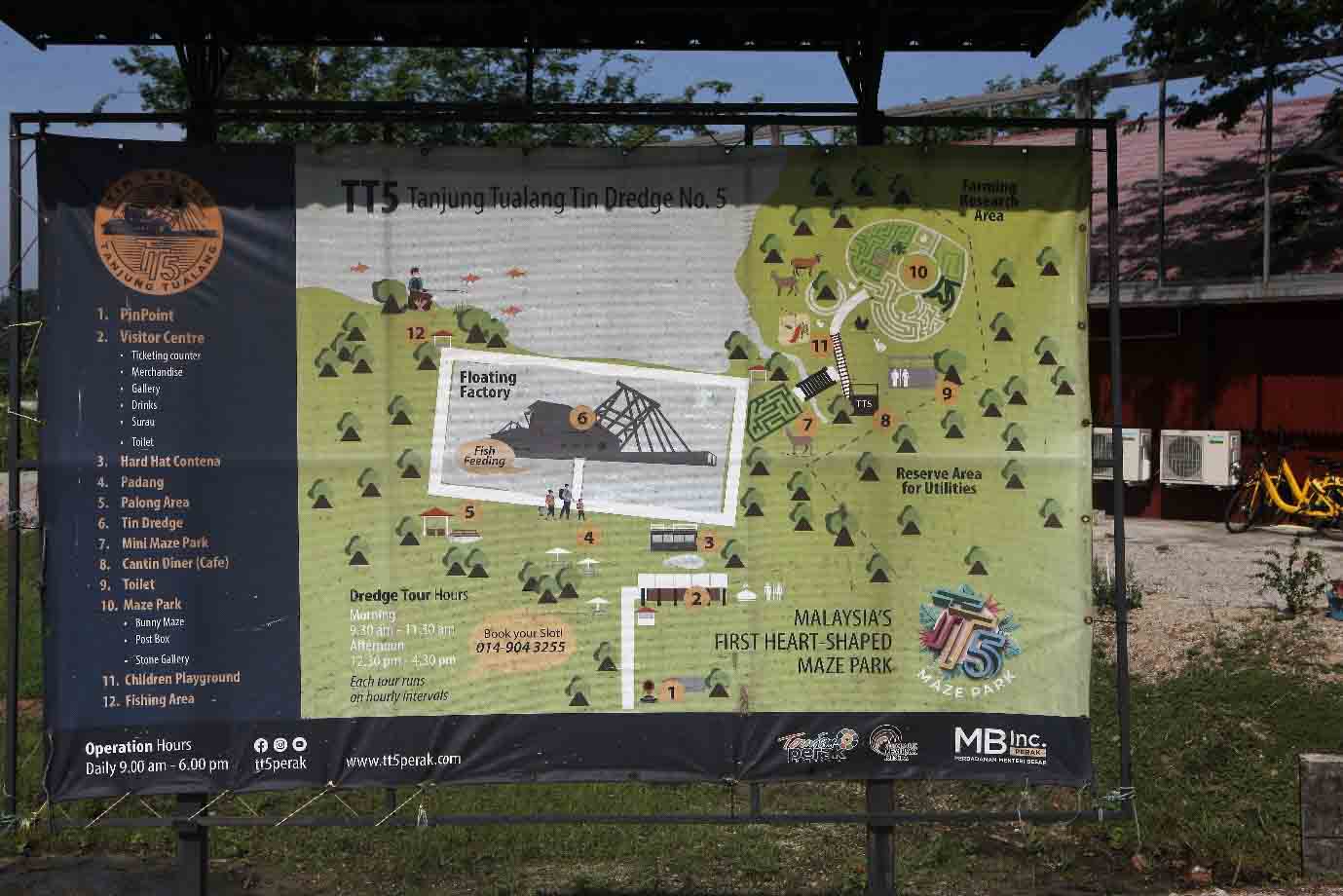
Board showing layout of the TT5 Park. Image credit: V. Jegatheesan.

Since 2018, TT5 has been part of the Kinta Valley National Geopark. The Visitors Centre and TT5 tours are managed by the Operation Executive, Encik Aizad Azeli.

To cap the extensive works to preserve the TT5, in March 2023, the Institution of Mechanical Engineers United Kingdom, presented Tanjung Tualang Tin Dredge No.5 an Engineering Heritage Award for being well-maintained, contributing to the state and national economy and having its own heritage characteristics. It is the first tin mining dredge to receive such an award.
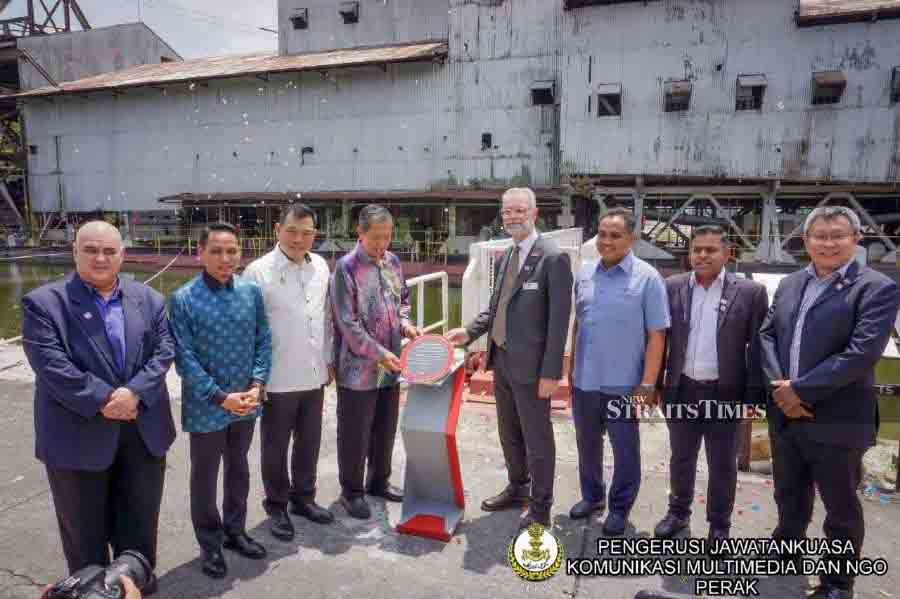
Image credit: New Straits Times 2023, March 23

In 2023, TT5 received the Travellers Choice Award from Tripadvsor.

TT5 is well worth a visit.

References:

Last surviving tin dredge TT5 receives IMechE award from UK. (2023, March 23). The New Straits Times. https://www.nst.com.my/news/nation/2023/03/892188/last-surviving-tin-dredge-tt5-receives-imeche-award-uk#:~:text=BATU%20GAJAH%3A%20The%20iconic%20Tanjung,Engineers%20(IMechE)%20United%20Kingdom.

EARLY 20TH CENTURY TIN MINING DEVELOPMENT. In Economic Heritage Malaya. https://www.ehm.my/publications/articles/about-tin-mining#:~:text=EARLY%2020TH%20CENTURY%20TIN%20MINING,much%20of%20the%2020th%20century.

A gold mine in tin. (2007, August 30). In Malaysian Bar. https://www.malaysianbar.org.my/article/news/legal-and-general-news/general-news/a-gold-mine-in-tin

Tanjung Tualang Tin Dredge. (2023). httpstt5perak.com

The Islamic Art of Wood Carving

By Emna Esseghir

Introduction

God is beautiful and He loves beauty.

— Tradition (hadith) of the Prophet Muhammad from Sahih Muslim

Within the Islamic theological framework, a core tenet asserts that God possesses the attribute of beauty, and this inherent beauty finds manifestation in His creations. It is a frequently reiterated notion that God is intrinsically beautiful, and He exhibits an affinity for aesthetics and beauty. This theological premise underscores the significance of aesthetics, harmony, and beauty across diverse facets of Islamic culture, encompassing art, architectural design, and the ethical comportment of individuals.

The concept that God cherishes beauty is intrinsically associated with the idea that human beings are encouraged to both recognise and cultivate beauty in their actions and environmental milieu. This is prominently exemplified in the rich artistic and architectural traditions of Islamic civilisation, wherein intricate designs, eloquent calligraphy, and geometric patterns are judiciously employed to embellish religious edifices, palatial structures, and various other architectural forms.

One of the major elements used to express this beauty in Islamic art was wood carving.

1. What is wood carving?

Wood, as the most abundant natural resource, has historically captivated the attention of humankind. Intriguingly, in numerous regions of the Islamic world, wood is relatively scarce, yet it enjoys a distinguished status and necessitates a high degree of craftsmanship. Within the context of Islamic art and architectural construction, woodcarving emerges as a prominent technique, particularly in the context of mosque construction. This art form exerts a profound influence, elevating the aesthetic appeal of these religious edifices while imbuing them with profound symbolism.

Woodcarving, at its core, entails the intricate creation of designs in wood, achieved through manual dexterity and specialised carving implements. The array of motifs ranges from the intricate and traditional to geometric precision or abstract patterns. A pivotal preliminary step in woodcarving involves the meticulous identification of the wood’s grain and texture before embarking on the carving process. The resulting carved elements consistently manifest in an abstract fashion, representing botanical elements or geometric configurations and can be categorised into three distinct architectural components: structural, elemental, and ornamental.

Woodcarving serves as both a technique and a final product, in which wood is meticulously shaped into decorative and artistic forms. Wood, as a widely accessible and sustainable resource, is available in diverse sizes suitable for crafting objects of various scales, from minor artefacts to grand architectural structures. Its intrinsic robustness enables it to bear substantial loads and span extensive areas. Furthermore, wood is amenable to manipulation by a judicious application of manual labor and lends itself readily to precision shaping using rudimentary hand tools. Its innate spectrum of colors, tonal nuances, and susceptibility to diverse surface treatments enhance its allure, rendering it an aesthetically pleasing and adaptable material.

2. Historic evolution of wood carving art in the Islamic world

Undoubtedly, the artistic evolution of wood carving among Muslim artisans during the formative centuries of Islam constitutes a remarkable historical and artistic phenomenon. This creative metamorphosis was profoundly molded by the convergence of Hellenistic (in the eastern Mediterranean and Middle East, the period between the death of Alexander the Great in 323 BCE and the conquest of Egypt by Rome in 30 BCE) and Sassanian artistic influences (officially known as Eranshahr was the last Iranian empire before the early Muslim conquests of the 7th–8th centuries AD).

The amalgamation of these disparate traditions ignited the development of a distinctive Islamic wood-carving style that left an enduring imprint on the artistic panorama of the Islamic realm.

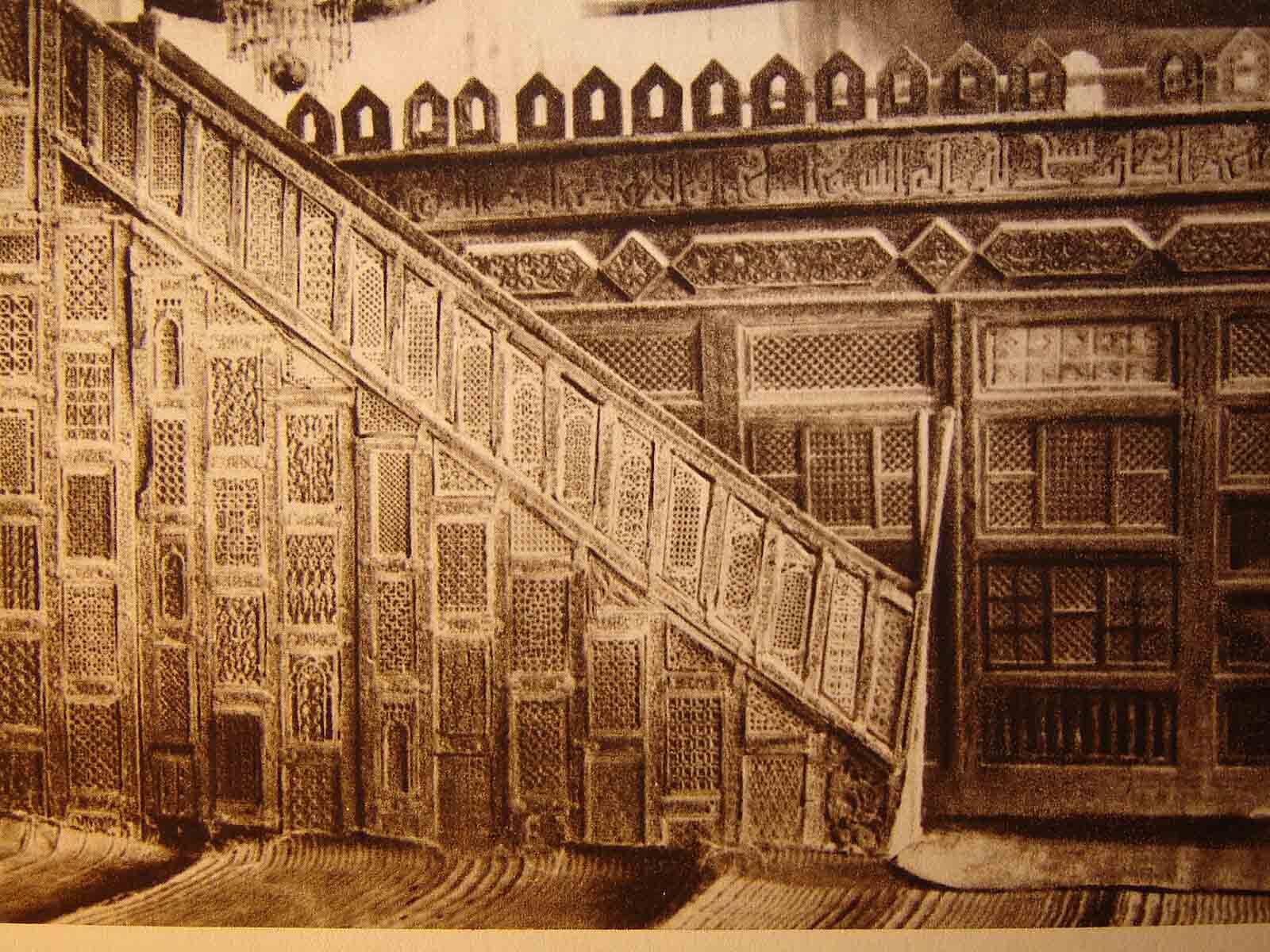
A prominent exemplar of early Abbasid wood carving, symbolising the culmination of these influences, resides in the prayer pulpit enshrined within the Qairawan mosque in Tunisia. This masterful creation, likely transported from Baghdad during the third/ninth century under the patronage of influential figures from the Aghlabid dynasty, stands as an epitome of wood-carving craftsmanship affiliated with the Baghdad School.

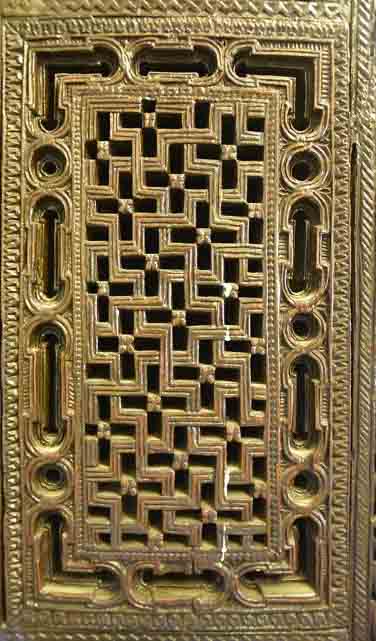
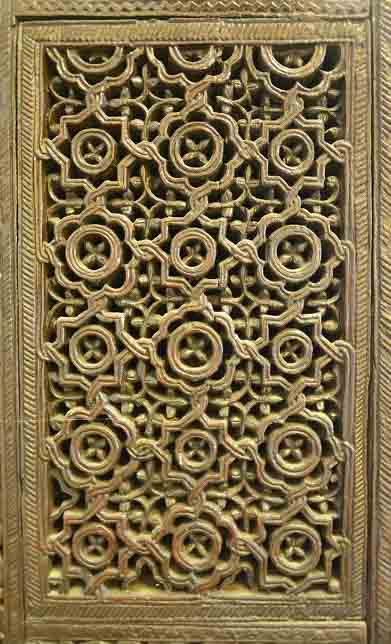
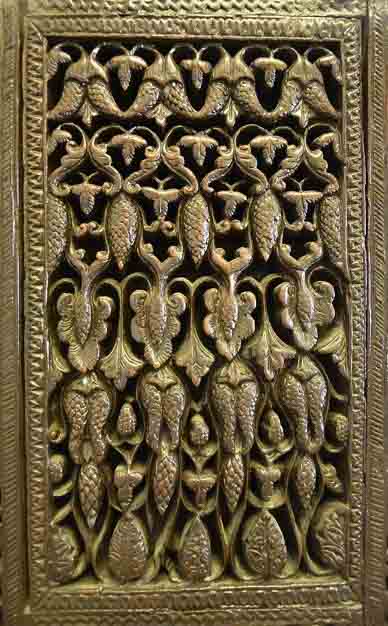
Adorned with meticulously crafted panels featuring geometric motifs and designs, it is believed to have been commissioned during the reign of Harun, the Abbasid Caliph.

This architectural marvel remains a source of inspiration for contemporary abstract art, serving as a testament to the enduring relevance of its patterns and designs.

An old postcard (1900) showing the carved teak 
Minbar and the Maqsura. Photo source: Wikimedia

The intricate detailing of the minbar.
Photo source: Issam Barhoumi- Wikimedia  

Over time, Abbasid artists developed their own unique style, breaking away from the artistic traditions of the Sassanian and Hellenistic periods. This new Abbasid style became popular among Egyptian craftsmen during the Tulunid era (935-969), especially in Cairo.

As the Abbasid artistic style matured, Egyptian craftsmen refined it further, creating a distinctive artistic expression by the 10th century. They began carving deeper and creating more rounded shapes, showcasing their creative skills.

Assessing how Egypt’s rich heritage of crafts and arts influenced the advancement of wood-carving by Egyptian artists is a complex task. Egypt’s legacy offered fertile ground for innovation, contributing to the mastery of Egyptian wood carving.

Over time, geometric patterns gave way to different forms of decoration, like intricate carvings of animals and arabesque scrolls. These works demonstrated the artists’ meticulous attention to detail, combining technical expertise and hard work.

During the Fatimid era, some wood panels stood out for their exquisite artistry. They portrayed typical Egyptian scenes, with a strong focus on birds and animals, reflecting the ancient Egyptian tradition of revering specific animals as deities, adding a cultural dimension to the wood carvings.

In the Ayyubid period, the influence of the Fatimids continued in wood carving, with arabesque scrolls becoming more intricate. The use of nasj script instead of Kufic inscriptions reflected evolving artistic tastes. This period also saw a greater commitment to intricate detailing, emphasising the dedication of the artists.

Panel with Inscription probably 13th century
Photo source: https://www.metmuseum.org/art/collection/search/448499

In Egypt, wood carving reached its peak over time but gradually declined in the 15th century, marking a significant turning point in its evolution.

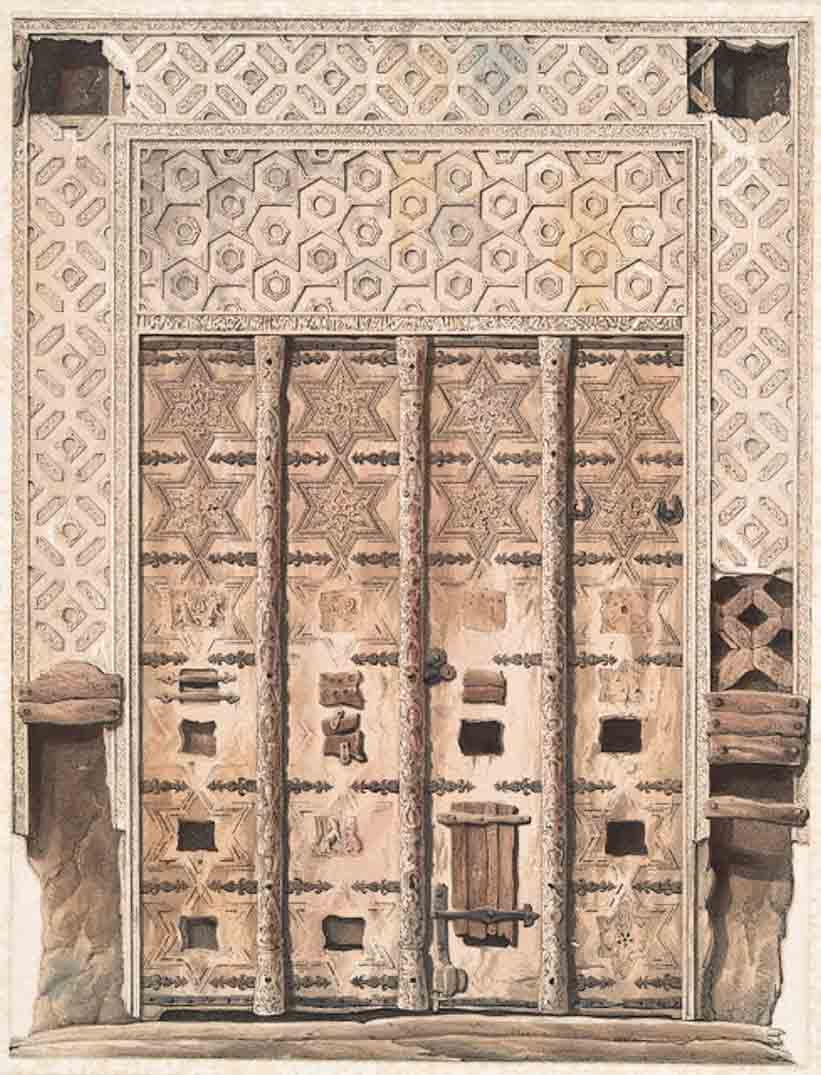
Conversely, in Iran, wood carving was mature even during Mahmud of Ghazni’s rule during Ghaznavide empire. A preserved door from his tomb in the Agra Museum demonstrates the innovative approach of Iranian artists, characterised by deep undercutting and multiple planes, showcasing an Iranian stylistic imprint.

Gates of the tomb of Mahmud of Ghazni, (James Atkinson in 1842)

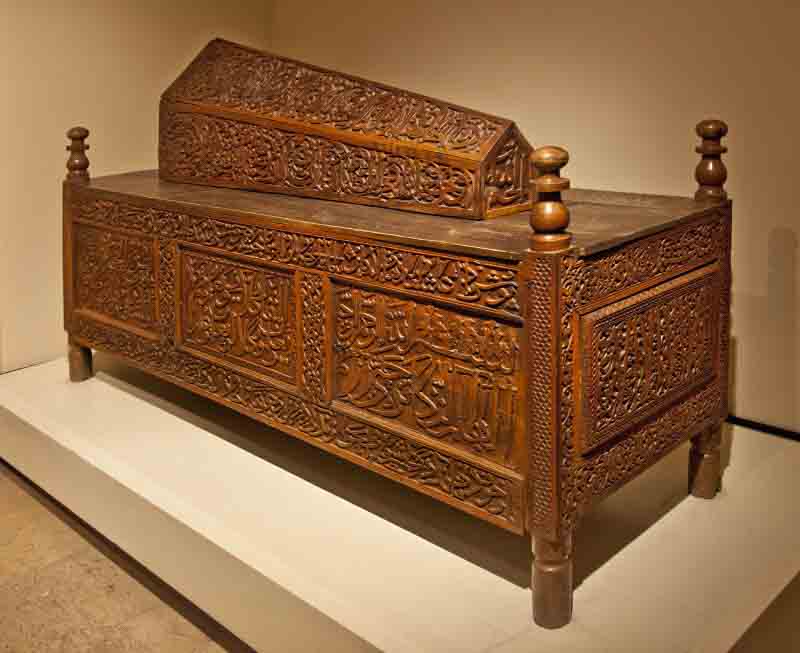
Although there are relatively few wood carvings from the Saljug period, it’s reasonable to believe that artists in Asia Minor during the 12th and 13th centuries crafted exceptional works, resonating with the quality seen in Egypt and Syria.

Wooden Sarcophagus from the Seljuk Period
the Museum of Turkish and Islamic Art in Istanbul.
Photo source: https://www.alamy.com/stock-photo/seljuq-period.html?sortBy=relevant

While wood carvings from the early Mongol period are scarce, historical evidence suggests that Iranian artists in Western Turkestan achieved remarkable technical perfection in the 14th century. The zenith of wood carving persisted during the Safavid period, although signs of decline appeared in the 17th and 18th centuries. During this era, panels transitioned from intricate carving to painting and lacquering, marking a transformative phase in the history of Islamic wood carving.

Wood carving from Safavid Period. Photo source: Hayk – Wikimedia

3. Wood carved artefacts with Islamic influence at the National Museum

The practice of traditional Malay wood carving represents a seminal facet within the domain of Malay cultural heritage, encompassing profound and substantive cultural importance.

It predates the arrival of Islam, but since the adoption of Islam as the religion of the Melaka Sultanate, we can distinguish some specific characteristics:

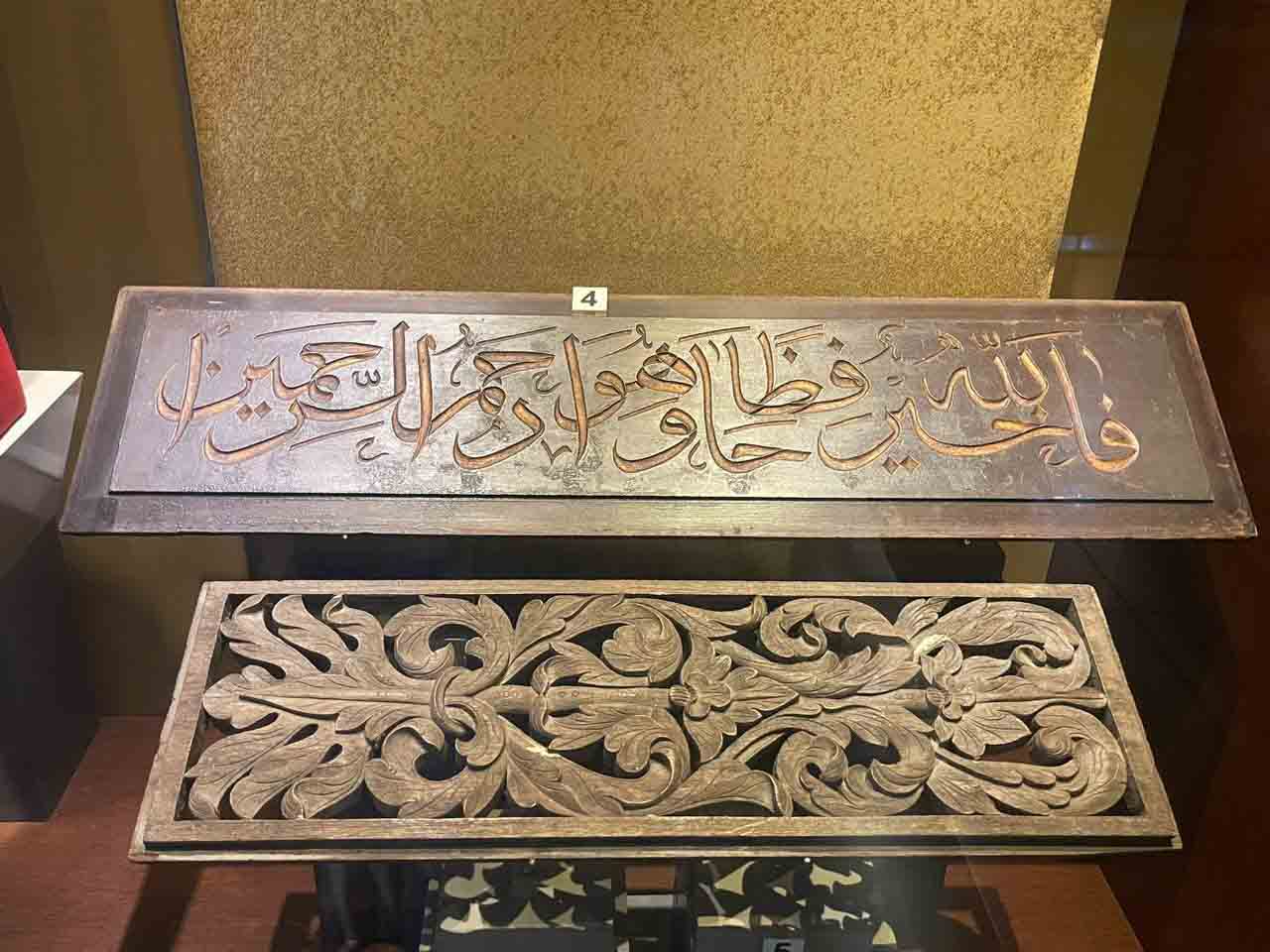
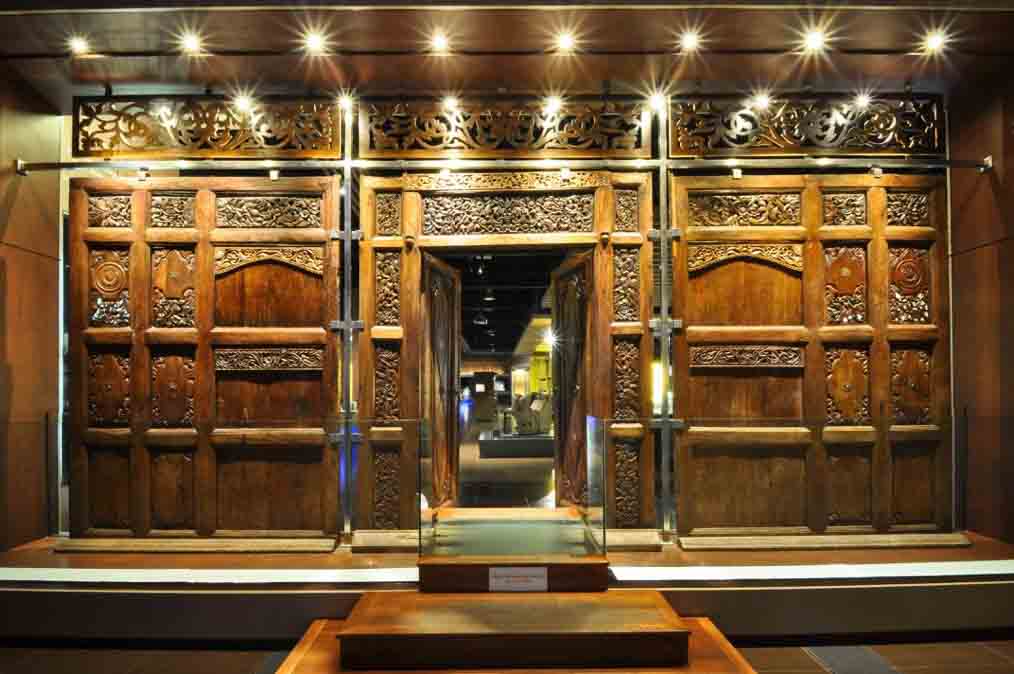
Integration of Arabic Calligraphy: A defining feature of Malay wood carvings within Islamic art is the sophisticated integration of Arabic calligraphy. These carvings frequently incorporate Quranic verses or excerpts from Islamic texts, meticulously inscribed with exceptional finesse. The utilisation of calligraphy transcends mere ornamental aesthetics; it serves as a conduit for the visual representation of sacred Islamic scripture, infusing these wooden artefacts with profound religious significance. The interplay of script styles, such as Kufic or Naskh, further underscores the artistic and spiritual dimensions of these carvings.

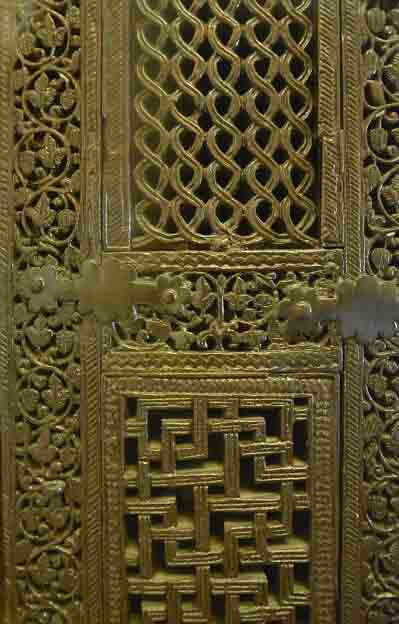
Doors panels inscribed with Quranic verses, on display at
Gallery B, National Museum. Photo source: Emna Esseghir

Wooden panel with sentence from the Holy Quran used to
decorate a muslim chapel, on display at Gallery B, National Museum.
Photo source: Emna Esseghir

The Setul palace door, displayed at Gallery B, National Museum.
Photo source: Maganjeet Kaur

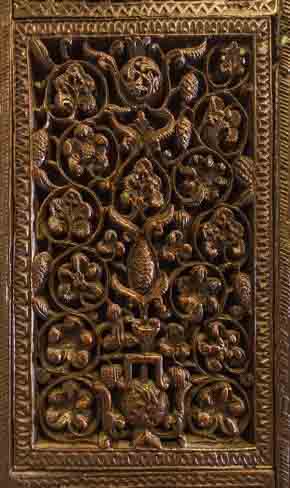
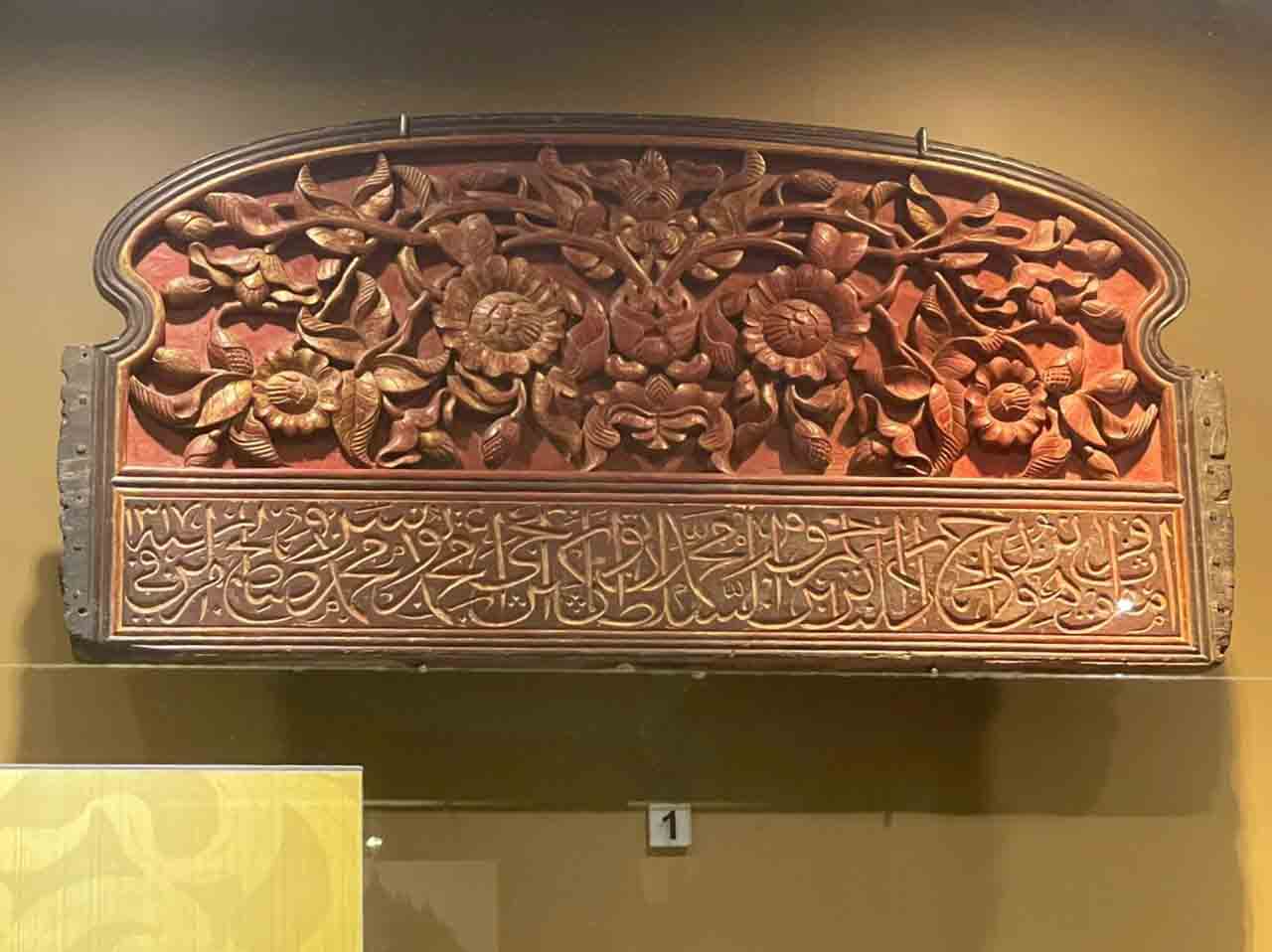
Harmonious Synthesis of Malay and Islamic Aesthetics: A salient feature of these carvings is their ability to harmoniously blend indigenous Malay motifs with Islamic artistic elements. This synthesis culminates in a unique visual language that encapsulates the multifaceted cultural identity of the Malay-Muslim community. By seamlessly interweaving Malay flora for example with Islamic motifs, these carvings offer a nuanced expression of both regional and religious identities, emphasising their role as cultural artefacts and religious conveyors.

Wooden panel with flora and sentence from the Holy Quran,
on display at Gallery B, National Museum. Photo source: Emna Esseghir

To conclude, Arabic Calligraphy meticulously inscribed with Quranic verses adds profound religious significance, while geometric precision reflects metaphysical themes. The harmonious synthesis of Malay and Islamic aesthetics highlights cultural identity. But beyond aesthetics, these carvings serve functional roles in Islamic architecture, enhancing sacred spaces and connecting the physical and spiritual realms. In essence, Malay wood carvings contribute significantly to the artistry and spirituality of the Malay-Muslim heritage.

References

A Study of Woodcarving Motifs on Traditional Malay Houses in Kuala Pilah, Negeri Sembilan: https://melaka.uitm.edu.my/ijad/images/PDF/1.pdf

DEVELOPMENT OF MALAY WOOD-CARVING MOTIFS FROM ISLAMIC PERSPECTIVES: https://oarep.usim.edu.my/jspui/bitstream/123456789/14524/1/4.BI.%20SAIS2021%20-%20Development%20Of%20Malay%20Wood-Carving%20Motifs%20From%20Islamic%20Perspectives.pdf 

Fatimid Wood-Carvings in the Victoria and Albert Museum: https://www.jstor.org/stable/862433

Gates of the tomb of Mahmud of Ghazni, by James Atkinson in 1842: https://commons.m.wikimedia.org/wiki/File:Gates_of_the_tomb_of_Mahmud_of_Ghazni,_by_James_Atkinson_in_1842.jpg

JULFA i. SAFAVID PERIOD: https://www.iranicaonline.org/articles/julfa-i-safavid-period

Panel with Inscription: https://www.metmuseum.org/art/collection/search/448499

The Islamic Art of Wood Carving: Exquisite Patterns on Furniture and Decorative Objects: https://russia-islworld.ru/en/kultura/the-islamic-art-of-wood-carving-exquisite-patterns-on-furniture-and-decorative-objects-2023-08-01-34970/

Wooden Sarcophagus from the Seljuk Period: https://etc.usf.edu/clippix/picture/wooden-sarcophagus-from-the-seljuk-period.htm

M & M – Muzium Negara & Mini Marathon

By Eric Lim

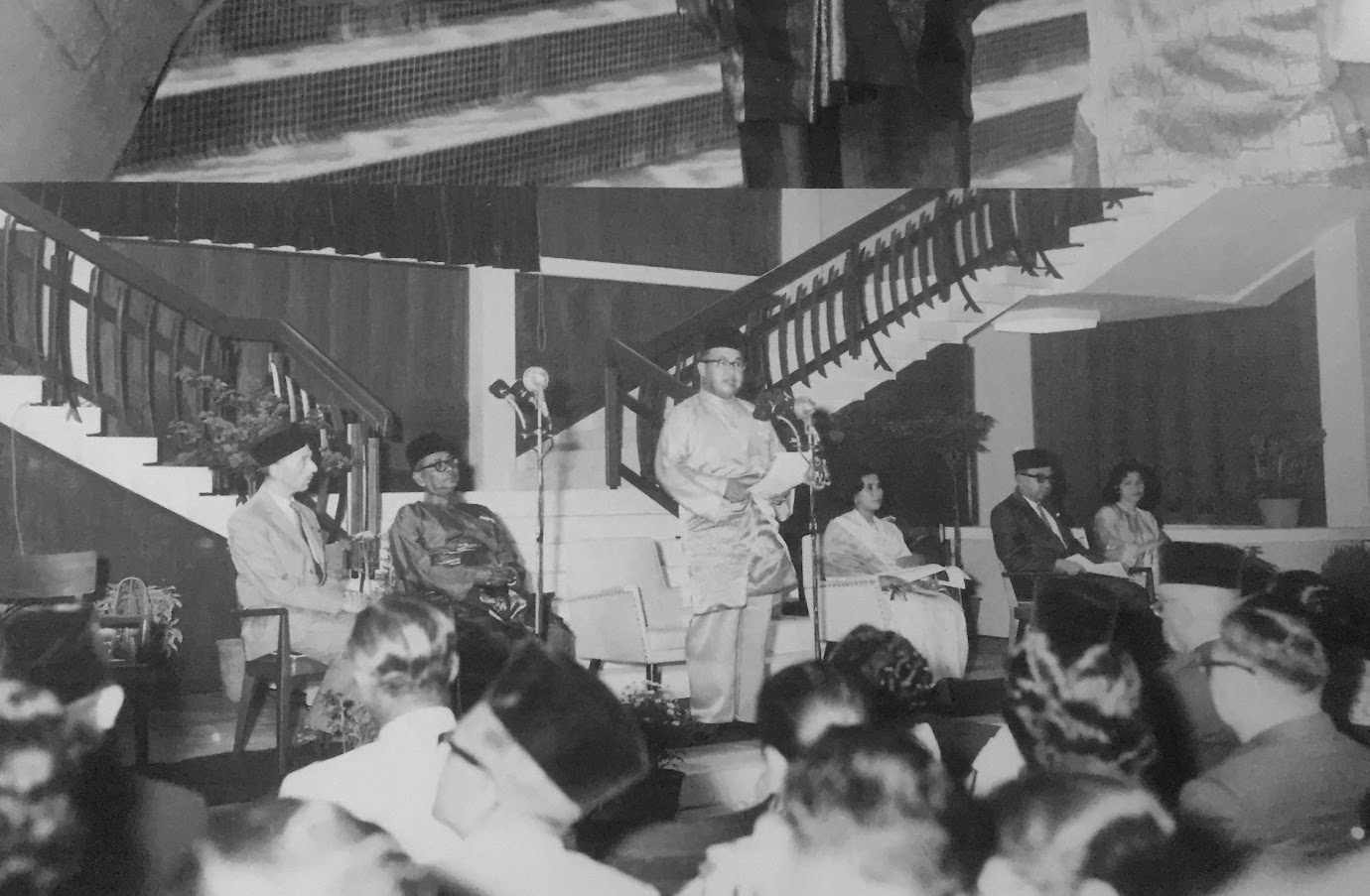
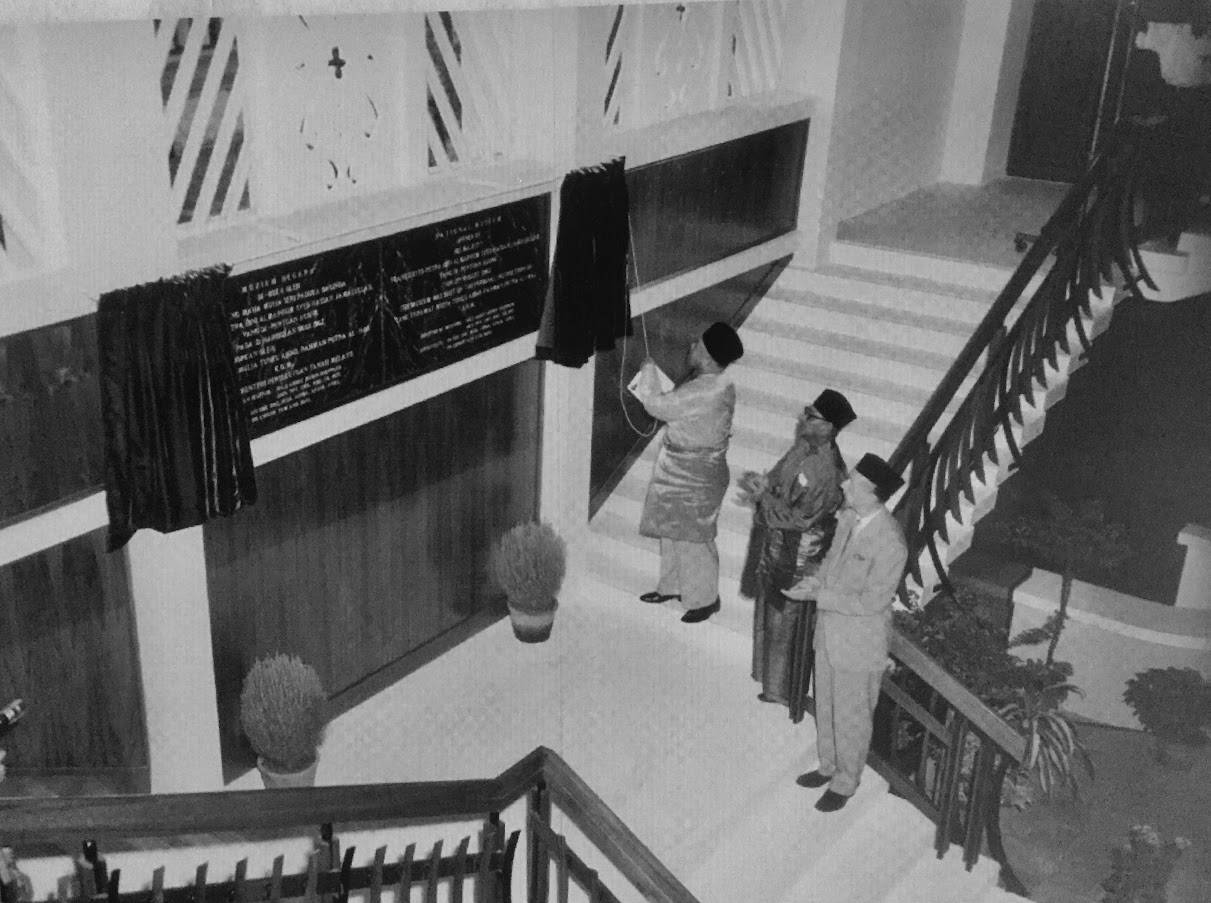
On 31 August 2023, our country celebrated its 66th National Day. This auspicious day also marked the 60th anniversary of Muzium Negara / National Museum since its establishment. The National Museum was officially declared opened by the Third Yang DiPertuan Agong, Tuanku Syed Putra Al-Haj Ibni Almarhum Syed Hassan Jamalullail (Raja of Perlis) in 1963.

The opening of Muzium Negara on 31 August 1963 / Photo source: National Museum’s 60th Anniversary Exhibition: A Retrospective. 

The present Muzium Negara building was constructed on the site of the former Selangor Museum which stood from 1906 to 1945. On 10 March 1945, a part of the building was mistakenly bombed by the Allied Forces and many artefacts were moved to the Perak Museum in Taiping. After Malaya’s Independence, the idea of establishing a National Museum was mooted and plans to build one was announced in 1959. Ho Kok Hoe, an architect from Singapore was commissioned to design the building and in 1961, Tunku Abdul Rahman endorsed the architectural design. 

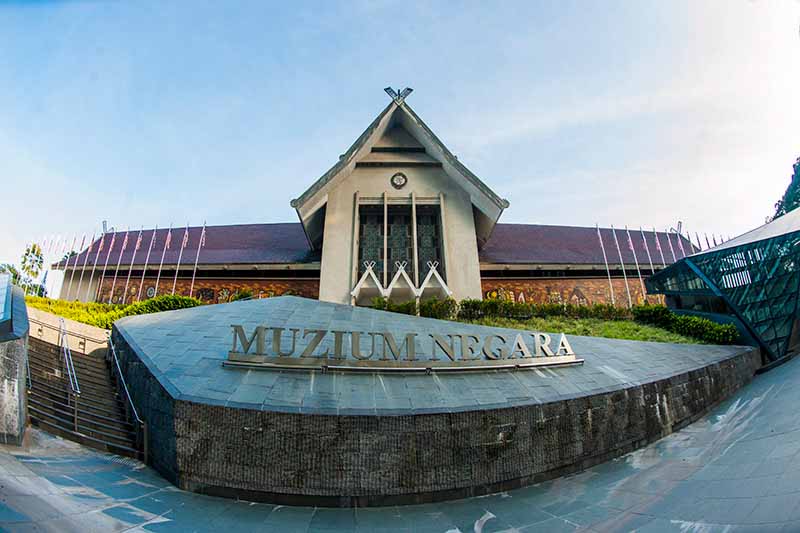
The design is based on the architectural characteristics of the palaces of the Malay Kings and another unique feature is the two huge murals made of Venetian glass mosaic that cover the facade of the building. The murals highlight the history and craft of the country respectively and it was designed by Cheong Lai Tong. The mosaic tiles were donated by Lee Kong Chian (of Lee Rubber) and Tan Kah Hee (founder of Xiamen University, China). Also, the tiles in the main hall were contributed by the Government of Pakistan. Back then, the National Museum together with Parliament house, National Monument (Tugu Negara) and the Lake Gardens (Perdana Botanical Garden today), formed a large recreational space. And the National Museum was certified a National Heritage Building under the National Heritage Act 2005 on 11 August 2015.

Muzium Negara / Photo source : National Museum

In conjunction with the jubilee anniversary celebration, the Department of Museums Malaysia (Jabatan Muzium Malaysia / JMM), organized a host of activities for four days starting from 31 August to 3 September. It includes two major exhibitions, National Museum’s 60th Anniversary Exhibition : A Retrospective at the main hall and Malaysia My Motherland Exhibition at Galeri 2, both running from 31 August to 31 October. Besides exhibitions, other programmes were Echo : Poetry Night, Mini concert, Media & Strategic Partner Appreciation Ceremony, National Museum 60th Anniversary Run (Mini Marathon) and launching of the Time Capsule by the Minister of National Unity, Aaron Aro Dagang at the official opening ceremony held on 1 September. 

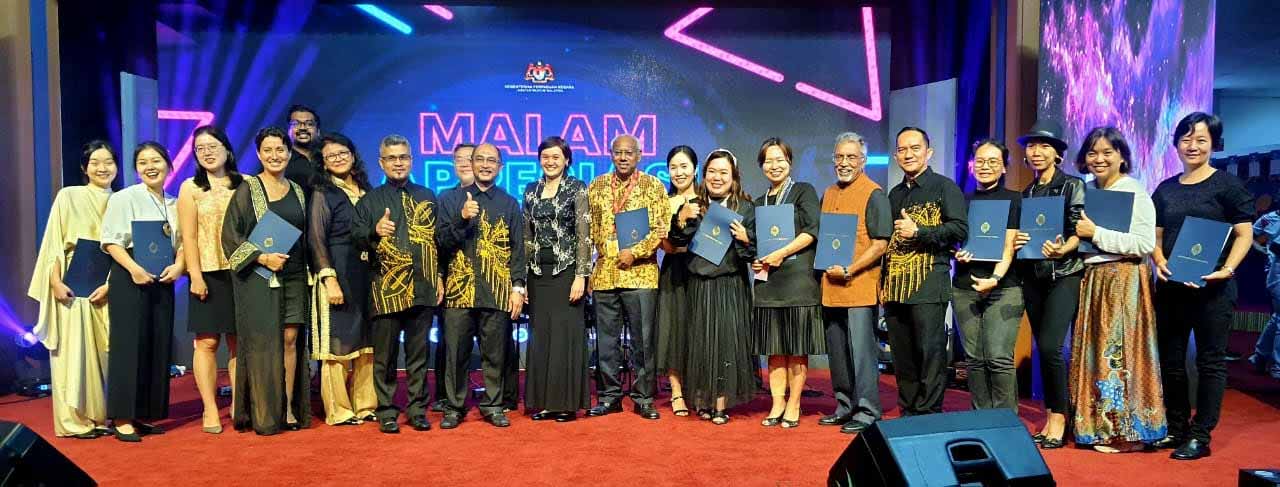
Museum Volunteers (MV) which is a non-profit, non-political and non-religious group supported by the Department of Museums Malaysia and based at Muzium Negara, was invited to some of the events. The highlight was the giving away of graduation certificates by the Director General of the Department of Museums Malaysia to graduates from Batch 38 and 39 at the Media & Strategic Partner Appreciation Ceremony held on the evening of 1 September at the Mainstage (Pentas Utama). It was truly a memorable occasion for the fresh graduates as it was the first time that it was organized on such a grand scale. At the same function, JMM also awarded a certificate to senior MV member, V. Jegatheesan (fondly known as Jega) for his significant contributions to the group.

MV graduates and Jega with their certificates.
Photo source: Courtesy of Lim Ee Lin

MV members also took part in the National Museum 60th Anniversary Run (Mini Marathon) that was held on 3 September 2023. The run was separated into two categories, namely the 5km Fun Run and the 10km Run.

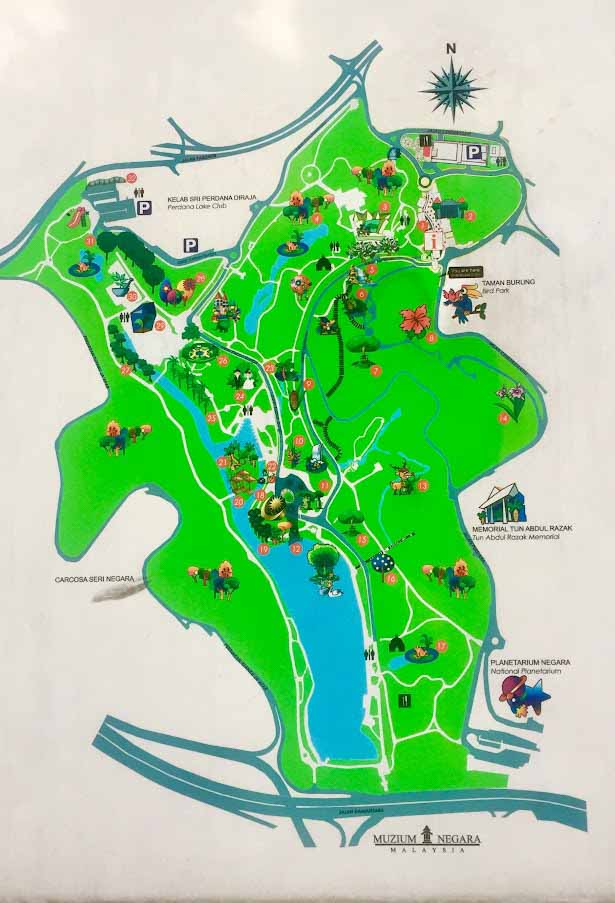
A map of the 10km marathon route. Photo source: Eric Lim

The longer route covered the perimeter of Perdana Botanical Garden with a detour towards Masjid Negara (National Mosque), and a turnaround before heading back to the garden to the finishing line at Muzium Negara.

Enroute, we passed the following sites:
Royal Lake Club Kuala Lumpur (Kelab Taman Perdana DiRaja Kuala Lumpur)
It was founded on 16 August 1890, two years after the Lake Gardens was established. Initially set up for the British working in the country, it has since evolved to become a leading cosmopolitan social club. In 1985, the name changed to Royal Lake Club when it was bestowed the royal patronage by the late Sultan Salahuddin Abdul Aziz Shah of Selangor.

KL Bird Park
The KL Bird Park is the world’s largest free flight walk-in aviary. It is home to more than 3,000 birds comprising over 200 different species. It was opened in 1991.

Tun Abdul Razak Memorial
It was the official residence building of our second Prime Minister, Tun Abdul Razak, from 1962 until his passing in January 1976. It was then known as Sri Taman Building. The building was later turned into a museum and was officially opened to the public on 6 May 1982 to commemorate his service and contributions to the country.

National Planetarium (Planetarium Negara)
It had its soft opening to the public in 1993 and was officially opened by the then Prime Minister, Tun Dr Mahathir Mohamad on 7 February 1994. The National Planetarium is within walking distance from Muzium Negara, connected by an overhead pedestrian bridge.

I was initially undecided whether to go for the fun run or 10km but thanks to fellow MV Emna who coaxed me into taking the longer route. I managed to complete within the time limit but I must admit that I lost out to avid runner and Hong Kong actor, Chow Yun Fat who still continues his running regimen in spite of the injuries he suffered two months ago. Kudos to fellow MVs who completed the run, short or long. The run was a perfect wrap up for the Muzium Negara celebrations.

MVs with their finishing medals.
Photo source: Courtesy of Kulwant Kaur

References

HK actor Chow Yun-fat continues to run despite doctors’ orders to stop following fall | Malay Mail: https://www.malaymail.com/news/showbiz/2023/08/15/hk-actor-chow-yun-fat-continues-to-run-despite-doctors-orders-to-stop-following-fall/85336

Lake Gardens Kuala Lumpur | Attractions | Wonderful Malaysia: https://www.wonderfulmalaysia.com/attractions/lake-gardens-kuala-lumpur.htm

Memorial Tun Abdul Razak: http://www.arkib.gov.my/web/guest/memorial-tun-abdul-razak3

National Museum: http://www.muziumnegara.gov.my/en/national-museum

Royal Lake Club: https://www.royallakeclub.org.my/

Malaysia Tanah Airku – Curator’s Tour

Article by Subramaniam a/l A V Sankar

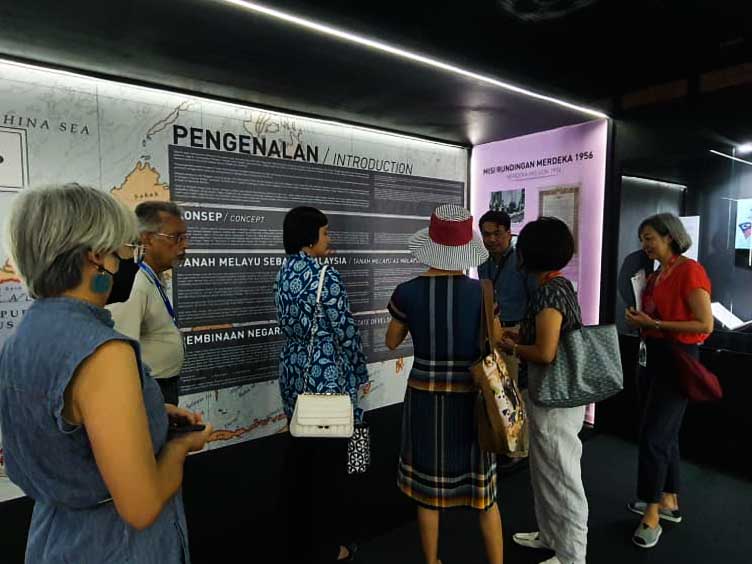
Curator Encik Nasrulamiazam giving us a walk-through of the exhibition.

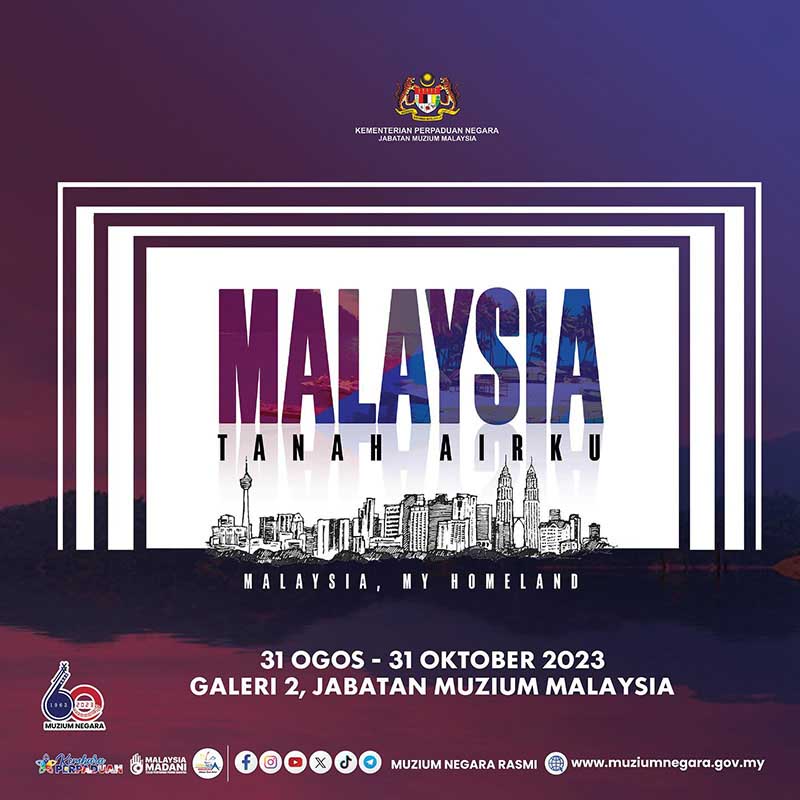
The exhibition poster. Source: Muzium Negara

6 fortunate MVs who could respond to a 1-day notice were fortunate to have had a conducted tour of the exhibition Malaysia Tanah Airku (Malaysia, My Homeland) on Thursday 7th Sept, by the exhibition Curator himself, Encik Nasrulamiazam, the Deputy Director of Muzium Negara, now being held at Gallery 2 in Muzium Negara until October 2023.

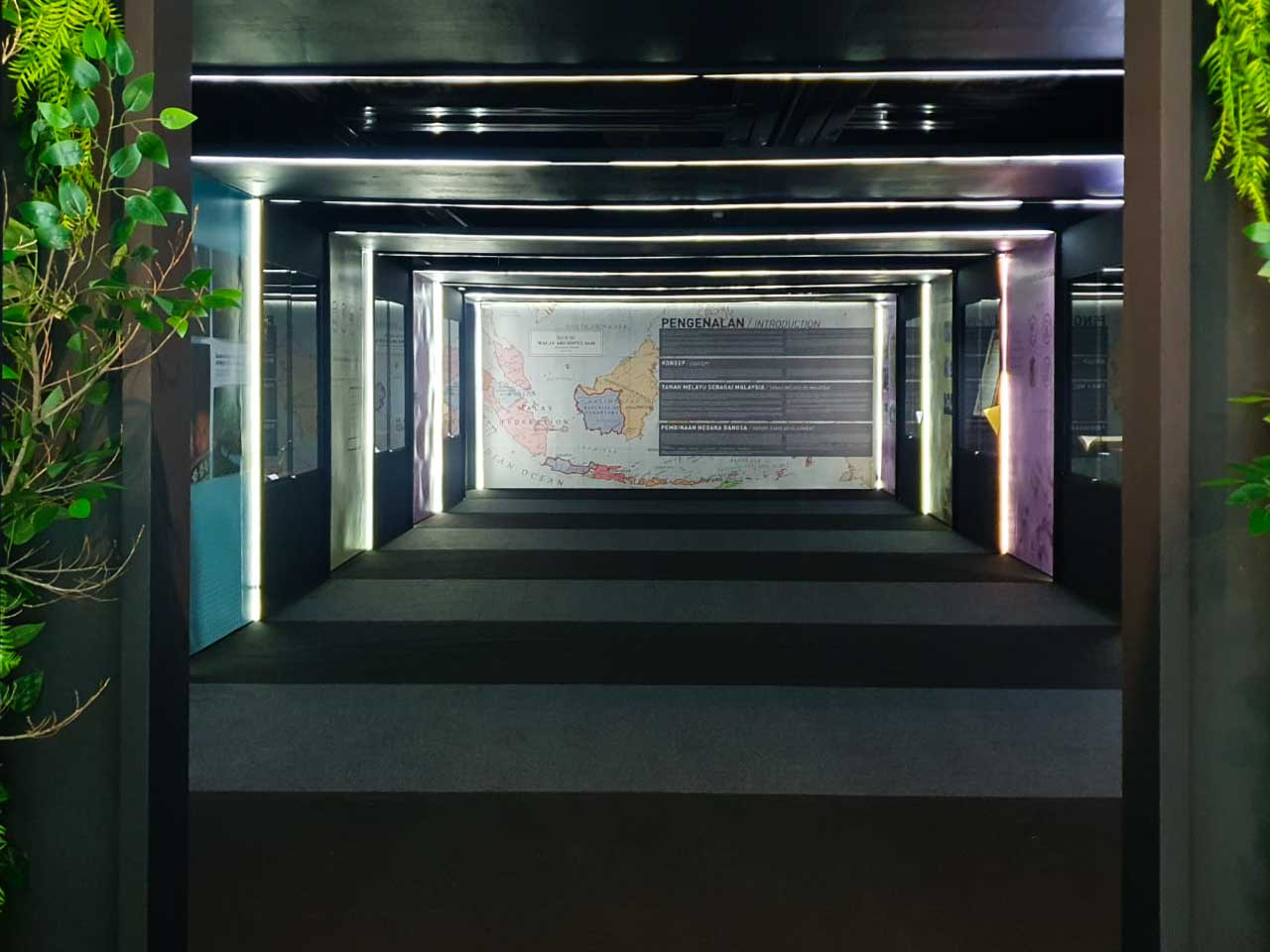
The exhibition is shown through 7 sections within starting with the early history of Tanah Air – the archipelago and island territories of South east Asia stretching from Indo-China to Indonesia.

At the introduction section of the exhibition.

These lands were also referred to as Nanyang in the Chinese records, Suvarnabhumi and Golden Chersonese in Indian and European records and comprised lands populated by expert Malay seafarers who facilitated trade all the way from China to India.

In this 1st section, Tanah Airku, our own part of that world, Malaysia is highlighted! Various texts by varied international scholars and traders are exhibited in the 1st gallery to show the importance of our nation in the ancient world.

There are many rare, 1st edition copies of Merdeka news and Articles here to capture the mood of independence in 1957.

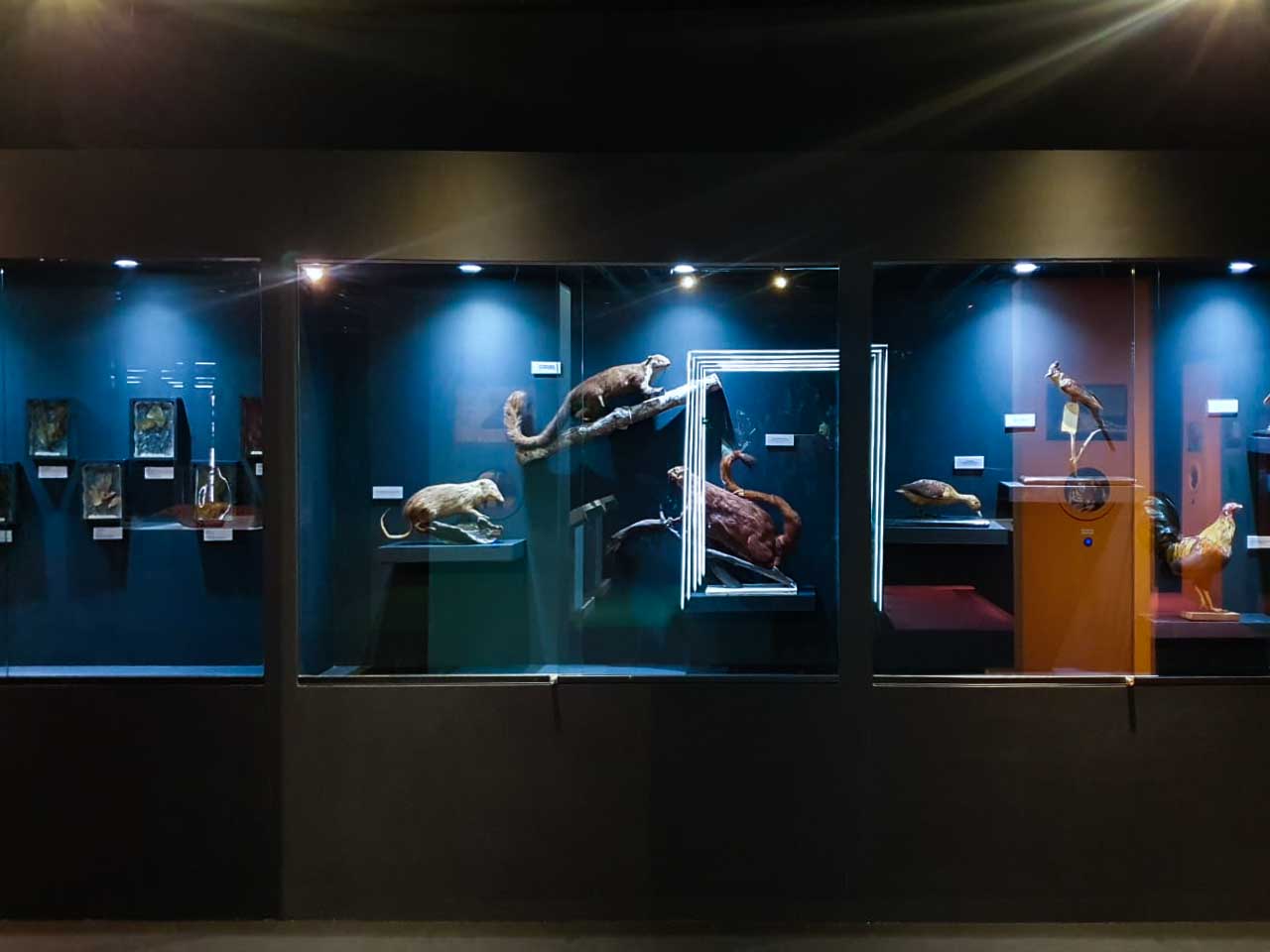
In the next gallery is a fascinating insight into various selected flora and fauna in our country.

A display of the taxidermy collection.

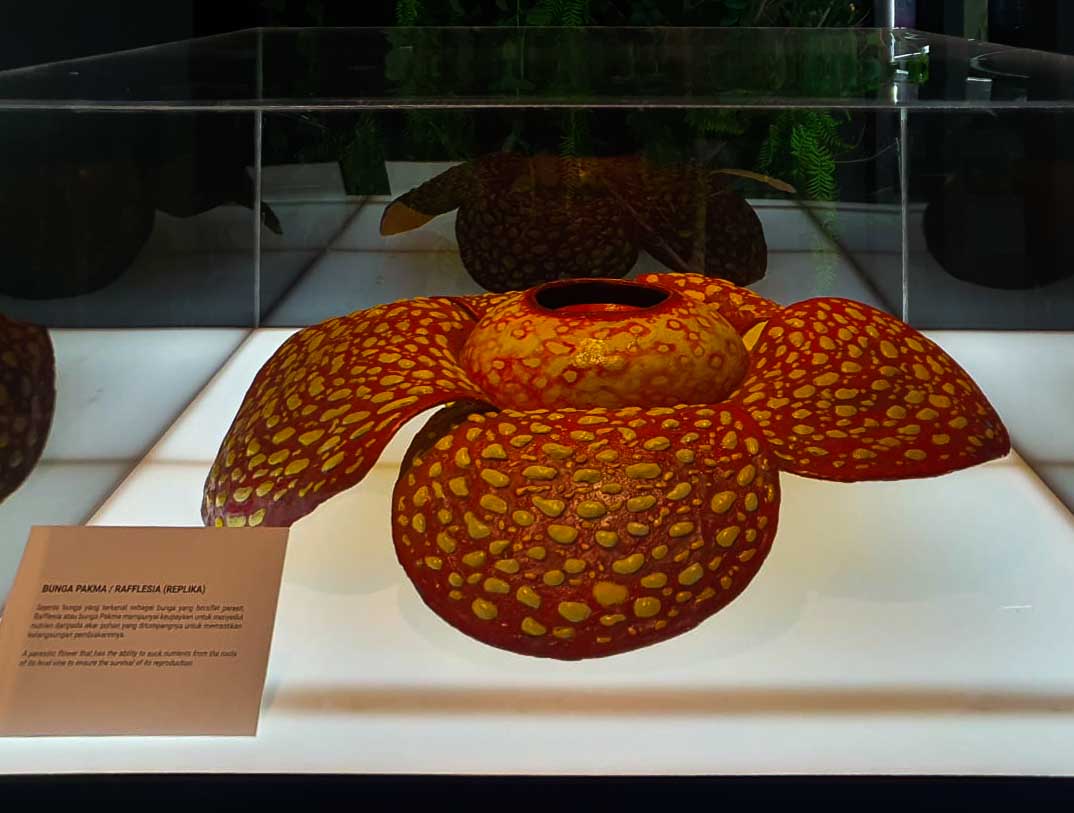
The flora shown is mostly of those used as herbs with medicinal qualities, a very educational insight into the richness of our tropical flora.

A replica of the rafflesia.

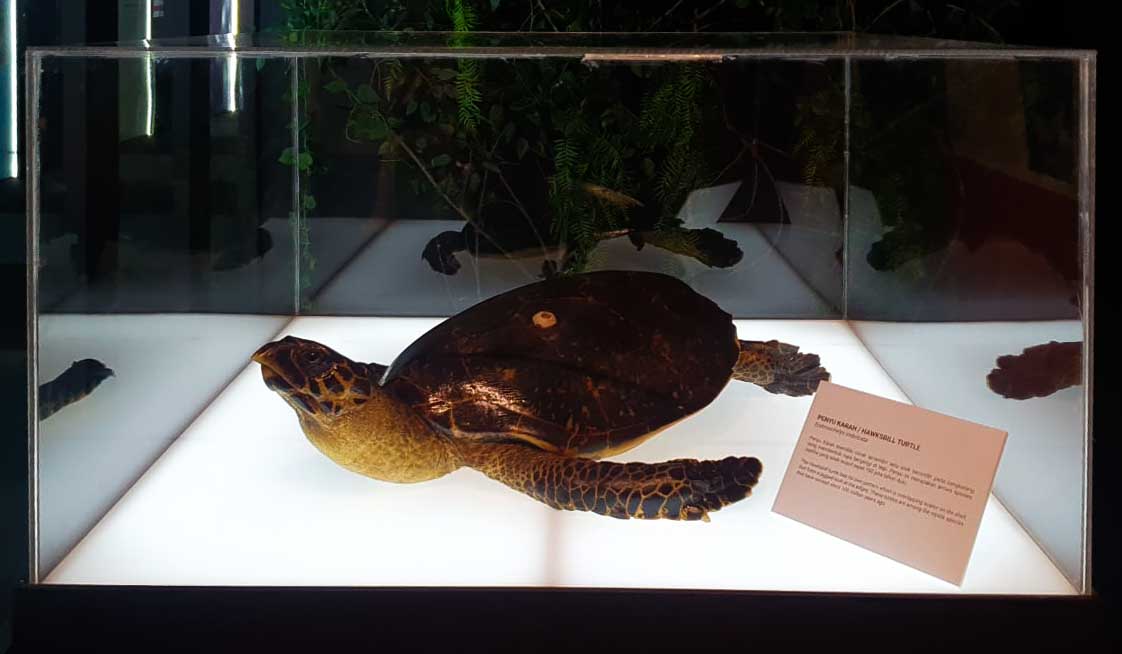
The fauna is shown through expert taxidermy work on various birds, reptiles and mammals and highlights the colourful diversity found here. It is a great chance to get close to wild animals in safety!

The hawksbill turtle.

In section 3, we get to see panoramic photos of iconic buildings in places around the country both as stills and videos. The quality of the photography is breathtaking and gives a unique, bird’s eye view of many familiar, iconic features, like the KL Mosque, to give a fresh insight and a 3D view to provide mesmerizing new angles to sights we thought we knew.

The exhibition then moves to the entertainment scene and highlights particularly the versatility of our cartoonist, Lat and film and acting legend, P Ramlee through their many cartoons and films, a nostalgic reminder to all.

The last gallery shows our sporting legends like Lee Chong Wei and other sports achievements in the country with displays of some of the old soccer and rugby trophies that were gloriously earned.

The exhibition is a work of love and done with passion by the Curator and well worth a visit to get the ‘feel good’ effect we enjoyed.

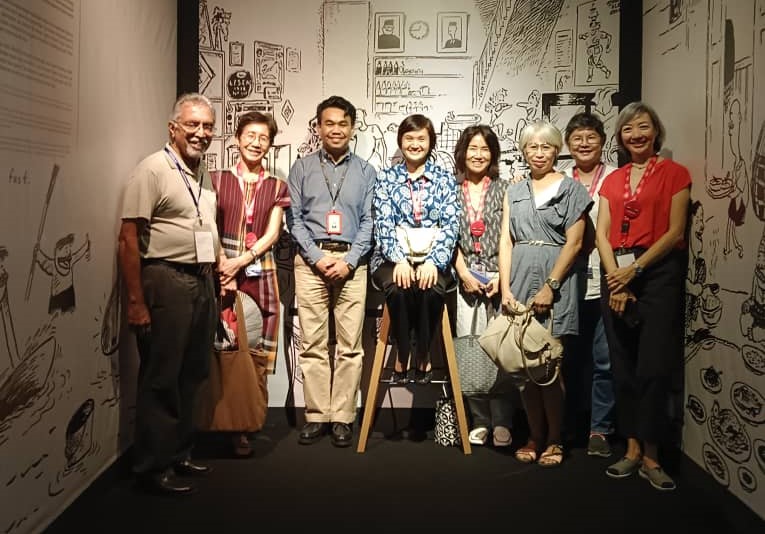
Our group photo with the Curator.

Heartfelt thanks to Curator Encik Nasrulamiazam for his efforts and explanations.