By Emna Esseghir
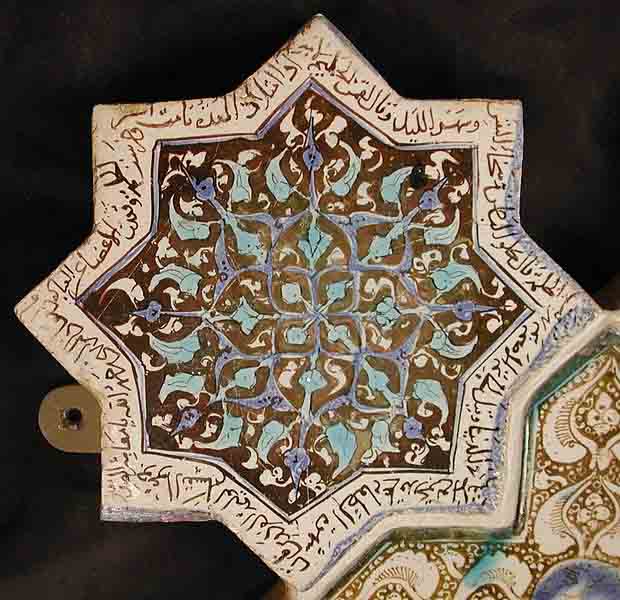
An eight-pointed star-shaped tile.
Image source: https://www.metmuseum.org/art/collection/search/444459
Introduction
Stars have perpetually held a captivating allure for humanity, drawing us into realms of scientific fascination, artistic ingenuity, and profound spiritual significance. These celestial entities have not merely fueled our scientific explorations, revealing their diverse classifications and intricate life cycles, but have also ignited the creative flames of art, poetry, and mythology, enduring as timeless symbols of hope and beauty.
In the realm of religion, stars occupy a revered position across various faiths and cultures, embodying divine manifestations, celestial emblems, and sources of spiritual guidance. Beyond these multifaceted dimensions, stars serve as a unifying thread that transcends both time and cultural boundaries, binding us together through our insatiable curiosity, our enduring spiritual connection to the cosmos, and our collective awe at the enigmatic mysteries of the universe.
In this article, I will delve deeper into the study of the eight-pointed star, a compelling exemplar of how celestial objects like stars can carry profound significance for humanity, owing to their rich history of symbolism across diverse cultures and religions.
What’s an eight-pointed star?
In geometry, an 8-pointed star is a geometric shape formed by the intersection of two squares, typically with one square rotated at a 45-degree angle relative to the other. It features eight distinct points or vertices radiating outward from a central point. The resulting figure often resembles an octagonal star and is commonly referred to as an octagram. This shape exhibits symmetry and can be constructed using various geometric methods.
The regular octagram is characterized by equal-length sides and angles, lending it a balanced and uniform appearance. It can also exhibit different variations.

Different variations of 8-pointed star.
Image source: https://www.outofstress.com/8-pointed-star-meanings/
Meanings and origins of the 8-pointed star
Its octagonal structure serves as a distinctive emblem, signifying both protective qualities and guidance, owing to its direct alignment with the eight cardinal directions. Moreover, this celestial symbol maintains a profound connection with the number 8, a universally recognized symbol of significance and good fortune across diverse cultural landscapes. Furthermore, the star’s octagonal shape has been associated with the eight phases of human spiritual growth.
Consequently, the 8-pointed star emerges as an exceptionally versatile symbol, possessing multifaceted applications encompassing realms such as spiritual healing, the facilitation of manifestation, and the attraction of positive energies.
The 8-pointed star holds immense cultural and religious significance across various historical contexts. It symbolizes celestial entities like the moon, sun, planets, stars, and comets. Its origins trace back to ancient Mesopotamia, particularly Babylon, where it was closely associated with the goddess Ishtar. Ishtar held sway over domains such as love, fertility, and warfare, and she bore a connection to the planet Venus, often referred to as the Morning Star.
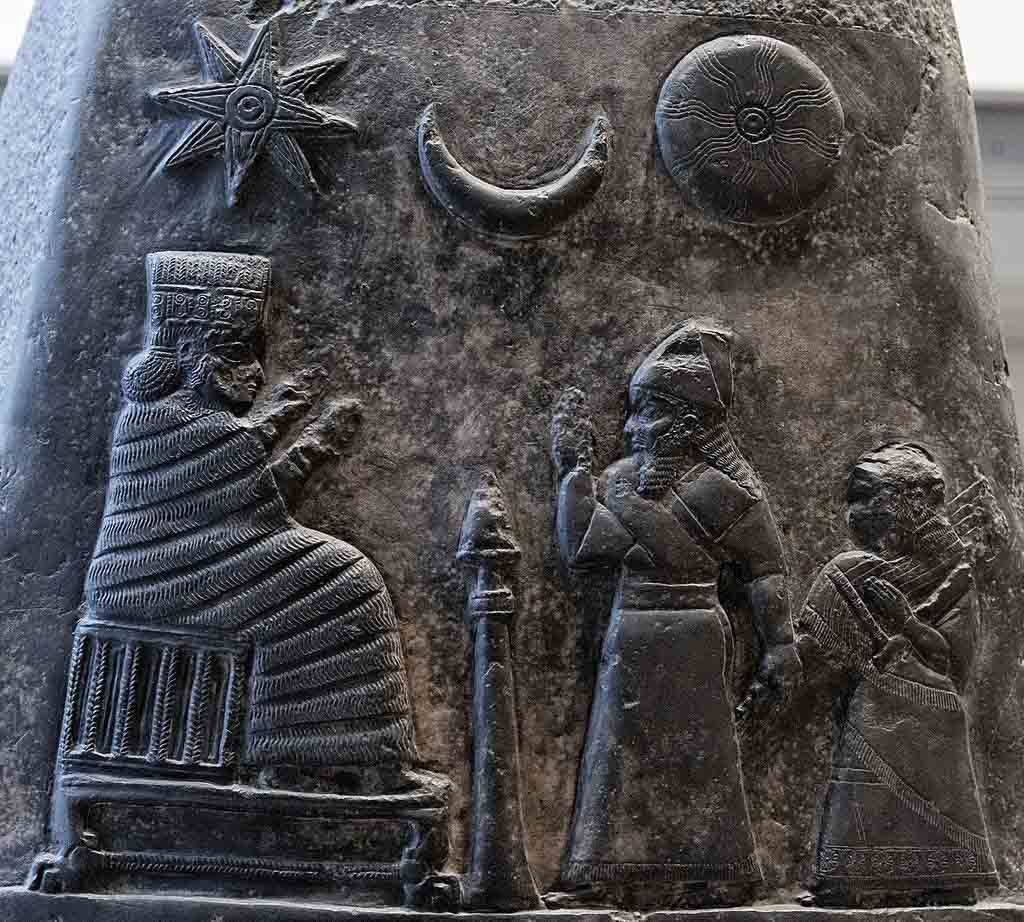
Depiction of the star of Ishtar (Image source: Jastrow via Wikipedia)
The eight-pointed star’s significance is not confined to a single cultural sphere, but rather extends its influence across diverse global civilizations. For instance, among Canada’s indigenous peoples, the eight-pointed star serves as a representation of the sun radiating its brilliance in all directions. Furthermore, several formerly Soviet republics, upon gaining independence, incorporated the eight-pointed star into their national flags, symbolizing the sun, as exemplified by the flag of Azerbaijan.
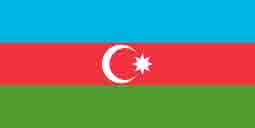
The flag of Azerbaijan (Image source: Wikipedia)
The 8-pointed star holds a prominent position within Islamic art and architecture. Emma Clark, as detailed in her book “The Art of the Islamic Garden,” elucidates that this symbol signifies God’s Throne. This symbolism is rooted in a Quranic verse that prophesies the presence of 8 angels flanking God’s Throne on the Day of Judgment, correlating with the 8 points of the star. Remarkably, upon the Throne, an inscription reads, “My Mercy Supercedes My Wrath,” instilling a profound sense of hope in God’s boundless mercy and the prospect of salvation.

“And the angels are at its edges. And there will bear the Throne of your Lord above them, that Day, eight [of them]”
SURAH AL-HAQQAH AYAT 17 (69:17 QURAN)
This numerical symbolism extends to the architectural layouts of various mosques, with notable examples including the Al-Aqsa Mosque and the Dome of the Rock with Najmat al Kods, traditionally believed to occupy the site of Solomon’s Temple.
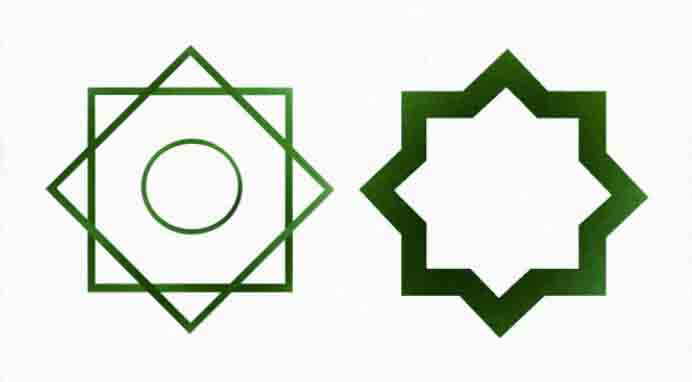
The Rub-el-Hzib and the more floral Najmat-al-Quds
(Image source: https://farbound.net/najmat-al-quds-star-of-jerusalem-humayuns-mausoleum-nizzamuddin-east/)
Also, its predecessor, the symbol Rub El Hizb, characterized by two intersecting squares enclosing a central circle, holds particular significance within the Islamic context: in Arabic, the expression “Rub El Hizb” signifies an object or concept divided into quarters, visually reflected in the symbol itself, where two squares have their edges divided into segments.
Historically, Muslims employed the Rub El Hizb as a tool for the recitation and memorization of the Quran. The symbol serves to represent each quarter of a “Hizb,” which designates a distinct section within the holy Quran.
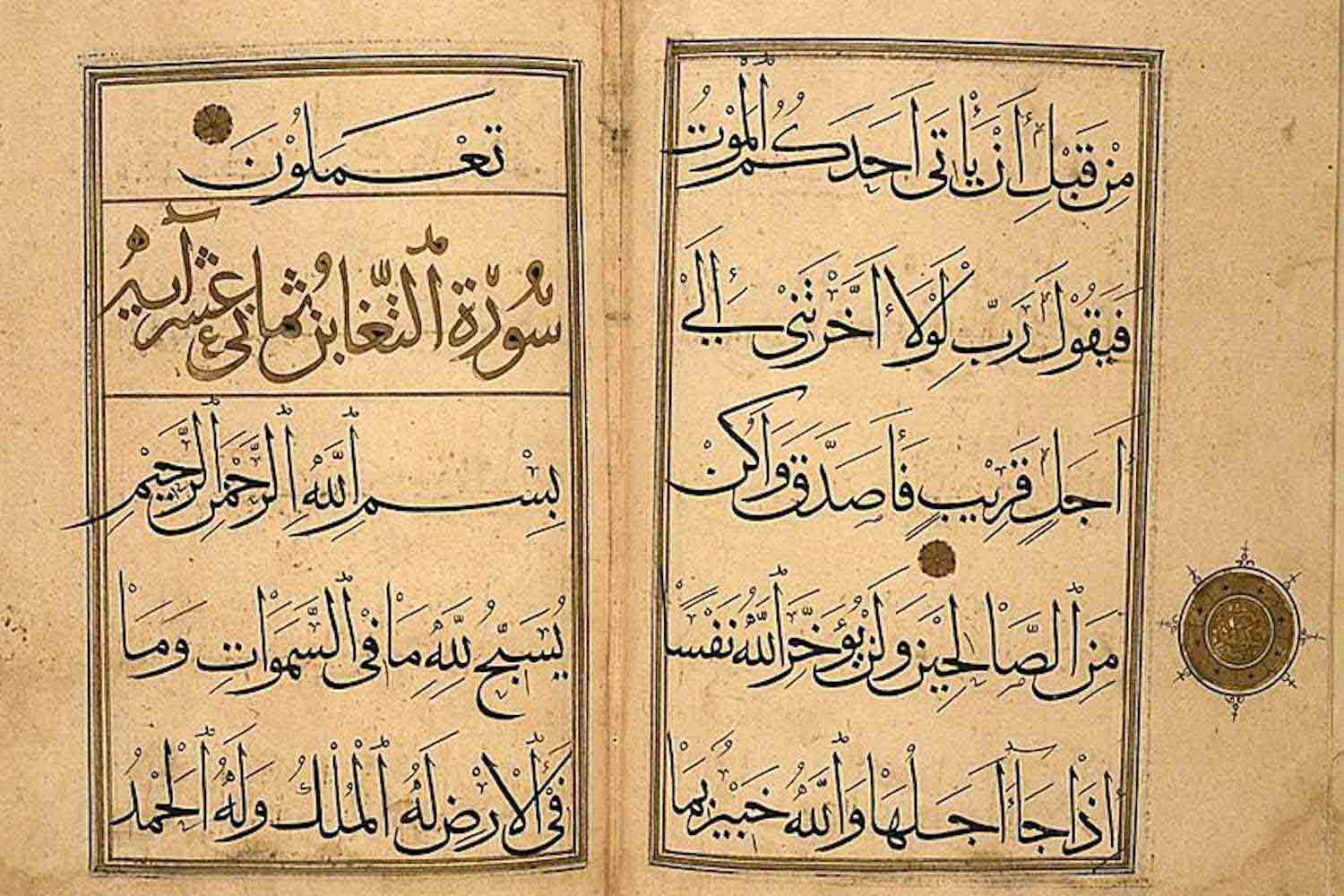
Rub El Hezb Symbole (Image source : LACMA/Wikimedia Commons/Public Domain)
In the world of Central Asian art and culture, the eight-pointed star enjoys prominence in numerous blue ceramic mosaics, exemplifying its enduring cultural appeal.
Within Christian sacred art, the eight-pointed Star of Bethlehem plays a pivotal role, guiding the three wise men to the birthplace of Christ and symbolizing the nativity of Christ and the redemption he offers to humanity.
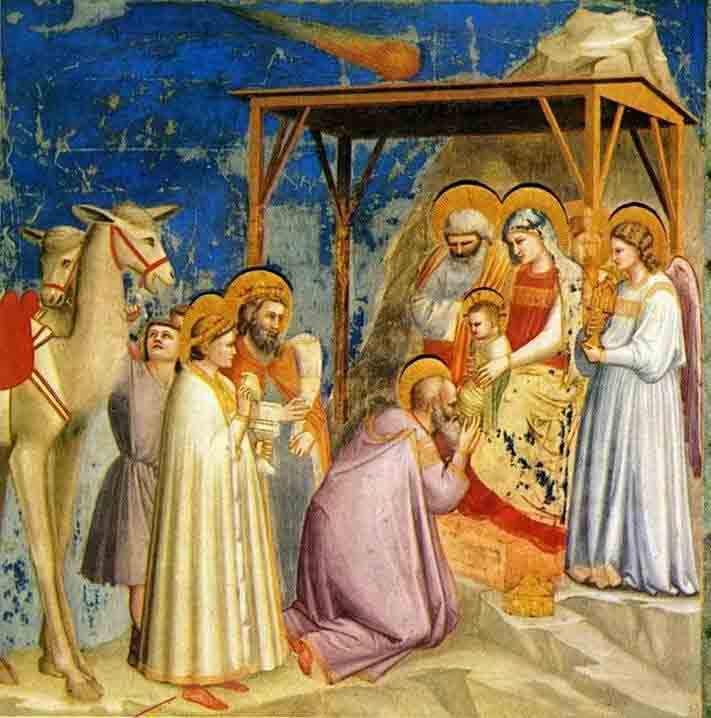
Adoration of the Magi by Florentine painter Giotto di Bondone (1267–1337).
The Star of Bethlehem is shown as a comet above the child.
(Image source: Hohum via Wikipedia)
In Hinduism, the Ashtha Lakshmi, also known as the star of Lakshmi, is a symbol made of two squares placed on top of each other at a 45-degree angle. This symbol represents the eight different forms of the goddess Lakshmi. Lakshmi is highly regarded as the goddess of fortune, wealth, and abundance.
This symbol is widely recognized and appreciated for its simplicity and is shared among various religions and civilizations around the world.
The initial emergence of the eight-pointed star in Islamic symbolism
Built between 687 and 691 A.D. during the rule of Arab Caliphs Abd-al-Malik and Al Walid I of the Umayyad dynasty, the Dome of the Rock stands as a significant achievement in Islamic architecture. It also served as an educational hub for Arabian architects and artists.
Inspired by Sassanid Persians, the Arabs embraced features like grand arches, ornate ornamentation, and Persian-style gardens. They also learned from the Byzantines how to construct large domes on tall drums, a technique seen in later Islamic structures worldwide, including the mausoleum of Humayun in Hindustan and the Taj Mahal.
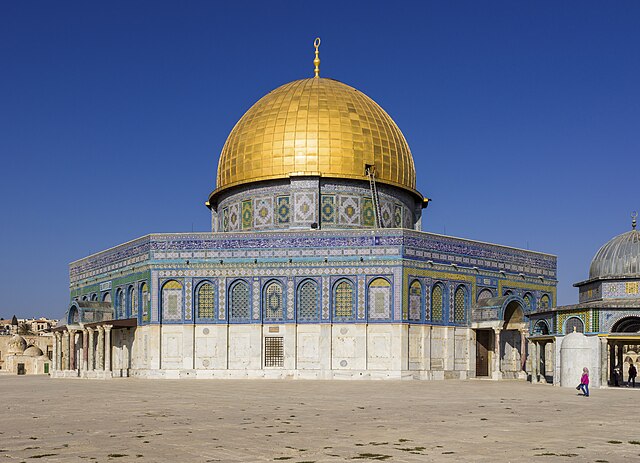
The Dome of the Rock.
(Image source: Andrew Shiva via Wikipedia | CC BY-SA 4.0)
The Dome of the Rock took cues from early Roman-Byzantine structures with an octagonal floor plan, a fusion of circle and square. It was crafted by Byzantine Christian artisans following Islamic guidelines, fostering the exchange of construction techniques, interior design, and a passion for mathematics, especially geometry, among the Muslim Arab community.
Inside, the shrine featured intricate marble works, glass mosaics, and Arabic calligraphy. The eight-pointed star emerged as a symbol, blending into the decor and architectural design.
The most famous eight-pointed star in Malaysia
At the outset, the twin towers were conceived with a modest height of 1400 feet (427m) in mind. However, it was the vision and determination of Dr. Mahathir that transformed them into a global architectural marvel. He saw the potential for these towers to not only be significant structures but also iconic symbols of Malaysia’s ambition and identity on the world stage.

The design of Petronas tower.
(Image source: https://www.petronastwintowers.com.my/)
The PETRONAS Towers’ connection to Islamic symbolism is strikingly evident in their design, which forms an eight-pointed star when viewed from above. This architectural choice holds profound cultural and symbolic significance in Islamic tradition. The eight-pointed star symbolizes unity, harmony, and stability, reflecting the principles of balance and togetherness. Islamic art and geometric patterns heavily influence the towers’ aesthetics.
This incorporation of Islamic symbolism and aesthetics is a testament to the architects cultural sensitivity, acknowledging Malaysia’s Islamic heritage while simultaneously projecting the nation’s modernity and ambition on the global stage. The PETRONAS Towers stand not only as architectural marvels but also as iconic representations of Malaysia’s rich cultural tapestry and its its harmonious blend of tradition and progress.
References
- Eight Pointed Star Rug Design: https://nazmiyalantiquerugs.com/area-rug-guide/motifs-symbols/eight-pointed-stars-rug-design-motif/#:~:text=Christianity%3A%20In%20Christianity%2C%20the%208,the%20birth%20of%20Jesus%20Christ.
- Giotto – Scrovegni – -18- – Adoration of the Magi: https://commons.wikimedia.org/wiki/File:Giotto_-_Scrovegni_-_-18-_-_Adoration_of_the_Magi.jpg?uselang=en#Licensing
- Juz’ 1 of the Quran : https://www.learnreligions.com/juz-1-of-the-quran-2004552
- Learn About the Meaning of an Eight Pointed Star : https://mythologian.net/learn-about-the-meaning-of-an-eight-pointed-star/#:~:text=The%20eight%2Dpointed%20star%20represents,Hope%20symbol%20as%20Star%20Knowledge.
- PETRONAS Twin Towers: https://www.petronastwintowers.com.my/
- Rub el Hizb : https://en.wikipedia.org/wiki/Rub_el_Hizb
- Star of David : https://www.researchgate.net/publication/304113265_Star_of_David
- Symbolic attribute of the eight-pointed star and its relation to Imam Reza (AS) based on the numbers science (abjad) : https://hsi.kashanu.ac.ir/article_111923.html?lang=en
- The star that is a landmark in Islamic architecture. : https://farbound.net/najmat-al-quds-star-of-jerusalem-humayuns-mausoleum-nizzamuddin-east/
- What You Should Know About Octagrams – Eight-Pointed Stars : https://www.learnreligions.com/octagrams-eight-pointed-stars-96015

 Museum Volunteers, JMM
