Emna Esseghir

Magic bowl, engraved with Arabic inscriptions (Quranic verses and prayers) and with engraved brass tags (charms or ‘keys’) attached, exhibited at the British Museum.
(source: https://www.britishmuseum.org/collection/object/W_1921-1025-5)
History of Magic:
The history of magic is a fascinating tapestry woven through the fabric of human civilization. Its roots extend deeply into ancient cultures worldwide, often entwined with religious practices, folklore, mysticism, and the pursuit of understanding the unknown.
Ancient civilizations across Mesopotamia, Egypt, Greece, and Rome held beliefs in magical practices, rituals, and individuals possessing supernatural abilities. These practices were often intertwined with religious ceremonies, healing rituals, and attempts to control natural forces.
In the Middle Ages, magic became associated with both mystical spirituality and the occult. Alchemists sought to transform base metals into gold and create elixirs of immortality, merging scientific experimentation with mystical beliefs.
During the Renaissance, the line between science, magic, and philosophy blurred further. Thinkers like Paracelsus explored the concept of a universal healing force, while figures like John Dee engaged in mystical practices and attempted to communicate with angels through rituals.
The Age of Enlightenment brought forth a shift toward empirical science, causing a divide between magical thinking and scientific reasoning. This era witnessed a decline in the societal acceptance of magical practices, which were often seen as superstitions or fraudulence.
However, interest in the occult, mysticism, and esoteric practices persisted in secret societies and among individual practitioners. The 19th and 20th centuries saw a revival of magical traditions, with movements like Theosophy, Hermeticism, and the study of ancient mystical texts gaining traction.
Today, magic persists in various forms, from stage illusions and entertainment to spiritual practices like Wicca, paganism, and various occult traditions. Modern practitioners often draw inspiration from ancient texts, folklore, and a diverse array of spiritual beliefs, seeking a deeper understanding of the mystical and the unknown within the framework of contemporary society.
Magic in Islam:
Magic within Islam holds a complex and nuanced position. The Quran acknowledges the existence of magic, referring to it as real but also as a forbidden practice. Islamic teachings distinguish between miracles performed by prophets with God’s permission and acts of magic, which are considered acts of deception and disobedience.
The practice of magic, or “sihr” in Arabic, involves invoking supernatural forces to perform actions that are beyond natural laws. Islam strictly prohibits the use of magic as it involves seeking power from sources other than God, leading to falsehood and harm. Those who practice magic are considered to be engaging in activities that are contrary to the teachings of Islam.
However, Islamic traditions also acknowledge the existence of protective measures against magic, known as “ruqyah.” This practice involves reciting specific verses from the Quran or prayers seeking protection from harm caused by magic or evil spirits. It’s seen as a permissible form of seeking refuge in God’s guidance and protection.
The concept of jinn, spiritual beings made of smokeless fire, is often associated with magic in Islamic belief. Some believe that certain practitioners of magic use jinn to perform their sorcery, although such actions are condemned in Islam.
Magic Medicinal Bowl
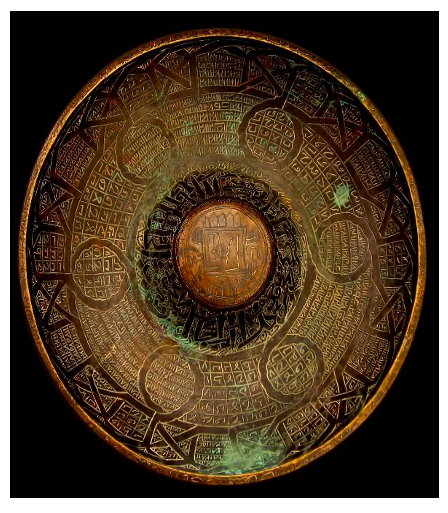
Magic Medicinal Bowl
(Image source: https://www.michaelbackmanltd.com/archived_objects/islamic-magic-bowl/)
In the captivating world of Islamic artistry, an exquisite array of artifacts unravels a narrative beyond mere aesthetics, revealing a profound tapestry interwoven with spiritual beliefs and cultural resonance.
Nestled among these treasures, the enigmatic allure of magical bowls unveils a saga that intertwines mystical beliefs, masterful craftsmanship, and spiritual rituals, encapsulating the essence of Islamic cultural depth. These enchanting vessels, revered for their mystical properties and spiritual significance, epitomize the intricate layers of understanding inherent in Islamic culture.
Every meticulously inscribed stroke of calligraphy serves not only as a visual spectacle but as a deliberate conduit, meticulously chosen to harness the divine power believed to reside within these sacred words.
Beyond their utilitarian function, these bowls held a revered status as conduits of celestial energy and reservoirs of ancient wisdom. The intricate symbols etched onto their surfaces transcend mere adornment, carrying profound layers of spiritual significance and serving as gateways to a realm beyond the physical. In some models, the inclusion of zodiac signs within these bowls further underscores the intimate connection between the celestial and earthly domains, symbolizing the celestial forces’ influence on human destinies and wellbeing.
This harmonious integration of cosmic elements with healing or divination practices showcases the seamless interplay between the mystical and the tangible, a hallmark of Islamic cultural heritage.
The act of filling these bowls transcended a mere ritual; it was a profound ceremony that bestowed the vessel with the potent energy encapsulated within the inscriptions. Partaking in the enchanted elixir was an act of unwavering faith, believed to harness the power of healing or unveil glimpses of the mysterious future. Far beyond their function as mere healing tools, these bowls embodied a collective consciousness, encapsulating the spiritual wisdom and intricate belief systems of their time.
They stand as enduring reminders of the deep reverence accorded to language, writing, and the unseen forces believed to be encapsulated within these meticulously crafted artifacts. The timeless legacy of these magical bowls unveils a mesmerizing fusion of spirituality, symbolism, and material culture within Islamic traditions.
They serve as enduring testaments to the eternal quest for healing, guidance, and spiritual alignment, transcending the limitations of time and continuing to intrigue and inspire across generations.
Some examples of magic medicinal bowl
Example #1
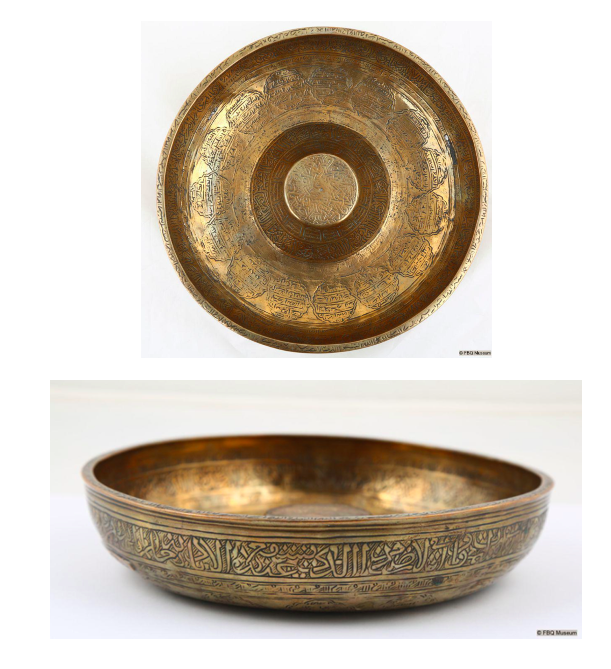
Magic Bowl displayed in Shahaniya, Qatar.
(Image source: https://islamicart.museumwnf.org/database_item.php?id=object;EPM;qt;Mus22;22;en&cp)
Wrapped around this bronze bowl, one finds the protective embrace of Quranic verses, blessings, and mystical symbols—a blend that characterizes the Islamic magic bowls, crafted to shield against fear, ward off evil, and repel malevolent forces like the jinn. These artifacts, originating from Karbala in Iraq, a revered pilgrimage site for Shiite Muslims, have emerged across regions like Syria, India, and Iran since the 12th century. Contrasting with earlier Sasanian bowls adorned with Aramaic inscriptions, these Islamic counterparts, fashioned from metal instead of clay, serve a divergent purpose, seeking protection rather than invoking demonic entities.
Adorning the bowl’s exterior in the graceful thuluth style of Arabic calligraphy is the esteemed Throne Verse (Ayat al Kursi) from the Qur’an, renowned for its talismanic defense. A hexagram, evoking the legacy of prophet Sulayman (Solomon), accompanies this, while nearby inscriptions offer blessings for the body and senses. Symbolically, the vessel’s twelve panels pay homage to the twelve Imams in Shia Islam. Further enriching the significance, the inclusion of science letters (ilm al huruf) attributes mystical properties to the array of letters inscribed on these panels.
Example #2
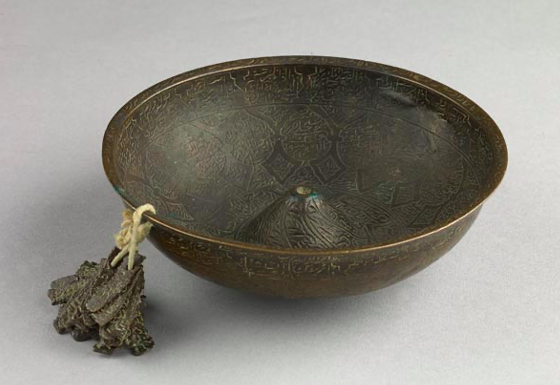
Magic bowl with attached prayer tablets. Probably 19th or 20th century, Iran.
(Image source: https://exhibitions.kelsey.lsa.umich.edu/pearls/objects/bowl2.html)
This model is adorned with intricate inscriptions and an array of zodiac signs, every surface of this metal bowl captivates the eye with its artistry. In the Islamic tradition, such magical bowls were revered for their dual purpose—either for healing or divination. Once filled, it was believed that these bowls infused the liquid they contained with the potent energy imbued in the inscriptions. People consumed this elixir in the hopes of finding relief from ailments or gaining glimpses into what the future held.
At the heart of this bowl lies a prominent central protrusion known as an omphalos or göbek in Turkish, meaning “navel.” Along the rim, a cleverly placed hole allowed for the attachment of a string of tablets referred to as kırk anahtar (forty keys) in Turkish. These tablets, adorned with bismillah prayer formulas, served a purpose akin to prayer beads or rosaries. While this specific bowl displays tablets linked by a string, other existing examples showcase tablets either attached to the rim with metal wire or arranged around the central omphalos. Regardless of their placement, these tablets produced a distinct rattling sound as the bowl was utilized, adding an intriguing dimension to its use.
Example #3
In our museum we have one displayed in Gallery B
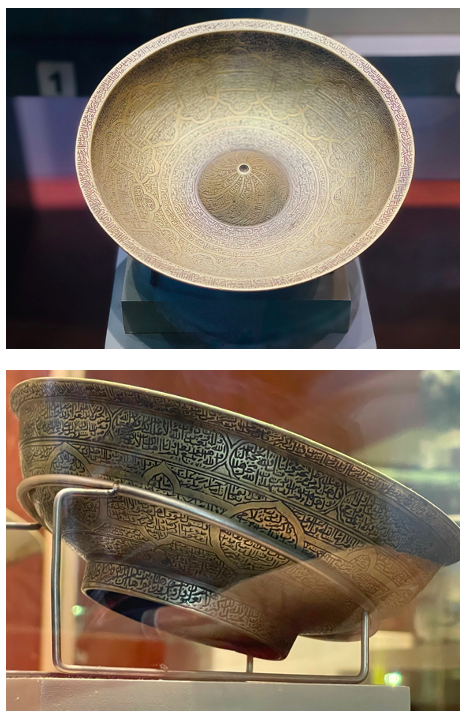
Bronze Bowl dated between14th and 15th century displayed in Gallery B, Muzium Negara. (Image source: Emna Esseghir)
As the previous example, this magical medicinal bowl typically incorporates intricate calligraphy, often Quranic verses or prayers for healing, along with elaborate geometric designs. These bowls are crafted with precision and care, sometimes using specific materials or techniques that are believed to imbue them with healing properties or spiritual significance
The combination of calligraphy and geometric design is intended to create a visually and spiritually powerful object believed to aid in healing or offer positive energy.
The Quranic verses can easily be distinguished from the first line on the bowl with recitations of prayers for the healing of the person who will use it, here some exemples of verses:
SURAH ASSAMAD:
( قُلْ هُوَ اللَّهُ أَحَدٌ (1) اللَّهُ الصَّمَدُ (2) لَمْ يَلِدْ وَلَمْ يُولَدْ (3) وَلَمْ يَكُنْ لَهُ كُفُوًا أَحَدٌ (4
Translation (sahih International) :
“He is Allah, One. He is the One, the Singular, Who has no peer, no assistant, no rival, no equal and none comparable to Him.”
The word (Al-Ahad) cannot be used for anyone in affirmation except for Allah within the Islamic Tradition.
SURAH YUNUS AYAT 107
وَإِن يَمْسَسْكَ اللَّهُ بِضُرٍّ فَلَا كَاشِفَ لَهُ إِلَّا هُوَ ۖ وَإِن يُرِدْكَ بِخَيْرٍ فَلَا رَادَّ لِفَضْلِهِ ۚ يُصِيبُ بِهِ مَن يَشَاءُ مِنْ عِبَادِهِ ۚ وَهُوَ الْغَفُورُ الرَّحِيمُ
Translation (Sahih International)
“And if Allah should touch you with adversity, there is no remover of it except Him; and if He intends for you good, then there is no repeller of His bounty. He causes it to reach whom He wills of His servants. And He is the Forgiving, the Merciful”
References
History of Magic: https://en.wikipedia.org/wiki/History_of_magic
Magic Medicinal Bowl: https://www.michaelbackmanltd.com/archived_objects/islamic-magic-bowl/
Magic, Marvel, and Miracle in Early Islamic Thought:
The magical fringes of the Islamic faith:
Islamic magic-therapeutic bowls:
Magic Bowl with Attached Prayer Tablets:
https://exhibitions.kelsey.lsa.umich.edu/pearls/objects/bowl2.html

 Museum Volunteers, JMM