A special exhibition of Japanese dolls is now being held in the Central Hall of the National Museum from May 7 to July 8.
The exhibition is supported by the Embassy of Japan in Malaysia and the Japan Foundation, and 67 dolls are on display.
This special exhibition of Japanese beauty of art and culture has been held in many countries around the world.
The exhibition is divided into four sections.
The first section is ‘ningyo to pray for children’s growth’, doll culture in Japan developed out of rites to protect children against misfortune and to pray for their happiness.
The unique Japanese culture of praying to these dolls has been passed down to the younger generations even today.
Traditional Hina dolls were mainly decorated with seven tiers.
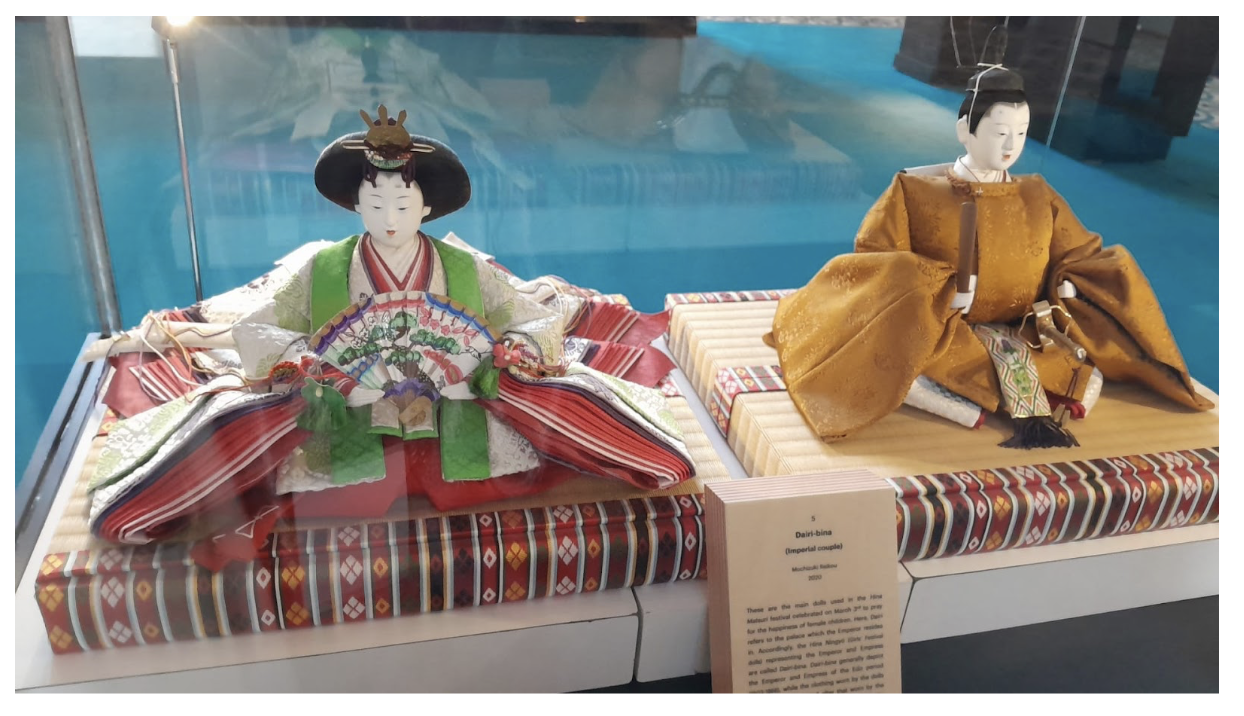
You will see Hina Ningyo of the Hina Matsuri festival at the center of the hall. They are called ‘Dairi-bina (Imperial couple)’ they are the main dolls used in the Hina Matsuri festival celebrated on March 3rd to pray for the happiness of girls.
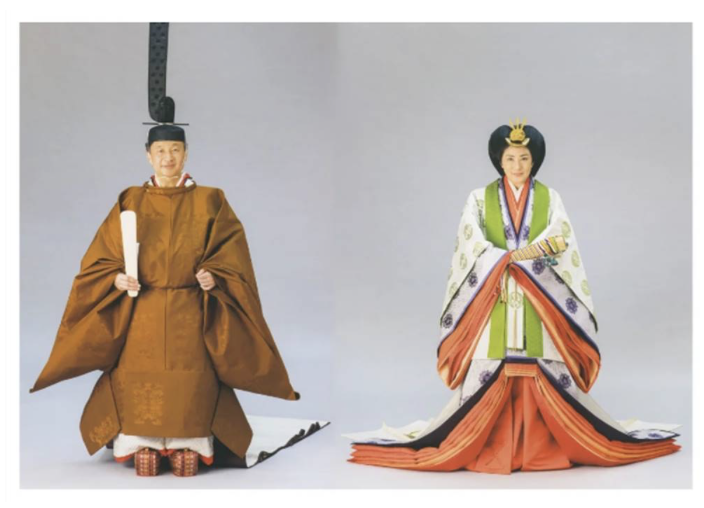
The clothing worn by the doll shown here is designed after that worn by the current Emperor and Emperess during a special imperial rites called the Enthronement Ceremony; Sokui no rei in 2019.
Many of you may have remembered the visit of the current Emperor when he was a prince to the National Museum in 2017.
The second section is ‘ningyo as fine art’, the evolution of the doll making techniques. Around from the 17th century, sculpting techniques, delicate colours, and finely produced clothing evolved so much.
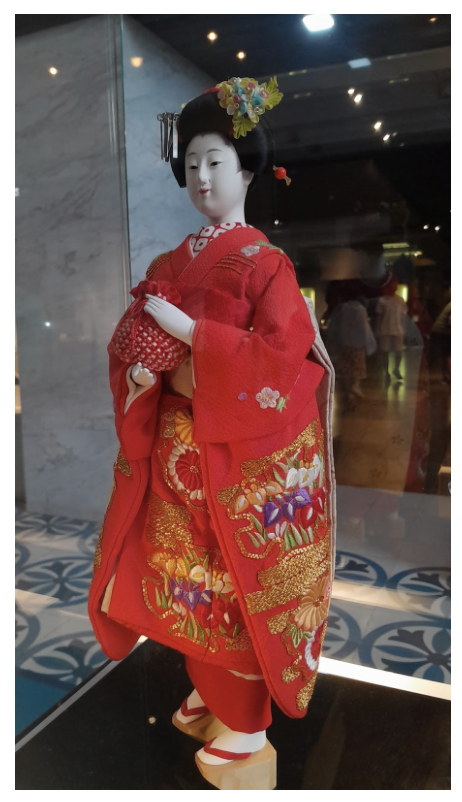
One of the great production is ‘Isho Ningyo; Maiko.’ Maiko is a young girl who performs professionally at traditional banquets in Kyoto.
The same weave, clothing and needlework is used with the same materials and methods to make the doll’s clothing as is used for actual clothes worn by Maiko.
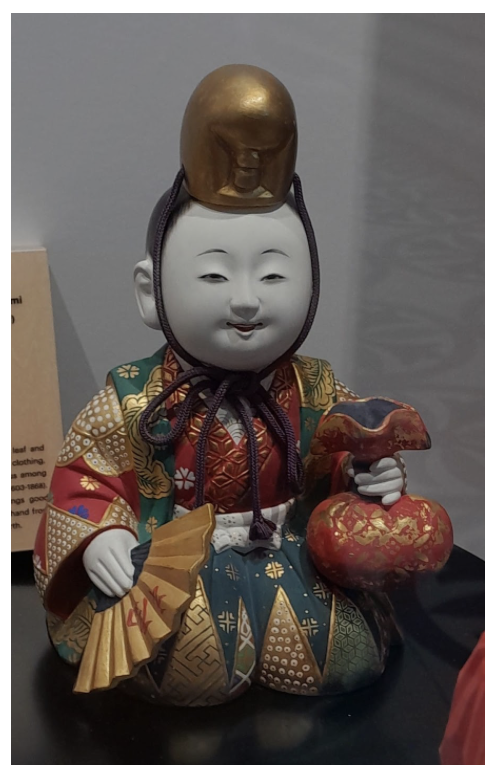
The other doll called ‘Saga Ningyo; Enmei fuku no Kami’, the God of happiness and longevity.
Fuku no Kami is a God who brings good fortune. In his left hand he holds a bag that is filled with all sorts of treasures.
Saga Ningyo are one of the most luxurious Japanese dolls from the Edo period(1603-1868). Its distinctive feature is the finely applied gold leaf and paint on the costumes.
The third section is ‘ningyo as folk art’, featuring traditional dolls from all over Japan.
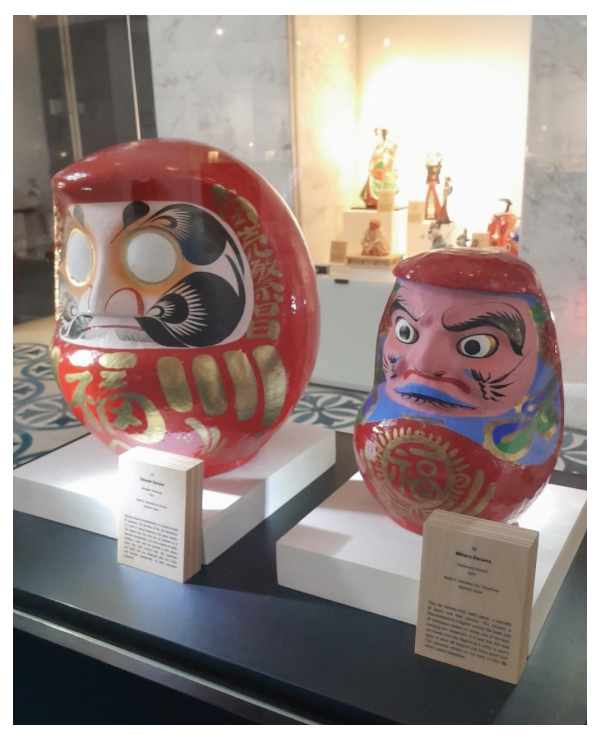
One of the most eye-catching dolls is the bright red, ball-like round doll Daruma.
The Daruma is a traditional Japanese doll that has been worshipped in Japan for centuries as a symbol of luck, success, and perseverance.
If the Daruma is said to bring good luck, how do we make use of it?
In fact, both eyes of the Daruma are empty when purchased.
After purchase, one eye is painted black when a wish is made. When this wish comes true or a goal is achieved, the other eye can be painted as well.
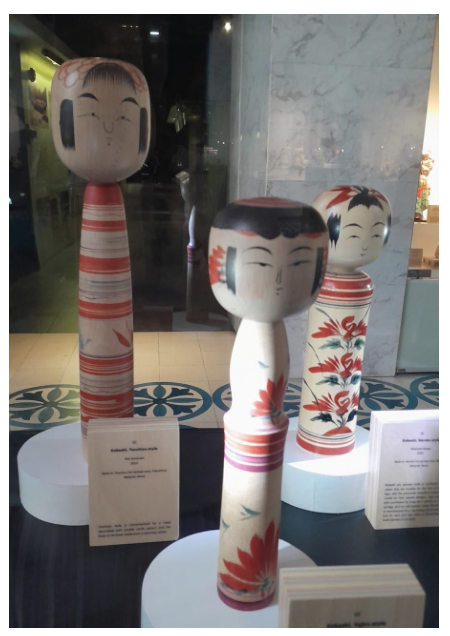
Similar to Darumas, the Kokeshi is a doll with no arms or legs, sold as a souvenir at hot spring resorts in the Tohoku region.
In some regions, it is believed that kokeshi dolls were created as a good-luck talisman to wish for the birth and healthy growth of a child.
Finally, the last section introduces the spread of Ningyo culture.
The reappraisal of dolls as art in modern times drove the emergence of many talented doll creators as works of art. As such, Japan’s doll culture further gave rise to the creation of collector figures which are popular throughout the world today.
Collector figures represent popular characters from games and animation. It is actually very difficult to recreate the 2D characters into 3D in a way that satisfies the expectations of the fans.
Come to the museum if you would like to know more about Japan’s Doll! There are many beautiful dolls for you to see and learn about.
It will surely be an enjoyable time for you.
>More videos from Japan Foundation (Japanese/English)
>The staff and curator of the National Museum gave an overvies to volunteer guids.
A MV FOCUS TALK by Professor Daniel Perret (27th May 2024) By Hani Kamal
Professor Daniel Perret, the head of the French School of Asian Studies at the Faculty of Arts and Social Sciences, History Department, Universiti Malaya, is currently serving as a visiting professor at the same institution. His research specialises in the history of epigraphy and archaeology in proto-urban sites throughout Southeast Asia. His presentation, titled “New Research into the History of the Patani Sultanate in the 16th-17th Centuries,” focused on investigating the historical aspects of Patani.
Perret and Jorge Santos recently conducted a translation of a substantial collection of articles sourced from European, Japanese, and Chinese historical records. These sources shed light on the extensive trade relationships established by European powers such as the Portuguese, Dutch, and British in Patani during the 16th and 17th centuries. Through their study “Patani Through Foreign Eyes: Sixteenth and Seventeenth Centuries,” published in 2022, Perret and Santos meticulously translated and re-analysed these foreign historical manuscripts detailing the dynamic events within the Patani Sultanate, particularly the reign of four successive queens.
Perret’s presentation emphasised the significance of combining physical evidence, such as monuments and artefacts, with information extracted from ancient manuscripts. These elements provide valuable insights into the events unfolding in the 16th and 17th centuries, showcasing Patani as a pivotal trading hub in the Eastern Seas under the influential rule of these queens. Examples of such artefacts include ancient royal tombstones such as Batu Acheh gravestones, a sketch of the old citadel and manuscripts documenting the legacy of the Patani queens.
Background of Patani
The word Patani originated from the Malay word “pantai ini” (this beach), and as mentioned in Hikayat Patani, it is where a white mouse deer was spotted. In the early days, Patani covered the entire Thai provinces of Patani, Yala, and Narathiwat and included parts of northern Kelantan in Malaysia. According to Hikayat Patani, which was recorded by various authors between 1690 and 1730, the early history of Patani must have been established in the early 2nd century when the strategic cape of Patani was sought after by ships travelling straight from the Gulf of Siam across from the Vietnamese point before going to the Malay Peninsula ports. According to Teeuw and Wyatt’s translated version of the “Hikayat Patani: The Story of Patani”, published in 1970, Patani was believed to be Langkasuka (208BC), situated in a very strategic location geographically ideal for a very complex Asian trade system. Professor Wheatley, in his book TheGolden Khersonese, A Study of Asian Historical Geography, concludes that Langkasuka transitioned into Kota Mahligai (now Yarang). But it became almost non-existent when the Srivijaya empire became powerful in the 8th and 9th centuries, dominating the Malay Peninsula. There were major power struggles among the Siamese, Khmer Empire, the Burmese Mon/Pagan Empire, the Cholas, and the Javanese in Southeast Asia during the same period. It is not clear as to when Kota Mahligai became Patani before 1500. However, three main themes emerged in the literary sources on Patani: Siamese influence, its conversion to Islam and its economic rise. (Bougas, 1990: Pg 114)
The peak period in Patani’s history is typically identified as the 16th and 17th centuries. However, by the latter part of the 17th century, the influences of Siamese Sukhothai and Ayuthaya began to dominate the region. In 1902, Siam further weakened Patani’s authority by dividing it into seven districts. The Treaty of Bangkok in early 1909 officially acknowledged Siam’s sovereignty over all the northern Malay territories, thus sealing the fate of Patani ever merging with the peninsula Malay states. Consequently, the Sultanate of Patani was dissolved, and its heir resided in exile in Kelantan. Following World War II, the Treaty of Songkhla in 1949 solidified the inclusion of Patani and the other northern Malay states into Thailand. The ongoing conflict and struggle for independence in Patani persist to this day amid continuing disputes.
The organisation of the Patani capital in early 17th CE
No maps portraying Patani during the 16th and 17th centuries have been discovered. The sole visual representation from that era is a depiction of the city, displayed in Figure 1, which was crafted by Jacob van Neck during his visit to Patani. An intriguing account from 1678 suggests that two trading officers from the British East India Company voyaged to Patani specifically to procure this city map, subsequently dispatching it to their office in Ayutthaya. Regrettably, Perret noted the absence of this document in the British Archives.
The illustration or sketch of the Patani capital, featured in Figure 1, offers a broad overview of the city during the 16th century. Jacob van Neck’s rendering highlights key locales such as the palace, the citadel, various town districts, the merchants’ quarters, and the harbour. This visual portrayal of the Patani capital’s layout is derived from on-site surveys, oral traditions and written accounts documented by diverse sources, including the Malay, Dutch, Portuguese, British, Japanese, and Chinese. Based on field data, it is inferred that this depiction dates back no further than 1584, a pivotal year marking the ascension of the first queen.
In Figure 1, Panarican—which appears eight times in the rutter—or “Penarekan” in Malay, denotes the dragging of boats across the river. “Tanjung Lulo”, appearing seven times in the rutter, is described as a headland on the sandy coastline with two bastions, including the largest in the city and its main gate. Tanjung Lulo is certainly the Tanjung Lulup mentioned once in the Hikayat Patani. Kuala Baca, a sandy beach area, was a town in Patani—it is the “Kuala Becha” mentioned in Hikayat Patani, as well as Dutch and Portuguese sources. On the west coast of the citadel, Garzen, which is frequently mentioned, is likely “Kerisik”, meaning coarse sand. This location fits well with the current location of Ban Kru Se (Kerisik). The “PINTU GARBA” mentioned is the Pintu Gerbang (main gate) in Hikayat Patani, large enough for elephants to pass through, also referred to as Pintu Besar (Big Gate) at the west of the Citadel. Kuala Saba (river mouth of Saba River), north of Panarican, has disappeared in the last four centuries.
Fig. 1. Sketch map of the city of Patani (late sixteenth – early seventeenth centuries) (adapted from Perret et al. 2004).
Portuguese sources—recounting a Portuguese attack on Patani in 1524—recorded Chinese living in brick houses in Patani. Dutch sources cite that Dutch lodges were built with bricks and that the English and Dutch lodged near the bay. The rutter also described the city as having a defence system that served as a channel for communication. According to the sources, the citadel walls were about eleven feet high and seemingly had a very imposing fort. Foreign sources also noted the formidable size of a cannon placed near the Pintu Gerbang. The royal family and Orang Kaya lived within the citadel. A small mosque was also located near the citadel. Salt pans, where salt was produced, were situated north of the citadel.
Similar sources also mentioned how the palace walls were adorned with gilded panels and other wood carvings. This is probably the earliest mention of woodcarving in the northeast state of the Malay Peninsula. The balairung (main royal hall) was described as abundantly decorated with gilded material and velvet-trimmed dais, and the queen sat by a large gilded window. A royal graveyard is also mentioned, and, based on oral tradition, the first Sultan of Patani could have been buried there. The tombstone could have been moved out of the city.
Unfortunately, the city was destroyed by fire four times between 1524 and 1613. By 1786, the Siamese had destroyed the entire city in retaliation to Patani’s assertion of independence.
Ancient Islamic Tombstones
Perret divided the tombstones he found in Patani into three styles: Batu Acheh, Batu Patani Brunei and Bai Sema.
The Batu Acheh tombstones, found across the Malay world, offer a unique insight into the region’s Islamic history. Characterised by sophistication and widespread distribution, these tombstones hold rich epigraphical data. Originating possibly in the 15th century around Pasai, these sandstone monuments signified a departure from local traditions. Although sharing similarities with architectural styles from Central Java and Siamese funerary monuments, batu Acheh was primarily reserved for sultans, high-ranking individuals, their relatives, and possibly affluent merchants. Despite a decline in the 18th and 19th centuries, a resurgence of batu Acheh can still be observed in regions like north Sumatra (Barus), Kedah, Pahang, and Penang.
Batu Acheh tombstones are generally made of sandstone, granites, quartz, river pebbles, marble, cement and wood. The types of material used for the tombstones also give an indication of the economic strength of the state—intricate quartz was used during the 17th century while wood and natural stone were used when the state was in decline. The Batu Acheh tombstones were imported from Acheh and had different shapes, motifs and Islamic Khad inscriptions. The grave of Raja Kuning (the last Queen of Patani) is marked with quartz markers found in Kubo’ Barahom.
Batu Patani Brunei (Figure 2) are tombstones brought in from Brunei. Brunei and Patani were trading partners between the 15th and 17th centuries. Two such grave sites were identified with Batu Patani Brunei in Kampung Parit and Kampung Pintu Gajah. The design was very specific to that found only in Patani and Brunei. It has Chinese motifs, such as clouds. One of the tombstones is believed to be that of the son of the founder of the Sultanate of Patani in the 15th century. It has an Arabic calligraphic inscription stating the son of the sultan on the south side and “Malik bin Mohamad” on the north direction. Unfortunately, no dates were found. Perret postulates that these tombstones could belong to the Brunei people who lived and were buried in Patani.
Fig. 2. Tombstone at Kuboʼ Barahom (D. Perret-EFEO, 1999)
Roeloefsz (1601-2) mentioned the existence of royal graves on the Seberang peninsula and this is the only source citing this interesting information. There were few tombstones found but no indication of a royal one. Ludvik Kalus (2004: 193-206).cited that there were two tombstones found and one of them believed to be the grave of the first Sultan of Patani (Fig.2).
According to oral tradition, Raja Ijau’s tombstone was made in the Bai Sema style (Figure 3), which is heavily influenced by Thai-Buddhist engravings. Originating from India, the Bai Sema designs resemble the Kala-Makara design, which is commonly found in the entrances of temples in Thailand and India. This style may have reached Patani from Trowulan, Surabaya. In Patani, Bai Sema tombstones are very rare.
Fig. 3 Raja Ijau Bai Sema Tombstone (Bougas: Pg 39)
Queen of Patani “The Rainbow Queens”
Female Rulers in the Malay World
When James Brooke visited the Bugis state of Waco, Brooke observed that six out of the eight prominent chiefs were female (Brooke, 1848 I, 74-5). In Islamic Southeast Asia, the presence of female rulers appeared to be a common occurrence. Notably, female Muslim rulers were intricately connected to the realm of commercial trading. Throughout the 15th to 17th centuries, women in these regions played a significant role in engaging in trade activities. For instance, Pasai, the first Muslim state in Southeast Asia, had two queens during its prosperous trading era (1405-1434). Similarly, Japara in North Java emerged as a key naval and commercial hub under the rule of its female queen, Kali Nyamt, in the 16th century.
“Similarly, the women rulers of the diamond-exporting centre of Sukadana in Southwest Borneo (c. 1608-22), pepper-rich Jambi in East Sumatra (163~. 1655), and the sandalwood base of Solor, to the East of Flores (c. 1650-70), were on the throne during the brief period these states were important commercial centres.” (Reid, 2020, Pg 641)
In her research on “Ratu Acheh,” Sher Banu explored the lives of the four Queens of Acheh in the 17th century. The first queen, Sultanah Safiatuddin (1612-1675), took the throne following the death of her husband, Sultan Iskandar Muda. She was succeeded by her daughter, and four Acheh Queens ruled the kingdom for sixty years.
Similarly, a comparable scenario unfolded in Patani during the 16th and 17th centuries, with the kingdom being governed by four consecutive queens. Patani served as a significant trading post, particularly with China, during this period. The preference for female rulers stemmed from the cooperation of the Orang Kaya (male royal councillors and religious ulama) with the queens, recognising their adeptness as rulers with business acumen rather than because they were running out of males to inherit the thrones. During the reign of Raja Ijau:
“Patani the first queen has reigned very peaceably with her councillors … so that all the subjects consider her government better than that of the dead king. For all necessities are very cheap here now, whereas in the king’s time (so they say) they were dearer by half, because of the great exactions which then occurred.” (Van Neck, 1604:206)
Patani, under Raja Kuning, the Orang Kaya, paid less levies as Raja Kuning was a wealthy heiress and a capable businesswoman. The Orang Kaya saw how female rulers were more businesslike and profitable for themselves. They were also mild in ruling the states compared to male rulers.
Raja Ijau, the eldest daughter of Sultan Patik Siam, took power in Patani after the sudden deaths of many male family members. During her 32-year rule, Raja Ijau led an army against Pahang and defended Patani against Ayutthaya, fostering diplomatic relations and promoting culture and art. She is credited with the origins of the Mak Yong dance. Raja Biru continued her mother’s diplomatic legacy and was an adept mediator between the Dutch VOC and British EIC. Raja Ungu defied Siamese rule, aligning with Portugal, Pahang and Johor to repel a Siamese force and further solidify alliances through strategic marriages. Raja Kuning enhanced Patani’s economic prosperity and established it as a prosperous Malay trading post. Following her overthrow by a minister, she retired to Kuantan, Pahang, marking the end of female rule in Patani.
As outlined by Perret, the era of female rulers in Patani was characterised by a decrease in violent incidents and massacres within the royal families. This period was notably peaceful, fostering a sense of safety that encouraged traders to conduct business with relative security. However, following the reign of these queens, the Patani throne shifted to male lineages, possibly influenced by conservative factions aiming to enforce Islamic practices that restrict female leadership over men. The subsequent male rulers exhibited intense competition and a diminished focus on trade, leading to a decline in safety and profitability for Patani as a trading hub during their governance.
The Queens’ Title
Perret noted the Patani Queens used the Indian Sanskrit male title “raja” instead of the Islamic “sultanah” or the Malay “ratu.” Historical sources from Patani do not provide evidence of the title “Sultanah” being used. The discovery of a gold coin inscribed with the words “al-sultana-al muazam” (the great Sultanah) and “Khalada Mulkaha” (May God preserve her government) has led some to speculate that it may have been associated with one of the Patani Queens. Perret pointed out discrepancies between this coin’s inscription and those on coins issued by the Sultanah of Aceh, as well as the absence of coinage from the Queens of Sukadana and Jambi in the 17th century. He further questioned the authenticity of the claim that the Patani Queens ever adopted the Islamic title of Sultanah and pondered why there is a lack of mention in Malay sources regarding minted gold coins.
The Color Names
The Patani Queens were named after colours, and thus, the acronym ‘’Rainbow Queens of Patani’’ was coined by Teuuw and Wyatt. Some scholars likened it to how in Malay tradition, females were given names associated with colours, or that green is an Islamic colour, and Raja Kuning (yellow) had yellow skin and was given the colour yellow. Jocelin de Jong’s documentation in 1961 highlighted the prevalent use of colour names among Malays. For instance, titles like Tun Hitam or Tun Putih were commonly bestowed upon Malay women in Sejarah Melayu.
Professor Perret suggested that the tradition of using names based on colour could be rooted in religious or traditional beliefs associated with auspicious symbolism. For example, the Katika Lima system—where a day is divided into five periods, and each period is associated with a colour—is directly related to a Hindu god. Each colour represents the time of birth of the queen. A second possibility is that the colour was related to the day/time of birth, like the zodiac. It could also be related to Buddhist influence. In Buddhism, each cardinal points are related to a colour as also with the Chinese belief. It is also believed that names with colours are linked to the traditional culture of Chinese zodiac practises:
“The centre of the system is Vairocana, associated with the white colour, while interestingly, the colours of the four cardinal points correspond to the names of the four queens: North is associated with Amoghasiddi and the green colour; East is associated with Akṣobhya and the blue colour; West is associated with Amitābha and the red colour; South is associated with Ratnasaṃbhawa and the yellow colour. Moreover, the colours are associated with the same cardinal points in traditional Chinese culture.” (Damais 1969: 83-84: extracted from Perret’s article, 2022)
Perret also found through the sources that the use of colours for the queens was only used within the palace, and as for the foreigners, the queens were referred to merely as “old queen” or “young queen.” These colour names are definitely not by chance but linked with greatness for the royal household, or they were intentionally meant to legitimise the queen’s sovereignty in the state of Patani.
Power Sharing
Perret also noted the unique power-sharing practised by the four queens. The old queen is assisted by a young queen who acts as a regent and is the next in line. This power-sharing system seems to have worked for the Queens, as during their reigns, Patani flourished economically and politically.
Chronology of the Queens
Perret suggested that the dates of the Patani queens require further investigation since dates were never mentioned in Malay writings (namely Hikayat Patani, Sejarah Patani, Syair Patani and Kelantan). However, when various sources written in foreign records surfaced, this suggested that the periods or dates as deduced in Hikayat Patani were different and required re-examination. Some foreign sources cited Christian years while others utilised the Muslim calendar, and confusion emerged.
More confusion arose when understudying the Patani sources as the use of colours for the Queens was only for the internal royal court; thus, for foreigners, it’s either the Old Queen or Young Queen, as names of the queens were never cited in any foreign sources. It was quite a task to identify the period of rule of the Queens also because the Malay sources did not include dates/periods. However, a letter surfaced, the correspondence between one of the queens and the King of Portugal dated 31 March 1637. This threw new light into the confusion of the chronology of the queens. According to Perret, the dates of ruling for the queens require some rearrangement. Perret summed up these reigns as follows:
Raja Ijau (Old Queen: r. 1584 – 28/08/1616; d. 28/08/1616)
Raja Biru (Young Queen: r. ≤ 1601 – 28/08/1616; Old Queen: r. ca. 09/1616 – ca. 03/1636; d. ca. 03/1636)
Raja Ungu (Young Queen: r. ≤ 1629 – 1634; d. between 1636 and 1638)
Raja Kuning (Young Queen: r. end of 1634 or 01/1635 – ca. 03/1636; Old Queen: r. ca. 03/1636 – ≥ 1642; d. ≥ 1642)
Fig. 4 Chronology of Patani Rulers
Patani’s Emergence as a Trading Hub
Following Malacca’s fall to the Portuguese in 1511, Patani emerged as a lucrative alternative trading centre. It was also a strategic port for sailors travelling from China to Java to stop at Patani for shelter, repairs and trading. The region attracted a diverse array of merchants, including Chinese, Malay, Siamese, Persians, Indians, Arabs, Portuguese, Japanese, Dutch, and English traders. The peak of Patani’s trading significance is often associated with the reign of Raja Ijau. Chinese entrepreneurs played a pivotal role in Patani’s rise as they exchanged goods like porcelain, silk, and lacquer for cloves, nutmeg, sandalwood, and pepper sourced from the spice islands.
Historical records indicate that Patani’s influence as a trade hub extended beyond local waters. Patani junks engaged in trade with Banda for nutmeg and mace as early as 1526, while Chinese junks from Fujian frequented Southeast Asian ports like Pahang and Patani in the late 1520s. Indian traders also participated in the exchange, offering textiles in return for pepper, gold, and food items. Chinese and Indian goods brought to Patani were further distributed by Malay traders across Thailand and the Indonesian archipelago. Additionally, the Kingdom of Ryukyu served as a crucial intermediary linking China, Japan, and Patani, facilitating trade growth in the region.
“Like all major coastal trading places at the time in Southeast Asia, Patani was home to a cosmopolitan population. It is thus reasonable to suggest that some twenty languages were in daily or occasional use in Patani during the sixteenth and seventeenth centuries. (Perret, 2022: Pg 143)
However, Perret summarised that Patani’s position as a trading hub declined by the mid-17th century as trade restrictions limited the movement of Japanese traders and hindered Chinese-Japanese trade interactions. Furthermore, shifts in market demands led to a decreased interest in local spices like pepper and a decline in the popularity of Indian cotton materials. Patani struggled to adapt to changing trade dynamics during this period, failing to sustain its earlier prosperity and meet evolving commercial challenges.
Conclusion
Perret and Santos’ examination of foreign sources proved useful in shedding light on how Patani emerged as a significant state during the 16th and 17th centuries. These sources offered insights into the queens’ chronology, Patani’s administrative system, the layout of the old city, and its economic, political, and social structures during that era.
Determining the precise timeline of the queens proved challenging due to discrepancies in various historical texts. Foreign sources often referred to the queens generically as ‘old queen’ or ‘young queen’ and not by their names. Perret’s meticulous analysis allowed for the reorganisation of the queens’ chronology based on available manuscripts.
Once again, foreign sources are abundant and detailed in their description of the city’s location and design, but they are also confusing or, on many occasions, contradictory. Perhaps as suggested by Bougas, where only by excavation of the city/citadel location, artefacts excavated will provide evidence to support the history of Patani. The old city has never been excavated, nor have any archaeological methods been used to verify the sites and compare them with historical narratives.
The extent of real power wielded by the Patani Queens within the kingdom remains a subject of inquiry. Questions arise regarding whether the queens held substantive authority or if the influence lay with other figures like the Orang Kaya, councillors, Islamic leaders, Chinese merchants, or Javanese traders. While Malay sources like Hikayat Patani and Syair Patani remain silent on the queens’ authority, foreign accounts highlight their roles in trade management.
It is possible that the real power was with the court councillors, while the queens handled foreign traders. But then again, the four female rulers reigned for almost a century. It could not have lasted 100 years if it had not been for their skilful manoeuvring of the Orang Kaya and social-economic skills when dealing with foreign merchants.
Perret and the foreign sources may not have found the answers to establish the use of the queens’ titles. However, these sources are able to clarify many questions concerning the presence of female rulers in Patani. They can probably inspire the people of Patani today.
Fig. 5. Salt ponds, Ban Pa Re (D. Perret, June 1997)
References:
MV Focus Talk by Professor Daniel Perret on 27th May 2024, MV Room, JMM.
The National Museum of Kuala Lumpur’s west wall isn’t just a surface; it’s a window into Malaysian craftsmanship. Artist Cheong Lai Tong’s iconic mural, “Malayan Crafts and Craftsmen,” goes beyond individual figures. It’s a thematic map, inviting us to explore the core elements that bind these crafts together: earth, fibres, metals, textiles, and wood.
Through this exploration, we’ll unlock a conversation between nature and human ingenuity.
This bi-weekly series will feature seven articles, each focusing on a specific element. We’ll appreciate the mural’s artistry while discovering corresponding collections housed within the museum’s walls.
A Legacy from Earth
The story of Malaysian pottery is a fascinating journey that begins with the earth itself. As early as the Neolithic period, when nomadic hunter-gatherers transitioned to a more agricultural lifestyle, the need for storage and transport vessels arose.
A key element in this tale is clay. Its remarkable malleability allowed these early artisans to shape the earth with their hands, creating vessels that could hold their form after drying and transform into permanent fixtures through the application of fire.
The museum’s collection reveals the multifaceted nature of Malaysian pottery. It’s a story not just of form and function but also of cultural heritage, technological advancements, and artistic expression. It facilitated early barter trade systems, as these functional objects became valuable commodities exchanged across the region.
Location
Pottery type
Description
Museum of Malay Ethnography
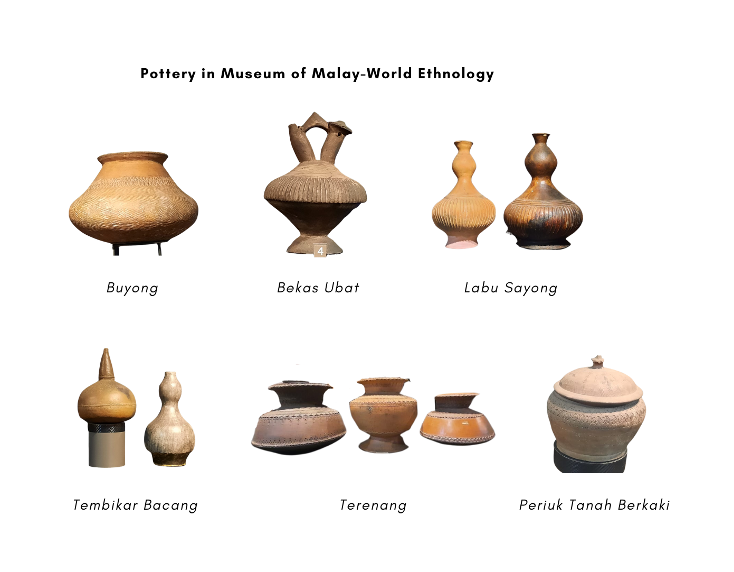
Bacong
Large, wide-mouthed jars traditionally used for storing water and rice.
Labu Sayong
Gourd-shaped water bottles made from terracotta feature ribbed bodies and are often adorned with incised geometric patterns. Traditionally, they were hand-moulded without the use of a potter’s wheel.
Buyong
Large, wide-bodied water containers with a narrow neck, often decorated with floral motifs.
Bekas Ubat (Medicine Container)
Small, lidded containers used for storing traditional Malay medicines. This double-spouted kendi is a water container used in Southeast Asian rituals. The name “kendi” comes from the Malay term derived from the Sanskrit word “kundika,” meaning “water vessel.” Unlike most kendi, which lack handles, this specific example features a small handle connecting the two spouts. Their use was prominent in important ceremonies like weddings and funerals. Water from a kendi would be sprinkled during these rituals.
Terenang
Crafted from earthenware, these cooking pots feature a rounded bottom and a wide rim. Decorated with stamped and incised geometric motifs around the body and rim. Terenang’s name derives from the word “tunang,” signifying its original role as a container for engagement rings in Pahang. Notably, Terenang is one of the few types of Tembeling pottery, and the “tali air” refers to the border separating each section of this potteryware.
Periuk Tanah Berkaki (Legged / Footed Claypot)
Clay cooking pot raised on three or four legs, designed for even heat distribution.
Photo credit: Manjeet Dhillon
Location
Pottery type
Description
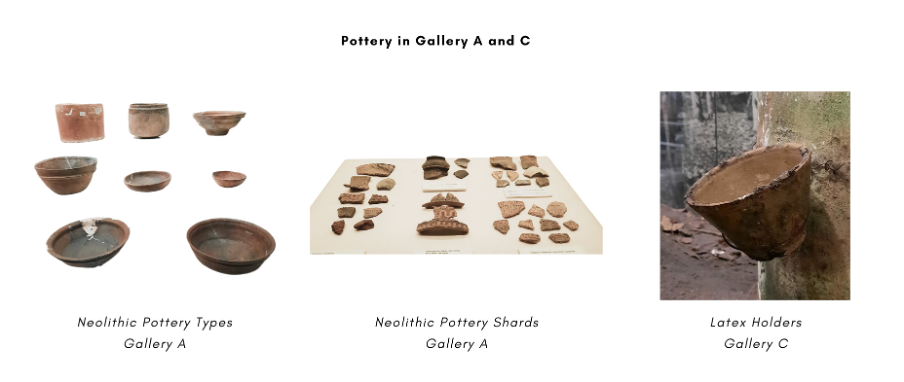
Gallery A
Neolithic Pottery
The earliest forms of Malaysian pottery date back thousands of years. Includes utilitarian vessels, shards with plain, tri-colour, or patterned decorations, unearthed from archaeological sites like Gunung Cha in Kelantan.
Gallery C
Ceramic Latex Holder
Container crafted from glazed ceramic, specifically designed to hold latex collected from rubber trees.
Photo credit: Manjeet Dhillon
Gallery A: Burial Vitrine
While these clay jars in Gallery A’s burial vitrine might seem like local creations, they were transported to Borneo through maritime trade routes, highlighting the interconnectedness of different cultures in the region.
These impressive clay jars, known as Martaban jars, were prized by the Iban people for both practical and symbolic reasons. They served not only as storage containers but also as markers of wealth and status. Interestingly, these jars, also called “tajau” by the Dayak people of Kalimantan, weren’t produced locally.
Some Martaban jars even feature moulded dragons on their sides, earning them the name “dragon jars.”
[Historical Connection]: Martaban is the name of a port on the east side of the Irrawaddy Delta in present-day Myanmar. This port became well known for its trade in huge storage jars. The association was so strong that “Martaban” eventually became synonymous with the name of the jars themselves.
[Cultural Insight]: Traditionally, potters evaluated the quality of Martaban jars by their sound. When struck with the hand or a wooden stick, a high-quality jar would produce a clear, ringing tone. This indicated the jar’s strength, density, and ability to properly store valuable goods. Hence, Martaban jars are often referred to as “talking jars.”
[Cultural Insight]: Among the indigenous communities in Sarawak, Martaban jars also serve as funerary equipment. Within a family home, an upside-down jar might stand out conspicuously. This signifies that an older woman has reserved it for her own burial, indicating her wish that it not be used for its more common purpose of fermenting wine. For further reading, you can explore Trade Objects by Lucas Chin.
With the museum’s collection as our guide, let’s explore some of the broader threads that define Malaysian pottery:
1- Sarawak Pottery: Here, we find two distinct pottery traditions.
Chinese potters near Kuching and Sibu craft stoneware jars (tempayan) in hues of brown, green, and blue with embossed and incised patterns. The pottery industry in Kuching nowadays can be found clustered together on Penrissen Road, Kuching. You can watch a video of Sarawak pottery.
In contrast, the Iban, Murut, and Kelabit communities produce a distinct type of pottery: simple and fired at a low temperature. This pottery is often used in their weaving ceremonies. Interestingly, the style of this pottery bears a striking resemblance to Neolithic pottery found in Sarawak, hinting at a long-standing tradition that may stretch back thousands of years.
Image source: Borneo Post Online
A potter’s toolkit, crafted from natural materials, is laid out here. From left to right:
i) Penempa: a carving tool carved from belian, a strong and durable ironwood.
ii) Batu segala or batu bulat: smooth stones used for shaping the clay.
iii) Simpai and bemban: these tools are made from rattan. The simpai is used for shaping or coiling the clay, while the bemban functions as a stand for the pots.
2- Malay Pottery: Characterised by four distinct forms:
3- Chinese Dragon Kiln Pottery: Over a century ago, Teochew immigrants brought a symbol of Chinese ingenuity – the long, roofed kilns. Fueled by the rubber boom’s demand for latex cups, families from Swatow (Guangdong, China) established clusters like those north of Ipoh near clay deposits. Today, these kilns have shifted their focus, primarily producing stoneware flower pots and water jars for a global audience. You can watch a video of these kilns in action here.
4- Indian Pottery: In Kampung Kedah (Parit Buntar) and Batu Dua (Kuala Selangor), potteries specialise in low-fired terracotta ware. These items are primarily used for religious and ceremonial purposes, such as oil burners and incense holders. One example of such pottery is the pannai pot, a traditional cooking vessel favoured for preparing Pongal, a dish of rice boiled in milk and raw sugar cane.
Pots, typically shaped like belanga or periuk, are decorated with simple stamped designs that reflect their utilitarian purpose. You can watch a video to see the pot-making process in Kuala Selangor.
photo credit : Manjeet Dhillon
Figures on the museum’s mural:
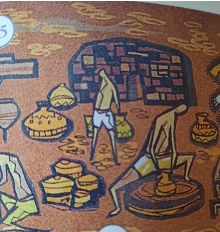
A central figure in the museum’s mural is a potter, busily working amidst a display of finished and in-progress earthenware forms. In the background, a kiln suggests the process of firing these ceramic creations.
From the Neolithic era to the present day, earth has served as a crucial element in shaping Malaysian crafts. As we move through the museum’s collection, we’ll discover how other elements – fibres, wood, textiles, and metals – contribute to this remarkable story of human ingenuity and artistic expression. In our next series, we’ll learn more about crafts made from Malaysian fibres, where bamboo, rattan, and pandanus leaves take centre stage.





 Museum Volunteers, JMM