Focus Talk: General Percival & The Fall of Malaya by Zafrani Amran

written by Manjeet Dhillon

The surrender of British forces to the Imperial Japanese Army on 15 February 1942 was more than a military defeat, it was a shattering of colonial dominance in Southeast Asia. In his compelling talk, Zafrani Amran explores the calculated strategies, critical oversights, and unforeseen events that led to this seismic event.

Japan’s Rise to Power and Expansionist Ambitions
From the Meiji Restoration in 1868 to the early 20th century, Japan transformed from a feudal society to a formidable industrial power. This modernisation fuelled its ambitions for regional dominance, culminating in its aggressive expansion across Asia. The slogan “Fukoku Kyohei” (Rich Country, Strong Army) guided the nation’s transformation.

By the late 1930s, Japan faced crippling resource shortages due to international embargoes, particularly on oil and rubber. These pressures drove its decision to secure Southeast Asia’s rich resources, making Malaya a critical target.

Key milestones in Japan’s rise include:

EventYearSignificance
Meiji Restoration1868Japan begins its modernisation process.Formation of the Imperial Japanese Army and Navy
Treaty of Ganghwa1876Opening Korea to Japanese influence
First Sino-Japanese War1894-1895Japan defeats China, gaining control of Taiwan and Korea.
Anglo Japanese Alliance1902-1923Japanese forces provided military support as part of this alliance, a role evident during the Singapore Mutiny of 1915.
Russo-Japanese War1904-1905Japan defeats Russia, emerging as a major power in Asia.
Annexation of Korea1910Japan formally annexes Korea.
Invasion of Manchuria1931Japan seizes control of Manchuria.
Second Sino-Japanese War1937-1945Japan invades China. (Marco Polo bridge incident)
Tripartite Pact,September 27, 1940a military alliance between Germany, Italy, and Japan, aimed to deter U.S. intervention in World War II
Occupied French IndochinaJuly 1941To secure its supply lines and further isolate China.
Capture of Lashio and closure of the Burma RoadApril 1942To further isolate China, Japan closed the Burma Road, a key supply route for Western aid. 

Japan’s Road To Conquest
Japan’s prolonged war with China drained its resources. To secure vital supplies and cut off Chinese access to foreign aid, Japan occupied French Indochina, a move facilitated by the Vichy French regime (a pro-German regime).
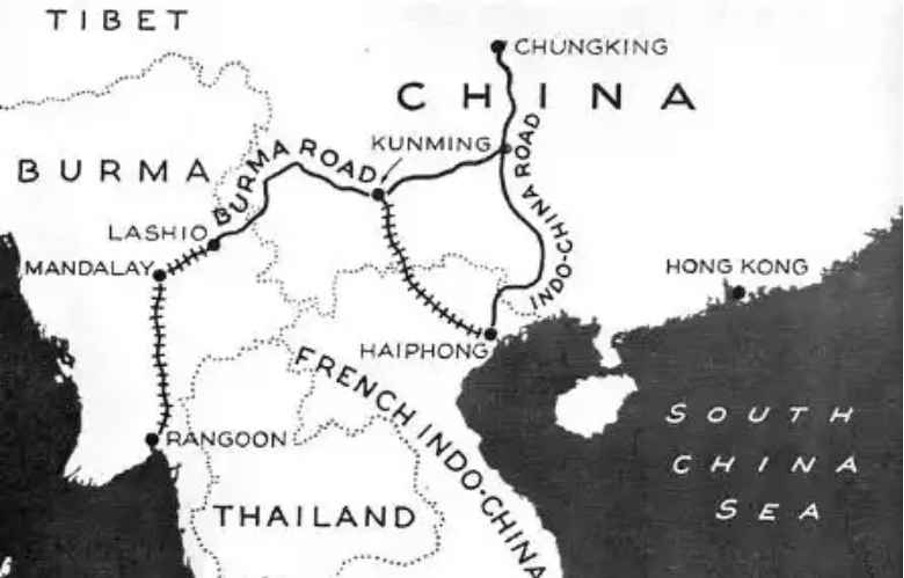
Burma road
Image source: https://www.dangerousroads.org/asia/china/321-burma-road-china.html

Faced with a crippling U.S. oil embargo, Japan sought alternative resources in Southeast Asia, particularly the oil-rich Dutch East Indies. Despite attempts at negotiation, the Dutch, backed by the U.S., refused to meet Japan’s demands. Recognising the intransigence of the Dutch and the urgency of its resource needs, Japan concluded that military force was the only viable option. To secure these resources and neutralise potential threats, Japan launched a bold military campaign. The attack on Pearl Harbor and the invasion of Malaya were crucial steps in this strategy, by neutralising the U.S. Pacific Fleet and capturing key British military bases, Japan aimed to create a defensive perimeter in the Pacific and secure its resource supply lines.

The desire for natural resources, particularly oil, and the pursuit of a “Greater East Asia Co-Prosperity Sphere” propelled Japan towards a fateful confrontation with the Western powers.

Preparation for War: The Malayan Campaign
To prepare for the invasion of Malaya, the Japanese military undertook a series of strategic initiatives:

● Establishing a Research Section: The “Taiwan Army Research Section,” led by Colonel Masataro Tsuji, was established to develop specialised tactics and doctrine for jungle warfare.

● Intensive Training: The Japanese military conducted extensive training exercises in Taiwan and Hainan Island, focusing on beach landings, rapid advances, and combined arms operations in jungle terrain.

● Intelligence Gathering: A network of spies (referred to as a “fifth column), including Major Kunitake, was deployed to gather critical intelligence on Malaya’s terrain, infrastructure, and British defences.
○ Major Kunitake, stationed as an assistant Japanese consul in Singapore, identified over 250 bridges crucial for military operations, enabling the Japanese to pre-plan rapid repair efforts in the event of British sabotage.

● Developing a Comprehensive Guidebook: Colonel Tsuji’s tactical manual, aptly titled “Read This Alone, And The War Can Be Won,” (これだけ読めば戦は勝てる) equipped Japanese troops with jungle warfare expertise.

Book cover: “Read This Alone, And The War Can Be Won”
Image source: https://www.jacar.archives.go.jp/aj/meta/listPhoto?LANG=default&BID=F2014120214353623900&ID=M2014120214353623902&REFCODE=C14110549200

By meticulously planning and preparing for the invasion, the Japanese were able to exploit the weaknesses in British defences and achieve a swift victory.


Singapore Naval Base
The Singapore Naval Base was a monumental engineering feat and a symbol of British naval power in the Far East. Constructed over a period of nearly 15 years, the base was intended to serve as an impregnable fortress, safeguarding British interests in the region.

The decision to establish the base was driven by growing concerns about Japanese expansionism. As Japan emerged as a regional power, the British recognised the need for a strong naval presence in Southeast Asia. The base was strategically located to protect British trade routes and to deter potential aggression from Japan.

The construction of the Singapore Naval Base began in 1923, but progress was interrupted due to political changes in Britain. The Conservative Party, which initially pushed for the construction, was replaced by the Labour Party in 1924, which halted the project due to economic concerns. Work resumed, and after nearly 15 years, the base was officially opened in 1936, featuring state-of-the-art facilities, including the world’s third-largest floating dry dock. The base’s construction was funded in part by local contributions, with the Federated Malay States and the Sultan of Johore (Sultan Ibrahim Ismail) providing significant financial support. In recognition of the Sultan’s generosity, one of the coastal defence batteries was named the Johore Battery. The base was equipped with powerful coastal defences and protected by the Royal Air Force, making it a formidable fortress.

To safeguard the naval base, the British established fixed defences organised into two Fire Commands:

Fire Command:ChangiFaber
Location:Protected the routes leading to the naval base at Seletar.Protected the approaches to Keppel Harbour and the western channel of the Johore Straits.
Armament: Each Fire Command was equipped with:One 15-inch batteryOne 9.2-inch batterySeveral 6-inch batteries

The Japanese devised a two-pronged strategy to circumvent Singapore’s formidable defences. Instead of a direct frontal assault, they opted for a flanking manoeuvre, attacking from the Malayan Peninsula.

A World Awakened
While the attack on Pearl Harbor (December 8, 1941) captured global attention, another battle was unfolding in Malaya. The Battle of Kota Bharu marked the beginning of Japan’s rapid advance, exploiting British vulnerabilities with surgical precision.

On the night of December 4th, the Japanese Imperial Army had set sail from Samah Harbour in Hainan Island, their destination: the Malayan Peninsula. Meanwhile, in Singapore, a sense of security prevailed. The arrival of the powerful Royal Navy battleships, Prince of Wales and Repulse, had bolstered British confidence. These formidable warships were seen as an impenetrable shield against any potential threat.

However, the Japanese had a different plan. On December 6th, Royal Australian Air Force (RAAF) Hudson aircraft spotted the Japanese convoy stealthily manoeuvring south of Cape Cambodia. The British were alerted, but the dense monsoon clouds provided the invading force with a veil of concealment. Operation Matador was considered. This plan involved a preemptive strike into southern Thailand to disrupt Japanese landing plans. However, the British Minister in Bangkok, Joseph Crofty, strongly advised against this course of action, fearing it would provoke a wider conflict. Operation Matador was ultimately cancelled.

The following day, December 7th, the Japanese fleet appeared on the radar screens, 110 miles north of Kota Bharu. The British, caught off guard, scrambled to respond. But the thick, impenetrable fog provided the Japanese with a crucial advantage, allowing them to close in undetected. As the fog lifted, the full scale of the Japanese invasion became apparent. The British, despite their valiant efforts, were ill-prepared to counter the swift and decisive Japanese advance.

The Battle of Kota Bharu
A lone soldier, silhouetted stark against the lightning sky, pointed a trembling hand out to sea. There, riding low in the water, a dark armada materialised from the mist. Japanese warships, led by the ominous Awajisan Maru, were disgorging a terrifying wave of soldiers into landing craft.
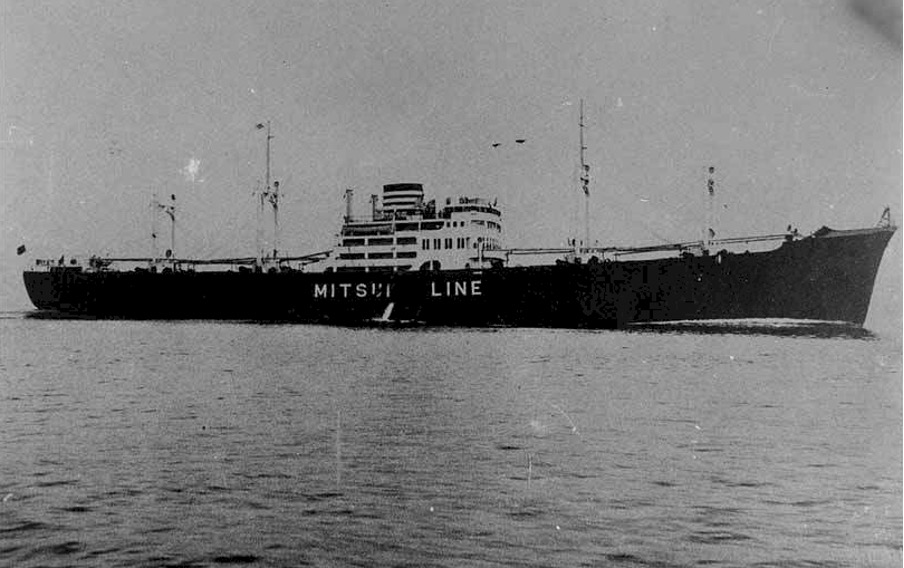
The Awazisan Maru, also known as Awajisan Maru or Awagisan Maru Image source: https://muhammadismailibrahim.wordpress.com/2011/12/08/december-8-1941-the-battle-of-kuala-pak-amat/

The deafening roar of Japanese bombers pounded the airfields at Kota Bharu, Machang, and Gong Kedak. Explosions rocked the nearby airfield, the once-proud defenders of Kota Bharu were now a scattering of panicked men, their dreams of a valiant stand shattered by the overwhelming force of the enemy. Meanwhile, the Japanese naval escort, facing heavy losses from RAAF air attacks, considered withdrawing. However, Major General Takumi, determined to secure the beachhead, overruled the decision.

With air superiority lost and the ground defences crumbling, Brigadier Key ordered a retreat to the southern outskirts of Kota Bharu. The Japanese, under the cover of darkness, launched a final assault on the airfield, capturing it by midnight. The Dogra Regiment, though outnumbered and outgunned, fought with courage and determination. Lieutenant Close, led his men in a desperate last stand, but the relentless Japanese onslaught proved too much to bear. The fall of Kota Bharu marked the beginning of a long and painful retreat for the British forces in Malaya, a defeat that would reverberate through the annals of history.

Lone Bomber
While the Japanese 5th Division stormed the beaches of southern Thailand, another drama unfolded on the other side of the Malay Peninsula. At the battered Butterworth airfield, a lone figure emerged: Squadron Leader Arthur Stewart King Scarf. A pilot of extraordinary courage, he was the last hope for the beleaguered British forces.

As the Japanese air force rained destruction upon the airfield, Scarf defied the odds. In his battered Bristol Blenheim, he took to the skies, his mission was audacious: to strike at the heart of the Japanese invasion, targeting the enemy airfield at Singgora.
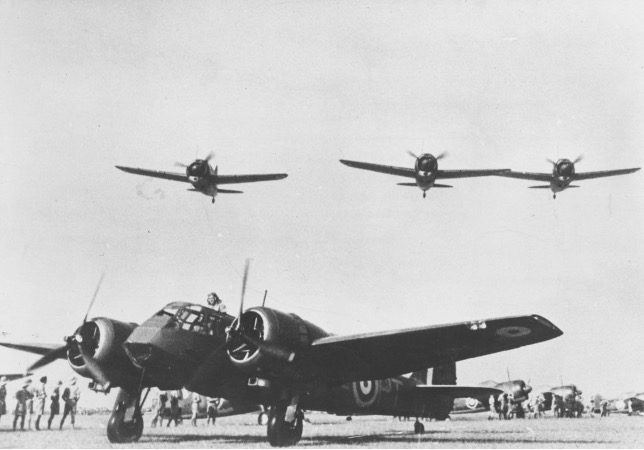
Blenheim of 62 Squadron and Brewster Buffalo fighters in Malaya 1941
(© RAF Museum X004- 7598/042/018)

With enemy fighters hot on his tail, Scarf pressed on, his plane a mere speck against the vast expanse of the sky. Undeterred, he unleashed a torrent of bombs, sowing chaos among the Japanese forces. But the cost was high, his plane, riddled with bullet holes, began to falter.

Wounded and weakened, Scarf struggled to regain control. With a final act of defiance, he attempted to land at Alor Setar airfield. However, his injuries proved too severe, he succumbed to his wounds. Squadron Leader Scarf’s bravery earned him the highest military honour, the Victoria Cross.

A Self-Inflicted Wound
The morning of December 8th, 1941, dawned with a false sense of security. The mighty HMS Prince of Wales, a symbol of British naval might, sailed out of Singapore Harbor towards the South China Sea, little did they know, their fate was sealed.

Winston Churchill’s public declaration of the Prince of Wales’s mission proved to be a fatal mistake. The British Prime Minister, in a moment of hubris, had inadvertently tipped his hand to the Japanese. Admiral Isoroku Yamamoto, the mastermind behind the attack on Pearl Harbor, seized the opportunity. He dispatched a wave of Mitsubishi G4M bombers to reinforce the already formidable air power in the region. These bombers, specially trained for ship-killing operations, were capable of launching torpedo attacks at extremely low altitudes.

The British mistook an Australian auxiliary plane for a Japanese threat, causing the Prince of Wales to turn back towards Singapore. Meanwhile, a Japanese submarine had detected the ship and dispatched its own bombers to deliver the killing blow. The Japanese attack was swift and decisive. Torpedoes tore through its hull, sending the once-mighty warship to the depths of the ocean. The sinking of the Prince of Wales and its sister ship, the battlecruiser HMS Repulse, marked a turning point in naval warfare, demonstrating the vulnerability of capital ships to air power.
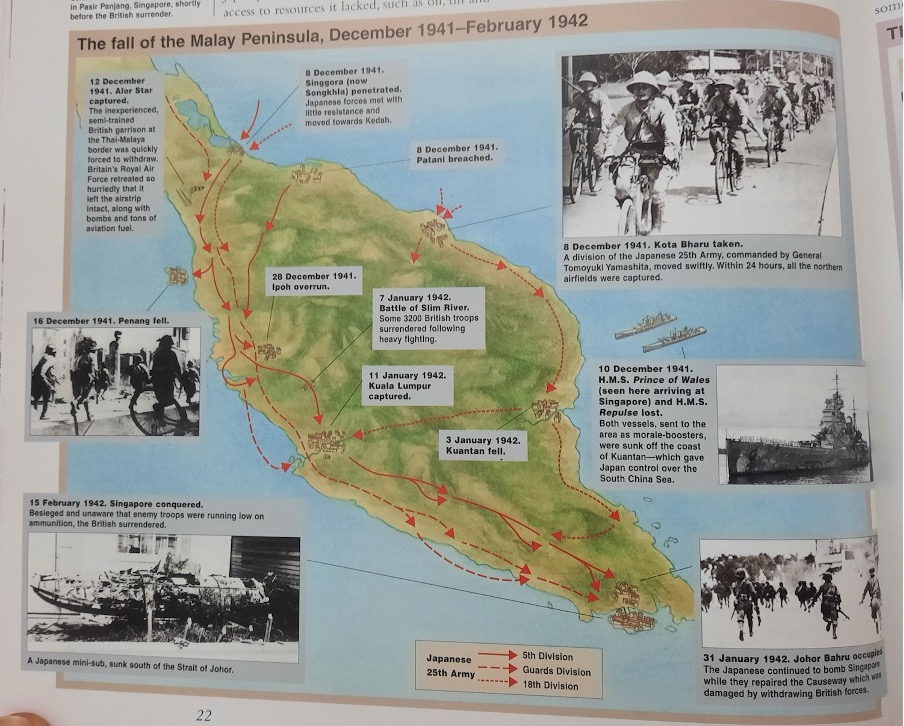
Image source: Encyclopedia of Malaysia: Government and Politics (1940-2006), Page 22

Battle of Jitra
Jitra, a sleepy hollow in northern Malaya, was about to become a battleground. As the Japanese juggernaut from the Seiki Detachment advanced southwards, a sense of dread settled over the British defenders.

The British plan was simple: hold the line with two brigades, the 15th Indian Brigade on the right and the 6th Indian Brigade on the left. A makeshift bunker at Changlun Timah, a roadblock hastily constructed, was meant to slow the Japanese advance. Several bridges were to be blown up along the Trunk Road and the main bridge over the Sungei Bata. However, the Japanese, with their characteristic ruthlessness and efficiency, had other plans.

The Japanese, on the other hand, were a well-oiled machine, having repaired damaged bridges, bypassed the British defences and launched a surprise attack on the Changlun Timah outpost. The defenders, caught off guard, were overwhelmed. The Japanese tanks, relentless and unstoppable, tore through the British lines, leaving chaos and destruction in their wake.

Meanwhile, a miscalculation by the British further compounded their woes. Mistaking a friendly force for the enemy, they destroyed a vital bridge at Manggoi River, cutting off vital supply lines. The Japanese, seizing the opportunity, exploited the confusion and pushed deeper into British territory.

British Order of Battle at Jitra, 11th Indian Division (Major General D. M. Murray-Lyon)

BrigadeUnitsRole
15th Indian Brigade (Brigadier K. A. Garrett)1/Leicestershire Regiment, 1/14th Punjab Regiment, 2/9th JatsRight Flank
6th Indian Brigade (Brigadier W. O. Lay)2/East Surrey Regiment, 1/8th Punjab Regiment, 2/16th Punjab RegimentLeft Flank (coastal)
28th Indian Brigade (Brigadier W. St. J. Carpendale)3 Gurkha BattalionsDivisional Reserve
155th Field Regiment Artillery Support
22nd Mountain Regiment Artillery Support
80th Anti-Tank Regiment Artillery Support

As the British retreated, the 28th Brigade was tasked with reinforcing the beleaguered 15th Brigade. The 28th Brigade, led by a determined commander, managed to halt the Japanese advance in several key engagements. However, the overall situation remained grim. The British, outnumbered and outgunned, were struggling to contain the relentless Japanese onslaught. The British retired in disorder towards Gurun, 30 miles along the Trunk Road to the south. The fate of Malaya hung in the balance.

Battle of Kampar
After the disastrous defeat at Jitra, the British forces retreated to the Kampar line, a defensive position that offered some natural advantages. Brigadier A.C.M. Paris, temporarily commanding the 11th Indian Division, hoped to hold the line and buy time for reinforcements to arrive. However, the Japanese 5th Division, led by Lieutenant General Matsui Takuro, was relentless. The Japanese launched a series of attacks, but the British defenders, though outnumbered and outgunned, fought with courage and determination.

The Japanese, however, were not to be denied. They launched a flanking manoeuvre, landing troops at Hutan Melintang. This move threatened to cut off the British supply lines and outflank their positions. Faced with this imminent threat, Brigadier Paris was forced to order a withdrawal. The Battle of Kampar, though a valiant effort, marked another significant setback for the British forces in Malaya.

Battle of Kuantan
The coastal town of Kuantan became the next battleground, with the 22nd Brigade tasked with defending the vital airfield. The British had fortified the beaches with pillboxes and barbed wire. The Japanese, ever relentless, launched a two-pronged attack on Kuantan. The Takumi Detachment advanced directly towards the town, aiming to capture the vital airfield. Simultaneously, another Japanese force attacked from behind, infiltrating through the rugged terrain of the Jabor Valley.

The fighting was fierce, with both sides suffering heavy casualties. Lieutenant Colonel Cumming, leading the 2/12th Frontier Force Regiment, displayed extraordinary courage in the face of overwhelming odds. Despite being wounded twice, he led his men in a desperate counterattack, buying precious time for the British forces to withdraw. His heroic actions earned him the Victoria Cross.

The fall of Kuantan marked another significant setback for the British. The loss of the airfield deprived the Allied forces of a vital airbase, further weakening their ability to resist the Japanese advance. As the British retreated, the shadow of defeat loomed large over Malaya.
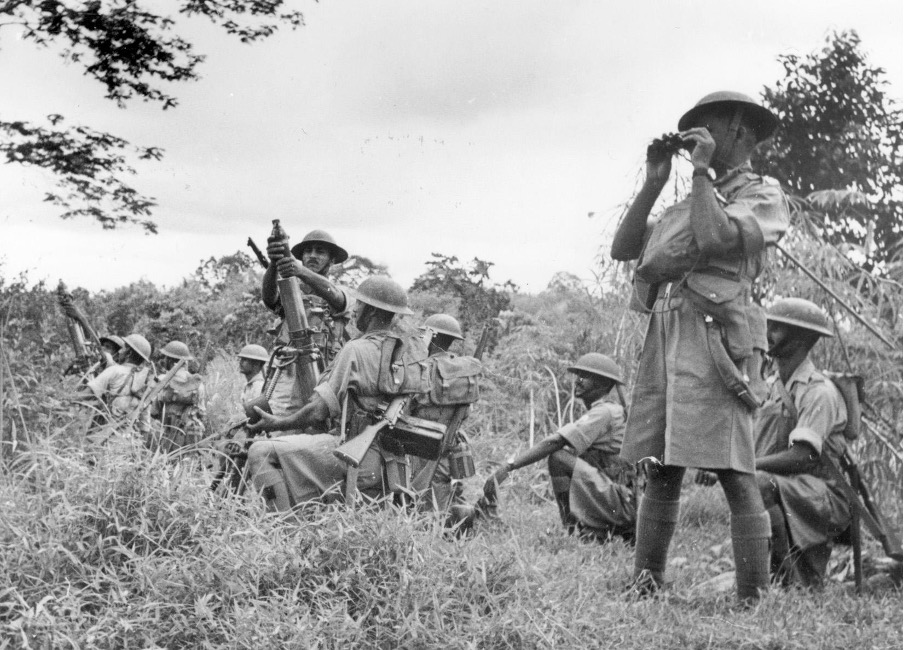
Standing their ground in the dense jungle of Malaya, Indian soldiers fire trench mortars from a tapioca patch at the oncoming Japanese. Image source: https://warfarehistorynetwork.com/article/the-fall-of-malaya-japanese-blitzkrieg-on-singapore/

Battle of Slim River
The battered British forces, reeling from the defeat at Kampar, retreated to the Slim River line. The dense jungle on either side of the road and railway track offered a semblance of security.

The Japanese, relentless as ever, launched a surprise attack in the early hours of the morning. Tanks rumbled through the jungle, their tracks tearing through the dense undergrowth. The British, caught off guard, were overwhelmed by the sheer force of the Japanese assault. Communication lines were down, and units were isolated, struggling to coordinate their defences. The British, unable to coordinate an effective defence, were forced to retreat.

The Fall of Kuala Lumpur
The relentless Japanese advance continued, and soon the heart of Malaya was within their grasp. Kuala Lumpur, the bustling capital city, fell to the invaders on January 11, 1942. The Japanese, utilising bicycles to swiftly maneuver through the dense jungle, outmaneuvered and overwhelmed the British defenders.
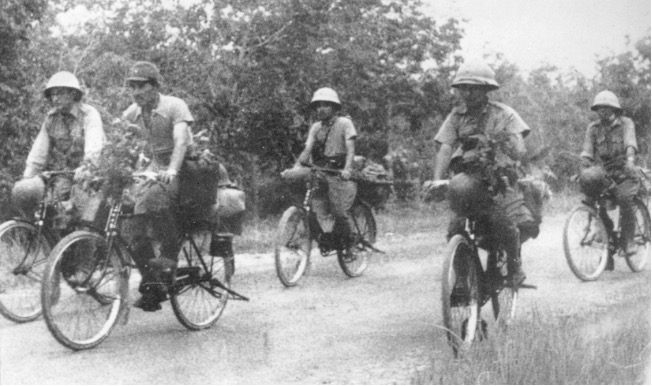
Riding bicycles, a Japanese unit rolls rapidly forward, when the tires went flat, the soldiers continued to ride on the metal rims. Image source: https://warfarehistorynetwork.com/article/the-fall-of-malaya-japanese-blitzkrieg-on-singapore/

Battle of Gemas
The final chapter of the Malayan Campaign unfolded in the southernmost state of Johor. The Australian forces, now tasked with defending the beleaguered peninsula, faced a daunting challenge. The Battle of Gemas was a desperate attempt to slow the Japanese advance. Australian troops, under the command of General Bennett, planned an ambush to inflict heavy casualties on the enemy. However, a series of tactical errors and logistical failures undermined the plan. The retreat from Muar, a crucial defensive position, further weakened the British defenses. The surviving troops were forced to withdraw to Parit Sulong, where they faced another brutal battle.

As the Japanese closed in on Johor Bahru, the British were forced to make a difficult decision. To deny the enemy a vital bridgehead, they destroyed the Johor Causeway, severing the land link between Malaya and Singapore. With the fall of Johore, the British were forced to abandon Malaya and retreat to the island fortress of Singapore.

And then a hero comes along…
The fall of Singapore was a devastat
ing blow to the British Empire. However, even in the darkest hours, acts of extraordinary bravery emerged. One such act was the heroic last stand of Lieutenant Adnan Saidi and his men at Pasir Panjang.

Adnan, a young Malay officer, led his troops in a desperate defense against the invading Japanese forces. Outnumbered and outgunned, they fought with courage and determination, holding off the enemy for days. The battle at Pasir Panjang became a symbol of resistance and sacrifice, inspiring generations of Malaysians.

Adnan, a true patriot, paid the ultimate price for his bravery. He was captured and executed by the Japanese, but his legacy lives on. He is remembered as a national hero, a symbol of courage and sacrifice.

The Japanese, with a formidable force of approximately 70,000 troops, needed just 68 days to conquer the Malay Peninsula and Singapore—one of the most decisive victories of World War II. Following this swift campaign, northern Borneo succumbed shortly after, with Sarawak and British North Borneo falling under Japanese control by the end of January 1942, facing minimal resistance.

The fall of Malaya was a turning point that reshaped Southeast Asia’s political and military landscape. It exposed the vulnerabilities of colonial powers and the impact of underestimating an adversary. Zafrani Amran’s analysis highlights the complexities of this campaign, reminding us that history’s lessons are as vital today as they were then.

About the speaker
Zafrani Amran hails from Kota Bharu, Kelantan, a place rich in history and significant as the site of the Japanese landing during World War II. Growing up, Zafrani often visited the beach, where he saw the pillbox and heard harrowing tales of Indian soldiers, chained inside, forced to fight against the Japanese. His father, who grew up during the Japanese occupation, also shared vivid accounts of life during that time. These stories sparked his curiosity and ignited a lifelong passion for uncovering and preserving stories from the Japanese occupation of Malaya.

Reference and Reading Material:
‘Sir, They Sunk Our Battleship’: HMS Prince of Wales Changed History Forever by Maya Carlin (https://nationalinterest.org/blog/buzz/sir-they-sunk-our-battleship-hms-prince-wales-changed-history-forever-210230)

Operation Battle of Jitra from https://codenames.info/operation/battle-of-jitra/

The Fall of Malaya: Japanese Blitzkrieg on Singapore from https://warfarehistorynetwork.com/article/the-fall-of-malaya-japanese-blitzkrieg-on-singapore/

First shot in the Pa­cific war: What hap­pened in Kota Baru 75 years ago to­day, when the Ja­panese ar­rived from https://www.pressreader.com/malaysia/the-star-malaysia-star2/20161208/281603830092588

Malayan Campaign from https://www.nlb.gov.sg/main/article-detail?cmsuuid=f2e9428f-c2cc-4c21-8a33-6ba79d03d77e

For Valour : Squadron Leader Arthur Stewart King Scarf (37693) VC Royal Air Force from https://www.rafmuseum.org.uk/blog/for-valour-squadron-leader-arthur-stewart-king-scarf-37693-vc-royal-air-force/

Commerating the Historical Event of Bukit Chandu and Lt Adnan Saidi from https://mymilitarytimes.com/index.php/2021/02/14/commerating-the-historical-event-of-bukit-chandu-and-lt-adnan-saidi/

Textile Museum: Telepuk: The Art of Gold Leaf

by Manjeet Dhillon

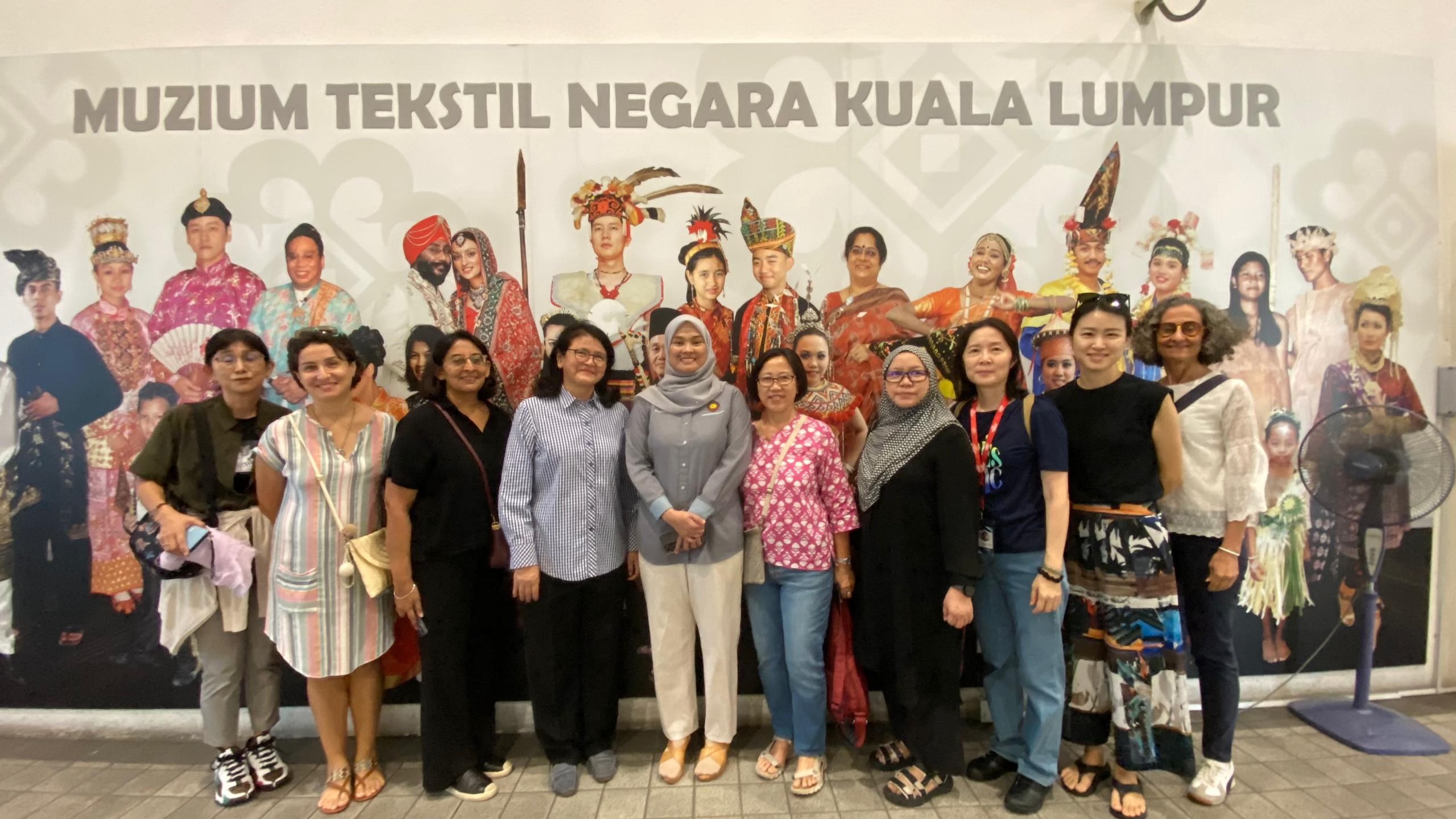
A group of Museum Volunteers (MV) gathered bright and early on a Tuesday morning, 19 November 2024, to explore the National Textile Museum’s special exhibit, Telepuk: The Art of Gold Leaf (Pesona Telepuk: Seni Perada Emas). Adding to the buzz of the day, a telepuk-making workshop was in full swing, with our very own MV’s Hani and Farah, rolling up their sleeves and getting hands-on with the craft. 

MV group photo, taken by Kulwant Kaur

Puan Salmiah ushered us to Gallery Saindera, where the textile exhibit is being showcased from 28 October to 31 December 2024. It’s divided into five segments, showcasing a whopping 183 collections. Among these, you’ll find 49 stunning examples of telepuk textiles, 130 intricately designed telepuk stamps, and a handful of manuscripts and publications that tie it all together.

In ancient Malay literary texts, telepuk originally referred to a type of lotus, the nymphaea stellata. Over time, the word became closely tied to the textile itself. Some believe it refers to the floral stamps used in the process, while others think it describes the shimmering golden patterns on the fabric, reminiscent of sunlit lotuses glistening on a calm lake. (https://telepuk.com/history/)

The first segment focused on the history of telepuk. This traditional technique involves creating motifs and designs on fabric, especially woven cloth, using a stamping technique with gold leaf. Artisans stamp Arabic gum onto the forearm, followed by the telepuk stamp carved with motifs. The gum acts as an adhesive for the gold leaf, which is then pressed onto the fabric. Kulwant asked why the forearm is used, and Puan Salmiah explained that its temperature is ideal for stamping. If the forearm isn’t used, the thigh is the alternative. 

The table below highlights the diverse names and practices of telepuk in Malaysia, Indonesia, and Korea, emphasising its royal connections and the use of gold leaf in textile decoration.

CountryNameDetails
MalaysiaTelepuk / Kain SerasahUses 24k gold leaf (often imported from Thailand) and is applied on woven fabrics like limar and satin, but not songket, as the latter already incorporates gold threads, making the combination visually excessive. Note: Gold leaf is imported from Thailand for its superior quality. It is produced in Thailand because it is traditionally used in the royal attire of the King of Thailand.
IndonesiaPeradaShares similarities with telepuk; the exact application and materials may vary.
KoreaGyumbakReserved for royalty (Joseon Period, 1392~1910), often adorning fine textiles with gold leaf or foil.
Sri Lanka Use gold water instead of gold leaf
IndiaVarakIn Rajasthan, particularly in Jaipur, Sanganer, Jodhpur, Sawai Madhopur, and parts of Gujarat, artisans practise a technique called varak, where delicate sheets of gold leaf, known as patra, are adhered to textiles. This is done using a special glue called safeda or saresh, made from powdered resin. A later variation, known as khari, uses gold powder instead of leaf, giving the textiles a slightly different but equally striking effect.

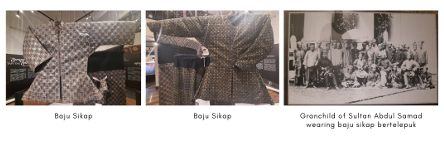
Among the displays was Sultan Abdul Hamid’s baju sikap, an outer garment worn over baju melayu, adorned with telepuk and featuring five gold buttons, typically a baju sikap has only one button. This piece was worn during King George V’s installation ceremony in 1911. Another was a baju sikap decorated with telepuk, belonging to Sultan Abdul Samad, the fourth Sultan of Selangor. Estimated to be 170 years old, this garment was also featured in a photo of his grandchild wearing it. Sultan Iskandar of Perak was also known to wear a headdress made of telepuk, while the late Sultan Hishamuddin of Selangor donned a baju layang, a cape-like garment that forms part of Selangor’s royal dress code.

We learned that telepuk was especially prominent in states like Selangor, Pahang, Terengganu, Perak, and Johor. Its historical significance is captured in Malay manuscripts such as Syair Siti Zubaidah Perang Chik, where it is referred to as perada

The exhibits also included a fascinating reference to The Malays: A Cultural History by R.O. Winstedt, which documented telepuk production in Pahang and Pattani. The book describes the process as practised in these regions, as well as in Selangor, noting its similarities to a technique from the state of Punjab, India. (excerpt from book: Patani, Pahang and Selangor produce cloths (kain telepuk) guided by a technique practised also in the Punjab. Cotton with a small pattern on a dark green or dark blue ground is polished (with cowry shells), stamped with armed wooden blocks that have been smeared with gum, and then covered with gold leaf that adheres to the gummy pattern.)

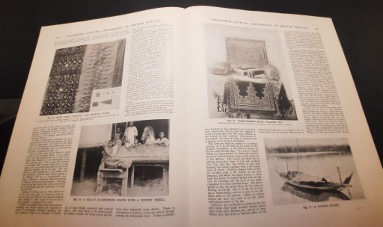
Twentieth Century Impressions of British Malaya: A historical reference capturing the art of telepuk, offering a glimpse into its cultural significance.

We now moved on to view collections, starting with one from Selangor. This piece stood out with its motifs of flora, fauna, and calligraphy. There’s even a section featuring the mirror image of a calligraphy inscription saying Bismillah ir Rahma ir Rahim (In the name of God, the Most Gracious, the Most Merciful), as well as Allah Muhammad, in a mirrored script. The designs aren’t just limited to nature and words, cosmic and geometric patterns also make appearances.

Kain telepuk with a mirror image of a calligraphy inscription saying Bismillah ir Rahma ir Rahim. Image source: www.https://tangankraf.com/

Baimi asked about the function of kain setangan, and Puan Salmiah explained that it’s folded into a headpiece for men, known as a tengkolok or tanjak. Kulwant chimed in, remarking how each wooden carving of the motifs is painstakingly detailed – definitely a lot of craftsmanship and precision goes into making these pieces!

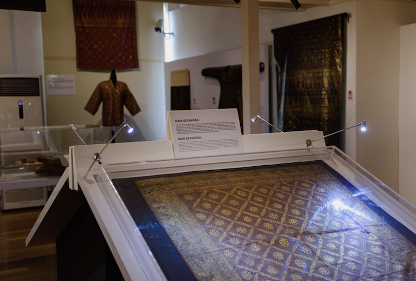
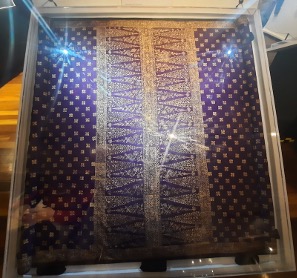
A piece of sarong cloth from the collection of the late Tan Sri Mubin Sheppard was on display, donated by his wife to the legendary craftsperson Norhaiza Nordin. Each kain sarong is usually split into three parts:

  1. Kepala (head of the cloth), often placed at one end of the sarong. It serves as a focal point when the cloth is worn or displayed. For the sarong cloth below this is where the motif is made up of two types of pucuk rebung (bamboo shoot): one with bamboo shoots, the other floral.
  2. Tepi hati tengah (middle of the cloth), this central section connects the kepala and kaki kain. It usually contains repeating patterns or simpler motifs to complement the boldness of the kepala.The sarong below features scattered flowers and a mangosteen motif.
  3. Kaki kain (end of the cloth), this is the bottom or border of the fabric. It often features a band of more intricate or bold designs, framing the entire sarong.

 From the collection of the late Tan Sri Mubin Sheppard

The MVs were further amused to learn that where you place the kepala kain on a woman’s attire actually symbolises her marital status! If it’s at the back, she’s married. In the front means she’s single, to the left is a divorcee (janda), and to the right is a widow (balu). The same idea applies to the samping worn with the baju Melayu: below the knee means the wearer is married, while above the knee signals they’re single.

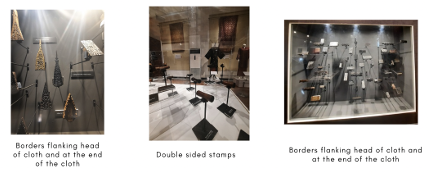
Moving on, we took a look at the stamps used to create the motifs. The main design we saw was a scattered flower pattern, and the stamps are typically made from kayu jelutong or kayu celah wood. Hani pointed out that some of the stamps had a metal-like top, which Puan Salmiah explained is a unique feature of a few stamps, but traditionally, they’re carved entirely from wood. The stamps on display, provided by the Department of Museums Malaysia, included both traditional ones and some whose origins could not be traced to a specific state.

Gold leaf is applied on these stamps to create the telepuk effect. The second vitrine featured stamps used for the kepala kain, often showcasing the pucuk rebung (bamboo shoot) design. We were all amazed by the intricacy of these carvings—each one carefully polished and varnished to a gleam. Next, we saw stamps for the tepi hati tengah section of the cloth, featuring a flower-in-a-box design. There were also stamps for bunga inti, smaller flowers placed between the pucuk rebung.

Continuing, we found stamps for the borders and kaki kain, known as sikat kain (comb stamps). These had more geometric, fence-like motifs (pagar istana) and some featuring awan larat (cloud patterns), ombak ombak (waves), and ulam raja (herbs).

One particularly special vitrine had double sided stamps, making it easier for the craftsman to switch from one side to the other when working on the telepuk design. This collection used both metal and wood.

MV Kulwant asked if these materials are still available for sale, and Puan Salmiah mentioned that Adiguru Norhaiza Nordin in Besut, Terengganu, would have some pieces for sale, as well as Gerakan Langkasuka.

We then explored the kebaya, where the gold leaf motif featured bunga kamunting cina. There was also a kain lepas(unstitched cloth) on display, typically used as a shawl or to cover one’s head. This was an example of wrap ikat (ikat tenun loseng) that incorporated telepuk. We also saw weft ikat pieces, like ikats limarkebaya, and kain sarong (which didn’t include the tepi hati tengah motif).

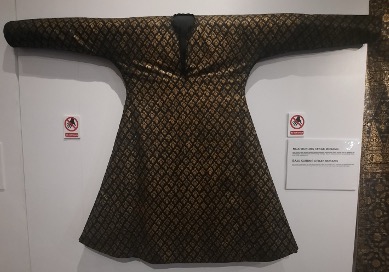
One of the highlights was a pantaloon decorated with gold leaf. Then, we came across a 19th-century baju kurung cekak musang, covered in a full floral pattern. It’s said that it takes anywhere from 6 months to a year to complete the full telepuk pattern on such a piece. Most of the collection is about 100 years old because telepuk production stopped after WWII, making this craft a dying art. But now, with efforts from the Gerakan Langkasuka, Yayasan Hassanah, and collaborations with the National Textile Museum, there are workshops and knowledge-sharing sessions to revive it.

Baju kurung cekak musang

Hani shared an interesting piece of history—back in the day, artisans would view their fabric printing as an offering to God. It wasn’t just a craft; it was a gift, a present that was made with deep care. This heart and soul commitment resulted in pieces that were beautifully straight and exquisitely crafted.

We also checked out the tools of the trade. There was a sample of the wood block used to carve telepuk stamps, made from cengal or jelutong wood. We saw a carving knife, as well as sketches by Adiguru Norhaiza Nordin and collections from the Department of Museums Malaysia.

We then looked at a Bugis cloth from Indonesia, which had a distinctive chequered pattern. The shiny finish comes from a calendering process known as gerus. Along with that, there were several examples of kain setangan featuring both calligraphy and floral motifs.

The third segment focused on the calendering process, with a detailed step-by-step explanation. A key element of this process is the use of siput bintang (cowry shells) as gerus. An exhibit demonstrated how the woven cloth is placed along a stick, with the bottom of the stick covered in cowry shells. The stick is then glided across the fabric, polishing it, enhancing its durability, and compressing the weaving yarns. Typically, one cowry shell can be used to calendar 2 to 3 pieces of cloth, each about 4 metres in length.

Before the gerus process begins, the woven cloth is washed with soap nuts (buah kerang) for pest control. The cloth is then dried, and a layer of wax is applied before the calendering process starts. This process can take up to a week, depending on the length of the cloth, after which the telepuk process can begin.

The telepuk process involves several materials: gold leaf, woven cloth, telepuk stamps, Arabic glue, and bamboo spatulas (used on the forearms). The process starts with applying Arabic glue to the forearms. Once the glue is in place, the telepuk stamp is pressed onto the forearm and then transferred to the fabric. After leaving it for a short while, the gold leaf is applied, and any excess is carefully brushed away with a fine brush.

We went upstairs for a showcase of carefully-selected collections from the Department of Museums Malaysia and exhibition partners consisting of state museums and individuals. Among them are collections of telepuk from the Terengganu Museum Board, Kedah Museum Board, Selangor Malay Customs and Heritage Corporation (PADAT), Johor Heritage Foundation and Mr. Norhaiza Noordin.

The final segment focuses on the sustainability of telepuk, featuring the latest creation: a long kebaya worn by Tengku Permaisuri Selangor, Tengku Permaisuri Hajah Norashikin, during her husband’s (9th Sultan of Selangor, Sultan Sharafuddin Idris Shah Alhaj) birthday in 2021. Recognising Selangor as one of the states renowned for telepuk, the Tengku Permaisuri is committed to uplifting and reviving this heritage in Selangor.

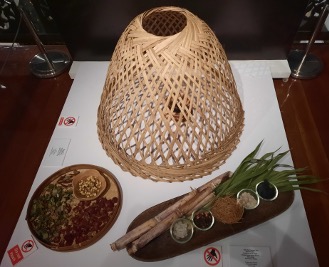
Our last insight highlights the traditional method of caring for textiles, known as wukuk kain. This special technique, akin to dry cleaning, involves placing the cloth over a basket, with a pot of incense burning beneath it. Pandan leaves, flowers, and sugar cane are added to the incense, emitting a fragrance that is transferred to the telepuk fabric. This process helps preserve the fabric’s colour and acts as a natural pest control measure.

As we concluded our exploration of the art of telepuk, we would like to express our heartfelt gratitude to Puan Salmiah for her invaluable insights and detailed explanations, which deepened our understanding of this traditional craft. A special thank you to all the artisans and curators who preserve and share these rich cultural legacies.

We left with a deeper appreciation for the artistry, history, and ongoing efforts to keep these traditions alive.

Reference:

National Textiles Museum

Korean Heritage Service – https://english.cha.go.kr/chaen/search/selectGeneralSearchDetail.do?mn=EN_02_02&sCcebKdcd=17&ccebAsno=01190000&sCcebCtcd=11&pageIndex=13&region=&canAsset=&ccebPcd1=&searchWrd=&startNum=&endNum=&stCcebAsdt=&enCcebAsdt=&canceled=&ccebKdcd=17&ccebCtcd=

https://www.instagram.com/korea_heritage_geumbakjang/

Adiguru Norhaiza’s Story | Reviving the Forgotten Textile Art, Telepuk – https://www.youtube.com/watch?v=f-IO9_Z-CtI

Bank Negara Museum tour 

By Aishah Nadirah

One Thursday morning, more than 20 MV’s gathered at the lobby of the Bank Negara Museum (BNM). I’ve often heard many good things about the museum and was incredibly grateful to be able to join this tour. Visitors were greeted by the grand spiral staircase in the middle of the museum’s hallway and by 10a.m., it was packed with tourists and buses of school children.

The tour was divided into 3 galleries: the Economics Gallery, the BNM Numismatic Gallery, and the latest gallery Masih Ada Waktu.

It kicked off with the first gallery led by En Nazran; the gallery’s definitely a boon for any economics’ enthusiast or those curious about Malaysia’s trading history. Immediately it became clear why there were so many school children in the museum. The interactive exhibits were an essential part of the museum, bringing life to the serious numbers and statistics all over the wall. En Nazran noted that the interactivity is key in the museum, which allows communicating with visitors more efficiently so they won’t have to rely wholly on a museum guide. 

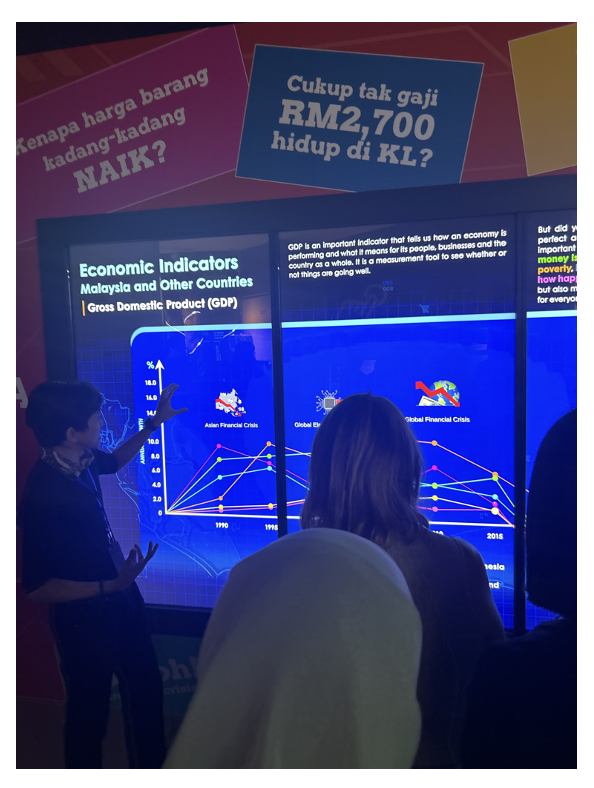
The history of Malaysia’s economic growth started with Malaysia’s natural resources, a history of which parallels that in Gallery C of Muzium Negara. It then transitions to Malaysia’s modern-day economics, displaying a switch from a resource-mixed economy to a financial information sector. 

Another standout display was the history of trading currency used in the Malay archipelago following the arrival of international traders from Spain, Holland, Portugal and Great Britain to the East Indies in the 16th century. Here, Encik Nazran shared the etymology of the word ‘ringgit’, which came from the jagged edge of a coin or in Bahasa Malaysia, ‘beringgit’.

The last 3 exhibits focused mainly on the nation’s modern economy, from Malaysia’s financial sectors’ development e.g. the prestigious institutions of Maybank, RHB, to the Asian financial crisis and a quick skim of the past governors at the helm during the crisis. The penultimate display was a history of all recorded world economic crises up to the last 2020 Covid crisis. Encik Nazran pointed out the arguably most interesting one: the tulip and bulb craze in the 1630s, where people would go so far as to sell 12 acres of their land for just one bulb of tulip. This led to a tulip and bulb bubble, which wasn’t sustainable and short-lived.

Next came the highlight gallery of the museum: the BNM Numismatic Gallery. Located on the second floor, this tour was guided by Puan Ilyana. It opened with the golden era of the Malay archipelago as the strategic centre of trade, a piece of history familiar to the MVs. There was a wall decorated with a reimagination illustration of Melaka as a trading centre and beside it, an exciting simulation game teaching on the barter trade system.

The next exhibit featured currencies found during the old Malay kingdoms. Displayed in a glass case, as well as its information projected on to the screen above it, many coins were on display in the dark room, giving it an important atmosphere. This flow, Puan Ilyana informed us, was inspired by the Malaccan river, where some of those very coins were discovered. This part of the gallery was a little narrow for the 20 or so of us museum volunteers but the screen was a welcome visual aid for those who weren’t able to catch a peek of the coins. The main attraction in the numismatic exhibit was the Kelantanese coin from the 17th-18th century used during the reign of legend Che Siti Wan Kembang. It was of a kijang emas (deer) which is now emblazoned as Bank Negara Malaysia’s corporate logo –– the first gold coin from Kelantan. Given its gold content, the coin is also valued at current gold prices.

Pn Ilyana took the time to answer each and every question from us. One interesting fact shared by her was that animal tokens, as seen in Gallery C of Muzium Negara of Muzium Negara, were not for transactional use. Instead, it was used as symbolic tokens for belief. For example, a trader would carry around the tortoise token with the belief for longevity.

The walls in the numatic gallery were lined with even more interactive games, bringing the history of coins to life. A personal favourite was one interactive wall featuring historic currencies used in the Malay archipelago, where we match the comically large token to its facts. Not only do we learn these interesting facts, we also get to admire the different currency designs from the different states. One that came to mind is the Johor currency during Sultan Sulaiman Badrul Alam Shah’s reign – it had a doughnut hole in the middle reminiscent of modern Danish currency 1 krone.

Another exhibit that stuck out was the wall of commemorative currency displaying the huge RM600 bill created in conjunction with the 60th anniversary of the signing of the Federation of Malaya Independence Agreement. According to the Guiness World Records, this was the world’s largest legal banknote in production.

The creation process of the ringgit also was featured, where it involved blending a special mix including polymer and cotton. Pn Ilyana pointed out that’s why the ringgit doesn’t get destroyed in the wash! Interestingly, the raw material blend were available as souvenir pens in their BNM Giftshop at the ground floor.

The numismatic gallery ended with a feature of international currency notes, arranged in alphabetical order. Here, Pn Ilyana shared how any Malaysian ringgit with a scratch on the Agong’s face is considered damaged and holds zero value.

The final exhibit was BNM’s temporary exhibit, Masih Ada Waktu: Sediakan Payung Sebelum Hujan (‘There’s Still Time’), an exhibit aimed to encourage young ones to save. This tour was led by one of the exhibit’s curators, Ms Gabrielle. Walking in was a huge contrast to the previous gallery: unlike the numismatic gallery’s dark and serious atmosphere, this one was brightly coloured and felt incredibly welcoming to children. Ms Gabrielle explained that due to the heavy nature of the content, the exhibit was divided into 4 sections: history of saving boxes, Malaysia’s history of saving, the kids corner featuring tips and tricks for daily savings, and lastly the technical details of saving.

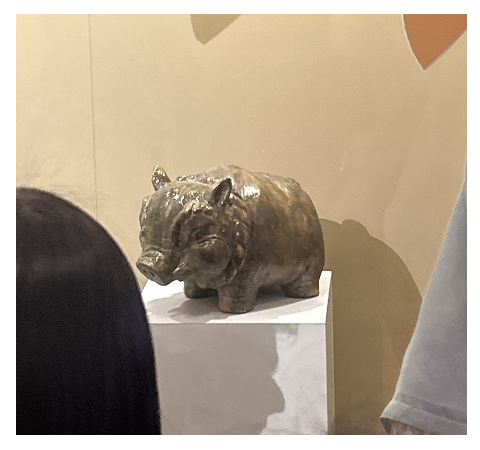
In the first part of the exhibit, we learnt about the piggy bank –– specifically, the ‘celengan’ or the Javanese piggy bank. Most of these piggy banks were originally found in the capital of Majapahit and in the shape of a pig, a symbol of strength and prosperity.

The most interesting thing in the Masih Ada Waktu exhibit, personally, was Malaysia’s history of saving, showing the government’s efforts in encouraging saving nationwide, especially in rural areas. Saving stamps were used at post offices to make saving more convenient for folks staying in the outskirts as banks were located too far away in the city. Interestingly, banking books all over the peninsular differed in design by states. Majority of MVs were also excited at the mention of kootu funds, especially when Ms Gabrielle pointed out that it was illegal when more than 10 contribute or the ibu kutu (leader of the kootu funds) charges interest. It then trails to other collaborations with individuals such as Malaysia’s beloved illustrator Dato’ Lat in the saving campaign, as well as smaller artists selling money banks up to RM2,000.

Finally, the campaign ends with a poppy coloured lifesized snakes-and-ladders game for children to learn as they play about saving habits and even debt. Overall it’s an exhibit that should not be missed, especially for parents, teachers and guardians of young ones. Ms Gabrielle, who also is part of the BNM Marketing team, proudly notes that other central banks visit BNM for guidance on how to make their museums more engaging such as those from Czech Republic and Pakistan. BNM has also several international museum awards under their belt, as well as Accessibility Sejagat award by DBKL. The tour was a highly recommended experience and would definitely be paying another visit to the BNM museum very soon.

M & M – From Menara Condong to Sky Mirror

By Eric Lim

This year, we commemorate our 67th Independence Day  with the theme ‘Malaysia Madani : Jiwa Merdeka”. And we took full advantage of the extended public holiday to visit the state of Perak, which incidentally is embarking to boost and revitalize its tourism sector by promoting the “Visit Perak Year 2024” campaign.

We took off early in the morning and exited Bukit Lanjan to join E1, the North South Expressway – Northern Route. Together with E2 which heads the Southern Route, it forms a section of the Asian Highway 2 (AH2) that connects Denpasar in Indonesia, through Singapore, Malaysia, Thailand, Myanmar, India, Bangladesh, Nepal, Pakistan and finally ends at Khosravi in Iran. We made a stop at Bidor for breakfast. The town’s claim to fame can be pinpointed to the discovery of the standing statue of the eight-armed Bodhisattva Avalokiteshvara which is permanently on display at the National Museum. The statue was found in a tin mine belonging to the Anglo Oriental company in 1936 and one of the arms was already broken when it was found. The bronze statue stands at 93 cm and weighs 63 kilograms. It is believed to date back to the 8th – 9th CE during the period of the Gangga Negara, a Hindu kingdom which was centered at Beruas. This artifact has been categorized as an Important Object among the 173 heritage items (and counting) declared as National Heritage in our country.

Statue of Bodhisattva Avalokiteshvara 

                    Photo : Avalokiteshvara | Official National Museum Website.

From Bidor, we travelled about 43 km west to the town of Teluk Intan, the administrative centre for the Hilir Perak district and the largest town in the south of Perak. Navigating through the town, we can use the Teluk Intan Fun Map as our guide to explore the key historical sites and landmarks. Each landmark is numbered based on the Fun Map, making it easy to follow along as we discover each location. The area was first explored at around the beginning of the 19th CE by a Mandailing trader by the name of Mak Intan who subsequently named the settlement Pekan Mak Intan. After the signing of the Pangkor Treaty in 1874, the town was made the administrative center and base for the British. Later, when Hugh Low was the British Resident of Perak, he requested for the creation of a new administrative town. General Sir Archibald Edward Harbord Anson took the task and drew up plans for its expansion. He was then made the First District Officer. When he retired in 1882, the town was named after him, Teluk Anson (Anson Bay). Next came the railway service. Despite an initial dispute on the route, it was finally settled after the construction of a bridge across Bidor River (No.10) that reduced travelling time from Teluk Anson to Tapah Road. With a total length of 550 ft (168 metres), the railway bridge was the longest ever constructed at that time. The line was opened in May 1893, linking the town to the network to the north and south of the peninsula. A year later, on 17 September 1894, a night mail train was derailed after a bull elephant charged at it while defending its herd (No.12). Meanwhile, Teluk Anson continued to develop into a busy port, so much so that it was the second most important port after Port Klang (Port Swettenham) from 1934 to 1940. It was also used as a processed oil storage terminal for Shell after the port overhauls in 1947. At the centenary celebration of the town’s establishment in 1982, Sultan Idris Shah renamed it back to Teluk Intan (Diamond Bay).

The railway bridge across Bidor River in 1893 / Photo : BERPETUALANG KE ACEH: The old railway bridge at Teluk Intan

The derailment on 17 September 1894 / Photo : 127 Years Ago, An Elephant Literally Fought A British Steam Engine Train In Perak | TRP

Today, one can visit the numerous historical sites located around the town – some are well preserved, some in need of restoration and others are missing or lost. 

Talking of the latter, the railway service ended its run in 1991 due to the shortage of passengers and the train station is repurposed into a driving academy. The old railway gate can still be seen in the town (No.11). The railway bridge across Bidor River has been converted for pedestrian and motorcycle use and Shell has relocated its processed oil storage operations to Lumut. The skull of the elephant that rammed into the train in 1894 is currently on display at the Perak Museum in Taiping. 

Of the many tangible heritage sites in the town, the Leaning Tower of Teluk Intan (No.1) must surely be the most iconic. Originally built as a water tower in 1885 by a local contractor by the name of Leong Choon Cheong, it started to tilt four years after its completion due to an underground stream. In July 1941, a decision was made to demolish the tower ahead of the impending war but two months later, the decision was reversed and it survived through the war. Now it serves as a clock tower. The first clock installed in 1894 was bought from the world famous clockmaker, James Wilson Benson of Ludgate Hill, London. The adjacent street (Jalan Ah Cheong) is named after the contractor in honour of his contribution to the town. The tower was declared a National Heritage Building by the Malaysian Heritage Department in September 2015.

Leaning Tower of Teluk Intan / Photo : Eric Lim

Also situated at the town centre, is the War Memorial (No.9) which is in the form of a boulder that sits on top of a base made of solid stone. It was unveiled to commemorate former residents of Hilir Perak district who fell in the Great War of 1914 – 1918 (World War 1).

The building of Teluk Intan’s old Courthouse (No.8) was completed in 1893 and besides providing judicial functions for the district, it was also used as a church for the Anglican Christians community on every Sunday for their weekly prayer service. It lasted until 1912 when a new church, Church of Saint Luke the Evangelist was inaugurated. It was a small wooden building until it was renovated in 2001. Other places of worship that stood the test of time are –

St. Anthony Of Padua (No.5) which was originally built in 1894 but it was destroyed in a fire in 1914. The current church was built in 1922 and was consecrated by Bishop Jean Marie Merel the following year. 

Hock Soon Keong Temple (No.4) was built in 1883 on a piece of land that was offered by General Sir Archibald Edward Harbord Anson when he was still in office. The generous offer was a sign of appreciation to  the community when he made a miraculous recovery from his serious illness. The temple was built according to architectural concepts from Southern China.

The Sri Thendayuthapani Temple (No.6) was built in the late 1890s with contribution from the local Chettiar community. They brought in the finest teak wood from Myanmar to be used for the foundation of the temple and also a silver chariot from India in 1932 for their annual festival.

Also located in the town is the Indian Muslim Mosque which is believed to be built in the late 19th CE or early 20th CE. It is the oldest mosque built in Teluk Intan.

These sites continue to play an important role in the local community. However, the following two sites are currently in need of restoration:

Old Police Station (No.7). Built in 1882, the building was initially used as a tax collection center and customs office. Later it was changed to a police station. During the war, the Japanese Military Police turned it into an interrogation centre..

The Old Palace of the Young Raja of Perak (Istana Lama Raja Muda Perak) was built in 1924 at a cost of $24,000. The first Raja Muda of Perak to reside here was the late Sultan Abdul Aziz who became the 31st Sultan of Perak while the last was the late Raja Muda Ahmad Siffuddin Ibni Almarhum Sultan Iskandar who died in 1987.The current Sultan of Perak, Sultan Nazrin Shah was due to stay here but he stayed at the palace in Ipoh instead. While the palace was in use, Teluk Intan was known as a Royal Town.

Besides the heritage sites, Pulau Bangau (No.2) or Stork Island, in Sungai Perak is a new attraction. Currently home to more than 30,000 birds of various species and amongst them, there are ten species of stork (shorebirds) like Bangau Besar (Great Egret), Bangau Batu (Pacific reef Egret), Bangau Bakau (Great billed Heron), Banbau Cina (Chinese Egret), Bangau Kecil (Little Egret), Bangau Kendi (Medium Egret), Bangau Kerbau (Cattle Egret), Bangau Paya (Purple Heron), Asian openbill heron and Striated Heron. There are also other interesting locations to explore like the shipyards, fish breeding farms, furnace of a sunken ship, just to name a few. 

For those who take the evening cruise, an added attraction is to watch fireflies light up the night with a display of flashing lights. The Pulau Bangau fireflies are of the Pteroptyx tener variety.

Teluk Intan Fun Map / Photo : Portal Rasmi Majlis Perbandaran Teluk Intan – Latar Belakang

After the river cruise, we drove to Bagan Datuk (previously Bagan Datoh). Bagan Datuk was upgraded into a full district in 2016, the 12th district in the state of Perak. It was once a major coconut producer around the end of the 19th CE until the middle of the 20th CE. We made a brief photo stop at Dataran Bagan Datuk. And located within walking distance from the square is the Tuminah Mosque Complex. This floating mosque concept on the banks of the Perak River is the latest and unique attraction in the district. It is the third floating mosque in Perak.

Photo stop at Bagan Datuk / Photo : Eric Lim 

Tuminah Mosque Complex / Photo : Portal Rasmi Majlis Perbandaran Teluk Intan – Latar Belakang

It was another 10 km drive from Bagan Datuk to our resort at Sungai Burung, located on the coast. As it was still early after our check-in, we decided to visit the Sunflower Garden. This garden was established in 2020 and since its inception, has garnered a lot of interest through social media. Some commented that they do not have to go abroad to look at the sunflowers as there is one in our very own backyard. The owners have also decorated the garden with many visually appealing props that made the place very instagrammable. Some interesting fun facts about sunflower –

*The binomial name for the common sunflower is helianthus annuus, and it is indigenous to Mexico, central and eastern North America. It was brought  to Europe by the Portuguese in the 16th century and by the 19th century, commercialization of the plant took place in Russia, Ukraine and South east Europe until today. The sunflower is the national flower of Ukraine.

*Sunflowers can remove toxic elements from soil like lead and uranium, and have been used in clean up operations at both Chernobyl and Fukushima.

*Sunflowers have developed an internal clock in their system where they track the sun movement akin to humans with the circadian rhythm. At dawn, sunflowers face east to greet the first rays and continue to move with the sun until sunset in the west. Overnight it swings back to the east. This movement is called heliotropism, but it only happens when sunflowers are still young. A matured sunflower (when it blooms) will remain steadfast facing the east. This is to promote pollination. 

Sunflower Garden at Sungai Burung / Photo : Perak Sky Mirror / Nine Island Agency Sdn Bhd | Bagan Datoh

Later, we were offered buggy rides to visit the small fishing village of Sungai Burung. Then it was time for dinner where we had a wide variety to choose for our D.I.Y seafood steamboat. As it was a public holiday, the restaurant was filled to the brim with tourists. Happily, we had filled our tummies and were all set for the next item on our itinerary i.e the Blue Tears tour (it is mentioned as Blue Sand tour in the pamphlet). We were taken out to sea and after a while, the boat was kept in an idle state, and suddenly, as if by magic, the guide scooped flashing sand out of the water using a net. Yes, it was stunning  to see that the sand was flashing blue lights however not for long, as soon as it touched the deck, the lights just faded out.

The Blue Tears / Photo : 7 Dreamy Locations To Catch Sight Of Blue Tears In Malaysia – Klook Travel Blog

The Blue Tears is a natural phenomenon caused by Dinoflagellates, a type of plankton (microscopic marine organism) and they are traditionally classified as algae. They have characteristics of both animals and plants, and live near the water surface where there is sufficient light to support photosynthesis. The blue light glow by dinoflagellates is a result of it being bioluminescence. Bioluminescence is light emitted by living things through chemical reactions in their bodies. Luciferin is the compound that actually produces light and dinoflagellates produce it on its own through photosynthesis. Dinoflagellates bioluminesce in a bluish-green colour. When the water becomes fertile, the algae will reproduce and will result in a  rapid and excessive growth of plankton population known as algal bloom. The algal bloom will cause the surface of the ocean to illuminate at night (Blue Tears). Fireflies are also bioluminescent organisms and they glow in the yellow spectrum.

Though we were quite disappointed not able to experience the maximum impact of the Blue Tears, the main highlight was still ahead, just under twelve hours away. The next morning, we were advised to wear vibrant, multi-coloured outfits. After a hearty breakfast and a cup or two of ‘kopi’, we relaxed in the sea breeze before heading out to the Straits of Malacca to experience and enjoy the Sky Mirror.

The Sky Mirror is simply a large, flat area with water that reflects the sky. The concept of Sky was inspired by Bolivia’s Salar de Uyuni, the world’s largest salt flat, which spans  4,000 square miles. At 3,656 metres above sea level, the flat holds 10 billion tons of salt, and beneath it lies 70% of the world’s lithium reserves, used in batteries for electric cars and mobile devices. Visitors flock to capture the striking mirror effects and perspective photos.

The introduction of Sky Mirror as a tourist destination in our country started less than ten years ago in Selangor. Since then, it has garnered a huge following thanks to the uploading of ‘crazy photos’ on social media. In our case, the mirror effect takes place in the Straits of Malacca, on a seabed that appears above sea level at low tide thus exposing vast sand flat for a few hours in the morning. Here are some ‘crazy photos’ that we took during our trip. If you do not want to miss these fun activities, you know where to go. Now, you do not have to travel halfway around the globe to do it, just do the ‘cuti cuti Malaysia’ way.

Photos by kind courtesy of Jane Ng, Everfit Yoga.

References

Avalokiteshvara | Official National Museum Website.

Taiping Museum to feature elephant skull from historic 1894 collision

Portal Rasmi Majlis Perbandaran Teluk Intan – Latar Belakang

In Perak, Pulau Bangau attracts domestic, foreign tourists | Malay Mail

Common sunflower | Kew

How sunflowers track the sun

Bioluminescence

Salar de Uyuni

Sky Mirror – Tourism Selangor