Historical Societies in our Country

by Eric Lim

Historical societies in our country have existed since the time of the Straits Settlements. The earliest was the Straits Asiatic Society formed at a meeting on 4 November 1877 at the Raffles Library and Museum in Singapore with its parent organisation, the Asiatic Society of Bengal.

The Asiatic Society of Bengal was founded on 15 January 1784 by Sir William Jones who was a lawyer and Orientalist. When he came to Calcutta (now Kolkata) on 25 September 1783, he took up the post as a Supreme Court judge and five months later, he formed the society, receiving strong support and encouragement from the Governor General of Bengal at that time, Warren Hasting. The setting of the society was to encourage Oriental studies.

The meeting on the formation of the Straits Asiatic Society was chaired by Archdeacon George Frederick Hose, who later became Bishop. It was attended by prominent members from the  expatriate communities in the three Straits Settlements states including D.F.A. Hervey (Resident Councillor of Malacca), Charles John Irving (Lieutenant General of Penang), and William A. Pickering (first Protector of Chinese of the Chinese Protectorate based in Singapore). The society started with an enrolment of 150 members. The Society’s mission was ‘to produce the collection and record of information relating to the Straits Settlements and the neighbouring countries’. Its other aims included producing a journal and establishment of a library.

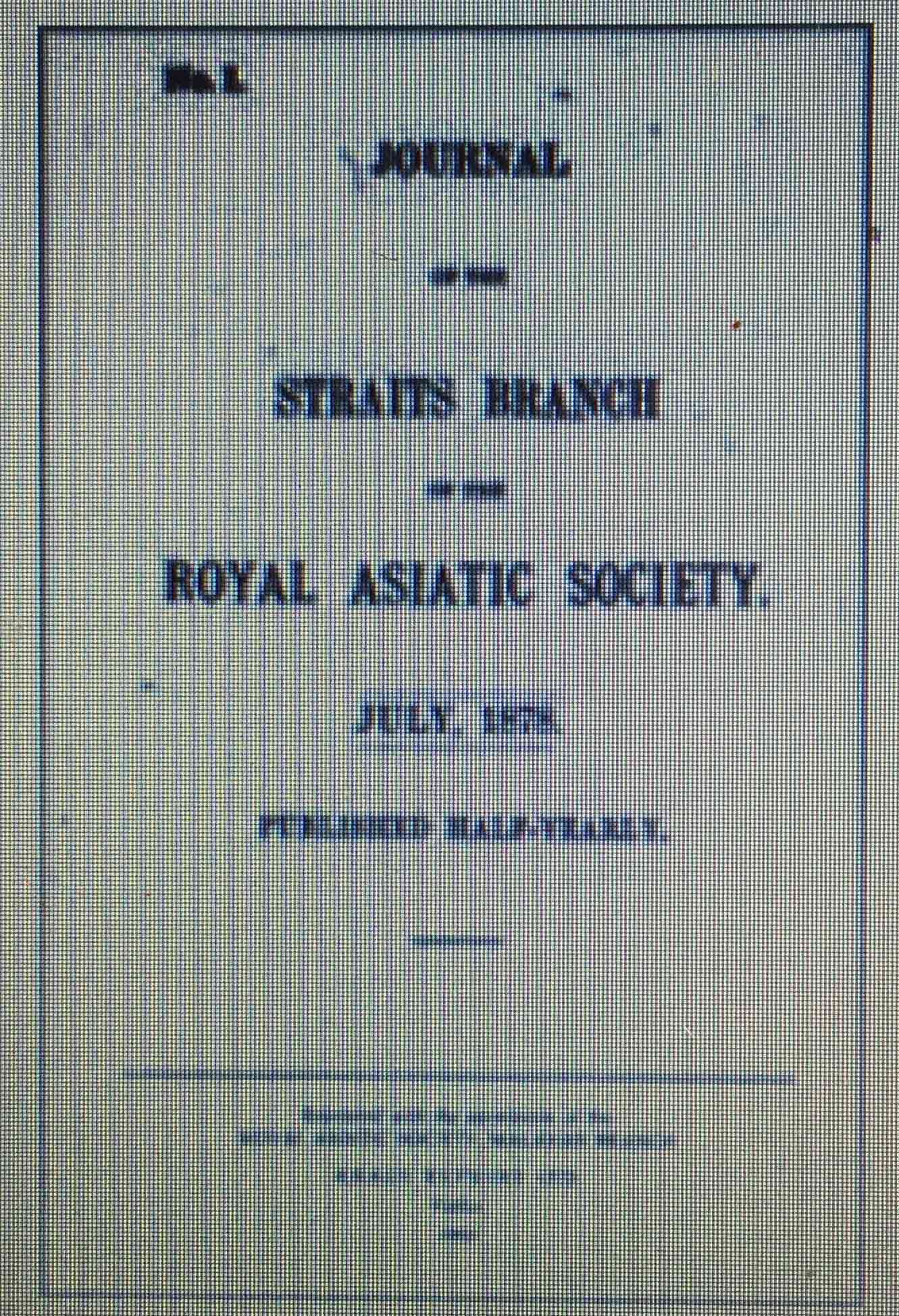
The following year, the society was renamed Straits Branch of the Royal Asiatic Society when its affiliation with the Royal Asiatic Society of Great Britain and Ireland or commonly known as Royal Asiatic Society, was confirmed on 6 May 1878. Bishop Hope was appointed as the first President of the Society and he went on to become one of the longest serving Presidents, from 1878 to 1908. The other founding members also took up appointments in the Society and contributed actively to its journal. The first journal was named Journal of the Straits Branch of the Royal Asiatic Society; it was dated July 1878 but it was published in September 1878.

The society then went through name-change on two occasions in accordance to the political situation of the time. In 1923, it was renamed Malayan Branch of the Royal Asiatic Society when the British influence went beyond the Straits Settlements; and in 1964, it was renamed Malaysian Branch of the Royal Asiatic Society, after the formation of Malaysia. The name remains until today. Its office was moved from Singapore to Kuala Lumpur. The name of the journal also changed in accordance to the renaming of the society. Some of its past illustrious members were Sir Hugh Clifford, Sir Frank Swettenham, Sir Ernest Woodford Birch, Alfred Dent, and Henry Nicholas Ridley to name just a few. 

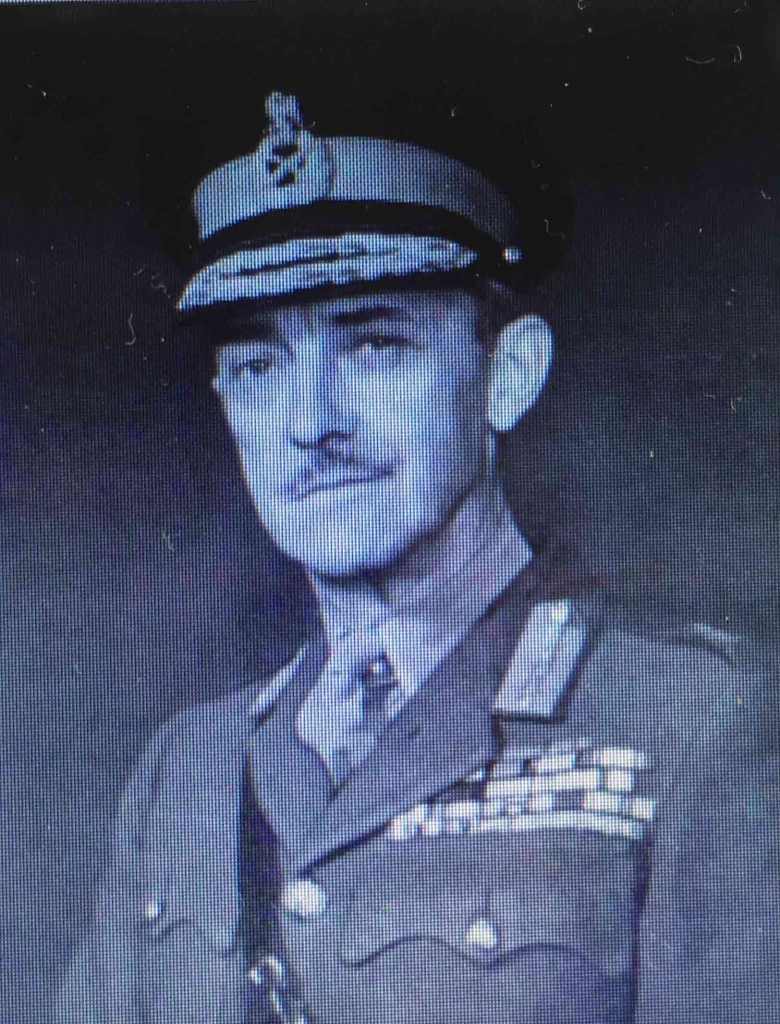
In 1930, of two more organisations were formed, namely the Malacca Historical Society and the Penang Historical Society. This was no coincidence as both states were under the Straits Settlements and had strong Western influence. Twenty-three years on, in 1953, the Malayan Historical Society (MHS) was formed, based in Kuala Lumpur. It was officially formed on 30 April 1953 at its first meeting held at the Kuala Lumpur Town Hall on Jalan Raja (the old City Hall). It was a grand inauguration attended by the British High Commissioner in Malaya, General Sir Gerald Templer, and the Malay Rulers – Sultan of Pahang, Yang DiPertuan Besar of Negri Sembilan, Sultan of Kedah, Sultan of Terengganu, Tengku Mahkota of Johor, Regent of Perak, and Deputy Raja of Perlis. Also in attendance were 200 local dignitaries – Datuk Onn Jaafar, Datuk Thuraisingam, Datuk Nik Ahmad Kamil, Datuk Tan Cheng Loke, and Tuan Za’aba, to name a few.

General Sir Gerald Templer in his speech emphasized that the Society is an effort to bring all the people of Malaya together to become a unified nation in the face of time and destiny of independence. He said ‘a nation which does not look back with pride upon its past, can never look forward with confidence towards its future’. He also tasked the Society ‘to ensure that things of beauty and historic value, old and new, find their way to a place where they’ll be properly cared for, and are not allowed to moulder, forgotten and unappreciated’. He also wanted the Society to work together with other organisations and the knowledge gathered about the history to be widely disseminated to the people: ‘This is not a Society for the Government, for the educated or for any class or section of the populations, it is for everybody, and everybody has something to contribute to it’.

At the end of the meeting, a Council was formed and it was headed by the first President, Datuk Mahmood Bin Mat. Its office was initially housed at the National Museum, but it was later moved to Dewan Bahasa dan Pustaka. In 1976, the Government provided a Government house located at No.958, Jalan Hose, Kuala Lumpur to be utilised as MHS’s headquarters. Tun Hussein Onn, the then Prime Minister, officially opened the building on 31 August 1976. Later, Tun Hussein Onn managed to secure a plot of prime land in Kuala Lumpur and awarded it to MHS. On 1 December 2003, MHS officially relocated to its new headquarters at Wisma Sejarah, No.203, Jalan Tun Razak, opposite the Institut Jantung Negara/National Heart Institute. 

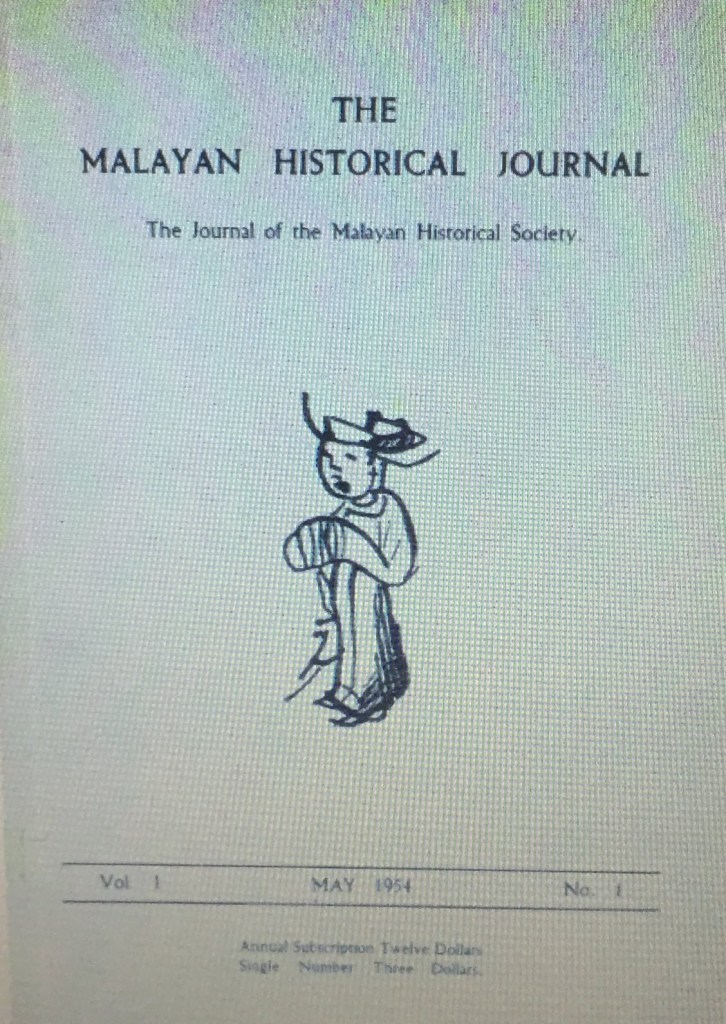
The first publication by MHS was entitled The Malayan Historical Journal; it was published in May 1954 and the editor was J.C. Bottoms. The annual subscription was twelve dollars and a single number (per issue) was priced at three dollars. In 1957, Tan Sri Mubin Sheppard took over from J.C. Bottoms and the journal was renamed Malaya in History. This journal went on for 15 years until April 1972, when Prof. Zainal Abidin Wahid took over, but from this time on (until today), the journal is produced in the Malay language and given a new name Malaysia dari segi Sejarah (Malaysia in History, in English). The late Prof. Emeritus Khoo Kay Kim was next in line to hold the editorial chair when he came on board in 1978 until 1989; he was then replaced by Prof. Dr. Nik Hassan Shuhaimi.

In addition to the journals, MHS also publishes books and monographs. Some of the bestsellers include Lembah Bujang (published in 1980), Historia (1984), Changi, the lost years (1989), Duri dalam daging (2001) and The Malay Civilization (2007). Today, the Malaysian Historical Society (Persatuan Sejarah Malaysia in Malay) maintains branch offices in all the states.

References

Malaysian Branch of the Royal Asiatic Society official website  [https://www.mbras.org.my/]

Persatuan Sejarah Malaysia / Malaysian Historical Society official website [http://www.psm.org.my/]

Singapore Infopedia website [https://eresources.nlb.gov.sg/infopedia/]

Some Islamic Artefacts at Muzium Negara

by Afidah Zuliana binti Abdul Rahim

The Islamic Arts Museum Malaysia (IAMM) 20th Anniversary Curators’ Sharing Sessions enhanced my appreciation of the Islamic artefacts on display at Muzium Negara. Here is an opportunity to highlight the artefacts in Gallery B based on information gleaned from the IAMM curators and publications.

The Malay world began to accept Islam from the 13th century onwards, with evidence first found in northern Sumatra. This early phase was characterized by a superficial understanding of the faith. From the 1400s, the Malays increased their understanding on living as Muslims. Eventually, from the 18th century onwards, there was an even deeper understanding of Islam, through the emergence of Islamic scholars such as Syeikh Daud al-Fatani and Raja Ali Haji.

Intellectual centres in the Malay archipelago included Palembang, Aceh, Batavia, Riau-Lingga, and Patani. These centres became Malay scriptoria where scribes and illuminators copied religious and literature manuscripts.

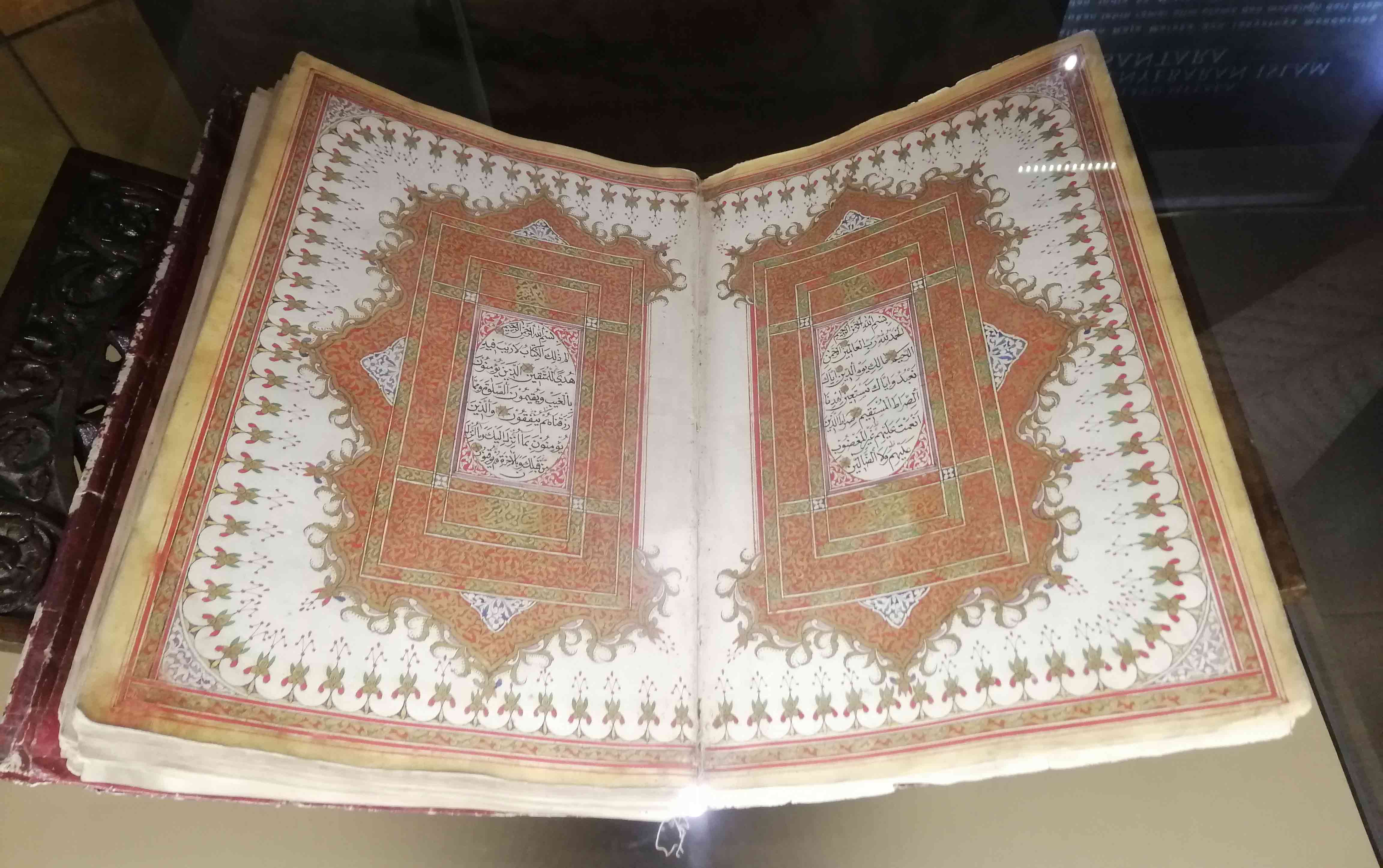
The Holy Quran on display at Gallery B originates from Terengganu, on the East Coast of the Peninsula. It is a sample manuscript from an area distinguished for its Islamic scholarship and calligraphic expertise. This Quran is a 19th century specimen in Naskh script – a calligraphy style valued for its clarity in assisting non-Arabic speakers recite the Quran accurately. Its arabesque design with floral motifs and vegetal scrolls reflect the natural Malay world. Red and green, colours also seen in woodcarving, echo the decorative traditions of this region. The use of gold suggests that this Quran was made for a royal patron.

Nakula (1980) wrote about the relationship between Islam and the Malay arts. One’s faith in the oneness of Allah can be manifested in the creation of artworks. In modern Malaysia, apprentices of master carver Adiguru Norhaiza Nordin are required to sit in nature so that they may realise the cosmic dimension and have the vision of multiplicity in oneness and oneness in multiplicity. With this understanding, the woodcarvers may then integrate all elements of their being into its proper centre, thus attaining purity and wholeness when executing their art.

The soul of Malay woodcarving is influenced by the moral ethical values connected with Malay worldviews. The poem below illustrates the Malay philosophy on woodcarving:

Tumbuh berpunca   
Punca penuh rahsia
Tajam tidak menikam lawan
Lilit tidak memaut kawan

Growth from a source
A source full of secrets
Sharp does not stab foe
Twines do not tie friend

The first two lines allude to Divinity – the starting point of life (God) is not seen. The other two lines indicate Community – the bowing leaves signify respect for one another and that there is harmony even in conflict.

The motifs carved contain underlying messages and sometimes act as a reminder. The door panel on display combines calligraphy and floral motifs, which reminds one of the Creator. Some motifs remain from pre-Islamic days, for example the lotus but these are given a new interpretation to fit the teachings of Islam. Woodcarvings are only displayed in clean or sacred places.

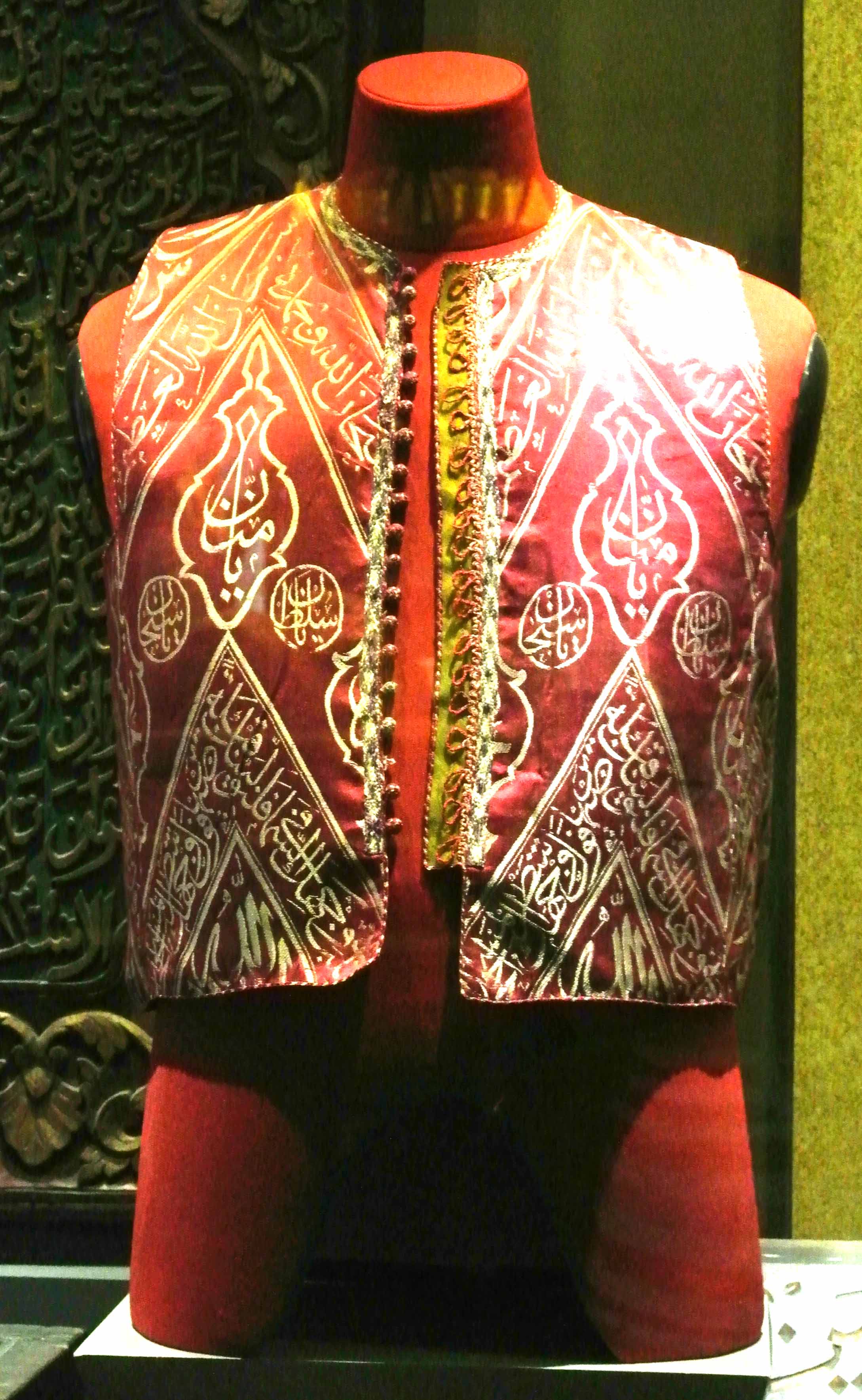
Calligraphy is also used for protection as shown by our red vest with verses. This talismanic vest would have been worn as an undershirt to safeguard its wearer in battle. A similar-looking 19th century silk vest from the Malay Peninsula with Quranic verses displayed at IAMM is made from the underside of the Kiswah – the cloth that covers the Kaaba in Mecca.

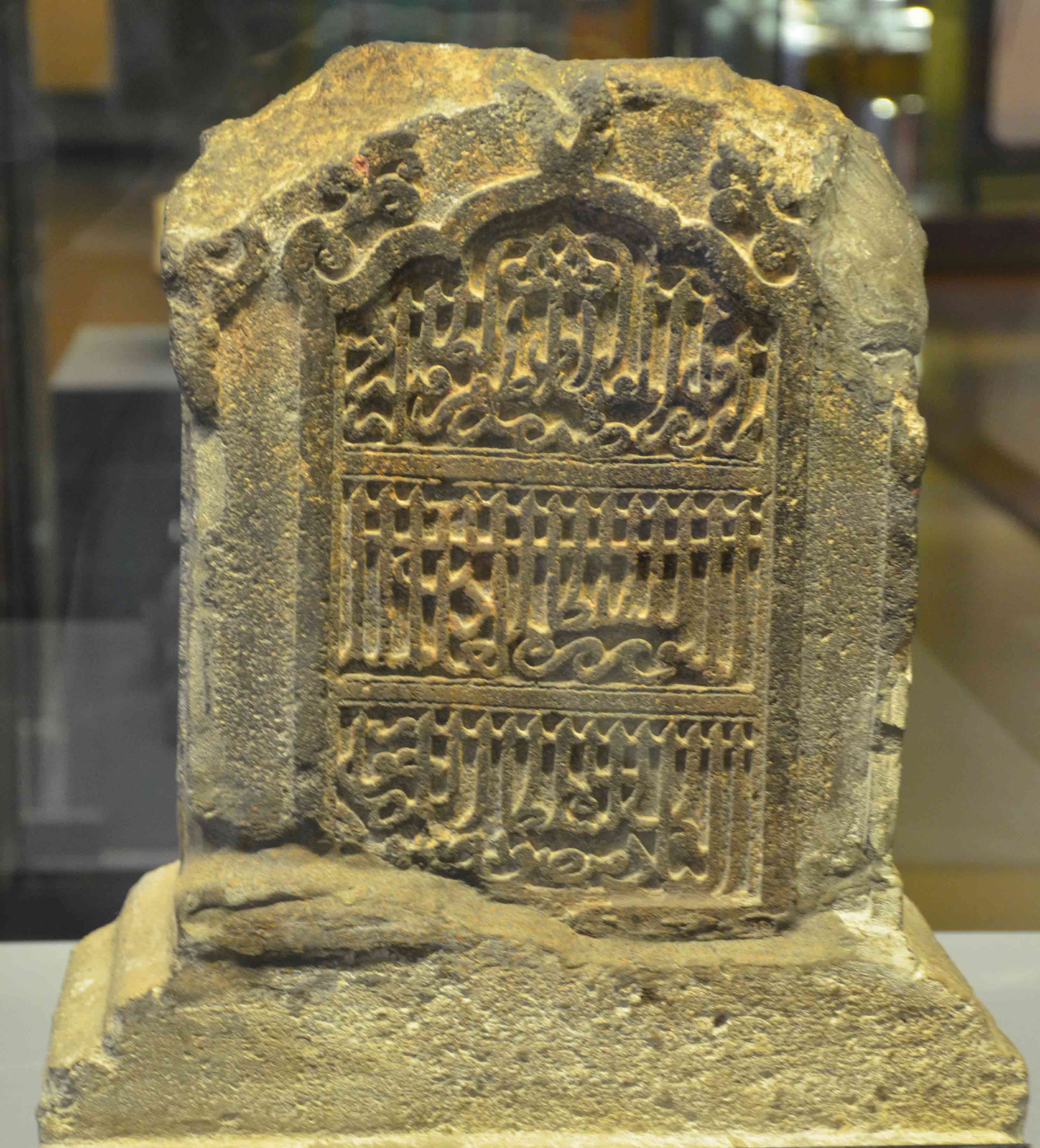
A distinctive sample of calligraphy from the Malay world is found on the tombstone of Sultan Mansur Shah. Batu Aceh tombstones are usually found in pairs – one for the head and the other for the foot of the grave. This tombstone has been moved from its original site, which probably explains why only one remains. In true Batu Aceh style, it has a Sufi couplet inscription referring to the transience of life. The calligraphy on this tombstone is challenging to read due to its overlapping nature. Recently, the IAMM curators have deciphered and translated the inscriptions for Muzium Negara. Look out for the new description on display.

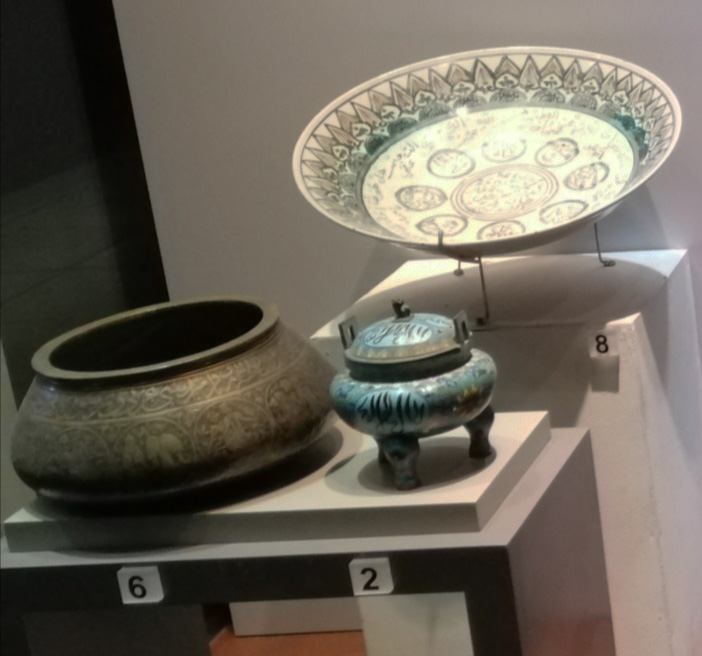
A noteworthy artefact in Gallery B is the 16th century ceramic plate from the Ming Dynasty inscribed with Quranic verses. The Aceh-style Swatow dish was a more affordable plate for the middle-class Acehnese who aspired to own Chinese ceramics. Its calligraphy may not be fine or accurate as it was mass-produced for the export market. The back of a similar plate at IAMM shows the crude finish with sandy grits on its base. It is likely that the piece at Muzium Negara has a similar base, albeit hidden from sight.

Islamic metalwork was once highly sought after in Europe. Such metal items made for the European market were known as Veneto Saracenic. Iran was renowned for fine metalwork as exemplified by the 17th century Isfahan copper bowl in Gallery B. Safavid Iran metalwork emphasized steel and copper, usually finished with tin. Isfahan was then its capital city. The use of figural motifs was allowed in the arts, with the understanding that such items were not displayed in sacred places. The copper bowl has calligraphic inscriptions and scenes of daily life – characteristic of Shia Islam.

Aceh-style Swatow dish (top right) and Isfahan copper bowl (left)

References

Abdullah Mohamed @Nakula (1980) Falsafah dan pemikiran orang-orang Melayu: hubungan dengan Islam dan Kesenian, Kuala Lumpur: Kementerian Kebudayaan Belia dan Sukan.

Introduction to Islamic Arts – Calligraphy: The collection of the IAMM (2016)

Islamic Arts Museum Malaysia Guide Book (2014)

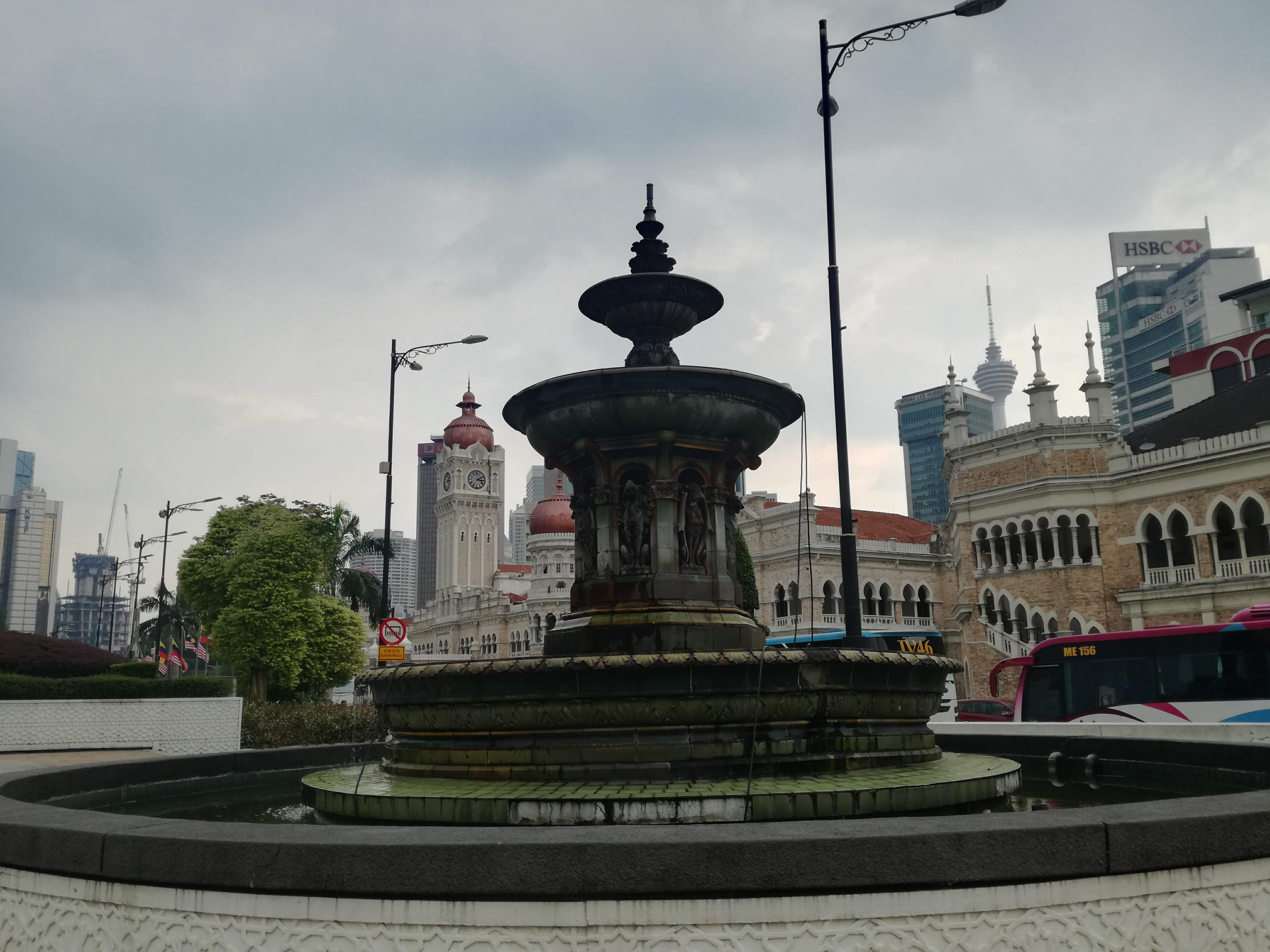
Fountain at Dataran Merdeka

by Eric Lim

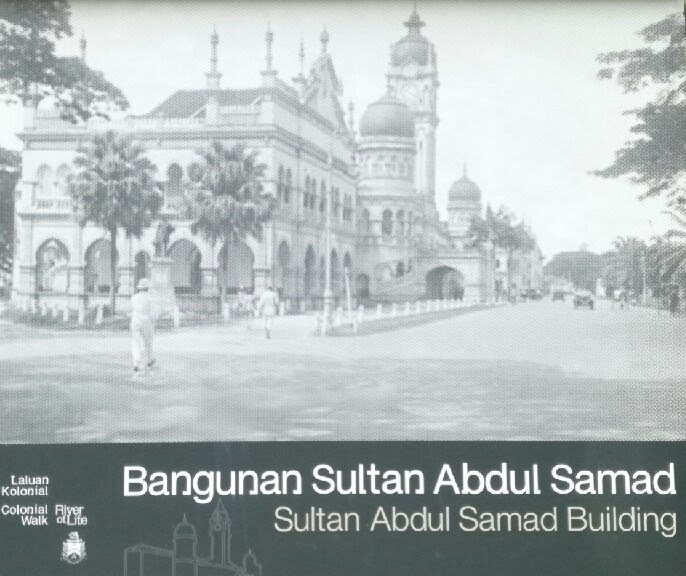
In my last article, I wrote about two Colonial monuments that were initially located at the Government Offices, now renamed as Sultan Abdul Samad Building, at Dataran Merdeka. First, the King Edward VII bronze bust on a marble pedestal, which was positioned right in front of the building and unveiled on 16 April 1912. The second monument is the bronze statue of Sir Frank Swettenham, erected on the front right-hand corner of the building and facing Gombak River. It was announced publicly for the first time on 19 January 1921 and it was a grand occasion attended by the Rulers from the Federated Malay States and top ranking British officials at that time.

During the Japanese Occupation, both monuments were removed and hidden away. After the war, the monuments were returned to their original sites. Today, they are standing tall at the grounds of the National Museum. Besides these two monuments, which originated at Jalan Raja, another monument still exits at Jalan Raja – at Dataran Merdeka.

This only surviving monument is the Fountain, located at the southern end of Dataran Merdeka, close to the 95 metres tall flagpole and near the intersection between the old General Post Office, the current Textile Museum and the former National History Museum, which was closed in November 2007. Prior to becoming the museum, the building housed the Chartered Bank of India, Australia and China (today they are known as Standard Chartered Bank).

Information board next to the fountain

A close scrutiny of the information on the board next to the Fountain, facing Jalan Raja only provides a one line introduction – `At the corner of the square stands a fountain that was built in 1897`. It was no surprise with the absence of facts of its origin and history because since it was erected, it was already shrouded in mystery. This prompted the Malayan Historical Society in Kuala Lumpur to put the record right with the help of the National Archives. They published their findings in their half-yearly magazine called `Malaya in History` volume VIII / number 1 / December 1962 issue.

When the Fountain was completed, KLites believed it was built to commemorate the Chief Inspector of Police, Steve Harper of the Selangor Military Police who died at home in 1896. He was at his prime at the time of his passing. Steve was popularly known to the locals as `Tuan Steeb`. Steve was one of three brothers who were very popular and successful in Selangor. There was Alfred Harper who was the Chief Clerk of the Courts and it was reported that he died at about the same time as Steve. And the third brother, Archie Harper, who founded the well-known firm of A.C Harper & Co. Ltd., which were agents for the Straits Steamship Company and importer for Peter Dawson`s Scotch whisky. Archie was one of the early members of Selangor Club (now Royal Selangor Club) and he was the first and best three Honorary Secretaries of the club. Archie retired in 1906.

The fountain

The publication at that time, the Malay Mail (newspaper) and Selangor Journal (periodical), appeared to support this tradition. The former reported that a fund was started in January 1897 to commemorate the late Steve Harper and it went on to receive contributions from KLites. The newspaper also published the list of contributors from time to time and it further reported that the memorial should take the form of a drinking fountain to be erected at the central market (built in 1888, it is still called Central Market, located at Jalan Tun Tan Cheng Lock. However, it is no longer a wet market but now houses mostly arts and craft, and souvenir shops). The Fountain was finally completed later that year but it was constructed at the Padang (now Dataran Merdeka). KLites concluded that it was the cop’s fountain and believed it was moved from the central market to the present site at an earlier date.

A year later after the start of the collection of subscription for the Steve Harper memorial, the Malay Mail reported in its 18 April 1898 issue that Mr Bellamy, the Selangor State Deputy Superintending Engineer, had informed in a meeting that the Fountain at the Padang was built by the Kuala Lumpur Sanitary Board at a cost of four thousand dollars. He recommended that the contributions toward the Steve Harper memorial fund be used for other schemes. One of them was to buy school books for the underprivileged students attending the prestigious Victoria Institution.

The Malay Mail followed up on this pending issue and reported in its 2 May 1898 publication that a meeting was organized on 30 April and it was decided after a vote count that the scheme for the purchase of school books was adopted. The three who voted namely Towkay Loke Yew (wealthy businessman), Thambusamy Pillai (leader of the Tamil community and businessman) and Mr Shaw (Headmaster of the Victoria Institution) were appointed the trustees of the fund. (For the record, Towkay Loke Yew voted against the book scheme, instead proposed for another fountain to be erected).

The project to erect the Fountain was given out to an engineering firm Messrs Riley, Hargreaves & Co, which carried out the work in October and November 1897. The materials were imported from England. The company was also involved in the building of two bridges in Kuala Lumpur, on Market Street and High Street (today, they are Leboh Pasar Besar and Jalan Tun HS Lee respectively).

The Malayan Historical Society concluded that the Fountain was erected by the Kuala Lumpur Sanitary Board with their own funds and not erected to commemorate the late Steve Harper.

(The current location of the Fountain is not its original site. It was moved to the current position when the Dataran Merdeka project was completed in late 1989)

(The Kuala Lumpur Sanitary Board was formed on 14 May 1890 and their responsibilities include sanitation, upkeep of roads, lighting of streets, planning and other functions. It would eventually become the Kuala Lumpur Municipal Council (Majlis Perbandaran Kuala Lumpur) and now Kuala Lumpur City Hall (Dewan Bandaraya Kuala Lumpur).

References

Three Memorials on Jalan Raja, Kuala Lumpur – A note on their History from the National Archives, Malaya in History, vol. VIII (1), December 1962, pp. 39-40.

Rimba (1922) Bygone Selangor: A Souvenir, Kuala Lumpur: Charles Grenier & Son.

Discovering the stories of Melaka

by Karen Woo

On 27 February 2020, 14 participants from Museum Volunteers Batch 34 (Patricia, Katya, Grazia, Cen, Melissa, and Annie) and Batch 36 (Debbie, Veronika, Fazlin, and I) with our friends (Yvonne, Ryoko, and Melissa’s two children) made a day trip to Melaka. We gathered at the car park of the National Museum at 6:30 am. From there, our chartered van made its way to Melaka. Traffic was smooth and we arrived in Melaka at the Dutch Square at about 9 am where we met up with our guide, Colin Goh. Casper and Marliza (from Batch 36) also joined us during the tour in Melaka, making it a group of sixteen.

Colin introduced everyone to the history of Melaka from its founding by Parameswara, to the development of the Malay Sultanate of Melaka, and the important contributions made by its maritime laws to international maritime law. However, this followed with the decline of Melaka, to its conquest, first by the Portuguese, then the Dutch, and subsequently the British. 

Following the introduction, Colin showed us the sites in Melaka, some of which were already familiar to us, accompanied with stories told from his local perspective. A visitor to Melaka cannot miss visiting the Dutch Square where Stadthuys, Christ Church, Melaka Clock Tower, and water fountain are prominently located. However, interestingly, apart from Stadthuys and Christ Church, both Melaka Clock Tower and water fountain were not constructed by the Dutch but were proud contributions by the people of Melaka. The clock tower was erected by a Melakan Baba who made his fortune in Singapore, whilst the water fountain was built by the people to celebrate the anniversary of Queen Victoria.

First on our list of stops was Christ Church. The Christ Church, which was planned as a commemoration of a centenary of the Dutch occupation of Melaka in 1641, was only completed in 1753. Inside the church, the original pulpit and lectern were the only two remaining Dutch artefacts.  Colin also showed us the oldest Christian tombstone, which is part of the floor of the church. It is dated 1562, and it is for a lady by the name of Giomar.

The tombstone dated 1562 of Giomar found inside Christ Church

The famous Stadthuys was the office of the Dutch Governor and Deputy Governor, and it was later extended to provide residence for other high officials. The lower level was also used as a warehouse for the VOC. The Stadthuys would subsequently be occupied by the British; it is a museum today.

From there, we made our way up to St. Paul’s hill. It was a nice, shady walk with an elevated view of the Dutch Square, the vast area of reclaimed land (and buildings) with a glimpse of the replica of the Flor de la Mar in the far distance.

The view on the way to St. Paul’s hill with the replica of the Flor de la Mar in the distance

Our story continues on St. Paul’s hill. It is said that in 1521, upon deliverance from calamity in the high seas, a Portuguese captain, out of gratitude, built a small wooden church on the hill. Later, when St. Francis Xavier arrived, the Portuguese authorities gave him the piece of land to build a school and the small church was also enlarged. St. Francis Xavier used this location as a base for his missionary journeys to Japan and China. From this historical event, today, this church has established a friendship with a church in Kagoshima in Japan, and there have been exchanges between them.    

The white church on top of St. Paul’s hill served as a strategic landmark for navigators sailing down the Straits of Melaka. Upon spotting it, they would know that they were approaching Melaka.  These days, one could still see the white church peeping out from behind the Ramada and Emperor hotels.

St. Paul’s Church with statue of St. Francis Xavier on top of St. Paul’s hill

Apart from this, St. Paul’s Church had other important roles, including as a burial ground for the Dutch and the British and even as a hanging gallows. There were many tombstones on display inside and Colin regaled us with some interesting stories. My favourite undoubtedly is that of the wife of Jan Van Riebeck, founder of Cape Town in South Africa. He was posted to Melaka for two years. During that time, his wife passed away and was buried in this church. Later, a memorial was built in Cape Town for Jan Van Riebeck and the authorities requested for the tombstone of his wife. The British agreed, and today, a plaque marked the spot where the tombstone used to be. This is such a nice story, and today, the couple’s tombstones are reunited in the memorial.

The plaque to mark the spot of the tombstone of the wife of Jan Van Riebeck in St. Paul’s Church

With that, we bid farewell to St. Paul’s Church and made our way to our next must visit spot, the Porta de Santiago (of the fortress). However, did you know that this gate was not part of the fortress? It was actually known as Bort’s Gate (to the Dutch) or Old Gate (to the British). Nevertheless, those who used the gate called it Porta de Santiago. 

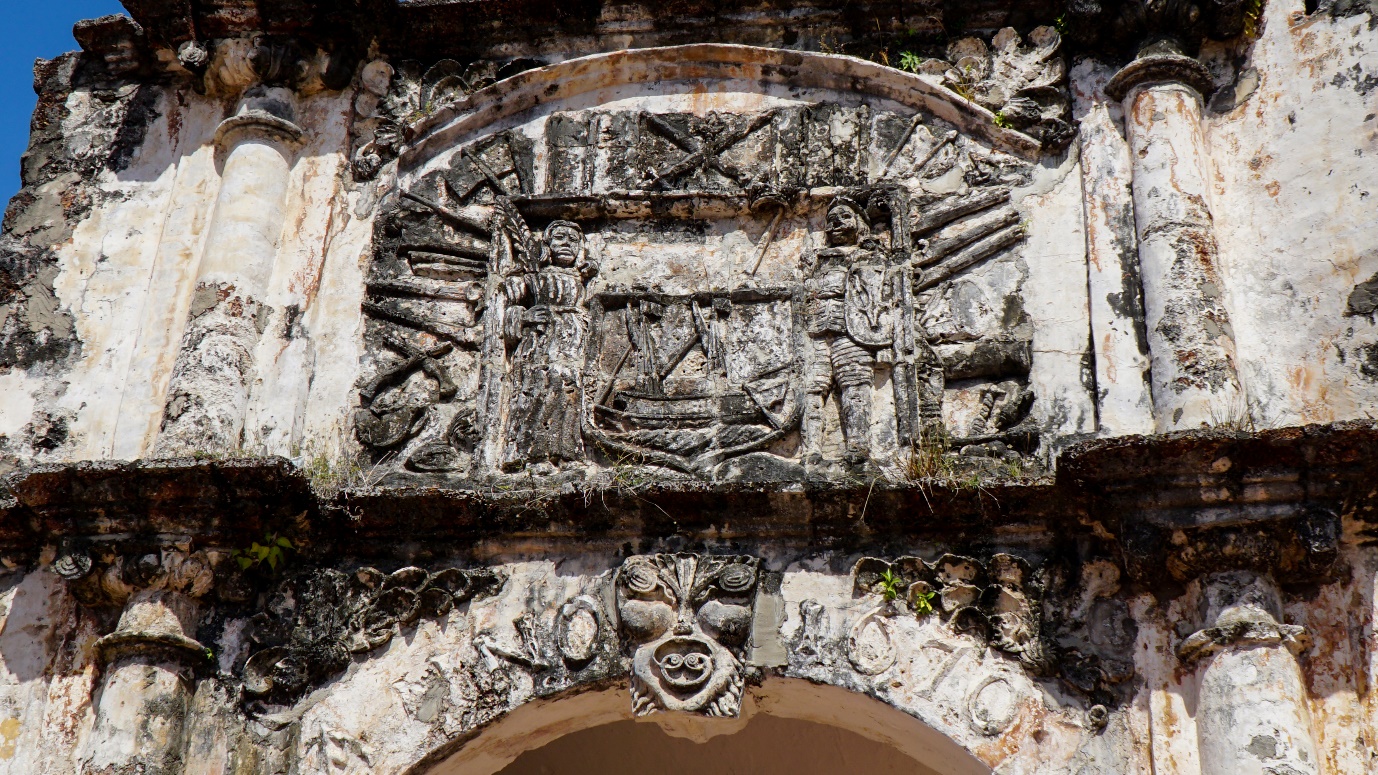
Focusing on the top of Porta de Santiago, Colin pointed out the Dutch emblem which comprises of a rectangle that is surrounded by battle weapons. Within the rectangle, a lady holding a stalk of wheat is placed on the left and a soldier bearing a shield with the words “VOC” is on the right, separated by a shield in the centre. On the front side of the Porta de Santiago, the year “1670” can also be clearly observed.

The Dutch emblem with the year “1670” on the front side of the Porta de Santiago

Colin also shared that some believed secret tunnels existed and connected the fortress to St. Paul’s hill and to St. John’s fort. The theory was that after the banishment of the Knights Templar in Europe, their remnants went to Tomar in Portugal and that order evolved into the Order of Christ. When the Portuguese came to Melaka, the Order of Christ, consisting of engineers and builders, also came along. Though the existence of the secret tunnels has not been proven, it certainly adds an air of mystery and intrigue to Melaka.

We then continued the next part of our tour to Bukit Cina by van. On the way, we passed by the Sacred Heart Convent, the Convent of Infant Jesus primary and secondary schools, and the previous site of the first Malay College in the country (before it was transferred to Kuala Kangsar). The graves in Bukit Cina date back to the Dutch era. At the foot of the hill, a temple was built for the descendants who visited the graves to perform their filial rites. There was also a famous well, Perigi Raja, that used to serve the best quality water, so much so that the Dutch built a wall, with guard posts, to protect the well, and water was delivered on a daily basis by bullock carts to the fortress.

Now, we come to the story of Li Poh. According to the people of Melaka, Li Poh was the daughter of a captain, rather than a Princess. This land was given to Li Poh and her people. Subsequently, the Dutch granted the land title to Cheng Hoon Teng temple, the oldest Buddhist temple in this country.

We were then dropped off close to Jonker Street heritage walk for the final part of our tour. Colin showed us the different styles of architecture left behind by the Dutch and the British. For example, there were some shop houses with Dutch frontage, which have no walkway, as opposed to others with the British walkways. We could also observe these changes by walking through the back lanes. This could be seen through the extension of the shop houses and the different styles of cramps used – the “C” kramp for the Dutch and the “X” cramp for the British.

The mirror image “C” kramp can be observed

Jonker Street itself went through changes – it used to be a bustling street that was a commercial and residential area for the working class. However, nowadays with the commercialisation of the street, the residents have moved out and the old-style coffee shops have also been replaced by cafes.  

Nearby is Jalan Tukang Emas (or Goldsmith Street), which used to house the goldsmiths from India during the Dutch colonial time.  Today, this street, which is also known as Harmony Street, is home to a Hindu temple, a mosque, and a Chinese temple, all located within close vicinity to each other.

After such a long day and being out in the hot sun, we were ready for our next adventure – lunch at Nyonya 63. The air-conditioned restaurant with its lovely oriental ambience was a welcome and pleasant interlude. Lunch was an absolute delight to our senses – we had chap chay, cincaluk omelette, assam fish, nyonya fried chicken, prawns cooked in prawn gravy, and buah keluak chicken. One of the group’s favourite was the prawns cooked in prawn gravy as the sweetness of the pineapple lent its flavour and mellowed the taste of the curry.  Buah keluak chicken, being a Nyonya speciality, is an acquired taste, highly recommended for everyone to try. We ended with the all-time favourite desserts, cendol, and ondeh-ondeh, courtesy of a friend of Annie’s.

After lunch, we had about an hour of free time before bidding our farewell to Melaka and its secret charms to make our way back to the National Museum. We had such an enjoyable time and were making plans for a return visit to Melaka. Would anyone like to join us for round two of Melaka? 

The 16 of us, peering from behind our hats and sunglasses, with Porta de Santiago and St. Paul’s Church in the background

Cheong Ah Peng, the Father of Kalumpang

by Karen Loh

An hour’s drive north from Kuala Lumpur on the North-South Expressway lies the town of Kalumpang. Situated in Hulu Selangor near Tanjung Malim, not many have heard of this small town much less its location. Founded by a tin miner, Kalumpang was unknown until the early 1900s and much of its development was due to the perseverance of one man – Cheong Ah Peng.

Cheong Ah Peng with his famous walking stick

Hailing from Guangdong, China, Cheong Ah Peng @ Chong Mun Peng or Cheong Hoong made his way to Malaya sometime around 1895 in search of tin. Cheong was fluent in Mandarin and Cantonese. He eventually learnt to speak Malay and a bit of English whilst living in Malaya. It is unclear how many places Cheong looked for tin in the early days but he eventually struck big in a hill at Hulu Selangor. The mine was in the hill itself and miners had to walk up the hill every morning to enter the mine.

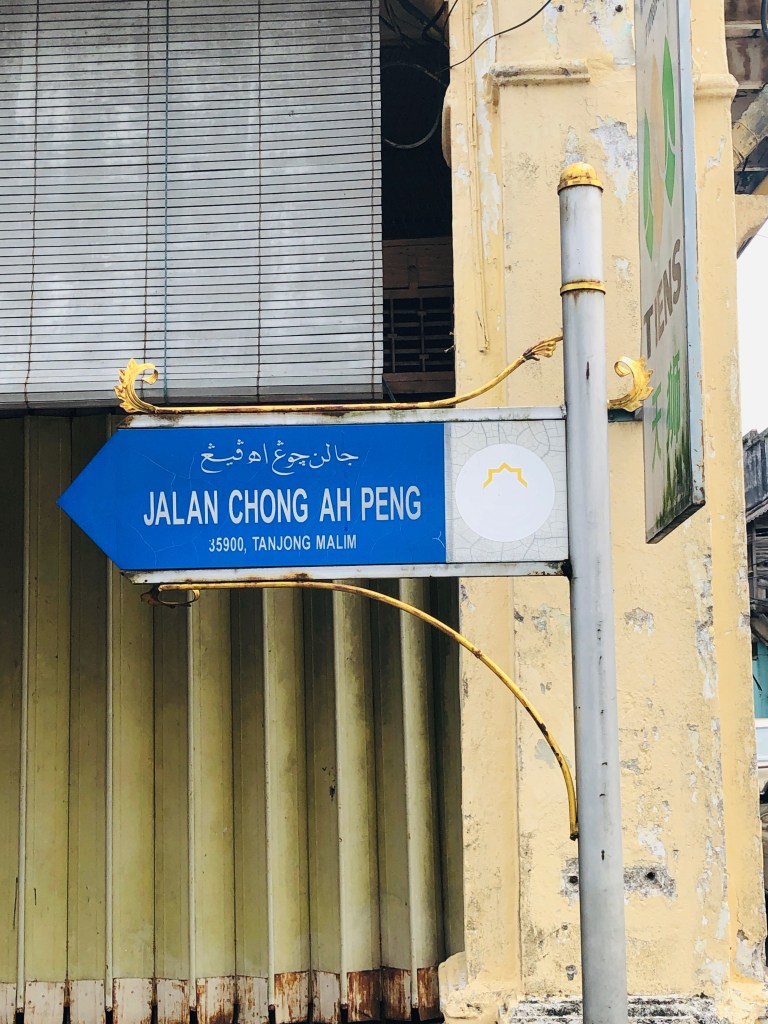
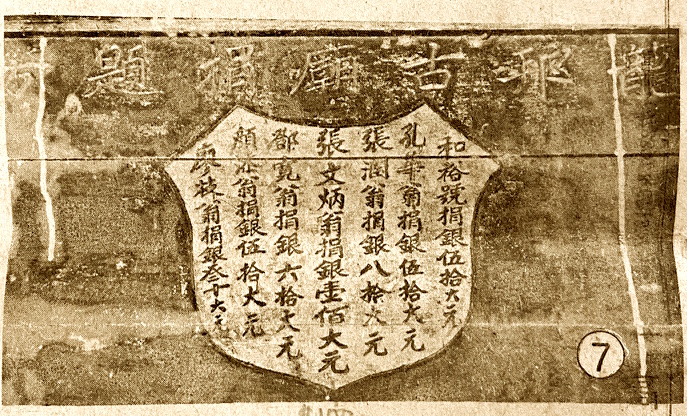
As more tin was mined from this hill generating much profit, Cheong built a row of nine double-story shophouses in Kalumpang (and similarly in Tanjung Malim), a Chinese temple close by, and a school for boys with male teachers. Later as the town of Kalumpang grew, more shophouses and houses were built together with a marketplace, a bus station, and a police station. Cheong even managed to secure five acres of land for a Chinese cemetery from the government. He became very rich, had two wives and three sons. He was recognised for his achievements by the Sultan of Selangor, who presented him with a walking stick and with this walking stick, the story goes that he would reprimand youths who dared to misbehave in his town. In 1924, Sultan Ibrahim of Johor also wrote a letter of commendation recognising Cheong as a progressive miner in Hulu Selangor. Such were his contributions that a road was named after him in Tanjung Malim.

The Chinese temple in Kalumpang

A Chinese newspaper; Malayan Thung Pau Daily News, published an article in October 1975 about Cheong Ah Peng, the town he built, and the tin miners who worked and settled there from early 1900. Here are excerpts from some of the tin miners’ stories:

A “My name is Yap. I came to Malaya when I was 14 years old. I came to work for Cheong Pak (uncle) who had a very big tin mine in the hill. I had to walk for 9 hours to reach the mine. The hilltop is a very lovely place to be on as the scenery is beautiful. From the top, one can even see the Straits of Melaka. The air is very cold around the hill. Cheong Pak was a very smart and nice man. Even though we were not allowed to take a day off from work, we had a big feast every time there was a festival. We culled chickens and ducks for the feasts and celebrated the festivals together. Some of the workers had to stay up in the hill to guard the mines. Cheong Pak built a long house for us to live in. Our days consisted of daily shifts of 4 hours per shift and we were paid every half year. During each payday, we used some of the money to gamble and Cheong Pak would join us too.

Besides working in the mines, we also grew vegetables during our free time. There were wild animals up in the hills. We encountered a black bear once and fortunately, no one was harmed. In 1926, the Government ordered the mine to be closed due to a very heavy thunderstorm that resulted in a severe landslide. It was rumoured that at least 10 men drowned but the workers were not from our mine. In fact, the people in our village were all very healthy and those who got sick were likely to have visited a prostitute den! Though we appealed to the Government not to close the mine as it still had tin deposits, we were still ordered to close it.”

B “I am Wong and 70 years old this year. I came to Malaya when I was 17 years old to look for work. My first job here was to dig out tin ore from the drains. The early miners believed that there were white crocodiles around the village but I have only ever caught one. With the help of 14 youths, we managed to trap the crocodile under a wooden bridge when the water was shallow. The crocodile was not white but grey in colour like any ordinary crocodile; it was 8 feet (2.4m) long and weighed over 100 kati (60 kg). Catching crocodiles seemed to be a favourite hobby for the people. Some even used dead chickens to lure the crocodiles though they often succeeded in catching only the smaller crocodiles weighing 10 kati (6 kg). We were paid every half year and I was the perfect gentleman as I did not go for the ‘dirty stuff’ (vices). With the money I saved, I got married and had eight children: 4 boys and 4 girls. Unfortunately, my wife passed away a few months ago.”

C “I am Siew and I remember that Cheong Pak was the person who lobbied for Chinese translation to be printed on railway tickets for our convenience, as most of us did not read English. Cheong Pak’s nickname was Sun Tai Wong (Mountain King). I was employed by Cheong Pak to guard and look after his buses. Cheong Pak owned a few buses and each bus could sit 23 passengers. Those days, a bus could travel 18 miles (29 km) with one gallon of petrol. Once there was a Japanese man who opened a photograph shop in Kalumpang. He turned out to be a spy. My second job with Cheong Pak was as a storekeeper in his mine. Everybody feared Cheong Pak, including Government officers as he was a fierce person and kept a revolver with him, which was a present from the Sultan at that time. Today, I believe that one of his daughters-in-law is living in Petaling Jaya and two of his grandsons, Cheong Loong Seng and Cheong Chap Ching are in Kuala Lumpur.

Today, there is only a small road in Kalumpang with 30 shophouses remaining and a population of about 3000 people. The original row of nine shophouses built by Cheong Pak was destroyed in a fire 50 years ago. The Cheong Fong Coffee Shop has a photograph of Cheong Pak with his friends. In this photograph, Cheong Pak is dressed in white, standing next to a car with his friends. It is believed that one of the people in the picture is Shuen Choong Sun (great man of China also known as Dr. Sun Yat Sen).”

Cheong, dressed in white, standing next to the cars in Kalumpang

D Leow, 74 years old. “I came to Kalumpang when I was 14 years old. When I arrived, Cheong Pak was already 50-60 years old. I remember my life with him around. He built two rows of houses at the Kuala Lumpur to Ipoh trunk road. When the houses were completed, many of the residents there rented the houses from him to start new businesses in the town. He was called Penghulu of Kalumpang.

Cheong Pak was a very nice and generous man. He did everything he could to keep us happy. He even attended court sessions with us. We adored him. Wherever he went, he would carry his walking stick, which was given to him by the Sultan. He built the (Chinese) temple in Kalumpang, which Dr. Sun Yet Sen visited and stayed a few nights while in Malaya. The temple has since been renovated three times. Cheong Pak donated a lot of money for the renovation. There is a plaque in the temple, which list him as a major donor. In 1907, Cheong Pak received $6000 from the Government for a major renovation. An important deity in this temple is the Malay Datuk statue, which stands 3 feet (0.91 m) tall. Nobody knows his actual name but it was believed that he was Cheong Pak’s good friend. When he died, Cheong Pak commissioned a statue in his form to remember him.”

Cheong decided to return to China after a few unfortunate incidents, taking his first wife with him. Maybe it was bad luck, cruel fate or maybe it was just an accident when a big fire burnt down his shophouses and much of the town. A severe thunderstorm also caused his mine to flood and collapse. He never recovered from these losses. His daughter-in-law, Choo Yuen Heng shares her story:

I married into the Cheong family when I was 20 years old. I lived with my husband, Cheong Po Seng in Kalumpang before moving to Ipoh. My father-in-law was a very nice, humble and generous man who was liked by all the people in Kalumpang. Even though he could only speak a few words of English, he managed to get along with government people and during each festive season, he gifted them food and wine. Those who worked with him became very rich but my father-in-law was unfortunate. First, his tin mine collapsed due to a big flood and then his shophouses burnt down. To rebuild the houses, he took a loan from a bank but as he could not repay the loan, he ended up selling his shophouses in Tanjung Malim. When his businesses failed, he returned to China leaving his second wife and myself behind in Malaya. My husband died shortly after the war (WWII). My father-in-law died at the age of 83. My son never knew his grandfather. We were only informed of Cheong Pak’s death by some sources in China.
Choo Yuen Heng, Cheong’s daughter-in-law

Although Cheong Ah Peng returned to China, his descendants here in Malaysia and the people of Kalumpang today remember Cheong’s legacy as the tin-miner who developed the town, built a famous temple, a school, a cemetery, created jobs, and was much revered by the people of Kalumpang.

Letter of commendation from the Sultan of Johor in 1924.

Two Colonial Monuments and a Malay Fort

by Eric Lim

I would like to bring your attention to two monuments located on the grounds of the National Museum. It is a pity that these monuments are hidden away in an obscure corner outside the main building. To access them: if you are entering the car park via Jalan Damansara, look out for a white archway that serves as one of the entrances to the National Museum (through the car park). Take the steps on the right (in between the archway and the locomotive) to reach the monuments. If you are already in the outside compound of the museum, locate the Bukit Bendera Penang Railway coach pavilion, and then take the steps on its right. Upon reaching the top, turn right for a further few steps. These two monuments are the King Edward VII bronze bust on a marble pedestal and the statue of Sir Frank Swettenham.

Before looking at the history of these two colonial monuments, it would be good to examine the white archway, which is a replica of Kacapuri Archway, one of two archways located at the Kuala Kedah Fort (the other archway is called the British Archway). Incidentally, there is also another replica (smaller in size) of the Kacapuri Archway at Gallery C in the main building.

Replica of Kacapuri Archway at Gallery C

The original fort was built during the reign of Sultan Sulaiman Shah II (1602-1619) with the help of the Portuguese who then used it as their military outpost. In 1619, Sultan Mahkota Alam of Aceh sent a fleet to destroy the fort and the Portuguese were ousted while 7,000 Malays including Sultan Sulaiman were taken captive. Next came the Bugis, who sided with the ruling Sultan Muhammad Jiwa against a power struggle with his younger brother in 1724. The feud ended two years later when the Bugis succeeded in driving away the enemy but it devastated Kedah. War broke out again in 1771; this time, the Bugis gave their support to dissident forces who wanted to depose Sultan Abdullah Mukarram Shah II, the 20th Sultan of Kedah. The Bugis managed to take control of the fort but Sultan Abdullah later obtained help from Captain Francis Light of the British East India Company (EIC), and the British recaptured the fort for Sultan Abdullah. Construction of the present fort then took shape and Sultan Abdullah immediately went on to strengthen the walls of the fort with stonework and bricks. He also purchased cannons from the British and Dutch, which were placed around the fort. The fort was completed in 1780.

The fort was then used by the EIC who in return, agreed to protect the Sultan from any attacks, in particular from its northern neighbour, the kingdom of Siam. This prompted the Sultan of Kedah to cede Penang Island to the EIC. In 1786, Francis Light declared British rule in Penang and named the island Prince of Wales Island and the town, Georgetown, in honour of King George III. However, the promise of protection by the British was never kept. The Siamese made a surprise attack in 1821 and the then Sultan of Kedah, Sultan Ahmad Tajuddin Halim Shah II, fled to Penang. In 1831, Tunku Kudin, the son of the Sultan of Kedah, and his men managed to drive the Siamese away from Kedah but the Siamese returned with a stronger force to take over the fort once again. It was the same story again in 1838, but that was the final time the Siamese laid siege to the fort. During the period of the Japanese Occupation (1941-1945), the fort was used as a military base by the Japanese. Today, the area is called Kuala Kedah Fort Historical Complex and it was certified as a ‘historical land site’ by the Department of Museums and Antiquities on 31 August 1978.

King Edward VII

King Edward VII was born on 9 November 1841 in Buckingham Palace, London. He was the second child and first son of Queen Victoria and Prince Albert and was given his father’s name and christened Albert Edward. Growing up, he was given rigorous education but he did not measure up to it. He was also forbidden to have a career in the army by his parents. In his role as Prince of Wales, he made many Royal Visits overseas that gained him popularity. In 1860, he became the first heir to the British throne ever to visit North America. It was a four- month round trip between the United States and Canada. He also toured the Middle East and India. In 1863, Albert Edward married Princess Alexandra of Denmark and they were bestowed a son, Albert Victor, the following year. Prince Albert Victor did not live long and died before both his parents in 1892. After the passing of Queen Victoria on 22 January 1901, Albert Edward ascended the throne and chose the title King Edward VII (Queen Victoria was at that time the longest-reigning British monarch, until 9 September 2015 when the current Queen Elizabeth II surpassed her). King Edward VII ruled for 9 years and he passed away on 6 May 1910 of heart failure.

One year after the passing of King Edward VII, British officials in Kuala Lumpur decided to start a fundraising targeting two proposals – a memorial to the late King and upgrading works for the Straits and Federated Malay States Government Medical School in Singapore. A total of $2,446.89 (Straits Dollars) was collected for the memorial and $15,135.00 for the latter. The huge sum collected for the Medical School was made possible when local businessman Loke Yew contributed $15,000.00. In 1921, the medical school changed its name to King Edward VII College of Medicine.

The job to make a bronze bust of the late King was awarded to a young sculptor in London by the name of A. Stanley Young. The memorial was completed and shipped out from London on 30 December 1911 and when it reached our shore, it was immediately erected in front of the Government Offices (now Sultan Abdul Samad Building). The unveiling ceremony took place on 16 April 1912, performed by Lady Brockman, the wife of the Chief Secretary and witnessed by the Sultan of Selangor, Sultan Alaeddin Sulaiman Shah. During the Japanese Occupation, the bust was removed and hidden away by Mr. K.S Maniam of the Public Works Department. After the war, it was returned to its original site and now, the monument sits at the National Museum.

Sir Frank Swettenham

Sir Frank Athelstane Swettenham was born in Belper, England in 1850. He arrived in our country as a young lad of 21 and learned the Malay language. This proved useful when he was involved in the Pangkor Treaty in 1874 as a translator on behalf of the Straits Settlements. After the first British Resident of Perak, J.W.W. Birch, was murdered, he became the British Resident for Perak for a while before moving to Selangor where he became the third British Resident of Selangor. He then returned to Perak and played a role in the formation of the Federated Malay States in 1896. He was appointed the First Resident General of the FMS from 1 July 1896 to 4 November 1901, taking up residence at Carcosa in Kuala Lumpur. While in office, he attended the First Durbar of the FMS held at Istana Negara at Kuala Kangsar in July 1897. From 1901 to 1904, he was the Governor and Commander-in-Chief of the Straits Settlement; he retired in 1904. Sir Frank Swettenham was also a well-published author. His first book was “Vocabulary of the English and Malay languages” written in 1881. The book was printed at the Government Printing Office in Singapore. Upon retiring, he returned to London and died at a ripe old age of 96 on 11 June 1946.

Sir Ernest Woodford Birch, the eldest son of J.W.W. Birch, was the eighth British Resident of Perak, from 1904 to 1911. When he retired, he initiated a fundraising project to build a monument to commemorate the services and contributions of Sir Frank Swettenham. The monument took the form of a bronze statue made by a well-known English sculptor by the name of C.L Hartwell, A.R.A of London. The statue was erected at the front right-hand corner of the Government Offices (now Sultan Abdul Samad Building), facing Gombak River. The unveiling ceremony on 19 January 1921 was attended by the sultans of Perak, Selangor, Pahang and Negri Sembilan as well as High Commissioner Sir Lawrence Guillemard, Chief Justice Sir John Murison and Sir Ernest Birch. The statue was removed during the Japanese Occupation but re-erected on the original site on 15 October 1946. A month later, sultans from nearly all the Malay States attended the unveiling of the restored statue by the then highest British officer, Sir Edward Gent. It was again moved in 1964 and today, the statue of Sir Frank Swettenham stands on the grounds of the National Museum, next to the bronze bust of King Edward VII.

Footnote

Coming event – Festival Kota Kuala Kedah (Kuala Kedah Fort Festival)

                         18-21 March 2020 @ Muzium Kota Kuala Kedah.

A Bronze Frog Drum

by Maganjeet Kaur

The solitary bronze drum standing exposed at the Lost Kingdoms exhibition (ongoing until April 2020) at Muzium Negara is an intriguing representation of an ancient drum-casting tradition from Vietnam. Its shape identifies it as a Type III in the Heger I-IV bronze drum classification system. This classification was developed by Franz Heger, an Austrian ethnographer, in an attempt to categorise the diversity of bronze drums derived from the Dong Son culture in northern Vietnam.

‘Dong Son’ is the name given to the bronze-age culture extending across the Red, Ca, and Ma river valleys in northern Vietnam from around 500 BCE to the third century CE. The intricate mushroom-shaped drums produced by this culture have been found distributed widely in Southeast Asia and in southern China. They were regalia of power, gifted to local chieftains to seal trade agreements. All the drums manufactured at Dong Son fall into the Heger Type I category; they are simply known as Dong Son drums. Both the bronze drums on display in Gallery A, National Museum of Malaysia, are of Heger Type 1.

Drums in the Types II to IV categories were local adaptations of Dong Son drums. Their distributions were therefore limited; the Heger Type III drums were found only in Myanmar, Laos and Thailand. In terms of shape, the Heger Type III drums are smaller and less bulbous. Unlike Dong Son drums, their tympanums (beating surface) extend over the top, resembling a lid.

The Karen and their Drums

The majority of Heger Type III drums were found in Myanmar, the prized processions of the Karen, a Sino-Tibetan ethnic group inhabiting the highlands between Myanmar and Thailand. According to Karen legends, their homeland was in the upper reaches of the Yellow River in China; they migrated southwards via Yunnan, China, and reached Myanmar around 600-700 CE. In Yunnan, they became acquainted with the bronze drum and its associated culture. Dong Son drums imported into Yunnan gave rise to a local tradition known as the Dian drum. Compared to the Dong Son drum, the upper segment of the Dian drum is cup shaped. The Karen prototype drum probably developed in Yunnan, its shape adopted from the Dian drum.

The Karens have continued to use their drums into the historical period and they may have thus preserved the ancient cultural practices of Dong Son and, especially, Yunnan. The drums served many functions, not least in instilling fear in an enemy and during celebrations after a victory in war. Reverberating in the hills, the pleasing tones emanating from the drums placated Nat spirits residing in trees, streams, rocks and other objects in the natural environment, thus ensuring these spirits would look kindly on the Karens and help them in times of need. The drums were also beaten to invite ancestor spirits to partake in feasts as well as to witness important ceremonies such as weddings and funerals. It was important to conciliate ancestor spirits as they could intercede with Nat spirits on behalf of the Karen.

The Karens practised dry-rice farming and the drums were beaten in agricultural rituals during the planting and harvesting seasons. Their basic slash-and-burn farming methods made them dependent on heavy rainfall and the drums accompanied a ritual dance to summon rain. It is thought that the low-frequency pitch produced by the beaten drum induces frogs to crock and croaking frogs are a harbinger of rain. Thus, Heger Type III drums are also known as rain drums or frog drums. All Karen drums have three-dimensional frogs embedded on their tympanum, an indication of the usage of these drums.

A drawing of a Karen frog drum being played. The drum is suspended by a rope, which is passed through one set of handles. This allows the drum to hang freely just above the ground. The musician, sitting on the ground, keeps the drum steady by inserting his big toe in the handle near the ground. He plays the drum by beating the tympanum with a padded stick and the body of the drum with thin pieces of bamboo. Image: Wikimedia Commons (public domain)

By the 19th century, the Karens had lost the knowledge to manufacture bronze drums and the drums were cast for them by Shan craftsmen, who were noted for their metalsmithing work. These craftsmen were based at Ngwe Taung, a small town located about 14 kilometres south of Loikaw. By this time, Karen culture had influenced other tribal groups such as the Lamets and Khmu in Laos and they too adopted the frog drum into their rituals. Annually, in October-November, at the end of the rainy season, all the various tribal groups would converge at Ngwe Taung to purchase these drums. On estimate, a hundred drums were produced and sold at Ngwe Taung annually.

Designs on the Drum

Tympanum of the exhibited drum

The rain drum displayed at the Lost Kingdoms exhibition has a 12-ray star at the centre of its tympanum. A star in this space is common to all Heger drums with the only difference being in the number of rays. Generally, for Heger Type III drums, the older drums have eight rays while the newer ones twelve. The symbology behind the star is unknown although many theories abound. The star is the location where most of the drumming takes place and hence it is raised to strengthen the area. Heger Type III drums commonly have a butterfly motif between the rays of the star. This appears to be missing on the drum exhibited, another indication this drum is of later manufacture.

There are 21 decorative panels of varying broadness around the central star; each panel is separated by a pair of concentric rings. Majority of the designs on the panels are common geometrical motifs – dots, ‘S’ shapes and circles with a dot. The design on the fourth panel from the star is however unique. It looks like a stubby tree and it has few parallels on other drums. Another unique design is the motif on the 2nd, 10th and 16th panels, which also resemble trees; the repeating motif faces clockwise in the second panel and anti-clockwise in the other two. This drum is lacking the typical motifs that decorated older drums – ducks, fishes and rice grains.

Four pairs of three-dimensional frogs have been placed in an anti-clockwise direction around the edge of the tympanum, straddling four decorative panels. In each pair, a smaller frog sits atop a larger one. Such superimposed frogs are a distinctive feature of Karen drums; some drums even have three superimposed frogs.

Drawing of a possible Wanjiaba drum, found in Myanmar. The design on the body resembles the tree-like motif (albeit more slender) on the fourth panel of the exhibited drum. Wanjiaba is a burial site located in Yunnan where a number of bronze drums were found. The history of these drums is disputed; they are classified as pre-Heger in the Chinese classification system and as Dong Son-derived in the Vietnamese classification. Image: Calo, Ambra (2014, figure 2.57).

The body of the drum can be divided into two segments – a bulging upper segment and a conical lower. The decorations on the upper segment are made up of the same geometric patterns as on the tympanum. This segment also contains two pairs of handles, decorated by vertical lines. Unusually, each pair of handles is placed directly under a pair of frogs; their usual position is between the frogs.

The conical lower segment is divided into three sections. The top and bottom sections have the geometrical patterns seen on the tympanum while the middle section is plain. An interesting depiction on the bottom-most section is a procession of three elephants and two snails walking towards the base of the drum. This is common on Karen drums but not present on Dong Son drums. However, unlike on the exhibited drum, the animals are usually placed under a pair of handles. Elephants were a symbol of wealth while snails are another iconography of rain – snails come out into the open when it is raining.

The middle section is seemingly plain but it does have some enigmatic symbols. Art historian Richard Cooler has likened the Karen frog drum to a ‘magic pond’; the middle section does have symbols that could indicate a pond-like environment. Straight vertical lines separate the ‘pond’ from the lower section and the chevron-like pattern above the lines can be seen as representing eddies in the pond. Notice that the snails are in the pond section of the drum. Additionally, there are two taro leaves (daun keladi in Malay) in the pond section; the taro is a tropical plant that thrives in a wet environment and hence is common around ponds and lakes.

Undecorated section of the drum

In summary, the Heger Type III drum on display at the Lost Kingdoms exhibition is believed to be a later drum based on features such as 12 rays of the central star, missing motifs between the rays of the star and elephants/snails walking on a plant (the plant is not present on older drums). Although originating from the Karen tradition, this drum has a number of unique features. Designs on the tympanum does not include the conventional aquatic animals and rice grain motifs but instead includes tree-like motifs. Other atypical features are its placement of handles and inclusion of taro leaves. The drum may have been cast for a different tribal group.

Three other bronze drums at the exhibition, displayed in glass cabinets, are also from the Karen tradition. Two of these drums are much smaller compared to the one discussed in this article but their shapes are typical of Karen drums. The third drum has an atypical cylindrical shape. However, this third drum has the designs, especially the fish and duck motifs, typical of Karen drums. It also has some enigmatic inscriptions and is deserving of an article of its own. All four drums belong to the collection of the Department of Museums, Malaysia.

References

Adnan Jusoh and Yunus Sauman Sabin (2019) ‘Motif hiasan tiga (3) buah Gendang Gangsa di Muzium Matang, Perak’, ResearchGate.

Calo, Ambra (2014) Trails of Bronze Drums Across Early Southeast Asia: Exchange Routes and Connected Cultural Spheres, Singapore: Institute of Southeast Asian Studies.

Cooler, Richard M (1995 ) The Magical Bronze Pond: The Classification, Authentication and Significance of a Late Karen Bronze Drum

Cooler, Richard M (1995 ) The Karen Bronze Drums of Burma: Types, Iconography, Manufacture, and Use. Leiden: Brill.

Fraser-Lu, Sylvia (1983) ‘Frog Drums and their Importance in Karen Culture’, Arts of Asia.

Siti Munirah Kasim and Nasrul Azam (2020), email communications.

University Malaya Medical Centre

by Eric Lim

After the war, Kuala Lumpur was developing rapidly as an economic hub, and by the early 1950’s, the British were worried about overpopulation and the building of squatters in and around Kuala Lumpur. To eliminate this problem, the solution was to build a satellite town. It was also a plan for the highest ranking British officer in Malaya at that time, Sir Gerald Walter Robert Templer, to resettle ethnic Chinese who were living at the fringes of the jungle and was supporting the Communist Terrorists to new settlements. 

In 1952, saw the creation of the satellite town and the following year, the satellite town was named Petaling Jaya (“Petaling” being the name of the district and “Jaya” Malay word with Sanskrit origin meaning victory or success). By the end of 1957, PJ (as called by the locals) grew into a township with over 3,200 houses, 100 shops and 28 factories. Also in the same year, saw the opening of the first phase of the Federal Highway linking the capital Kuala Lumpur, PJ and Port Klang and it was opened to traffic in 1959; and it essentially divided PJ into two halves, Southern PJ, that include the first settlement and by now known as PJ Old Town and Northern PJ.

Moving forward to the 1960’s, it was reported that the population of PJ had reached 35,100 in 1964 and the size had extended to an area of 19.9 square kilometres. PJ was growing steadily, in particular Northern PJ, where tall structures were built and one such building is the Main Tower of University Hospital, completed in 1966. This building became one of the landmarks of PJ. In the 1990’s, University Hospital was renamed University Malaya Medical Centre, in line with the expansion from a hospital into a full medical centre. We shall now look at the history of U.M.M.C.

To know about U.M.M.C, we have to first get to know about  King Edward VII College of Medicine and Raffles College. In the Anglo Dutch Treaty signed in 1824 between the British and Dutch, Malacca was offered to the British and in return, the Dutch got hold of Bengkulu (Bencoolen) located in Sumatra. Following this, saw the establishment of the Straits Settlements, combining the states of Penang, Malacca and Singapore, in 1826 with Penang as the administrative centre. Prior to the formation, the importance of Singapore as an international trading port grew tremendously since its founding in 1819, and in a short span of 4 years, Singapore already overtook Penang and Malacca in total trade figure. Recognizing the speed of growth, Singapore became the new administrative centre for the Straits Settlements in 1832. It was further boosted with the introduction of steamships and the opening of the Suez Canal to navigation on 17 November 1869, which cut travelling time from London to Singapore, from 117 days to just 45 days. 

King Edward VII College of Medicine – Photo from UM Memory

The population of Singapore also grew in tandem with the progress and this prompted a call to establish a medical school in 1889. But the plan did not take off until 1904 when a local businessman and philanthropist Tan Jiak Kim, petitioned to the colonial government for the setting up of a medical school. Immediately, the Chinese and non-European communities raised enough funds for the project and the Straits and Federated Malay States Government Medical School was officially opened on 28 September 1905. The name was changed to King Edward VII Medical School when the school received a donation of $ 125,000.00 from the King Edward VII Memorial Fund in November 1912. The school was renamed again in 1921 as King Edward VII College of Medicine. When Singapore fell to the Japanese on 15 February 1942, the college building was taken over by the Japanese Army Medical Corp and used as it’s department of bacteriology and serology. After the surrender of the Japanese in 1945, the building was returned to the college authorities and classes resumed in June 1946.

Aerial view of Raffles College – Photo from UM Memory

The establishment of Raffles College was in 1918 to commemorate the centenary of the founding of  Singapore. The college was designed by two London architects, Cyril Farey and Graham Dawbarn, after they had earlier won the competition for the design. It was set up as a college for higher education in the field of arts and sciences. However, due to a series of delays and unforeseen circumstances (Sir Stamford Raffles was away from Singapore most of the time was one of the reasons for the delay) it only commenced operation ten years later, in June 1928 with an inaugural batch of 43 students. It had its official opening on 22 July 1929 by Sir Hugh Clifford who was then the Governor of the Straits Settlements and British High Commissioner in Malaya. Earlier on, Sir Hugh Clifford was the British Resident in Pahang 1896 – 1900 and 1901 – 1903. It ceased operation during World War II and reopened on 10 October 1946.

The evolution of the University of Malaya

After the war, a commission was set up to make recommendations concerning university education in Malaya. On 8 October 1949, King Edward VII College of Medicine and Raffles College merged to form the University of Malaya. A grand ceremony was held at Raffles College to mark the event. Ten years later, on 15 January 1959, the university split to form the University of Malaya in Singapore and University of Malaya in Kuala Lumpur. The University of Malaya in Singapore became known as University of Singapore in 1962 and then in 1980, it is known as National University of Singapore, when it merged with Nanyang University.

University of Malaya was established on 1 January 1962 and is located on about 750 acres of land in Pantai Valley,Kuala Lumpur. Our first Prime Minister, Tunku Abdul Rahman was installed as the first Chancellor later that year. On 2 August 1965, saw the official opening of the Faculty of Medicine of the University of Malaya by the Honourable Deputy Prime Minister Tun Haji Abdul Razak Bin Hussein. At the same time, Tun Haji Abdul Razak also laid the foundation stone of the University Hospital. The earliest erected structure of UM Medical Training Centre comprises of the faculty and the hospital. And by December 1966, the main building which is also known as the Main Tower of the hospital was completed. University Hospital began operation in March 1967 and before the end of that year, all the wards, clinics and the 24-Hour Accident and Emergency Unit have started operating. University Hospital was officially opened by the Yang di-Pertuan Agong IV, Al-Marhum Tuanku Ismail Nasiruddin Shah Ibni  Al-Marhum Sultan Zainal Abidin (Sultan of Trengganu) on 5 August 1968 to serve the three main areas of teaching, research and service. Tunku Abdul Rahman was also in attendance on that day. 

University Hospital has since expanded extensively from its sole Main Tower and ancillary blocks and now is a medical complex with additional modern and purpose-built buildings like primary care medicine building (1992), East Wing containing the expanded Clinical Diagnostic Lab and Clinic Services Complex (1997), trauma and emergency building (2003), Obstetrics and Pediatrics building (2008), South Tower (2012) that houses the Department of Rehabilitation Medicine,Department of Bio-Medical Imaging and Cardiology Unit. Today, the hospital is officially known as University Malaya Medical Centre (U.M.M.C).

I make regular visits to U.M.M.C to donate blood at the Department of Transfusion Medicine. For those of you who are making resolution / plan for the coming new year, do consider to become a Blood Donor. You can register at the Department of Transfusion Medicine, U.M.M.C, National Blood Centre in Kuala Lumpur or at any blood bank of selected Government hospitals, and these centres are open every working day during office hours.

Kendi

by Karen Loh

A kendi is a drinking or pouring vessel with two distinctive openings and a handle-less form. The two openings are the wider mouth on top of the vessel, where liquid can be poured in, and a spout to pour out from. It may or may not have a neck or lid. Liquid cools very quickly in the kendi. To drink from a kendi, the neck of the vessel is held and the liquid is poured without touching the lips. The vessel’s shape makes it easily transportable either on foot or by boat.

Whilst it is unknown when the kendi first appeared, etymological evidence suggests that such vessels were first used in Asia. This is evidenced from the various names used in Indonesia, such as ‘kandi’ in Toba and ‘kondi’ in Acheh, Sumatra, as well as ‘gendi’ in Java and ‘gandi’ in Macassar, Sulawesi. In South India, kendi was known as ‘gindi’ and ‘kindi’ in Kerala. Buddhist ceremonies in Sri Lanka utilized an earthen or metal ‘kendiya’ or ‘kotala’ (kotayala). The Sanskrit name for the container is ‘kundi’, which means a pot without a spout, and this is probably where the vessel’s name originated. It is also referred to as a ‘kundi-ka’; ‘ka’ meaning small in Sanskrit. The smaller kundika usually serves as a sprinkler. In addition, it is called “kamandalu” in Hindi, which means water jug or container used by Buddhist monks and priests.

Blue-and-white elephant-shaped kendi. © Karen Loh

Kendis have been produced and traded widely in South East Asia since early times. Thailand, Indonesia, the Philippines and Vietnam became major sources, although kendi were also produced in China from the Tang Dynasty (618-906CE), primarily for export. The discovery of ceramic ware, such as celadon and brown-glazed ware, fine paste bottles and kendi was made from artefacts recovered from the Intan Wreck (930 CE), Cirebon Wreck (11th century), Java Sea Wreck (c1275 CE), and Bakau Wreck (15th century). Such discoveries underline the demand and use of the kendi. By the 17th century, kendis were made in Japan, the Netherlands and Germany, and Dutch blue-and-white delftware kendis depicted pictures of nature and everyday scenes.

The kendi is functional and utilitarian, being used for everyday storage, cooking as well as in spiritual ceremonies. Besides water, kendis were also used to decant wine, administer medicine, and as alterware for rituals, such as pouring or sprinkling ‘holy water’ during religious ceremonies. The practice of sprinkling holy water from kendis was widely used in Hindu and Buddhist ceremonies from the 7th to the 15th centuries. The kendi is one of the eighteen sacred items carried by Buddhist pilgrims, and Buddhist statues of Avalokitesvara and Maitreya (the future Buddha) are depicted holding such jugs. Similarly, Hindu statues and images of deities such as Brahma and Shiva are also depicted with kendis. The kendi is made of metal in Pakistan and is named the lota, and is still used by Muslims for ablutions before praying. The pots were also used to ward off evil and given as wedding gifts. In traditional Indonesian and Philippine societies, kendis were offered as funerary items and used in ritual ceremonies for pouring libations of holy water collected from sacred rivers. Archipelago rulers cleansed themselves with holy water poured from a kendi as a symbol of purification during their installation ceremony. Europeans also made use of kendis and even manufactured them, which they referred to as a ‘goglet’, from the Portuguese word ‘gorgoleta’, (with ‘gorja’ meaning throat).

17th century Chinese blue-and-white kendi made for the European market. © Karen Loh

Kendis can be either plain or patterned. The form can be either male or female: a male form taking an angular shape with square shoulders, while the female form is round. There was no tradition that dictated which form should be used for any specific purpose, although in remote Sumatran agrarian villages, men drink from a female kendi while women drink from a male kendi, to symbolize the importance of procreation and fertility. Another type of kendi which is a symbol of fertility is the kendi susu (milk kendi), which has a squat body and a spout in the form of a female breast.

Plain kendis usually have a flat base and take the shape of either a pumpkin or an onion, having either a mammiform or an elongated body with a tall neck, while others have short, straight necks. Kendis normally have a lipped mouth at the end of the neck and a spout on the shoulder. Bulbous kendis are the most common shape, usually made from unglazed fired clay or earthenware. Patterned kendis are often more elaborately shaped, taking the form of a creature such as a dragon, crocodile, frog, elephant, or goose, and can be scored with floral patterns or geometrical strokes. Some kendis have stylized leaf, floral or botanic scrolls, still life motifs or Buddhist emblems. Such ornate pieces are usually made either of precious metals such as gold, silver or bronze, or of fine porcelain or celadon. The kendi maling or thieves’ kendi is an interesting and unusual variety that originates from Indonesia. Also known as valalu kotalaya (secret jug) in Sri Lanka, this type has no upper aperture, and is filled by means of a funnel in the base when the inverted vessel is submerged.

A terracotta kendi from Java. Photographed at ACM

K.G.C.K.K.B

by Eric Lim

If you have been following this blog, you may recall that yours truly wrote about visiting Kuala Kubu Bharu or KKB in short, in September. Well, guess what, I was back to good old KKB just last week (November 16) to participate in a golf competition organized by K.G.C.K.K.B ie Kelab Golf & Country Kuala Kubu Bharu.

The last time around, the whole country was facing the haze problem and it peaked at A.P.I reading of 367 “hazardous” level in Sri Aman, Sarawak on September 17. At this juncture, our country was fourth on the World Air Quality Index’s list of countries with the worst air quality. Just for the record, Mexico was reported to be numero uno on the list at that time with a reading of 882!

With the haze issue gone, we are now smack right at the beginning of the monsoon season, the North East monsoon to be precise. It usually starts in the middle of October to the end of March. It brings a lot of rain to the East coast of the Peninsular and resorts located in Pulau Perhentian, Pulau Redang and Pulau Tioman are closed during the monsoon season. In ancient times, the North East monsoon would bring traders from China to South East Asia. The Chinese came as early as the 8th century c.e, at about the time of the Song Dynasty, then through the Yuan Dynasty and the great Ming Dynasty. At Gallery B in the National Museum, visitors can see display of old time and antique pottery that Chinese traders brought for trading. These pottery were discovered from shipwrecks, mostly Chinese junks, in the South China Sea.

Shipwrecks in the South China Sea and display of old time and antique pottery from China at Gallery B National Museum.

The golf game was scheduled in the afternoon and most of the players were anticipating rain to stop the game at some point but it turned out to be “blue skies and everything nice” throughout. Even then, many players were still complaining about their high score at the end of the round. Unlike basketball, football or hockey, in the game of golf, you need low score to win. As a non-contender, I had expected the highs and lows and was satisfied with the end result. More importantly, I was happy to finish the game.

KGCKKB was officially registered as a club in 1969, and this year is the club’s 50th Anniversary Celebration. Incidentally, Sesame Street, US children’s television series also celebrate its 50th Anniversary, it premiered on November 10, 1969. They have lined up a series of events, like Show Special, Fan Games etc to mark its Golden 50th celebration. For KGCKKB, it is practically non-existent and many members are not even aware of its significance. Vijaya, a long time staff here, confirmed that the club was registered in 1969 and had its official opening on 3 July 1971 by the then Second Prime Minister of Malaysia, Tun Abdul Razak. Vijaya also said that the plaque is no longer in the club and it may have been stolen. It is hoped that the piece of history did not land up as scrap metal. The first President of the club was the late YB Tan Sri Khaw Kai Boh who managed it from 1968 to 1972 and this was followed by YB Encik Chan Keong Hon (1972 – 1980).

The idea for the formation of a golf club in the Ulu Selangor district actually came from YB Tan Sri Khaw Kai Boh way back in 1965 when he was a Member of Parliament for Ulu Selangor (P078). YB Tan Sri Khaw was a strongman from MCA and he was also Minister for Local Government and Housing in Tunku Abdul Rahman’s cabinet. He went on to be the MP for two terms ie 1964 – 1969 and 1969 – 1972. Barely two years later, KCKKB was in full swing and the course was ready for play. In 1968, he was made the First President of KGCKKB. A close scrutiny of YB Tan Sri Khaw initials reveal that it is KKB, and what a perfect union! KKB heading KKB. On another front, YB Tan Sri Khaw and the late Tun Tan Siew Sin were instrumental in the setting up of Tunku Abdul Rahman College (TARC) in Setapak, KL. Today, two of the buildings in the campus are named after them. By coincidence, November 16 was the by-election at Tanjung Piai in Johor and one of the key factors on the minds of the voters was the issue concerning TARC, now known as TAR UC. YB Encik Chan Keong Hon together with Kien Toh set up Selangor Dredging Berhad (SDB) when Chan was given a mining lease for his involvement in getting independence for Malaya. SDB went on to become the first Malaysian company to have its own tin dredge in 1967, and was then regarded as the largest in the world. In those days, only British companies were able to own tin dredges that cost millions of dollars. SDB’s tin dredge was put to use at a village specially built for tin mining and it is aptly called Kampung Selangor Dredging. This village still stands today in Dengkil, Selangor. Six years later, another tin dredge was commissioned close to the first site. Today, the site is known as Paya Indah Wetlands. YB Encik Chan was the Selangor State Assembly Representative for Kuala Kubu Bharu from 1969 – 1974. Currently, the District Officer of Ulu Selangor district automatically becomes the President of the club.

Some of the earliest Life Members of the club include the who’s who in KKB town like Wong Swee Soon who was a two term Selangor State Assembly Representative for KKB (1959 to 1964 and 1964 to 1969); local businessmen Ngui Thong Ling, Lee Siak Wah and Sia Yew; Coates Theater owner Lim Yau Tuan and S.M.J.K (Ing) K.K.B former Headmaster, the late A.M Francis. Moving forward to 1974, a swimming pool was built next to the club house as a remembrance of YB Tan Sri Khaw for the founding of the club as well as his sacrifices and contributions made to the club. YB Tan Sri Khaw’s wife came to declare it open to club members and the public. The pool was used for underwater filming for the making of a Malay movie entitled “Potret Mistik” on 21 April 2004.

By the 80’s, KGCKKB was growing in status as a premier 9 hole golf course in the country. The design of the course had made full use of its natural surroundings and as a result, it had a hilly character which was very demanding and challenging for golfers, with some golfers calling it a commando course. Another special feature at KGCKKB is the suspension bridge that link the clubhouse to the golf course. It was then a landmark for KKB. Today, the bridge is hardly used due to the use of golf buggies.Golfers who insist on using the bridge are advised to cross with caution. Yet another special feature of the club is its wide affiliation agreements with other clubs in the country, including major clubs like Royal Perak GC, Royal Pahang GC, Royal Johore GC and Seremban International GC. Today, the club still keeps affiliation arrangements with more than 20 clubs in the country as well as three overseas clubs; in Singapore, in Zhuhai, China and in the Hunter Valley, Australia. As a matter of fact, this affiliation list may put a lot of big clubs in the country to shame.

Come the 90’s, there were huge transformations in KGCKKB, akin to the coming of the Neolithic Age. The exploits of members of the club who did very well in local competitions and these put the club very much in the limelight. P.Gunasagaran who used to be caddying at the club to earn pocket money during his younger days, represented the country in the 1989 SEA Games in KL and he won the Gold medal in the Team event. He then turned professional in 1992. His moments of “near “ glory came in March 1994 where he nearly captured the prestigious Malaysian Open that was staged at the Royal Selangor Golf Club in KL. He lost out in an eight-hole playoff to Sweden’s Joakim Haeggmann. Later that year, Guna, as he was popularly known, partnered his uncle M.Ramayah in the World Cup of Golf held in Puerto Rico and they came out in ninth position, the best finishing for the country in this event. They were paired again for the 1999 edition that was held at the Mines Resort and Golf Club in Seri Kembangan. Sadly, Guna had passed away in 2017 at the age of 53. 

KGCKKB became the talk of the local golf fraternity when the club came out top in the 2nd Petronas Inter Club Team Championship in 1995. It was held over two days (7th and 8th April) at two different courses, namely Perangsang Templer Golf Club and Templer Park Country Club, Rawang. KGCKKB beat 49 other teams to be the Champion and the victorious quartet comprises of Wilson Liew (Captain), A.Durairaj, Jefferson Tan and R. Nachimuthu. It was even sweeter when the same quartet retained the team title the following year, held on 19 and 20 March 1996 at the Tropicana Golf and Country Club. They beat the second placed team, Kajang Hill Golf Club by a massive 10 strokes. They were not satisfied with just the team title as R.Nachimuthu captured the individual title when he carded an 8-over 152 to take home the title. Nachimuthu is still actively competing in the local Professional Golf Malaysia circuit.

A new wing was opened in 1993 and by now, there was talk of developing the second nine holes. As far as club competitions were concerned, there were easily two or three every month and practically, members were spending most of their weekends at the club. I could remember very well that a Malay golfer friend told me that GOLF means Golongan Orang Lupa Famili (Group of people who forget their family). One particular competition that yours truly remember and find it to be interesting was the Ulu Semangkok Trophy. It was a team competition and competed amongst four clubs namely, Bentong GC, Raub GC, Frasers Hill GC and KGCKKB. It was held annually and each club would take turns to host the event and most of the time, the hosting club would win the trophy (talking about home advantage!). Incidentally, Ulu Semangkok is a name of a mountain that sits on the Main Ranch, within the borders of Pahang and Selangor and its height is 1,394 metres. It is a popular destination among hikers in and around the Klang Valley. Golfers from Klang Valley were making a beeline to join the club and soon, the new second nine holes were opened to upgrade the course into a full 18-hole course. It had its soft opening of the second nine holes on 31 December 1999.

For a rural club to come this far is indeed no small feat. For that, due recognition must be given to the Committee Members who have been working tirelessly to ensure that the course is kept well and that scheduled competitions are run come rain or shine. Yours truly know of bigger clubs who have stopped organizing Monthly Medal competitions for their members for many years now. Also, KGCKKB is lucky to have members who are still active playing in the club competitions and supporting all the club’s activities. At the just concluded Deepavali Golf Classic event, the organizing committee generously handed over a cash sum of RM 10,000.00 to the club. It is hoped that such contributions from the members would continue to keep the club moving forward to achieve the next ten years just as the country is targeting to achieve the Shared Prosperity Vision 2030.