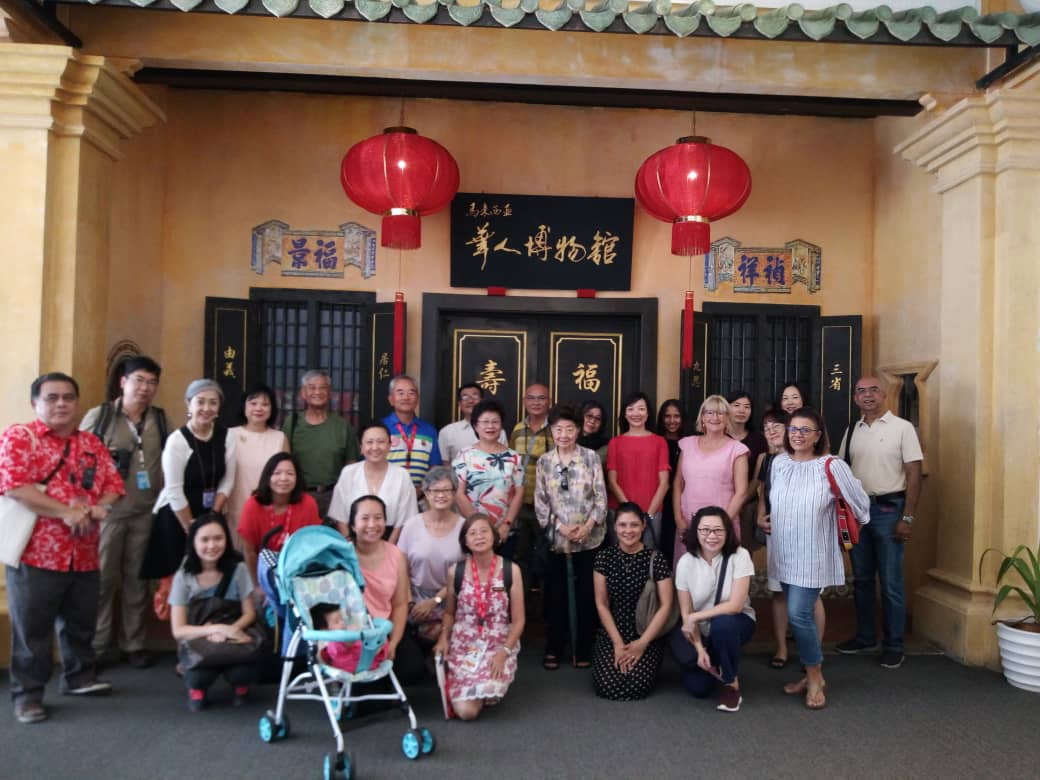
30 Museum Volunteers from the National Museum visiting the Malaysian Chinese Museum on 27th March 2019, photo by Mona Tan.
Established by the Federation of Chinese Associations of Malaysia (Hua Zong), the Malaysian Chinese Museum at Wisma Huazong in Seri Kembangan, Kuala Lumpur opened its doors to the public in 2018. The museum tells the story of the Chinese in Malaysia through a delightful mix of text, graphics and historical reconstruction.
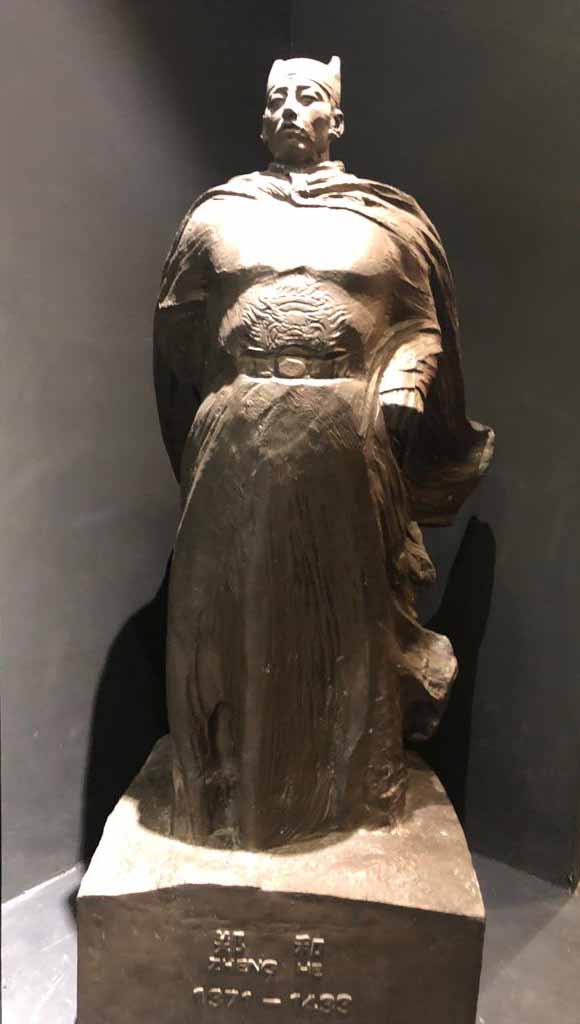
In the 15th century and possibly earlier, there were diplomatic relations between China and Malacca. During the Ming Dynasty, Admiral Zheng He made no less than five grand voyages to Malacca. The Malaccan rulers also travelled to China to pay tribute in the Imperial Court.
Statue of Admiral Zheng He. Photo by Margaret Yeo.
Part of a Chinese map showing the Malay Archipelago. Photo by Janet Wong.
During the late Qing Dynasty, unrest and famine in China and the promise of greener pastures abroad led the Chinese to make their way to South East Asia. However, life here after a tempestuous journey was almost always harsh (especially for those in bondage), and often migrants resorted to opium and alcohol to block out their pitiful existence.
An opium user. Photo by Margaret Yeo.
The Chinese migrants were grouped based on their place of origin in China, and many formed triads to protect their interests. The triads fought over control of resources such as the mines, and this sometimes led to wars eg. Perang Larut, fought between the Hai San Society and Ghee Hin Society.
A fight between triad members. Photo by Margaret Yeo.
There were also migrants who became successful businessmen, such as Tan Kah Kee. In 1860, Tan Kah Kee travelled from Xiamen, Fujian to Singapore (then part of the Straits Settlements) to help his father with the family business (rice trading). Eventually, he built a business empire stretching across sectors such as rubber, manufacturing, canneries, real estate and rice trading. The museum has statues of Tan Kah Kee and his son-in-law, Lee Kong Chian, also a prominent businessman.
Besides that, along with the people came their culture and naturally the industries to support that culture. In the museum, there are reconstructions of several shopfronts.
During the Japanese Occupation (1942-1945), the Chinese here suffered grave casualties and cruel treatment. Some joined the Malayan Peoples’ Anti-Japanese Army (MPAJA), which fought hard against the Japanese invaders. After the war, eight MPAJA members received awards for their anti-Japanese efforts.
An MPAJA member awarded the Star of Burma by Lord Mountbatten. Photo by Margaret Yeo.
After World War II, many of the MPAJA members joined the Malayan Communist Party (MCP), which became embroiled in armed conflict against the British colonial government. This eventually led to the declaration of the Malayan Emergency, during which measures such as the introduction of identity cards and creation of New Villages were implemented. A diorama at the museum reconstructs the situation during the Emergency, which officially ended in 1960 with the victory of the Malayan forces.
After independence in 1957, the Chinese have gradually integrated into Malaysian society without sacrificing their cultural identity, as can be seen from the reconstructions of Chinese markers of culture such as the religion, cuisine and forms of entertainment.
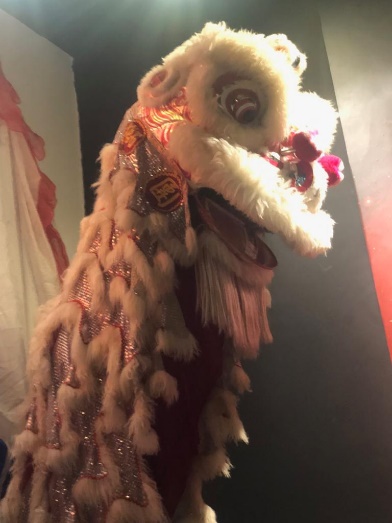
Lion dance. Photo by Margaret Yeo.
Offerings to the Jade Emperor on his birthday. Photo by Ong Li Ling.
Furthermore, Chinese education continues to be upheld. The museum traces the development of the Chinese education system in Malaysia. It is to be noted that outside China and Taiwan, Malaysia is the only country that provides Chinese education from primary to tertiary level. The groups of Chinese educationalists responsible for this achievement, amongst them Jiao Zong and Dong Zong, are acknowledged in the museum.
Last but not least, the museum has a breathtaking miniature display of a bustling marketplace where the different races in Malaysia can be seen working together for the betterment of the nation, in a depiction of the present and hopefully, the future as well.
A bustling marketplace. Photo by Janet Wong.
All in all, while the museum occupies a mere 10,550 square feet, the space has been very cleverly used and the museum is well worth a visit.
At the conclusion of the guided tour, the museum presented our library with a book entitled “A Journey Through History: The Chinese and Nation-Building in Malaysia”. We would like to express our heartfelt gratitude for the hospitality and the special gift. We would also like to thank Mona Tan for organising this trip.
The first quarter of 2019 was very eventful for me. I made two overseas trips, the first to Guangzhou, China, in January followed by an 18-day sojourn to the North Island of New Zealand, between February and March. Taking these excellent opportunities, I visited the local museums and I would like to share my experiences with you.
1. Archaeological Site Museum of Nanyue Palace in Guangzhou
The history of Guangzhou started more than 2,000 years ago. Qin Shi Huang, the first emperor of the Qin Empire succeeded in unifying the Lingnan Region, which comprised 3 prefectures namely Nanhai, Guilin and Xiang.
The Qin dynasty ended when military captains staged
revolts causing great upheavals in the Central Plains of China. Zhao Tuo took
over and established the Nanyue Kingdom with Panyu (original name of Guangzhou)
as its capital. The Nanyue Kingdom was ruled successively by 5 kings and
endured 93 years until it was obliterated by Emperor Wu of the Han Dynasty in 111
BC. Since then, Guangzhou was further developed by another 10 cultural strata,
right up to the Republic of China.
The museum sits between shops fronting the Beijing Road and dwellings on the other side, with the main entrance located at Zhongshan 4th Road. As the name suggests, the focus is on the historic site of the palace and garden of the Nanyue Kingdom. The royal garden consists of a large stone pond and a crooked stone brook. The latter was discovered in 1997 and it meanders from the north to south, a distance of 160 metres. It is the earliest and the best-preserved royal garden discovered so far in China.
The palace of the Nanyue Kingdom
During the excavation of the
pond, a large quantity of the remains of turtles was found at the bottom,
implying the animals might have been kept as pets in the royal garden. Chinese
authorities also found that stone structures used in the construction of the
royal garden were built with materials similar to those of Western stone
structures, thus testifying to the meeting of East and West in Guangzhou in
ancient times.
Exchanges between the Chinese and Western cultures
Besides the site of the palace
and garden of the Nanyue Kingdom, there is also the palace site of the Nanhan
Kingdom, which includes the Nanhan courtyard paved with fabulous butterfly
peony square bricks. At the exhibition building for Guangzhou’s ancient wells,
visitors can see over 500 wells built during the different dynasties. During
excavations at this site, many valuable artefacts were found. Over 100 pottery
jars were unearthed from the wells constructed by the Eastern Han Dynasty
(25-20 BCE).
(Left) Well of Eastern Han Dynasty 25-220 BC (Right) Well of Qing Dynasty 1644 – 1911
Towards the end of 2004, hundreds
of inscribed wooden slips were excavated from the wells built during the Nanyue
Kingdom. These are the very first of such artefacts ever discovered in the
region that provide great value for academic research.
There is no admission fee to visit the museum but visitors must get tickets at the main entrance by showing personal ID cards or, in the case of foreigners, by showing passports.
2. Auckland War Memorial Museum in Auckland
The Auckland Domain is Auckland’s oldest park and it is located just
outside Auckland’s CBD. This spacious 75 hectares park is also one of the
largest parks in the city and it has been developed around the cone of the
extinct Pukekawa volcano. Sitting proudly atop it is the Auckland War Memorial
Museum.
Auckland War Memorial Museum
The
museum is housed in a large neo-classical styled building and is considered as
one of the finest heritage buildings. It was opened in 1929 to commemorate the
loss of 18,166 New Zealanders who died in the First World War. Today, AWMM
is one of the top tourist attractions. The museum is divided into 3 levels:
Ground Level – This level examines the diversity of Maori and Pacific Island cultures. It also talks about the movement of people from South East Asia to the islands in “Near Oceania” 5,000 years ago, then progressing further to the distant island groups in “Remote Oceania” such as New Caledonia, Vanuatu, Fiji, Tonga and Samoa between 3,500 – 3,000 years ago. By then, these people were known as the Lapita people, the immediate ancestors of the Polynesians. Then after “The Long Pause”, a period of over 1,000 years, they started sailing again after the development of larger ocean-going canoes reaching as far North as the Hawaiian islands and as far South as Aotearoa New Zealand 800 years ago. It was believed that the Polynesians have sailed as far as South America and brought back kumara and gourd.
Movement of people from SEA to the Pacific Islands and New Zealand
Level One – Talks about the Natural History of New Zealand, from geological origins to its ancient flora and fauna. The Moa was the tallest bird known and the female grew as tall as 3 metres, measured in an upright standing position. This level also highlights the uniqueness of many New Zealand birds, which are flightless, large, dull or dark in colour and slow breeders. Of course, there is mention of the Kiwi, national pride of New Zealand.
The Moa
Level Two – This gallery is named Scars on the Heart. It is a war memorial centered mainly on the First and Second World Wars. There is also a section that talks about Kiwis being called into action in Asia, namely in Malaya, Borneo and Vietnam.
The first
New Zealanders that fought in Asia were based at the Changi Air Base in
Singapore from 1949 to 1951, during the time of the Malayan Emergency, and they
remained in the country until 1989. Their engagement grew larger during the
time of the Confrontation over Borneo in 1964. In the 1960’s, pressured by the
American government, New Zealand committed resources to the Vietnam War.
We were again given the
spotlight, this time on the stained glass ceiling above the main foyer, which depicts
the Coat of Arms of all British Dominions and Colonies during the First World
War. The Coat of Arms of Malaya and Straits Settlements are proudly displayed
on this glass ceiling.
Coat of Arms of Malaya and Straits Settlements on glass ceiling (extreme left and second left)
A portrait of Sir Edmund Hillary, who was born in Auckland, is also on display. On 29 May 1953, Sir Edmund and his Sherpa guide, Tenzing Norgay, became the first climbers to reach the peak of Mount Everest.
The general admission fee to this museum is NZ $25.00 and the highlights guided tour is an additional NZ $15.00.
3. Navy Museum in Devonport
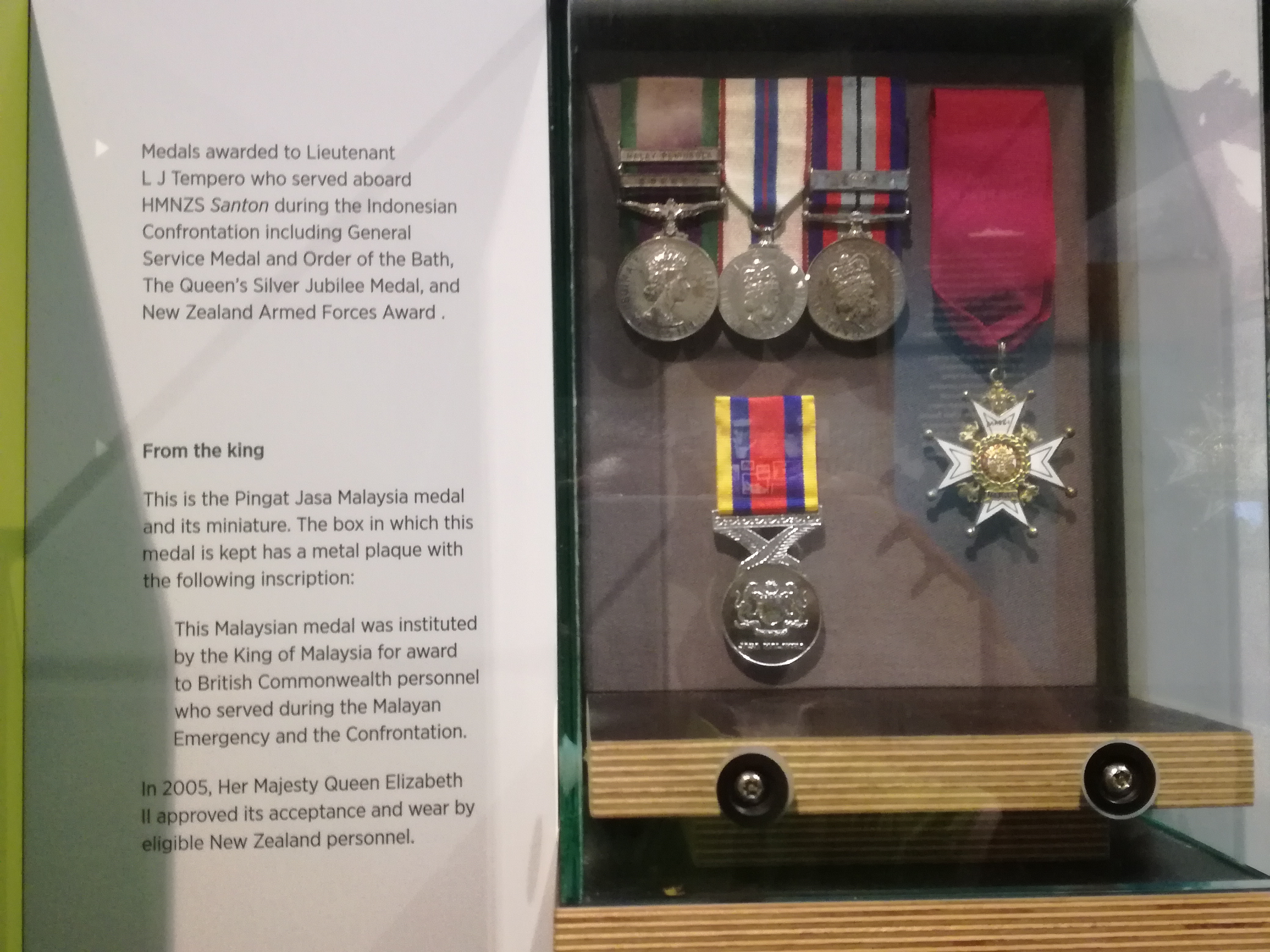
Still in Auckland, I also visited the Navy Museum in the village of Devonport. Here, visitors can learn about New Zealand’s contribution at sea in the major conflicts of the 20th century and as well as during peace-time. Again, the Malayan Emergency and Confrontation are highlighted. The museum is open seven days a week, 10.00 am to 5.00 pm and admission is free.
Malaysian Medals awarded to British Commonwealth personnels who served during the Malayan Emergency and Confrontation
A
driver attempting to cross the bridge had apparently been oblivious to the fact
that he was driving in the wrong direction. The resulting commotion essentially
amounted to a series of loud commands ordering him to reverse. Someone notes
his licence plate: “Wilayah”. Well, that explains a great deal.
Yet
our Wilayah driver was not the first one who had difficulty crossing that section
of the Melaka River. Jambatan Tan Kim Seng was built by a wealthy Peranakan
man, who had sought his fortune in Singapore and built monuments in Melaka
thereafter. However, our guide, En. Shaukani, tells us of another bridge that
was in fact destroyed by the British during the Japanese invasion of Melaka. In
an attempt to slow down Japanese advancement, British troops carried out a
‘scorched earth’ policy of destroying bridges. That bridge lies alongside
Jambatan Tan Kim Seng, but remains invisible to all save those with an
awareness of the incident. This was a fitting point to begin the ‘intangible’
segment of our Melaka trip, a tour not of monuments, but of memories.
Memories:
sometimes clear, sometimes hazy, and always bound to make their mark. My own
memories of this part of the trip were affected by heat, low-blood sugar, and
the fact that I did not set everything down the moment I returned. Nonetheless,
I attempted at scratching away some notes whilst keeping up with my group in
the midst of the Malaccan sun.
How
does one map out a city’s history? Does the answer lie in the names of old
streets and famous buildings? Or does history lie behind those streets, somewhere
between the memories of those long dead and the commerce of those still living?
As one recalls plodding through the streets of Melaka, such questions come to
mind, a reminder that heritage is not merely about what we inherit, but how we choose to inherit.
En.
Shaukani takes us to ‘Black Smith Street’ (Jalan
Tukang Besi), so called because of the occupation of those who used to work
there. The past tense can no doubt produce dismay; almost all of the craftsmen
have since left the area, and their crafts have gone with them. As our guide
points out, the old crafts have since been replaced by modern alternatives,
with knives being bought from the supermarket rather than the local blacksmith.
Tinsmiths and bucket makers have long departed the scene. Instead, one sees
mural paintings, massage parlours, and the modern world in its various forms. Had
we been on our own, we may have been left with disappointment. However, we were
in the presence of a tour guide with experience on his hands, and En. Shaukani
transformed the view before us into one filled with bullock carts, lorries, opium
smoking, fights, and naked ghosts.
“NAKED
GHOSTS?!” you exclaim, voicing your shock and disbelief to me from – well, from
wherever you happen to be at the present moment. “If there are naked ghosts in
the street, I am never going to
Melaka!” Keep calm reader. Rest assured; if we had seen ghosts, we would
certainly have behaved in a quintessentially Malaysian fashion (i.e. taking one
picture for our relatives and then running for our lives back to KL). However, we
saw none, for En. Shaukani merely made mention of ‘Coolie Street’ and the naked
ghosts said to inhabit that area. From what I recall, these ghosts are
apparently the coolies themselves, while the story was told to young children
to prevent them from going to the area. Regardless of who or what actually
resides in Coolie Street, I am personally grateful for not having gone there; I
can take ‘intangible’ tours, but not supernatural ones.
The
picture painted thus far can provide the impression of a dead city. Yet this is
far from the truth, for Melaka is a city full of life and colour. Though most
of the craftsmen have gone, we were fortunate enough to come across one man who
has maintained a family tradition. Much later in the tour, we had the good
fortune of meeting Mr T.S. Lim, who runs a shop making handmade shoes. Yet
these are no ordinary shoes, but glass slippers. Remove that image of
Cinderella’s footwear from your mind, for those transparent ‘one-size only’
high heels pale in comparison to these vibrant traditional Nyonya beaded shoes,
made from potong beads. The rows of traditional shoes displayed at the
front of the shop are like a cross between beautiful paintings and coloured candy,
reminding one of the multi-coloured tiles that typify Peranakan culture. Inside
the store, Mr. Lim is kind enough to share his knowledge with our group,
showing us some work in progress contained in an embroidery hoop. As Mr. Lim
explains to us, the design on one shoe must be a mirror image of the other shoe
that forms the pair. On the shelves, one sees that Mr. Lim has created contemporary
high heels featuring the potong beads on their straps, an ingenious and
tasteful blend that combines modern styles with traditional techniques. It is
an indication that the tradition is still alive, quite literally carrying on
its own journey on the feet of others.
As
for our own feet, we found ourselves on yet another road: Harmony Street. The
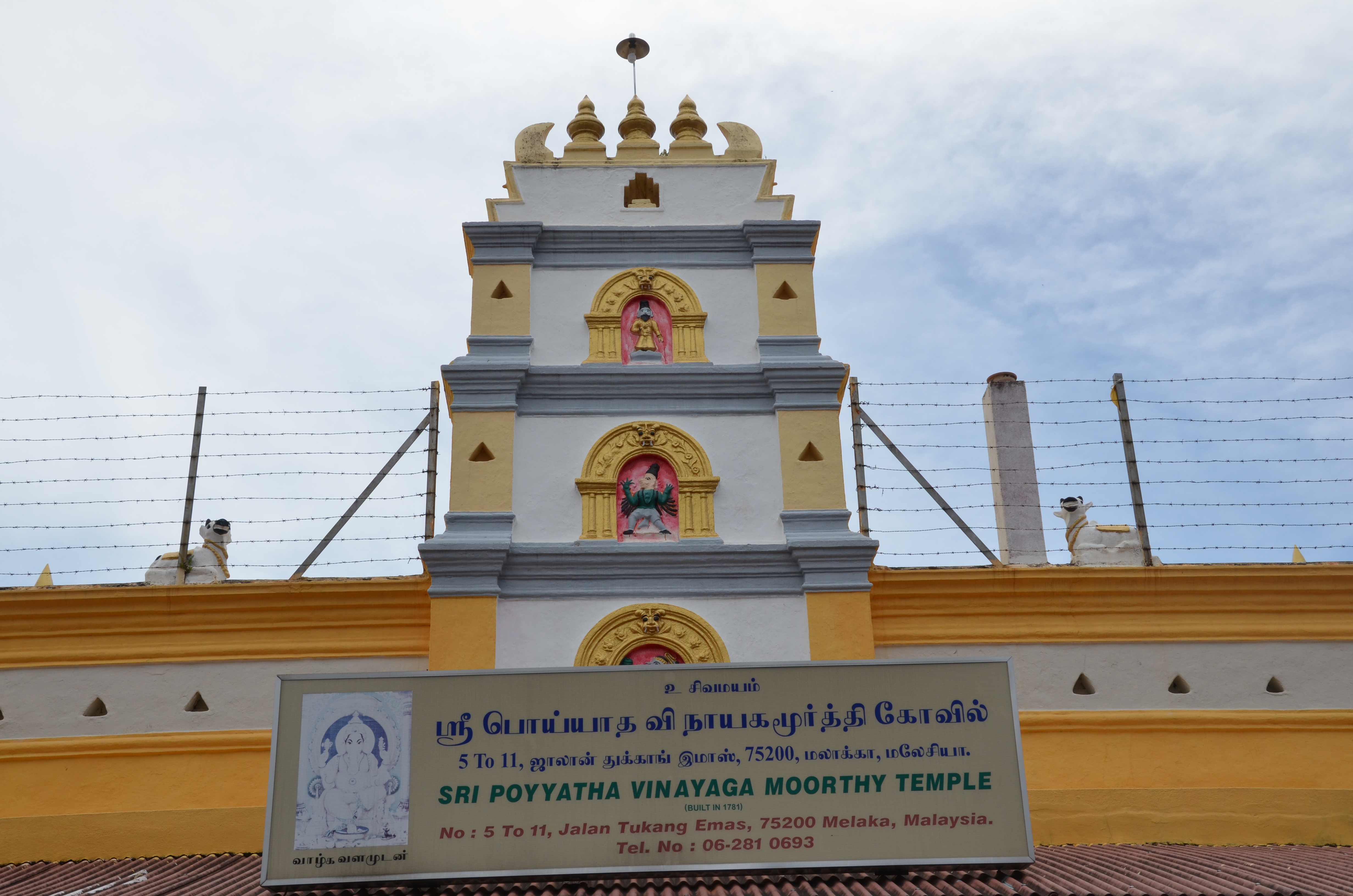
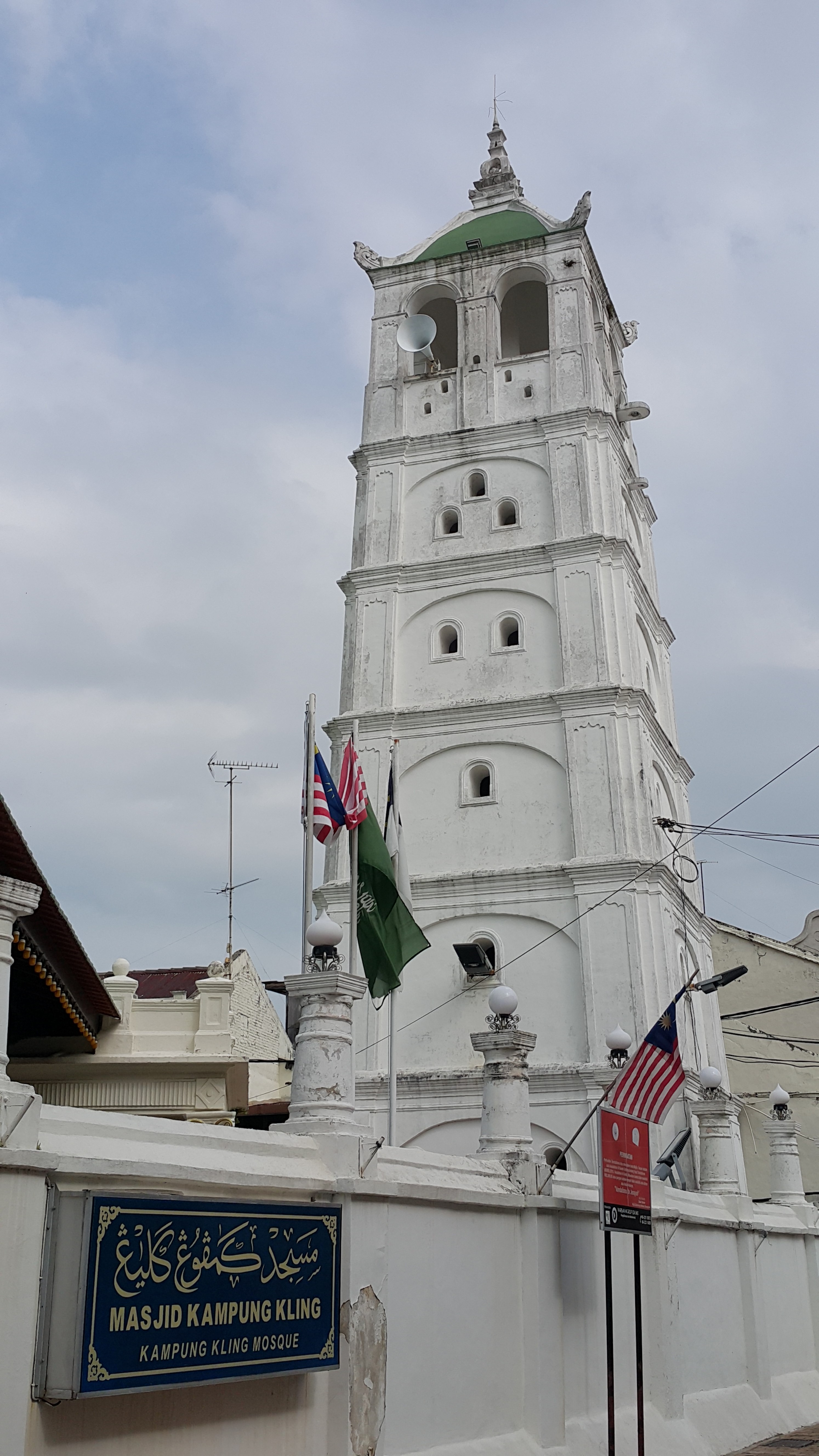
road owes its name to the presence of the Sri Poyatha Moorthi Temple, the
Kampung Kling mosque, and the Cheng Hoon Teng temple, each of which is located beside
the other. The close proximity of these historic places of worship is a
reminder that peaceful co-existence and acceptance is not a new invention in
Malaysia, but an established part of our country’s traditions. The Sri Poyatha
Moorthi Temple was built by the Chitty community on land given by the VOC
(Dutch East India Trading Company), and is one of Malaysia’s oldest Hindu temples.
It thus occupies a unique place in our country’s history, not least because
Chitty temples are now a rarity in Malaysia. Just as historic is the Kampung
Kling mosque, originally built by Indian Muslim traders. The mosque has the
tiered roof that is characteristic of many traditional Malaysian and Indonesian
mosques. Yet like so many Malaccan mosques, the Kampung Kling mosque also bears
elements of Chinese architecture, with the main structure having a pagoda-like
feel. En. Shaukani also points out to us the use of pineapple motifs on the
mosque’s archway, the pineapple being a traditional Chinese symbol of
prosperity. Unique to Southeast Asian Chinese culture is the use of Peranakan
tiles, which adorn the mosque with a variety of colours. These elements do not
merely co-exist; they work in harmony to create a new effect, one that is
greater than the sum of particular artistic influences. In an age when religion
often feels dry and harsh, the Kampung Kling mosque is a loving reminder of the
beauty of faith.
I
would return to the mosque later, but for the time being it was on to the next
building: the Cheng Hoon Teng temple. Yet to refer to its current function as a
temple does not reveal the complex history underlying this building. Though it
is currently a house of worship for Mahayana Buddhists, the building was
originally a community centre commissioned by Tay Kie Ki, a kapitan or leader of Melaka’s Chinese
community in 1645. As En. Shaukani tells us, Melaka’s community had a “kapitan system”, with En. Shaukani
mentioning three kapitan: kapitan Melayu, kapitan kling, and kapitan Cina. As far as I can understand
– I was writing whilst standing, so the shorthand is vague – the Dutch would
liase with the various kapitan in
question. But the British abolished this system, and the building was
subsequently converted into a temple. According to Kenny Mah, the building is a
reflection of Southern Chinese architecture, and every aspect of the building
is aligned with feng shui. The use of
red makes this building a truly stunning sight, befitting of this beautiful
Chinese monument.
We
passed by many other buildings, each with some story of its own. An apparently
insignificant building is really a property once owned by Tan Cheng Lock, with
the house being the site of many meetings held to discuss our independence. The
house of the Chi family links us unexpectedly back to home, with the Chi family
helping to finance Raja Abdullah’s tin mining in Kuala Lumpur. Yet what stood
out most for me was the Aik Cheong Coffee Roaster shop lot. Although it is now
a location selling packaged coffee, the lot was once a coffee shop; En.
Shaukani recounted how the smell of roasted coffee used to fill the air. Once
again, it was not the tangible that counted but the intangible, a history not tucked
away in dusty archives but written on the tablets of human memory.
We had come to the end our tour, but some time remained for us to explore the city on our own. For myself, I needed to make a trip back to the mosque to perform the canonical prayers. Though modern mosques have taps, the Kampung Kling mosque has a square-shaped pool for worshipers to perform the ritual purification (wudu), at the centre of which is a golden fountain. In the midst of the Malaccan heat, taking cool water from the pool reminds one of the desert oasis. One also thinks of the words of the Prophet (SAW): “I go before you, and I am your witness. Your tryst with me is at the Pool”. I cannot remember if these thoughts entered my head at the time. What I do remember is looking up and being calmly but clearly confronted with reality, with the gravestones of the deceased being in front of the pool. They were slightly to the left but inescapably in view, and though one can laugh at the thought of ghosts, one cannot truly behold the men and women who have gone before without thinking of what lies ahead. It is a reminder that the true bridge is an invisible one, visible only to those who remember.
REFERENCES
Lings,
Martin. Muhammad: His Life Based on the
Earliest Sources. London: George Allen & Unwin, 1983.
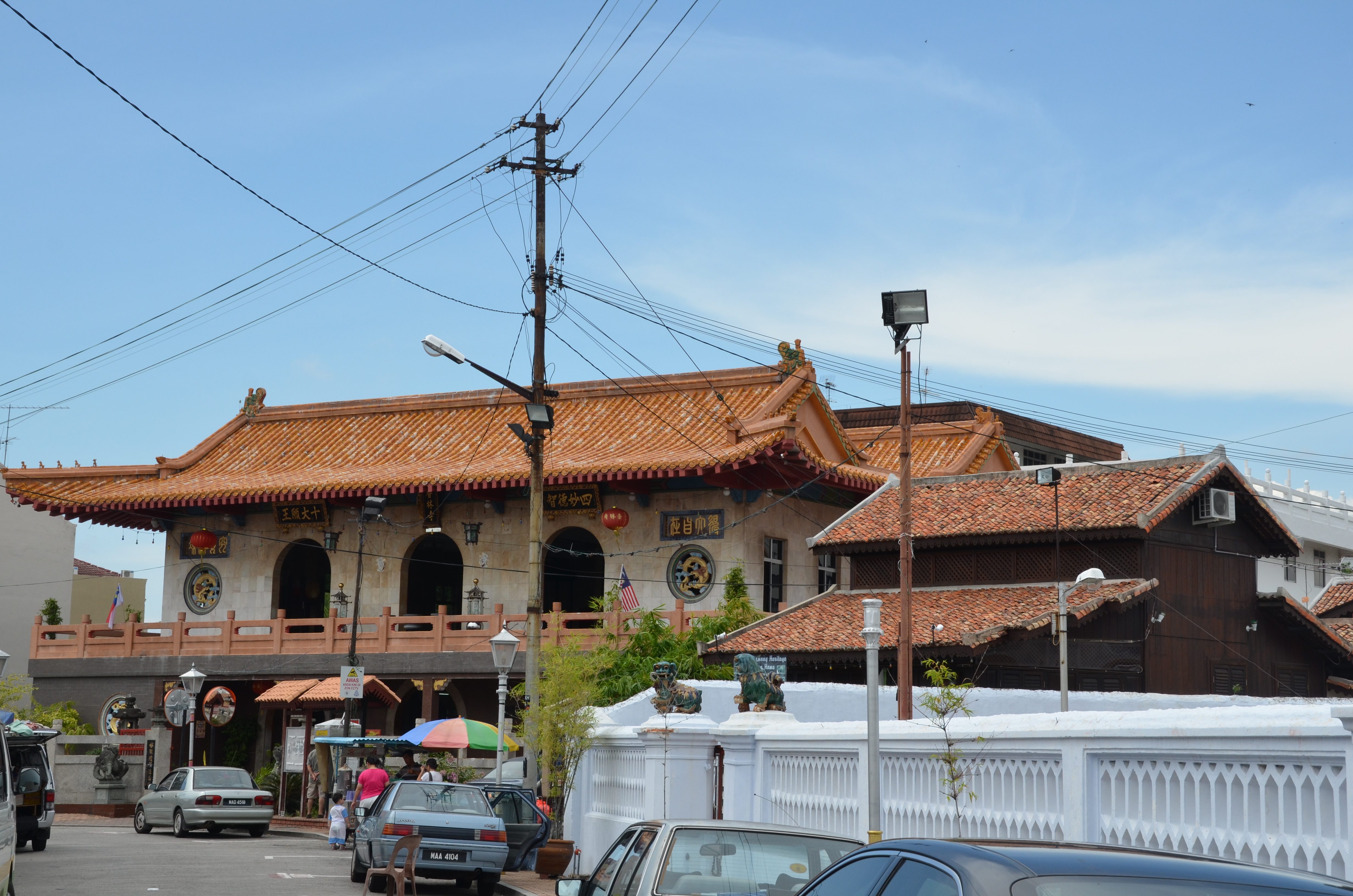
A morning visit to Stadthuys, St. Paul’s Hill, Dutch Cemetery, Porta de Santiago
On the fine Saturday
morning of 12 January 2019, a group of 22 including MV trainers and trainees set
off from Muzium Negara and arrived in Melaka at approximately 9.45 am. An
experienced local guide, En Shaukani Abbas, from Friends of Melaka Museums, led
our day’s itinerary. Upon introducing himself, he shared some tips and techniques
on tour guiding: 1 – Understand the history; 2 – Say the facts in your own
words; 3 – Tell the story from your heart using your imagination; and finally 4
– Have humour in your presentation.
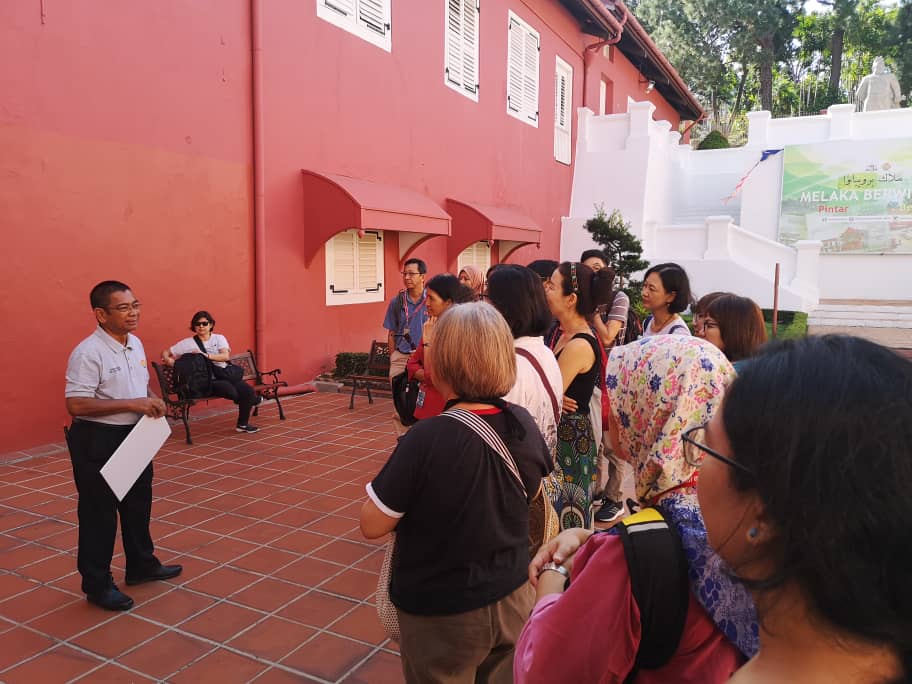
Our first stop was
the Stadthuys, a prominent red building believed to be the oldest surviving
structure of the Dutch in the East; if a modern Dutch visitor wishes to see a
historical Dutch building, Melaka is where it can be found. The Stadthuys was
built in 1641 on top of a Portuguese building as evidenced by Portuguese wells
found below the ground. It was the official administration centre and dwelling
of Dutch governors and officers. In 1982, it was converted into a museum displaying
the rich history of Melaka’s colonial past and local customs and traditions. Its
Dutch-style architecture can be clearly seen in its steep and high roofing as well
as its wide doors and windows.
One of the rooms has
ornate engravings on its ceiling; this room is believed to have been the living
room of the governor. Also on display are items traded during the Dutch period
in this region under the Dutch East-India Company (VOC) and portrait paintings
of the Directors of the company are hung at one corner of the room. Just
outside of the building but connected by a walkway is the kitchen, also known
as the Big Toaster. In the olden days, servants would bake bread overnight in
order to serve it fresh to their masters the next morning. The original brick
flooring and massive ovens give the space a rustic feel.
Moving deeper into
the museum, dioramas on traditional wedding and ceremonial events are displayed
and they provide an overall glimpse of the various cultures and customs
practiced by the multi-racial people of Melaka. It was especially interesting
to learn about the Chitty ceremony of shaving a baby’s head and the Baba Nyonya
wedding bed for newlyweds. The remaining tour in the museum was regarding the
Melaka sultanate, Portuguese and foreign invasion and miniature models of the A
Famosa fortress.
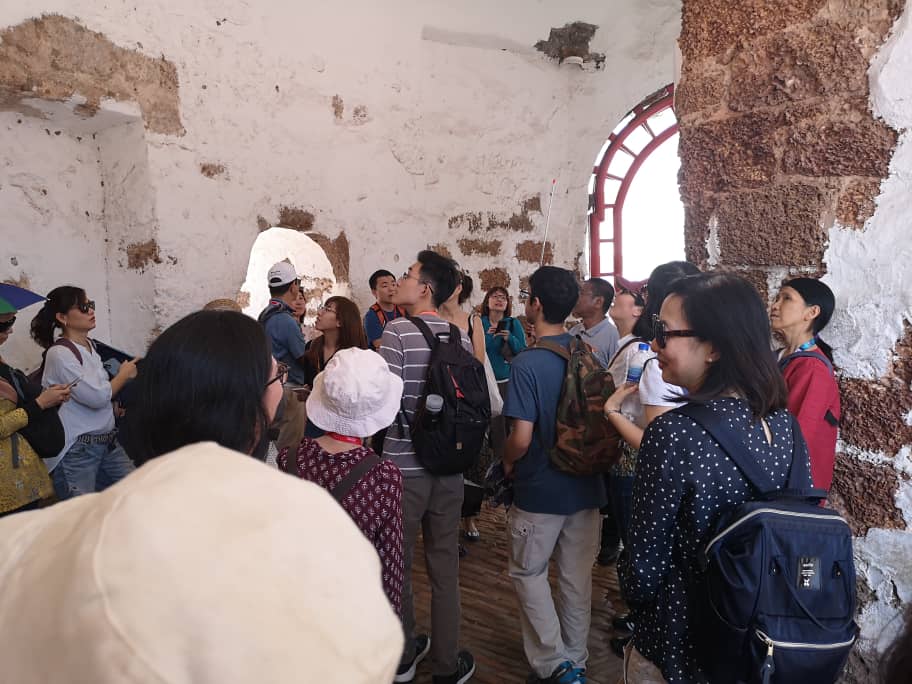
After an information-packed session at the museum, we walked up St. Paul’s Hill to visit ruins of the church. Propped up against a wall are headstones, which were well preserved and have beautiful patterns carved onto the stone. It is believed that the headstones were brought from overseas, as the material is not found locally. We also came across St. Francis Xavier’s statue, which was given by the Archbishop of Melaka. The statue is missing a right arm and En. Shaukani told the story of a nearby tree that fell onto the statue during a storm, hence the missing limb.
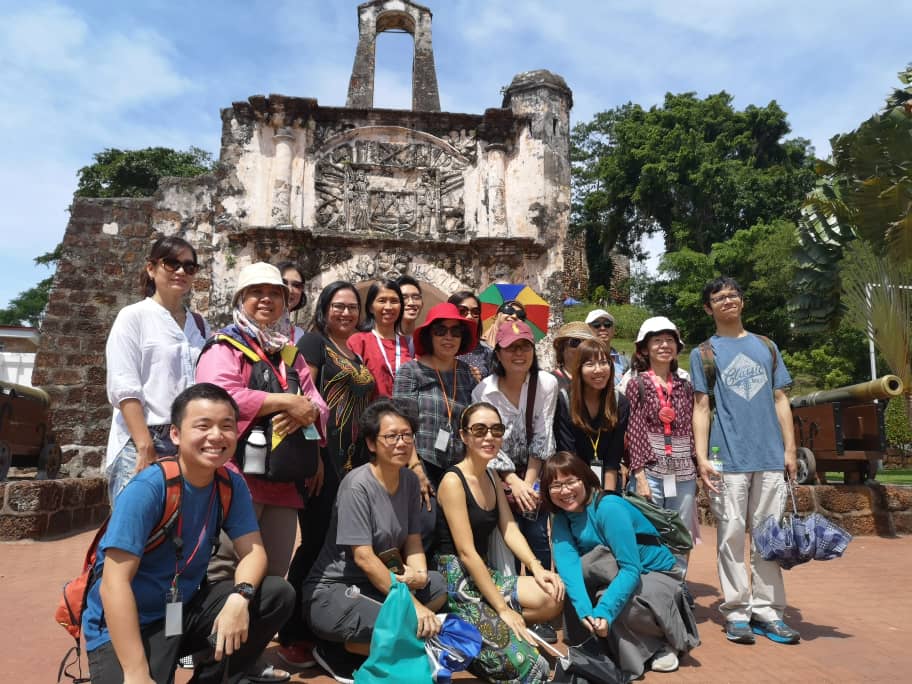
As we descended the hill, we saw an old Dutch cemetery and we learnt that despite its name, only seven Dutch graves are found there while the rest of about 30 plus graves are those of British military personnel and their wives. We continued walking towards Porta de Santiago, the only gate that survived the destruction of A Famosa. We took a happy group photo there under the scorching sun. By this time, we were ready for a lunch break to fuel ourselves for the rest of the afternoon in the historical city of Melaka.
Mohammad Eunos
Abdullah (1876-1933) was a campaigner for the Malay cause in Singapore. He was
also known as the father of modern Malay journalism. Eunos fought hard for
Malay rights especially in education. He died at the age of 57; he was a
journalist, a politician and founder of the Singapura Malay Union (Kesatuan
Melayu Singapura,KMS). His passion in championing Malay rights in Singapore
went on to inspire future Malay nationalists in Malaya.
Eunos was
born in Singapore to a successful Minangkabau trader from Sumatera, Indonesia. He
had his early education in a Malay school in Kampong Glam and he was among the
very few Malays who studied at Raffles Institution. Upon graduation, he joined
the government service. His early career in Singapore was that of an attendant
at the Harbour Master’s office; he was later promoted as Harbour Master in
Muar, Johore.
A portrait of Mohammad Eunos Abdullah. Photograph from the display boards of National Museum of Singapore
In the
early 19th century, Munshi Abdullah, the father of modern Malay
literature, was also a renowned Islamic scholar with his modernistic interpretation
of Islam in the region. Eunos was inspired by his writings. At the age of 31,
Eunos was offered a job as an Editor for the Utusan Malayu, a Malay
language version of the English newspaper in Singapore. Thus, was the beginning
of his opinionated voice on racial nationalism of “bumiputra” son of the soil issues.
He also spoke up against the Muslim Arab descendants who were monopolizing the
social and economic environment in Singapore. From literary work, he instantly
became a political activist representing the Malay voice during the colonial
era.
In 1922, he was appointed as Justice of Peace and subsequently appointed as a member to the municipal commission. He was the first Malay given this position in Singapore. Following the British’s administration policy to increase local representation in the Legislative Council of the Straits Settlement, Eunos was made a Legislative Councillor in 1924. He was the first Malay councillor. In his first public appearance, Eunos stood up to condemn the government’s education policy that side lined the Malay youth. Eunos concluded:
“Being unable to swim, he sinks and is lost in the swelling sea of unemployment. Surely, Sir, this is not a thing to be desired among the original son of the soil? I am confident, Sir, ways and means can be found which will enhance the prospects of boys of the soil and remove forever the penalization which oust them from their own markets simply because they happen to be the imperfect products of an imperfect system of education”.
The minutes
of this Legislative Council’s proceedings recorded that there was an immediate applause
from his friends and Asian councillors in the audience.
Empress Place. Meetings of the Legislative Council were held here. Eunos Abdullah became an unofficial member of the Council on 14 April 1924 and delivered his first speech at the following meeting on 30 June. Photograph from the display boards of National Museum of Singapore
In 1926,
Eunos and his associates formed the Kesatuan Melayu Singapura (KMS) or the
Singapore Malay Union; he was made its President. KMS was the first political
organisation set up to champion Malay rights such as increasing Malay
representation in the government service, upholding Malay interests, and promoting
higher education for the Malays.
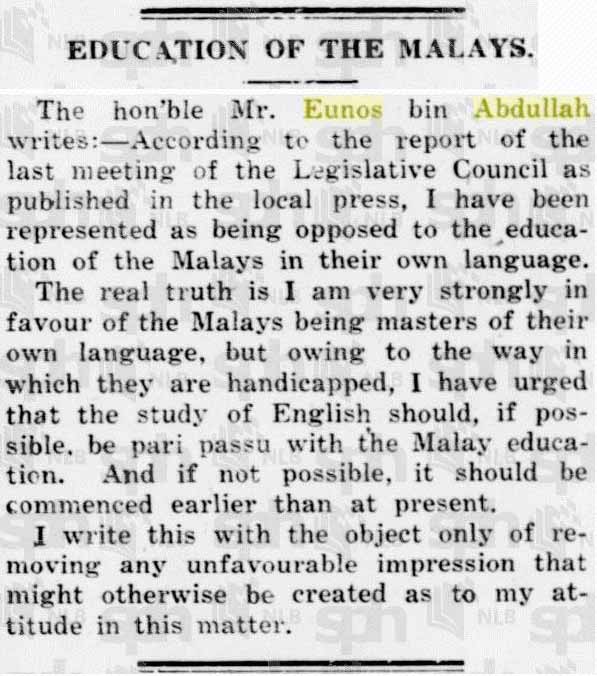
A letter from Eunos Abdullah to The Straits Times. During the legislative meetings, Eunos Abdullah also pushed for Malay children to be taught English from a younger age so they would not be handicapped when transiting from vernacular to English schools. From The Singapore Free Press and Mercantile Advertiser, 7 November 1924, Page 6.
He wanted a strong sense of Malay nationalism and called for the preservation of its culture or roots to be known and recognised. Eunos pushed to increase the education budget so that Malays could enter into the medical college and attend Malay vernacular or trade schools. He also advocated for better living conditions and sanitation for the Malay community. He proposed to build a settlement of Kampung Melayu to uphold the Malay values. Eunos was eventually given a grant to purchase and build the settlement. It was named Kampung Melayu or Kampung Eunos. In 1981, the settlement paved way for the construction of Pan Island Expressway and development of housing estates. To commemorate Eunos’s legacy, one of the local residential districts near Kampung Eunos was named EUNOS.
A procession at Jalan Eunos Malay Settlement in the 1930s. Photograph from the display boards of National Museum of Singapore
Eunos retired in early 1933 and passed away in December 1933. He was laid to rest in the Bidadari Cemetery, Singapore.
References:
eresources.nib.gov.sg
National Museum Singapore- Board Captions
Marx Ravinder Frost & Yu-Mei Balasingamchow (2009) Singapore: A Biography, Singapore: EDM & National Museum of Singapore
The exhibition at the Islamic Arts Museum, Malaysia (IAMM) titled ‘Al-Tibb: Healing Traditions in Islamic Medical Manuscripts’ has been extended until end of January this year. If you were planning a visit to IAMM, this month would be a good time to go.
‘Tibb’ is the Arabic word for medicine and this exhibition displays IAMM’s collections of manuscripts and objects related to the science of medicine in the Islamic world. The collections are from across the Islamic world and cover a number of areas including prophetic medicine, pharmacy and dietetics, bimaristan (hospital), anatomy, Malay medicine, and traditional medicine.
Knowledge of healing from around the Malay Archipelago is encapsulated in a number Kitab Tibb Melayu, the first of which was written in 1638 CE by Sheik Nuruddin al-Raniri, an ulama in the Aceh Sultanate. IAMM has a number of Kitab Tibb in its collection; samples from a few pieces are shown below.
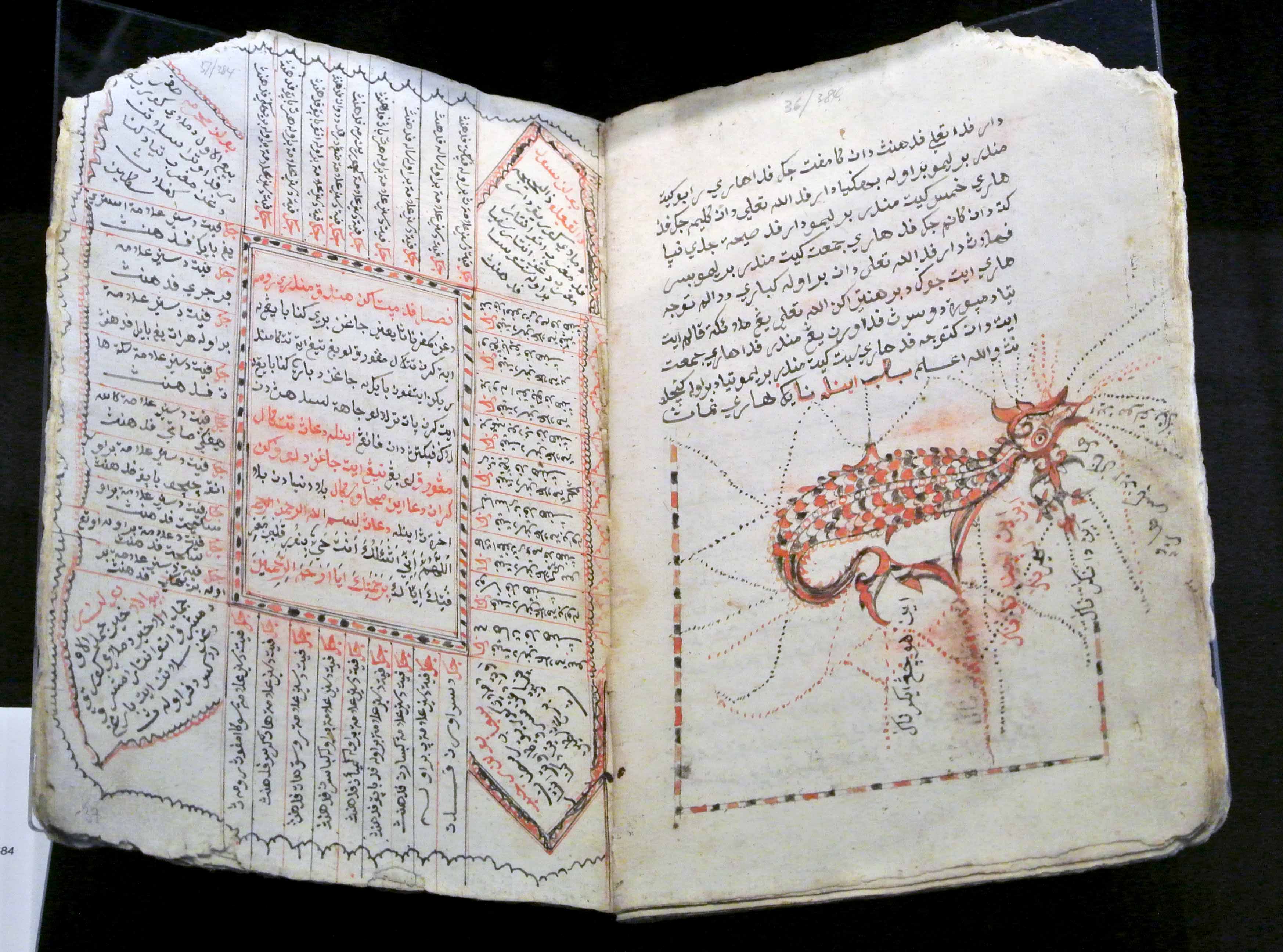
A 19th century Kitab Tibb Melayu from the Malay Peninsula written in Jawi script. This manuscript is dedicated to the tropical disease puru (yaw), a disease that infects the skin, bones, and joints leaving scars and deformities. It was widespread in the Malay Archipelago and this manuscript provides information on its development, symptoms, and treatment.
The 2-page spread in the photograph provide illustrations of the human body labelled with the various types of puru at the different locations on the body. The manuscript also provides illustrations on the shapes of pustule clusters. For example, the keri getah (sickle used in cutting rubber trees) shaped cluster appears between 1-7 days while the buaya laut (sea crocodile) shaped cluster would indicate the person has been infected for 15 days.
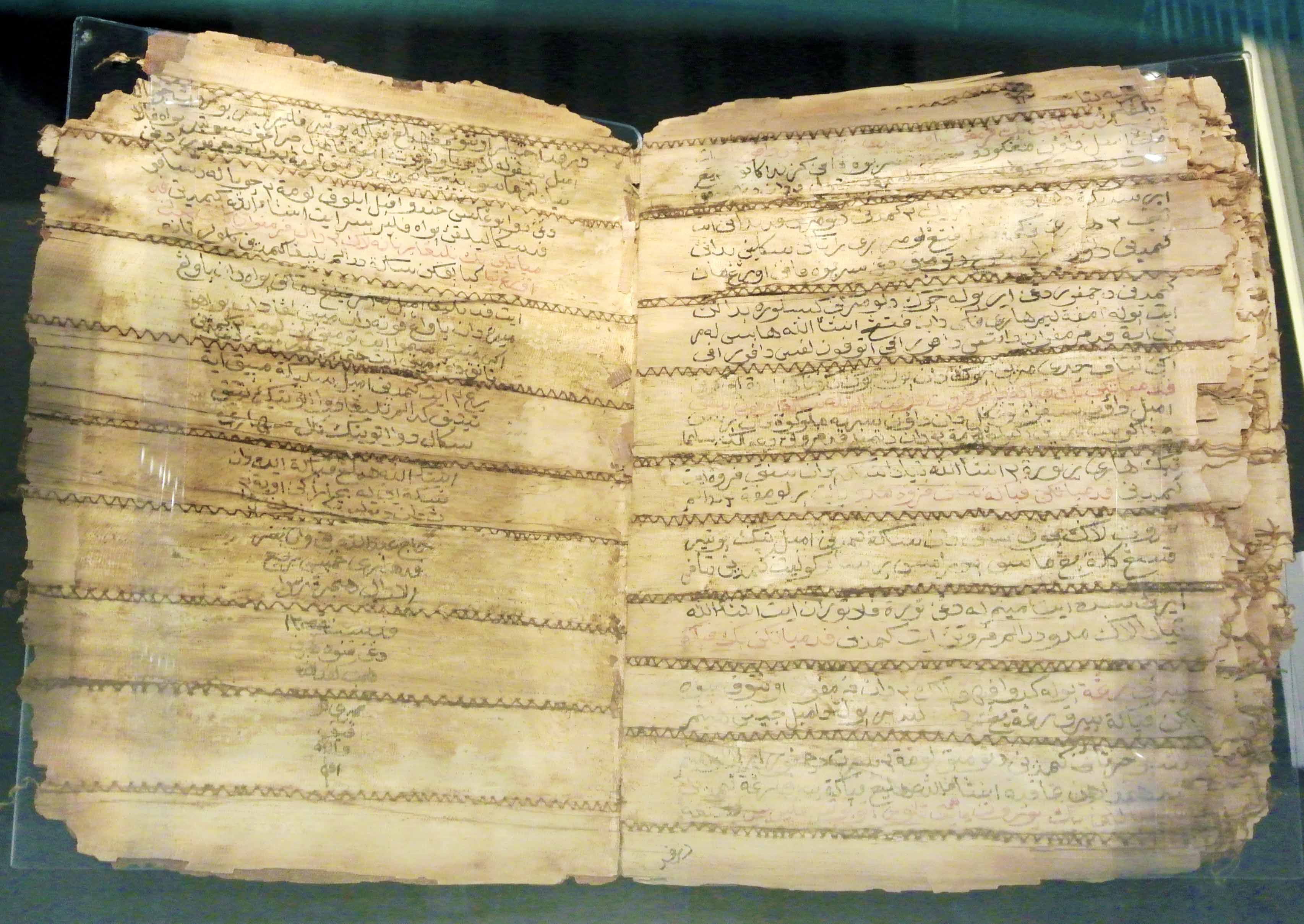
This Kitab Tibb is written on the leaves of the nipa palm. As can be seen in the photograph, the leaves are stitched together. The page on the left is the colophon page, which attributes the authorship of the book to Haji Abdullah bin Wan who completed the work in May 1936 CE. The treatise describes herbal remedies for a large number of common maladies from sore throat to snake bites and to tuberculosis. Some treatments prescribed for new mothers continue to be practised today, for example bertangas, a herbal steam bath. The herbs used in the remedies were easily obtained locally.
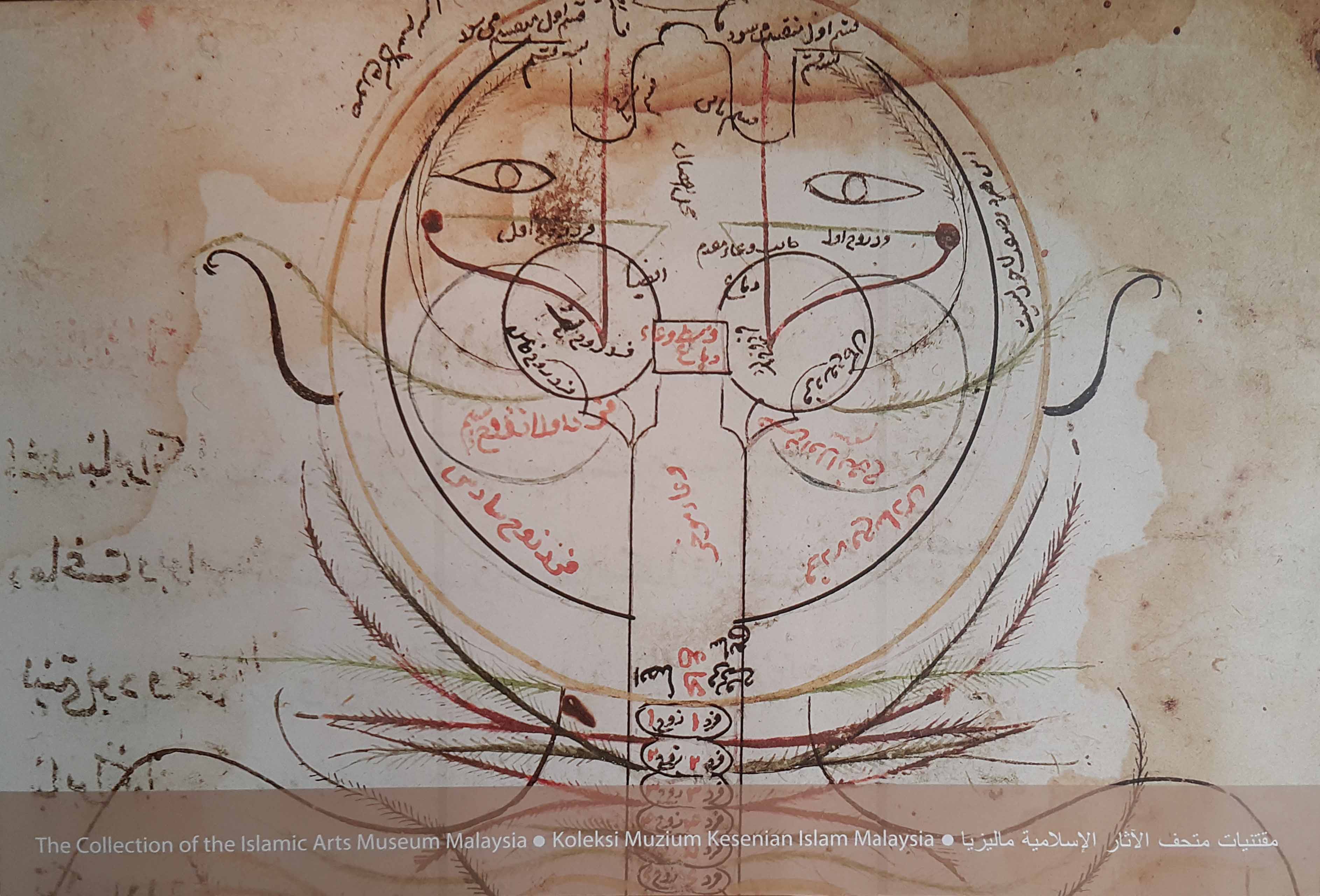
This medical treatise from the Malay Peninsula (19th century CE) is a training guide on becoming a bomoh (medicine man). It includes knowledge on obtaining assistance from the Rijal al-Ghaib (invisible beings), traditional healing ceremonies, and predicting the patient’s future well-being though calculations using the Lawh al-Hayat (Board of Life) and Lawh al-Mamat (Board of Death). It also includes treatment for various diseases.
The page in the photograph contains an illustration of the front (right) and back (left) of a human body. Puru (yaw) clusters are marked on the right image while the puru names are labelled on the left image. The puru on the right foot is named Gajah Mata (Elephant Eye), the right knee Anjing Basah (Wet Dog), and right shoulder is Batu Tengah Laut (Stone in Middle of Ocean). The inclusion of this page shows the prevalence of this disease and the effort spent in documenting it.
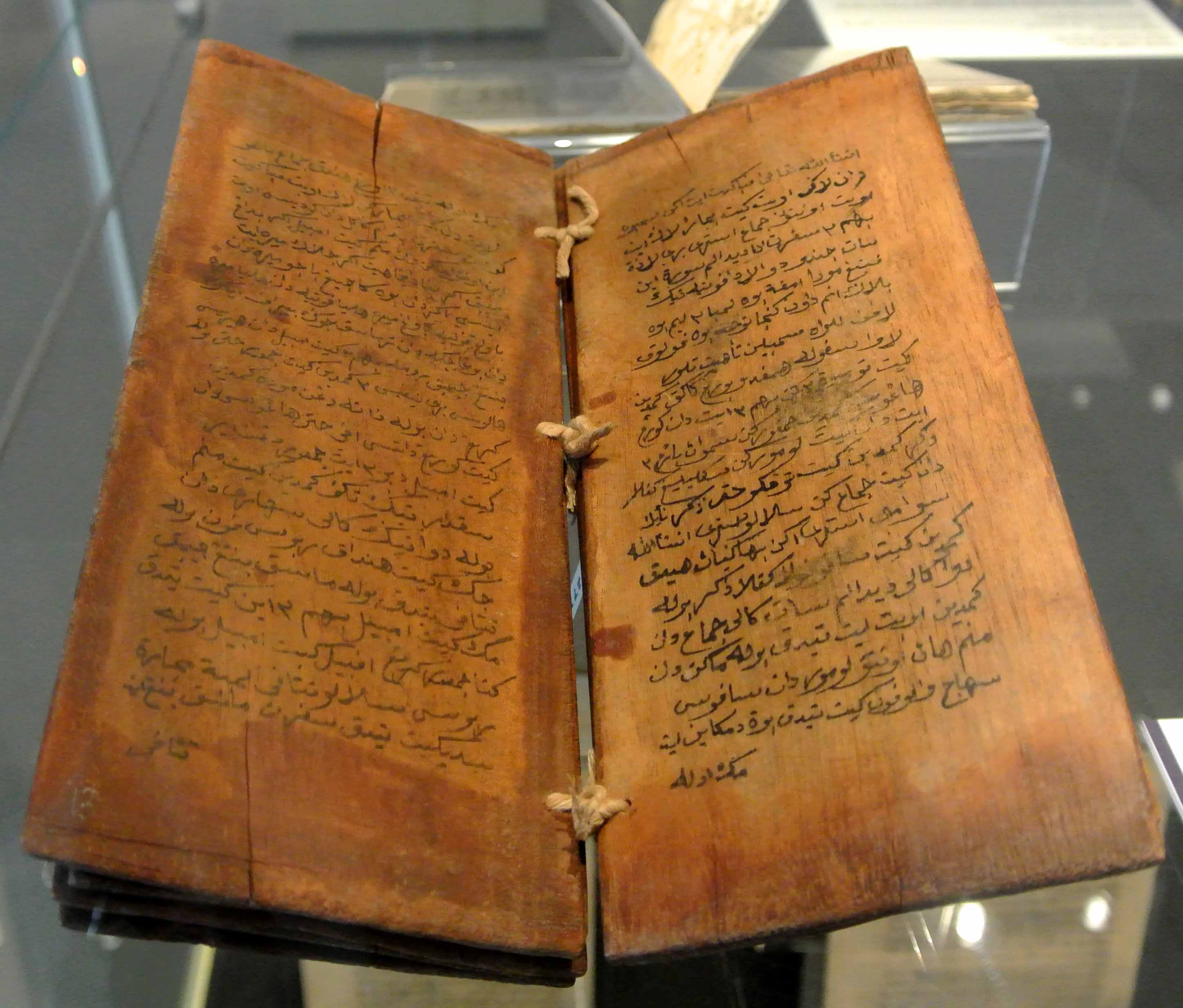
A Kitab Tibb from Patani, dated to either 1786 CE or 1883 CE. It is written on 12 pieces of wood tied together with white thread. This medical treatise describes remedies for a number of skin diseases, vascular diseases, and diabetes. The remedies make use of plants, especially their leaves and roots. Cautionary advice to stop taking the medication if headaches occur is included. Dietary advice is also given – for example a diabetic patient is advised not be consume certain types of meat and seafood.
A Kitab Ramalan (Book on Divination) from the Malay Peninsula dated to the 19th century CE. It describes a number of different divination methods to determine the auspicious and inauspicious start dates for a wide range of activities, for example the right time to prepare medicine, build a house, make a boat, and travel.
The left page in the photograph is a guideline for building houses. The right page has an illustration of the Naga Hari (Daily Rotating Naga). This serpent moves across the cardinal directions (N, S, E, W) on different days. Another serpent (not shown in the photograph) known as the Naga Tahun (Yearly Rotating Naga) moves across the cardinal directions every three months.
Reference
Harun Mat Piah (2018) ‘The Malay Knowledge of Healing’, in Lucien de Guise (editor) Al-Tibb: Healing Traditions in Islamic Medical Manuscripts, Kuala Lumpur: IAMM.
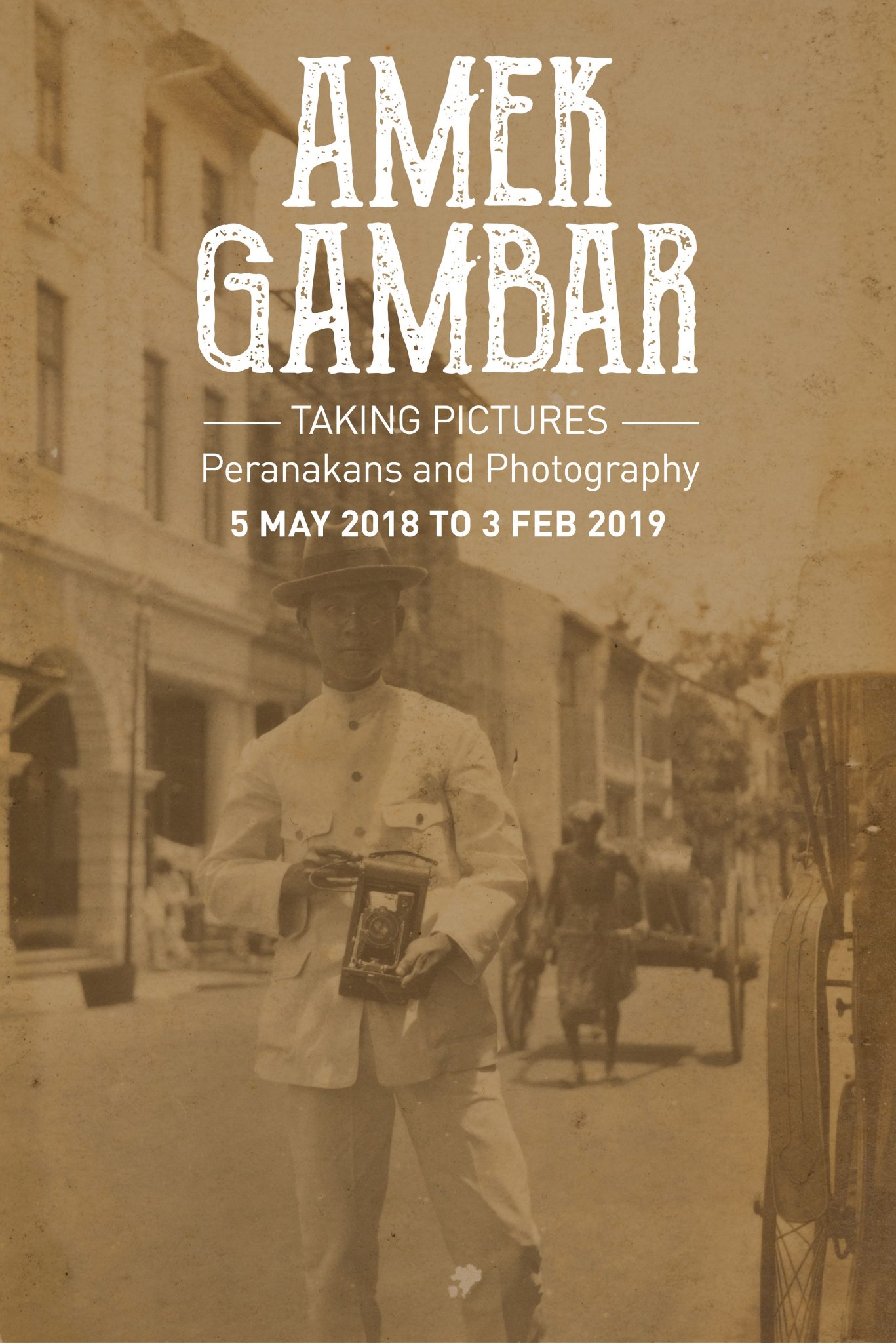
After a lovely tour of the permanent galleries by volunteer docent Marjon de Winter and visiting the various other parts of the museum, I just had enough time for a whirlwind walk through the Amek Gambar exhibition. According to the write up, it “presents over a century of photographs, tracing the emergence, adoption and evolution of photography in Southeast Asia.”
I was fortunate enough to catch the tail end of a private, informal tour and this experience truly drove home the point that museum docents play an important role in helping visitors on their journey of discovery. For me, having the dots connected, deepened my appreciation of the images on display and the insight they afforded into the world of the Peranakans. More so, when the guide has first-hand knowledge on the subjects of the photographs and shares a bit a local gossip here and there!
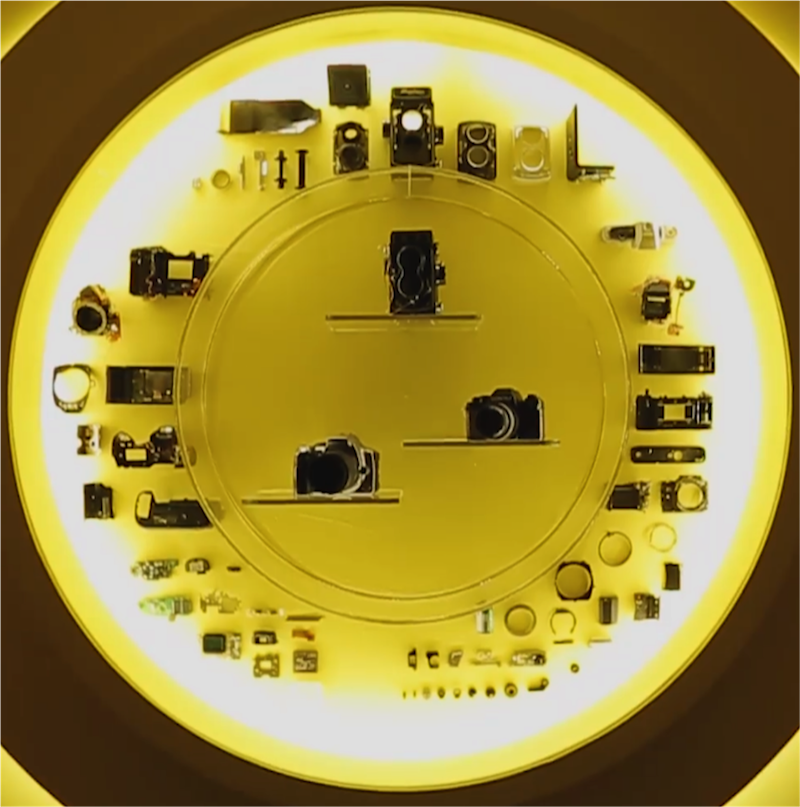
The photographs range from the earliest photo of Singapore to crowd sourced digital images – capturing people, places and events to tell a story of the scene captured. A majority of photographs were donated by Mr and Mrs Lee Kip Lee. The tools of the trade – cameras, negatives, photo albums – are also given prominence. Visitors are given the opportunity to see the photographs as they would have been kept, used or displayed in their time – framed for hanging or displayed on table tops, in albums, within official documents as well as with their negatives, transparencies or slides.
Mr. Lee Kip Lee
Camera wall
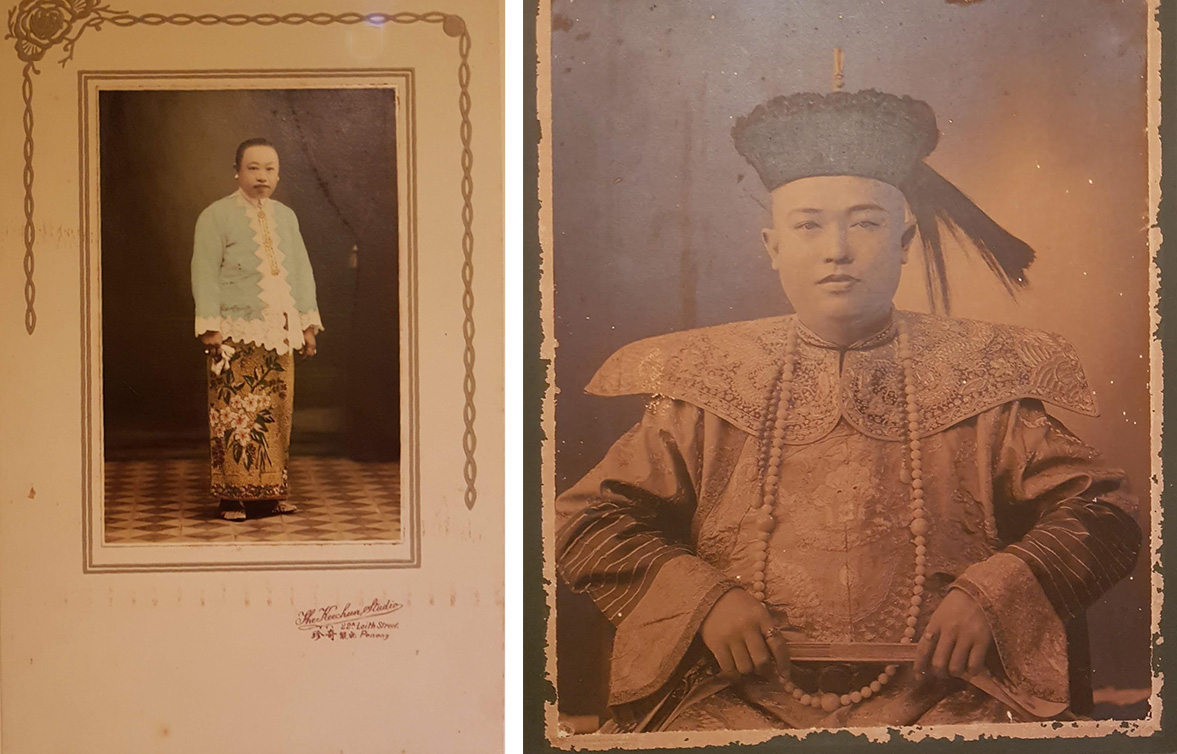
Walking through the exhibition, you can also see the evolution from sepia to black and white; from colour prints to colour painted photographs. The change in photography techniques is paralleled by the variety of ways the Peranakans were captured by Western and Asian photographers as well as how they chose to depict/capture themselves.
With the portraits, you get to see the poses evolve from the formal pose to the more casual; locations shift from the studio to a formal setting in the subject’s home and later to a more casual outdoor setting. In some of the early photos, the costumes range from formal Peranakan wear to western costume to fashion of the day.
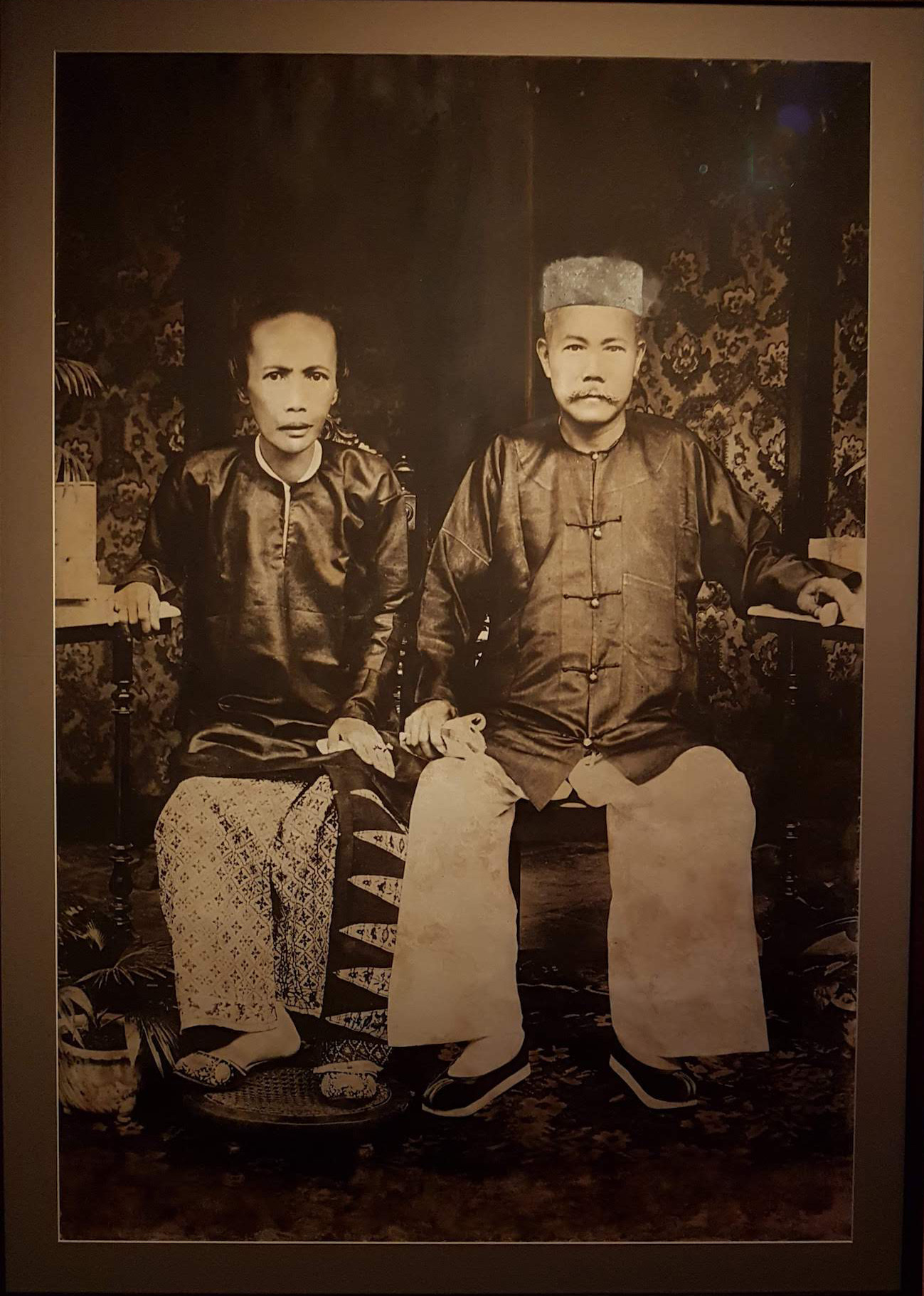
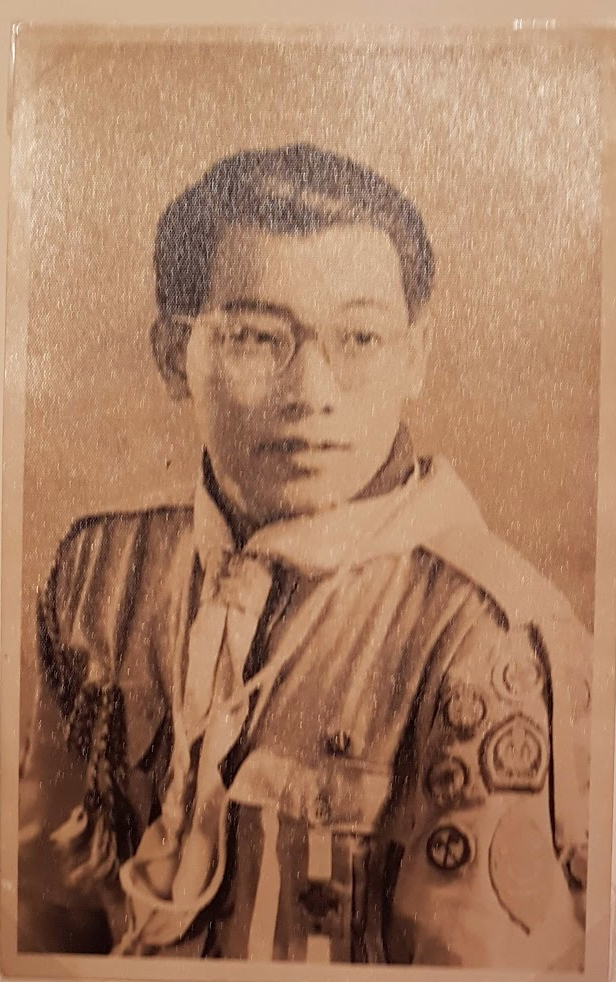
Oei Tiong Nam
Herbert Lim
The use of camera “tricks” or creative development of the print from more than one negative appeared to be popular innovations. I rather enjoyed these photos that were in the exhibition. The gentleman in the photograph below, taken in Java in the 1930s, decided to portray himself in 3 poses.
A baba in three poses
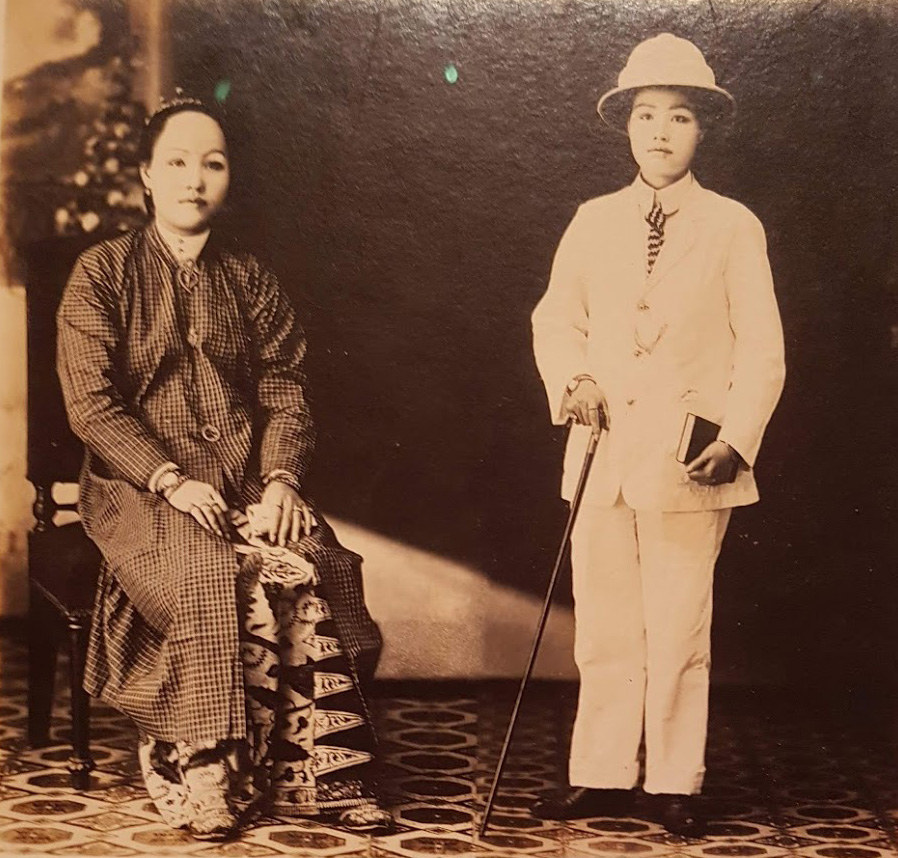
The following photo that was taken in Ipoh in the 1920s features a woman in both traditional women’s wear as well as in the male colonial costume complete with cane and pith helmet! What were they trying to portray of themselves?
Same woman, in two different poses
It appears cross dressing does not seem to be an issue with the Peranakans. The guide mentioned that these pictures were mainly for the promotion of a theatre show but who knows if they also are a manifestion of the baba’s interest in cross dressing! The photo of the baba in a kebaya shows him in impeccable form – reminding me of my grandmother who always said that it is important to ensure that one must always be properly turned out and present one’s best angle in pictures.
Baba in heels
Baba in a sarong kebaya
Given a chance, I would revisit Amek Gambar and spend more time going through the photos. They presented a people and culture that were familiar to me yet offered a refreshing at look the Peranakans.
Amek Gambar – Taking Pictures: Peranakans and Photography runs until 3 February 2019.
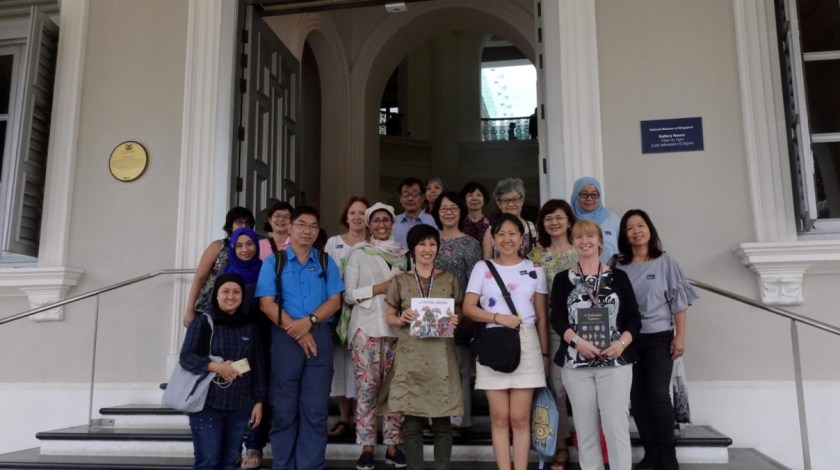
After a chatty and delicious lunch at Equilibrium Restaurant Capitol Plaza, a group of us museum volunteers made our way in the rain to the National Museum of Singapore. The gloomy weather could not dampen our excitement of the special tour organized for us, courtesy of the Friends of Museums. After being warmly greeted by two volunteer guides we were split into two groups; group was led by Sally McHale and she proceeded to guide us to the Singapore History Gallery at Level 1. This gallery narrated the development of our neighbouring country through 4 distinct eras: Singapura, Crown Colony, Shonan-to, and Post-War Singapore including the struggles in the road to self-government and independence, challenges of the future and the successful development of the country.
The Building
Before we entered the gallery, Sally, our guide, gave us a brief account of the building. Opened in 1887, the National Museum of Singapore, originally known as the Raffle’s Library and Museum, is the nation’s oldest museum and it celebrated its 130th anniversary in 2017.
Singapura (1299-1818)
First, we stood in front of a huge digital map the original of which was compiled by a Flemish cartographer, Abraham Ortelius, in 1570. Singapore was already on this map and known as “the land below the winds”. It was strategically located on the trade routes and was part of the Maritime Silk Road from before the British colonisers. Ships from China sailed here, traded and returned home blown by the monsoon winds. Right on cue, the image and sound effect of the seasonal monsoons came on to highlight the significance of the trade winds that were so vital for bringing the merchants to trade in the region.
It is believed the island was already a substantially inhabited trading post even earlier than the 16th century as evidenced by the 3 metres wide and 3 metres high Singapore Stone. This is part of a sandstone boulder, dated between the 10th and 14th centuries, which once stood at the mouth of the Singapore River, near where the present day Fullerton and Merlion are located. Inscription on the boulder is written in Kawi script with some Sanskrit words but it has never been fully deciphered. Even Sir Stamford Raffles made rubbings of the inscription to decode its meaning but to no avail!
The earliest written record said Singapore was called Tamasik or Temasek in the late 14th century before it was called Singapura (City of the Lion in Sanskrit). Tales from Sejarah Melayu told of the first ruler Sang Nila Utama who landed on shores white as a sheet of cloth, spotted a strange lion-like animal, took it as an auspicious sign and named the island Singapura. Exhibits of Chinese coins and fishing hooks placed on the white sands of the 14th century (dug out from the Padang in front of the National Gallery where the first settlement was believed to be) brought to life the legend of Sang Nila Utama stepping on the fine white sand.
Five kings ruled here for 100 years and the last king, Iskandar Shah, fled from Singapura to Melaka and founded the Kingdom of Melaka. Exhibits uncovered on the forbidden hills where royalties resided included gold armlet and earrings, uncovered during the building of a reservoir in the 1920s. On the clasp of the amulet is the head of Kala, a protective deity. Alas, it did not offer much protection to the last king of Singapura as Iskandar Shah had to flee the island. Other trading exhibits displayed show that even after the disappearance of the royal families, trades still flourished along the Singapore River with the existence of Temenggong of Johor Sultanate.
Crown Colony (1819-1941)
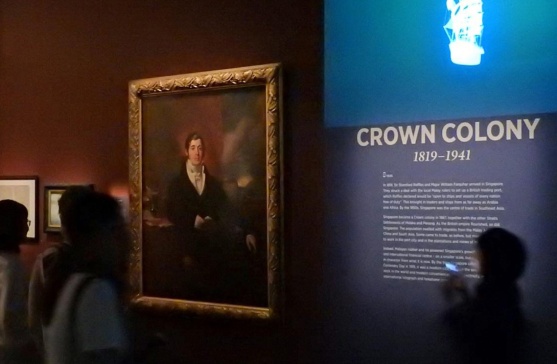
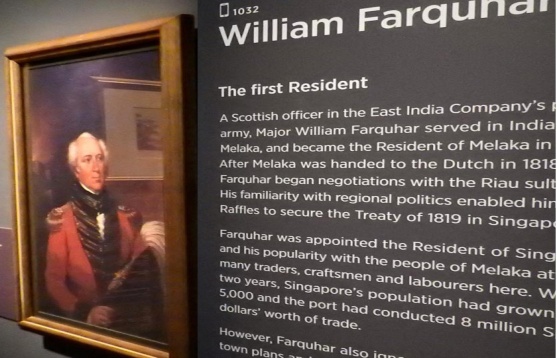
Sir Stamford Raffles, the founder of modern Singapore, was already familiar with this region before he arrived in Singapore in 1819 through his previous postings to Penang and Java. He signed a treaty with his handpicked Sultan of Johor to allow the British East India Company to establish a trade base here and, subsequently, Major William Farquhar opened the port to all nations free of duty thus making the island a springboard to be developed by 1850 into the centre of trade in South East Asia. We were also briefed on how Raffles managed to eliminate the Dutch influence from Singapore and helped to form the new Johor Sultanate in 1819. The first immigrants arrived in Singapore in 1850’s landing near today’s Lau Pa Sat Food Court (we dined there!), where many temples and mosques were built next to each other, giving diversity to the country’s culture. Many immigrants of various ethnicities (the Chinese, Indians and Malays) arrived here particularly after Singapore became a Crown Colony in 1867. Schools, churches and residential areas were built and segregated in accordance with the Jackson Plan promulgated by Raffles to bring order to the city of Singapore. Much of the Jackson Plan still exists today.
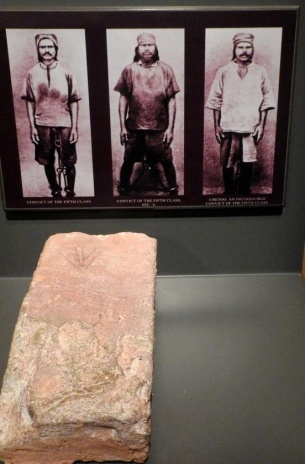
The population grew from 1,000 in the 1820’s to 60,000 in the 1850’s. The ratio of men to women was 14 to 1. Most men came alone, resulting in marriage with local women. One community arising from the interracial marriage was the Peranakan. From India, many Sepoy soldiers came in as the workforce of the British government and from 1826 onwards when it became the Straits Settlement, even convicts from the jails of Calcutta were brought in. Today Singapore’s population is composed of 70% Chinese, 15% Indians, and 15% Malays.
Stopping in front of a painting of Abu Bakar, the descendent of Temenggong–derived Sultan of Johor who made his fortune from rubber products, we were told of his interesting life. In England he was known as Albert Baker and was even a good friend of Queen Victoria!
During the 1860’s, huge changes took place with the opening of the Suez Canal and the appearance of steam ships which docked in Singapore. Changes included the increase in the number of Chinese opium addicts who sought temporary comfort to escape from daily hardships and backbreaking jobs. Even newspapers warned and illustrated how even industrious men fell victims to opium addiction. The British government was appealed to make the opium trade illegal, but to no avail, as it was the major source of income for them. It was not until the Japanese occupation that opium was outlawed completely.
Education also became a forefront of the country’s development. Locals began to influence the social and economic development of the country. A major benefactor of education was Tan Kah Kee, a billionaire who made his fortunes from rubber and pineapple trading. Eunos Abdullah, one of the few Malays educated at the Raffles Institution and the only Malay representative on the Straits Settlements Legislative Council, was an editor of Utusan Melayu, an influential Malay Paper.
A sense of nationalism was beginning to rise in the 1920s/30’s.The Malays started to question the right of the British rule as did the Chinese. The “Singapore Mutiny” led by Bengali-Muslim regiments showed that cracks were beginning to appear in the British Administration. The all-Muslim unit feared being sent to fight against their fellow Muslim Turks during World War I. 39 mutineers were executed in public, watched by 15,000 residents. However no one knew that an even worse “winter was coming”.
Shonan-to (“Island of the Light of the South” 1942-945)
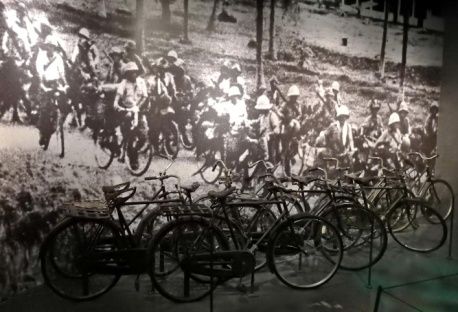
In December 1941, Singapore was bombed by the Japanese and that was the start of World War II in Asia Pacific. After landing on the Peninsular of Malaya on 8th December 1941, they came down to Singapore by bicycles and defeated the British capturing Singapore and the Peninsular within 70 days. The British Prime Minister, Sir Winston Churchill called the stunning defeat “the biggest calamity the British Empire has ever seen”. Japan is a country with scarce important resources such as oil, gold and coal, all of which however were abundant in Malaysia and Indonesia. The main purpose of their invasion was to take over the huge British naval base in Singapore and get access to these natural resources.
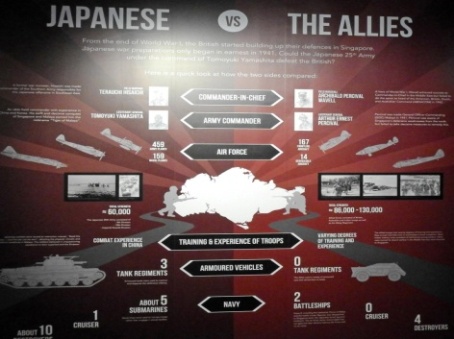
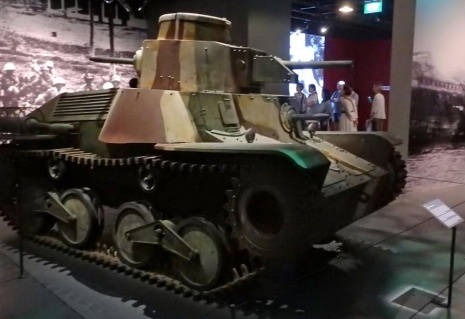
The chart comparing the might of the Japanese armed forces and artillery and that of the British brought home how well prepared and equipped the Japanese were. In terms of army planes, tank regiments and soldiers, the British were outnumbered completely. The pride of the British navy battle ships, the Prince of Wales and the Repulse, were sunk at early stage of the war. The British resources were stretched due to the war in Europe. Airplanes were obsolete and not suitable to tropical conditions. Lieutenant-General Arthur Percival was forced to surrender in February 1942 faced with the fact that 1 million people, soldiers and civilians were crammed in the heart of the island with the Japanese having taken control of the water and food supply.
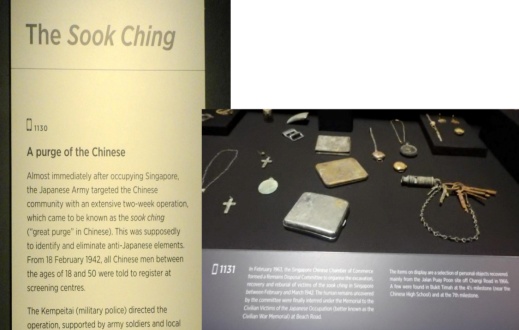
After capturing the island, the Japanese immediately started the Sook Ching (Cleansing) Massacre. Chinese aged between 18-50 suspected of being involved in anti-Japanese activities, boycotting Japanese goods, sabotaging Japanese companies and sending money to the Chinese in China to support their fight against the Japanese were all screened. Once they were identified to be involved, confirmed or otherwise, they were sent to remote areas such as Changi Beach where they were never seen again. It was poignant seeing one of the blue doors of Changi prison behind where soldiers were held, rail man’s whistle, watches, doctor’s stethoscope, eye glasses, pens of the victims of Sook Ching which were uncovered during the 1960s when there were lots of building works in the city outskirts. The belongings suggested women were victims as well as men. The Japanese admitted to 5,000 deaths but excavations suggest 25,000 victims.
Post-war Singapore (1946-Present)
The British returned in 1945 after the war. The 1940’s and the early 1950’s were tough days because of shortage of food, necessities, jobs, schools, etc. There were also natural disasters such as floods. Many were left homeless. Trade unions were formed and riots occurred all of which were threats to the British government. To deal with these problems, David Marshall, the first Chief Minister and a lawyer, sought for more freedom and subsequently self-government for the people of Singapore. Although his goal was not successful in early stages, Singapore gradually attained full self-government, which was finally granted in 1958. In the 1959 election, the Peoples’ Action Party led by Lee Kuan Yew won the polls in a landslide victory and he became the first prime minister. In 1963, Singapore joined Malaysia to form the Federation of Malaysia. However, the merger was an uneasy one. We watched a video of an emotional Lee in tears when Singapore was kicked out of Malaysia in 1965 due to the conflict of policies adopted by two countries. Singapore became independent on 9 August of the same year, now celebrated as National Day.
Many things such as new bank notes, national anthem and national service had to be created for the new nation to establish the identity of the Singaporeans. Economic and educational plans were also implemented, from establishing the Jurong Industrial Estate where multinational companies could invest in, to sending Singaporeans abroad for higher education. Our attention was drawn to an old Setron television set which stood as a symbol of success in transforming old industries to modern ones. The factory manufacturing the TV set was originally processing coffee beans from Indonesia. Supply was cut short due to Indonesia’s “unhappiness” with Singapore joining the Federation, thus forcing the factory to take a gamble to switch to manufacturing of electrical goods. An impressive feat was the social welfare systems such as house ownership scheme by the Housing Development Board, which built 10,000 units for the population within 5 years and improvement of infrastructures. Today Singapore is known as the City in a Garden with strong green policies of planting trees within specified distances contributing to the creation of images of a green city. Assisted by many capable men, Lee brought great success to the Singapore we see today.
We expressed our sincere gratitude to the two guides after the one and a half hour tour, which ended all too soon. The visit to the museum indeed gave us an insight to our neighbour country, Singapore.
References:
National Museum of
Singapore Guide
The Encyclopedia of
Malaysia, Vol 16, The Rulers of Malaysia
もっと知りたいシンガポールー弘文社
History of Singapore https://en.wikipedia.org/wiki/History_of_Singapore
Level 2 has five galleries: Ancient Religion housed in two separate areas, Christian Art Gallery, Scholar Gallery, Islamic Art Gallery and Ancestors & Rituals Gallery. Both the Islamic Art and Ancestors & Rituals Galleries are under renovation, opening in December and early 2019 respectively. In addition, there are two galleries on Level 2 for event space and as a special exhibition gallery.
The Ancient Religion Galleries hold a large collection of Hindu and Buddhist sculptures from Asia. The displays found are from the second century up until the early twentieth century. It also features art objects from Jainism, the third great religion of India.
ACM caption : Head of bodhisattva (Gandhara, around 4th century , Terracotta) The face and curly hair show the powerful influence of the West on the development of Buddhist art. Ancient Greece and Rome played a significant role in the development of Gandhara (in present-day Pakistan and Afghanistan). Bodhisattvas wear jewellery, and have beards and moustaches, which distinguishes them from figures of the Buddha. The jewellery seen here is typical of the Gandhara period. A circular indent on his forehead, called an urna, is a mark of nobility and illumination: it would originally have been inlaid with a precious stone. The sculpture was modelled with wet clay that was then fired. This technique allowed deep indentations and free forms, as evident in the beard and hair. Terracotta (literally, baked clay) allowed large statues to be assembled from several pieces.
Hinduism and Buddhism from India spread widely outside India including to Southeast Asia. The development of Hinduism and Buddhism then evolved combining localized features and animistic beliefs. The concepts of the original religions took many forms. – some human, some divine with supernatural powers and some abstract. By the 7th century, the form of the images moved away from those found in India as sculptors started reflecting local characteristics. Hinduism and Buddhism were widely practiced at the royal courts. Kingships even took the form of Vishnu, adding merits to their power. The Srivijayan era in the 7th century saw beautiful objects created depicting kings and their gods. At the height of the Majapahit Empire, Java (13-15th century) developed its own traditions in art, merging two religions into one.
ACM caption: Buddha teaching (Gandhara, 3rd or 4th century, Schist) The hand gesture signifies the turning of the wheel of Buddhist law, and therefore indicates the Buddha teaching.The halo behind his head denotes his spirituality. Two small donor figures below stand in an attitude of adoration. Remnants of pigment indicate that the stone was originally painted. The drapery, strong muscular form, and facial features show influence from Western classical styles. But his yogic pose and eyes downcast in contemplation show the deep spirituality of the Buddhist religion.
Buddhism became popular between the 8th to 15th century in Thailand, Myanmar, Vietnam, Laos and Cambodia. This influence lasts until today.
ACM caption : Walking Buddha ( Thailand Sukhothai, 15th or 16th century, Bronze) This image, full of fluidity and movement, was an innovation of the Sukhothai period. The dynamic posture, curvaceous arms with tapering fingers, and flowing hemline of the robe accentuate the sense of movement. He has a flamed top-knot (cintamani) and raises one hand in abhaya mudra (gestures of fearlessness). The sculpture embodies ideal features attributed to the Buddha – lotus petal-shaped eyelids, parrot beak nose, chin in the shape of the mango seed, and so on. This image probably refers to Buddha ‘s return from Tavatimsa Heaven, when he preached to his mother. It could represent the Buddha’s walking meditation in the garden after his enlightenment.
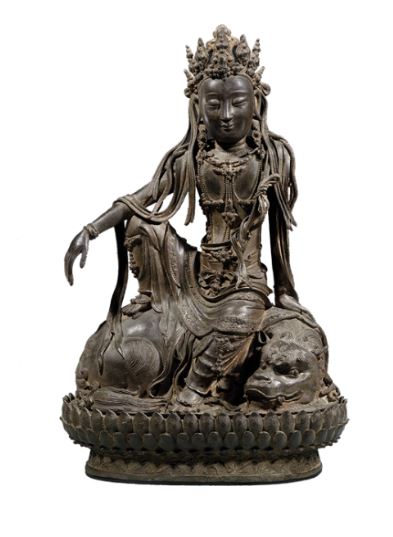
In China, Buddhism grew out of Indian beliefs and was practised alongside Confucius and Taoism. Here, the famous male Avalokitesvara was personified in the form of Goddess of Mercy or Guan Yin, and became a female. The virtue of a compassionate Guan Yin was more suited to a female than a male.
ACM caption: Shi Hou Guanyin China , 14th or 15th century Bronze. Acquired with funds from the Kwan Im Thong Hood Cho Temple.
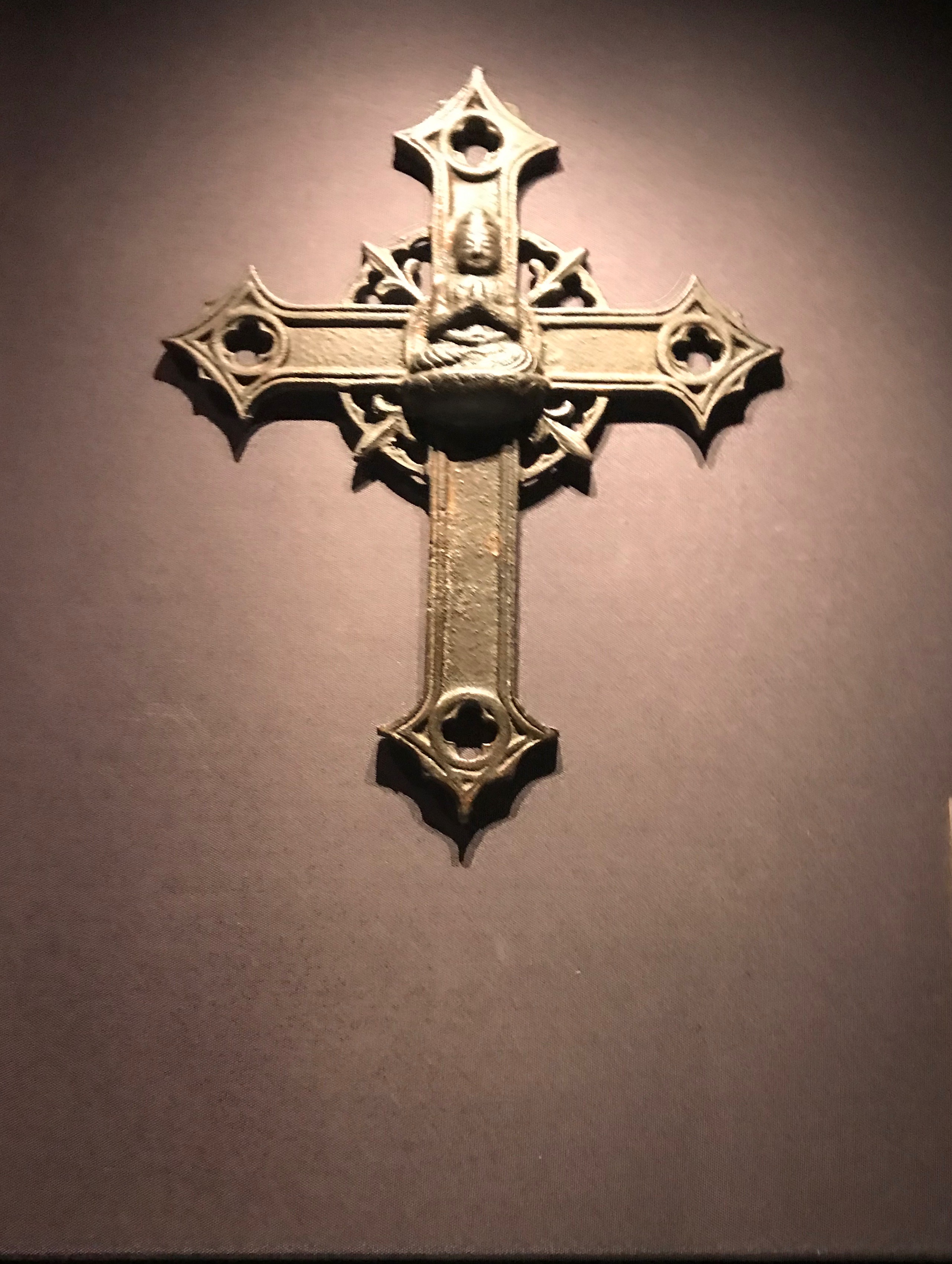
The Christian Art Gallery features collections of art from China, Japan, Middle East, Southeast Asia and other countries. Christianity was introduced by Catholic missionaries from Portugal and Spain, and later Dutch Protestants. The art objects took a different form merging western ideologies with Asian techniques and materials.
ACM caption: Cross with the figure of Amitabha Nagoya, Japan, 1945-50 Iron –copper alloy
ACM caption: Virgin and Child Timor-Leste, 19th century Wood
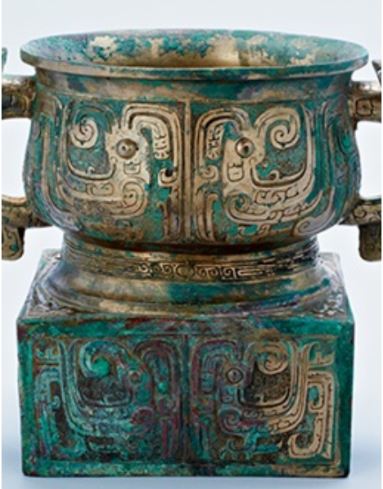
The Scholars Gallery showcases Chinese beliefs and philosophy, strongly depicting Confucius teachings and Taoism practiced by scholastic officials. Here are collections of paintings, furniture and objects used by Chinese scholars depicting their lifestyles and their education.
ACM Caption: Ritual Food Vessel. This vessel was used to hold food offerings in ceremonies to honour ancestors and gods. An inscription identifies it as property of the duke of Rui, a region in present-day Shaanxi province. The circular bowl rising above a square platform recalls the symbols of heaven and earth in Chinese cosmology





























 Museum Volunteers, JMM