Qualla Lampart, a village between two rivers

Danie Picot

When navigating up the Klang river to try and go as far upstream as possible, you have to stop at this confluence between two rivers. The current becomes more tumultuous as you approach the mountains. The passengers of the boats have already suffered three long days to go upstream, they have to move forward with a long stick planted in the river bed, they take the pole in turn. During this river trip, they stop at the Damansara river, there is a “pengkalan”, a wharf where one can moor the long boats loaded with food and equipment. There, travelers can find enough food to refresh, a lot of fruits, spring water, raised platforms to rest and prepare for the long ascent.

When they see the foothills looming, when the pole can no longer fight against the flow, they stop at this second “Pengkalan” in the heart of the jungle.

There are a few houses on stilts, they belong to the Temuan who are settled Orang Asli. 

On a hill a little further live the Mandaling people who came from Sumatra in the middle of the 19th century.

Klang River, circa 1880. (Source: KITLV Universiteit Leiden)

It is a confluence and a landing place that is called Pengkalan in Malay and Temuan. Over time, towards the end of the 19th century, more and more people arrived and settled, they spoke different languages, the word “pengkalan” changed, got misspelled, became “kalan” and then “kuala”.

Yet a “kuala” is an estuary, not a confluence, but it is kuala that remains.

There are other Kuala that are not estuaries, Kuala Kangsar, royal city on the Perak river,

From Pengkalan Lumpor, this village between two rivers was now called Kuala Lumpur. The boats arrived, docked, and left. Coolies, men, women and children trampled on the water edge, they lived there, it became muddy, the water rose quickly during the rains, the place was certainly muddy.

The river was brown, silty. For a long time, the veins of tin ore upstream had been worked, the mines size increased and more alluviums went down the current, muddying further the water.

In bahasa Melayu, mud is Lumpor, which became Lumpur.From Pengkalan Lumpor, the muddy wharf, this village between the two rivers was now called Kuala Lumpur.

Lumpur is sometimes explained differently. Several maps and testimonies speak of the Lumpoor River. Anderson was a translator and writer of the English East India Company, he crossed the Klang river in 1818. He wrote ”the river is easily navigable up to the confluence with the Damansara river. Then it goes further up to the tributary Sungei Lumpoor, where we can mine the tin deposits.”

A Chief Mines Inspector, Gripper, wrote that the Sungai Lumpur merges with the Klang River. To Gripper, the Gombak river was the Lumpur river; it changed its name after the Selangor Wars 1873. According to Malaysian custom, the confluence takes the name of the smaller of the two rivers, Kuala, the wharf, took the name of Lumpur.

Today in Kuala Lumpur the muddy estuary is a confluence where 2 rivers meet, the Gombak and the Klang, the water is rather green-brown but not really muddy, the fish jump there lightly, sometimes between plastic bottles going down the stream. Thanks to the government rehabilitation program called River of Life, the Klang and the Gombak are getting a makeover, to the delight of walkers and visitors.

source : https://www.malaysia-traveller.com/old-malaya-photos.html

The banks had been inhabited for a long time. The Temuans, natives of the region settled there. They live in houses on stilts. The river was meant for fishing, ablutions, wandering buffaloes, as a playground for children, and a thousand daily chores.

Thanks to the numerous streams which cross the jungle, people cleared and planted rice fields, enough for the community and a little more for trade. They used to cruise down with their canoes to the mouth at Pengkalan Kallang (Klang). They needed salt, cotton, knives, metal hooks and baked clay ovens. They enjoyed ikan bilis, sun-dried fry that improved their staple food. They brought rice, durians and wild rambutans. Medicinal herbs were much sought after because the Temuan Shamans knew how to cure fevers, blood clots, kidney disease, and much more thanks to herbs and animals. Also, in baskets braided with pandan leaves, they brought tin ore. 

The Temuans exploited  the rich deposits of the Klang and Gombak rivers and their smaller tributaries: Sungai Ampang, Sungai Sering, Sungai Bunus, Busuk, Kerok, Jinjang, Kemunsing, Belongkong, Puteh. They worked like gold panners do: using large wooden trays they rotated, the water discharged and the ore remained at the bottom of the tray. Villages of few houses were scattered along rivers and in the jungle. There was a network of trails through the forest. When they went up with their goods against the current, they stopped at a larger confluence where the Damansara river joined the Klang. Then they went further upstream. It is quite possible that they had already opened a path through the jungle between the confluence of the Damansara and the next confluence between the Klang and the Lumpoor. Attack by a tiger on this road was not uncommon. Today the tigers are driving their car along that same  jalan Damansara.

This is how Kuala Lumpur became a gateway to an interior rich in tin and forest products. Thanks to the pathways along the rivers and streams, one can cross the cordillera and reach Pahang and  its rich gold mines.

Other people went up the river: men, women, families in small groups, settled at the confluence. The Sumatran Mandallings cleared a hill on the left bank of the Klang, out of reach of flooding and planted pineapples. It’s Bukit Nanas.

The Mandallings were refugees fleeing from wars called the Padri War and Dutch colonization.

[The Padri were a group of Muslims influenced by the Wahhabis during a trip to Mecca. At the beginning of the 19th century the Padri sought to purge the culture, traditions and beliefs of the people of Sumatra such as the Minangkabau, the Mandallings, the Rawas, the Raos because they believed that their customs were not in accordance with Islam. Smoking opium, cock fighting, chewing betel nut were considered pagan, even practiced by Muslims. Whole villages were burned, the inhabitants were massacred, except the men and the young healthy girls who were sold as slaves. A virgin girl is worth a barrel of powder. (Lubis p.99)

The Dutch were called for help. Colonization did not help the population. Forced farming on poor, mountainous land was extremely difficult. All of this led to a mass exodus.]

These inhabitants of Sumatra worked the gold mines. They were miners and they naturally went where one could find gold, and later, tin. The Minangkabau settled in Melaka, gateway to immigrants, then in the Negeri Sembilan. The Mandailings mostly settled in Pahang for its gold mines or inland upstream the Sungai Klang.

Later, when the British chose Kuala Lumpur as headquarters of the colonial administration, the Minangkabau and the Mandailings were considered as “Malays”. 

Between the two rivers, and in several small villages scattered in the forest, from 1830, they cleared and planted more rice fields and tapioca, built houses, fortified Bukit Nanas, opened mines, widened the paths. Because all the communications with the littoral passed by the river, there was no road. The locals, by tradition, lived on the left bank of the Klang, so the two communities shared the territory.

The men’s job was to take care of the rice fields and to clear and find tin deposits. The women were busy with their large wooden trays to extract the ore. In exchange for their sales, they bought needed tools, salt, dried fish, clothes and a little opium.

Sutan Puasa left Mandailing territory badly damaged by the Padri wars and impoverished by the Dutch occupation. He joined his community in Kuala Lumpur and made his wealth  in  tin mining. He went along the ore road to Melaka. In 1859, on his way back, he stopped at Lukut, which was already a flourishing mining town. There, he persuaded two Chinese merchants from whom he bought supplies, to return with him and the goods to settle in “the village between the two rivers” where he resided.

Hiu Siew and Ah Sze Keledek were looking for a location not far from the river and on the path used by the coolies on their way from the mines. Ore tin was carried  back in baskets balanced on their shoulders. They cleared an area which will later be the main market square, Pasar Besar. They built their houses side by side and started their business there in 1859. Ah Sze Keledek was a sweet and easygoing man thus his nickname of Ah Sze sweet potato. Both were partners in starting and operating the tin mines. They carried on their trade in food and various goods to equip the mines. Ah Sze Keledek would become one of the wealthiest mine owners in the region.

Hiu Siew, of Hakka origin, took care of the workers from his clan who arrived in large numbers to work in the mines. He built longhouses to house them, set up a small opium den, brought in singsong girls from China, and foremost, promised to take care of the funeral rites should they die. He became the first Captain China of this mining village which was now called Kuala Lumpur.

(source: Wikipedia)

Other merchants arrived later on and opened businesses to supply the industry.

For centuries, tin had been mined in the rich deposits that followed a seam along the North-South Cordillera from Thailand to Malaysia. Dongson drums from the 6th century BCE, are made of an alloy of tin, copper and lead. They were found near Klang and along the Sungai Klang in Selangor, next to  the places that landed the productions from the interior deposits.

These drums, which are found in several places in Asia, show the existence of a maritime trade in the export of tin. The port of Klang received the ore collected by the local tribes and all the profits went to the chiefs who had control of the ports and the rivers. From the 10th century, the Peninsula supplied the tin needs of SouthEast Asia.

The tin mines of Lukut in the Negeri Sembilan were in full production from the beginning of the 19th century. Sultan Muhammad, a Bugis warrior who inherited the Sultanate from the Malaysian kingdoms, reigned over the territory of Selangor and granted two members of his family, Raja Jumaat and Raja Abdullah, the authorization to search for tin seams upstream of the territory’s rivers.

Raja Jumaat operated the Lukut mines and Raja Abdullah obtained the rights to the tin reserves upstream the Klang River. In 1857, he set up an expedition, mainly financed by Baba Chee Yam Chuan, a wealthy Hokkien merchant from Melaka. Bolstered by his brother Raja Jumaat, who provided him with the workforce, he went with eighty seven miners up the Klang river and landed at the confluence between the Klang and the Lumpoor (or Gombak).

In each boat, there were ten men and a large amount of food and equipment. For this trip, the boats were loaded with rice, jars of coconut oil, tobacco, gambier, spirits and opium chest. There were also hoes with axes and other tools, baskets to transport the earth. They took weapons for their protection, muskets, gunpowder, knives and spears. Each man also had his personal package or box containing his spare clothes and a few other possessions. The river was a highway through the jungle, the main road leading to the heart of Selangor.

The boats glide in between two walls of dense vegetation. Near the estuary are the mangroves, trees with aerial roots where a crocodile can sometimes be seen with its mouth open, nipah palms that look like a palm leaf planted straight in the water. In the sweltering, warm air, the trees on the shore sometimes provided some shade. Large bamboo shoots gave a lighter green tone in this endless vegetation that the miners crossed for three long hot days, distracted only by the howling of monkeys.

Most of these young men did not survive the difficult conditions, they had to clear the jungle, to dig within the current and basically to live in the water. Most of them perished from malaria, cholera or dysentery. Other miners arrived from Lukut in boats loaded with provisions. They worked the mines of Ampang and Petaling which started to export their first ingots in 1859. The mines required significant manpower and Raja Abdullah was granted the “Kuasa Cina”. That was the right to import Chinese coolies to work in the Upper Klang mines. These arriving Chinese people were trying to escape the misery of their country. Poverty and famine caused by the defeat of China against the European powers during the opium wars. A man, the Dato Bandar, placed by Raja Abdullah, collected taxes from the crossing of rivers, a dollar for a kati or 600 grams of tin.

Other merchants arrived, and people settled along the roads in slightly raised houses:a plank platform, walls of dried mud or of woven bamboo panels and the roofs made of superimposed  long leaves of attap palm or Nipah palm. These houses sheltered the family from the sun, the rain, wild and domestic animals. Unfortunately they were prone to fire and flooding when the river overflowed.

The jungle remained omnipresent. Inhabitants were allowed to grow vegetables at the back of their house, put a few pigs in a den, hens were running free.

The land belonged to the Sultan or Raja, the population was small and of different origins, from the Mandailings of the Kerincis and the Rawas of Sumatra to the Chinese. With the consent of the Raja,the property belongs to the one who clears and occupies the land permanently. If they cleared more than necessary, they could rent their land to newcomers who would farmed it.

An open cast mine in Perak during the early 20th century. 

(source: https://www.nst.com.my/lifestyle/sunday-vibes/2019/05/489672/magic-and-opium-hardship-faced-early-tin-prospectors)

The village of Kuala Lumpur was developing into an important mining center.

It was a logistic platform, thanks to the numerous surrounding mines and a rich hinterland. The collected and melted tin, the various products of the jungle and the vegetables from the farms on the slopes of the Titiwangsa reef were collected to the benefit of the rest of the country. Goods, equipment, food and more men arrived.

After the death of Hiu Siew , Liu Ngim Kong, his assistant, became Captain China. The title of Captain dates back to Malacca at the time of the Portuguese occupation. It was the usual title of the chief of fairly important Chinese villages in the Malay Peninsula. In 1862 Liu Ngim Kong came to Kuala Lumpur with a young Chinese Hakka, Yap Ah Loi, whom he met in the mines of Lukut and Sungei Ujong (Seremban). Yap Ah Loi was Liu’s right hand and looked after his mines. In 1868, Liu died and Yap Ah Loi succeeded him. He was Captain China until his death in September 1885.

Image Yap Ah Loi & Sutan Puasa (https://cilisos.my/sutan-puasa-vs-yap-ah-loy-who-actually-founded-kuala-lumpur/)

The Sultan, the heads of the Royal House and the great commoners, all live along the river, drawing their income from tolls on the traffic of the river and its tributaries.

In 1867, the royal families of the Selangor tore themselves apart for the rights to export the tin of Klang and Kuala Selangor. The Selangor tin mines provided significant revenue. Six years of fighting ensued for the control of the forts on the river estuaries.

During this period of war, the miners of Kuala Lumpur seek other means and routes to convey the tin towards the ports for international trade. By thus, the tin escaped river taxmen and the Malays fighters  moved towards  inner Selangor to take direct control of the tin mines.

In August 1872, Kuala Lumpur fell, Its fragile wooden and palm houses were completely burned. The mines were abandoned and flooded. Yap ah Loi escaped to Klang.

There was another final battle in March 1873, following which, Yap Ah Loi repossessed what was left of the city and the adjacent mines.

The civil war could have lasted a long time without any results being seen. But it so happens that the Selangor went under British protection in February 1874 and the fighting stopped.

Yap Ah Loi’s first post-war problem was the economic reconstruction of Kuala Lumpur. The mines have turned into muddy ponds. Water wells, chain pumps, smelters and all mine equipment were destroyed. The large Kongsi houses in which the miners lived had been used as military centers and burned down during fights.

The mining workforce has been killed in combat or dispersed to other mines.

Buying equipment, pumping water from the mines, bringing back men, housing them, feeding them, all this had a significant cost. The fortune that Yap Ah Loi had won during his harbor master’s office was swallowed up in the reconstruction of ‘his’ city. Thanks to this indomitable energy, at the end of 1875, he had restored his work force to 6000 miners, compared to 10 000 in 1870.

source: G.R. Lambert & Co – Vision of the Past – A history of early photography in Singapore and Malaya, The photographs of G.R.Lambert & Co., 1880-1910

It is a filthy town, the streets are crowded and dirty, the garbage is piled up on the roadsides. Dysentery, smallpox, cholera and other epidemics run in the population. There is no fire prevention, only a rule requiring all households to keep a barrel full of water always on the ready.

A huge hut of disjointed planks, with the roof badly thatched with palm leaves serves as a game room where a constant horde of loud Chinese and Malaysians bet and play.

In the opium barracks, which are just as badly tied up, planks used as beddings are stacked along the walls, one climbs to those at the top by use of a ladder. A lively servant burns a nugget which he places quickly on the furnace of a long pipe. The reclining man inhales in small puffs the opiate smoke which will help him to continue with his life, to endure the physical pains and the hardships of being far from his country in such difficult conditions.

In a mining town where men outnumber women, there were inevitably innumerable brothels. Most of the very young girls, bought for little from their parents, lived and plied their “trade” in squalid conditions. The houses were filthy, tiny rooms with no windows and no ventilation, so dark that a candle was lit all day long. These young girls, almost slaves, prayed to Hua Fen Fu Ren, the goddess of beauty at the little temple next door.

Father Letessier, the French priest of the Société des Missions Etrangères de Paris, who arrived in Penang in 1880 and 1883 in Kuala Lumpur, arranged a larger and healthier house for prostitutes. There were up to 300 women in 1884 and in 1899 Sister Levine of the congregation of the infant Jesus welcomed their orphans.

Captain China Yap Ah Loi is everywhere, takes care of everything, builds gaming houses and brothels, builds houses for rent, provides public services, school, police, prison, hospital, and makes considerable profits everywhere.

To manage this increasingly large administration, he relied on the organization of Chinese secret societies. Order, law, defense, development, the means of supply, the daily life of minors and the rites after death were taken care of and helped by the Kongsis.

Always, Yap Ah Loi was at the center of all aspects of social affairs. In economics, politics, administration, he took all the important decisions.

Swettenham believed that it was Yap Ah Loi’s personal determination that had prevented the Chinese from abandoning the mines around Kuala Lumpur in 1875.

source: https://www.ttgasia.com/2021/02/11/old-kuala-lumpur-east-west-connection-virtual-tour/

During the years 1875 to 1878 the British were into the habit of regularly visiting Kuala Lumpur. They began to settle in late 1879.

In 1874 Davidson was the resident “advisor” to Sultan Abdul Samad of Selangor.

Indeed, following the wars between the Chinese clans enemies in Perak, and the disputes of the sultans for questions of territoriality and successions as in Selangor, the British were brought to intervene. The East India Company first and then the Colonial Ministry offered to help the Sultans by placing a resident by their side to advise them on economic matters. Sultans and Rajas were to keep ancestral customs and religion. In reality it is the Resident who will govern.

In 1874 after the treaty of Pangkor which ratified these agreements, there was a Resident in Perak, in Selangor, in Pahang and in Negeri Sembilan.

In 1895 the British thought that it was more advantageous to bring these sultanates together in a federation. That was the creation of the Federated Malaysian States, the British Malaya.

In 1896,  the city developed very quickly and more and more inhabitants arrived. The place was almost in the center of the federated states and close to the straits of Melaka, thus it was decided to create a capital between the two rivers Klang and Gombak, at the muddy confluence, Kuala Lumpur.

References

Ref les Temuans: wikipedia Temuan People (consulted 6/12/2019)

Ref les Temuans: Early History

Ref Padri war: Wikipedia Padri War (consulted 9/12/2019)

Ref Dongson drums: https://www.nst.com.my/news/nation/2019/04/477866/dong-son-drums-found-msia-could-be-more-2000-years-old (consulté le 15/02/2020)

Ref Lubis 

Sutan Puasa, Abdur-Razzaq Lubis

  • Padri War, Lubis pages 57 à 147
  • Étain, Lubis page 149
  • Sutan Puasa, Lubis page 187 à 189

Ref Gullick

  • Journal article Kuala Lumpur 1880-1895 J.M. Gullick (journal of Malayan of Branch of the Royal Asiatic Society)
  • Old Kuala Lumpur J.M.Gullick

Jacques de Morgan, Exploration dans la presqu’ile malaise 1884

Jeanne Cuisinier, What I saw in Malaya

Ref prostituees: Lucy Chang Hirata JSTOR, Free indentured enslaved: Chinese prostitutes in 19th century America

À mots couverts, sur les traces de George Orwell en Birmanie

Spiritual Treasures of Islamic Art: Magic Bowls

Emna Esseghir 

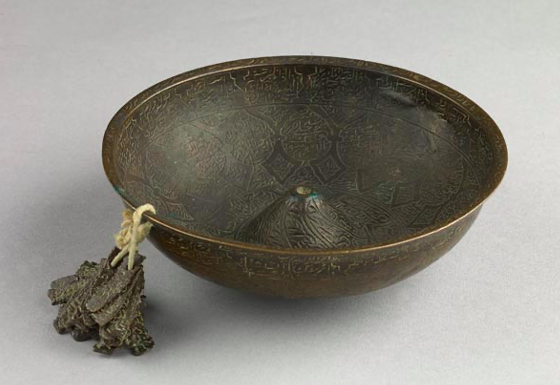
Magic bowl, engraved with Arabic inscriptions (Quranic verses and prayers) and with engraved brass tags (charms or ‘keys’) attached, exhibited at the British Museum.

(source: https://www.britishmuseum.org/collection/object/W_1921-1025-5)

The history of magic is a fascinating tapestry woven through the fabric of human civilization. Its roots extend deeply into ancient cultures worldwide, often entwined with religious practices, folklore, mysticism, and the pursuit of understanding the unknown.

Ancient civilizations across Mesopotamia, Egypt, Greece, and Rome held beliefs in magical practices, rituals, and individuals possessing supernatural abilities. These practices were often intertwined with religious ceremonies, healing rituals, and attempts to control natural forces.

In the Middle Ages, magic became associated with both mystical spirituality and the occult. Alchemists sought to transform base metals into gold and create elixirs of immortality, merging scientific experimentation with mystical beliefs.

During the Renaissance, the line between science, magic, and philosophy blurred further. Thinkers like Paracelsus explored the concept of a universal healing force, while figures like John Dee engaged in mystical practices and attempted to communicate with angels through rituals.

The Age of Enlightenment brought forth a shift toward empirical science, causing a divide between magical thinking and scientific reasoning. This era witnessed a decline in the societal acceptance of magical practices, which were often seen as superstitions or fraudulence.

However, interest in the occult, mysticism, and esoteric practices persisted in secret societies and among individual practitioners. The 19th and 20th centuries saw a revival of magical traditions, with movements like Theosophy, Hermeticism, and the study of ancient mystical texts gaining traction.

Today, magic persists in various forms, from stage illusions and entertainment to spiritual practices like Wicca, paganism, and various occult traditions. Modern practitioners often draw inspiration from ancient texts, folklore, and a diverse array of spiritual beliefs, seeking a deeper understanding of the mystical and the unknown within the framework of contemporary society.

Magic within Islam holds a complex and nuanced position. The Quran acknowledges the existence of magic, referring to it as real but also as a forbidden practice. Islamic teachings distinguish between miracles performed by prophets with God’s permission and acts of magic, which are considered acts of deception and disobedience.

The practice of magic, or “sihr” in Arabic, involves invoking supernatural forces to perform actions that are beyond natural laws. Islam strictly prohibits the use of magic as it involves seeking power from sources other than God, leading to falsehood and harm. Those who practice magic are considered to be engaging in activities that are contrary to the teachings of Islam.

However, Islamic traditions also acknowledge the existence of protective measures against magic, known as “ruqyah.” This practice involves reciting specific verses from the Quran or prayers seeking protection from harm caused by magic or evil spirits. It’s seen as a permissible form of seeking refuge in God’s guidance and protection.

The concept of jinn, spiritual beings made of smokeless fire, is often associated with magic in Islamic belief. Some believe that certain practitioners of magic use jinn to perform their sorcery, although such actions are condemned in Islam.

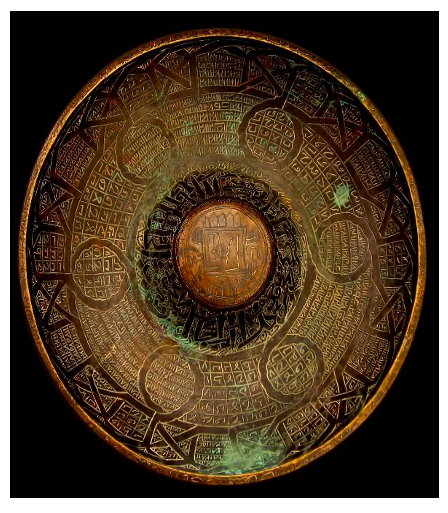
Magic Medicinal Bowl

(Image source: https://www.michaelbackmanltd.com/archived_objects/islamic-magic-bowl/)

In the captivating world of Islamic artistry, an exquisite array of artifacts unravels a narrative beyond mere aesthetics, revealing a profound tapestry interwoven with spiritual beliefs and cultural resonance. 

Nestled among these treasures, the enigmatic allure of magical bowls unveils a saga that intertwines mystical beliefs, masterful craftsmanship, and spiritual rituals, encapsulating the essence of Islamic cultural depth. These enchanting vessels, revered for their mystical properties and spiritual significance, epitomize the intricate layers of understanding inherent in Islamic culture. 

Every meticulously inscribed stroke of calligraphy serves not only as a visual spectacle but as a deliberate conduit, meticulously chosen to harness the divine power believed to reside within these sacred words. 

Beyond their utilitarian function, these bowls held a revered status as conduits of celestial energy and reservoirs of ancient wisdom. The intricate symbols etched onto their surfaces transcend mere adornment, carrying profound layers of spiritual significance and serving as gateways to a realm beyond the physical. In some models, the inclusion of zodiac signs within these bowls further underscores the intimate connection between the celestial and earthly domains, symbolizing the celestial forces’ influence on human destinies and wellbeing. 

This harmonious integration of cosmic elements with healing or divination practices showcases the seamless interplay between the mystical and the tangible, a hallmark of Islamic cultural heritage. 

The act of filling these bowls transcended a mere ritual; it was a profound ceremony that bestowed the vessel with the potent energy encapsulated within the inscriptions. Partaking in the enchanted elixir was an act of unwavering faith, believed to harness the power of healing or unveil glimpses of the mysterious future. Far beyond their function as mere healing tools, these bowls embodied a collective consciousness, encapsulating the spiritual wisdom and intricate belief systems of their time. 

They stand as enduring reminders of the deep reverence accorded to language, writing, and the unseen forces believed to be encapsulated within these meticulously crafted artifacts. The timeless legacy of these magical bowls unveils a mesmerizing fusion of spirituality, symbolism, and material culture within Islamic traditions.

They serve as enduring testaments to the eternal quest for healing, guidance, and spiritual alignment, transcending the limitations of time and continuing to intrigue and inspire across generations.

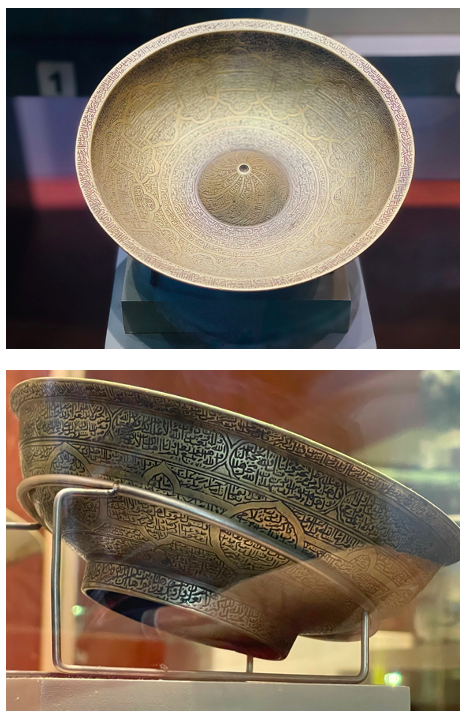
Magic Bowl displayed in Shahaniya, Qatar.

(Image source: https://islamicart.museumwnf.org/database_item.php?id=object;EPM;qt;Mus22;22;en&cp)

Wrapped around this bronze bowl, one finds the protective embrace of Quranic verses, blessings, and mystical symbols—a blend that characterizes the Islamic magic bowls, crafted to shield against fear, ward off evil, and repel malevolent forces like the jinn. These artifacts, originating from Karbala in Iraq, a revered pilgrimage site for Shiite Muslims, have emerged across regions like Syria, India, and Iran since the 12th century. Contrasting with earlier Sasanian bowls adorned with Aramaic inscriptions, these Islamic counterparts, fashioned from metal instead of clay, serve a divergent purpose, seeking protection rather than invoking demonic entities.

Adorning the bowl’s exterior in the graceful thuluth style of Arabic calligraphy is the esteemed Throne Verse (Ayat al Kursi) from the Qur’an, renowned for its talismanic defense. A hexagram, evoking the legacy of prophet Sulayman (Solomon), accompanies this, while nearby inscriptions offer blessings for the body and senses. Symbolically, the vessel’s twelve panels pay homage to the twelve Imams in Shia Islam. Further enriching the significance, the inclusion of science letters (ilm al huruf) attributes mystical properties to the array of letters inscribed on these panels.

Magic bowl with attached prayer tablets. Probably 19th or 20th century, Iran.

(Image source: https://exhibitions.kelsey.lsa.umich.edu/pearls/objects/bowl2.html)

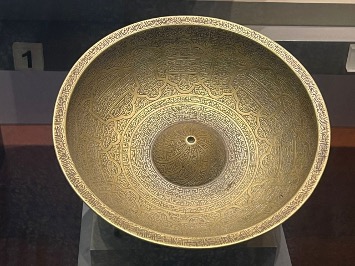
This model is adorned with intricate inscriptions and an array of zodiac signs, every surface of this metal bowl captivates the eye with its artistry. In the Islamic tradition, such magical bowls were revered for their dual purpose—either for healing or divination. Once filled, it was believed that these bowls infused the liquid they contained with the potent energy imbued in the inscriptions. People consumed this elixir in the hopes of finding relief from ailments or gaining glimpses into what the future held.

At the heart of this bowl lies a prominent central protrusion known as an omphalos or göbek in Turkish, meaning “navel.” Along the rim, a cleverly placed hole allowed for the attachment of a string of tablets referred to as kırk anahtar (forty keys) in Turkish. These tablets, adorned with bismillah prayer formulas, served a purpose akin to prayer beads or rosaries. While this specific bowl displays tablets linked by a string, other existing examples showcase tablets either attached to the rim with metal wire or arranged around the central omphalos. Regardless of their placement, these tablets produced a distinct rattling sound as the bowl was utilized, adding an intriguing dimension to its use.

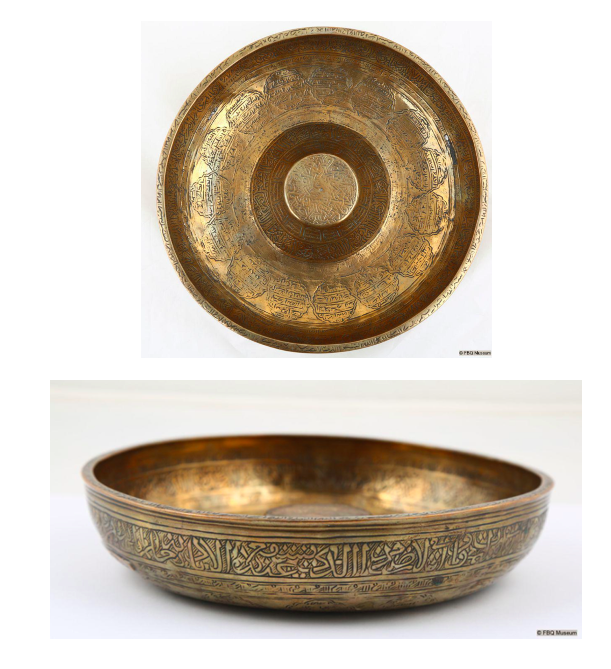
In our museum we have one displayed in Gallery B

Bronze Bowl dated between14th and 15th century displayed in Gallery B, Muzium Negara. (Image source: Emna Esseghir)

As the previous example, this magical medicinal bowl typically incorporates intricate calligraphy, often Quranic verses or prayers for healing, along with elaborate geometric designs. These bowls are crafted with precision and care, sometimes using specific materials or techniques that are believed to imbue them with healing properties or spiritual significance

The combination of calligraphy and geometric design is intended to create a visually and spiritually powerful object believed to aid in healing or offer positive energy.

The Quranic verses can easily be distinguished from the first line on the bowl with recitations of prayers for the healing of the person who will use it, here some exemples of verses:

SURAH ASSAMAD:

( قُلْ هُوَ اللَّهُ أَحَدٌ (1) اللَّهُ الصَّمَدُ (2) لَمْ يَلِدْ وَلَمْ يُولَدْ (3) وَلَمْ يَكُنْ لَهُ كُفُوًا أَحَدٌ (4

Translation (sahih International) :

“He is Allah, One. He is the One, the Singular, Who has no peer, no assistant, no rival, no equal and none comparable to Him.”

The word (Al-Ahad) cannot be used for anyone in affirmation except for Allah within the Islamic Tradition.

SURAH YUNUS AYAT 107 

وَإِن يَمْسَسْكَ اللَّهُ بِضُرٍّ فَلَا كَاشِفَ لَهُ إِلَّا هُوَ ۖ وَإِن يُرِدْكَ بِخَيْرٍ فَلَا رَادَّ لِفَضْلِهِ ۚ يُصِيبُ بِهِ مَن يَشَاءُ مِنْ عِبَادِهِ ۚ وَهُوَ الْغَفُورُ الرَّحِيمُ

Translation (Sahih International)

“And if Allah should touch you with adversity, there is no remover of it except Him; and if He intends for you good, then there is no repeller of His bounty. He causes it to reach whom He wills of His servants. And He is the Forgiving, the Merciful”

References

History of Magic: https://en.wikipedia.org/wiki/History_of_magic

Magic Medicinal Bowl: https://www.michaelbackmanltd.com/archived_objects/islamic-magic-bowl/

Magic, Marvel, and Miracle in Early Islamic Thought:

https://www.cambridge.org/core/books/abs/cambridge-history-of-magic-and-witchcraft-in-the-west/magic-marvel-and-miracle-in-early-islamic-thought/BA6255F5E53C5DC6C3A96F5E69DF6B8D

The magical fringes of the Islamic faith:

https://www.seattletimes.com/entertainment/books/magic-in-islam-the-magical-fringes-of-the-islamic-faith/

Islamic magic-therapeutic bowls:

https://as.nyu.edu/research-centers/silsila/events/2018-2019/l_orientale–islamic-magic-therapeutic-bowls.html

Magic Bowl with Attached Prayer Tablets: 

https://exhibitions.kelsey.lsa.umich.edu/pearls/objects/bowl2.html

My Path as a Volunteer Guide at the National Museum

By Emna ESSEGHIR

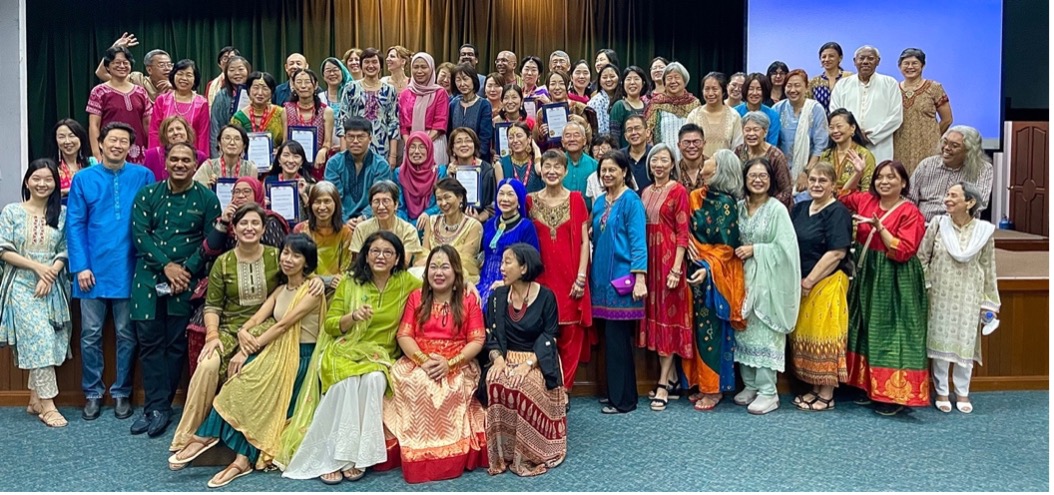
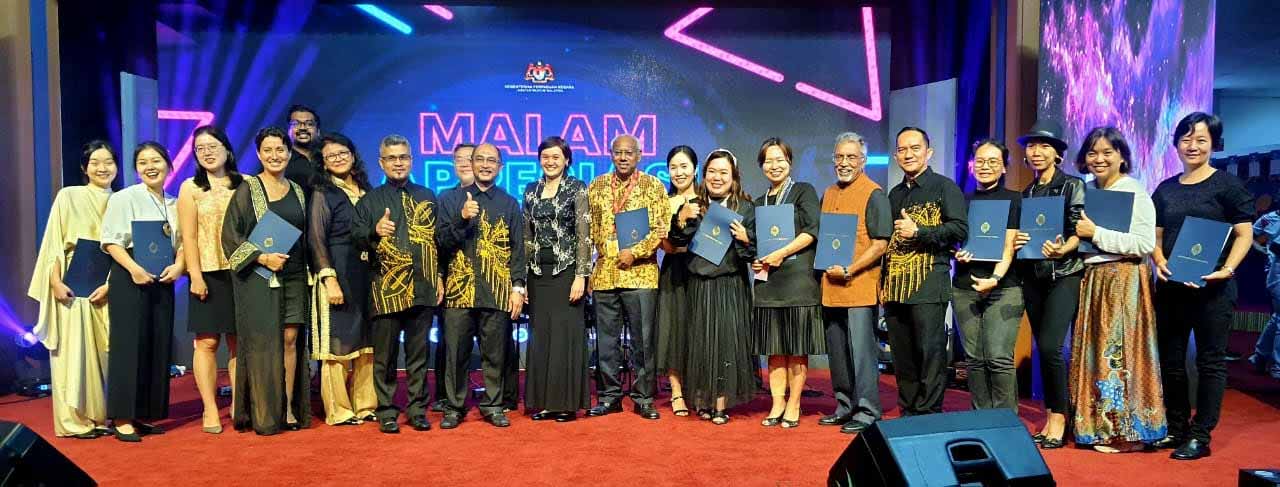
As I gazed at the group photograph of the museum volunteers captured at our year-end “MV Party”, all I saw were radiant smiles, spontaneous reactions, and newfound friendships. This was an opportunity for us all to give thanks and reconnect. Batch 40 MVs were especially jubilant as the party was also their graduation ceremony. As for the rest who attended, we were not short of being excited and spirited. I can most definitely attest this to be true for Batch 38, my batch!

How did this incredible journey unfold? Let me weave the tale of my enchanting odyssey towards becoming a volunteer guide at the National Museum. I’ll illustrate just how exhilarating my journey was. Who knows? This might just kindle the same spark within you to do the same.

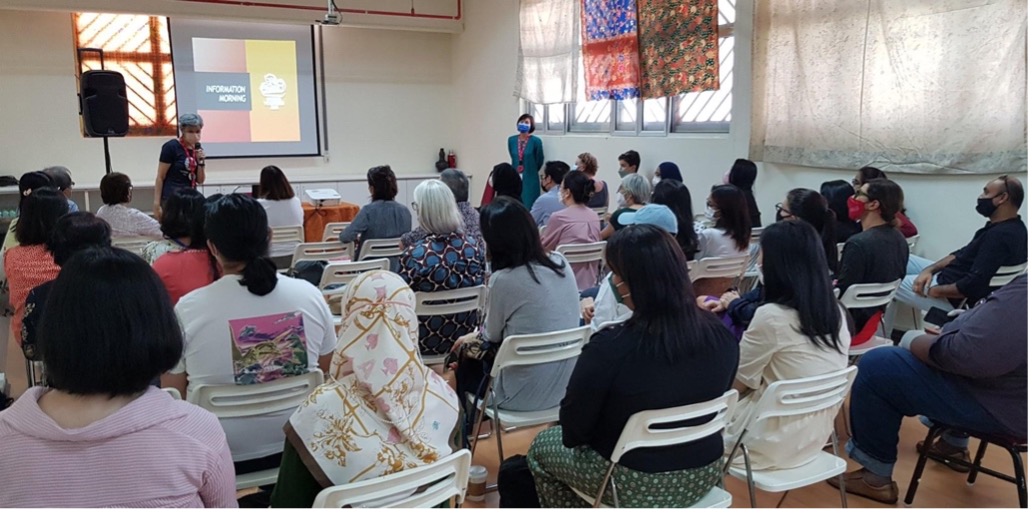
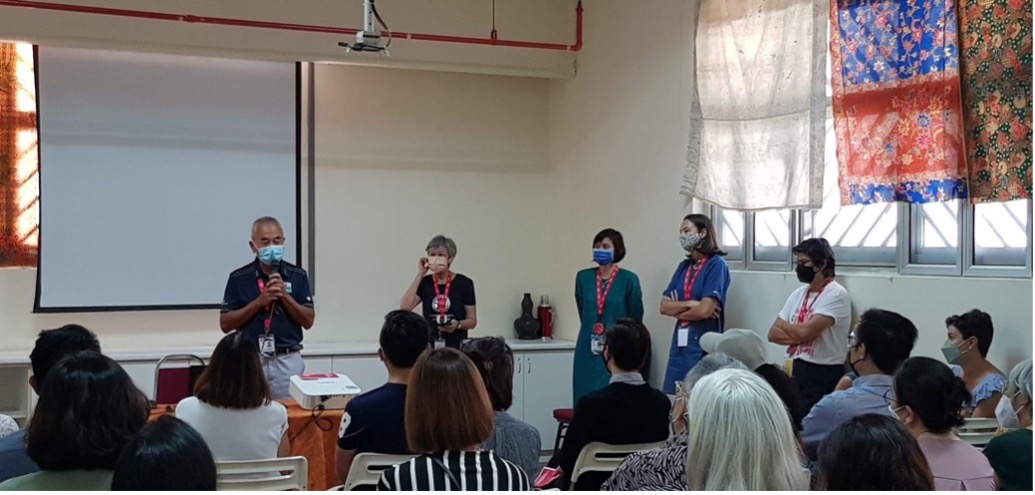
It all started in May 2022, upon the recommendation of two esteemed French-speaking guides. Stepping into the presentation room during an information morning session, I was met with a sea of eager faces, a diverse mosaic of different age groups and backgrounds, converging in pursuit of something magical. Throughout the session, I found myself to be further inspired to guide visitors through the museum’s treasures. The presence of existing experienced MVs added a sense of wisdom, while the discourse brimmed with motivation and passion. In that moment, a fervent thought surfaced, “I must be a part of this!”

I soon enrolled, and the thrill of being officially accepted was like a surge of electricity, igniting my excitement for the training which commenced in September 2022. Embracing the same anticipation, I felt as though I was a child eagerly awaiting to return school after a long summer vacation. I was bubbling with enthusiasm.

Before the training kicked off, I made a trip to the bookstore to get some stationery – notebooks, paper, and some colourful pens, like a burst of colours which aptly represented my readiness to dive headfirst into this adventure!

At last, the day of my first class arrived. The not-so-spacious MV Room was already buzzing with attendees. I quietly settled into a seat at the back of the room, observing the unfamiliar faces around me. Apart from a fellow French individual, I was a stranger among strangers, but hey, it was just the first day! 

As the roll call commenced, prompting us to sign next to our names, it felt like we were at school again. We were strongly encouraged not to miss any sessions unless absolutely necessary, with a cautionary note that repeated absence might hinder our progress. 

That was not an issue for me as Tuesday classes were a perfect fit for me. The training team’s introduction was warm and approachable. I have a tendency to infuse my initial impressions with positivity. Striving to be an attentive learner, I absorbed each detail like a sponge. 

It was revealed to us that the diverse topics crucial to Malaysia’s history will form the content of our training. Each of us will be put to the test by undergoing oral assessments of varying durations – 3, 7, and 15 minutes – fun I’d say! Notably, the assessment demanded a supporting written essay with a pre-determined format, character count, and referencing, not unlike an academic research paper!

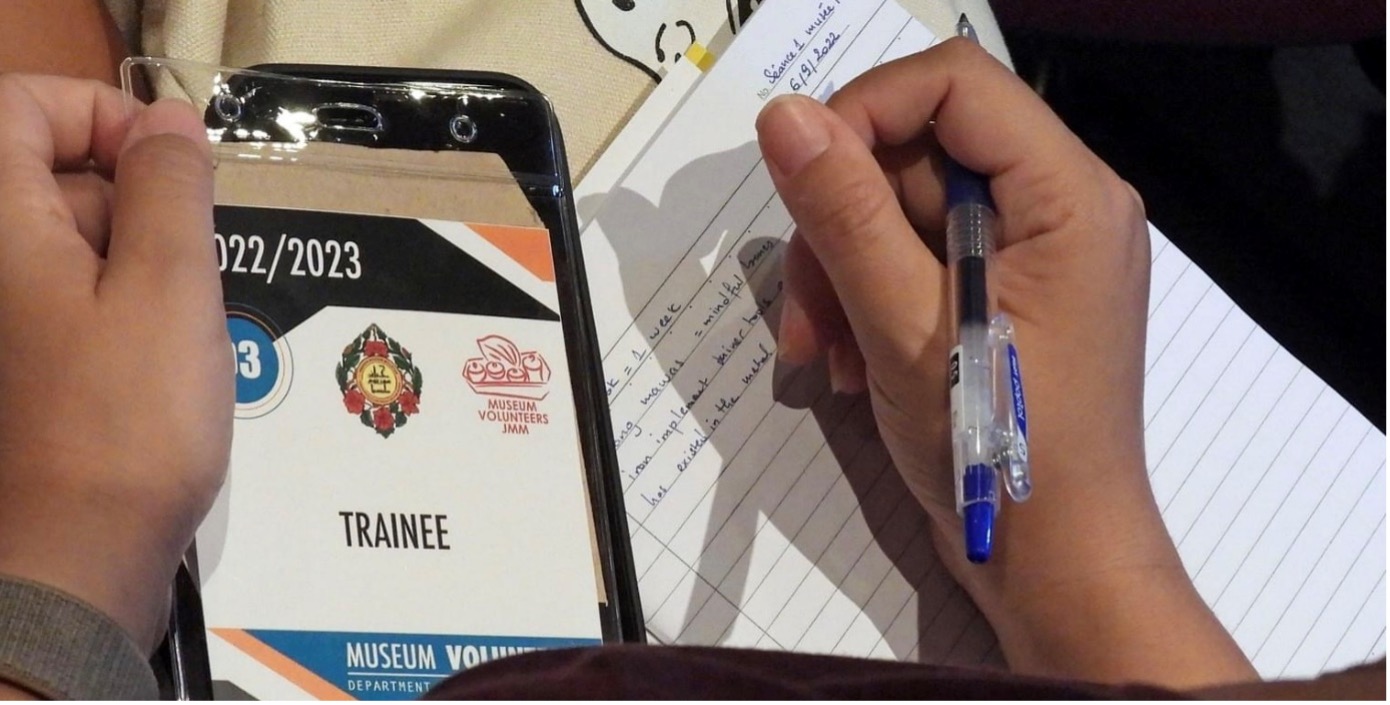
We had our photographs for our future MV tags, this felt like an initial stride towards a promising journey. Our group was subsequently divided, each subgroup was entrusted to an experienced guide. I found myself under the guidance of Mr. Jega, who exuded an air of wisdom and commanded respect effortlessly. He seemed to possess an encyclopedic knowledge of the museum, almost as if he had been a part of its history from the very start. The setting up of a WhatsApp group with him was aimed at streamlining communication, and each student was tasked with randomly selecting their first three-minute topic. Mine turned out to be ‘tulang mawas.’ A quick dive into Google helped unravel the mystery behind this intriguing phrase! Well, it seemed like diving into reading and research was the name of the game! 

The early sessions posed a challenge, especially for a foreigner like me struggling with a new geography. Feeling lost was a familiar sentiment until a presentation on the ‘Bujang Valley’ prompted a strategic shift. 

I began prepping before class, diving into research to grasp, follow, and engage with the material. Waking up early had long become a routine, a habit cultivated since childhood. Progress was swift, and as the training advanced, I found myself increasingly enjoy reading and researching. Mr. Jega with his insistence for factualness, attention to detail, and kindness, helped polished my knowledge. Thankfully, my presentations sailed through on the first attempt. Our mentors – Jega, Rama, Debbie, Sibilla, and Anna – were stellar trainers. In the classroom, we were all learners, irrespective of our levels. The space fostered camaraderie, gradually breaking down barriers among us. I cherished the conversations I had with my two Korean friends seated in front, even before learning their names. Engaging with my friend Rueben, sometimes relying on his translation for English or Malay words, added to the friendliness. 

Mutual support bound us together. The visible disappointment in someone’s eyes when they had to retake a test was met with a reassuring word. As our journey progressed, the ties within our Batch 38 family strengthened, evolving into something truly priceless.

The passing weeks were a whirlwind, and our volunteer librarians, Jean and Lai Meng, were the pillars of unwavering support, guiding us on how to select suitable books as reference.

Each of us was tasked with experiencing at least three guided tours to absorb, contrast narrative styles, and explore various approaches. Personally, I dove headfirst into more than 10 tours, uncovering hidden gems with each visit. 

As we approached the program’s conclusion, the pivotal moment arrived when we needed to select a mentor for an extensive museum tour. I approached my guide, Mr. Jega, requesting to continue under his wing, and to my delight, he graciously accepted. 

The pride I felt was immeasurable—I aspired to navigate the entire museum in English, a language not native to me, but a challenge I welcomed with open arms! My decision led me through the four galleries, and oh, the tales I have from that journey! 

In our compact team, led by Mr. Jega, each member possessed a distinct style. I surmise this diversity was a common thread among other groups. Yet, amid this diversity, one remarkable and undeniable thread prevailed: the unprecedented unity among us! 

We freely exchanged resources and ideas, fostering an environment devoid of rivalry. We collectively believed in the power of shared knowledge, understanding that its distribution only magnifies its impact. Our mutual support was palpable, a cascade of motivation and encouragement. The elation I experienced witnessing my peers conquer galleries was akin to my own triumphs. Perhaps it’s ingrained in our culture or fostered by our group dynamic. Following Fuad in Malay or someone else in Chinese? Absolutely no issue there! Language barriers crumbled in the face of friendship. Being there, shoulder-to-shoulder with friends, providing unwavering support in times of struggle, is the very essence of our shared experience. In our realm, friendship speaks a universal language, unifying us beyond any linguistic boundaries.

I made it a point to be there for my buddies as they were there for me. That mutual support meant the world, there was no awkwardness among us. My first big win? Jega’s ‘good’ on my report on 26/01/2023. That maiden tour felt like an epic saga! They said it took two hours, but trust me, it felt more like a marathon – easily four hours. We stopped at every single artefact, diving deep into their stories. Mr. Jega wanted to make sure I knew the museum inside out. Round two, a few days later, 03/02/2023, and guess what? Nailed it! I was the first to wrap up, and my mentor’s comment – “completed successfully” – felt like a display of fireworks within me! But wait, it wasn’t a wrap yet, my gang hadn’t finished, and my buddies in other groups were still getting assessed, so I stayed on standby to lend a hand. 

Hey! I’m not some prodigy – everyone was worked hard, and it was beyond amazing! Every day, one of our mentors would blast out a success story on our WhatsApp group. The vibes were all about cheers and high-fives! And voilà! We aced our tasks, every single one of us. Personally, after acing it in English, I aced my French tour, guided by the fabulous Marie Andrée, our experienced French-speaking guide. What a ride!

Then came my very first official tour, and guess who was in my group? A VIP – a distinguished professor, a big shot in the tin world. Was I nervous? Not really nervous, but this thought kept popping up: ‘What if I blank out? What if I can’t find the right info?’ But then I told myself, ‘Come on, Emna! You’ve put in the work for this moment – you’ve got this!’ I had eight visitors in total, and you know what? I completely forgot it was my first tour. It felt like second nature, like I’d been doing this my whole life. Sharing my knowledge was an absolute blast! And you know what topped it off? The feedback was all thumbs up, which gave me a huge sense of peace.

That day, entering Gallery C, I ran into my mentor, Mr Jega. His smile and words of encouragement felt like a beacon of honour, affirming my efforts. The tours kept rolling – English, French, and most recently, Arabic. 

Peering out my window every day, I see the National Museum, a place that now feels like a second home, draped in its traditional Malay style. Memories rush in – cultural escapades, eye-opening visits, mind-boggling conferences, city jaunts, and delightful lunches. 

We’ve woven a tapestry of experiences, deeper than the mere tours. Opting for this program stands tall as one of my most pivotal choices since landing in Malaysia. 

Uncovering the layers of history in this remarkable land has been a rewarding quest. Yet, the real gem lies in the friendships, the extended family I’ve discovered along this path. This expedition continues, and I hope that our friendships endure, transcending the museum’s walls. 

A resounding thanks to everyone, near and far, whose contributions supported our journey. Your encouragement has been our fuel, and we’re driven not to disappoint.

Thank you! 

Focus Talk 18 November 2023: WAYANG KULIT

Speaker : Dato’ Kapten Professor Emeritus Dr Hashim Bin Yaacob

Write-up by Shirley Abdullah

In Malaysia and the Malay-speaking parts of Southern Thailand, Wayang Kulit may be classified into four categories;-

Wayang Kulit Siam (Wayang Kulit Kelantan)

Wayang Kulit Jawa (Wayang Kulit Melayu)

Wayang Gedek (Nang Talung)

Wayang Kulit Jawa (Wayang Purwa)

Prof Dr Hashim focused his talk on his personal experience as a practitioner of Wayang Kulit Siam . He also performed selections from  repertoires written by himself, with the assistance of his colleague, Che Su.  MV Anne was also roped in to perform as one of the characters and mustered a convincing turn as the evil protagonist  ! We could see that the performance involves a great deal of arduous effort and the tok dalang has to be highly skilled in order to accomplish a seamless performance.

Commenting on the evolution of various forms of wayang kulit  in Kelantan, he said that in the 1920’s, puppeteers from Kelantan were sent by the royal court to Java to learn the Javanese form of shadow play, primarily for performances within the confines of the royal households. However the stiff, archaic, classical styles generated little enthusiasm among viewers. “There was little movement, they kept repeating the same themes in the storylines, it was boring, thus it died a natural death, “ he said.

Wayang Kulit Siam is still performed in Kelantan, Terengganu, Kedah, Perak and Patani.  In the past, it was much cherished as a source of entertainment by village folks.. Often the performance is completed in a single night but Prof Dr Hashim recalls occasions, usually connected with wedding celebrations when the performances were extended over seven nights, and generated considerable excitement among enthralled rural audiences. 

The wayang kulit performances  take place on an open-air theatre (panggung) elevated about one metre above the ground.  Spectators will be seated in front on the grass or on benches .

The panggung represents the universe. The screen at the front of the stage , on which shadows of the puppets are projected, represents the world with images of people passing through.  The dalang gives life to the puppets by switching the lamp (symbolizing the sun) , on and off

The tree of life ( Pohon Beringin ) represents the elements  ( water, earth, air, fire.)

The Tok Dalang ( dalang ) narrates the story and mimics the voices of the various characters. To do this, he has to sing as well as modulate his voice for dozens of parts The puppets have a sharp split-bamboo point  on their base which is  stuck onto  a banana stem. This enables the dalang  to deftly switch puppets for different characters. 

Apart from being skilled in puppet manipulation, the dalang coordinates his performance with the orchestra who receive cues from him.

The orchestra comprises of  between seven to ten musicians, who play a double-reed oboe ( serunai ), gongs ( tetawak, canang), hand cymbals ( kesi ), and various drums ( gendang, gedumbak, gedung ).

The principal Wayang Kulit Siam storyline is based on Hikayat Maharaja Wana, a Malay version of the Ramayana. The original trunk story ( cerita pokok ) focuses on the rivalry between Rama and Ravana for Siti Devi’s hand. 

Branch stories (cerita ranting) were spin – offs invented by dalangs who used characters from the Ramayana but developed new story lines. This afforded them the opportunity to also highlight contemporary issues, and provide social commentary. Entertainment for the masses remained  the main focus  so performances were heavily laced with humour  and rousing music .

According to Prof Dr.Hashim, he is concerned that Wayang Kulit in its current state as an art form is fast approaching the point of extinction.

He is aware that not many people are interested in viewing wayang kulit performances, not to mention actively promoting it. This is also because not many are able to understand the language used during the performances. This is predominantly the Kelantanese dialect of the Malay language, which is challenging for even native Malay speakers from out of state. 

He also felt that wayang kulit performances failed to attract a younger audience because they did not incorporate contemporary elements.  Neither the traditional storylines nor the music had evolved or adapted  to satisfy the appetites of the younger generation. 

The banning of wayang kulit performances by the state government of Kelantan in 1998 had also dealt a serious blow to the art form. The negative perception created by the labeling of wayang kulit performance as haram and going against the teachings of Islam had a considerable impact especially in deterring the older generation from patronizing the art form. The ban has since been lifted in 2019.

Prof Dr. Hashim explained the reason for the initial ban on Wayang Kulit Siam performances.

 Wayang kulit is performed by a master puppeteer known as “Tok Dalang”. The tok dalangs were also  bomohs who served the local communities as Malay shamans and traditional medicine practitioners. They were steeped in traditions and rituals in which they claimed to act as intermediaries for spirits. 

The Tok Dalangs  performed rituals in conjunction with Wayang Kulit performances such as “Kenduri” (feast), “Buka Panggung” (rites to commence the theatre ) and “Berjamu” (ritual performance). These rituals involved the recital of invocations for appeasement of the spirits which constitutes “syirik” (associating others with God). During the performances, the dalang could also go into a trance. Ascribing power to anything other than the one God violates Islamic belief (monotheism). 

While Prof Dr. Hashim  was a dentistry professor at Universiti Malaya, he was already heavily involved in the Malay poetry scene. He ventured into performing poetry recitals in public in an attempt to curb a nervous condition when he first became a young lecturer. He strongly advocates public performance to anyone who wants to conquer stage fright ! Since then he flourished as a prolific poet with five anthologies of poetry publications and the prestigious Anugerah Sastera Perdana ( National Literary Award )  under his belt. 

His close friendship with the then Vice-Chancellor of Universiti Malaya Royal Professor Dr. Ungku  Abdul Aziz Ungku Abdul Hamid also influenced  his interest in culture and arts, as both shared a mutual interest in fostering  and promoting local art forms.

The Kelantan state government ban on wayang kulit in 1999 aroused his concern for  the future of the art form. Prof Dr. Hashim  draws from a family lineage of wayang kulit dalangs; his grandfather Jusoh was a revered dalang.

After being schooled for 7 years by renowned  Kelantanese dalang, Dollah Baju Merah and his pupil Ariffin Che Mat, he ventured into live performances as a dalang  in rural Kelantan. Instead of the traditional incantations to the spirits which accompanied traditional performances, he recites Islamic prayers during the opening and closing of the show. His intention is not to transform wayang kulit into Islamic wayang kulit but to make it compatible with government rulings as well as to popularize it and enable the art form to thrive. 

Prof Dr.Hashim made efforts to remove elements which are in conflict with Islamic teachings from the performance scripts. He has invested considerable time and effort to propagate a better understanding and appreciation of Wayang Kulit by writing books which provide translations of the language used in the performances and explanations of the story lines. To make wayang kulit more accessible to the man on the street, he uses standard Malay during his performances. He has also performed Wayang Kulit as a puppeteer not only in Malaysia but also in Singapore, Egypt, Indonesia ,India, Japan, and Korea He has also delivered his performances in various languages such as in Mandarin, English and Arabic.

While purists lament the decline of the art form in its original state, Prof Dr.Hashim stresses that adhering to the traditional style will only result in declining  audience numbers. He feels that wayang kulit plots should go beyond the traditional plots from the Ramayana. He has written scripts with unorthodox themes and many of them are humorous skits. When he was Vice-Chancellor of Universiti  Malaya in 2003, he taught wayang kulit as a 28- hour elective.for undergraduate students.

How did the practitioners of Wayang Kulit Siam and their audience, who were mainly Muslims, receive Hindu influenced storylines?

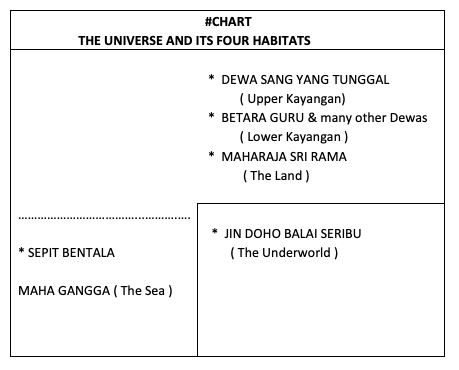
In his book, Prof Hashim explained that according to Dollah Baju Merah, the renowned master puppeteer , the Universe is divided into four habitats with their own inhabitants. 

Refer to the chart below :

CHART : THE UNIVERSE AND ITS FOUR HABITATS 

OF WAYANG KULIT SIAM ( WAYANG KULIT KELANTAN )

# Reference: Sejarah Dan Pengalaman Gaya Bahasa Wayang Kulit; Author : Hashim Bin Yaacob  Publisher: Pekan Ilmu Publications Sdn Bhd

The chief of the universe resides in the uppermost kayangan and he is known as Dewa Sang Yang Tunggal.  The term “Tunggal” means “one” which denotes the oneness of the Dewa, creator of the universe of the wayang kulit, who has great power over all things.

The ocean in Wayang Kulit Siam is ruled by a dragon – king called Sepit Bentala Maha Gangga, the underworld by a genie (Jin) called Jin Doho Balai Seribu  and the land by a mortal , Sri Rama.

“Sri Rama, the hero prince of Wayang Kulit Siam epitomizes the perfect man, at the very least in the physical form. What then are some of his attributes to warrant the privilege ? Whatever they are, they must be conjured up according to the taste of the day among the Wayang Kulit Siam supporters”, said Prof Dr.Hashim.

We are told that out of boredom and loneliness in the Uppermost Kayangan , Dewa Sang Yang Tunggal decided  to descend to earth to see the affairs of the world, disguised as a commoner. 

His willingness to suffer humility and become the servant of Maharaja Wana is viewed as a positive trait. The practice in humility  (  rendah diri ) and modesty is a distinctive feature of the social conduct in Malay society which persists until today.

Clear messages can be drawn from the varied dramatic repertoires, which may influence the general audience in leading their lives, in their code of conduct and in their perception of the world. Negative traits among humans such as ungratefulness, pride, greed, telling lies, slandering a person, ridiculing a person are also emphasized as undesirable traits.

The importance of forging  close ties among family members is also expounded. Sri Rama could always count on the help of his younger brother, Raja Muda Laksamana, and his son, Hanuman Kera Putih..

Prof Hashim feels that one of the most important messages is the respect accorded to learned individuals ( orang yang berilmu )  and the process of acquisition of knowledge  ( ilmu ) itself.  Wayang Kulit Islam  also emphasizes relationships between men and women through marriages. In its repertoires, we are constantly reminded of the love Sri Rama had for his wife, Siti Dewi  . Sri Rama had to face all odds and obstacles including fights against the demon king, Maharaja Wana,  in order to win back his wife after she was abducted.

Prof. Dr.Hashim feels that the positive messages in Wayang Kulit Siam are a reflection of the teachings in Islam and are imparted by dalangs through the heroes and villains of the various repertoires. He remains positive about the future of this treasured art form . He emphasizes that even though  it is necessary for the art form to evolve to ensure its survival, whatever efforts taken must ensure that the local identity of the people of the land should not be lost.

The Beauty and Legacy of Arabic Calligraphy: An Artistic Odyssey

By Emna Esseghir

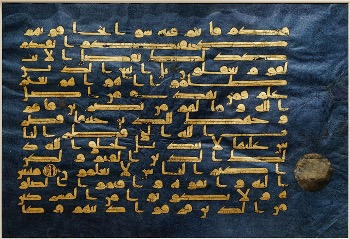
Leaf from the Blue Quran of Tunisia showing Sura 30: 28–32, Metropolitan Museum of Art, New York. (Photo: Wikimedia Commons)

Human is Social by Nature

Ibn Khaldun, the distinguished Tunisian historian and scholar, expounded in his seminal work, the “Muqaddimah,” the profound idea that humans innately gravitate towards forming social groups, tribes, and communities. He persuasively argued that these intrinsic social bonds not only define our human nature but also serve as the bedrock for the development and sustainability of entire civilizations. This notion of social cohesion finds resonance in our broader human proclivity for connectivity, which echoes resoundingly throughout history.

The fascinating evolution of human communication further underscores our fundamental need to express and safeguard knowledge. This captivating journey commenced with rudimentary visual storytelling through cave paintings and progressively evolved into more structured forms of writing, including early pictograms and ideograms etched in cuneiform and hieroglyphics. As human societies advanced, the emergence of abstract scripts, epitomized by the Phoenician alphabet, substantially enhanced the efficacy of communication. The pinnacle of this progress was reached through the artistry of calligraphy, where skilled artisans elevated writing into a form of visual expression. Through the medium of calligraphy, they crafted exquisite manuscripts, sacred texts, and official documents, eloquently illustrating our unwavering commitment to conveying ideas, sharing wisdom, and etching an enduring legacy on the tapestry of human history.

To explore the captivating world of Arabic calligraphy, which serves as a testament to the beauty of written expression, In this article, I will explore the history and evolution of Arabic calligraphy. Additionally, I will elucidate various aspects of Arabic calligraphy exhibited within the Muzium Negara.

What’s Arabic Calligraphy?

Based on the definition given by the Unesco, Arabic calligraphy is the artful practice of elegantly writing Arabic script, aiming to convey a sense of harmony, grace, and beauty. This tradition, passed down through both formal and informal educational channels, involves the skillful arrangement of the twenty-eight letters of the Arabic alphabet in a flowing, cursive style, typically from right to left. Initially designed to enhance the legibility of written text, it gradually evolved into a revered form of Islamic Arab art, applicable to both traditional and contemporary works. The flowing nature of Arabic script offers endless creative possibilities, allowing letters to be elongated and transformed in various ways to create diverse visual patterns.

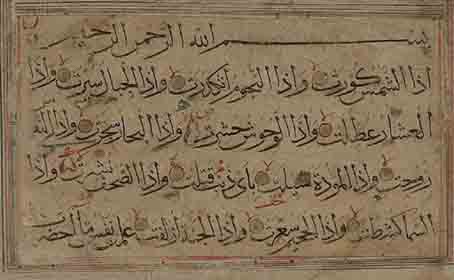
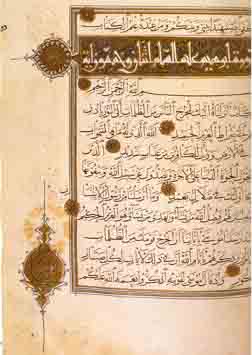
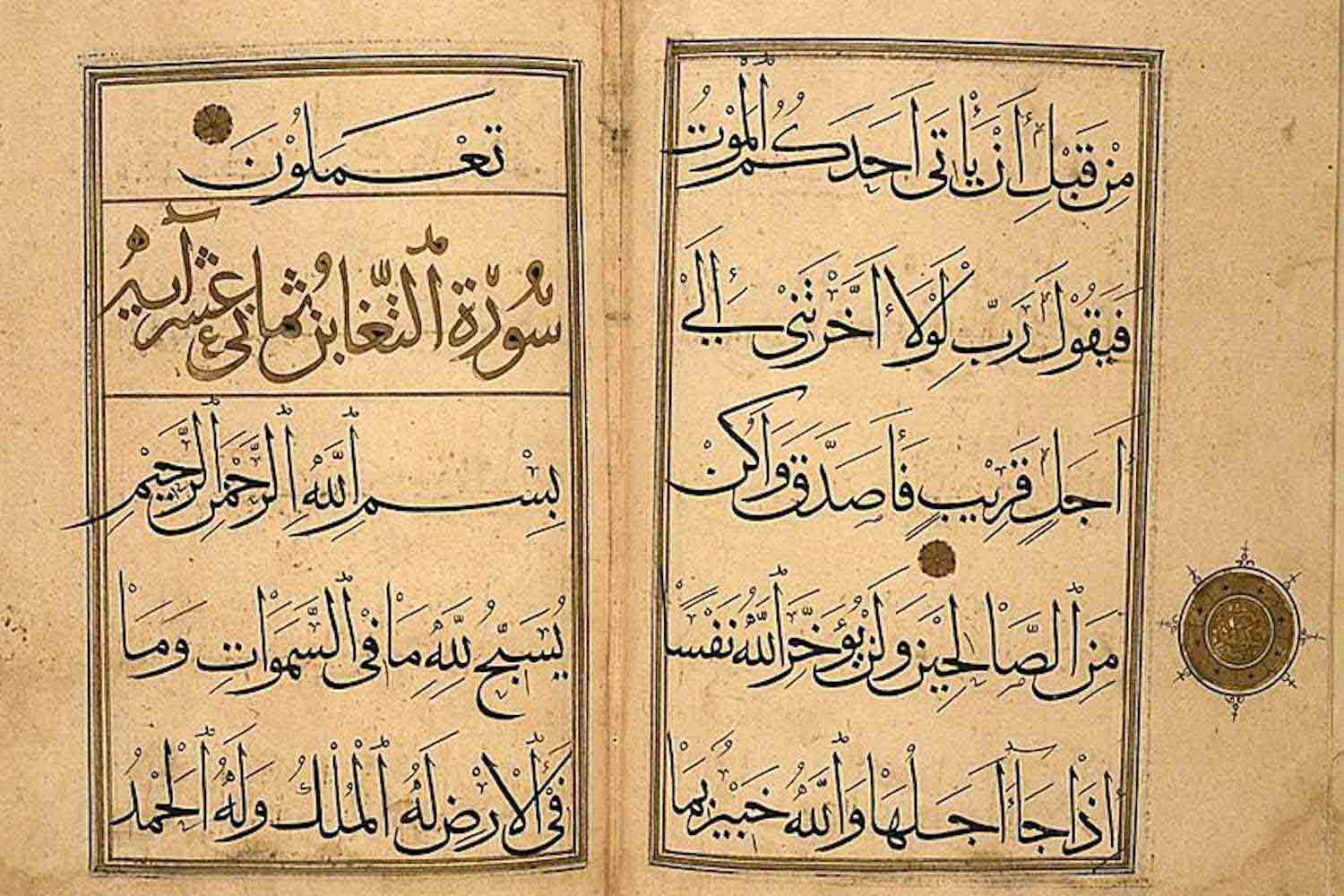
Text from a 14th century Quran written in the Rayhani script
(Photo: Wikimedia Commons)

Traditional techniques employ natural materials like reeds and bamboo stems as writing tools, while ink is meticulously crafted from a mixture of honey, black soot, and saffron. The paper used is handmade and treated with starch, egg white, and alum. In contrast, modern calligraphy frequently employs markers and synthetic paints, and spray paint becomes the medium of choice for calligraffiti, which adorns walls, signs, and buildings. Artisans and designers utilize Arabic calligraphy to enhance various art forms, including marble and wood carving, embroidery, and metal etching.

Origins of Arabic Calligraphy

The pre-Islamic period in the history of Arabic calligraphy was characterized by a relatively rudimentary form of the Arabic script. During this time, the Arabian Peninsula was home to various tribal communities, and the Arabic script, which had evolved from the Nabatean script, was used primarily for practical purposes such as inscriptions and basic record-keeping.

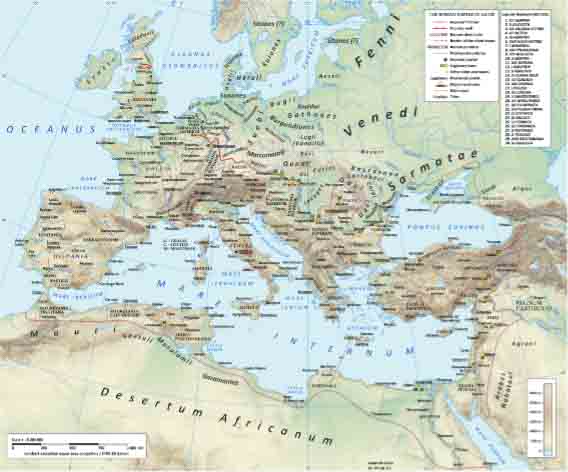
Map of the Roman empire under Hadrian (ruled CE 117–138), showing the location of the Arabes Nabataei in the desert regions around the Roman province of Arabia Petraea

This script had a limited number of characters and was written from right to left. Over time, as the Arabian Peninsula became more interconnected through trade and cultural exchange, the script began to evolve to accommodate the Arabic language.

In pre-Islamic Arabia, the primary means of communication and cultural preservation was through oral tradition. Poems and stories were passed down orally from one generation to the next. Writing was less developed, and the use of the Arabic script was limited mainly to practical purposes such as inscribing names, tribal markings, and important declarations on stones and other surfaces.

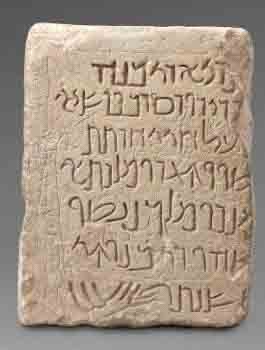
Examples of Nabataean inscriptions from Petra (Source: https://www.swissinfo.ch/spa/multimedia/tras-las-huellas-de-scheich-ibrahim_petra–esplendor-del-desierto/34695166)

The early Arabic script bore the influence of neighboring scripts like Aramaic and Syriac, evident in some of the shapes and characters present in early Arabic inscriptions.

These initial instances of Arabic script dating from that era are observable in inscriptions on pre-Islamic artifacts, including tombstones, coins, and the foundations of structures. These inscriptions tended to be straightforward and pragmatic, serving functional purposes rather than showcasing the artistic finesse associated with calligraphy.

It’s worth highlighting that the development of Arabic calligraphy as a refined and artistic tradition occurred later, coinciding with the rise of Islam. The Quran, revealed to the Prophet Muhammad, played a pivotal role in elevating the Arabic script to a higher status. This transformation ultimately gave rise to the diverse calligraphic styles and forms that we now associate with Arabic calligraphy.

Arabic Calligraphy’s Zenith

The early development of Arabic calligraphy represents a captivating narrative of artistic evolution that defies linear progression. Across geographically dispersed regions like Damascus, Baghdad, Morocco, and Spain, a rich tapestry of scripts flourished and waned in popularity. Among these, Kufic, originating from the city of Kufah in Iraq, emerged as the initial universal script, holding sway over Arabic calligraphy from the 7th to the 11th century. However, during this early period, Kufic retained a certain ruggedness and lacked the systematic refinement that would characterize its later incarnations during the “Golden Age” of calligraphy.

The turning point in the journey of Arabic calligraphy arrived in 762 when the Abbasid Caliph Mansur embarked on a grand endeavor—the construction of Baghdad, a meticulously planned city positioned strategically along the banks of the Tigris River. Baghdad swiftly ascended to the status of the cultural nucleus of the Middle East, attracting scholars, artists, and intellectuals from far and wide. It was in this vibrant and intellectually charged atmosphere that Arabic calligraphy reached its zenith of development.

This illustrious “Golden Age” of Arabic calligraphy is often epitomized by the contributions of three iconic calligraphers:

1- Ibn Muqla (886–940) introduced groundbreaking principles of proportion and aesthetics to the art, elevating it beyond mere utility.

2- Ibn al-Bawwab (believed to have lived from 961–1022) pushed the boundaries of script and composition, further enhancing the art’s visual appeal and complexity.

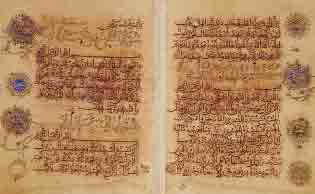
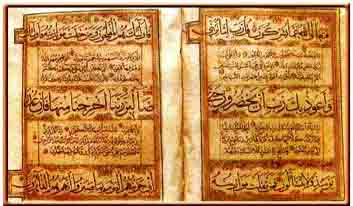
Two folios of the Quran, written by Ibn al-Bawwab in 1001 CE. The original copy is preserved in Chester Beatty Library, Dublin (Credit: Chester Beatty Library, Dublin)

A folio from the Quran written by Ibn al-Bawwab (Chapter 971 Al-Qadr and Chapter 98: Al-Bayyinah) (Credit: Chester Beatty Library, Dublin)

3- Yakut al-Musta’simi of Amasya (d. 1298) left an indelible mark with his intricate and ornate calligraphic works, exemplifying the pinnacle of the craft.

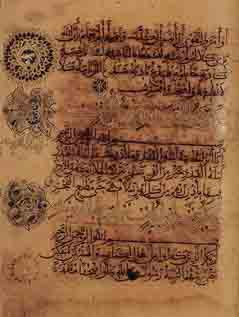
A folio of the Quran, written by Yaqut al-Mustasimi, preserved in Topkapi Saray Library, Istanbul

Two folios from the Quran, written by Yaqut al-Mustasimi in 1269 CE, are preserved in Khuda Bakhsh Library, Patna, India

In this era, Arabic calligraphy transcended mere writing; it became an art form that harmoniously blended form, function, and artistic expression. It was not merely a conduit for conveying words but a source of visual beauty and cultural significance.

The “Golden Age” of Arabic calligraphy refined the art to such an extent that it continues to inspire admiration and scholarly inquiry, standing as a testament to the enduring marriage of creativity and tradition. This legacy endures in the intricate and elegant calligraphic works that grace Islamic architecture, manuscripts, and various forms of artistic expression today.

4- Arabic Calligraphy different style

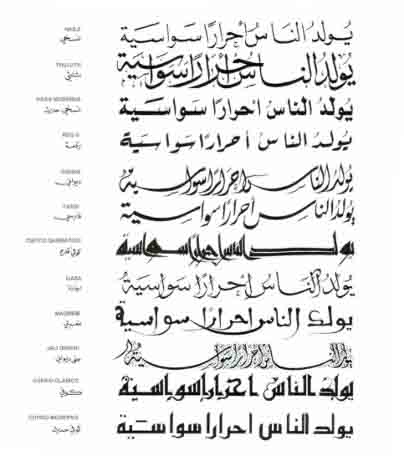
Arabic calligraphy encompasses an array of script styles characterized by cursive forms, vertical extensions, and intricate geometric designs. Some scripts adopt more pronounced curves and intricate linkages between letters. Each style of Arabic calligraphy serves a distinct purpose, tailored to the specific intentions of the calligrapher.

Same sentence written in 12 different styles
(Source: https://www.pinterest.com/pin/321514860892971724/)

5- Examples of fusion with the Arabic Calligraphy:

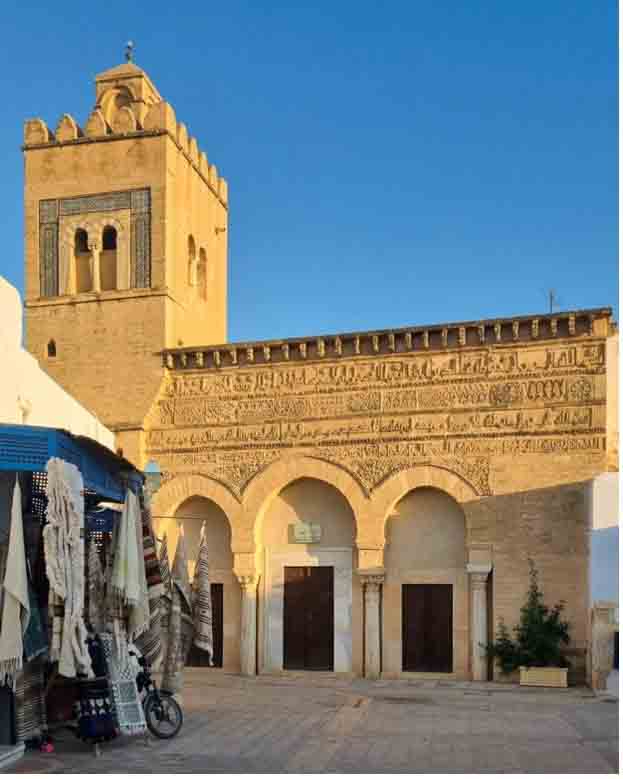
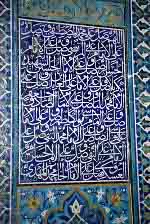
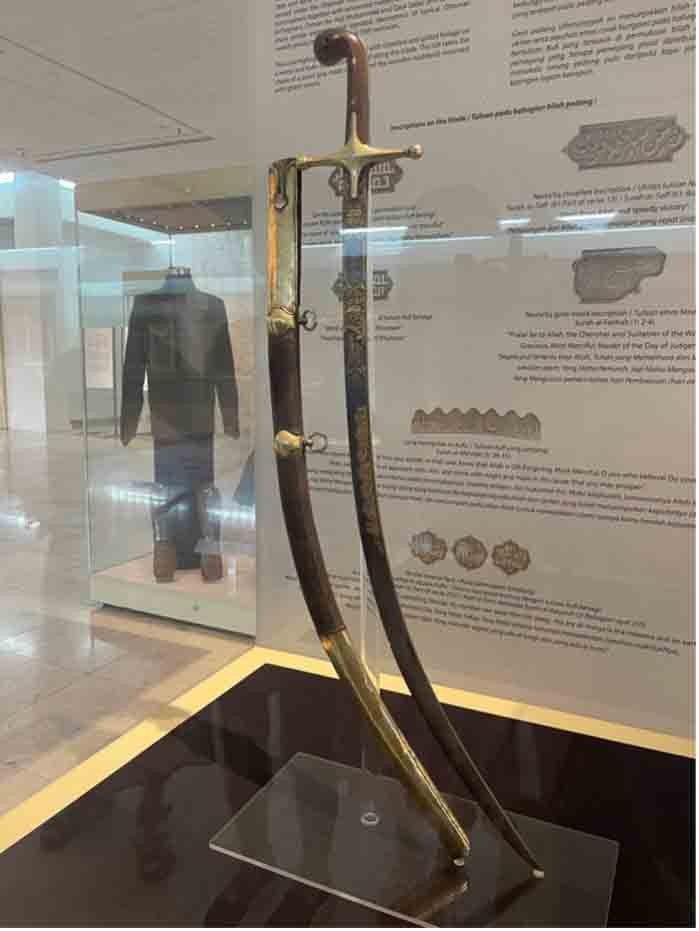
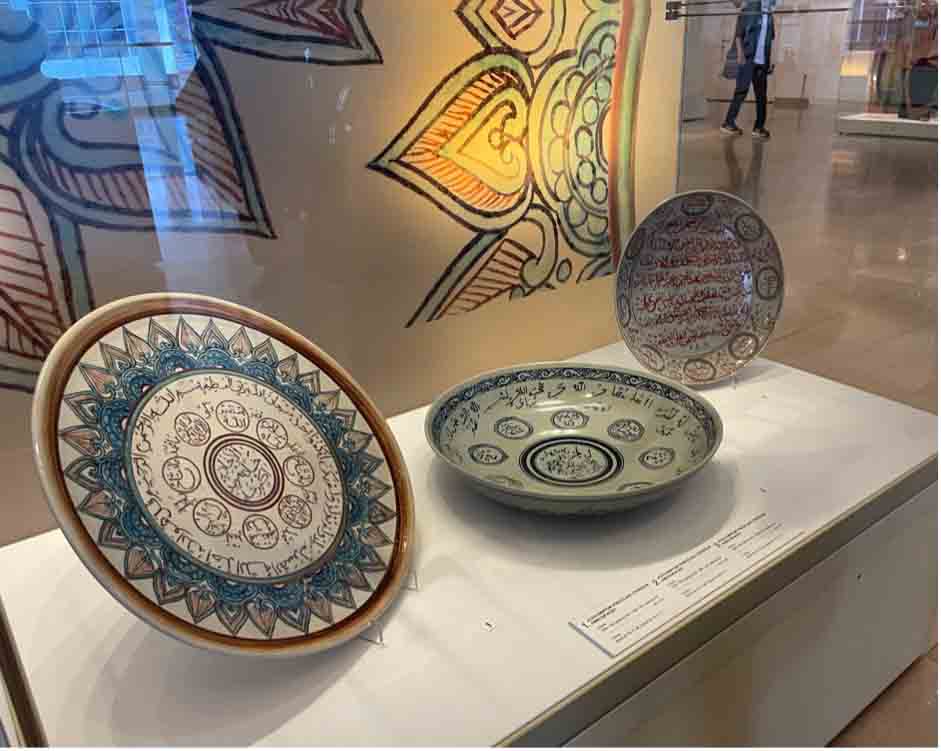
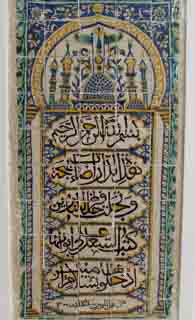
Here are photos of several buildings, ceramics, weapons, and artefacts adorned with Arabic calligraphy. They come in various forms and styles, usually designed to convey moral messages through Quranic verses.

Facade of Mohamad Ben Khairoun El Maarefi’s Masjed in Kairouan – Tunisia With Kufi Script (Photo: Issam Barhoumi)

Calligraphic mosaic, Iran
(Source : https://www.sciencephoto.com/media/83654/view/calligraphic-mosaic-iran)

Ottoman Sword By Ahmad Al Khurasani with Arabic calligraphy, exhibited at IAMM (Photo: Emna Esseghir)

Aceh plate with Arabic calligraphy exhibited at Islamic Arts Museum, Malaysia
(Photo: Emna Esseghir)

Tiles with Quran verses exhibited at Bardo Musuem Tunisia
(Photo: Mohamed Yazid Ben Abdessalem)

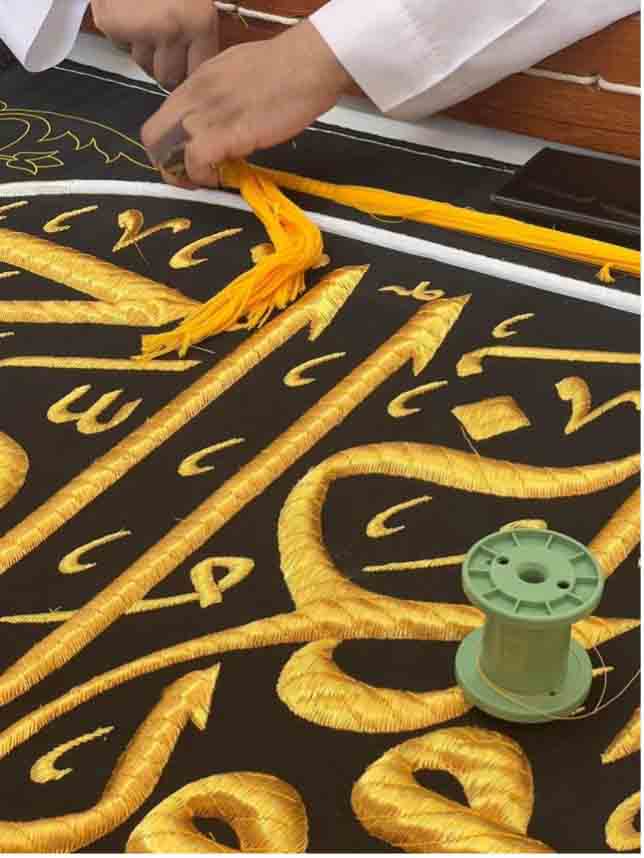
The Kaaba’s gold laced cover
(Photo: Sami Mansour)

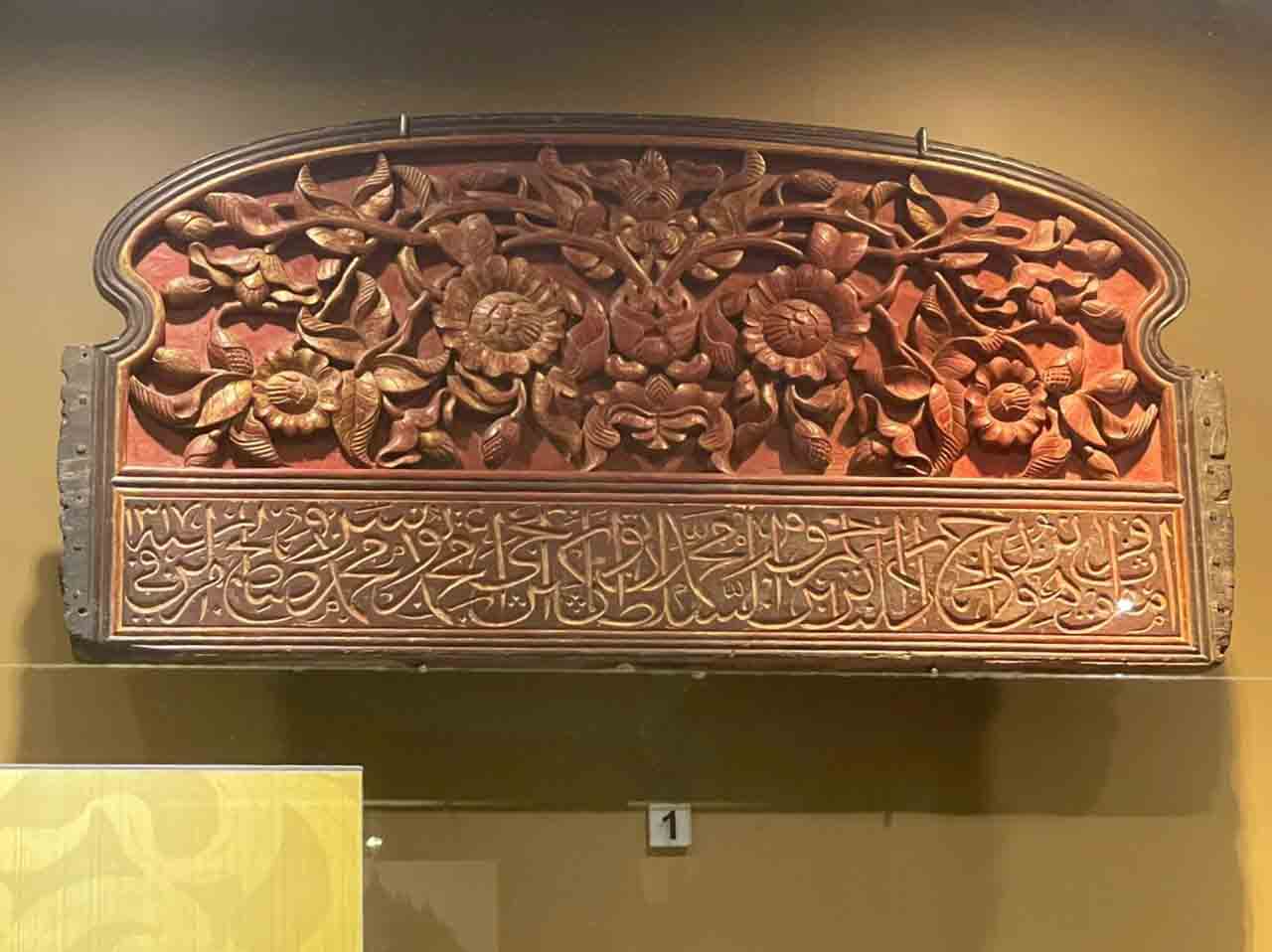
The calligraphic inscription between the zigzag designs and medallion reads: Blessings to Allah and praise be to Him, Blessed be Allah the Great, Oh, Lord who give us riches, There is no God but Allah and Prophet Muhammad is the Messenger, Surah al-Baqarah (2:144), and Oh, Sultan.

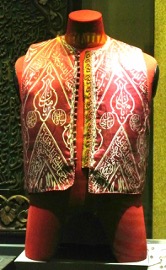
Red vest with verses displayed in Gallery B, Muzium Negara
(Photo: Emna Esseghir)

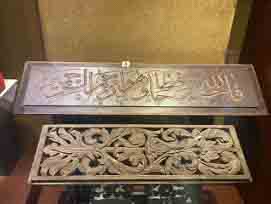
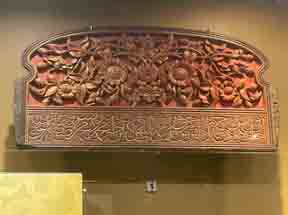
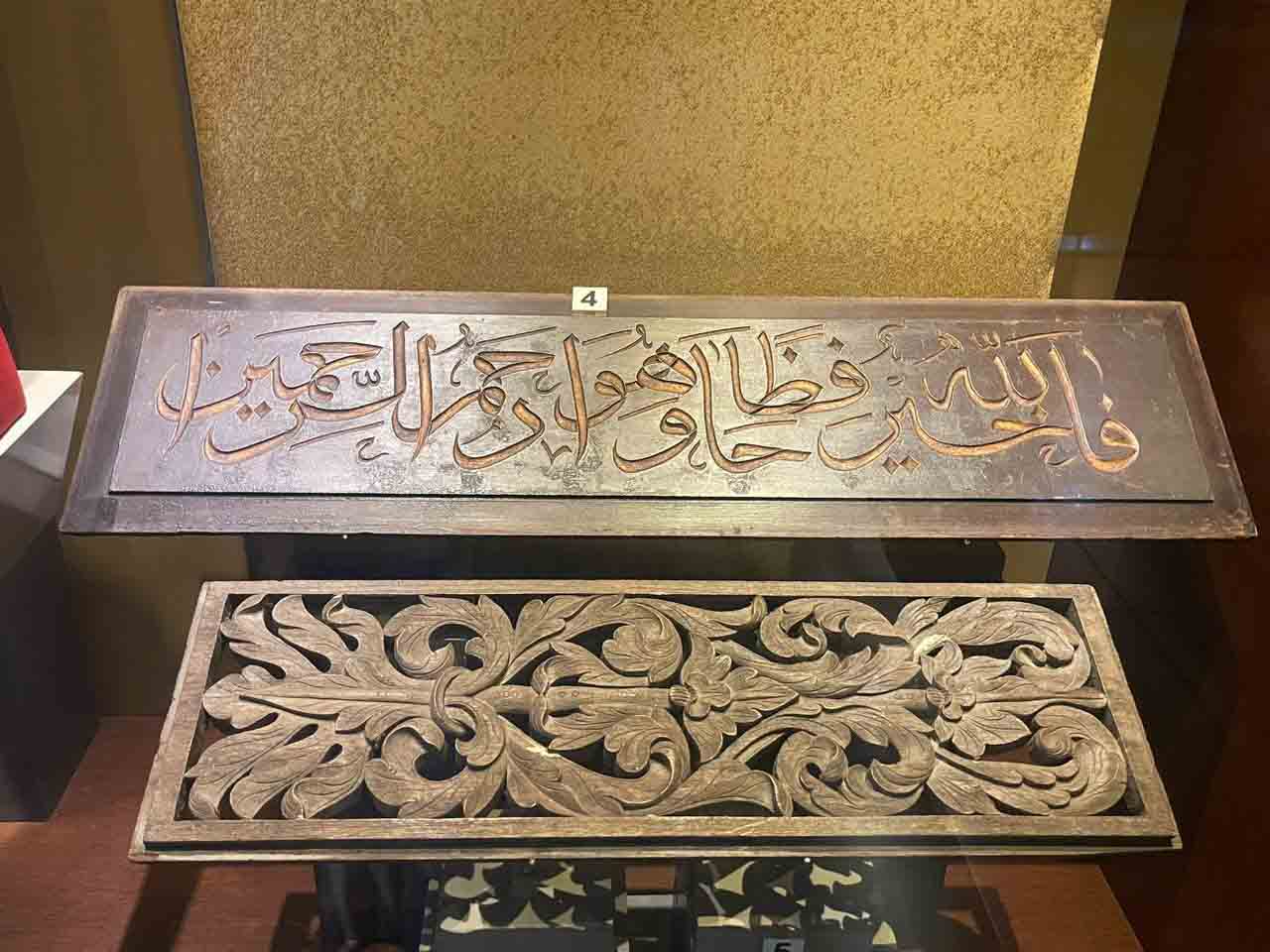
*woodcarving is influenced by the moral ethical values with Quranic verses:

Wood carved plates, Gallery B Muzium Negara
(Photo: Emna Esseghir)

Persian or Iranian Brass Islamic Magic Bowl, Gallery B, Muzium Negara
(Photo: Emna Esseghir)

References

  1. Blue Quran: https://en.wikipedia.org/wiki/Blue_Quran
  2. THE MUQADDIMAH by Abd Ar Rahman bin Muhammed ibn Khaldun: https://delong.typepad.com/files/muquaddimah.pdf
  3. Arabic calligraphy: knowledge, skills and practices: https://ich.unesco.org/en/RL/arabic-calligraphy-knowledge-skills-and-practices-01718#:~:text=Arabic%20calligraphy%20is%20the%20artistic,cursive%2C%20from%20right%20to%20left
  4. A Brief History of Arabic Calligraphy: https://www.skillshare.com/en/blog/a-brief-history-of-arabic-calligraphy/
    https://www.metmuseum.org/learn/educators/curriculum-resources/art-of-the-islamic-world/unit-two/origins-and-characteristics-of-the-arabic-alphabet
  5. Ibn Muqla: https://artcalligraphy.net/en/ibn-muqla/
  6. Ibn Muqla: The prophet of Arabic Calligraphy by Md. Monirul Islam: https://ocd.lcwu.edu.pk/cfiles/Arabic/Min/FA-101/IbneMakla.pdf
  7. Hasan Celebi, Turkey’s Master Calligrapher by Professor A. R. MOMIN: https://www.iosminaret.org/vol-8/issue21/Hasan_Celebi.php
  8. Arabic Calligraphy Styles: https://www.arabic-calligraphy.com/arabic-calligraphy-styles/
  9. Some Islamic Artefacts at Muzium Negara: https://museumvolunteersjmm.com/2020/04/01/some-islamic-artefacts-at-muzium-negara/

Unlocking the Eight-Pointed Star’s Mystery

By Emna Esseghir

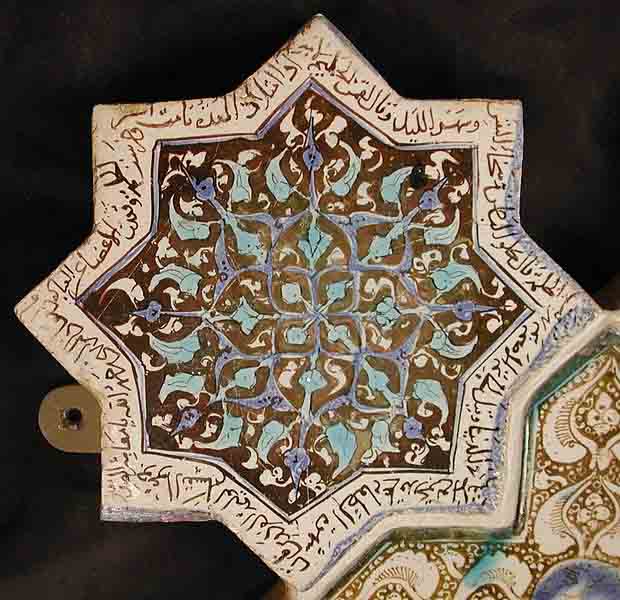
An eight-pointed star-shaped tile.
Image source: https://www.metmuseum.org/art/collection/search/444459

Introduction

Stars have perpetually held a captivating allure for humanity, drawing us into realms of scientific fascination, artistic ingenuity, and profound spiritual significance. These celestial entities have not merely fueled our scientific explorations, revealing their diverse classifications and intricate life cycles, but have also ignited the creative flames of art, poetry, and mythology, enduring as timeless symbols of hope and beauty.

In the realm of religion, stars occupy a revered position across various faiths and cultures, embodying divine manifestations, celestial emblems, and sources of spiritual guidance. Beyond these multifaceted dimensions, stars serve as a unifying thread that transcends both time and cultural boundaries, binding us together through our insatiable curiosity, our enduring spiritual connection to the cosmos, and our collective awe at the enigmatic mysteries of the universe.

In this article, I will delve deeper into the study of the eight-pointed star, a compelling exemplar of how celestial objects like stars can carry profound significance for humanity, owing to their rich history of symbolism across diverse cultures and religions.

What’s an eight-pointed star?

In geometry, an 8-pointed star is a geometric shape formed by the intersection of two squares, typically with one square rotated at a 45-degree angle relative to the other. It features eight distinct points or vertices radiating outward from a central point. The resulting figure often resembles an octagonal star and is commonly referred to as an octagram. This shape exhibits symmetry and can be constructed using various geometric methods.

The regular octagram is characterized by equal-length sides and angles, lending it a balanced and uniform appearance. It can also exhibit different variations.

Different variations of 8-pointed star.
Image source: https://www.outofstress.com/8-pointed-star-meanings/

Meanings and origins of the 8-pointed star

Its octagonal structure serves as a distinctive emblem, signifying both protective qualities and guidance, owing to its direct alignment with the eight cardinal directions. Moreover, this celestial symbol maintains a profound connection with the number 8, a universally recognized symbol of significance and good fortune across diverse cultural landscapes. Furthermore, the star’s octagonal shape has been associated with the eight phases of human spiritual growth.

Consequently, the 8-pointed star emerges as an exceptionally versatile symbol, possessing multifaceted applications encompassing realms such as spiritual healing, the facilitation of manifestation, and the attraction of positive energies.

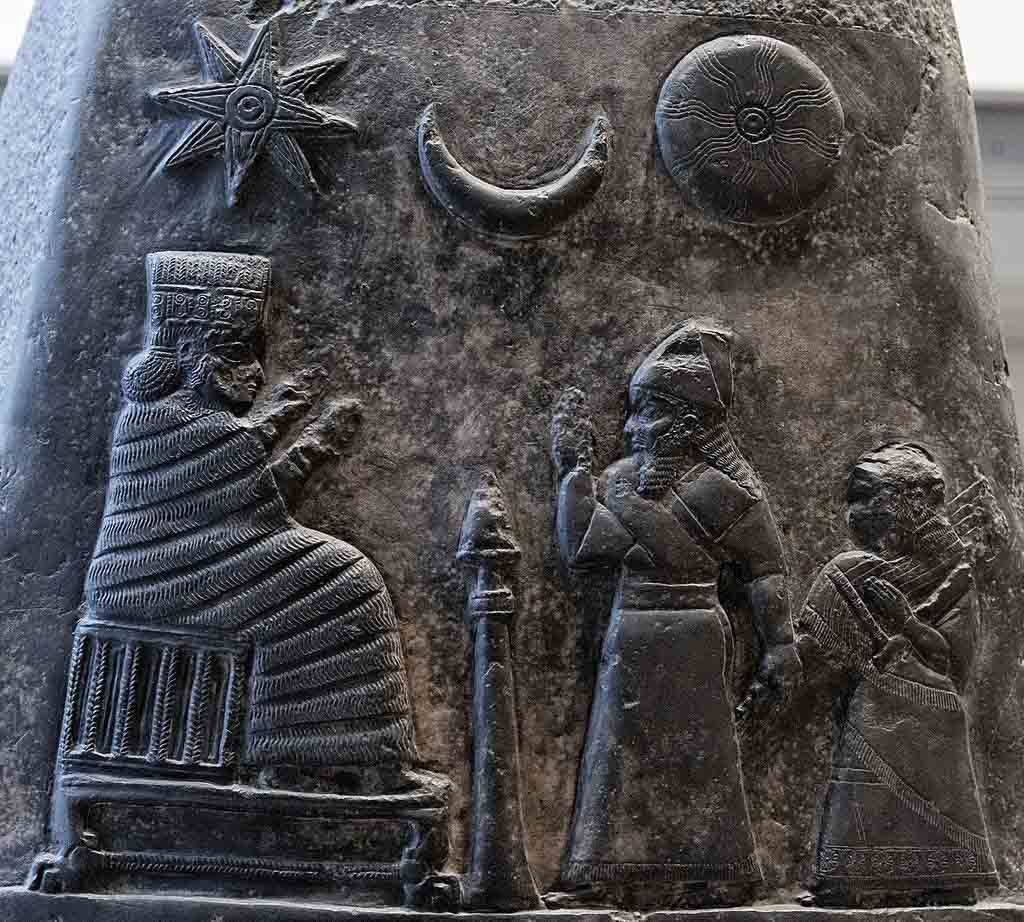
The 8-pointed star holds immense cultural and religious significance across various historical contexts. It symbolizes celestial entities like the moon, sun, planets, stars, and comets. Its origins trace back to ancient Mesopotamia, particularly Babylon, where it was closely associated with the goddess Ishtar. Ishtar held sway over domains such as love, fertility, and warfare, and she bore a connection to the planet Venus, often referred to as the Morning Star.

Depiction of the star of Ishtar (Image source: Jastrow via Wikipedia)

The eight-pointed star’s significance is not confined to a single cultural sphere, but rather extends its influence across diverse global civilizations. For instance, among Canada’s indigenous peoples, the eight-pointed star serves as a representation of the sun radiating its brilliance in all directions. Furthermore, several formerly Soviet republics, upon gaining independence, incorporated the eight-pointed star into their national flags, symbolizing the sun, as exemplified by the flag of Azerbaijan.

The flag of Azerbaijan (Image source: Wikipedia)

The 8-pointed star holds a prominent position within Islamic art and architecture. Emma Clark, as detailed in her book “The Art of the Islamic Garden,” elucidates that this symbol signifies God’s Throne. This symbolism is rooted in a Quranic verse that prophesies the presence of 8 angels flanking God’s Throne on the Day of Judgment, correlating with the 8 points of the star. Remarkably, upon the Throne, an inscription reads, “My Mercy Supercedes My Wrath,” instilling a profound sense of hope in God’s boundless mercy and the prospect of salvation.

“And the angels are at its edges. And there will bear the Throne of your Lord above them, that Day, eight [of them]”

SURAH AL-HAQQAH AYAT 17 (69:17 QURAN)

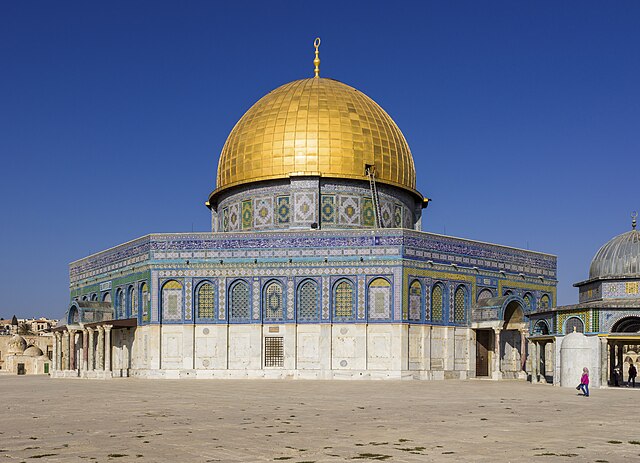
This numerical symbolism extends to the architectural layouts of various mosques, with notable examples including the Al-Aqsa Mosque and the Dome of the Rock with Najmat al Kods, traditionally believed to occupy the site of Solomon’s Temple.

The Rub-el-Hzib and the more floral Najmat-al-Quds

(Image source: https://farbound.net/najmat-al-quds-star-of-jerusalem-humayuns-mausoleum-nizzamuddin-east/)

Also, its predecessor, the symbol Rub El Hizb, characterized by two intersecting squares enclosing a central circle, holds particular significance within the Islamic context: in Arabic, the expression “Rub El Hizb” signifies an object or concept divided into quarters, visually reflected in the symbol itself, where two squares have their edges divided into segments.

Historically, Muslims employed the Rub El Hizb as a tool for the recitation and memorization of the Quran. The symbol serves to represent each quarter of a “Hizb,” which designates a distinct section within the holy Quran.

Rub El Hezb Symbole (Image source : LACMA/Wikimedia Commons/Public Domain)

In the world of Central Asian art and culture, the eight-pointed star enjoys prominence in numerous blue ceramic mosaics, exemplifying its enduring cultural appeal.

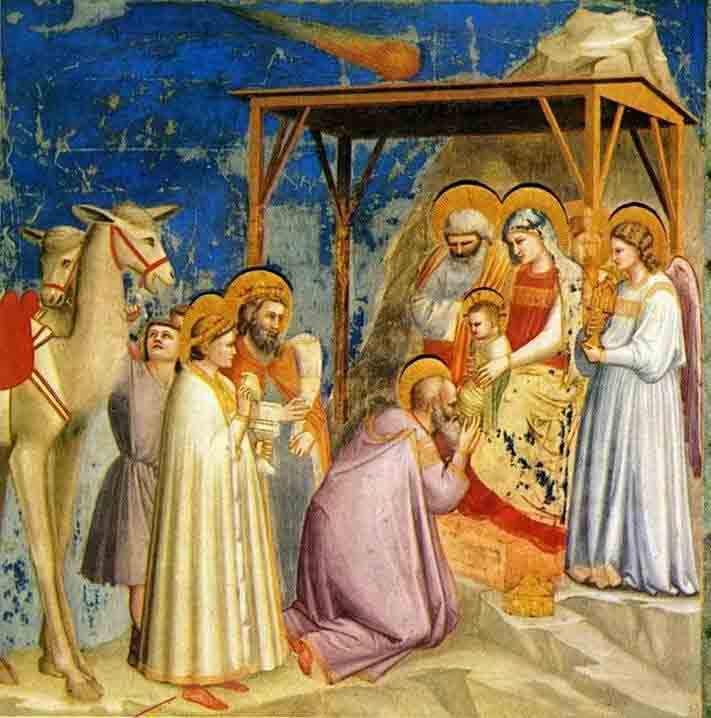
Within Christian sacred art, the eight-pointed Star of Bethlehem plays a pivotal role, guiding the three wise men to the birthplace of Christ and symbolizing the nativity of Christ and the redemption he offers to humanity.

Adoration of the Magi by Florentine painter Giotto di Bondone (1267–1337).

The Star of Bethlehem is shown as a comet above the child. 
(Image source: Hohum via Wikipedia)

In Hinduism, the Ashtha Lakshmi, also known as the star of Lakshmi, is a symbol made of two squares placed on top of each other at a 45-degree angle. This symbol represents the eight different forms of the goddess Lakshmi. Lakshmi is highly regarded as the goddess of fortune, wealth, and abundance.

This symbol is widely recognized and appreciated for its simplicity and is shared among various religions and civilizations around the world.

The initial emergence of the eight-pointed star in Islamic symbolism

Built between 687 and 691 A.D. during the rule of Arab Caliphs Abd-al-Malik and Al Walid I of the Umayyad dynasty, the Dome of the Rock stands as a significant achievement in Islamic architecture. It also served as an educational hub for Arabian architects and artists.

Inspired by Sassanid Persians, the Arabs embraced features like grand arches, ornate ornamentation, and Persian-style gardens. They also learned from the Byzantines how to construct large domes on tall drums, a technique seen in later Islamic structures worldwide, including the mausoleum of Humayun in Hindustan and the Taj Mahal.

The Dome of the Rock.
(Image source: Andrew Shiva via Wikipedia | CC BY-SA 4.0)

The Dome of the Rock took cues from early Roman-Byzantine structures with an octagonal floor plan, a fusion of circle and square. It was crafted by Byzantine Christian artisans following Islamic guidelines, fostering the exchange of construction techniques, interior design, and a passion for mathematics, especially geometry, among the Muslim Arab community.

Inside, the shrine featured intricate marble works, glass mosaics, and Arabic calligraphy. The eight-pointed star emerged as a symbol, blending into the decor and architectural design.

The most famous eight-pointed star in Malaysia

At the outset, the twin towers were conceived with a modest height of 1400 feet (427m) in mind. However, it was the vision and determination of Dr. Mahathir that transformed them into a global architectural marvel. He saw the potential for these towers to not only be significant structures but also iconic symbols of Malaysia’s ambition and identity on the world stage.

The design of Petronas tower.
(Image source: https://www.petronastwintowers.com.my/)

The PETRONAS Towers’ connection to Islamic symbolism is strikingly evident in their design, which forms an eight-pointed star when viewed from above. This architectural choice holds profound cultural and symbolic significance in Islamic tradition. The eight-pointed star symbolizes unity, harmony, and stability, reflecting the principles of balance and togetherness. Islamic art and geometric patterns heavily influence the towers’ aesthetics.

This incorporation of Islamic symbolism and aesthetics is a testament to the architects cultural sensitivity, acknowledging Malaysia’s Islamic heritage while simultaneously projecting the nation’s modernity and ambition on the global stage. The PETRONAS Towers stand not only as architectural marvels but also as iconic representations of Malaysia’s rich cultural tapestry and its its harmonious blend of tradition and progress.

References

  1. Eight Pointed Star Rug Design: https://nazmiyalantiquerugs.com/area-rug-guide/motifs-symbols/eight-pointed-stars-rug-design-motif/#:~:text=Christianity%3A%20In%20Christianity%2C%20the%208,the%20birth%20of%20Jesus%20Christ.
  2. Giotto – Scrovegni – -18- – Adoration of the Magi: https://commons.wikimedia.org/wiki/File:Giotto_-_Scrovegni_-_-18-_-_Adoration_of_the_Magi.jpg?uselang=en#Licensing
  3. Juz’ 1 of the Quran : https://www.learnreligions.com/juz-1-of-the-quran-2004552
  4. Learn About the Meaning of an Eight Pointed Star : https://mythologian.net/learn-about-the-meaning-of-an-eight-pointed-star/#:~:text=The%20eight%2Dpointed%20star%20represents,Hope%20symbol%20as%20Star%20Knowledge.
  5. PETRONAS Twin Towers: https://www.petronastwintowers.com.my/
  6. Rub el Hizb : https://en.wikipedia.org/wiki/Rub_el_Hizb
  7. Star of David : https://www.researchgate.net/publication/304113265_Star_of_David
  8. Symbolic attribute of the eight-pointed star and its relation to Imam Reza (AS) based on the numbers science (abjad) : https://hsi.kashanu.ac.ir/article_111923.html?lang=en
  9. The star that is a landmark in Islamic architecture. : https://farbound.net/najmat-al-quds-star-of-jerusalem-humayuns-mausoleum-nizzamuddin-east/
  10. What You Should Know About Octagrams – Eight-Pointed Stars : https://www.learnreligions.com/octagrams-eight-pointed-stars-96015

Tanjung Tualang Tin Dredge No. 5 (TT5) – A Refurbished Dredge in All its Glory

By V. Jegatheesan

Tanjung Tualang Dredge No. 5. Image credit: V. Jegatheesan.

The Tanjung Tualang tin dredge, also popularly referred to as TT5, is an old dredge that went out of use as the tin industry faded away in the 1980s, with tin giving way mainly to aluminium. Nostalgia and a keen interest in preserving this machinery, led to its refurbishment, so as to give the populace a chance to see how it worked and how it helped the tin mining industry. It is now located on the 9th Km, Jln Tanjung Tualang, 31000 Batu Gajah.

Tin has been a lucrative product in Malaya for a long time. The Dutch of the 18th century were well known to have negotiated agreements for tin supplies from the areas around Pulau Pangkor and Kuala Selangor. However, mining methods, such as panning, were very basic. A large tray or dulang, was used to scoop water and sand in the rivers. The sand and earth would be filtered out and the heavy ore would remain. This would be further processed to make ingots and then sold, ending up ultimately as tin products. Tin has had many uses. Its main usage was in the canning industry, making bullets and, nowadays, in the electronic industry in solder. Interestingly, while many think a tin can is all tin, it is actually a tinned can – a steel can, which gives it strength, plated with tin, which prevents corrosion!

Dulang washing was of course an arduous process and not very productive. Subsequently, better technology emerged including opencast tin mining in which pumps shoot water at high pressure onto the sloping ground. The loosened earth or slurry is conveyed to the top of a sluice – palong – andwater pushes it down trellises; the heavier ore is held back by wooden slats while the rest of the earth and sand flows into a large lake. The recovered ore is then sent to a smelter for further processing and export. This was still labour-intensive. These methods were used until the end of the large-scale tin-producing era. Dulang washing is back in practice with the current rise in demand for tin.

Image credit: A poster in the TT5 Visitor Centre

The dredge evolved from a simple ‘spoon dredge’ in 1862 through to the bucket dredge of the 1880s used in New Zealand and Australia. Since 1891, attempts were made to construct a dredge in Kinta, but all failed. In January 1913, Malayan Tin Dredging Ltd. initiated the first operational dredge in Batu Gajah; it later owned six of them. These were steam-operated. The TT5 is one of the five owned by its sister company, Southern Malayan Tin Dredging Ltd. It was built in 1938 by F. W. Payne and Company. Upgraded and electrified in 1963, it ceased operations in August 1982. In 1997, the Malaysian Mining Corporation (MMC), which subsequently owned the dredge, donated TT5 to the Perak State Government, which, since 2017, has spent almost Rm 10 million on its repair and maintenance.

A dredge in those days typically cost Rm 40 million to build. At today’s prices, a dredge would cost Rm 200 million. This behemoth could scrap up tin-bearing earth, 24/7, as is said nowadays. In very large quantities too. However, the cost was prohibitive so only companies with the ability to lay out large capital could afford the dredge. These were usually European companies, mainly British. This is why, other tin-mining methods continued. In due course, 123 dredges produced 60% of the tin, while other methods produced the remaining 40%. In 1912 some 80 per cent of Malaya’s tin production was under Chinese management, by 1931 British firms accounted for more than 60 per cent of total tin production.

Those who travelled along the Penang Singapore trunk road would remember seeing these dredges. But we all drove past assuming they would always be there. But not so. Over the years, greater use of aluminium, falling tin prices as well as increased production in Indonesia and China adversely affected the production in Malaysia. It was simply not economically viable.

TT5 is now restored to showcase how these mighty machines worked to contribute to the economy of Malaysia. Its actual operation area was not far off from where it is now located. A guided tour is provided and takes about 30 minutes. In fact this article transcribes the tour by Volunteer Guide, Encik Hafizal Arif. Note that this article describes TT5 only as other dredges will differ in size and equipment.

The process in its elements is very simple. Large quantities of tin-bearing earth were continuously scrapped from the ground by a conveyor made up of large metal buckets, processed mechanically to separate the tin from the earth, collect the tin and discharge the rest back into the lake on which it floats. A more detailed description, avoiding technicalities, is transcribed from the guided tour.

The dredge weighs 4500 tons and is 75m in length, 19.5m in width and four floors in height. A NO ADMITANCE signage at the entrance is in English, Chinese, Punjabi, Jawi and Tamil, reflecting the various groups of people working on this dredge.

Signage reflecting the various groups working on the dredge.
Image credit: V. Jegatheesan.

The entire structure floats on 47 pontoons. These are hollow tanks which keep the dredge afloat in the water. In this dredge, the pontoons are 3.1m deep and are accessible for maintenance, mainly patching leaks.

           Pontoon top with the cover off. Image credit: Maganjeet Kaur.

TT5 has 115 buckets. These two-ton buckets are set on a looping chain, or ladder, in the front of the dredge. The ladder continuously circulates and can be lowered for the buckets to scrape the lake bed or the earth face on the lakesides beneath the water. Being a moderately-sized dredge, TT5 can scrape down to 33m. Other dredges can go down to even 100m.

Buckets on the looping chain. Image credit: V. Jegatheesan.

As the now three-ton buckets move up the ladder, they carry the scooped earth to the top of the dredge into trommel screens. These screens are cylindrical and perforated.

Jets of water wash through the earth in the trommel screen to separate the heavier tin ore. The ore is passed into vibrating jigs to further filter the ore. The jig is equipped with a screen or sieve that allows smaller particles to pass through while retaining the larger, denser particles. After a second jig, the purer ore (Cassiterite Concentrate) is channelled to be stored in tanks. We were restricted from visiting this area. The water used in the screen and jigs is pumped up from the lake itself. The sand and unwanted material after these processes, called tailings, are discharged through the chutes out at the back of the dredge into the lake.

The tank can hold one ton and one day’s dredging produced 30 tons. A crane on either side will carry the tanks out to the lakeside. It is later sent to the smelting plant in Penang. The resulting ingots are then exported.

A rough estimate values a day’s production at 30,000 to 35,000 USD of the time. It seems that a year’s production could recover the cost of the dredge! This is the reason that the tank area access is limited only to authorized personnel to prevent theft by stuffing ore into pockets or helmets. Even the discharge chutes for the tailings have a spider web netting to prevent anyone from climbing in.

Hafizal Arif explaining the storage tank for the ore. Image credit: V. Jegatheesan

Spider netting encircling the discharge chutes. Image credit: V. Jegatheesan.

A description of the dredging process. Image credit: Maganjeet Kaur

              Poster in the Visitor Centre. Image credit The Tin Board.

The operation is managed by a Dredge master. Employees work in three shifts and do not live on board. They are ferried by a small boat. Each shift has 20 people. There is a pantry area for them to rest and have their meals, which are brought by them as there are no cooking facilities. There is a toilet at the back, over the lake.

Pantry at the top. Image credit: Maganjeet Kaur.

Though TT5 is tethered to the lakeside by ropes today, the dredge had cables in front and sides. The cables were attached to a mooring winch. The dredge could be moved by winching in or out.

Tethering of dredge to the side. Right image shows the gangway to the dredge. Image credit: V. Jegatheesan.

Views of either side of the dredge decks. Image credit: V. Jegatheesan.

Over the years, dredges have been sold to Thailand or Indonesia, while some have even been scrapped.In 2015, the Perak State Government mandated the Menteri Besar Incorporated (MB Inc.) to conserve the TT5. Visitors can go onto the dredge and its workings are explained by guides. Visits can be made by calling ahead and specifying a time slot or walking in to join the next group.

Board showing layout of the TT5 Park. Image credit: V. Jegatheesan.

Since 2018, TT5 has been part of the Kinta Valley National Geopark. The Visitors Centre and TT5 tours are managed by the Operation Executive, Encik Aizad Azeli.

To cap the extensive works to preserve the TT5, in March 2023, the Institution of Mechanical Engineers United Kingdom, presented Tanjung Tualang Tin Dredge No.5 an Engineering Heritage Award for being well-maintained, contributing to the state and national economy and having its own heritage characteristics. It is the first tin mining dredge to receive such an award.

Image credit: New Straits Times 2023, March 23

In 2023, TT5 received the Travellers Choice Award from Tripadvsor.

TT5 is well worth a visit.

References:

Last surviving tin dredge TT5 receives IMechE award from UK. (2023, March 23). The New Straits Times. https://www.nst.com.my/news/nation/2023/03/892188/last-surviving-tin-dredge-tt5-receives-imeche-award-uk#:~:text=BATU%20GAJAH%3A%20The%20iconic%20Tanjung,Engineers%20(IMechE)%20United%20Kingdom.

EARLY 20TH CENTURY TIN MINING DEVELOPMENT. In Economic Heritage Malaya. https://www.ehm.my/publications/articles/about-tin-mining#:~:text=EARLY%2020TH%20CENTURY%20TIN%20MINING,much%20of%20the%2020th%20century.

A gold mine in tin. (2007, August 30). In Malaysian Bar. https://www.malaysianbar.org.my/article/news/legal-and-general-news/general-news/a-gold-mine-in-tin

Tanjung Tualang Tin Dredge. (2023). httpstt5perak.com

The Islamic Art of Wood Carving

By Emna Esseghir

Introduction

God is beautiful and He loves beauty.

— Tradition (hadith) of the Prophet Muhammad from Sahih Muslim

Within the Islamic theological framework, a core tenet asserts that God possesses the attribute of beauty, and this inherent beauty finds manifestation in His creations. It is a frequently reiterated notion that God is intrinsically beautiful, and He exhibits an affinity for aesthetics and beauty. This theological premise underscores the significance of aesthetics, harmony, and beauty across diverse facets of Islamic culture, encompassing art, architectural design, and the ethical comportment of individuals.

The concept that God cherishes beauty is intrinsically associated with the idea that human beings are encouraged to both recognise and cultivate beauty in their actions and environmental milieu. This is prominently exemplified in the rich artistic and architectural traditions of Islamic civilisation, wherein intricate designs, eloquent calligraphy, and geometric patterns are judiciously employed to embellish religious edifices, palatial structures, and various other architectural forms.

One of the major elements used to express this beauty in Islamic art was wood carving.

1. What is wood carving?

Wood, as the most abundant natural resource, has historically captivated the attention of humankind. Intriguingly, in numerous regions of the Islamic world, wood is relatively scarce, yet it enjoys a distinguished status and necessitates a high degree of craftsmanship. Within the context of Islamic art and architectural construction, woodcarving emerges as a prominent technique, particularly in the context of mosque construction. This art form exerts a profound influence, elevating the aesthetic appeal of these religious edifices while imbuing them with profound symbolism.

Woodcarving, at its core, entails the intricate creation of designs in wood, achieved through manual dexterity and specialised carving implements. The array of motifs ranges from the intricate and traditional to geometric precision or abstract patterns. A pivotal preliminary step in woodcarving involves the meticulous identification of the wood’s grain and texture before embarking on the carving process. The resulting carved elements consistently manifest in an abstract fashion, representing botanical elements or geometric configurations and can be categorised into three distinct architectural components: structural, elemental, and ornamental.

Woodcarving serves as both a technique and a final product, in which wood is meticulously shaped into decorative and artistic forms. Wood, as a widely accessible and sustainable resource, is available in diverse sizes suitable for crafting objects of various scales, from minor artefacts to grand architectural structures. Its intrinsic robustness enables it to bear substantial loads and span extensive areas. Furthermore, wood is amenable to manipulation by a judicious application of manual labor and lends itself readily to precision shaping using rudimentary hand tools. Its innate spectrum of colors, tonal nuances, and susceptibility to diverse surface treatments enhance its allure, rendering it an aesthetically pleasing and adaptable material.

2. Historic evolution of wood carving art in the Islamic world

Undoubtedly, the artistic evolution of wood carving among Muslim artisans during the formative centuries of Islam constitutes a remarkable historical and artistic phenomenon. This creative metamorphosis was profoundly molded by the convergence of Hellenistic (in the eastern Mediterranean and Middle East, the period between the death of Alexander the Great in 323 BCE and the conquest of Egypt by Rome in 30 BCE) and Sassanian artistic influences (officially known as Eranshahr was the last Iranian empire before the early Muslim conquests of the 7th–8th centuries AD).

The amalgamation of these disparate traditions ignited the development of a distinctive Islamic wood-carving style that left an enduring imprint on the artistic panorama of the Islamic realm.

A prominent exemplar of early Abbasid wood carving, symbolising the culmination of these influences, resides in the prayer pulpit enshrined within the Qairawan mosque in Tunisia. This masterful creation, likely transported from Baghdad during the third/ninth century under the patronage of influential figures from the Aghlabid dynasty, stands as an epitome of wood-carving craftsmanship affiliated with the Baghdad School.

Adorned with meticulously crafted panels featuring geometric motifs and designs, it is believed to have been commissioned during the reign of Harun, the Abbasid Caliph.

This architectural marvel remains a source of inspiration for contemporary abstract art, serving as a testament to the enduring relevance of its patterns and designs.

An old postcard (1900) showing the carved teak 
Minbar and the Maqsura. Photo source: Wikimedia

The intricate detailing of the minbar.
Photo source: Issam Barhoumi- Wikimedia  

Over time, Abbasid artists developed their own unique style, breaking away from the artistic traditions of the Sassanian and Hellenistic periods. This new Abbasid style became popular among Egyptian craftsmen during the Tulunid era (935-969), especially in Cairo.

As the Abbasid artistic style matured, Egyptian craftsmen refined it further, creating a distinctive artistic expression by the 10th century. They began carving deeper and creating more rounded shapes, showcasing their creative skills.

Assessing how Egypt’s rich heritage of crafts and arts influenced the advancement of wood-carving by Egyptian artists is a complex task. Egypt’s legacy offered fertile ground for innovation, contributing to the mastery of Egyptian wood carving.

Over time, geometric patterns gave way to different forms of decoration, like intricate carvings of animals and arabesque scrolls. These works demonstrated the artists’ meticulous attention to detail, combining technical expertise and hard work.

During the Fatimid era, some wood panels stood out for their exquisite artistry. They portrayed typical Egyptian scenes, with a strong focus on birds and animals, reflecting the ancient Egyptian tradition of revering specific animals as deities, adding a cultural dimension to the wood carvings.

In the Ayyubid period, the influence of the Fatimids continued in wood carving, with arabesque scrolls becoming more intricate. The use of nasj script instead of Kufic inscriptions reflected evolving artistic tastes. This period also saw a greater commitment to intricate detailing, emphasising the dedication of the artists.

Panel with Inscription probably 13th century
Photo source: https://www.metmuseum.org/art/collection/search/448499

In Egypt, wood carving reached its peak over time but gradually declined in the 15th century, marking a significant turning point in its evolution.

Conversely, in Iran, wood carving was mature even during Mahmud of Ghazni’s rule during Ghaznavide empire. A preserved door from his tomb in the Agra Museum demonstrates the innovative approach of Iranian artists, characterised by deep undercutting and multiple planes, showcasing an Iranian stylistic imprint.

Gates of the tomb of Mahmud of Ghazni, (James Atkinson in 1842)

Although there are relatively few wood carvings from the Saljug period, it’s reasonable to believe that artists in Asia Minor during the 12th and 13th centuries crafted exceptional works, resonating with the quality seen in Egypt and Syria.

Wooden Sarcophagus from the Seljuk Period
the Museum of Turkish and Islamic Art in Istanbul.
Photo source: https://www.alamy.com/stock-photo/seljuq-period.html?sortBy=relevant

While wood carvings from the early Mongol period are scarce, historical evidence suggests that Iranian artists in Western Turkestan achieved remarkable technical perfection in the 14th century. The zenith of wood carving persisted during the Safavid period, although signs of decline appeared in the 17th and 18th centuries. During this era, panels transitioned from intricate carving to painting and lacquering, marking a transformative phase in the history of Islamic wood carving.

Wood carving from Safavid Period. Photo source: Hayk – Wikimedia

3. Wood carved artefacts with Islamic influence at the National Museum

The practice of traditional Malay wood carving represents a seminal facet within the domain of Malay cultural heritage, encompassing profound and substantive cultural importance.

It predates the arrival of Islam, but since the adoption of Islam as the religion of the Melaka Sultanate, we can distinguish some specific characteristics:

Integration of Arabic Calligraphy: A defining feature of Malay wood carvings within Islamic art is the sophisticated integration of Arabic calligraphy. These carvings frequently incorporate Quranic verses or excerpts from Islamic texts, meticulously inscribed with exceptional finesse. The utilisation of calligraphy transcends mere ornamental aesthetics; it serves as a conduit for the visual representation of sacred Islamic scripture, infusing these wooden artefacts with profound religious significance. The interplay of script styles, such as Kufic or Naskh, further underscores the artistic and spiritual dimensions of these carvings.

Doors panels inscribed with Quranic verses, on display at
Gallery B, National Museum. Photo source: Emna Esseghir

Wooden panel with sentence from the Holy Quran used to
decorate a muslim chapel, on display at Gallery B, National Museum.
Photo source: Emna Esseghir

The Setul palace door, displayed at Gallery B, National Museum.
Photo source: Maganjeet Kaur

Harmonious Synthesis of Malay and Islamic Aesthetics: A salient feature of these carvings is their ability to harmoniously blend indigenous Malay motifs with Islamic artistic elements. This synthesis culminates in a unique visual language that encapsulates the multifaceted cultural identity of the Malay-Muslim community. By seamlessly interweaving Malay flora for example with Islamic motifs, these carvings offer a nuanced expression of both regional and religious identities, emphasising their role as cultural artefacts and religious conveyors.

Wooden panel with flora and sentence from the Holy Quran,
on display at Gallery B, National Museum. Photo source: Emna Esseghir

To conclude, Arabic Calligraphy meticulously inscribed with Quranic verses adds profound religious significance, while geometric precision reflects metaphysical themes. The harmonious synthesis of Malay and Islamic aesthetics highlights cultural identity. But beyond aesthetics, these carvings serve functional roles in Islamic architecture, enhancing sacred spaces and connecting the physical and spiritual realms. In essence, Malay wood carvings contribute significantly to the artistry and spirituality of the Malay-Muslim heritage.

References

A Study of Woodcarving Motifs on Traditional Malay Houses in Kuala Pilah, Negeri Sembilan: https://melaka.uitm.edu.my/ijad/images/PDF/1.pdf

DEVELOPMENT OF MALAY WOOD-CARVING MOTIFS FROM ISLAMIC PERSPECTIVES: https://oarep.usim.edu.my/jspui/bitstream/123456789/14524/1/4.BI.%20SAIS2021%20-%20Development%20Of%20Malay%20Wood-Carving%20Motifs%20From%20Islamic%20Perspectives.pdf 

Fatimid Wood-Carvings in the Victoria and Albert Museum: https://www.jstor.org/stable/862433

Gates of the tomb of Mahmud of Ghazni, by James Atkinson in 1842: https://commons.m.wikimedia.org/wiki/File:Gates_of_the_tomb_of_Mahmud_of_Ghazni,_by_James_Atkinson_in_1842.jpg

JULFA i. SAFAVID PERIOD: https://www.iranicaonline.org/articles/julfa-i-safavid-period

Panel with Inscription: https://www.metmuseum.org/art/collection/search/448499

The Islamic Art of Wood Carving: Exquisite Patterns on Furniture and Decorative Objects: https://russia-islworld.ru/en/kultura/the-islamic-art-of-wood-carving-exquisite-patterns-on-furniture-and-decorative-objects-2023-08-01-34970/

Wooden Sarcophagus from the Seljuk Period: https://etc.usf.edu/clippix/picture/wooden-sarcophagus-from-the-seljuk-period.htm

M & M – Muzium Negara & Mini Marathon

By Eric Lim

On 31 August 2023, our country celebrated its 66th National Day. This auspicious day also marked the 60th anniversary of Muzium Negara / National Museum since its establishment. The National Museum was officially declared opened by the Third Yang DiPertuan Agong, Tuanku Syed Putra Al-Haj Ibni Almarhum Syed Hassan Jamalullail (Raja of Perlis) in 1963.

The opening of Muzium Negara on 31 August 1963 / Photo source: National Museum’s 60th Anniversary Exhibition: A Retrospective. 

The present Muzium Negara building was constructed on the site of the former Selangor Museum which stood from 1906 to 1945. On 10 March 1945, a part of the building was mistakenly bombed by the Allied Forces and many artefacts were moved to the Perak Museum in Taiping. After Malaya’s Independence, the idea of establishing a National Museum was mooted and plans to build one was announced in 1959. Ho Kok Hoe, an architect from Singapore was commissioned to design the building and in 1961, Tunku Abdul Rahman endorsed the architectural design. 

The design is based on the architectural characteristics of the palaces of the Malay Kings and another unique feature is the two huge murals made of Venetian glass mosaic that cover the facade of the building. The murals highlight the history and craft of the country respectively and it was designed by Cheong Lai Tong. The mosaic tiles were donated by Lee Kong Chian (of Lee Rubber) and Tan Kah Hee (founder of Xiamen University, China). Also, the tiles in the main hall were contributed by the Government of Pakistan. Back then, the National Museum together with Parliament house, National Monument (Tugu Negara) and the Lake Gardens (Perdana Botanical Garden today), formed a large recreational space. And the National Museum was certified a National Heritage Building under the National Heritage Act 2005 on 11 August 2015.

Muzium Negara / Photo source : National Museum

In conjunction with the jubilee anniversary celebration, the Department of Museums Malaysia (Jabatan Muzium Malaysia / JMM), organized a host of activities for four days starting from 31 August to 3 September. It includes two major exhibitions, National Museum’s 60th Anniversary Exhibition : A Retrospective at the main hall and Malaysia My Motherland Exhibition at Galeri 2, both running from 31 August to 31 October. Besides exhibitions, other programmes were Echo : Poetry Night, Mini concert, Media & Strategic Partner Appreciation Ceremony, National Museum 60th Anniversary Run (Mini Marathon) and launching of the Time Capsule by the Minister of National Unity, Aaron Aro Dagang at the official opening ceremony held on 1 September. 

Museum Volunteers (MV) which is a non-profit, non-political and non-religious group supported by the Department of Museums Malaysia and based at Muzium Negara, was invited to some of the events. The highlight was the giving away of graduation certificates by the Director General of the Department of Museums Malaysia to graduates from Batch 38 and 39 at the Media & Strategic Partner Appreciation Ceremony held on the evening of 1 September at the Mainstage (Pentas Utama). It was truly a memorable occasion for the fresh graduates as it was the first time that it was organized on such a grand scale. At the same function, JMM also awarded a certificate to senior MV member, V. Jegatheesan (fondly known as Jega) for his significant contributions to the group.

MV graduates and Jega with their certificates.
Photo source: Courtesy of Lim Ee Lin

MV members also took part in the National Museum 60th Anniversary Run (Mini Marathon) that was held on 3 September 2023. The run was separated into two categories, namely the 5km Fun Run and the 10km Run.

A map of the 10km marathon route. Photo source: Eric Lim

The longer route covered the perimeter of Perdana Botanical Garden with a detour towards Masjid Negara (National Mosque), and a turnaround before heading back to the garden to the finishing line at Muzium Negara.

Enroute, we passed the following sites:
Royal Lake Club Kuala Lumpur (Kelab Taman Perdana DiRaja Kuala Lumpur)
It was founded on 16 August 1890, two years after the Lake Gardens was established. Initially set up for the British working in the country, it has since evolved to become a leading cosmopolitan social club. In 1985, the name changed to Royal Lake Club when it was bestowed the royal patronage by the late Sultan Salahuddin Abdul Aziz Shah of Selangor.

KL Bird Park
The KL Bird Park is the world’s largest free flight walk-in aviary. It is home to more than 3,000 birds comprising over 200 different species. It was opened in 1991.

Tun Abdul Razak Memorial
It was the official residence building of our second Prime Minister, Tun Abdul Razak, from 1962 until his passing in January 1976. It was then known as Sri Taman Building. The building was later turned into a museum and was officially opened to the public on 6 May 1982 to commemorate his service and contributions to the country.

National Planetarium (Planetarium Negara)
It had its soft opening to the public in 1993 and was officially opened by the then Prime Minister, Tun Dr Mahathir Mohamad on 7 February 1994. The National Planetarium is within walking distance from Muzium Negara, connected by an overhead pedestrian bridge.

I was initially undecided whether to go for the fun run or 10km but thanks to fellow MV Emna who coaxed me into taking the longer route. I managed to complete within the time limit but I must admit that I lost out to avid runner and Hong Kong actor, Chow Yun Fat who still continues his running regimen in spite of the injuries he suffered two months ago. Kudos to fellow MVs who completed the run, short or long. The run was a perfect wrap up for the Muzium Negara celebrations.

MVs with their finishing medals.
Photo source: Courtesy of Kulwant Kaur

References

HK actor Chow Yun-fat continues to run despite doctors’ orders to stop following fall | Malay Mail: https://www.malaymail.com/news/showbiz/2023/08/15/hk-actor-chow-yun-fat-continues-to-run-despite-doctors-orders-to-stop-following-fall/85336

Lake Gardens Kuala Lumpur | Attractions | Wonderful Malaysia: https://www.wonderfulmalaysia.com/attractions/lake-gardens-kuala-lumpur.htm

Memorial Tun Abdul Razak: http://www.arkib.gov.my/web/guest/memorial-tun-abdul-razak3

National Museum: http://www.muziumnegara.gov.my/en/national-museum

Royal Lake Club: https://www.royallakeclub.org.my/

Malaysia Tanah Airku – Curator’s Tour

Article by Subramaniam a/l A V Sankar

Curator Encik Nasrulamiazam giving us a walk-through of the exhibition.

The exhibition poster. Source: Muzium Negara

6 fortunate MVs who could respond to a 1-day notice were fortunate to have had a conducted tour of the exhibition Malaysia Tanah Airku (Malaysia, My Homeland) on Thursday 7th Sept, by the exhibition Curator himself, Encik Nasrulamiazam, the Deputy Director of Muzium Negara, now being held at Gallery 2 in Muzium Negara until October 2023.

The exhibition is shown through 7 sections within starting with the early history of Tanah Air – the archipelago and island territories of South east Asia stretching from Indo-China to Indonesia.

At the introduction section of the exhibition.

These lands were also referred to as Nanyang in the Chinese records, Suvarnabhumi and Golden Chersonese in Indian and European records and comprised lands populated by expert Malay seafarers who facilitated trade all the way from China to India.

In this 1st section, Tanah Airku, our own part of that world, Malaysia is highlighted! Various texts by varied international scholars and traders are exhibited in the 1st gallery to show the importance of our nation in the ancient world.

There are many rare, 1st edition copies of Merdeka news and Articles here to capture the mood of independence in 1957.

In the next gallery is a fascinating insight into various selected flora and fauna in our country.

A display of the taxidermy collection.

The flora shown is mostly of those used as herbs with medicinal qualities, a very educational insight into the richness of our tropical flora.

A replica of the rafflesia.

The fauna is shown through expert taxidermy work on various birds, reptiles and mammals and highlights the colourful diversity found here. It is a great chance to get close to wild animals in safety!

The hawksbill turtle.

In section 3, we get to see panoramic photos of iconic buildings in places around the country both as stills and videos. The quality of the photography is breathtaking and gives a unique, bird’s eye view of many familiar, iconic features, like the KL Mosque, to give a fresh insight and a 3D view to provide mesmerizing new angles to sights we thought we knew.

The exhibition then moves to the entertainment scene and highlights particularly the versatility of our cartoonist, Lat and film and acting legend, P Ramlee through their many cartoons and films, a nostalgic reminder to all.

The last gallery shows our sporting legends like Lee Chong Wei and other sports achievements in the country with displays of some of the old soccer and rugby trophies that were gloriously earned.

The exhibition is a work of love and done with passion by the Curator and well worth a visit to get the ‘feel good’ effect we enjoyed.

Our group photo with the Curator.

Heartfelt thanks to Curator Encik Nasrulamiazam for his efforts and explanations.