By Eric Lim
In school I was told by my Tawarikh teacher that a Hindu prince from Palembang by the name of Parameswaraonce fled from Temasek (Singapore) after he had assassinated the local chief. One afternoon, whilst Parameswara and his followers rested under a tree, they witnessed a fight between their dogs and a little kancil deer. Kancil stood its ground and kicked the dogs into the river. Prince Parameswara was so overwhelmed by the bravery of Kancil that he immediately announced that he would make this place his new kingdom. He then asked the name of the tree beneath which they were resting: it was the Melaka tree.
Like Melaka, many cities and towns in Malaysia are named after trees, fruits or plants, e.g. Pulau Pinang (pinang palm tree), Ipoh (ipoh tree), Tanjung Rambutan (rambutan), Durian Tunggal (durian). But have you heard of a small town in Johor by the name of Kelapa Sawit? Located along Federal Route 1 on the Jalan Kulai – Air Hitam road, its name literally translates as ‘oil palm’, a clear indication of the town’s close association to the palm oil industry.
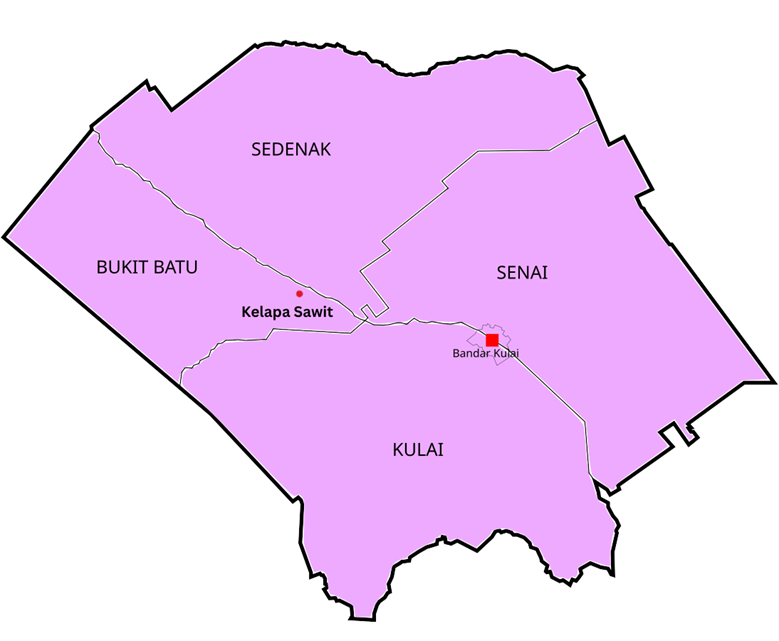
Kelapa Sawit is situated in the mukim (subdistrict) of Bukit Batu, one of four mukims that make up the district of Kulai. The main administrative town of the district is Bandar Kulai, 9 km south of Kelapa Sawit. It became a full district on 1 January 2008, known at that time as Kulaijaya District. In August 2015, Sultan Ibrahim Ibni Sultan Iskandar (the current Yang DiPertuan Agong) ordered the State Government that it, however, should revert to its original name of Kulai. The origin of the town’s name dates back to the 19th century when an influx of turtles coming to shore was observed each time the area flooded. The Chinese, mainly Hainanese at that time, named it Kulaimeaning ‘turtle coming’.
(龟来)
The following is a brief historical overview of the Johor Sultanate and the state agriculture sector. Immediately after Melaka fell to the Portuguese in 1511, Sultan Mahmud Shah fled to the inland areas of the south, then to Pahang and Bintan in the Riau islands. In 1528, Sultan Alauddin Riwayat Shah, son of Sultan Mahmud Shah, established the Johor Sultanate by settling his base at Johor Lama, along the Johor River. The kingdom managed to overcome prolonged war with the Portuguese and Aceh during which they were forced to relocate their capital 20 times, each time moving further upstream of the Johor River. Finally in 1641, Johor, together with the Dutch and Acehnese, captured Melaka from the Portuguese. For their part in taking Melaka, Johor was offered special trade and political privileges by the Dutch. By the 19th century, the sultanate grew to control the Straits of Melaka. In 1819, Stamford Raffles succeeded in acquiring the lease of Singapore from Johor and the rights for the British East India Company (EIC) to set up a trading post. The signatories for Johor wereSultan Husain and Temenggong Abdul Rahman.
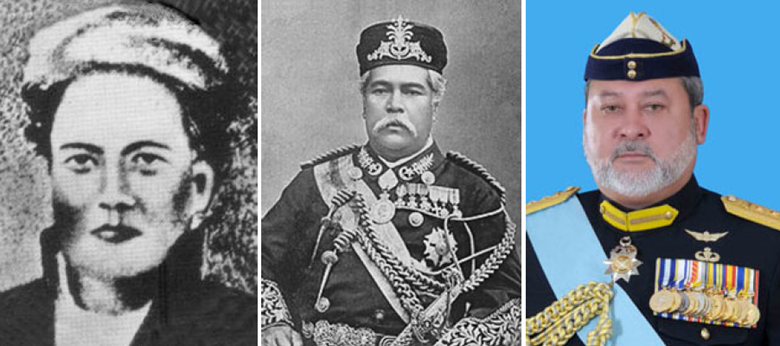
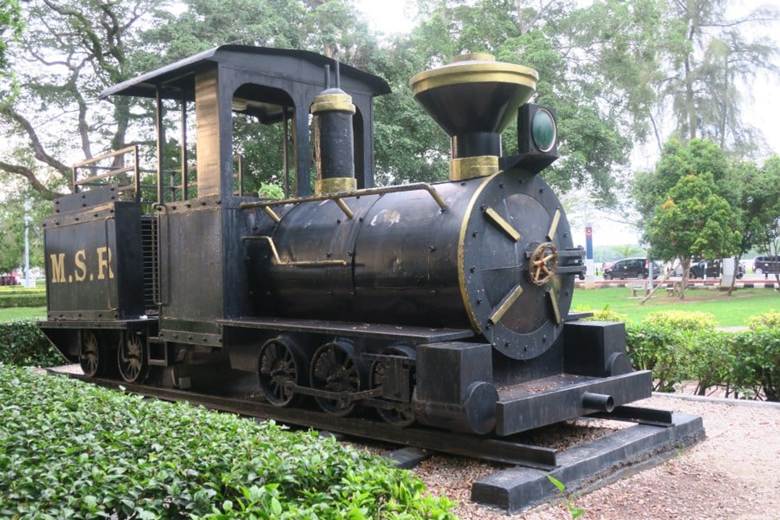
In 1825, Daeng Ibrahim succeeded Abdul Rahman as the Temenggong of Johor. He immediately went on to develop Johor as a centre for the production of pepper and gambier by implementing the ‘Kangchu system’ for Chinese cultivators and importing labourers from Java. Essentially the Kangchu system was a scheme to develop a large part of virgin jungle into town and cultivated land. The first area to be developed was along the Sekudai (Skudai) river in 1844, followed by the Tebrau river area. Later, it covered the northern region, including Muar, Yong Peng, Kota Tinggi, Endau and Batu Pahat. In 1855, the entire state of Johor was ceded to Temenggong Ibrahim in a treaty signed by Sultan Ali Iskandar Shah. In the same year, Temenggong Ibrahim established the town ofIskandar Puteri in Tanjong Puteri. Following his death in 1862, his son Abu Bakar took over, using the title Dato’ Temenggong Sri Maharaja Johor, which he later shortened toMaharaja Abu Bakar. Under his administration, Johor continued to develop until he gained the trust and recognition of the British as Sultan of Johor. In 1866, Abu Bakar changed the name of Iskandar Puteri to Johor Bahru and three years later, he ordered the construction of the ‘Johor Wooden Railway’, linking Johor Bahru to Gunong Pulai. The second railway line in the state,the ‘Muar State Railway’ connecting Muar to the coastal settlement of Parit Jawa, began operations on 11 March 1890. Both these lines were funded from the state’s own coffers. Sultan Ibrahim reigned as Sultan of Johor from 1895 until his passing in 1959. He was succeeded by Sultan Ismail (1960-1981) followed by Sultan Iskandar (1981-2010). On January 23, 2010, Sultan Ibrahim ibni Almarhum Sultan Iskandarbecame Sultan of Johor; he was installed as the 17th Yang DiPertuan Agong of Malaysia on 31 January 2024.
The introduction of the Kangchu system had made Johor a key state in the agricultural sector, becoming a major producer of pepper and gambier in the 19th century. The Kangchu system was eventually abolished in 1917 under the Kangchu Rights (Abolition) Enactment during the British administration. Chinese farmers then turned to growing coffee, tapioca and pineapple. With the advent of the automobile industry, rubber became the main commercial crop. After independence, however, the Malayan government’s focus turned to diversifying the economy, paving the way for the formation of the Federal Land Development Authority (FELDA).The new agency was tasked with the resettlement of the rural poor into newly developed areas and to organize smallholder farms growing cash crops, mainly rubber and palm oil. Johor became one of the benefactors of the scheme as there was a significant shift to the cultivation ofpalm oilin the state. Johor soon became the state with the highest palm oil plantation in the Peninsula.
By the turn of the century, Johor had emerged as a modern state of the Malay Peninsula. The railway line passing through Johor was completed in 1907 and officially opened to the public in 1909. It was initially known as the ‘Johor State Railway’ but three years later, its operation came under the ‘Federated Malay States Railway’ (FMSR)who leased it for 21 years. As for road transport, the Johor Bahru–Kulai section of the Federal Route 1, the oldest federal highway in the country, was completed in 1915, followed by the Kulai–Yong Peng section in 1928. The availability of both rail and road made Kulai easily accessible and it soon developed into an administrative hub for the surrounding area.
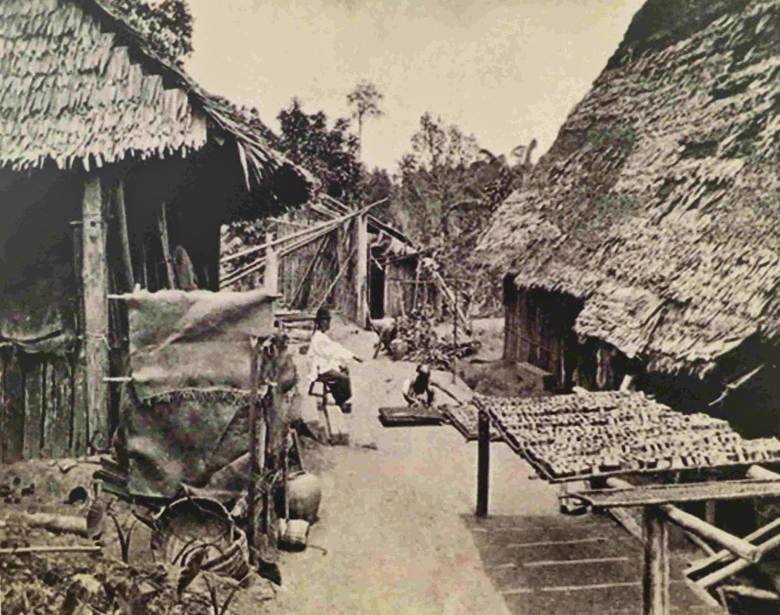
The town of Kelapa Sawit (加拉巴沙威) is believed to have its origins in the 1930s when the first group of Chinese immigrants, particularly Hopo Hakkas from Kulai, moved north and settled near the 24th milestone. Over time, more Hopo Hakka migrants arrived and expanded further into the 26th and 27th milestone. They were engaged in rubber tapping, pineapple farming, vegetable planting and rearing pigs. The settlement was initially known as Changan Village. During ‘The Emergency’ of 1948 – 1960, the Briggs Plan (1950) – a programme to resettle rural populations into New Villages throughout the country– was implemented. Residents of this area were forced to relocate to a New Village on the 26th mile. It was believed that during this resettlement, the town received the new name of Kelapa Sawit, due to its location near a palm oil estate. Eight schools in the surrounding area were merged into one, the precursor to the current SRK (C) Sawit. A British reconnaissance plane had earlier mistakenly bombed one of the original schools, believing it to be a communist stronghold. Inhabitants of new villages were to be kept under strict rules , which included curfew, body searches, identity card checks and food restrictions, such as food rationing and communal cooking. The village head of Kelapa Sawit was against the practice of communal cooking which he called ‘big pot meals’, thus refusing to sign the agreement. Due to his persistence, the British relented; the villagers were exempted from the practice.
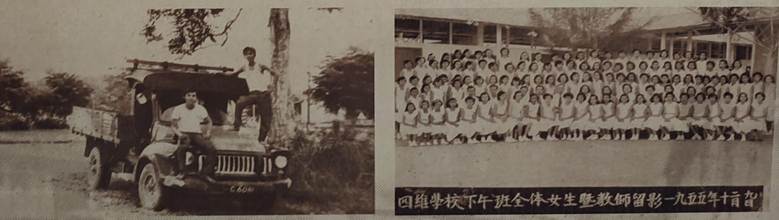
In the 1960s and 1970s, large scale palm oil plantations were established in Kelapa Sawit, leading to the growth of the local economy and the development of an infrastructure to support the industry. Besides palm oil, Kelapa Sawit was also known for its pepper cultivation upon which 65% of its residents relied. This came to an end in 1982 when the government imposed an export tax on pepper.
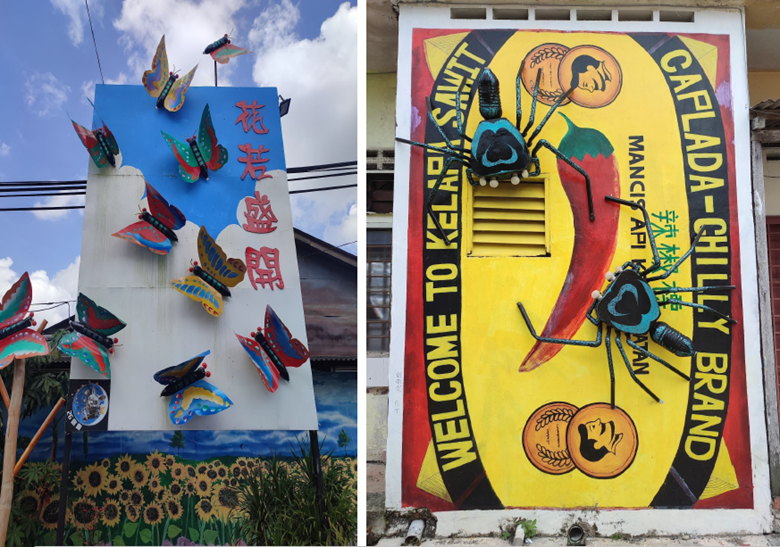
The ‘South Johor Economic Region’was established in 2006 as a major economic zone aimed at attracting investment and promoting development in Southern Johor. It was later renamed Iskandar Malaysia, in honour of the late Sultan Iskandar. Kelapa Sawit is located within this economic corridor which has fostered economic growth and seen an increase in industrial and commercial activities within the area. The ‘Johor Singapore Special Economic Zone’ (JS-SEZ)agreement signed between Singapore and Malaysia further turbo-charged development in Southern Johor. Kelapa Sawit has since evolved from a purely agricultural ecosystem into a thriving residential town. Besides its growing infrastructure, it is fast becoming a tourist destination with its artistic and colourful wall murals, creative art works and traditional Hopo Hakka food.
On our day visit, we first met Lily Tsai (pronounced as Chai) a long-time resident of Kelapa Sawit, currently living in a housing estate around the periphery of the town. Later she brought us to meet her mother who still stays in the old town. She is no ordinary mother but the matriarch of an extended family of five generations. Another remarkable achievement is her age, for she has passed the century mark and is now anactive centenarian! We then made our way to the most ‘happening’ part of town known as the Wall Art street, adjacent to the main trunk road / Federal Route 1. There are plenty of opportunities for photo shoots here. Once you have accomplished the task or feel a tad tired, just drop by any of the restaurants for Kelapa Sawit’s specialities of Hopo Hakka Lei Cha Fan (擂茶饭) and Choy Pan (菜粄)
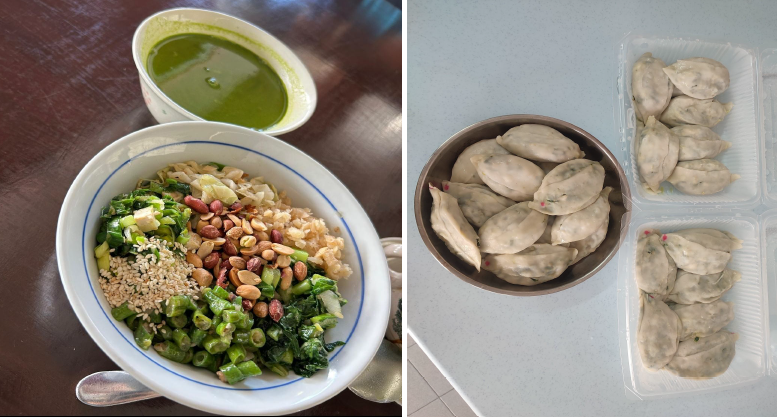
The direct translation of Lei Cha Fanis ‘Thunder Tea Rice’, a traditional Hakka dish originally eaten by farmers in China for energy and detoxification. At the heart of the dish is the Lei Cha or concentrated tea paste made from green oolong tea leaves, basil and mint leaves, coriander, peanuts and sesame seeds. There are two ways to enjoy Lei Cha Fan i.e. either pour the soupy Lei Cha over the rice and vegetables and eat as a broth, or keep as tea in a separate bowl to sip on the side.
Choy Pan is another Hakka food that originated from Southern China which has evolved into a popular street food in both Malaysia and Indonesia, particularly Pontianak and Singkawang in West Kalimantan which has a sizeable Hakka population. It is basically a steamed dumpling with soft, smooth, white skin typically filled with shredded jicama (Mexican turnip / sengkuang), bamboo shoots and chives (daun kuchai). Choy Pan is eaten with chilli sauce or a soy-based dipping sauce.
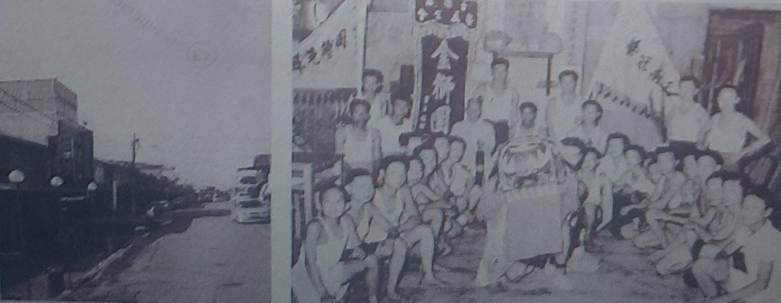
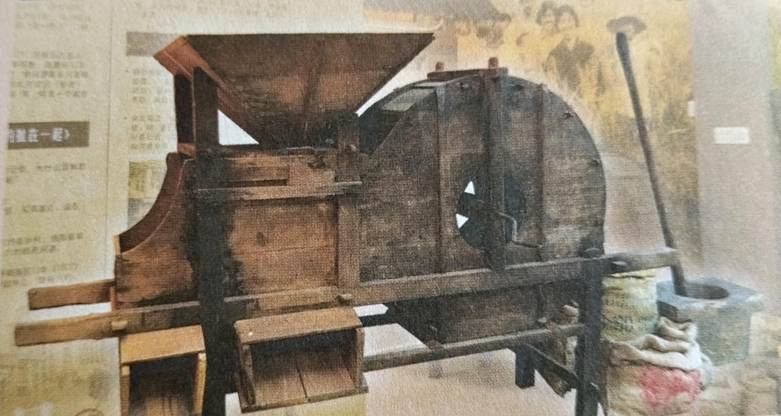
After the healthy meal, we travelled to Kulai to visit theJohore Hopo Cultural Museum, located on the first floor of the Johore Hopo Association building. In September 2026, it will celebrate its tenth anniversary since its establishment as a museum. As we stepped into the main hall, we were greeted by a mural that describes the origin of the Hopo Hakka people. Then, we navigated through the History Corridor which showcased antiques, cultural relics, documents, currency notes/ coins and ancient sundry necessities. Display boards give a brief description of the establishment of nine Chinese new villages set up in the Kulai district. At the end of the corridor, is a dedicated corner showing the history of Nanyang Overseas Chinese mechanics in Malaya during the Japanese Occupation. There is a special display of the Hopo Lion Dance, whose shape and form are rather different from other Lion Dances. The museum tour ended with a display of a reconstructed new village house of the past. Members of the association are actively involved in organizing 4×4 expeditions across China; I was fortunate to participate in their last expedition in 2024.
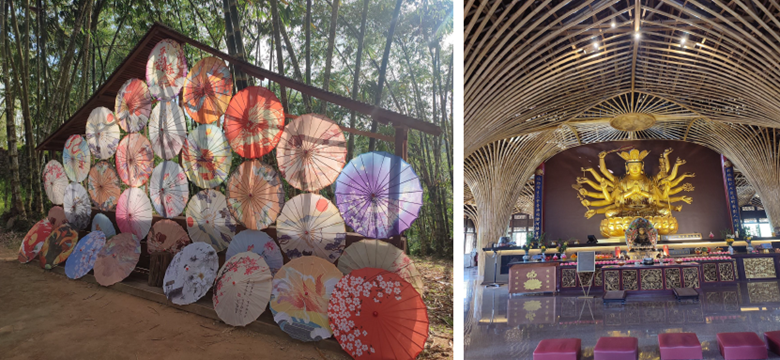
Our next stop was Putuo Village, about 10 km south of Kulai town. What used to be a bamboo forest, has now become a Buddhist cultural village–cum–eco tourism spot. The main attractions are the Purple Bamboo Valleyfeaturing an installation of seasonal decorations (e.g. Chinese New Year, Mid-Autumn celebration) in picturesque surroundings and the Bodhi Sanctuary (temple), home to the largest indoor statue of Cundi Bodhisattva (Zhunti Guanyin) in South East Asia. To access Purple Bamboo Valley, an admission fee of RM 10.00 is collected at the gate to be used for the conservation of the bamboo forest. Incidentally, Putuo Village in Kulai has no connection with Putuo Village in Ningbo, China. They are two totally different entities. Putuo Village in Kulai is most likely named after Putuoshan (Mount Putuo),the famous Buddhist mountain sacred to Guanyin (Avalokitesvara).
We then made our way to Bandar Indahpura, a township developed by Genting Development. The township is surrounded by many facilities like MSC Cyber City, Senai International Airport and Air Cargo hub, Senai Industrial Park, Johor Premium Outlets, and international standard golf courses Lily Tsai had earlier made a reservation at a local restaurant and we managed to arrive there on time. We enjoyed the meal which marked the end of our brief sojourn in southern Johor.
Directions
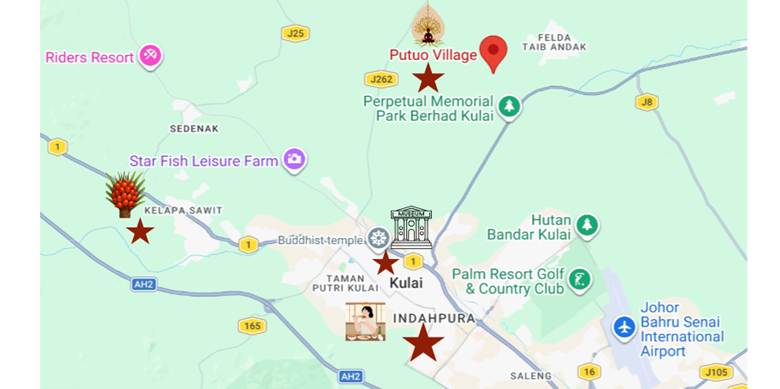
AH2 (North-south Highway / south bound) from Sungai Besi toll to Kelapa Sawit. Take Exit 253 Sedenak, and at the junction, turn right to join Federal Route 1.Travel about 51 km to reach Kelapa Sawit.
From Kelapa Sawit to Kulai, use Federal Route 1. From Kulai to Putuo Village, take Route 94 Jalan Kulai – Kota Tinggi. Use the same route to return to Indahpura
References
Profil Daerah Kulai – Pentadbiran Tanah Johor
Sultan: Change Kulaijaya’s name back to Kulai
Profil Daerah Kulai – Pentadbiran Tanah Johor
Sultan: Change Kulaijaya’s name back to Kulai
THE FORMATION OF KANGKAR AS THE FRONTIER CHINESE SETTLEMENT IN JOHOR,MALAYSIA | International Journal of Built Environment and Sustainability
Sejarah Kesultanan Johor | Laman Web Rasmi Kemahkotaan DYMM Sultan Ibrahim, Sultan Johor
Tracing Johor’s royal lineage | The Star
Johore Hopo Cultural Museum, 1st Floor, No. 71 & 72, Batu 21, 81000 Kulai, Johor.


Like.