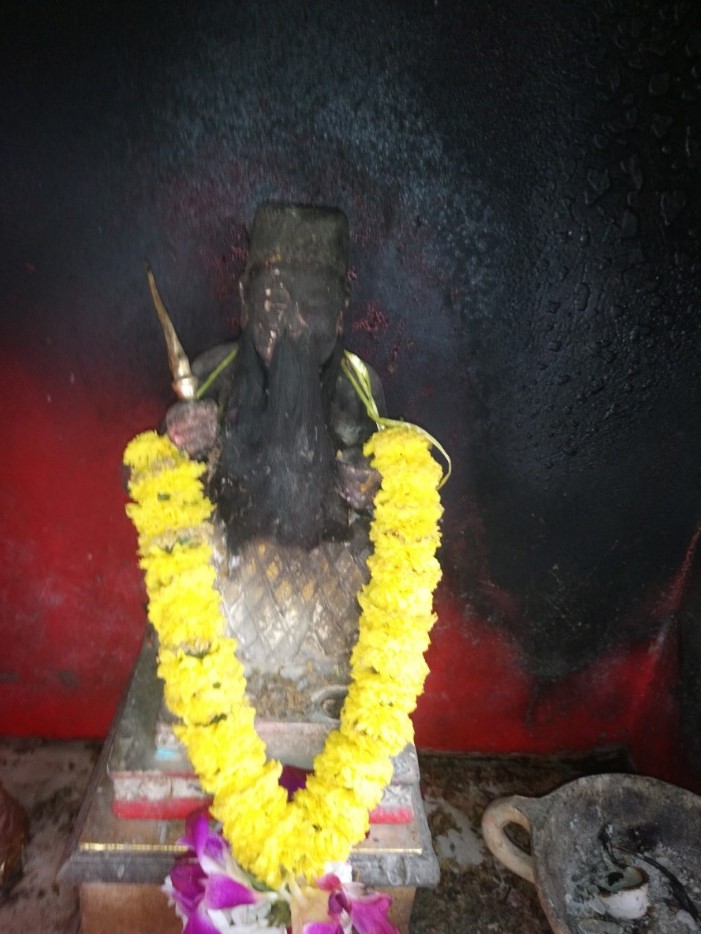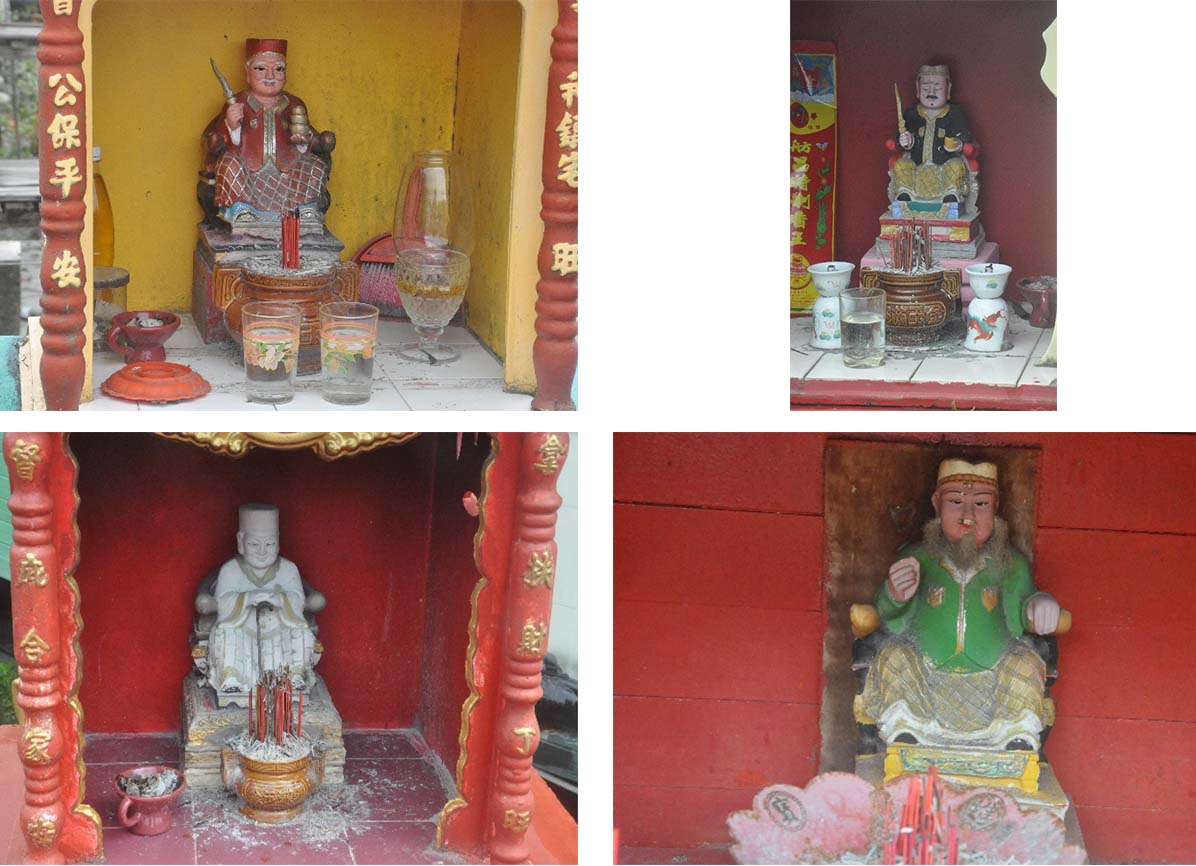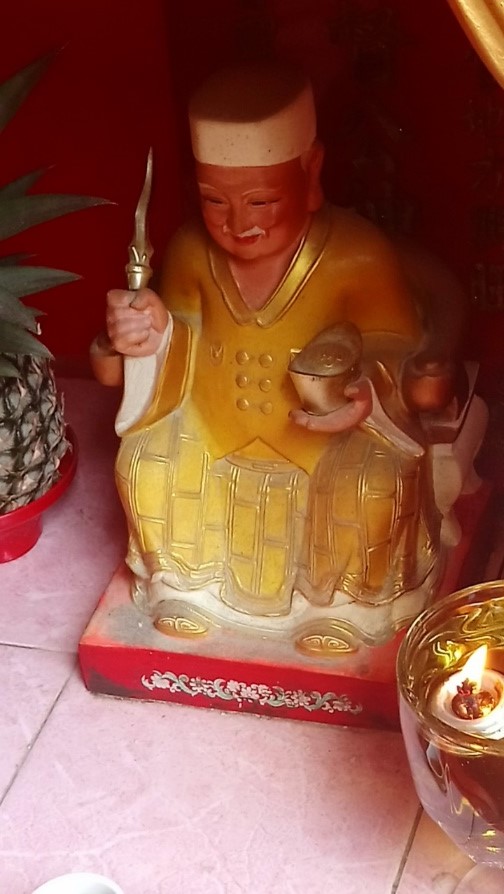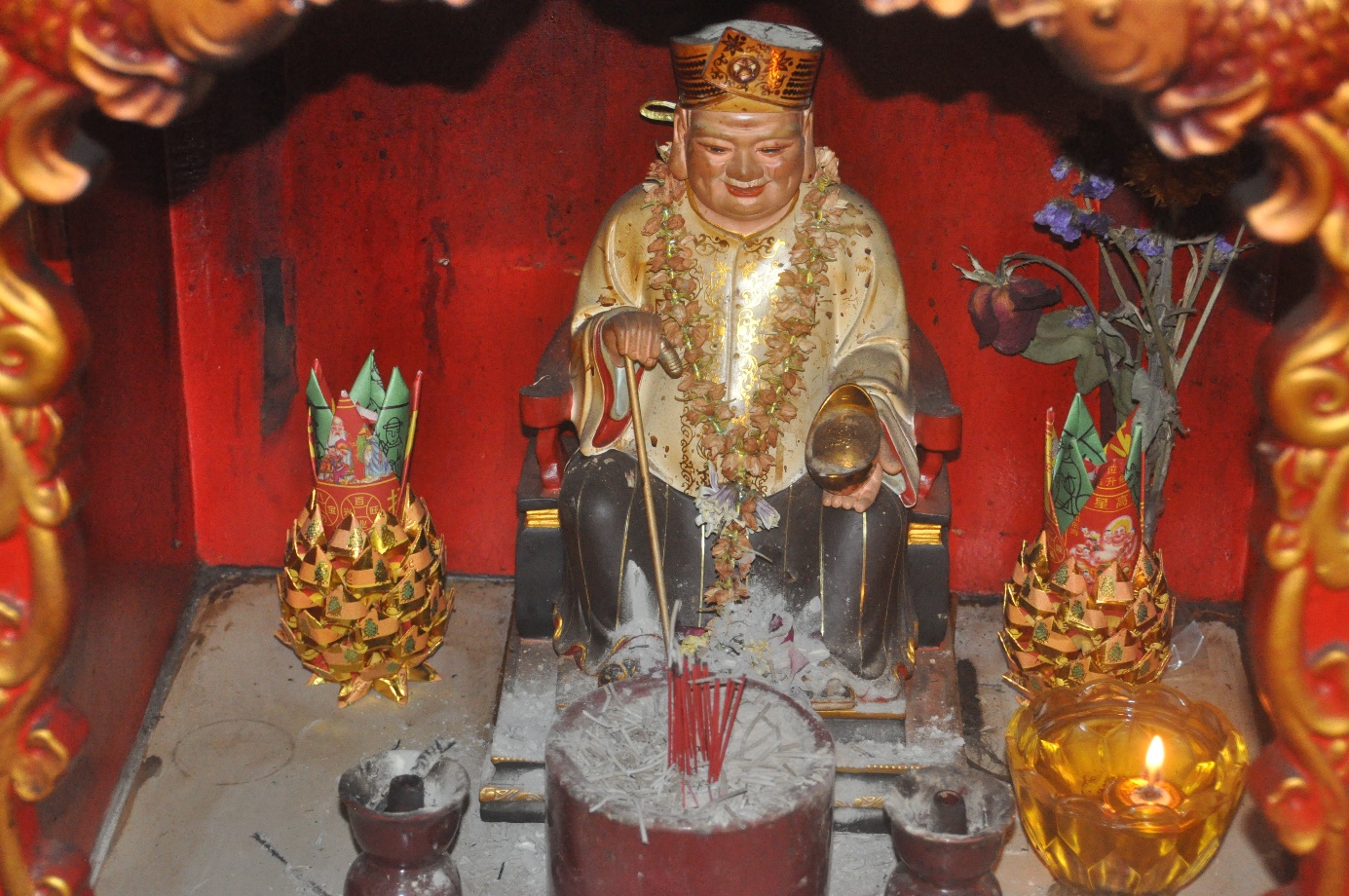
Dato’ Kong or Na Tuk Kong or La Tuk Kong or Dato’ Keramat or 拿督尊王, who are they?

by Jean-Marie Metzger

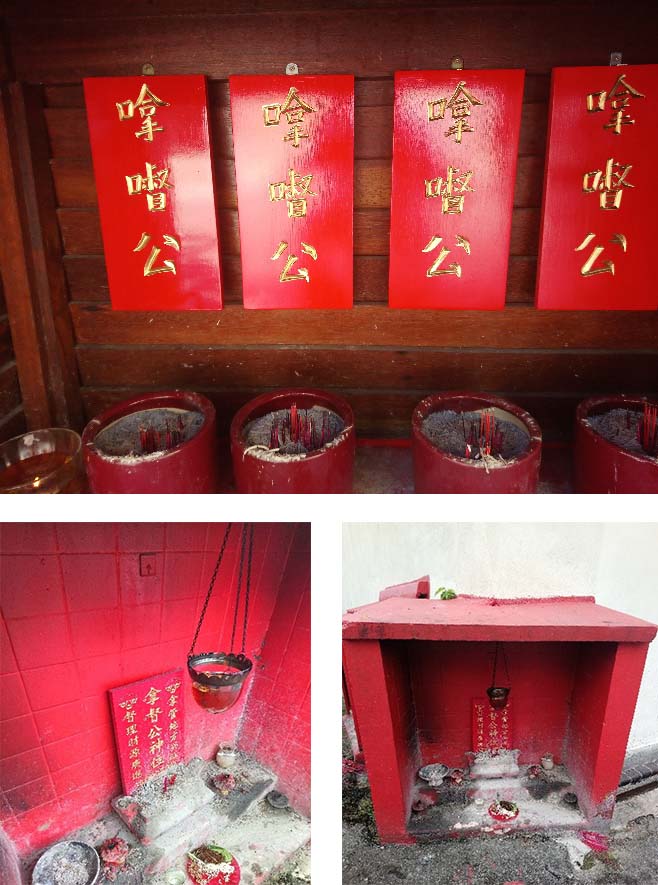
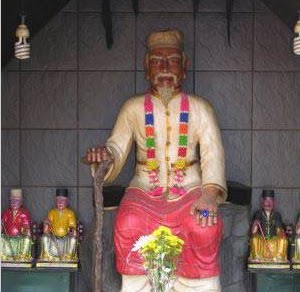
Wherever you go in Malaysia, be it countryside, villages, cities, or golf course, you will often encounter little red shrines on the side of the road, or at the entrance of houses or temples, or at the boundaries of a land plot.  Sometimes these shrines are empty with only some inscriptions that, of course, unless you are fluent in Chinese, you will not understand. However, even if the shrine is empty of any statue, offerings are still present, which are witness of a cult to some kind of deity or spirit. Fortunately for the layman, mostly if he is not Chinese, a statue will be present and…surprise! It is clearly a Malay figure. So who is he? How comes a Malay is present and worshipped in a Chinese shrine?

“Empty” shrines in Penang (©J. M. Metzger 2017)
It seems this is a direct legacy of early animism that infused Malay and Chinese religions. Called Dato’, or Datuk, in Malay, often associated with the word keramat, it represents a spirit of the place. Dato’ means ‘grandfather’ in Malay and the earliest presence of this word dates back to Srivijayan times. What does keramat mean? It is related to the miracles accomplished by Muslim Sufi saints or more generally to “high places” (places of worship according to Mr Bellamy in the Selangor Journal, quoted by W. W. Skeats, “kramat may be roughly translated prophet or magician”).

Altogether, the Dato’ can be associated with either early pre-Muslim animism, to Sufi Islam, or to Chinese Taoism, some also relate it to Hindu-Buddhism.

When the first Hakka immigrants arrived in Malaya in the early 15th century, they paid respect to all the ‘earth spirits’ (tree, water spring, rock or hill – the penunggu of early Malay culture) that were worshipped by the locals. This was not far different from the practice of Taoism which, linked to nature, worships its different spirits (the shen). The Dato’ Keramat, either legendary figures once human, or prominent persons, such as famous silat warriors, pious Muslims, or even shamans (bomoh), later become deities. This was very similar to the Taoist practice by which a famous figure may become a shen and worshipped as such (for example Guan Di –general of the Three Kingdoms–, or much later Sin Sze Ya).

Therefore, it was not difficult for the Chinese immigrants to adopt local practices which led to worshipping a Malay-Muslim figure in a typical Chinese shrine.

While the Dato’ Kong (Na To Kong or La To Kong in Chinese), which means  ‘great Grandfather’, is generally associated with trees, or more generally is considered the protector of the place where it stands, the tradition of Dato’ Keramat, often also called Datuk Panglima, lists nine of them:

  • Datuk Panglima Ali (Ali)
  • Datuk Panglima Hitam (Black)
  • Datuk Panglima Harimau (Tiger)
  • Datuk Panglima Hijau (Green)
  • Datuk Panglima Kuning (Yellow)
  • Datuk Panglima Putih (White)
  • Datuk Panglima Bisu (Mute)
  • Datuk Panglima Merah (Red)
  • Datuk Panglima Bongsu (Youngest)
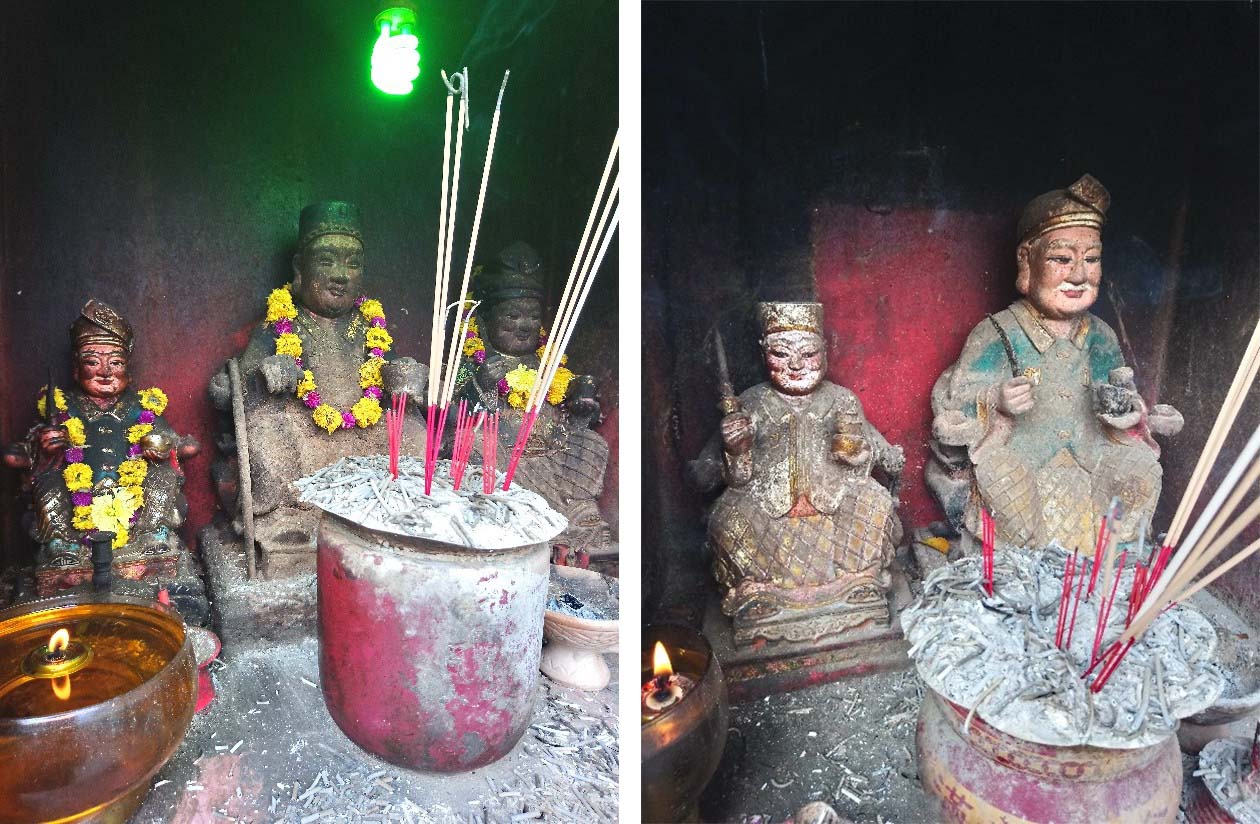
Datuk Panglima Putih, with DP Merah, DP Kuning and DP Hijau (©Shih Perng Liew)

Associating colours with the deities is a legacy of Hinduism, while the Tiger attribute may refer to Shiva; colours could also refer to the five elements and directions in Chinese belief: white=metal/west, red=fire/south, yellow=earth/centre, green=wood/east, black=water/north.

Apart from these, there are numerous Datuk. Some consider that there are 108 Datuk, identifying them with the 108 Ruesi of Hindu-Buddhism, characters who are gifted with spiritual and magical powers (Buddha, as well as Shiva, are considered Ruesi).

At the KDE Golf club in Ampang, there is a Datuk Panglima Hussein shrine. This shrine may be related to Nakhoda Hussin, quoted by W. W. Skeat in Malay Magic as a jin presiding over water, rain, and streams, who has a kramat, or holy place, in Bukit Nyalas (Johor). This would be consistent with the fact that a stream runs across the premises of the club.

Datuk Panglima Hussein at KDE Golf club in Ampang (©J. M. Metzger 2017)

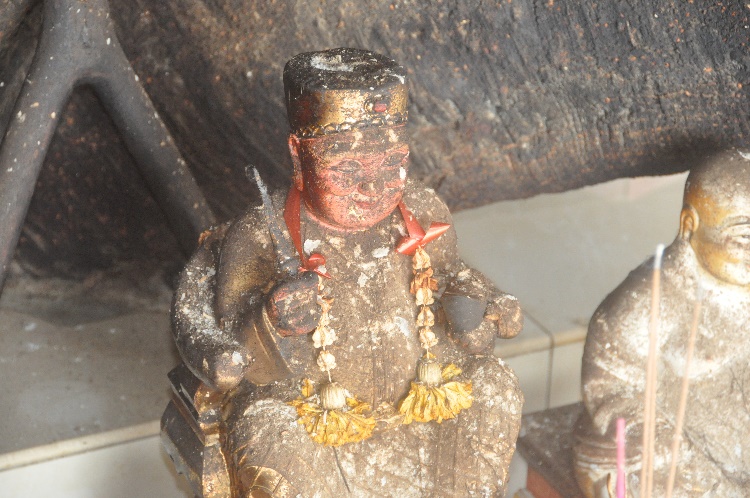
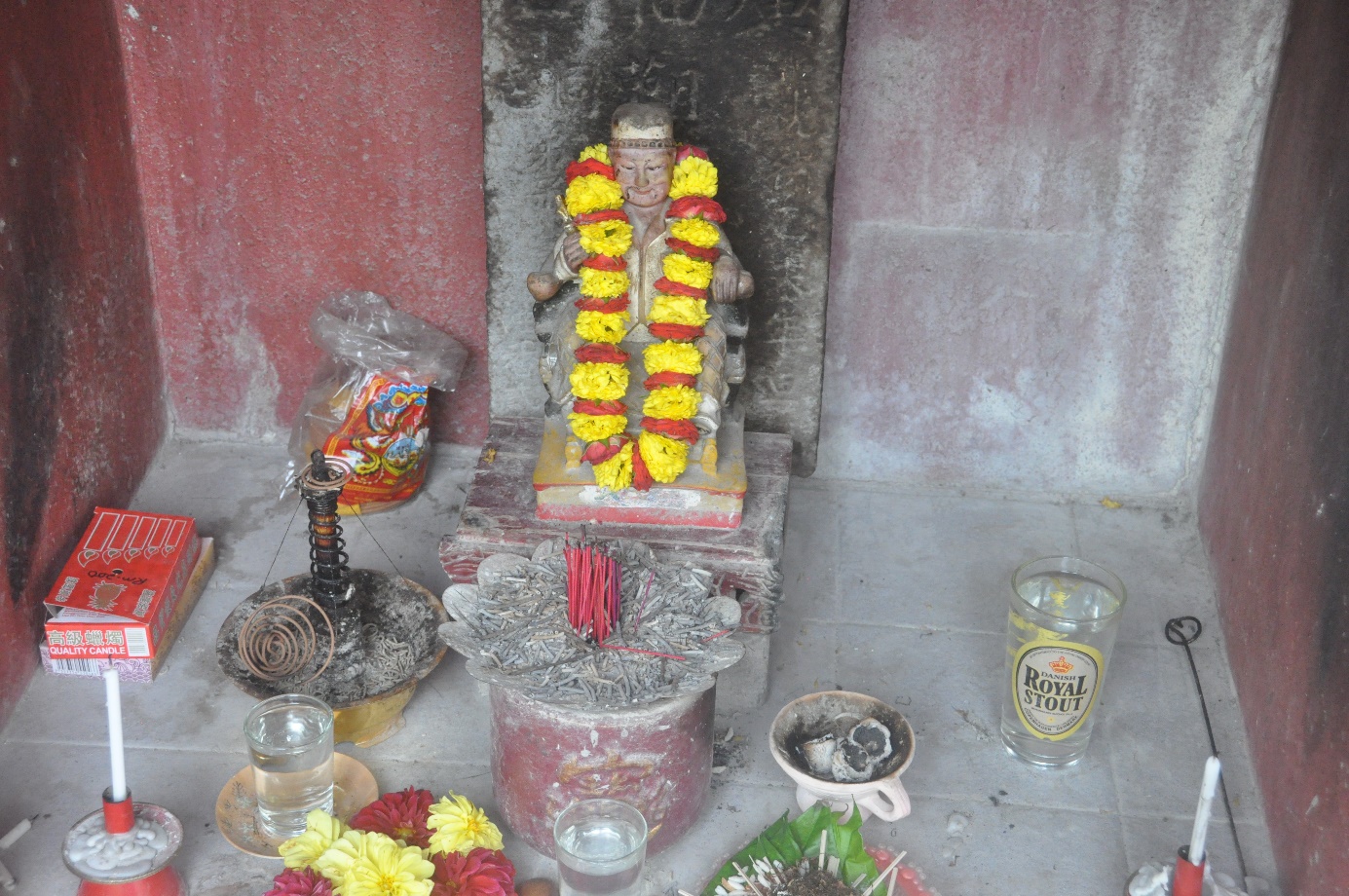
Dato’ Kong shrines are generally situated outside buildings, be it a temple or a house. In some cases, it may be placed inside a tower, but often at the entrance of the car park, as is the case with Integra Tower in KL (is this because fortune flows in at the toll barrier?). When the statue of the Dato’ Kong is present in the shrine, which is the most frequent situation, it cannot be mistaken for any other deity, as it has all the attributes of a Malay: he usually wears a songkok or a haji white hat, sometimes a tengkolok, and often holds a keris. This Malay attire does not exclude holding a Chinese gold ingot, to bring the appropriate wealth to the worshippers, or showing the long ears of Buddha as a symbol of wisdom.

In Penang and along the coast of Perak, there are female Datuk, called Nenek.

Offerings may vary (betel leaves, bananas, eggs, chicken…cigars and coffee are much appreciated by Datuk Panglima Harimau), but, of course, pork and alcohol are strictly forbidden!

Dato’ Kong, tree spirit, at Chew Jetty in Penang (©J. M. Metzger 2017)
Dato’ Kong, tree spirits, at the entrance of Guan Yin Temple in Penang (©J. M. Metzger 2017)
Dato’ Kong in the back garden of Guan Yin temple in Penang (©J. M. Metzger 2017)
Dato’ Kong in Klang (©J. M. Metzger 2017)
Private homes in Pulau Ketam (©J. M. Metzger 2017)
Dato’ Kong Sin Sze Si Ya Temple, Kuala Lumpur (©J. M. Metzger 2017)
Dato’ Kong at the entrance of the car park of Integra Tower in Kuala Lumpur (©J. M. Metzger 2017)

Now, what can we learn from the omnipresence of Dato’ Kong in Malaysia:

  • That the Chinese immigrants respected the local culture
  • That the Chinese pray to whatever may work and bring them good fortune
  • That Malaysia has always been a land of syncretism and mix of cultures throughout the centuries

Sources:

  • The Three Chinese Wisdoms (in French), Cyrille J.D. Jarry, Ed. Albin Michel (2010)
  • Malay Magic, Walter William Skeats (1900)
  • http://www.lersi.net/108-ruesi/

MRT Link: Walking between Muzium Negara and KL Sentral

by Maganjeet Kaur

The nearest train station to Muzium Negara is the Muzium MRT station. However, if you are taking the LRT, you can get off at the KL Sentral station and walk to the museum via the walkway that links the LRT and the MRT stations. This walkway is well sign-boarded. It is a short and convenient walk. The downside is that, as you are not taking the MRT, you will incur a cost of Rm0.80 for walking through the MRT station.

You can avoid paying the Rm0.80 by taking an alternative route, albeit a little circuitous.

Walking from KL Sentral to Muzium Negara

  • Follow the sign-boards towards the MRT Station
  • Look out for a fork. Take the right branch, following the sign-board that says ‘Menara CIMB|Q Sentral’
    • The left branch would take you down the escalator to the MRT Station where you will have to make the Rm0.80 payment
  • You will come to a T-Junction. The left will take you to the CIMB carpark. Take the right (this is a sharp turn) towards Q Sentral.
  • Go down the escalator
  • Take the lift to ‘LG2’. When you go out of the building, you will see Muzium Negara on the opposite side of Damansara Road.
  • Go into the MRT Station and take two escalators down to cross this road.
  • Take the lift/escalator/stairs to Muzium Negara.

Walking from Muzium Negara to KL Sentral

  • At the MRT Station, head towards St Regis / Pintu A|Jalan Damansara.
  • Take two escalators up to cross Damansara Road.
  • Go into Q Sentral (on your right as you come out). It is the building between St. Regis Hotel and CIMB.
  • Take the lift to ‘G’.
  • Take the escalator up.
  • Turn around and head towards a signboard that says MRT / KL Sentral / Menara CIMB|Hilton|Le Meridien.
  • Turn left at the T-junction (turning right takes you to CIMB’s carpark).
  • Follow the signboards to KL Sentral.

Switching between the LRT and MRT line

If you are taking the LRT, you can opt to switch to the MRT line at the Pasar Seni station.

Get off the Pasar Seni LRT station. Go down to the MRT platform and hop onto the MRT line (towards Sungai Buloh). The two stations are connected and you don’t have to exit the barriers. The Muzium MRT station is one stop away. The fare difference is only 10 sen to change trains at Pasar Seni instead of getting off at KL Sentral.

The stations’s on the right

Islam in the Malay World

By Anne Deguerry and Jean-Marie Metzger

This article was originally written for and published in the Gazette of the Association of Francophones in Malaysia and is reproduced here with the gracious authorization of its President, Ms Elizabeth Galland; it also widely draws upon Anne’s 7 minutes presentation written for Batch 28 MV training course.

Islam started to spread all over the world at the end of the seventh century C.E, but the Islamization of insular Southeast Asia was achieved much later on, by the penetration of merchant networks and not by conquest.

Several factors have been put forward to explain the extension of Islam in the Malay world at this time. The Malay Archipelago was perfectly located at the crossroads of trade routes between East (China) and West (Europe, Middle East, India), at the reversal of the monsoon, and in shallow waters that fostered navigation. It stimulated international trade.

  • India was exporting fabrics (cotton fabrics, muslins, patola), cowries (shells used as currency collected in the Maldives and piled up in Gujarat), pearls, gemstones, and local spices.
  • China was exporting silk, ceramics, paper and copper.
  • Locally, merchants could find raw materials of great value such as precious wood, plants, resins and wax, spices (cloves from Ternate and nutmeg from Banda islands), tortoiseshell, feathers, ivory, tin, silver and gold.

The ethno-geographical group formed by the Malay archipelago and the peninsula of Malaya was, from the first centuries CE, influenced by Indian merchants whose presence favored the establishment of Malay kingdoms. These were marked by language, culture, and religion (Hinduism and Buddhism), imported from the south of India. According to Chinese texts of the 3rd century CE, nearly 100 kingdoms were known in the region. Small political entities, or often, probably, somewhat large cities of fishermen and merchants at the mouths of rivers, evolved into stronger structures and, from the 7th century, the Buddhist Srivijaya empire, based in Palembang (Sumatra), started gaining suzerainty over Sumatra and the Malayan Peninsula. From the 13th century, the decline of Srivijaya, which controlled the Straits of Malacca and Sunda, left the door open for the emergence of a new political and religious order.

The texts relating to the arrival of Islam in the region are varied, not always coherent and often written, very late, with objectives of historical and political reconstruction for the benefit of the reigning dynasties. Among these texts, the Malay Annals, Sejarah Melayu which, even today, forms the basis of much of the national story of Malaysia, was written from the 16th century and has not less than 32 different versions. The Kedah Annals or Hikayat Marong Mahawangsa, believed to have been written between the 18th and the 19th century, could have been intended to rewrite history in order to give Kedah anteriority over the Sultanate of Malacca, considered today as the founder of Islam in the Peninsula.

Islam, most likely, came from India through Muslim merchants (both Indian and Arab). Gujarat was then a very dynamic trading center. Commercial outposts were created on the coasts of Southeast Asia, and then, in the late 13th century CE, merchant sultanates arose, such as in Samudra-Pasai in northern Sumatra, in Champa in today’s central Vietnam, and finally in Malacca.

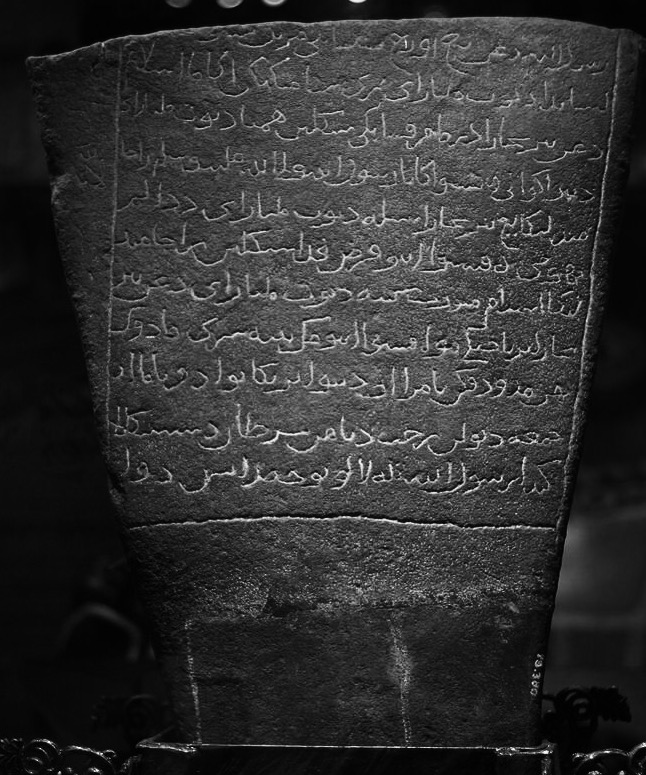
In 1292, Marco Polo signaled the presence of an important Muslim Kingdom in Aceh. Long before that, evidence of trade with the Abbasids, dating from the 9th century, was discovered in Kedah in the form of coins. A stone inscribed ‘Ibnu Sardan 213’ was also found in Bujang Valley. The Ibnu Sardan family is mentioned in different texts of the time and they were known as intellectuals, sailors and missionaries. The date 213 Hegira (Hijra) corresponds to the year 823 of our era. The Kedah Sultanate is dated to 1136 upon the conversion to Islam of the Raja who then took the name of Sultan Mudzaffar Shah.

181
Stone of Ibnu Sardan – Gallery B, National Museum Malaysia

Beyond the influence of India, one must also consider the contribution of the Chinese. Admiral Zheng Ho, himself, who led seven maritime expeditions from 1405 to 1453, of which at least 4 stopped in Malacca, was a Muslim, as was his translator Ma Huan. Ma Huan, considered as one of the artisans of the Islamization of Java, took part in three of the seven expeditions and recorded the journeys. While the number of ships and people accompanying the fleets may have been exaggerated, the fleet of Zheng Ho was huge and heavily armed; it was the official symbol of Chinese diplomacy. Following Zheng Ho’s journeys, the Sultanate of Malacca placed itself under the protection of China, against the attacks of Siam and Java.

If archaeological findings or ancient texts attest to the presence of Muslims in the Peninsula since the 9th century, the first indigenous evidence of the presence of Islam in the Malay Peninsula is a granite stele, known as the Terengganu Stone, inscribed in Malay using Arabic characters -a script known as Jawi, still used in official documents or in the Northern sultanates such as Kelantan or Terengganu (it is also used on street name plates in Melaka). The stele was discovered in 1899 in Kuala Berang in the State of Terengganu. Its date is deciphered as 1303 (702 Hegira) although there are contentions on this date.

Why is this stone so important? First of all, because it is not a tombstone. The early Muslim tombstones (Batu Aceh), many of which were discovered in Malaysia and Indonesia, only show that a Muslim person was buried and often have no personal names. But the Terengganu Stone is engraved with a set of Islamic laws. It indicates an early Islamization of the northeast coast of the Malay Peninsula and the legal character of the inscription is a sign of strong anchorage in society.

Terengganu Stone or Batu Bersurat Terengganu – Terengganu State Museum

In any event, although it occurred nearly one century later than the date inscribed on the Terengganu Stone, the most important event was the conversion to Islam of the rulers of Malacca, from which they gained undeniable political and economic advantages:

  • Patronage of powerful Muslim traders
  • Legitimation against Majapahit, the largest kingdom after the demise of Srivijaya
  • Legitimation of sultanate authority, a new form of government

It is however rather difficult to determine who was the first Muslim ruler of Malacca as the sources vary, some being more literary than historical. Depending on the case, there are assertions between Parameswara, his son Megat Iskandar Shah, and his grandson.

Parameswara, a prince of Srivijaya, was said to have founded Malacca in 1400 (but this date itself is controversial!), then married a Muslim princess of the Pasai Sultanate in northern Sumatra and may have converted. But according to Portuguese sources, it is the son of Parameswara, Megat Iskandar Shah (1414-1424), that first converted to Islam. Finally, the Malay Annals attribute the conversion to the grandson of Parameswara, Muhammad Shah (1424-1444). Legend says that Muhammad Shah was visited one night by an angel in a dream; on waking up he could quote verses from the Quran verbatim. The next morning, his advisers told him about some Arab scholars debating at the port. He met with them. He was immediately struck by their learning, courtesy, and high character and he decided to adopt Islam. This is the version retained in Gallery B of Muzium Negara.

The conversion of Muhammad Shah – as per the diorama at Gallery B, National Museum Malaysia

But whatever was the conversion timeline, Islam was attractive to Malacca:

  • it emphasized the individual value of each man;
  • with the view that the ruler was seen as “The Shadow of God on Earth”, Islamic traders would regard Malacca as a safe place;
  • it provided access to the learning and sophistication of the Muslim world (continuing the intellectual tradition of Palembang, from where Parameswara originated, as a center of Buddhist studies, Malacca quickly became a famous center for Islamic studies)

Altogether, it does not matter which, Kedah, Terengganu or Malacca, or even the Malay States of the archipelago, was the first to convert to Islam, the conversion of the Sultan of Malacca was a founding act by establishing, clearly and publicly, Islam as a state religion. In this sense, modern Malaysia is certainly the heir of Malacca.

The arrival of Islam in the Malay world greatly influenced the Malay lifestyle and culture and brought a vibrant influence in the archipelago, through the development of arts.

  • Calligraphy, Arabic script (jawi)
  • Decorative applied arts (calligraphy/geometric patterns/arabesques)
    • Metal ware and jewellery
    • Ceramics
    • Carving
A Terengganu Koran with typical Malay features: eg. illuminations of central pages with triangular patterns – Islamic Arts Museum, Kuala Lumpur

Borobudur Panel

by Maganjeet Kaur

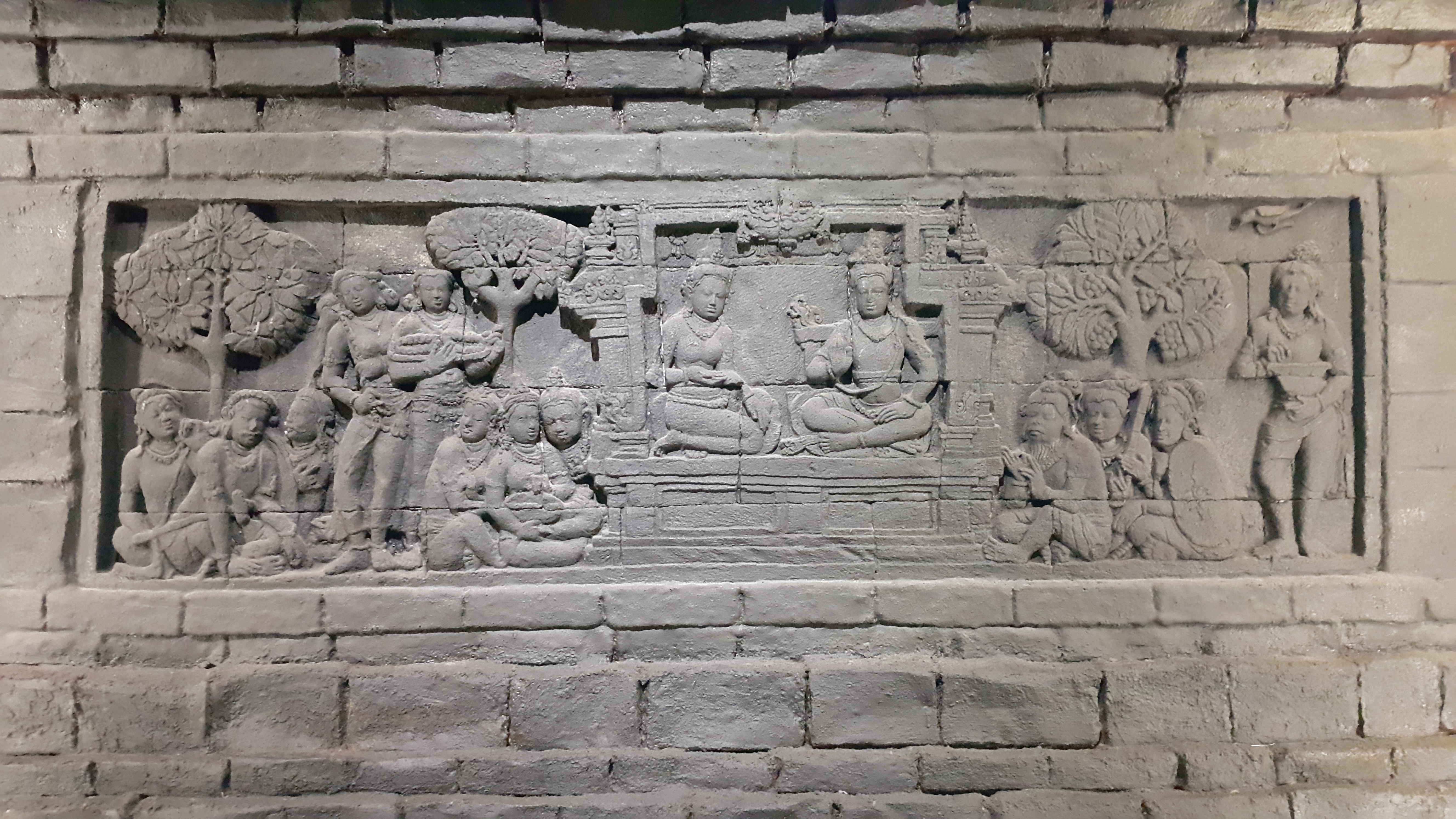
The replica of a panel at Borobudur on display at Gallery B, Muzium Negara depicts a scene from the Lalitavistara Sutra, a Mahayana Buddhist text. In this panel Queen Maya and King Suddhodhana, parents of the future Buddha, are shown  at their palace in Kapilavastu. The trees on the panel indicate that they are most likely seated in a garden pavilion. In this scene, the Queen has approached the King and seated herself on his right. She requests permission from the King to take a pledge of self-denial and, judging by the King’s hand gesture, he has consented to this request.

Replica of Borobudur panel at Gallery B. It shows a scene from the Lalitavistara Sutra

In the Lalitavistara text, this scene takes place in the music hall and the royal couple are seated on a throne with jeweled latticework. The Borobudur panel, on the other hand, shows ashoka trees (Saraca asoca) indicating an outdoor scene. The text also mentions that the Queen came accompanied by 10,000 women but only five of them, shown behind the Queen, are represented in the carving.

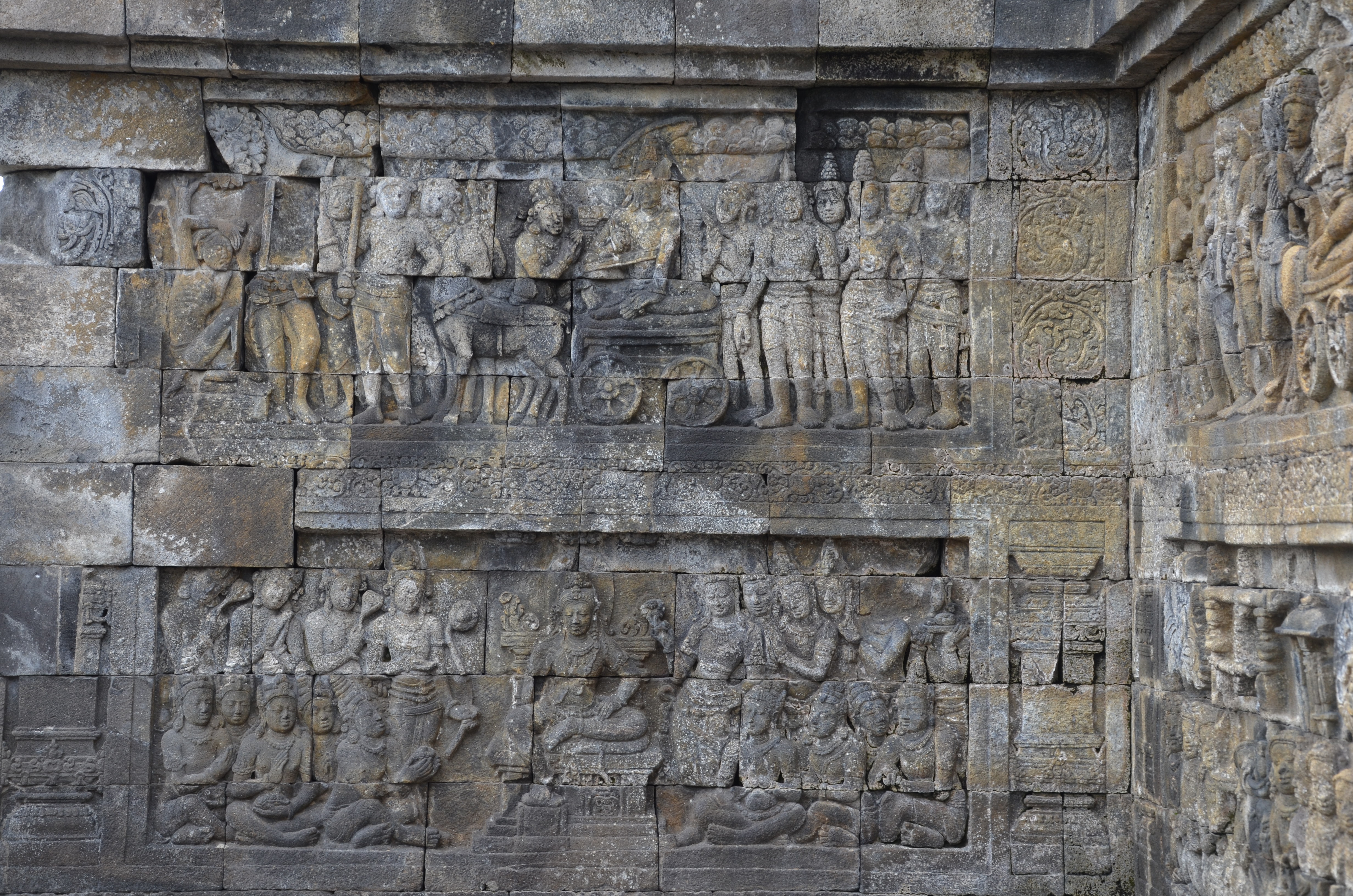
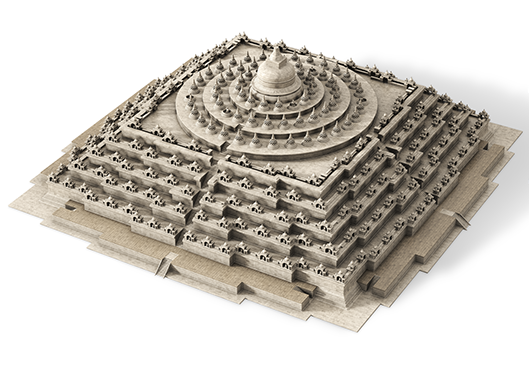
The Lalitavistara, translated loosely as ‘The Play in Full’, provides an account of Buddha’s descent into this world and how he attained his awakening. Borobudur has 1,460 bas-reliefs depicting scenes from the Lalitavistara, Jataka, and other Buddhist texts. These bas-reliefs are found in the galleries of the first four floors. Each floor has these bas-relief panels on both sides of the walls. The first floor has four series of panels, two series on the inner wall and two on the outer wall. The other three floors have two series of panels each, one on each side of the wall. This makes a total of ten series of panels; ten is an important figure in the Buddhist cosmology as it represents the ten stages of a bodhisattva’s path to awakening.

The first floor has two series of panels on each side of the wall, one series on top of the other

The correct way in which to circumambulate Borobudur is to start from the east staircase, turn left on the first floor, and walk clockwise while viewing the top series of panels on the outer wall. The visitor would then do another three rounds on the first floor while viewing the remaining three series of panels. The visitor then moves to the second floor and goes around this floor twice to view the series of panels on both the inner and outer walls. Two rounds each are again made on both the third and fourth floors. In this way, the visitor would have walked ten rounds. The Lalitavistara panels are located on the inner wall (top series) of the first floor.

Model of Borobudur. Image taken from https://www.behance.net/gallery/25154373/Borobudur-Temple

References:

Lalitavistara, The Play in Full, translated by the Dharmachakra Translation Committee.

John Miksic (1990) Borobudur: Golden Tales of the Buddhas, Hong Kong: Periplus Editions.

The Toraja Burial Customs

by Marie-Andree Abt

The Toraja people were originally from central Sulawesi in Indonesia. They are about 1.5 million strong but less than 500,000 live in their native land, the remainder have sought work in Makassar or Jakarta. By doing this, they can send money to their family in Tanah Toraja.

Their traditional burial customs are expensive to practice, particularly for the noble caste. The caste system is still used in Toraja society; there are nobles, warriors, traders, free men and “slaves”, the last ones being well treated and respected. A “slave” can cut tie with the family he works with at his own time and will.

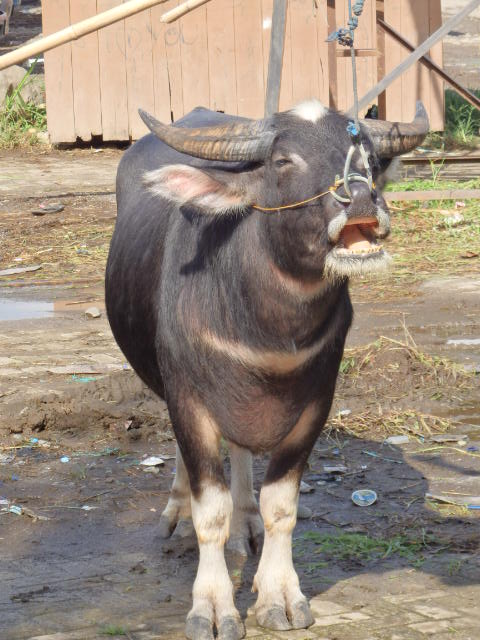
When someone dies, the body is quickly embalmed but it stays at home, up to one year sometimes, so family and friends can come and see the dead who is considered “very sick” until the burial ceremony takes place. For this ceremony, the family will first buy buffaloes (one animal and up to two hundred, depending on how wealthy was the dead). The price of each buffalo depends on the marks of his robe; one with the proper “white” marks on the head can fetch several tens of thousands dollars.

Then they prepare the temporary bamboo huts to welcome the guests. The enlarged family, the friends, and all the people who have been familiar with the dead are invited; the family of the dead “gives back” to every person who has helped in one way or another to enable the dead to become wealthy.

The ceremony is now ready to take place. Generally, it lasts several days. Each day, the male slaves of the family sacrifice one to several buffaloes followed by pigs (bought at the market). They prepare the meat to feed everybody while the women prepare the drinks.

Some men dance while singing the main events of the dead’s life. All the guests bring gifts. The ceremony master states the names of the guests and their gifts. When all the gifts have been given, the dead is ready to be buried. As the earth is here to give birth, corpses cannot be buried and so the Toraja entomb the bodies in cliffs or large boulders.

It takes six months for a man to chisel out the grave from a boulder.

In addition, the nobles and warriors have the right to have their effigy sculpted in wood and displayed on a “balcony” near the grave.

If they are really wealthy and have sacrificed at least 200 buffaloes, a megalith can be raised in a specific field close to their village.

When a little baby dies, he is not strong enough to reach heaven by himself, so the Toraja entomb him in a big tree trunk so the tree can help the baby to go to heaven. The tree shall be alive and if the tree dies, a part of it is transferred to another tree that becomes the next “passeur d’âme”.

I learned about the Toraja burial practices during my short stay in Tanah Toraja, a very nice part of Sulawesi surrounded by mountains. Our guide, Otto who is part of the noble cast, was very helpful in teaching us all the customs of his tribe.

From Angkor to Bujang Valley

by Jean-Marie Metzger

“From Angkor to Bujang Valley”. That was the title of the conference which took place at Alliance Française of Kuala Lumpur on Jan 25th. And as you all know, when MVs hear the words “Bujang Valley”, they tend to flock like birds on a wire. And indeed a large audience, comprising quite a few MV docents, trainees, and trainers, gathered to listen to Dr Daniel Perret, researcher from the French School for Asian Studies. The talk was mostly oriented towards the program of research in South-east Asia and the archaeological methods employed by this unit.

20170125_210536
Dr Daniel Perret

The French School for Asian Studies (Ecole française d’Extrème-Orient) is a public institution under the Ministry for Higher Education and Research. It was founded in 1898 in Saigon and, therefore, started its activities mostly in what was French Indochina. Today it is established in twelve countries, with eighteen research centers, from India to Japan. In Malaysia, the Center is hosted by the Department of History, Faculty of Arts and Social Sciences, University of Malaya. It conducts research in cooperation with the University of Malaya, UKM, JMM…

A lot of research has been devoted to Indochina: it included, from 1992, the rehabilitation of many Angkor Temples, but the center has also been active in countries such as Laos (Vat Phu Temple -11th-13th century CE), Vietnam (Quang Ngai wall, a 19th century fortified wall extending for 127 km in the Champa region), and Myanmar (inventory of 2,800 monuments in Pagan (Bagan) -1044-1287 CE-).

img_0059
Temples at Bagan

Dr Perret himself has devoted a lot of his activities in Indonesia, mainly Sumatra, and in Malaysia, including in the Bujang Valley.

In Sumatra, research, which has now turned away from the exclusive study of temples and monuments, has been devoted to the evolution of three settlements, Barus (on the west coast), Padang Lawas (central Sumatra) and Kota Cina (on the north-east coast).

All research on human settlements, in the absence of temples, must be correlated with other types of data (archaeological findings – Chinese ceramics being often important for dating, local epigraphy, local literature and traditions, foreign written sources).

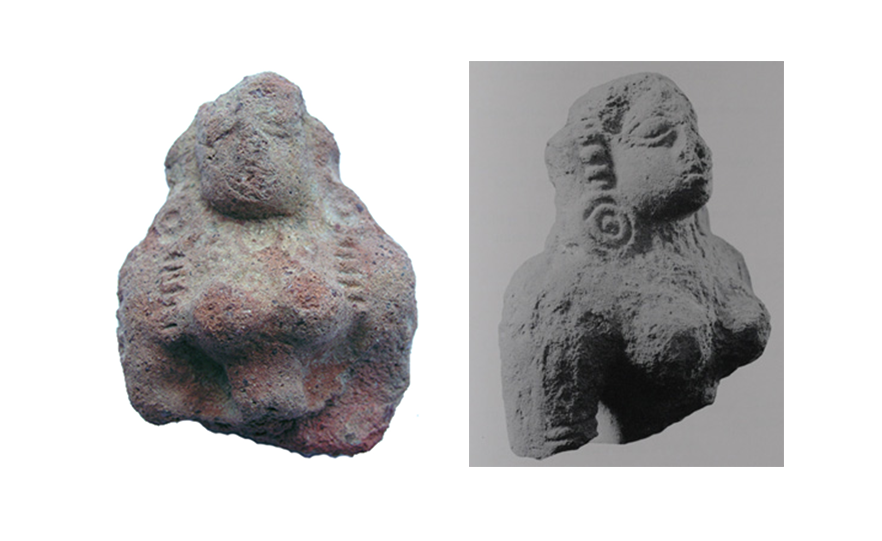
In the case of Barus, a Tamil inscription (1088 CE) indicates that the earliest known inhabitants were Tamils, a fact in accordance with local literature and tradition. Other sources include the “Sejarah Raja Raja Barus” (late text from 19th century), an Armenian maritime chart (12th century), the Archives Cairo Geniza (11th-13th century), Marco Polo’s writings (13th century), many Chinese and a few Portuguese and VOC sources. One of the difficulties conducting archaeological research in Indonesia is the concentration of layers which do not exceed 30 cm in depth and, hence, chronology is often difficult to establish between the different artifacts found. Nevertheless, interesting findings could relate the settlements to Indian presence and trading activities with many parts of Asia: for example pottery, analogous to Cambay Ghee pots still used in Southern India. A figurine, dated between 12th and 16th century, analogous to an Old Bahrein figurine (12th-14th century) was also unearthed. Stoneware was also found originating from China, and also Vietnam, Thailand, Myanmar, Japan (in particular originating from Hizen kiln active in the first half of the 17th century).

bahrein
left: figurine found in Barus Ⓒ D. Perret; right: figurine from Bahrein

In Padang Lawas, archaeological research had been very active in the past, about 30 Hindu-Buddhist monuments and some 1,039 inscriptions (in Malay, old Sanskrit, paleo-Sumatran) had been catalogued, but nobody was interested, until recent years, in the settlements themselves. One of the astonishing findings, related again to trade activities, was a Bukhara Dirham, dated 1003-1004 CE, from the Qarakhamid/Ilek Khan Dynasty.

image3
Dirham from Bukhara Ⓒ D. Perret

In Kota Cina, where some Hindu-Buddhist images were found in the 1970’s, the site for digging had a particularity: there was a lot of water infiltrating the soil. That was a big problem because water had to be pumped out regularly, but also a big benefit as water better preserves organic remains. Hence, wooden construction pillars, animal remains (mostly turtles) and also human skeletons were found. The site also yielded some 160,000 pieces of earthenware (around 1,5 t), making it the biggest site in Sumatra, but also more than 1,000 coins, mostly Chinese. The dating of all these findings  ranges from the end of the 11th century till the beginning of 14th century, but analysis is just beginning.

image4
Fragment of jarlet from Bujang Valley Ⓒ D. Perret

Dr Perret’s research in Malaysia was devoted first to the cataloguing of Batu Aceh tombstones: 450 of them were studied in Johor. In Bujang Valley, Dr Perret studied glassware. Some 6,000 shards were categorized, many of them (about 95%) coming from jarlets (a small type of vessel, about 3 cm for the rim and the base, 6 cm for the height). A recent book has been edited by Dr Perret (together with Zulkifli Jaafar) and published by JMM, “Ancient glassware in Malaysia – The Pengkalan Bujang Collection”.

Finally, Dr Perret explained how external interference can bring some kind of perturbation to academic work and spice it up a little. When he and his team found a human skeleton at Kota Cina, although it seemed clearly to be dated a few hundred years before the discovery, it appeared it could make a criminal “cold case” as the skeleton had both hands and feet bound together…so the local police claimed the skeleton for forensic investigation! Fortunately, when a second skeleton was found the police considered they had enough with one and left it to the archaeologists…

We, MVs, are very lucky to know that the Perak Man died from a tooth infection, otherwise we could have been caught in another episode of “NCIS Lenggong Valley”!!

kota-cina
Excavation at Kota Cina, taken from Dr Perret’s presentation

Puja Pantai at Pulau Carey

by Marie-Andree Abt

On the first day of February, Jean-Marie, my husband and I went to a Puja Pantai (sea healing ceremony) at Pulau Carey, which is about one hour’s drive from Kuala Lumpur. A Puja Pantai is a Hari Moyang (spirit day) for the fishing Mah Meri villagers.

JM joined us early at our home so we could be at Kampong Bumbun at 9am, as instructed by the young lady in charge. Actually, we had plenty of time to visit, for 3 to 4 times, the museum in this charming cultural village. Now we know plenty about the Mah Meri culture and wood carvings!

Finally we were invited to wear a nice origami headdress and instructed to keep it on our heads throughout the ceremony so the spirits could recognize us as guests.

OLYMPUS DIGITAL CAMERA

Two of the three shamans

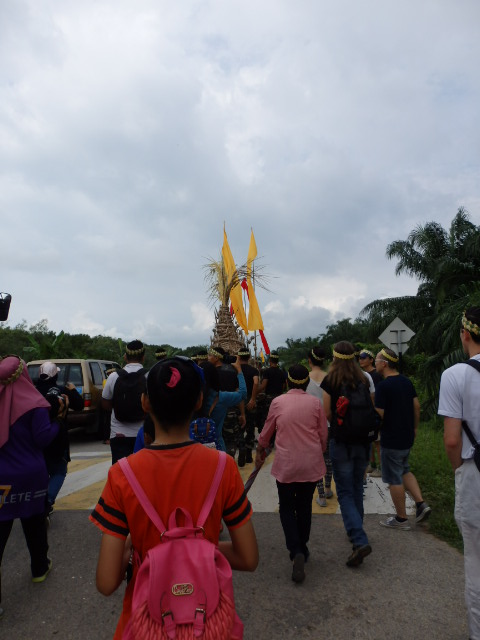
Then we took our car to join the procession coming from Kampung Judah, another Mah Meri village. Jean-Marie and I followed the procession while my husband had to follow by car as he could not leave the car on the road side. We walked with the crowd, trying to take pictures on the way of the shaman, the musicians, the navy soldiers who were there to carry the busot jantan (a mound made of bamboo frame and plaited palms leaves).


The busot jantan

After about 2 kms, we turned left and, there, the shaman and his helper sanctified the cross road to show the way to the spirits.

The shaman dance

Finally we arrived at the beach where we waited about two hours while the shamans chewed betel, smoked, and ultimately came to a trance.

Then, to please the spirits, there was a Jo-oh dance. Several young ladies began to dance around the busot jantan. A male mask dancer joined them and finally the shaman entered the dance.

The Jo-oh dance
The male mask dancer
The shaman enters the dance

Following the dance, the procession went to the beach itself to join the rumah moyang now that the tide was low.


The Forgotten Duo

by Maganjeet Kaur

Raja Abdullah and Yap Ah Loy have been pushed centre-stage to battle it out as founders of Kuala Lumpur, relegating to the background the two entrepreneurs who had developed a trading post at the confluence of Klang and Gombak Rivers, a trading post that would grow to become Kuala Lumpur. No street names laud their contributions but Hiu Siew was the first Kapitan Cina (Chinese Captain) of Kuala Lumpur and Ah Sze could have been either the second or third Kapitan had he wanted the job.

Their story starts in Lukut where they were joint owners of a tin-mine. It was here that they contracted a friendship with Sutan Puasa, a Mandailing trader servicing the Ampang tin mines, on whose advice they moved to the future Kuala Lumpur. Lukut was, until the border treaty of 1878, a part of Selangor and under the control of Raja Jumaat, an enterprising and capable leader. In 1857, Raja Abdullah, brother of Raja Jumaat, took 87 Chinese miners from Lukut and they started mining activities at Ampang, about five kilometres inland from the confluence. Raja Abdullah’s men were by no means the first miners at Ampang; this honour belongs to the Sumatrans who were probably there from as early as the 1820s. However, the increased activity brought about by Raja Abdullah’s team saw traders from Lukut moving to Ampang where they supplied the miners with food, essential items, opium, and spirits.

tin-mine-at-ampang
A tin-mine at Ampang. Source: KITLV Universiteit Leiden

Goods bound to and from Ampang were loaded/unloaded at the confluence and, in all likelihood, a settlement existed there from an early period. However, the trading post had to be expanded rapidly in order to keep pace with the increased activity at Ampang and Sutan Puasa succeeded in persuading Hiu Siew and Ah Sze to relocate there. He also paved the way for them by introducing them to the local Malays and their acceptance by the Malay community saw Hiu Siew being appointed as the first Kapitan Cina of Kuala Lumpur.

The exact location of this trading centre has not been identified. However, it is said that when Yap Ah Loy became the third Kapitan, he appropriated the property of Liu Ngim Kong, the second Kapitan, who had himself appropriated the property of Hiu Siew. We know that Yap Ah Loy’s house was located near the river, at the present site of the Pacific Express Hotel, and it is possible that Hiu Siew’s property was at this same location and that Yap Ah Loy’s ‘market’ was originally Hiu Siew’s.

yap-ah-loys-houses
Yap Ah Loy’s properties (around Medan Pasar) after they were rebuilt in brick following the 1881 fire. This was possibly also the original location of Hiu Siew’s properties. Source: Arkib Negara

The head panglima (commander) to Hiu Siew was Liu Ngim Kong. Liu had previously been panglima to the Kapitan Cina of Sungei Ujong and Yap Ah Loy had acted as his assistant during that time. When Hiu Siew passed away in 1861/62, Liu took over his role as Kapitan Cina as well as, purportedly, his private property. Liu invited Yap Ah Loy, who was Kapitan Cina at Sungei Ujong, to join him in Kuala Lumpur. The wealth of Kuala Lumpur induced Yap Ah Loy to move and he took over the position of Kapitan Cina after Liu’s death in 1868.

Ah Sze, in the meantime, had become among the wealthiest traders in Selangor. He also had mining concerns in Kanching which, together with Ampang (and Kuala Lumpur), were the only Chinese enclaves in Selangor north of Lukut at the time. Ah Sze was kingmaker. He had twice rejected offers to be Kapitan Cina: first after the death of Hiu Siew and again after the death of Liu. However, the selection of Liu Ngim Kong and Yap Ah Loy as the second and third Kapitans respectively were made in consultation with Ah Sze. The relatives of Liu Ngim Kong were unhappy with the ascension of Yap Ah Loy to the position of Kapitan and his appropriation of Liu’s property. Their attempt to redress the situation saw the murder of Ah Sze, seen as a powerful ally of Yap Ah Loy. This was done in order to weaken Yap’s position.

Kuala Lumpur was already a rich and flourishing settlement before Yap Ah Loy moved there. This was in large part due to the efforts of Hiu Siew, Ah Sze, and Liu Ngim Kong who come across as very capable leaders. However, information on them is scarce as they have largely been ignored in historical writings. One possible explanation for this is that the bulk of historical records come from the British whose official involvement in the Selangor state starts only after the treaty of 1874. They had involved interactions with Yap Ah Loy but only cursory dealings, if any, with the other three.

klv001011882-bridge-over-sungai-klang-in-kl-c1880
Klang River, circa 1880. Source: KITLV Universiteit Leiden

Fruit Parachu Ceremony

by V. Jegatheesan

Fruit Parachu, or Parachu Buah Buahan as it is called in Malay, is the second form of ancestral worship that the Chitties observe in a year. The first is the Bhogi Parachu in January. This second Parachu is observed for a month between June 15th and July 15th. The time period is fixed and the individual can observe the Parachu anytime within this period. Many tend to observe it on a Sunday for convenience.

This article records a visit to Gajah Berang, Melaka, on 3rd July 2016 to observe the Fruit Parachu ceremony held in the home of Nadarajan Raja, an elder of the Chitty community.

The house was full of activity by the time we arrived at 2 pm. The ondeh ondeh was being prepared by Nadarajan’s wife and sister-in-law. Ondeh Ondeh is brown palm sugar wrapped in a rice paste coloured green from pandan (screwpine), then boiled and smothered with grated coconut. His brother, Raj, was preparing the chili to make the chili cucumber with onions. Others were frying fish, making the fish curry and the roe with belimbing (carambola). Those who finished some of these then started cutting the fruits. All this was done in a friendly atmosphere with a lot of bantering with each other. The main event, to call it that, is the making of the pulut tekan.

DSCF2667
Family members at rest and at work

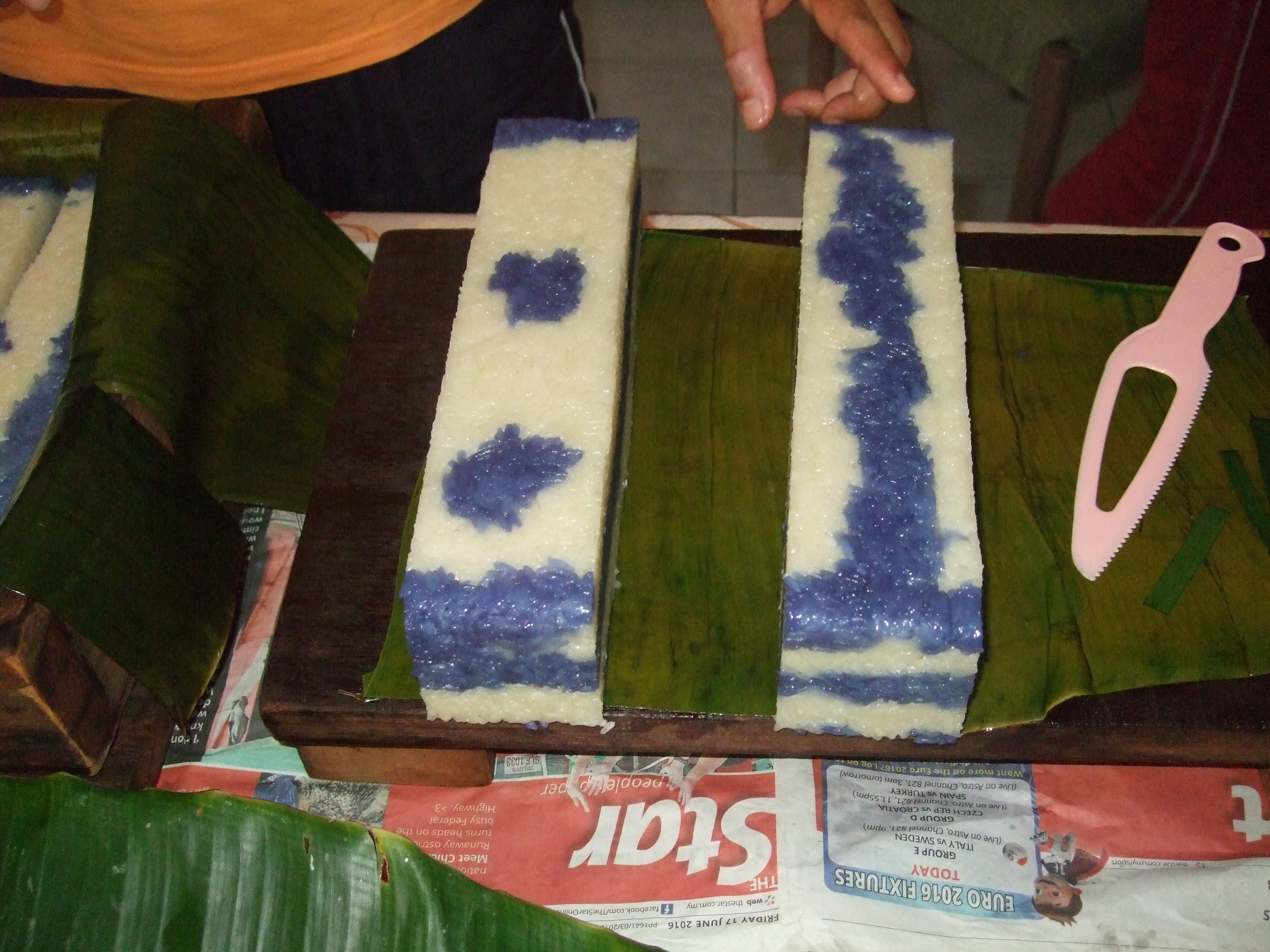
The preparation of the day usually starts with making the pulut tekan. This is a white glutinous rice cake pressed firm, parts of which are with a blue tint to form a design. The whole process can take some seven hours. The rice is first cooked. Then the coconut milk is added and the rice steamed. A portion of this rice will have a blue colouring added. This colouring is from the blue coloured bunga telang (blue pea or butterfly pea). The rice is continually tested for the right consistency and when the rice is steamed to the right softness, it is drained and pressed into a 10 cm deep wooden square box. It is spread out in layers between the white and the blue rice to give the desired design. The inside of the box is lined with banana leaves. A wooden cover is placed on top and weights are laid on the cover to slowly press the contents of the box into a hard cake. The usual weights are two grindstones.

DSCF2656
The box with the pulut being pressed

full pic of pulut tekanWhen it is ready after some hours, the weights are removed and the box is taken and placed on the table. The hardness is tested and if not right, it is placed back under the weights. When ready, the top of the box is lifted off. The sides of the box are removed and this leaves the cake on the base. The banana leaves are then carefully removed.

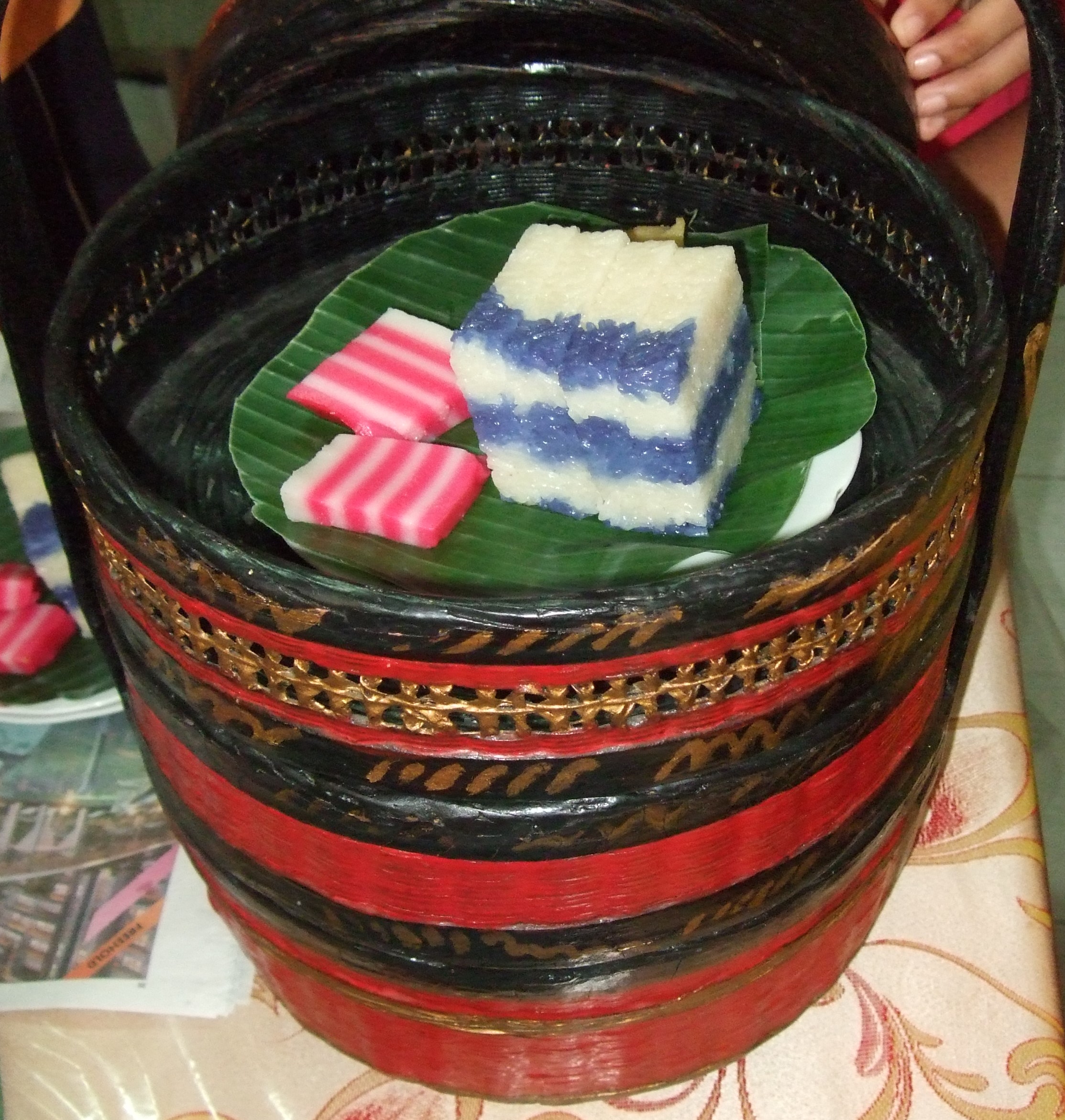
An approximate 5 cm thick block has to be cut which will have a nice design of the white cake with blue colour. This is left to the individual, in this case, Shanmugam, another of Nadarajan’s brothers. The selected block of pulut is placed on a tray covered with a banana leaf cut to the shape of the tray. The blocks that are not used for the offering, are cut into smaller portions and placed in a bakul siah, a tiered lacquered wooden basket.

DSCF2662
The specially cut pulut blocks for the offering
DSCF2659
Seri Kaya
Kuih Ginggang
Kuih Ginggang

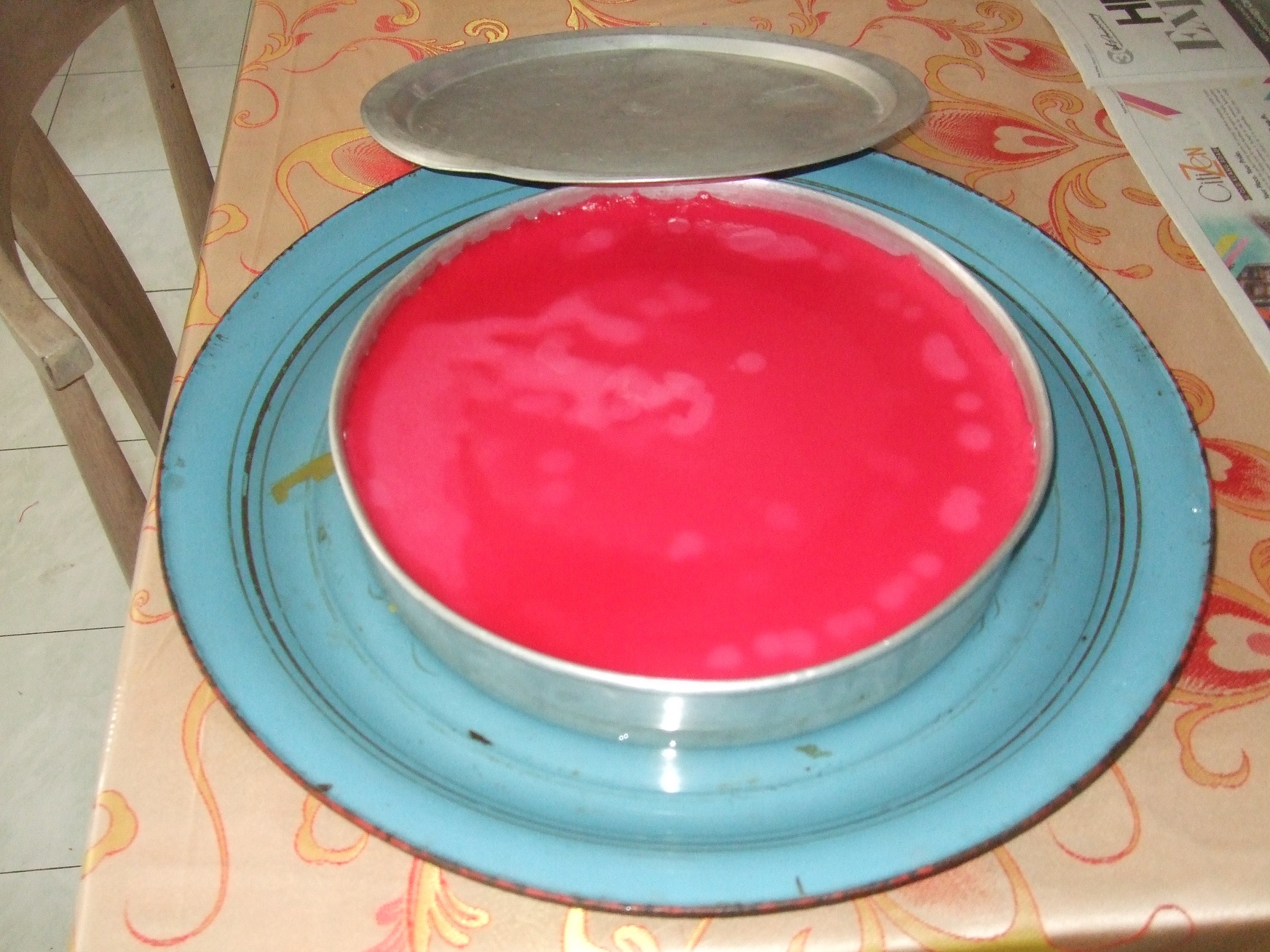
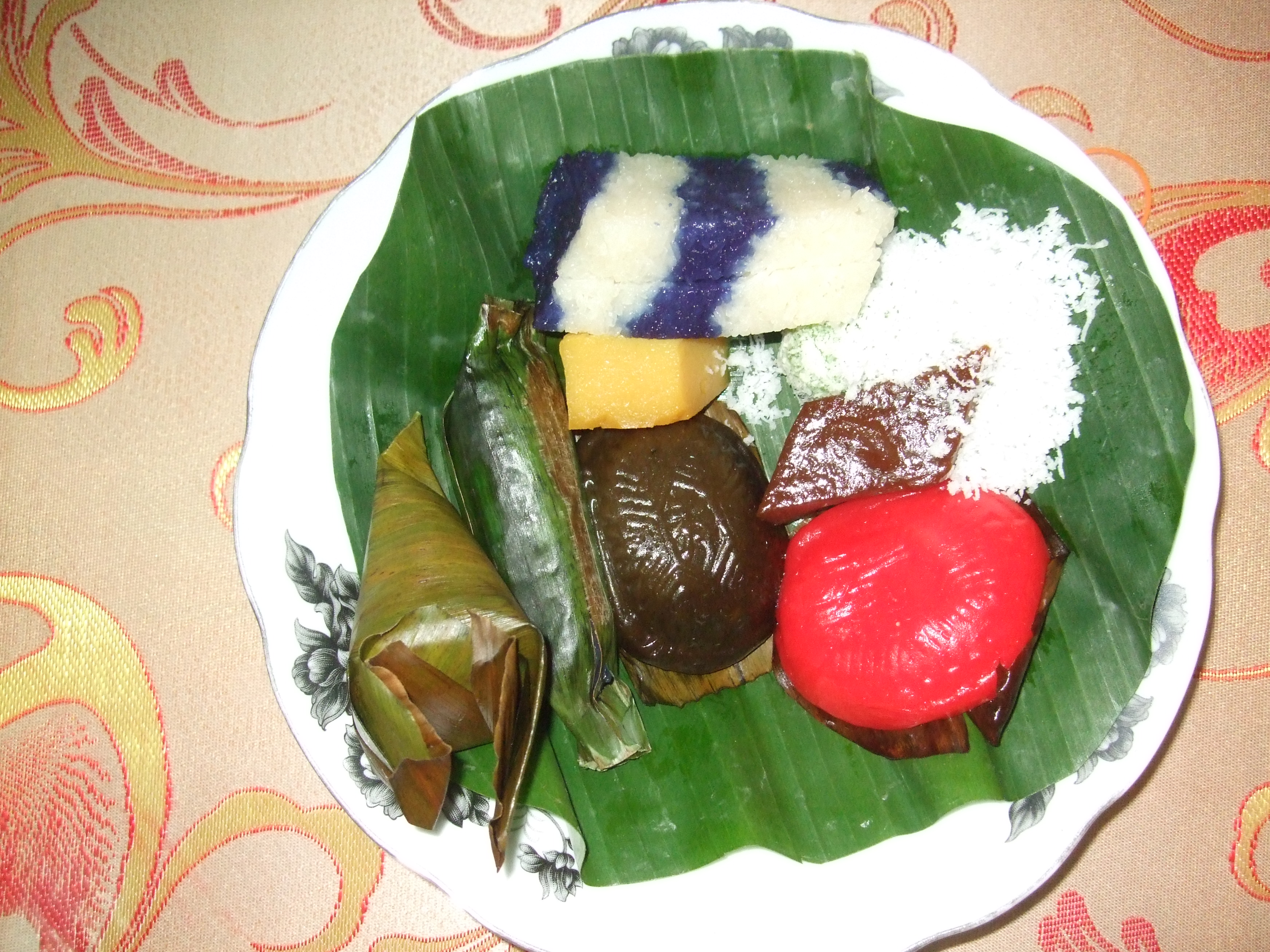
The seri kaya is also prepared earlier. This is coconut jam but a firmer type. A portion is cut and placed beside the pulut tekan for the offering. Another portion is placed in the bakul siah. A portion of the kuih ginggang, red and white layered cake is cut for the offering as well as a portion to be put in the bakul siah.

A few bakul siah are prepared in a similar way. The children then take these and present it to various close relatives or friends living in the neighbourhood. They, in turn, give some of their preparation if they are observing on the same day.

DSCF2675
Bakul Siah with the pulut and kuih

Nadarajan then got the front living room floor cleaned. One by one, Nadarajan and Shanmugam placed the various items on the floor.

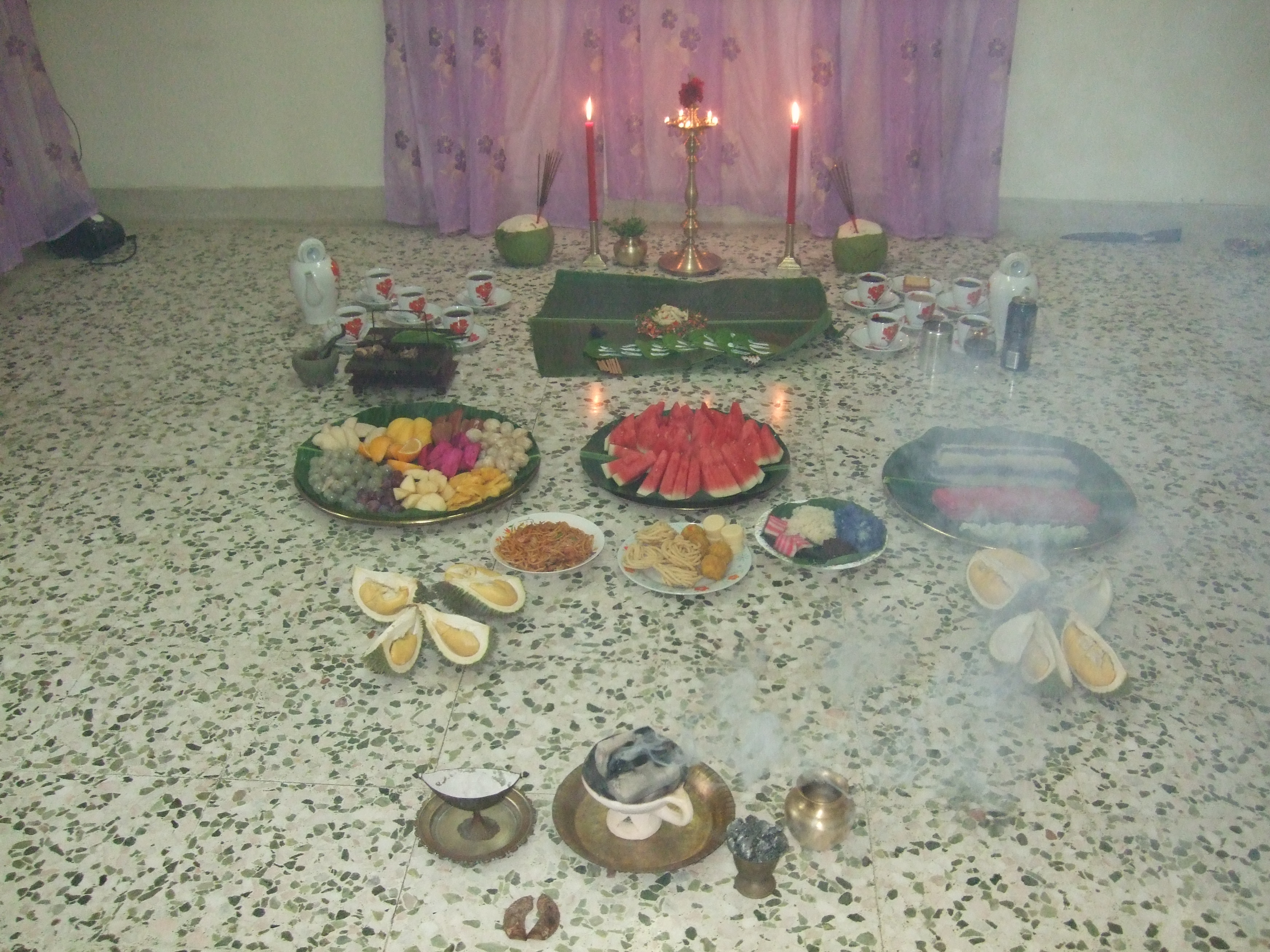
The complete display of the offerings

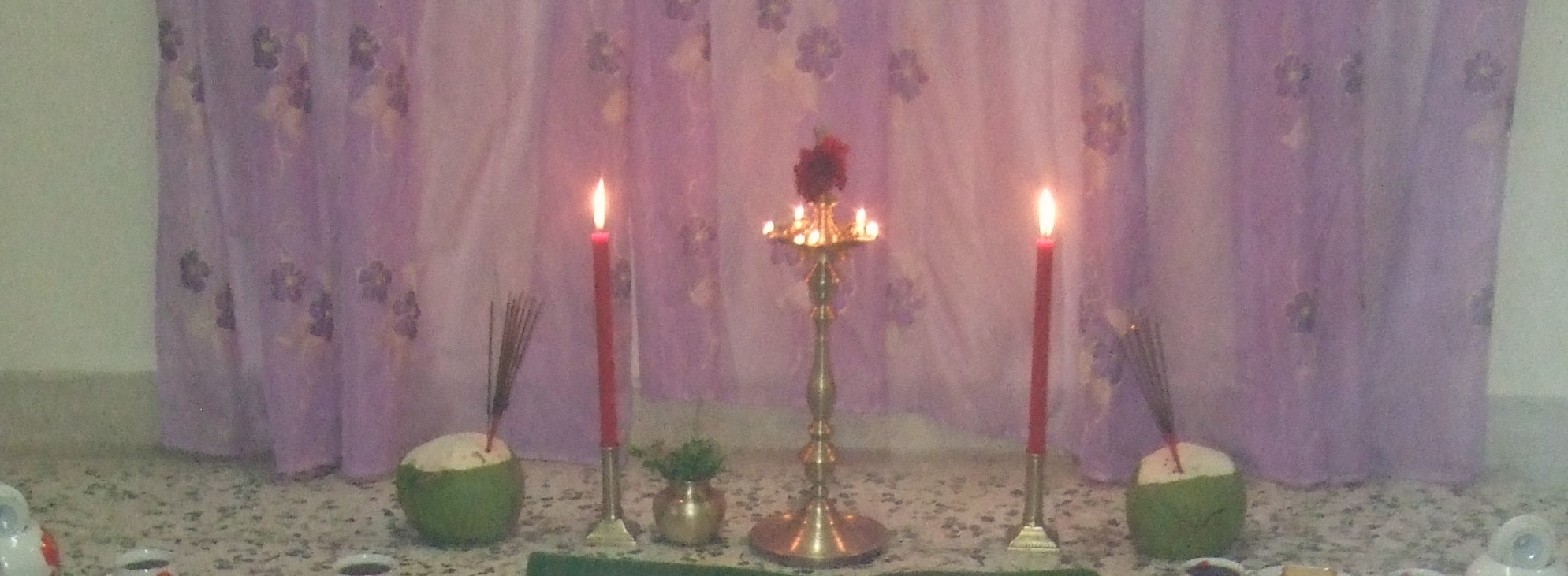
The display is laid out on the left of the entrance of the house. Two red candles with a kuthu vilakku, (Indian oil lamp) in between are placed in the centre. On the centre of the oil lamp is a hibiscus flower for decoration. There is a brass bowl (chembu) with tulasi (holy basil) in between the candles. These are flanked by two young shaved coconuts with incense sticks stuck in as shown below.

DSCF2701aIn the front centre is a large banana leaf laid with the head on the right. The head is the top of the banana leaf, or the narrowing part. In the centre is a bowl of bunga rampai, scented flowers. There are also seven betel leaves lightly smeared with lime powder. In front on the left are seven cigarettes of tobacco wrapped in tobacco leaf and on the right are five modern cigarettes. This is seen below.

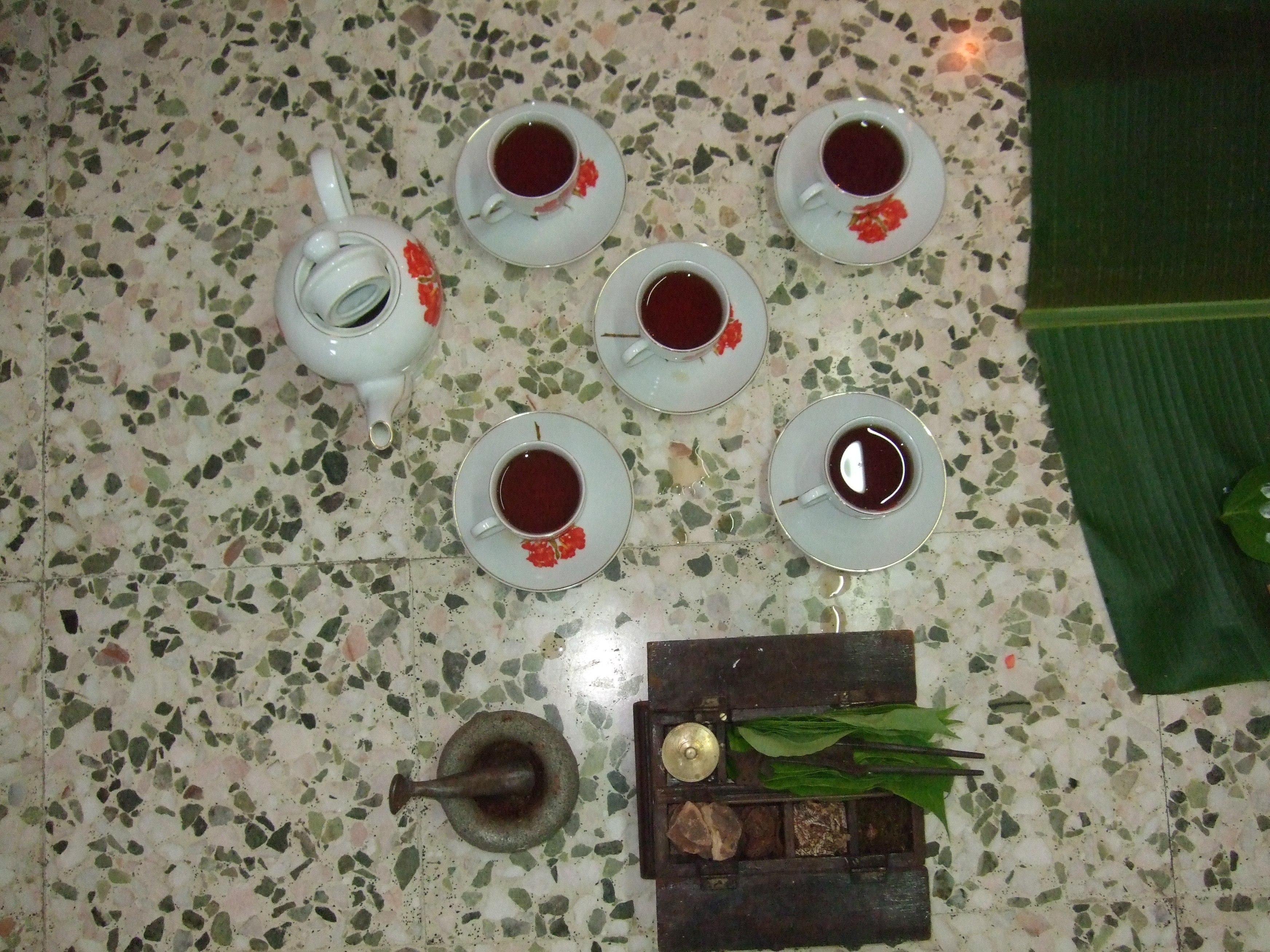
DSCF2697On the floor on the left, there is an arrangement of five cups and a teapot with tea. Next to this is a tumbuk (stone pestle and mortar) and an old wooden tepak sireh set (betel leaf and betel nut set). Three betel leaves are smeared with lime paste and wrapped with a piece of pekak. Pekak is a pink hard powder which turns red when eaten with the betel leaf. This wrap is then crushed in the tumbuk (mortar) and placed among these.

DSCF2695On the right is an arrangement of four cups with black coffee and one with Milo. There is also a tin of coffee with milk and a can Guinness stout.

DSCF2696In front of this is the tray of fruits, a tray of watermelon, the kuih,  a plate of fried noodles, kuih from the neighbours, some Indian savouries and three opened durian fruits.

The fruits that Nadarajan prepared were jackfruit, mata kuching (related to the longan or soapberry), mangoes, dragon fruit, jambu air (water apple or water rose apple), salak, watermelon, durians, grapes, apples, oranges and pears. Local fruits are used as much as possible but nowadays, common foreign fruits are also added. This also depends on the availability of the fruits.

DSCF2690The variety of kuih served were, the pulut tekan, seri kaya, kuih ginggang and ondeh ondeh. Offerings included some additional kuih sent by neighbours. These were the same glutinous rice but the white and blue being separate, angku (red tortoise cake), wajih (glutinous rice with sugary syrup and other local kuih.

DSCF2693
The seri kaya, pulut tekan, kuih ginggang and ondeh ondeh
Further variety made by others

The fruits and other edible items are usually the favourites of the ancestors and are presented in odd amounts.

In front of these are a brass bowl of vibuthi (wood ash), a brass bowl of water, an earthenware holder for smouldering charcoal and benzoin resin. This latter gives off smoke. There are also two pieces of kidney shaped wood.

Other items presented

The ceremony starts when the nearby temple bell is sounded off at 6.30pm. Nadarajan as the head of the household, takes the earthenware holder and goes to the outside of the house. He holds the holder up and invites his parents and ancestors to come and partake in the offerings.

He then comes into the house and shows the holder to the items on the floor, circling over all the offerings. Next, he goes to the pictures of his father, his aunt and his grandfather and circles the pictures with the holder. These pictures are decorated with the jasmine flowers and incense sticks. He comes back to the living room and places the holder on the floor. His brothers and other male relatives or close friends will do the same. This is followed by the females in the family and close friends.

Finally, Nadarajan will cut the young coconut open. With this the ceremony is over.

The guests are then invited to dinner. Nadarajan served rice with fried fish, fish gravy, watercress, chili cucumber and fish roe with belimbing.

Despite Malacca being a small place, Chitty practices vary from which part they come from. Those at Gajah Berang and Bacang use milk rice while those from Tranquerah use nasi lemak.

The kuih here are referred to as wet cakes. Others prepare dry cakes, as in not oily, such as kuih bakul, kuih bahulu, kuih kacang soya etc. Admittedly, there is now a mix which includes Nyonya, Malay and perhaps Portuguese kuih as well. This is the result of the many years of assimilation and intermarriages between them. It must be remembered that these groups have been together for 500 years.

Generally speaking, one wonders about the origin and the reason behind the use of the various items. One simple reason is that these are the things most commonly found in the vicinity. Some have magical or mystical properties ascribed to them from so long ago that the meaning or reason is lost today.

There must be some explanation as to why rituals are being performed and certainly not simply for the sake of doing something. Again the routine has caused the significance to be eroded with time. After all, the Hindu religion has been practised for thousands of years and the Chitties have been performing these for some 500 years. Many rituals have been performed by the temple priests only, as only they were educated in these matters. The ordinary folk followed and believed in what was done.

But now we live in an age where education levels have vastly increased resulting in individual thinking and questioning or in fact, re-inventing all things. While we continue to perform and believe in these rituals, it is now left to the current generation to study the religion, history and reintroduce the rituals so that when these are performed, it is done with a greater understanding and this in turn reinforces the faith.

On the Path of Prehistoric Migrations

by Maganjeet Kaur

20160521_105656The Kedah Tua International Conference (KTIC) in Sungai Petani kick-started on 21 May 2016 with Dr Stephen Oppenheimer presenting the first keynote address. His presentation focused on using genetic phylogeography to trace the migration patterns in South East Asia. Two pieces of DNA are used to build a gene network: mitochondrial DNA (mtDNA) which is passed from mother to daughter and Y-chromosome (NRY) which is passed down the male line. As these two pieces of DNA do not recombine during reproduction, they are transmitted unchanged through the generations allowing scientists to trace human migrations through random mutations that occur in these DNA strands.

009
Three distinct worldwide sea-level rises (around 14 000, 11 500, and 8000 years ago), due to melting of the ice caps, caused the sinking of Sundaland. Photo taken from the display boards of Gallery A, Muzium Negara

A large part of Dr Oppenheimer’s presentation centred on a recently published paper that used genetic methods to study the ancestry of inhabitants in island South East Asia (ISEA). For the past 30 years, the Out of Taiwan theory has held sway to explain these origins. This theory is based primarily on linguistic evidence; the antecedents of Austronesian languages spoken in ISEA can be traced to the aboriginal population of Taiwan. By extension, Southern China is theorised as their original homeland. The Austronesian speaking population is said to have arrived in Taiwan from Southern China around 6500 ya. From Taiwan, they moved into the Philippines around 5000 ya and reached southern Philippines by 4000 ya. From here, there was rapid dispersal to the rest of ISEA and Oceania with arrival in the Pacific by 3000 ya.

A model that combines this Holocene colonisation with an earlier Pleistocene colonisation from Southern China via the mainland has successfully withstood attacks from detractors who favour a homeland from within the Sunda shelf. The Out of Sunda theory proposes that the inhabitants of ISEA originated from within ISEA itself and that it was the sinking of the Sunda platform which provided the impetus for dispersal. This turns things around and places insular South East Asians as ancestors of the aboriginal Taiwanese. Genetic evidence has been employed by scientists on both sides of the divide to support their views. The recent study conducted by a group of international scientists, of which Dr. Stephen Oppenheimer was a part, is the most comprehensive undertaken to date. It uses a combination of mtDNA, NRY, and published genome-wide data. The results are surprising in that while they mostly support the Out of Sunda theory, the study also detected minor migrations during the Late Holocene from Taiwan, corresponding to the Out of Taiwan time-frame. However, the study noted that these migrations did not have much influence on the ISEA gene pool and that the impact was mostly cultural and linguistic.

migration
Taken from http://www.bradshawfoundation.com/journey/

The story of human migration starts around 85 000 ya in East Africa when a group of Homo sapiens (modern humans) crossed the Red Sea into the Arabian Peninsula and then travelled along its coastline into the Indian subcontinent. All humans outside Africa are descended from this single exit. These beach-combers continued around the Indian Ocean coast to arrive at Lenggong Valley in the Malayan Peninsula by at least 74 000 ya. They then traversed the edge of the Sunda platform before moving north into Indo China and Southern China as well as south into Australia. It should be noted that an earlier migration out of Africa arriving at the Levant around 125 000 ya failed to populate the world as the onset of an ice-age either killed the population or forced them back into Africa.

20160521_110838
Taken during Dr Oppenheimer’s presentation

The diagram above shows clusters of gene types (mtDNA). The green circles represent gene types in Africa and the large circle on the right shows gene types in the rest of the world. The single exit out of Africa is represented by the haplogroup L3 which gave rise to two important branches outside Africa. The M branch evolved in present day India and is found in all humans outside Africa except Europeans and Levantines. The N branch evolved around present day Pakistan/Iran and is found in all humans outside Africa including Europeans and Levantines. The M supergroup gave rise to M9 which evolved in SEA around 50 000 ya. M9, in turn, gave rise to the haplogroup E which developed in Sundaland around 23 000 ya. This haplotype is widely dispersed and some of its daughters can be found in Taiwan; 15% of all gene lines in ISEA and Taiwan belong to haplogroup E.

One of the main reasons behind the wide dispersal of haplogroup E was the sinking of the Sunda platform caused by three rapid rises in sea levels between 15 000 and 7000 ya. The effects of these sea level rises can be seen in the genetic record – genetic drift, equivalent to extinction, corresponds to the three distinct rises in sea levels. The extinctions were followed by a major expansion of haplogroup E which expanded throughout ISEA, as far north as Taiwan, and east of Guinea. As the land halved and the coastline doubled, the population adapted itself to maritime activities allowing them to carry their genes far and wide.

The Austronesian migration can be seen through mtDNA haplotype M7c3c. It has a similar distribution as E but goes in the opposite direction. Coming from China into Taiwan, it spread from Taiwan into SEA around 4000 ya. This haplotype is present in around 8% of Indonesians.

20160521_111146
Taken during Dr Oppenheimer’s presentation

The diagram above shows that, along the route out of Africa, Sundaland has the highest number of founding branches, 30 in total, making it the most diverse place outside Africa. If we look at the indigenous populations of the Malayan Peninsula, 86% of their lineages come from locally founding Sunda lineages and 14% from East Asian lineages. For the Malay population, around 58% of their lineage is from local Sunda founding lineages, 38% from East Asia, and 4% from South Asia. Of the local Sunda lineages, 33% of these lineages go back 60 000 – 25 000 ya. Of the East Asia lineages, only 7% are from Taiwan.

14
Suevite at Bukit Bunuh. Suevite is rock that has been transformed due to the high temperatures and pressure of a meteorite impact

The Malayan Peninsula not only facilitated movements from Indo China and East Asia to ISEA (the spread from Indo-China to ISEA associated with Hoabinhian culture is about 20 000 ya), it also facilitated movements from Africa to Indo China, East Asia, and Australia.

Archaeological evidence supports the assertion that Lenggong Valley was a key area on the migration path of humans. Kota Tampan in Lenggong Valley has yielded a stone tool making workshop covered in ash from the volcanic eruption that created Lake Toba in Sumatra. This ash dates to 74 000 ya attesting that modern humans must have arrived in Lenggong Valley before this eruption took place. The Lenggong Valley has also shown continuous settlement from 40 000 ya to present. The finding of a stone hand-axe dated to 1.83 million ya at Bukit Bunuh, about 1 km away from Kota Tampan, shows that Lenggong was also on the migration path for Homo erectus, an earlier species of the Homo genus. This hand-axe was found buried in suevite. Its discovery puts Lenggong Valley on the migration path of Homo erectus, whose best known representatives are the Java Man (700 000 years old) and Peking Man (500 000 – 300 000 years old).