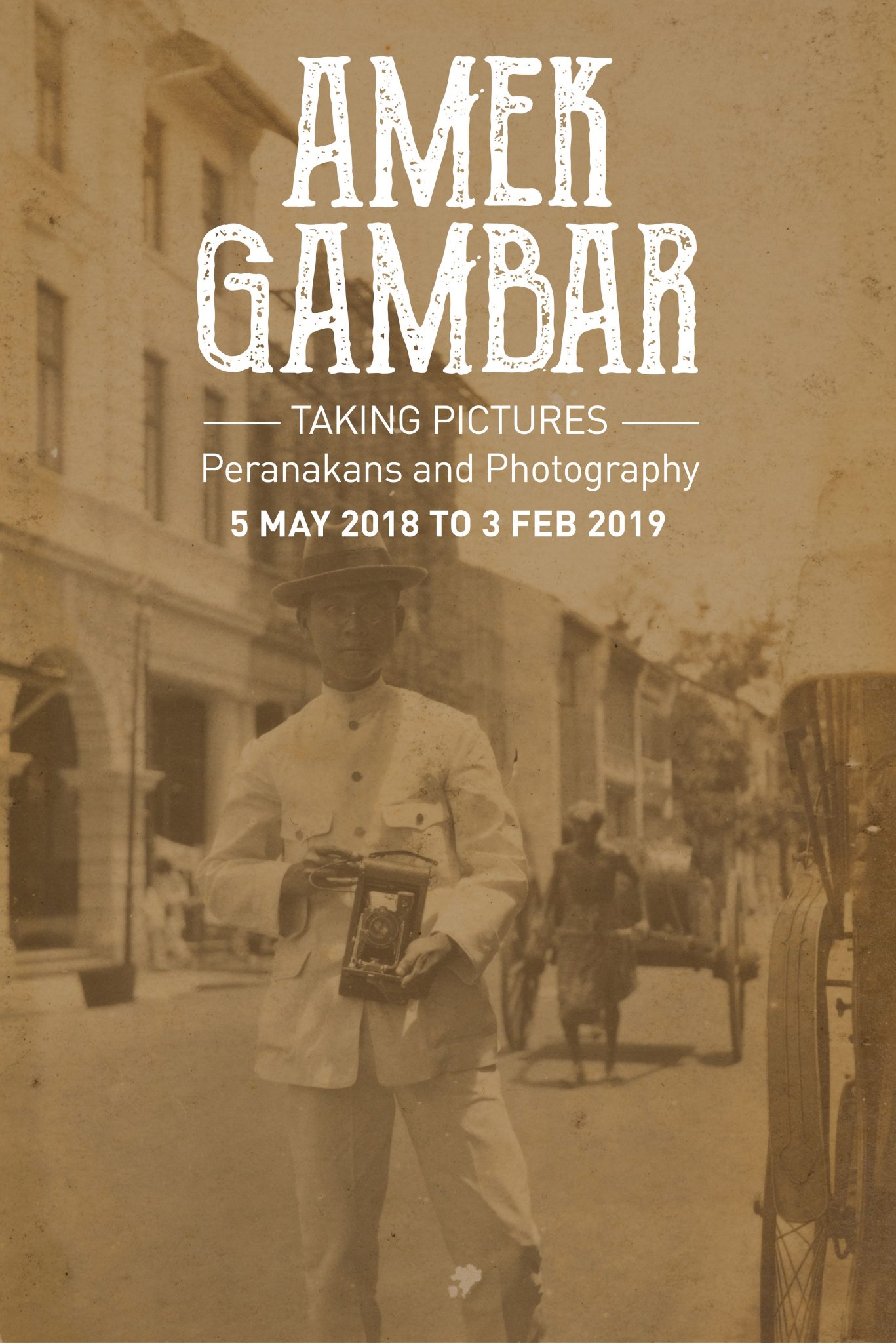
After a lovely tour of the permanent galleries by volunteer docent Marjon de Winter and visiting the various other parts of the museum, I just had enough time for a whirlwind walk through the Amek Gambar exhibition. According to the write up, it “presents over a century of photographs, tracing the emergence, adoption and evolution of photography in Southeast Asia.”
I was fortunate enough to catch the tail end of a private, informal tour and this experience truly drove home the point that museum docents play an important role in helping visitors on their journey of discovery. For me, having the dots connected, deepened my appreciation of the images on display and the insight they afforded into the world of the Peranakans. More so, when the guide has first-hand knowledge on the subjects of the photographs and shares a bit a local gossip here and there!
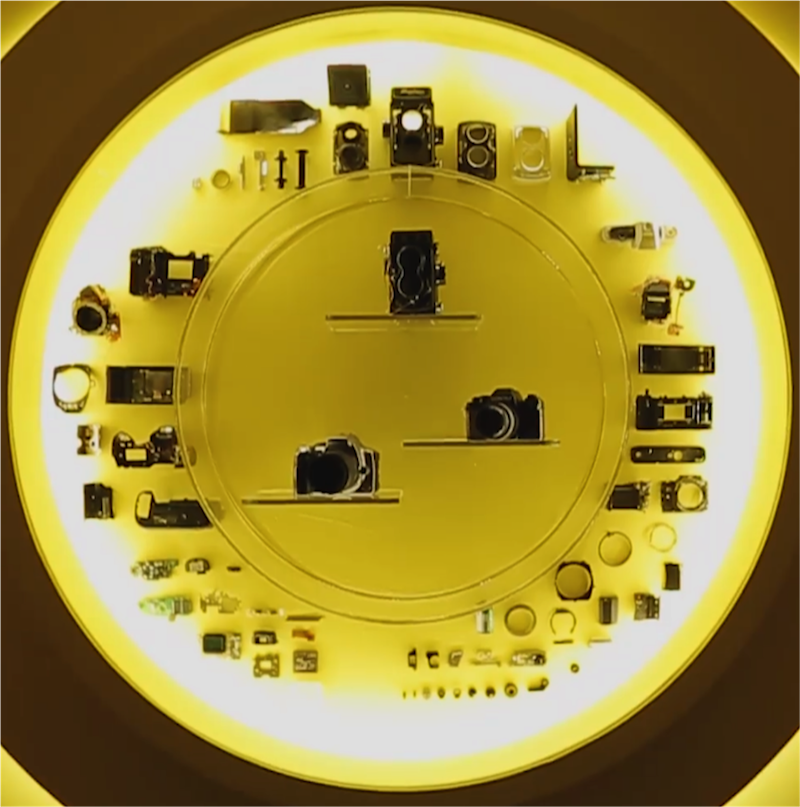
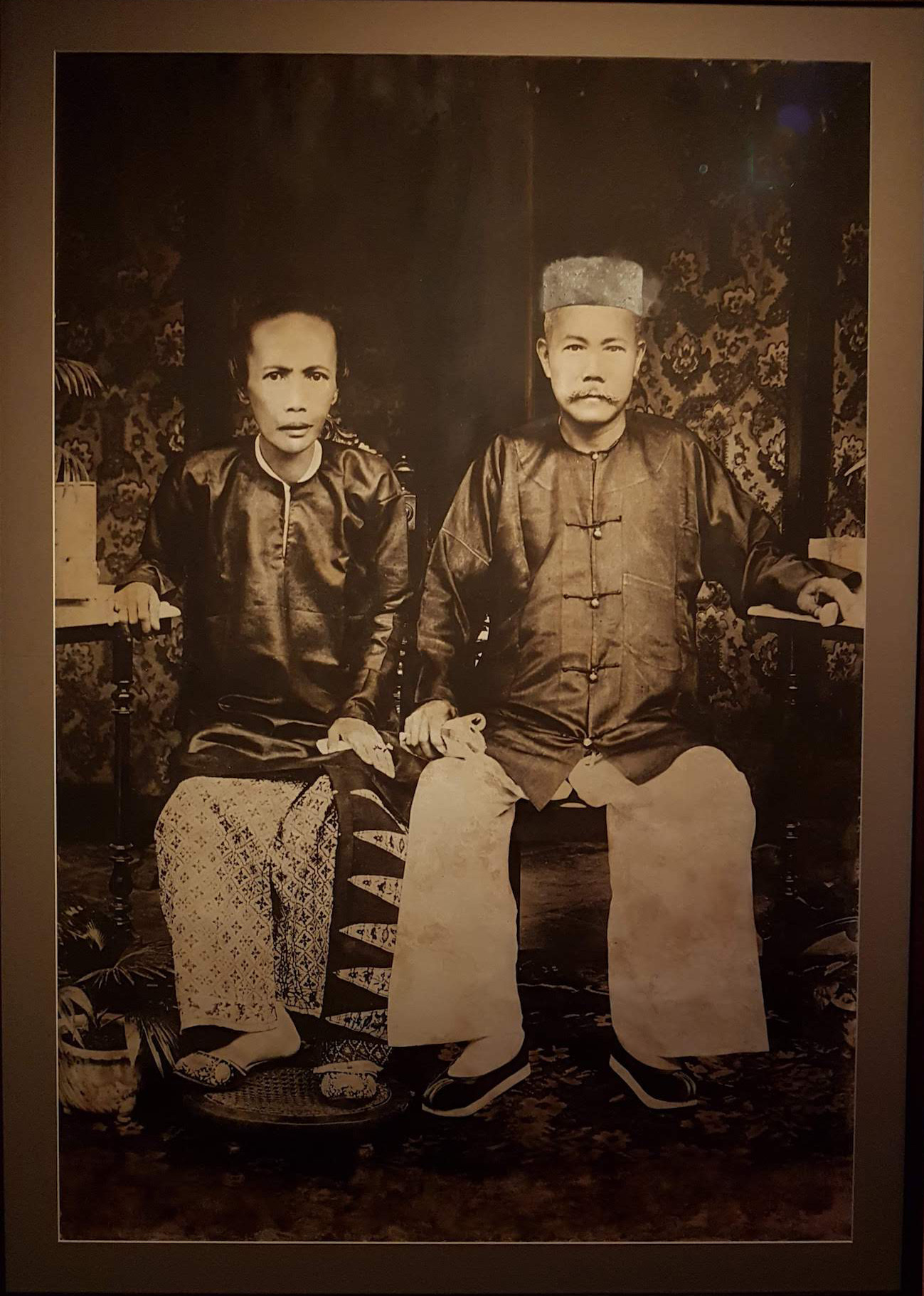
The photographs range from the earliest photo of Singapore to crowd sourced digital images – capturing people, places and events to tell a story of the scene captured. A majority of photographs were donated by Mr and Mrs Lee Kip Lee. The tools of the trade – cameras, negatives, photo albums – are also given prominence. Visitors are given the opportunity to see the photographs as they would have been kept, used or displayed in their time – framed for hanging or displayed on table tops, in albums, within official documents as well as with their negatives, transparencies or slides.
Mr. Lee Kip Lee
Camera wall
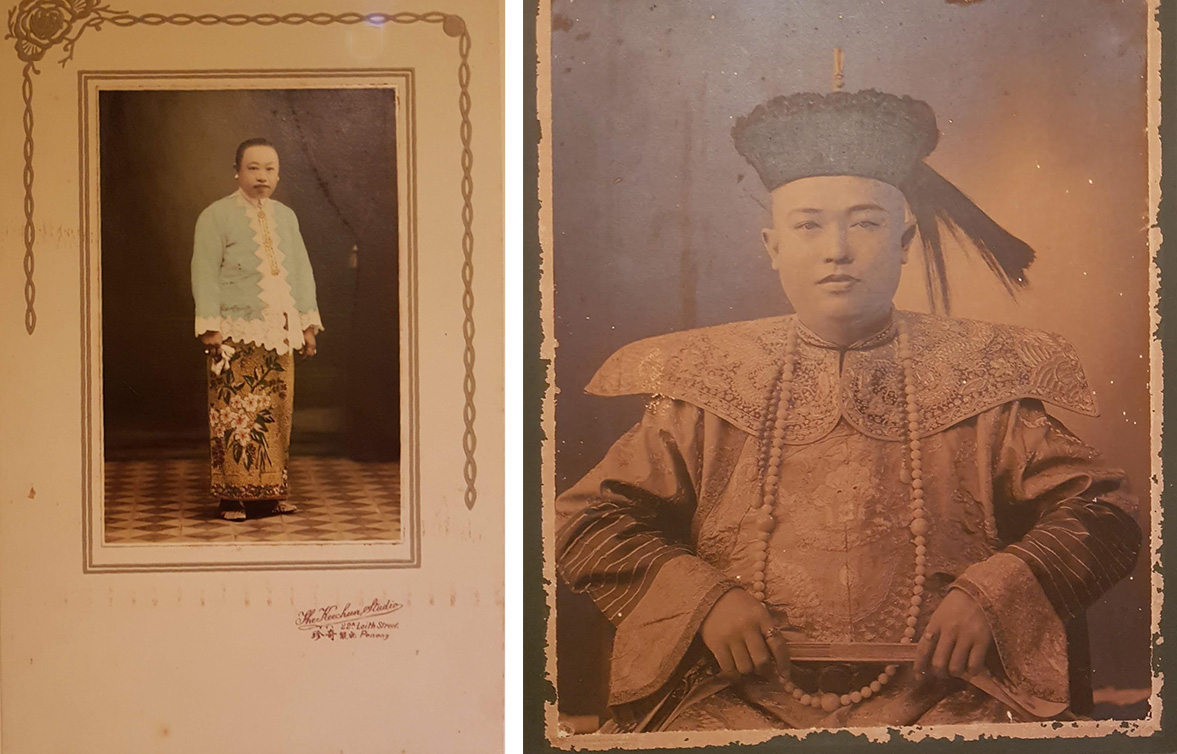
Walking through the exhibition, you can also see the evolution from sepia to black and white; from colour prints to colour painted photographs. The change in photography techniques is paralleled by the variety of ways the Peranakans were captured by Western and Asian photographers as well as how they chose to depict/capture themselves.
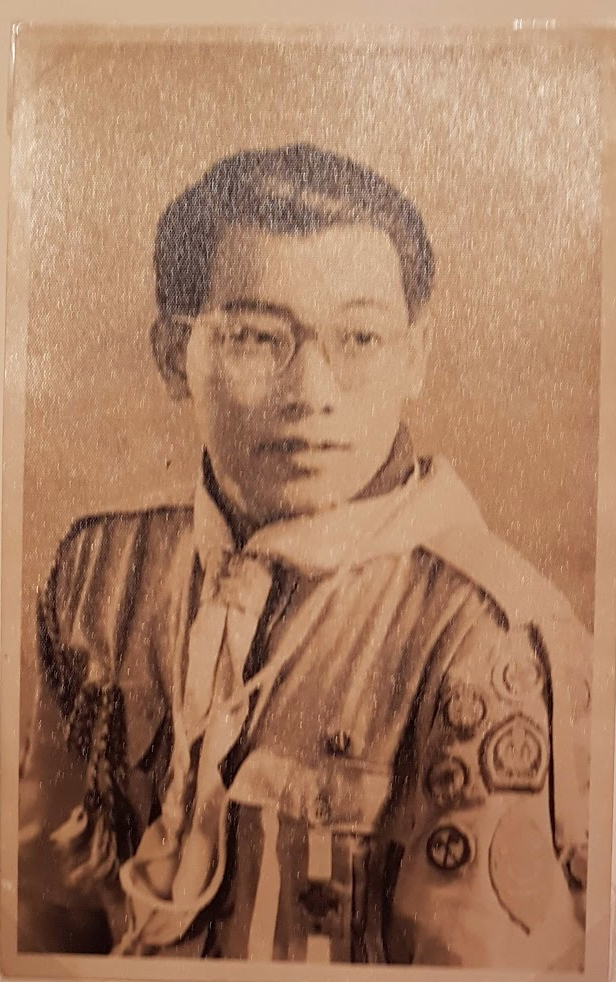
With the portraits, you get to see the poses evolve from the formal pose to the more casual; locations shift from the studio to a formal setting in the subject’s home and later to a more casual outdoor setting. In some of the early photos, the costumes range from formal Peranakan wear to western costume to fashion of the day.
Oei Tiong Nam
Herbert Lim
The use of camera “tricks” or creative development of the print from more than one negative appeared to be popular innovations. I rather enjoyed these photos that were in the exhibition. The gentleman in the photograph below, taken in Java in the 1930s, decided to portray himself in 3 poses.
A baba in three poses
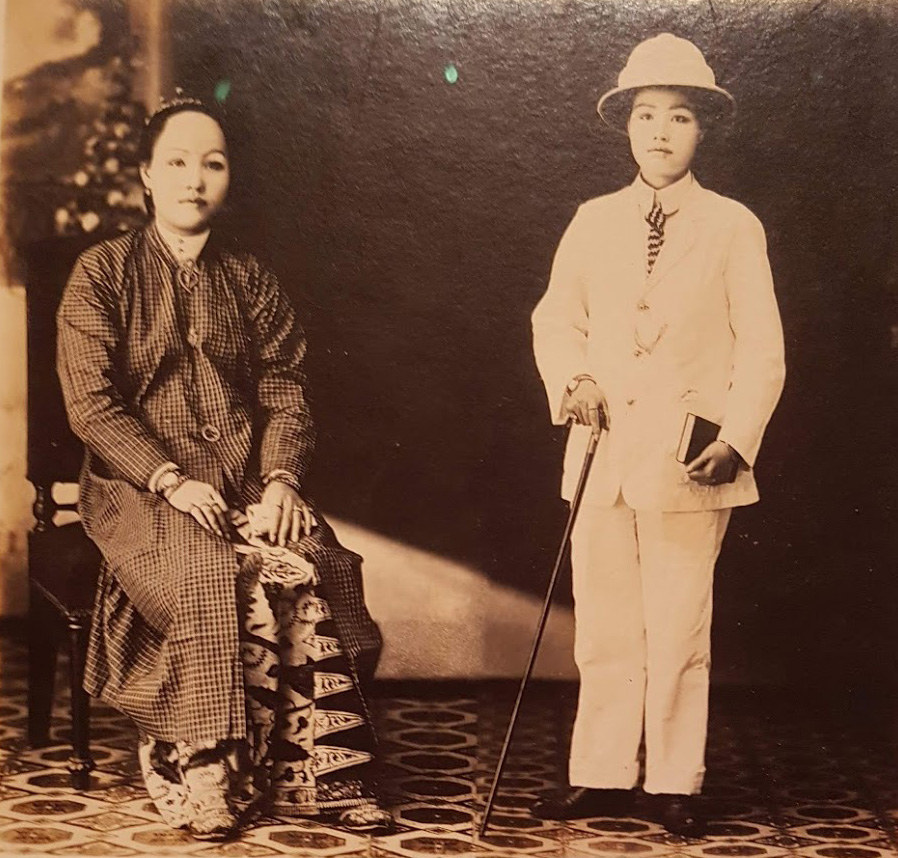
The following photo that was taken in Ipoh in the 1920s features a woman in both traditional women’s wear as well as in the male colonial costume complete with cane and pith helmet! What were they trying to portray of themselves?
Same woman, in two different poses
It appears cross dressing does not seem to be an issue with the Peranakans. The guide mentioned that these pictures were mainly for the promotion of a theatre show but who knows if they also are a manifestion of the baba’s interest in cross dressing! The photo of the baba in a kebaya shows him in impeccable form – reminding me of my grandmother who always said that it is important to ensure that one must always be properly turned out and present one’s best angle in pictures.
Baba in heels
Baba in a sarong kebaya
Given a chance, I would revisit Amek Gambar and spend more time going through the photos. They presented a people and culture that were familiar to me yet offered a refreshing at look the Peranakans.
Amek Gambar – Taking Pictures: Peranakans and Photography runs until 3 February 2019.
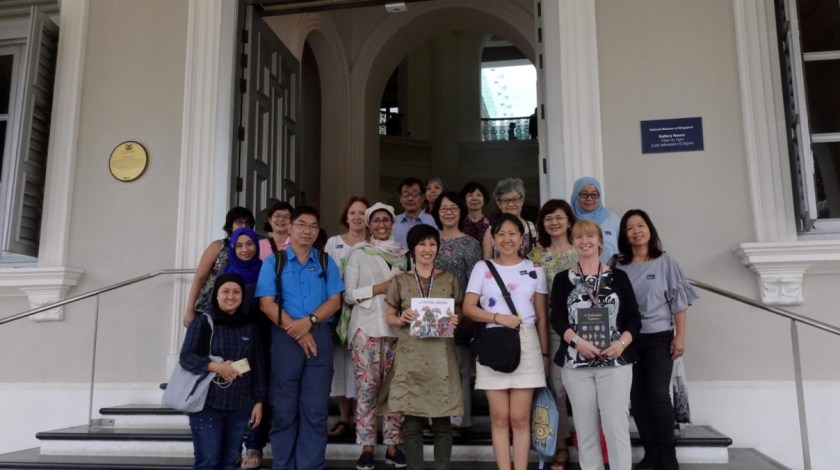
After a chatty and delicious lunch at Equilibrium Restaurant Capitol Plaza, a group of us museum volunteers made our way in the rain to the National Museum of Singapore. The gloomy weather could not dampen our excitement of the special tour organized for us, courtesy of the Friends of Museums. After being warmly greeted by two volunteer guides we were split into two groups; group was led by Sally McHale and she proceeded to guide us to the Singapore History Gallery at Level 1. This gallery narrated the development of our neighbouring country through 4 distinct eras: Singapura, Crown Colony, Shonan-to, and Post-War Singapore including the struggles in the road to self-government and independence, challenges of the future and the successful development of the country.
The Building
Before we entered the gallery, Sally, our guide, gave us a brief account of the building. Opened in 1887, the National Museum of Singapore, originally known as the Raffle’s Library and Museum, is the nation’s oldest museum and it celebrated its 130th anniversary in 2017.
Singapura (1299-1818)
First, we stood in front of a huge digital map the original of which was compiled by a Flemish cartographer, Abraham Ortelius, in 1570. Singapore was already on this map and known as “the land below the winds”. It was strategically located on the trade routes and was part of the Maritime Silk Road from before the British colonisers. Ships from China sailed here, traded and returned home blown by the monsoon winds. Right on cue, the image and sound effect of the seasonal monsoons came on to highlight the significance of the trade winds that were so vital for bringing the merchants to trade in the region.
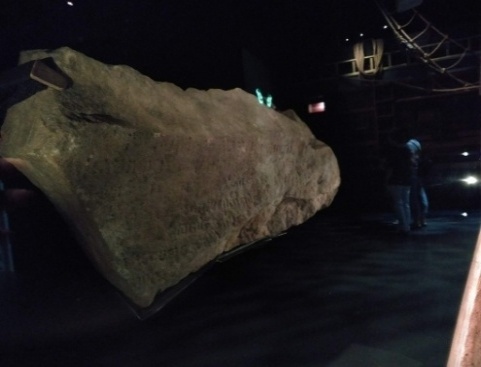
It is believed the island was already a substantially inhabited trading post even earlier than the 16th century as evidenced by the 3 metres wide and 3 metres high Singapore Stone. This is part of a sandstone boulder, dated between the 10th and 14th centuries, which once stood at the mouth of the Singapore River, near where the present day Fullerton and Merlion are located. Inscription on the boulder is written in Kawi script with some Sanskrit words but it has never been fully deciphered. Even Sir Stamford Raffles made rubbings of the inscription to decode its meaning but to no avail!
The earliest written record said Singapore was called Tamasik or Temasek in the late 14th century before it was called Singapura (City of the Lion in Sanskrit). Tales from Sejarah Melayu told of the first ruler Sang Nila Utama who landed on shores white as a sheet of cloth, spotted a strange lion-like animal, took it as an auspicious sign and named the island Singapura. Exhibits of Chinese coins and fishing hooks placed on the white sands of the 14th century (dug out from the Padang in front of the National Gallery where the first settlement was believed to be) brought to life the legend of Sang Nila Utama stepping on the fine white sand.
Five kings ruled here for 100 years and the last king, Iskandar Shah, fled from Singapura to Melaka and founded the Kingdom of Melaka. Exhibits uncovered on the forbidden hills where royalties resided included gold armlet and earrings, uncovered during the building of a reservoir in the 1920s. On the clasp of the amulet is the head of Kala, a protective deity. Alas, it did not offer much protection to the last king of Singapura as Iskandar Shah had to flee the island. Other trading exhibits displayed show that even after the disappearance of the royal families, trades still flourished along the Singapore River with the existence of Temenggong of Johor Sultanate.
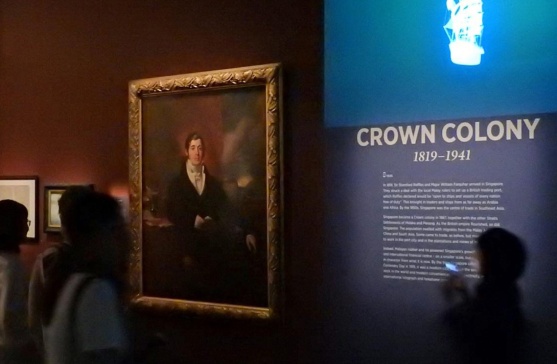
Crown Colony (1819-1941)
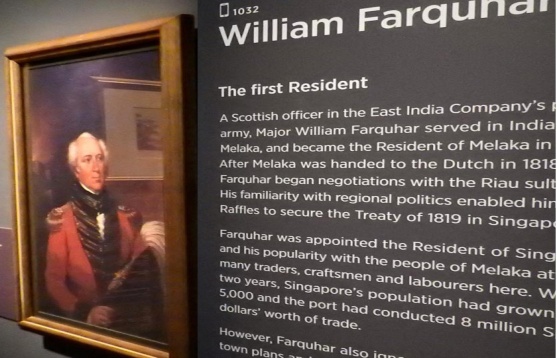
Sir Stamford Raffles, the founder of modern Singapore, was already familiar with this region before he arrived in Singapore in 1819 through his previous postings to Penang and Java. He signed a treaty with his handpicked Sultan of Johor to allow the British East India Company to establish a trade base here and, subsequently, Major William Farquhar opened the port to all nations free of duty thus making the island a springboard to be developed by 1850 into the centre of trade in South East Asia. We were also briefed on how Raffles managed to eliminate the Dutch influence from Singapore and helped to form the new Johor Sultanate in 1819. The first immigrants arrived in Singapore in 1850’s landing near today’s Lau Pa Sat Food Court (we dined there!), where many temples and mosques were built next to each other, giving diversity to the country’s culture. Many immigrants of various ethnicities (the Chinese, Indians and Malays) arrived here particularly after Singapore became a Crown Colony in 1867. Schools, churches and residential areas were built and segregated in accordance with the Jackson Plan promulgated by Raffles to bring order to the city of Singapore. Much of the Jackson Plan still exists today.
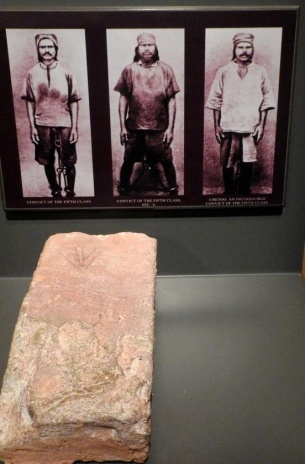
The population grew from 1,000 in the 1820’s to 60,000 in the 1850’s. The ratio of men to women was 14 to 1. Most men came alone, resulting in marriage with local women. One community arising from the interracial marriage was the Peranakan. From India, many Sepoy soldiers came in as the workforce of the British government and from 1826 onwards when it became the Straits Settlement, even convicts from the jails of Calcutta were brought in. Today Singapore’s population is composed of 70% Chinese, 15% Indians, and 15% Malays.
Stopping in front of a painting of Abu Bakar, the descendent of Temenggong–derived Sultan of Johor who made his fortune from rubber products, we were told of his interesting life. In England he was known as Albert Baker and was even a good friend of Queen Victoria!
During the 1860’s, huge changes took place with the opening of the Suez Canal and the appearance of steam ships which docked in Singapore. Changes included the increase in the number of Chinese opium addicts who sought temporary comfort to escape from daily hardships and backbreaking jobs. Even newspapers warned and illustrated how even industrious men fell victims to opium addiction. The British government was appealed to make the opium trade illegal, but to no avail, as it was the major source of income for them. It was not until the Japanese occupation that opium was outlawed completely.
Education also became a forefront of the country’s development. Locals began to influence the social and economic development of the country. A major benefactor of education was Tan Kah Kee, a billionaire who made his fortunes from rubber and pineapple trading. Eunos Abdullah, one of the few Malays educated at the Raffles Institution and the only Malay representative on the Straits Settlements Legislative Council, was an editor of Utusan Melayu, an influential Malay Paper.
A sense of nationalism was beginning to rise in the 1920s/30’s.The Malays started to question the right of the British rule as did the Chinese. The “Singapore Mutiny” led by Bengali-Muslim regiments showed that cracks were beginning to appear in the British Administration. The all-Muslim unit feared being sent to fight against their fellow Muslim Turks during World War I. 39 mutineers were executed in public, watched by 15,000 residents. However no one knew that an even worse “winter was coming”.
Shonan-to (“Island of the Light of the South” 1942-945)
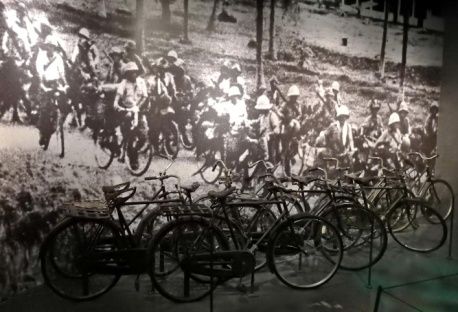
In December 1941, Singapore was bombed by the Japanese and that was the start of World War II in Asia Pacific. After landing on the Peninsular of Malaya on 8th December 1941, they came down to Singapore by bicycles and defeated the British capturing Singapore and the Peninsular within 70 days. The British Prime Minister, Sir Winston Churchill called the stunning defeat “the biggest calamity the British Empire has ever seen”. Japan is a country with scarce important resources such as oil, gold and coal, all of which however were abundant in Malaysia and Indonesia. The main purpose of their invasion was to take over the huge British naval base in Singapore and get access to these natural resources.
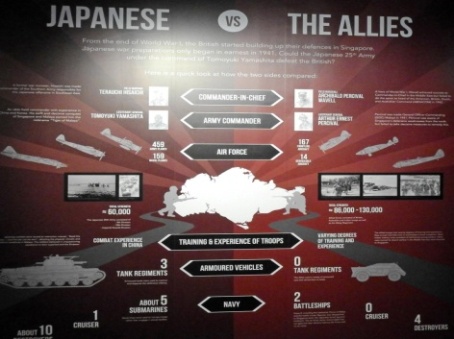
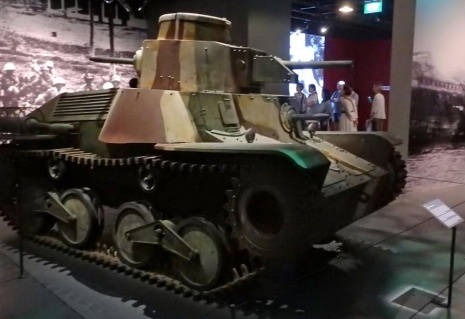
The chart comparing the might of the Japanese armed forces and artillery and that of the British brought home how well prepared and equipped the Japanese were. In terms of army planes, tank regiments and soldiers, the British were outnumbered completely. The pride of the British navy battle ships, the Prince of Wales and the Repulse, were sunk at early stage of the war. The British resources were stretched due to the war in Europe. Airplanes were obsolete and not suitable to tropical conditions. Lieutenant-General Arthur Percival was forced to surrender in February 1942 faced with the fact that 1 million people, soldiers and civilians were crammed in the heart of the island with the Japanese having taken control of the water and food supply.
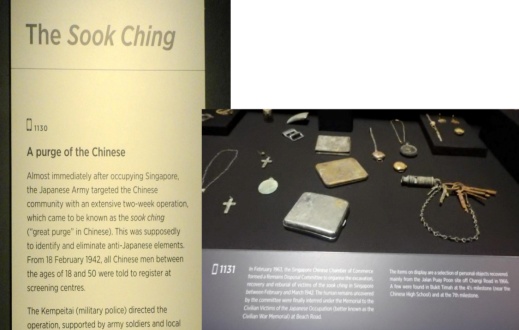
After capturing the island, the Japanese immediately started the Sook Ching (Cleansing) Massacre. Chinese aged between 18-50 suspected of being involved in anti-Japanese activities, boycotting Japanese goods, sabotaging Japanese companies and sending money to the Chinese in China to support their fight against the Japanese were all screened. Once they were identified to be involved, confirmed or otherwise, they were sent to remote areas such as Changi Beach where they were never seen again. It was poignant seeing one of the blue doors of Changi prison behind where soldiers were held, rail man’s whistle, watches, doctor’s stethoscope, eye glasses, pens of the victims of Sook Ching which were uncovered during the 1960s when there were lots of building works in the city outskirts. The belongings suggested women were victims as well as men. The Japanese admitted to 5,000 deaths but excavations suggest 25,000 victims.
Post-war Singapore (1946-Present)
The British returned in 1945 after the war. The 1940’s and the early 1950’s were tough days because of shortage of food, necessities, jobs, schools, etc. There were also natural disasters such as floods. Many were left homeless. Trade unions were formed and riots occurred all of which were threats to the British government. To deal with these problems, David Marshall, the first Chief Minister and a lawyer, sought for more freedom and subsequently self-government for the people of Singapore. Although his goal was not successful in early stages, Singapore gradually attained full self-government, which was finally granted in 1958. In the 1959 election, the Peoples’ Action Party led by Lee Kuan Yew won the polls in a landslide victory and he became the first prime minister. In 1963, Singapore joined Malaysia to form the Federation of Malaysia. However, the merger was an uneasy one. We watched a video of an emotional Lee in tears when Singapore was kicked out of Malaysia in 1965 due to the conflict of policies adopted by two countries. Singapore became independent on 9 August of the same year, now celebrated as National Day.
Many things such as new bank notes, national anthem and national service had to be created for the new nation to establish the identity of the Singaporeans. Economic and educational plans were also implemented, from establishing the Jurong Industrial Estate where multinational companies could invest in, to sending Singaporeans abroad for higher education. Our attention was drawn to an old Setron television set which stood as a symbol of success in transforming old industries to modern ones. The factory manufacturing the TV set was originally processing coffee beans from Indonesia. Supply was cut short due to Indonesia’s “unhappiness” with Singapore joining the Federation, thus forcing the factory to take a gamble to switch to manufacturing of electrical goods. An impressive feat was the social welfare systems such as house ownership scheme by the Housing Development Board, which built 10,000 units for the population within 5 years and improvement of infrastructures. Today Singapore is known as the City in a Garden with strong green policies of planting trees within specified distances contributing to the creation of images of a green city. Assisted by many capable men, Lee brought great success to the Singapore we see today.
We expressed our sincere gratitude to the two guides after the one and a half hour tour, which ended all too soon. The visit to the museum indeed gave us an insight to our neighbour country, Singapore.
References:
National Museum of
Singapore Guide
The Encyclopedia of
Malaysia, Vol 16, The Rulers of Malaysia
もっと知りたいシンガポールー弘文社
History of Singapore https://en.wikipedia.org/wiki/History_of_Singapore
Level 2 has five galleries: Ancient Religion housed in two separate areas, Christian Art Gallery, Scholar Gallery, Islamic Art Gallery and Ancestors & Rituals Gallery. Both the Islamic Art and Ancestors & Rituals Galleries are under renovation, opening in December and early 2019 respectively. In addition, there are two galleries on Level 2 for event space and as a special exhibition gallery.
The Ancient Religion Galleries hold a large collection of Hindu and Buddhist sculptures from Asia. The displays found are from the second century up until the early twentieth century. It also features art objects from Jainism, the third great religion of India.
ACM caption : Head of bodhisattva (Gandhara, around 4th century , Terracotta) The face and curly hair show the powerful influence of the West on the development of Buddhist art. Ancient Greece and Rome played a significant role in the development of Gandhara (in present-day Pakistan and Afghanistan). Bodhisattvas wear jewellery, and have beards and moustaches, which distinguishes them from figures of the Buddha. The jewellery seen here is typical of the Gandhara period. A circular indent on his forehead, called an urna, is a mark of nobility and illumination: it would originally have been inlaid with a precious stone. The sculpture was modelled with wet clay that was then fired. This technique allowed deep indentations and free forms, as evident in the beard and hair. Terracotta (literally, baked clay) allowed large statues to be assembled from several pieces.
Hinduism and Buddhism from India spread widely outside India including to Southeast Asia. The development of Hinduism and Buddhism then evolved combining localized features and animistic beliefs. The concepts of the original religions took many forms. – some human, some divine with supernatural powers and some abstract. By the 7th century, the form of the images moved away from those found in India as sculptors started reflecting local characteristics. Hinduism and Buddhism were widely practiced at the royal courts. Kingships even took the form of Vishnu, adding merits to their power. The Srivijayan era in the 7th century saw beautiful objects created depicting kings and their gods. At the height of the Majapahit Empire, Java (13-15th century) developed its own traditions in art, merging two religions into one.
ACM caption: Buddha teaching (Gandhara, 3rd or 4th century, Schist) The hand gesture signifies the turning of the wheel of Buddhist law, and therefore indicates the Buddha teaching.The halo behind his head denotes his spirituality. Two small donor figures below stand in an attitude of adoration. Remnants of pigment indicate that the stone was originally painted. The drapery, strong muscular form, and facial features show influence from Western classical styles. But his yogic pose and eyes downcast in contemplation show the deep spirituality of the Buddhist religion.
Buddhism became popular between the 8th to 15th century in Thailand, Myanmar, Vietnam, Laos and Cambodia. This influence lasts until today.
ACM caption : Walking Buddha ( Thailand Sukhothai, 15th or 16th century, Bronze) This image, full of fluidity and movement, was an innovation of the Sukhothai period. The dynamic posture, curvaceous arms with tapering fingers, and flowing hemline of the robe accentuate the sense of movement. He has a flamed top-knot (cintamani) and raises one hand in abhaya mudra (gestures of fearlessness). The sculpture embodies ideal features attributed to the Buddha – lotus petal-shaped eyelids, parrot beak nose, chin in the shape of the mango seed, and so on. This image probably refers to Buddha ‘s return from Tavatimsa Heaven, when he preached to his mother. It could represent the Buddha’s walking meditation in the garden after his enlightenment.
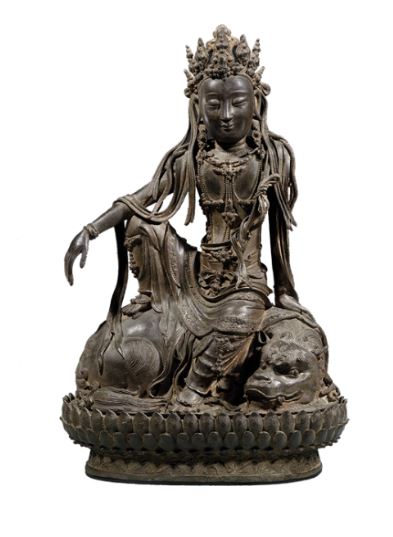
In China, Buddhism grew out of Indian beliefs and was practised alongside Confucius and Taoism. Here, the famous male Avalokitesvara was personified in the form of Goddess of Mercy or Guan Yin, and became a female. The virtue of a compassionate Guan Yin was more suited to a female than a male.
ACM caption: Shi Hou Guanyin China , 14th or 15th century Bronze. Acquired with funds from the Kwan Im Thong Hood Cho Temple.
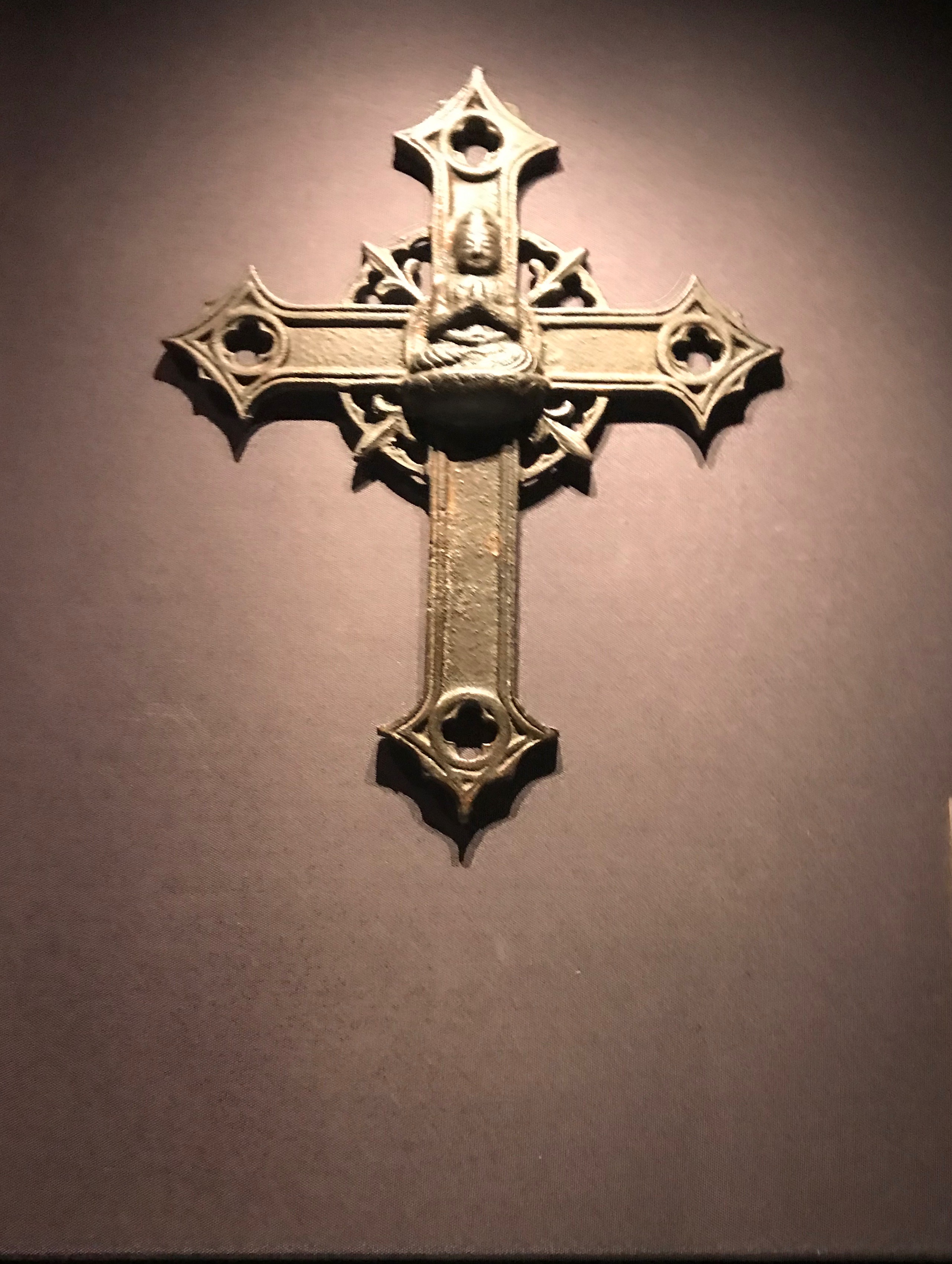
The Christian Art Gallery features collections of art from China, Japan, Middle East, Southeast Asia and other countries. Christianity was introduced by Catholic missionaries from Portugal and Spain, and later Dutch Protestants. The art objects took a different form merging western ideologies with Asian techniques and materials.
ACM caption: Cross with the figure of Amitabha Nagoya, Japan, 1945-50 Iron –copper alloy
ACM caption: Virgin and Child Timor-Leste, 19th century Wood
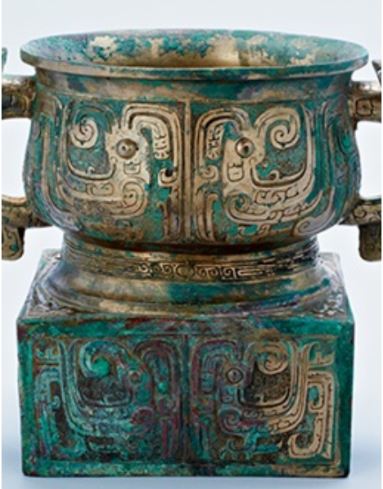
The Scholars Gallery showcases Chinese beliefs and philosophy, strongly depicting Confucius teachings and Taoism practiced by scholastic officials. Here are collections of paintings, furniture and objects used by Chinese scholars depicting their lifestyles and their education.
ACM Caption: Ritual Food Vessel. This vessel was used to hold food offerings in ceremonies to honour ancestors and gods. An inscription identifies it as property of the duke of Rui, a region in present-day Shaanxi province. The circular bowl rising above a square platform recalls the symbols of heaven and earth in Chinese cosmology
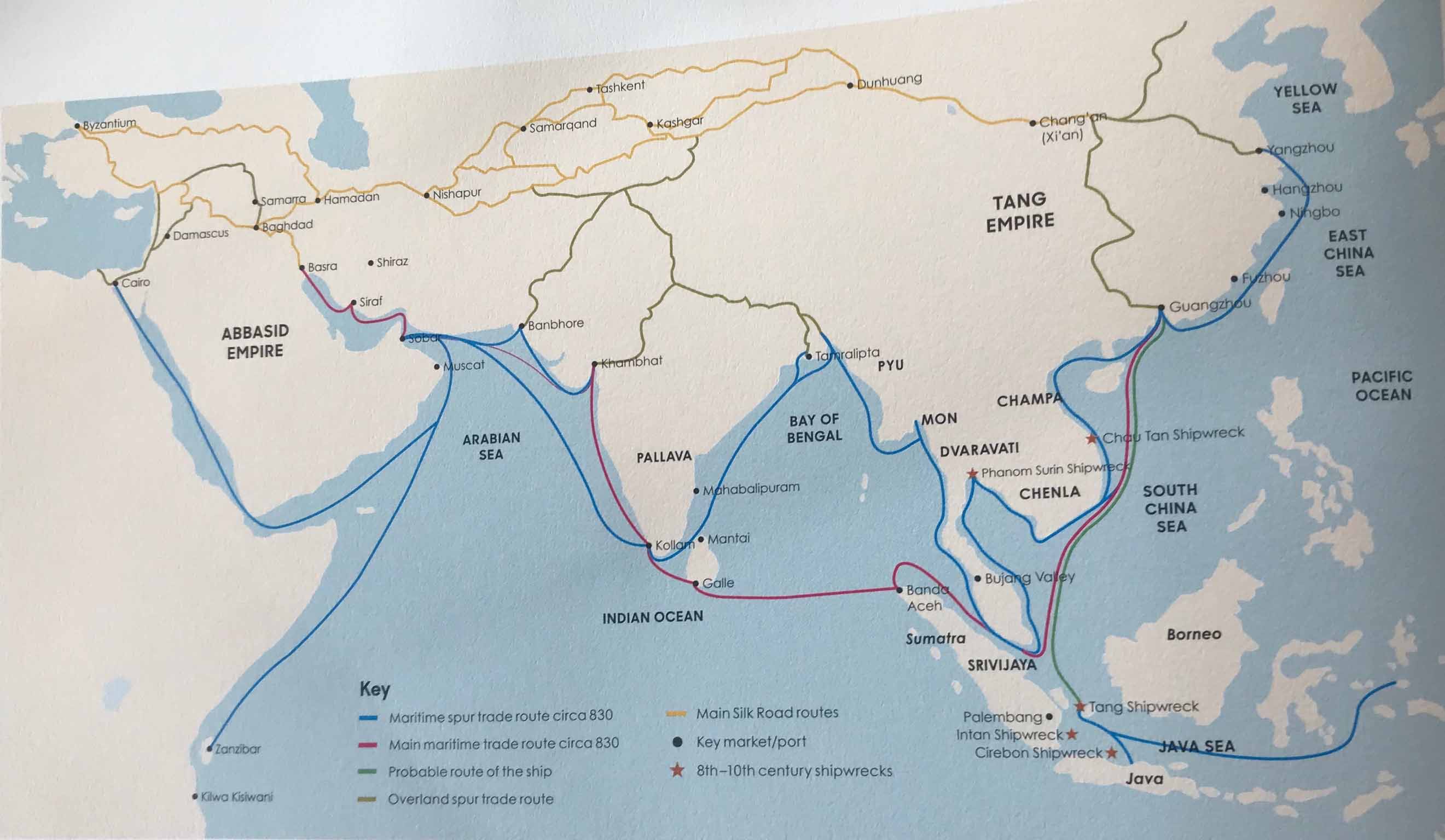
This Gallery, on the First Level of ACM (Asian Civilisations Museum), tells the story of trade through the Tang shipwreck. The story begins in the 9th century when it was already a part of an earlier era of globalization. So let’s learn more about this shipwreck.
The Tang Shipwreck, discovered off Belitung Island in Indonesia in 1998 has revolutionized the way we see the world in the 9th century. It provides an early evidence for the bulk trade between China, Southeast Asia and the Middle East during that period.
Trade was over land and sea, linking diverse parts of Asia. As ships could carry a much greater load than camels could, the maritime route from East Asia through Southeast Asia to South and West Asia became more important, with the Gulf serving as an important hub.
The sea trade made mass exports of heavy, fragile Chinese ceramics possible for the first time.
The ninth-century was dominated by two great powers: The Arab Abbasid (750 -1258) (covering Iran, Iraq, and surrounding regions) and the Chinese Tang (618–907) dynasties.
The ship
The ship itself was Arab by construction – an Arab dhow. It consisted of wooden planks sewn together with rope. The construction technique indicated that the ship may have been built on the Arabian Peninsula, in a Gulf port, or perhaps on the coast of Oman, where similar vessels were still being built in the twentieth century. It had sailed all the way from the Middle East to China and was on its way home when it sank in the Java Sea.
What was traded ?
Glass was brought from the Middle East, cotton from India, spices and wood from Southeast Asia, and ceramics and silk from China.
In the shipwreck, more than 60,000 glazed bowls, ewers, and other ceramic items were discovered – most from Changsha, as well as luxury objects made of gold and silver, bronze mirrors and ordinary objects belonging to the crew. Its contents were protected from erosion as they were packed in jars.
So let’s see some of these wares:
Green-Splashed Ware
The ewer below was made in China, probably in the Gongxian kilns, around the 830s. It is, perhaps, the grandest ceramic piece found in the Tang Shipwreck. The lozenge with flowers is a design developed in the Abbasid Empire. Chinese artists adopted the pattern, probably to export to Middle East customers. The overall form of the ewer is based on objects made in metal, as is evident from the upturned rim of the base, and the thinness of the handle.
Ewer – Stoneware, height 104 cm
Changsha Ware
The vast majority of the Tang ship’s ceramic wares came from the kilns of Changsha, in the central southern province of Hunan: 55,000 Changsha bowls and 2,500 other wares.
These wares seem to have been popular in markets overseas as well as in China itself. The motifs were painted in brown, green, using iron and copper oxide based pigments. One of the bowls had an inscription mentioning a summer’s day in 826. Drinking tea was very popular during the Tang dynasty and, instead of cups, these bowls were used to drink tea.
Changsha wares
Blue-and-White Plates
Three white dishes with a blue design were found in the shipwreck. These are among the earliest known Chinese blue-and-white ware. The cobalt used was most likely an import from Arabia-Persia and the motifs – one or two lozenges surrounded by foliage – were of Abbasid design.
left: made in China; right: made in Basra (Iraq)
Bronze Mirrors
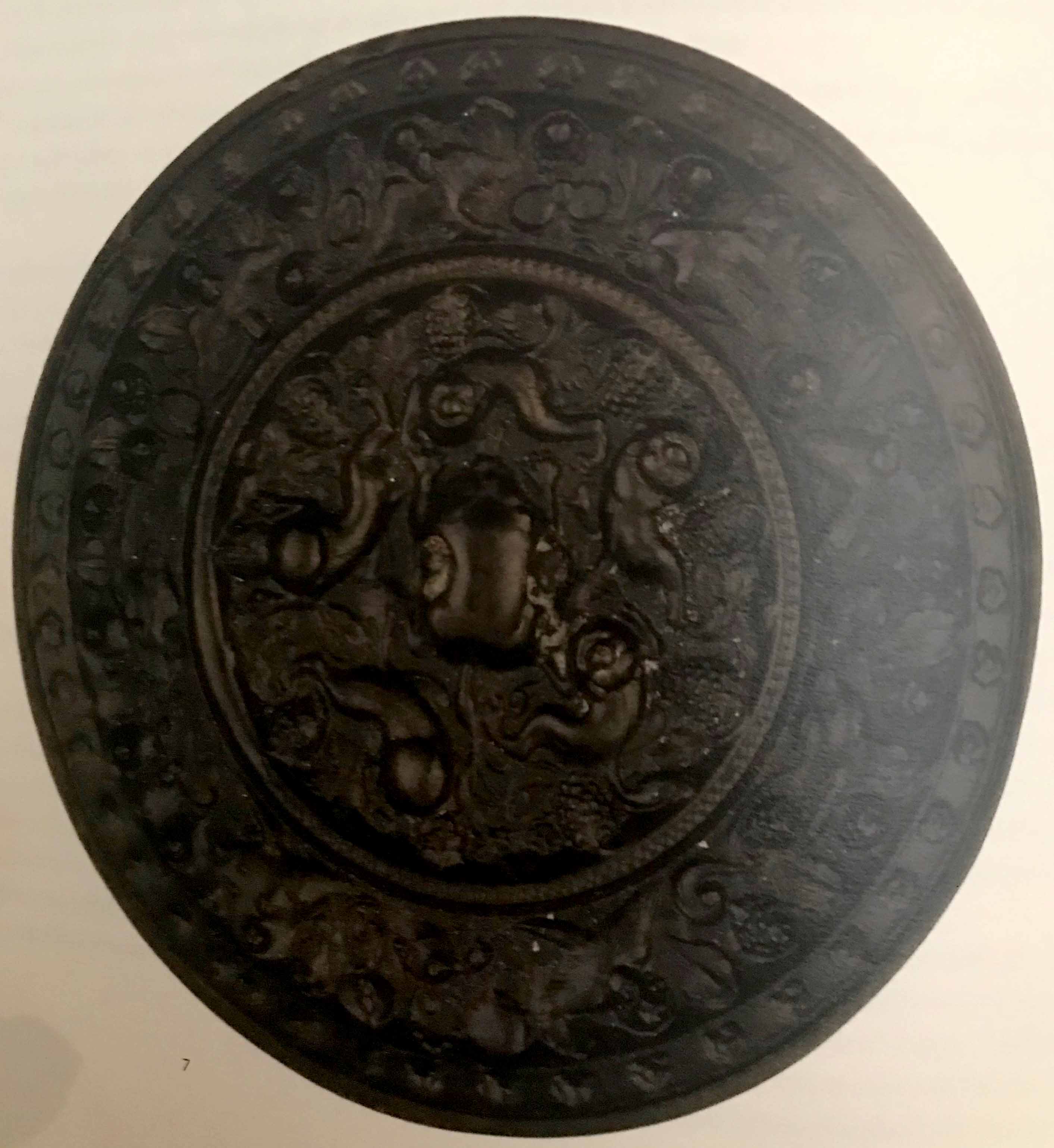
Thirty-nine Chinese bronze mirrors, designed for trade, were found in the shipwreck. Many of them had blackened but were originally silvery. One side was polished smooth to provide a reflective surface, the other side was decorated with different motifs, such as flowers or auspicious animals.
An interesting piece among the mirrors was one that was almost a thousand years old by the time the ship sailed; it dates from the Han era (206 BCE – 220 CE). Another antique piece dates from the Six Dynasties period (220–589 CE).
Many of us have already visited ACM once, twice, a half dozen times. NO MATTER!!!. It’s time to head down to Singapore to enjoy the newly renovated treasure trove whose freshly curated galleries are bursting with artifacts you probably have not seen before. Virtually all of ACM’s galleries tell stories shared by Malaysia and are sure to inspire our guiding.
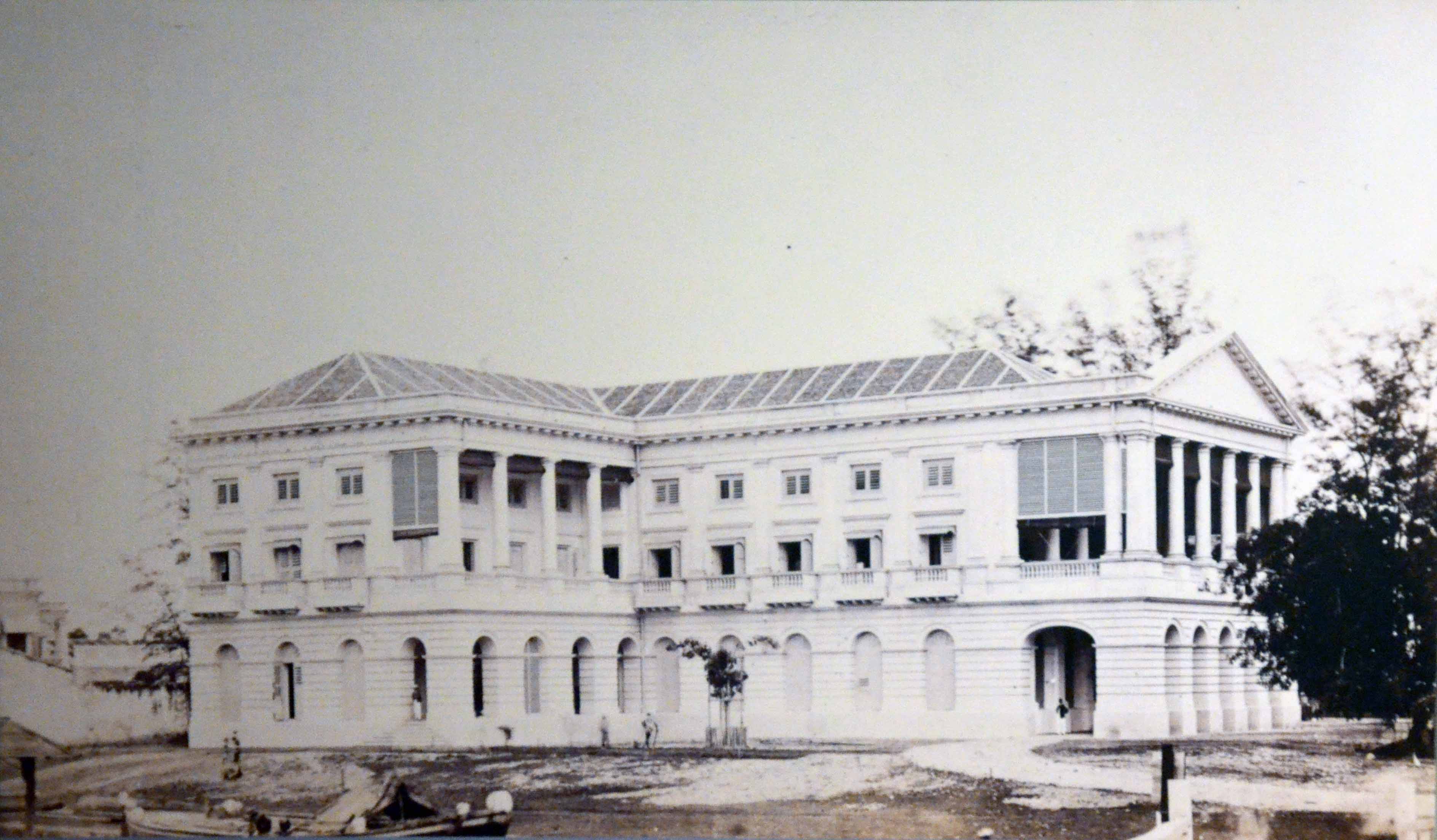
This is the oldest part of Empress Place, the building housing ACM. It is its middle section, built between 1864-67. The building was constructed to house offices of the British Colonial Government and, hence, the building was simply known then as “Government Offices”.
In 2014 ACM announced an ambitious plan to build a modern new wing, develop a light filled entrance upon the Singapore River and create larger spaces where stories about artifacts and culture can flow into one another like the rivers and trade routes of South East Asia. These large and lovely new galleries opened in 2017.
For museum docents, the curatorial ambitions of the new spaces are even more exciting. In 2014 the initial vision was explained by Director Alan Chong:
“We’ve spent a lot of time thinking about how to present Asian art and culture in an interesting, new way. We thought it would be more interesting to reflect Singapore’s multiculturalism by looking at how these cultures connected, not only in the great port cities of Asia, but also how they interacted and blended, and communicated with each other, engaging in a cultural dialogue over thousands of year.” 1
The latest director Kennie Ting further developed the integrated approach and explained that the Museum is sifting from an ethnographic focus to one that pays more attention to art.
“What this means is not that we forget the cultural and historical significance of each object… but in the curation of the pieces here, we are also now focusing on the aesthetics, the elements of craftsmanship, design and tradition. In presenting only masterpieces from Asia, we say that in Asia, we have a very long tradition of excellent innovation and craftsmanship. We should be extremely proud of this heritage we have, particularly here in South-east Asia.”2
ACM Volunteer, Dr. Vidya Schalk, describing an ewer found on the Belitung Shipwreck, a shipwreck discovered off the coast of Belitung island laden with Tang Dynasty ceramics.
The practical realization of these curatorial visions are immediately apparent on each floor which are filled with artifacts and stories shared with Malaysia. The ground level flows through with the history and culture of South East Asian trade. The second floor shows how systems of faith and belief spread across South East Asia, with resulting cultural and aesthetic adaptions of religious art. In 2019 the third level will open focusing on the textile traditions of South East Asia, another shared focus. Subsequent write ups will share details of the treasures to be viewed.
Muzium Negara is filled with far more artifacts and displays than can be shared in one tour. It can be energizing to re think your route through the museum using new threads of emphasis. A few ideas: How might you structure a tour based on the ACM focus of aesthetics? Trade focus? Craftsmanship? Cultural and or religious adaption? Migrations of peoples?
If you are looking for some inspiration to change your tour, every corner of The Asian Civilizations Museum should provide enlightenment. The guides who visited just last month are already out of date. Since our tour the Islamic Galleries have opened and feature a magnificent Hornbill sculpture from Sarawak that the Docents of Muzium Negara are sure to appreciate.
The ongoing exhibition ‘Sunken Treasure: The Underwater Secret’ displays artefacts from eleven shipwrecks from around the waters of Malaysia. It ends on 31 October; do drop by the exhibition at Muzium Negara.
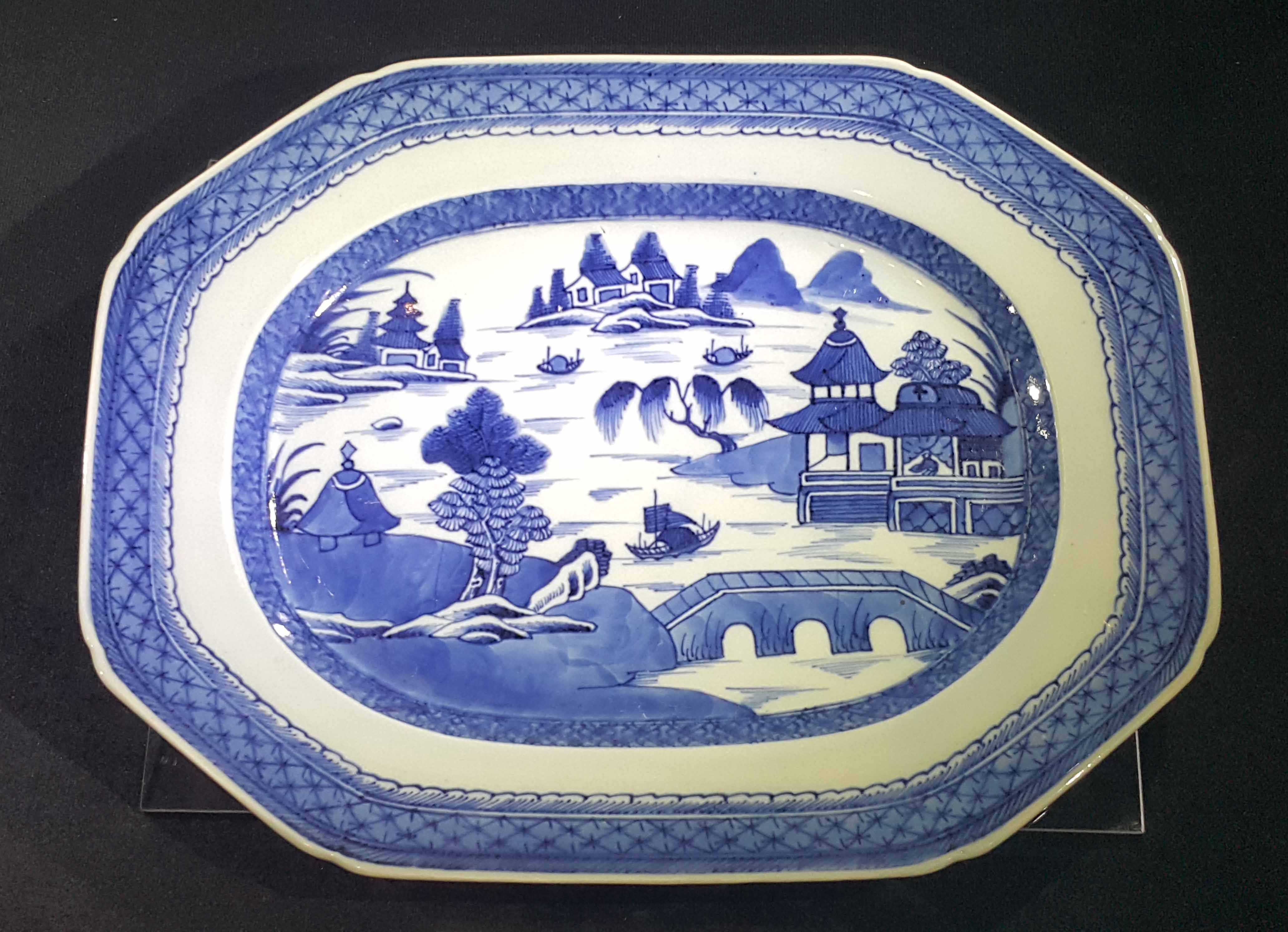
On display are a number of blue-and-white pieces from a collection of 24,000 recovered from The Diana. This ship belonged to an agency house based in Calcutta (Kolkata) owned by John Palmer. She was licensed to the East India Company and was used to make the trade run between India and China. Having delivered cotton and opium to China, she was on the journey back laden with ceramics, silk and tea when she hit some rocks and sank off the coast of Melaka. She was found on 21 December 1993, 178 years after sinking.
Blue-and-white plate from The Diana
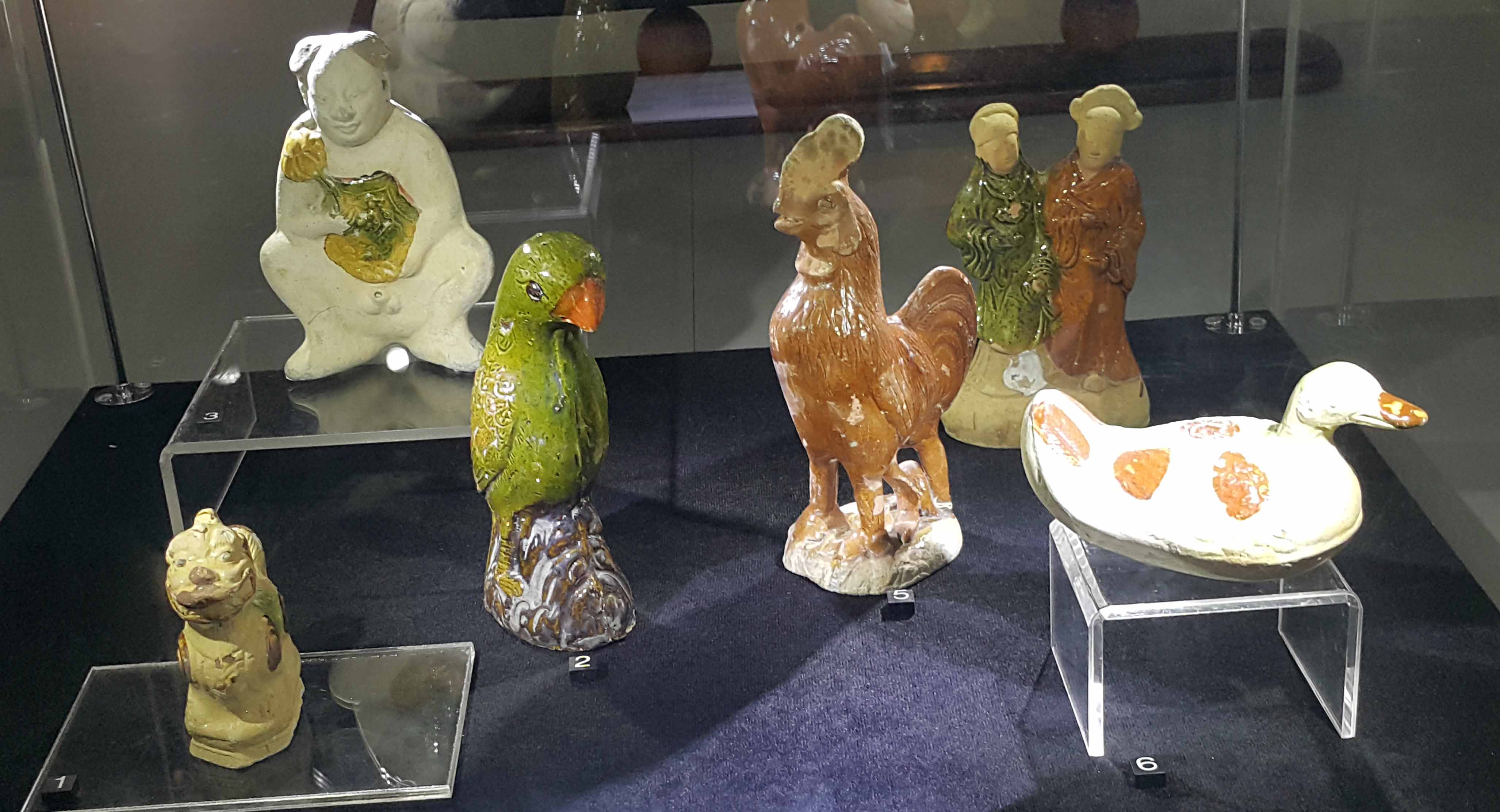
Ceramic trinkets recovered from The Diana
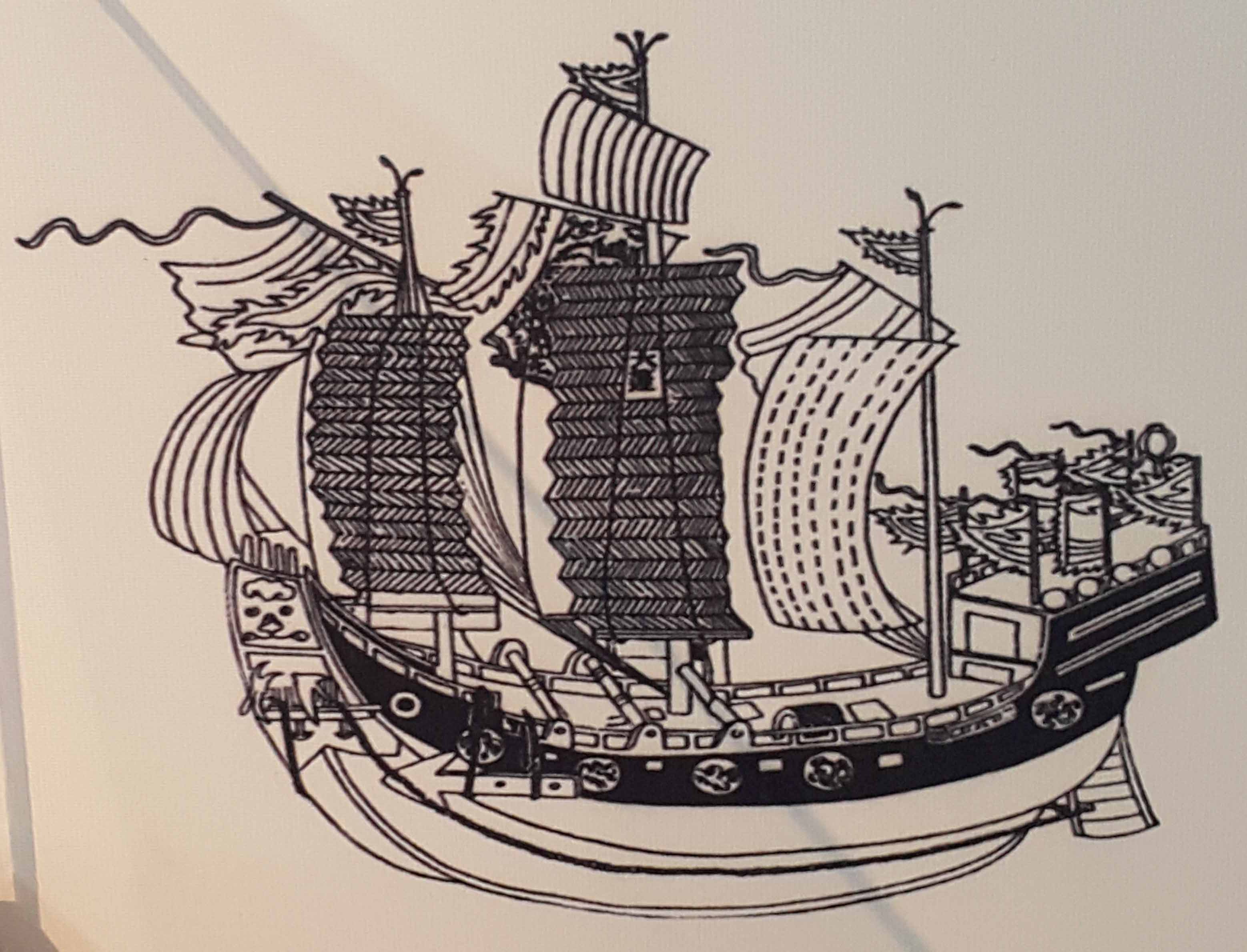
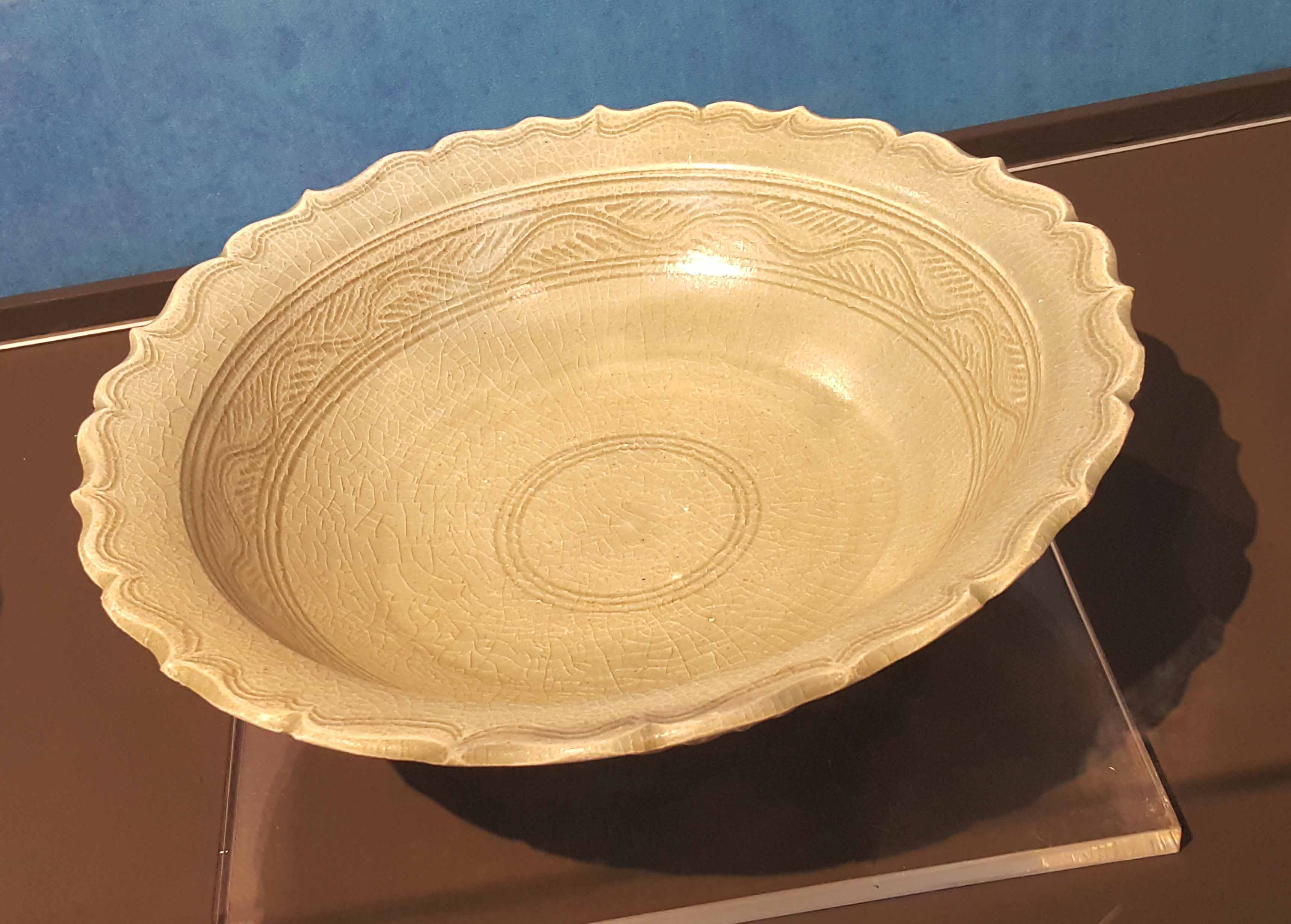
The Royal Nanhai, dating circa 1460, was discovered off the coast of Kuantan in 1995. Salvage of this 28-metre Southeast Asian vessel was completed in May 1998 yielding 21,000 pieces of ceramics. While most of the ceramics were from the Si Satchanalai kilns in Thailand, four Chinese and two Vietnamese blue-and-white pieces were found concealed below the floorboards.
An artist’s impression of the Royal Nanhai
A celadon Si Satchanalai plate from the Royal Nanhai
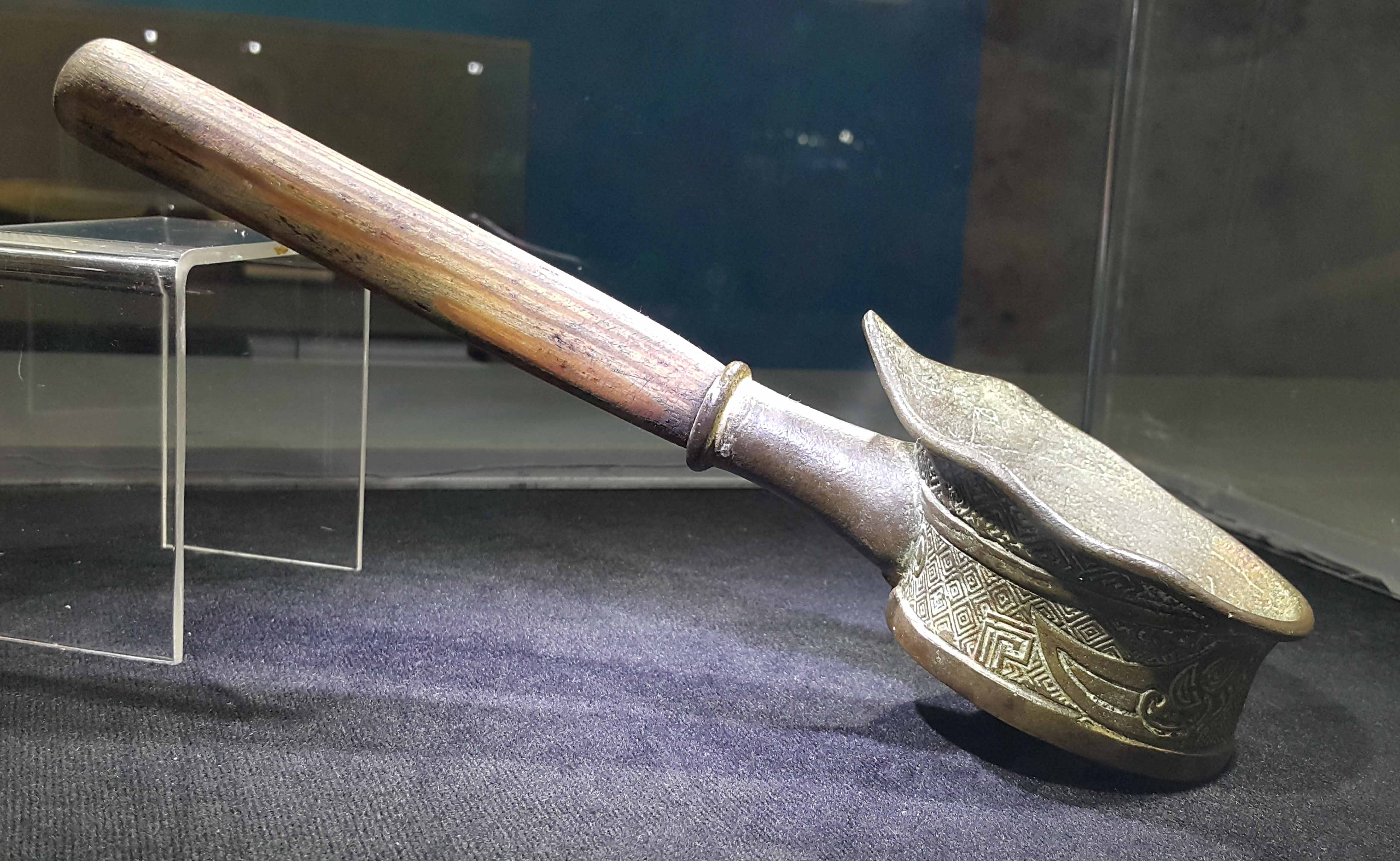
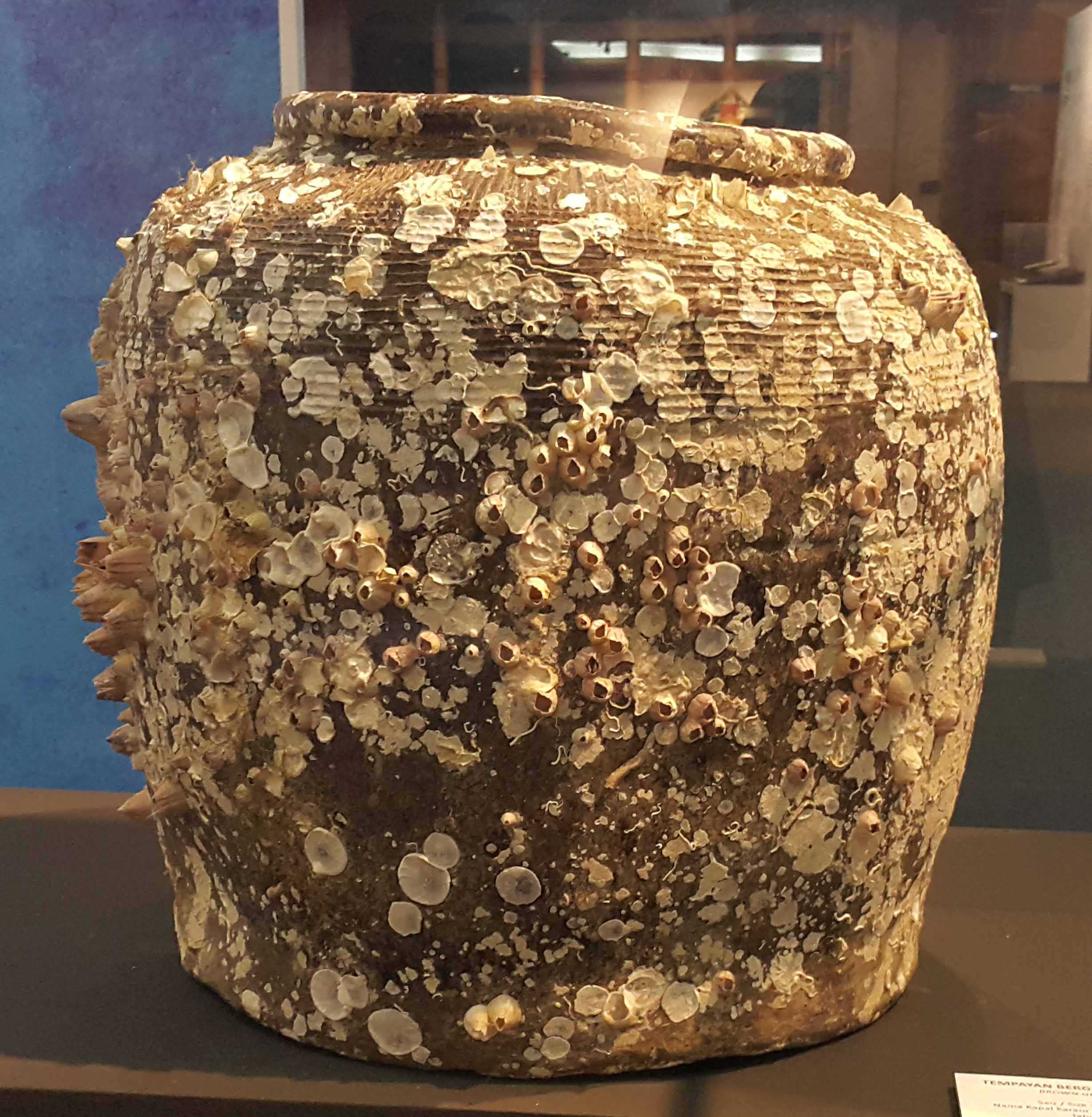
The Desaru was a Chinese vessel dated to 1845 that sank off the coast of Johor, near Desaru. It was a narrow ship, 30 metres in length and 7 metres wide, made of pine and cedar. Salvage recovered Chinese ceramics with a large number of blue-and-white spoons.
A brass iron from the Desaru
A brown-glazed storage jar covered in barnacles recovered from the Desaru
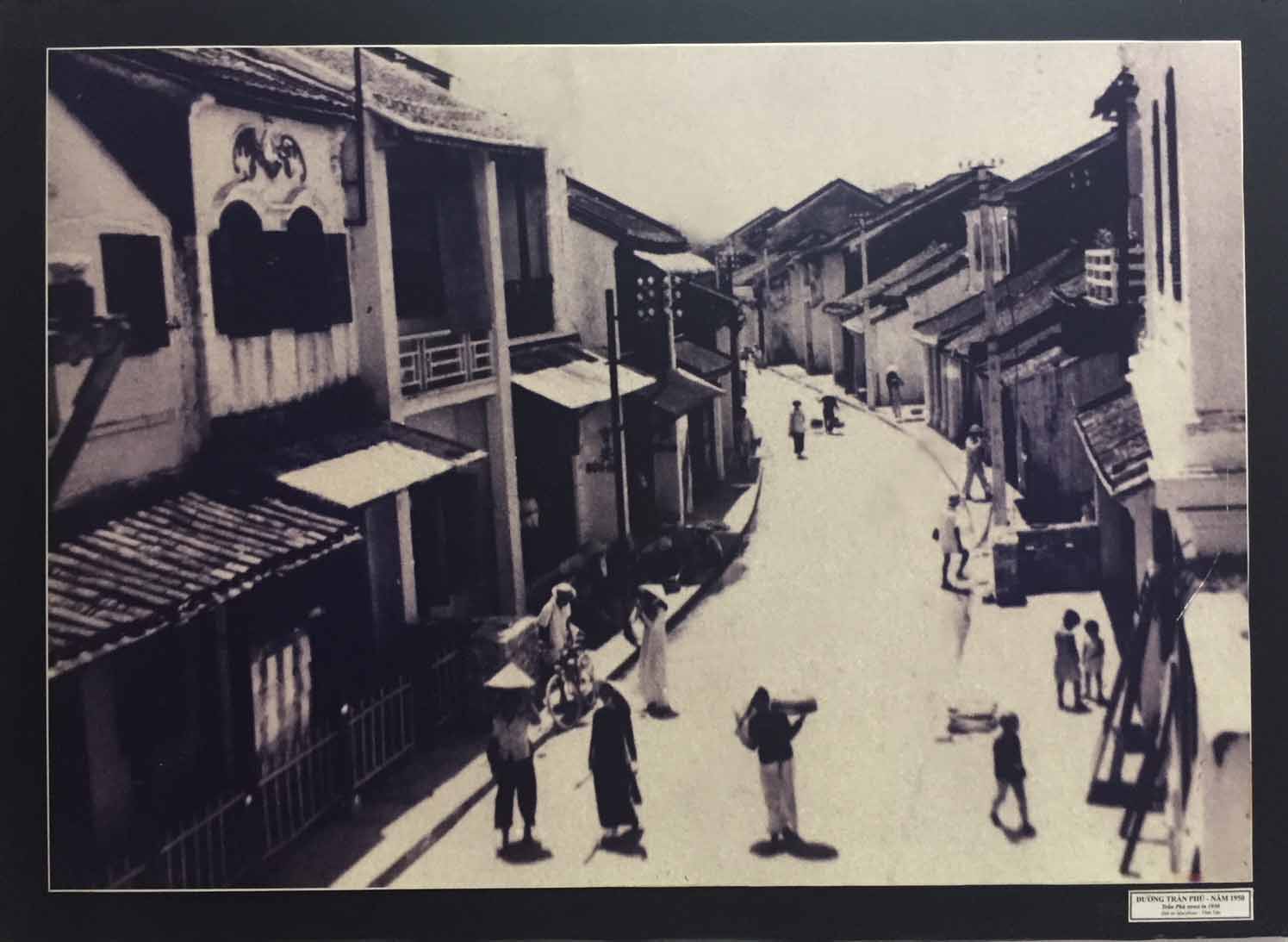
The ancient town of Hoi An lies thirty kilometres southeast of the city of Da Nang, Vietnam, on the northern bank of the Thu Bon River in Quang Nam province. Declared a UNESCO World Heritage Site in 1999, Hoi An was once an international port town where traders from China, Japan, Arabia, Persia and Southeast Asia came to trade during the Champa period (2nd – 15th century CE) and later, traders from Europe during the Dai Viet period (15th – 19th century CE). Today, the town remains intact with more than 1,000 well-preserved building structures comprising architectural monuments, commercial and domestic houses, pagodas and temples. Hoi An has a total area of 60 square kilometres with a population of around 90,000 people.
Hoi An Museum
The Hoi An Museum is a building on its own with two floors of galleries housing artefacts, sketches and photographs from the pre and proto historic periods (ancient times to the 2nd century CE), the Champa period (2nd – 15th century CE), Dai Viet period (15th – 19th century CE), and the Resistance War against the Americans (1955 – 1975).
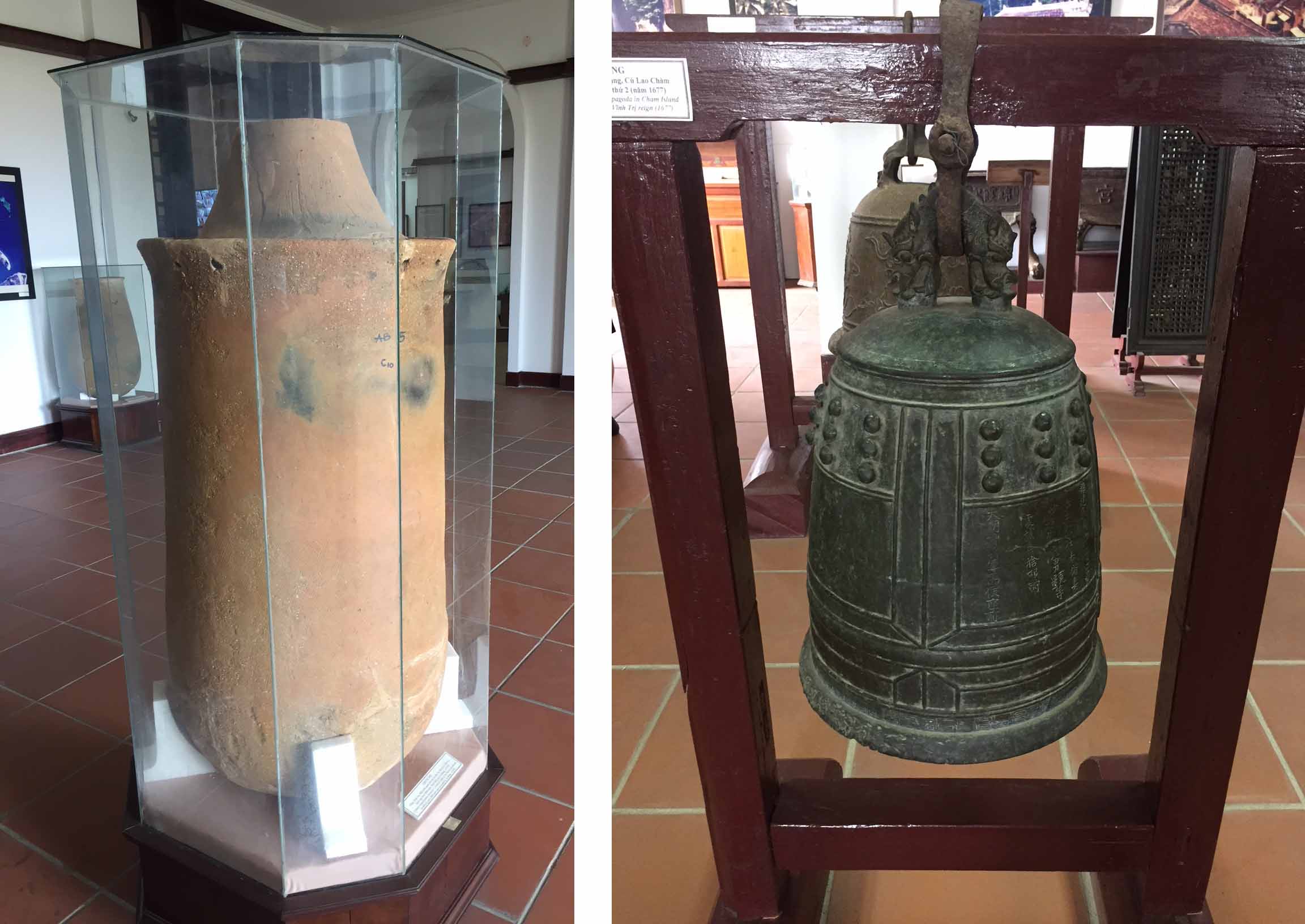
Left: one of the large burial jars in the gallery; Right: bronze bell from the Champa period
There are two galleries on the first level of the museum. One gallery displays numerous burial jars and urns in various sizes dating back 2,000 years while the other gallery has a collection of bronze bells and Vietnamese blue-and-white ceramics from the Champa period. It is believed that the Champa people founded Hoi An, which was originally called ‘Lam Ap Pho’ or Champa City. The Kingdom of Champa in Vietnam is considered the oldest in the Malay world dating to the 2nd century CE as the people practiced Malay culture and spoke Malayo-Polynesian language originally while the Cham language became the official language later. Hoi An was a very wealthy port between the 7th – 10th centuries CE, trading in spice and silk, exporting aloe and ivory.
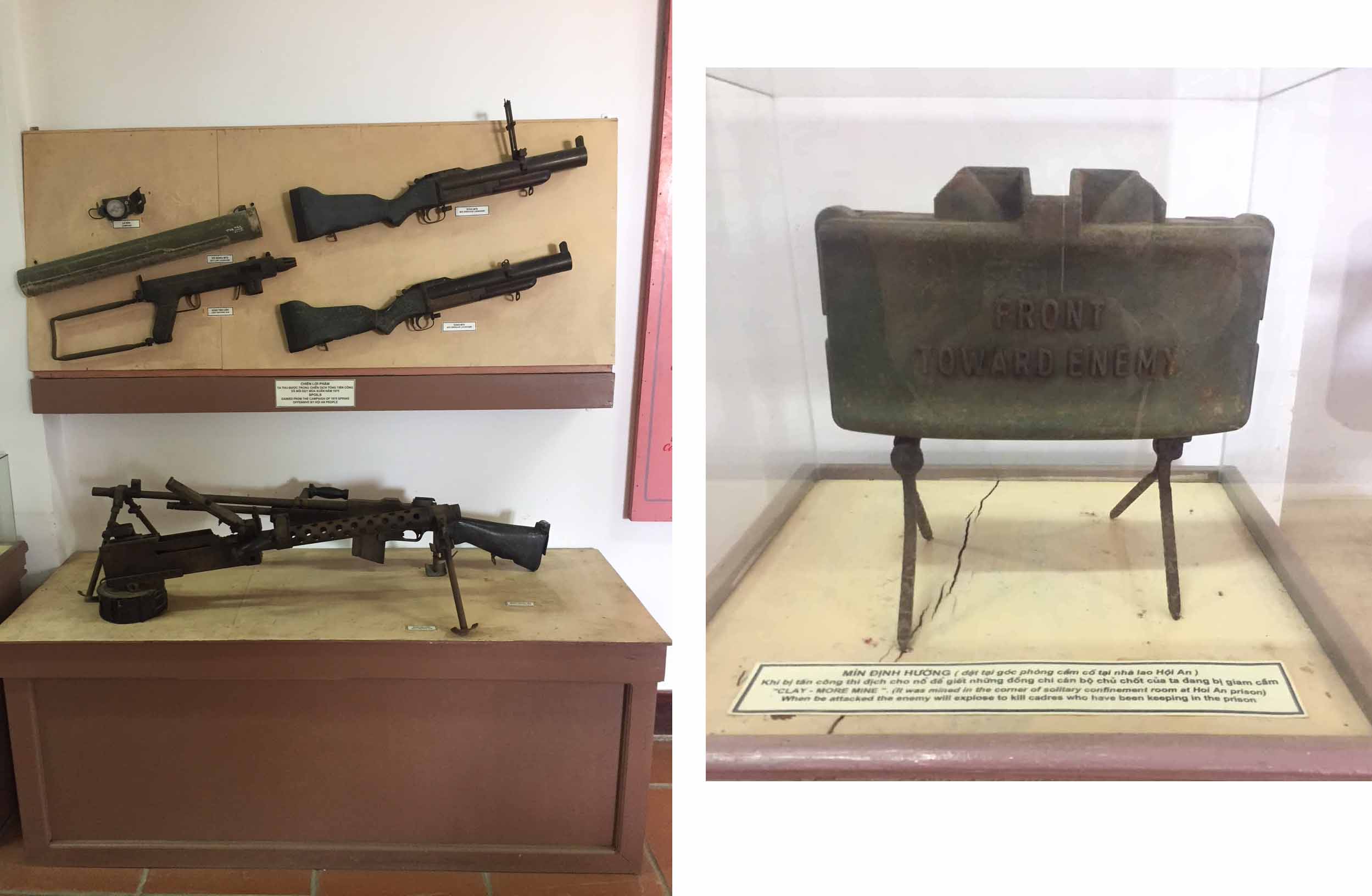
Left: machine guns from the Resistance War; Right: a claymore mine
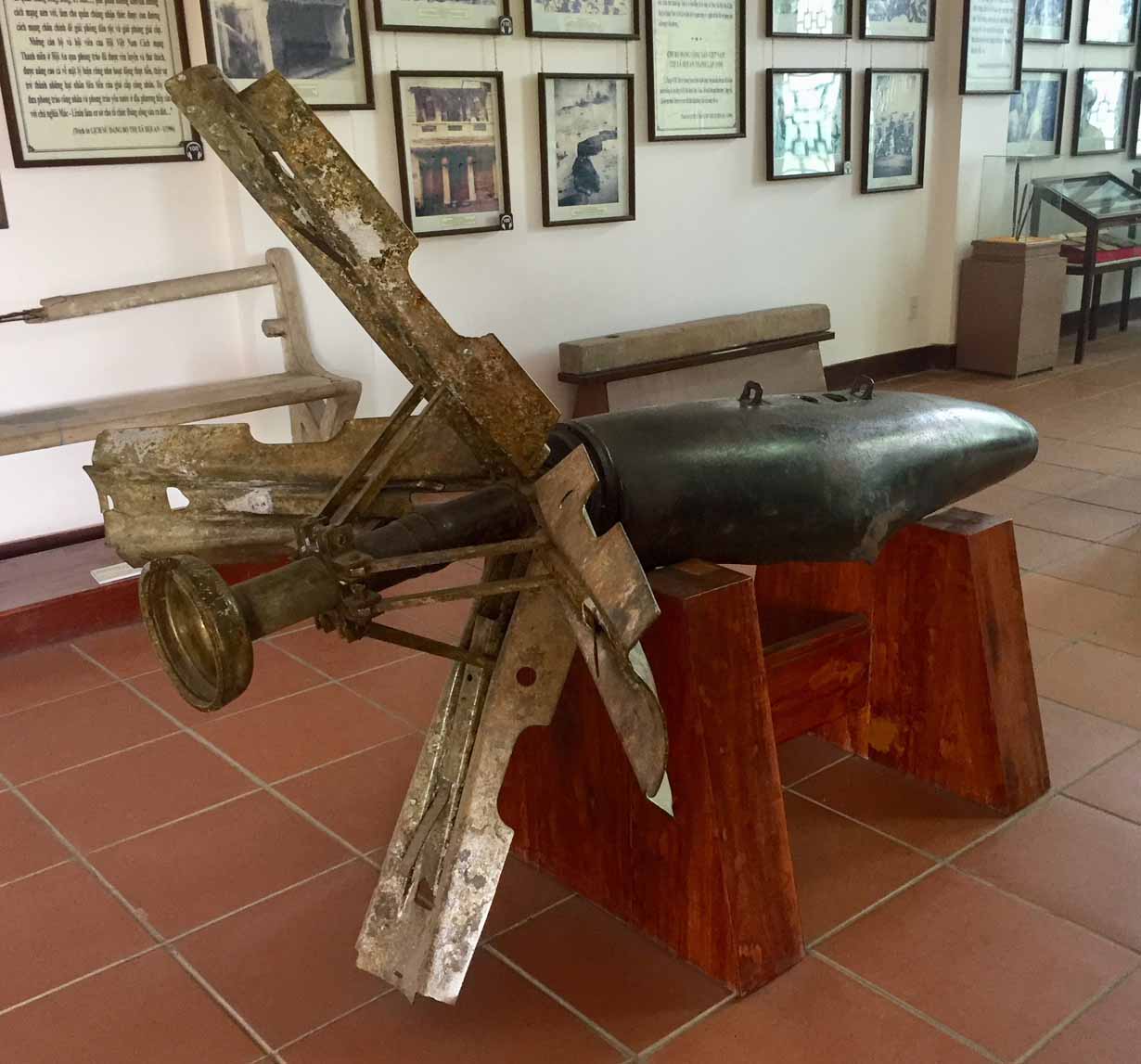
The gallery at the top floor exhibits artefacts from the Resistance War with the Americans. Many types of weapons and machine guns, parts of planes, bombs, clothing, torture instruments and even a trap of iron spikes can be seen here, supplemented by photos and information boards in Vietnamese.
A guided bomb
Left: iron spike trap made by the Vietnamese army. Right: pair of rubber sandals and shovel used for digging tunnels during the resistance
The topmost floor of the Hoi An museum is where visitors have the opportunity to get a bird’s-eye view of the city from above. The outdoor environment also provides a picturesque scenery for visitors should they want to snap a few pictures of the ancient town in all its charm. The visit to the museum can be completed within an hour as the museum is quite small and as written on one of their information boards; ‘only some symbolic artifacts and photographs are shown’.
Our guide during the visit was the affable Chong Keat Aun who is the founder and curator of Petaling Street Heritage House. He is a writer and filmmaker and was a radio presenter for Radio Television Malaysia’s green channel, which is a Chinese language service.
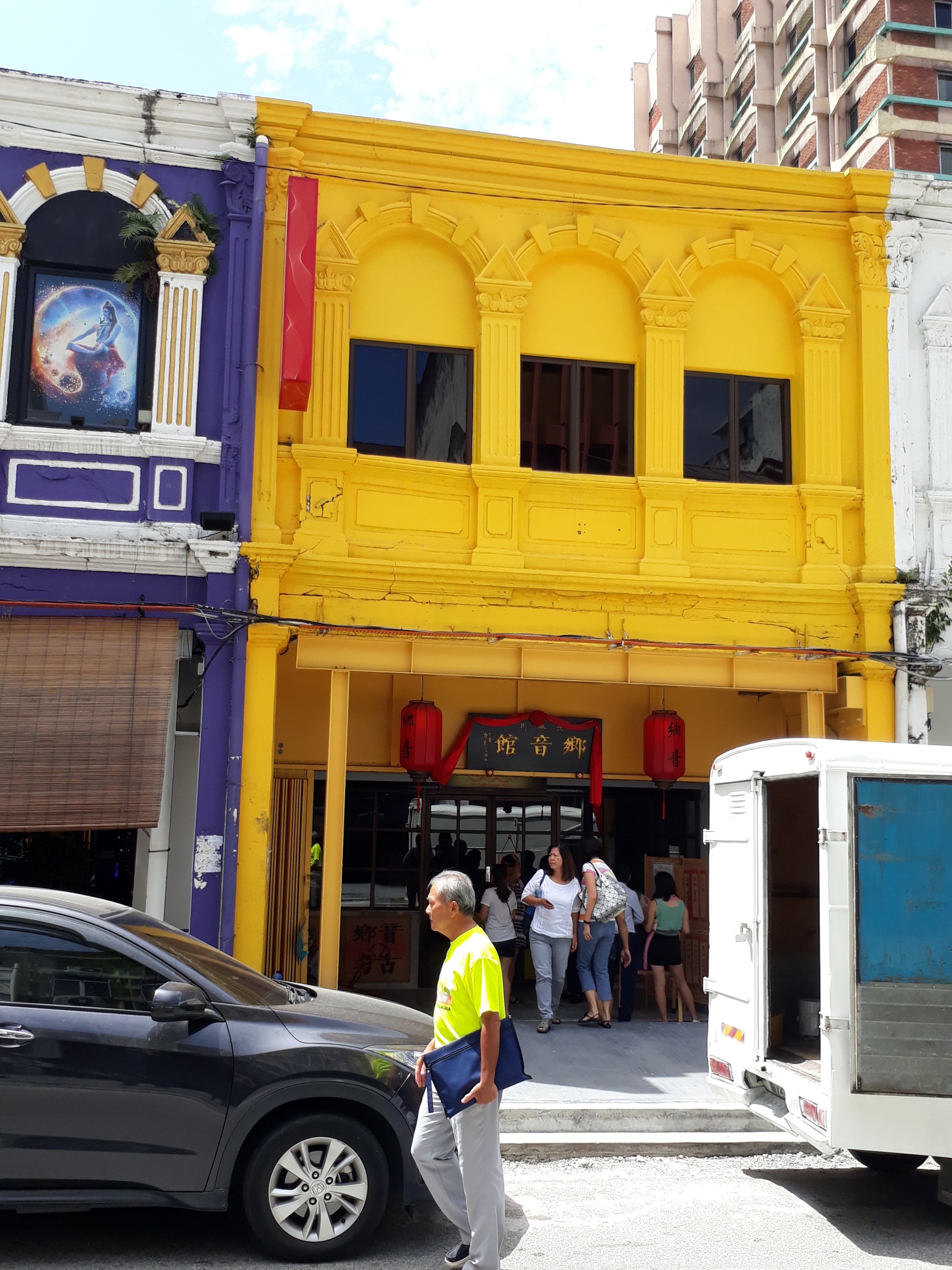
Bright yellow facade of the Heritage House. Photo courtesy of Yow Wai
Chong spearheads a project that began in 2005 to conserve the history of Kuala Lumpur’s Chinatown quarter. The project gained momentum when Kuala Lumpur’s Mass Rapid Transit project affected the Chinatown quarter, and forced some of the residents to sell their shophouses to make way for the new MRT train station. This quarter is often referred to as Petaling Street, which is a generic reference to the popular shopping street. However, the quarter comprises several other streets such as Jalan Sultan, Leboh Pasar Besar, Jalan Yap Ah Loy and Jalan Tun HS Lee. The Petaling Street Heritage House is located at 196 Jan Tun HS Lee. Other prominent landmarks along this street include the Sri Mahamariamman Temple and the Guan Di Temple.
Restaurant at the ground floor. Photo courtesy of May
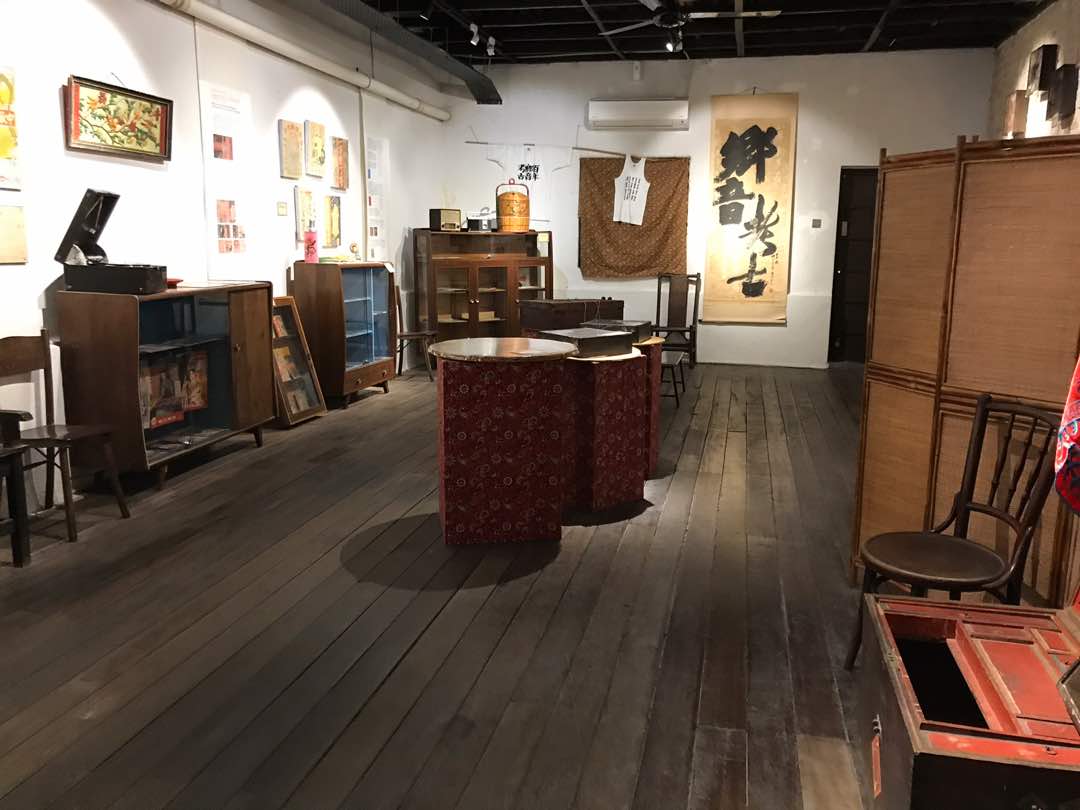
The Heritage House is in a two-storey pre-War shophouse that has been completely refurbished. At street level, it stands out with its bright yellow façade. On the ground floor is a restaurant that serves dishes from the seven Chinese dialect groups. It operates the restaurant as a means of raising funds in order to be self-sustaining as it does not receive any government support. The upper floor houses the current exhibition detailing the theatre development in Petaling Street.
Museum on the top floor. Photo courtesy of May
Chong explained that in Malaysia, there are seven dialects of the Chinese language spoken – Cantonese, Teochew, Hainanese, Foochow, Hokkien, Puxian and Hakka. However, in Petaling Street, Cantonese was the dominant lingua franca as most of the residents are descendants of migrants from Guangdong province in China. Chong derived much information from oral accounts of residents of Petaling Street, who had sold their shophouses or halted their business activities in the area when the MRT project began in 2010. Most of the artefacts on display were donated by these old folks from their personal collections. And some were even salvaged from backstreets when the residents discarded them when they moved out, oblivious to their intrinsic historical and cultural value!
Photo courtesy of Ong Li Ling
An old record of a Cantonese opera. Photo courtesy of Poh Leng
The focus of the Petaling Street Heritage House is the preservation of Chinese dialect songs and its musical heritage. A famous record store called Yan Kee was located on Petaling Street. When the owner passed away in 2010, her son donated 2000 LPs (long-playing records) circa 1950 to 1960 of Chinese opera to the Petaling Street Heritage House project. This collection is being digitalized into MP3 format and preserved. Students from New Era College are conducting research utilizing the collection and the Heritage House intends to establish an aural history archive.
Yan Kee record store plastic bag. Photo courtesy of Shirley
Yan Kee was also involved with providing radio scripts about operas to Radio Malaya and to Rediffusion, which was a subscription-based Chinese language radio service that was extremely popular in the 1960s to 1980s. The radio presenters would use the radio scripts to help listeners learn more about the characters and understand the plots of the operas.
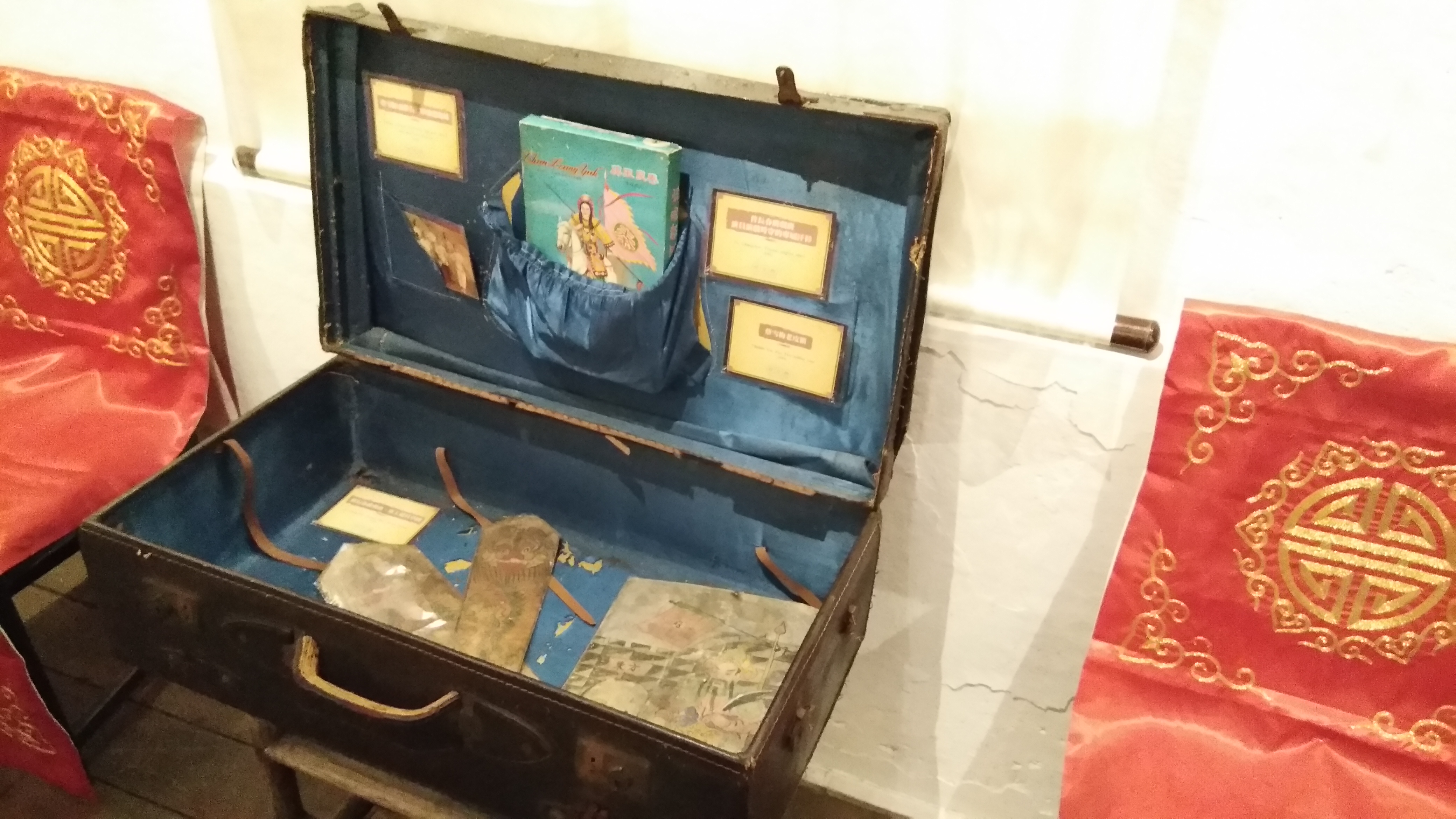
An opera stage complete with its intricate hand-painted backdrop, a seating area and even a backstage dressing table used by the opera’s leading actress are on display, together with stage costumes and interesting stage props and even a dressing case which was used by travelling opera singers . The Cantonese opera singers of that time were mega stars and fan magazines prominently featuring them are also included in the collection.
Photo courtesy of Michelle
The booming tin-mining and rubber industries and the affluent Chinese business community fuelled the growth of Cantonese opera in Malaya. The Yan Keng Benevolent Dramatic Association was formed in 1917 and its Cantonese Opera Group arm actively promoted Cantonese opera in the country. They would bring in famous stage performers from China and Hong Kong. Teahouses such as Yen Lok and Seng Kee flourished in the early 1920s. Patrons would enjoy listening to famous Cantonese ballads while sipping their tea. During major festivals like the Mooncake festival, some of the leading opera singers would perform at these teahouses.
Dressing case. Photo courtesy of Yow Yai
Dressing case used by travelling opera singers. Photo courtesy of Josiane
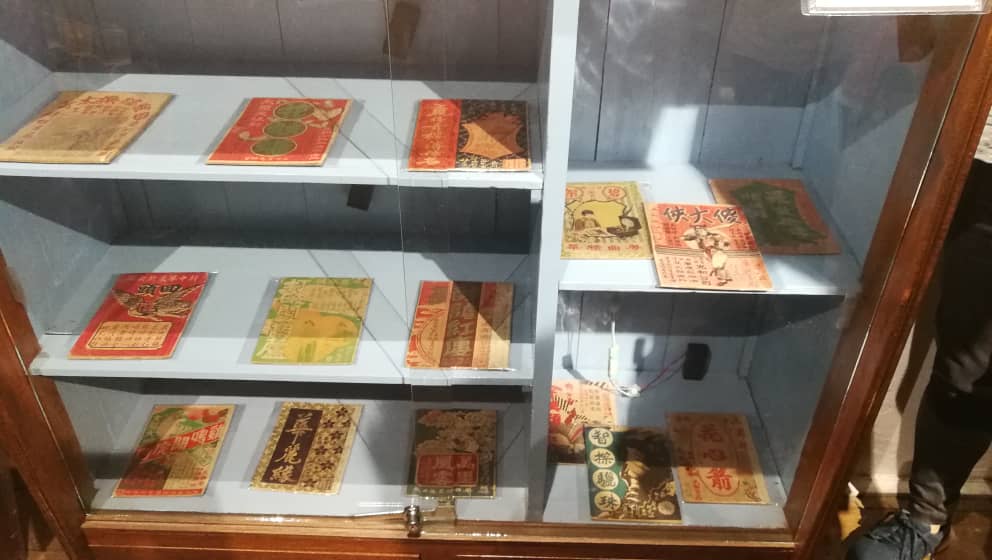
Song lyric books of Cantonese opera known as Muyu Shu (which means Wooden Fish Book) are also on display. The reference to wooden fish comes from China where blind people traditionally sang these songs and used wooden blocks carved into fish shapes as percussion instruments. These books were preserved by Kai Chee Book Store in Petaling Street and were printed between 1920 and 1935. This was introduced by earlier migrants to South East Asia to express their feelings of homesickness. The lower income groups could not afford the luxury of spending time listening to music in a teahouse. To cater to the man in the street, some impoverished scholars copied and printed popular opera lyrics and songs for sale and this evolved into a variation of karaoke as a popular pastime for ordinary folks who would sing these songs themselves.
A full script with directions for lighting and props. Photo courtesy of Katherine
Opera watching and listening no longer remained the domain of the upper class following the emergence of Pu Changchun Opera Troupe and Madras Theatre at Petaling Street. The Madras Theatre was known as Chung Hwa Cinema Hall in Chinese.
Curator Chong Keat Aun with a red vinyl record. Photo courtesy of Ong Li Ling
An antique phonograph. Photo courtesy of Katherine
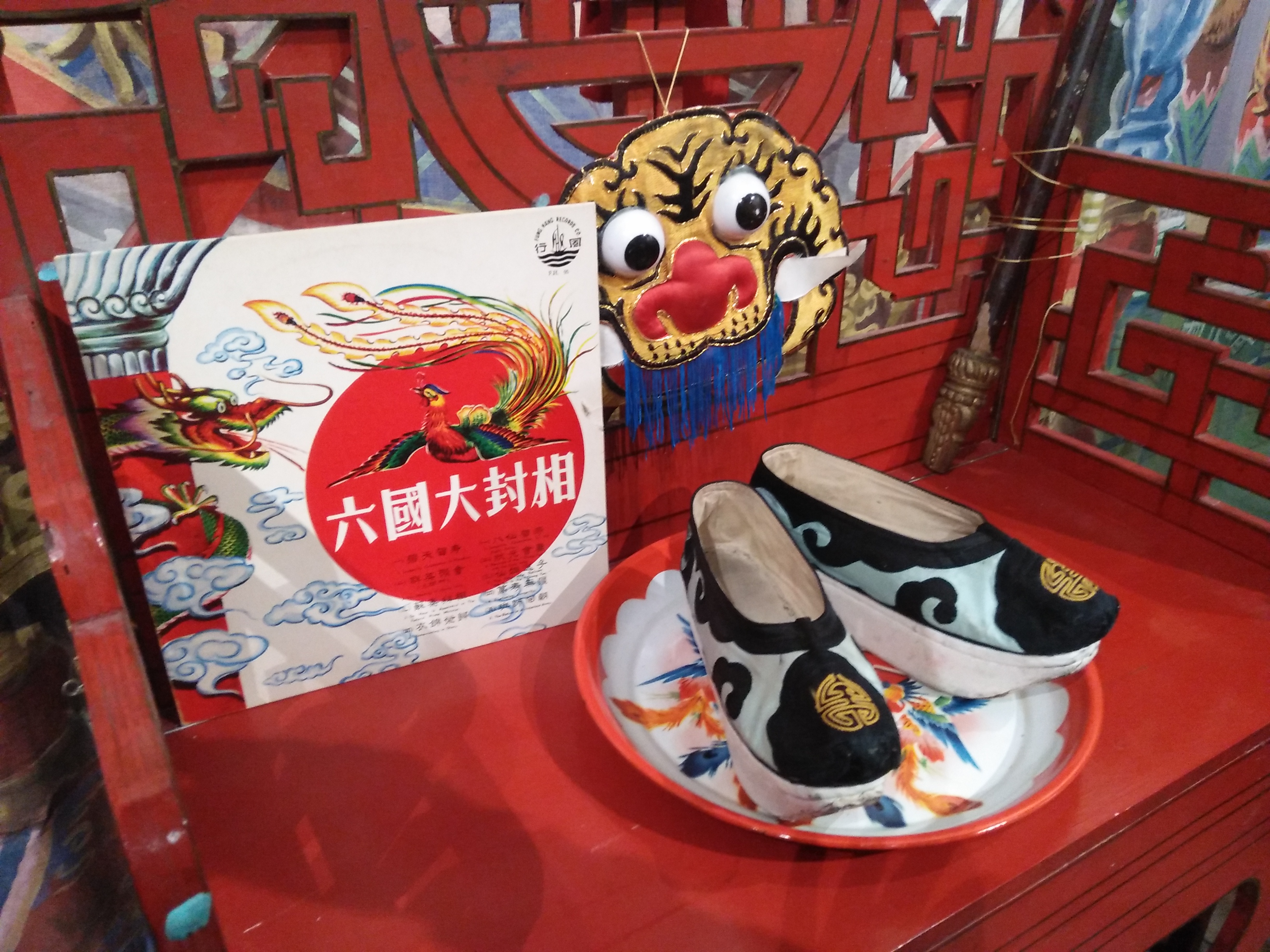
The unique feature of the Heritage House is its preservation of aural history. Chong played the recordings from 1946 of an opening opera piece originating from the Chin Dynasty commonly referred to as Welcoming the Generals (and officially as The Inauguration of the Six States Prime Minister!) which was always performed during the opening night of the Opera, as an auspicious gesture to bestow luck. Chong also played recordings of the narration by Dr Too Chee Cheong of his life’s recollections about his grandfather, his father and himself. Apart from being a medical doctor, Dr Too was a renowned composer and a poet, who has also translated classic Chinese poems into English. Dr Too’s grandfather, Too Nam, is well known among older Chinese in Malaysia as a follower and supporter of Dr Sun Yat Sen. Dr Too believed that his grandfather, Too Nam, who was a Chinese tutor to Dr Sun Yat Sen in Hawaii, strongly influenced the young Sun, who, later in life, became the Chinese revolutionary credited with establishing the Republic of China. Dr Too Chee Cheong passed away last year at the ripe old age of 93 years.
Props: platform shoes and an old vinyl for the Cantonese opera ‘Installation of the Prime Minister by the Six Warring States’. Photo courtesy of Katherine
At the end of the tour, we thanked Chong for his interesting tour and for his efforts in conserving the cultural history of Petaling Street. The group also contributed financial donations on a voluntary basis, as the project needs support.
I tagged along with the King’s College Alumni for a weekend tour of Malacca earlier this month. The highlight of the weekend was a walking tour conducted by Professor Johannes Widodo from the NUS School of Architecture. The tour started at the Tun Tan Cheng Lock Centre for Asian Architectural and Urban Heritage located at 54-56 Jalan Tun Tan Cheng Lock. A write-up on this Centre will be the first instalment of my “Professor Widodo Malacca Walking Tour” series.
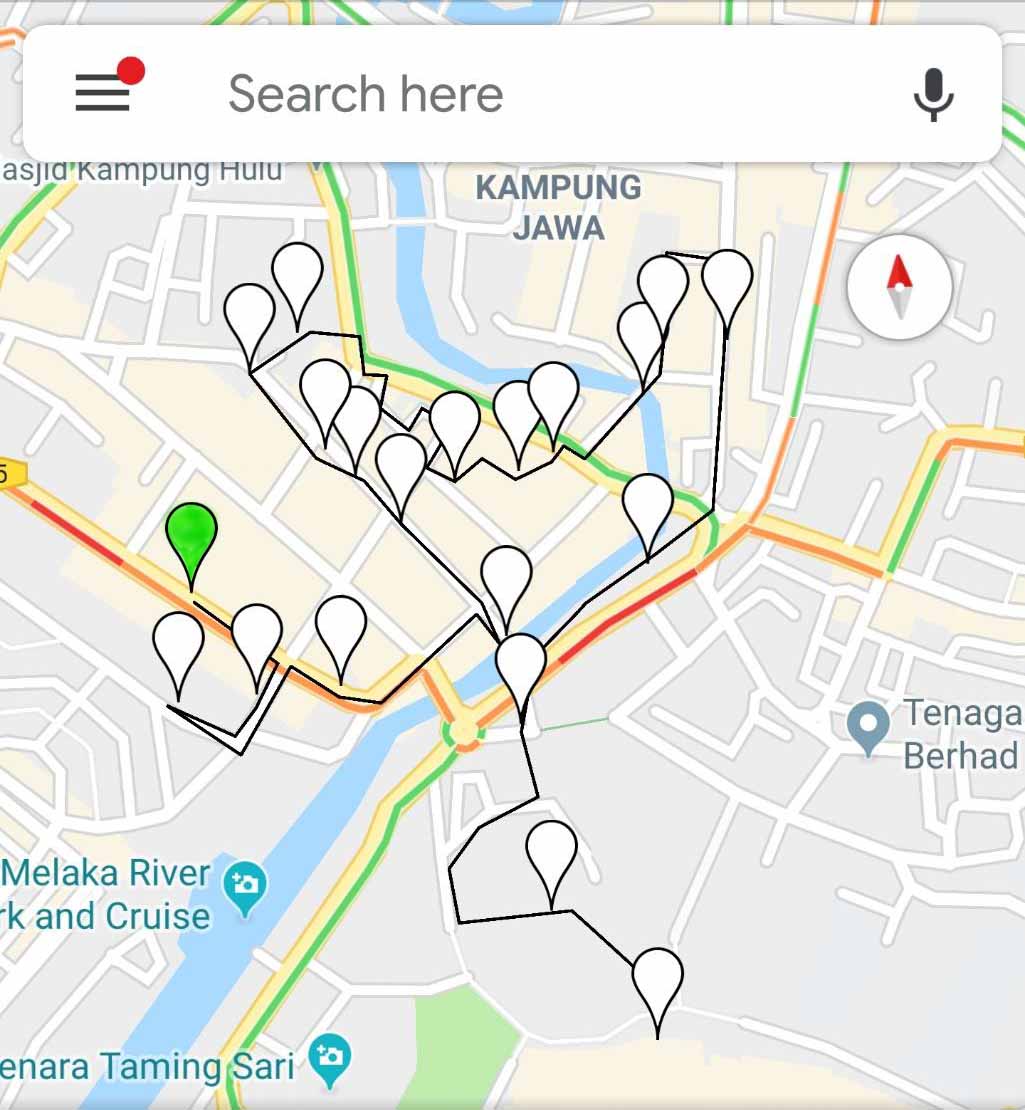
Route taken during the walking tour. The Tun Tan Cheng Lock Centre is marked in green.
Tun Tan Cheng Lock was a Baba Chinese. He was a leading member of the Straits Community and was the first elected president of the Malayan Chinese Association (MCA). He contributed significantly in the field of education, social welfare and politics. The road was named to commemorate his many contributions.
The Tun Tan Cheng Lock Centre is located in a townhouse along Jalan Tun Tan Cheng Lock. It was almost demolished 10 years ago as there was a proposal to create a walkway from the Kota Laksamana parking area to Jonker Walk. The plan to demolish this building failed due to the intervention of local NGOs.
This building was used as a maternity clinic for Dr Ong Bak Hin (one of the first Malaysian doctors who graduated in England) in 1920, Yeoh Maternity home in 1955, Aik Siow Clinic in 1977 and in 1980 as a rest house and subsequently a storage warehouse for Syarikat Abdul, an antique junk dealer. The two shoplots were sold in December 1992 to Tay Kheng Soon, a Singaporean architect, and they were finally purchased by Miss Agnes Tan and bequeathed to the School of Architecture NUS.
A 1605 Portuguese map of Malacca shows that there was a market place where this building currently sits.
In a map dating 1663, the location of building is where the orange box is. It is close to the sea which is at the bottom of the map.
All the yellow beams in the ceiling are original, but the brown wood is a replacement because the original wood was rotten.
The wall of the building almost collapsed and had to be restored. After the plaster was scrapped off, the conservationists saw different types and sizes of bricks dating from the Portuguese, Dutch, British and Malaysian eras. The plaster was not reapplied as they want to let the wall tell the story of the building. The Breaking Line of the wall indicates the movement of this building and tells us that this building was not built at one go as there were extensions forward and backward from the core.
The Line on the brick wall shows the first facade of building when the surrounding area was still the sand and was near the sea.
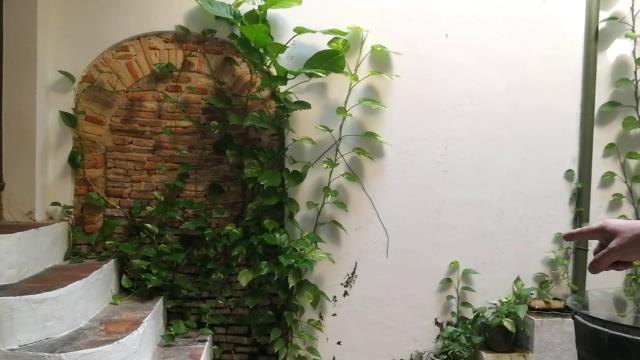
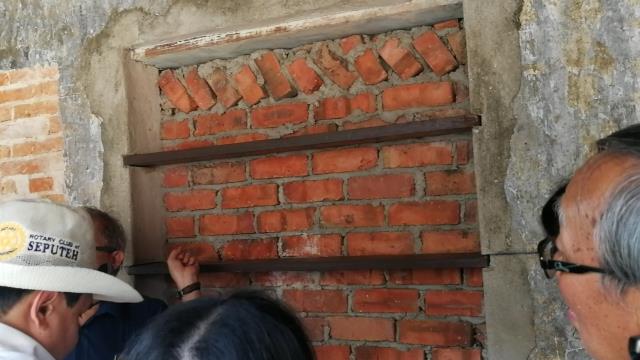
The steps were built after they closed the connecting door. In the beginning the neighbouring houses were connected. The subsequent owners closed the connection and they then built the second floor.
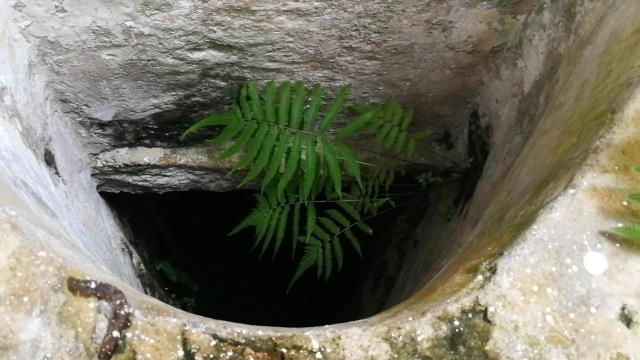
The well was shared with the neighbours.
The hole in the wall was made when the building was used as a warehouse in the 1980s when it belonged to Syarikat Abdul.
This wall collapsed and was stitched with concrete but the concrete was not covered up so that students can learn how to stitch a falling a wall.
Conservationists experimented with various types of plaster so that they can learn which one is better for conservation.
The Pit is kept open to show that there is sand inside. This used to be a coastline. You can find seashells and corals.
A connection to the Chariot House next to the Royal Press was found.
A horse stable was found as evidenced from the horse bones buried. It is speculated that the horses were used to pull the chariots.
Roof tiles used in Malacca cannot be found in Malaysia anymore. However, similar ones can be found in Vietnam. The tiles are made by placing clay on the thighs. So the sizes are not even.
Professor Johannes Widodo and team want to turn this place into a conservation clinic to show that it is possible to do a sensitive conservation and not to turn everything into boutique hotels and cafes.
During the opening ceremony, the Malacca Governor was invited to officiate and he suggested calling this place 54-56. The contractor bought 4D and was delighted when he won the first prize! He bought a 4-Wheel Drive with his winning money.
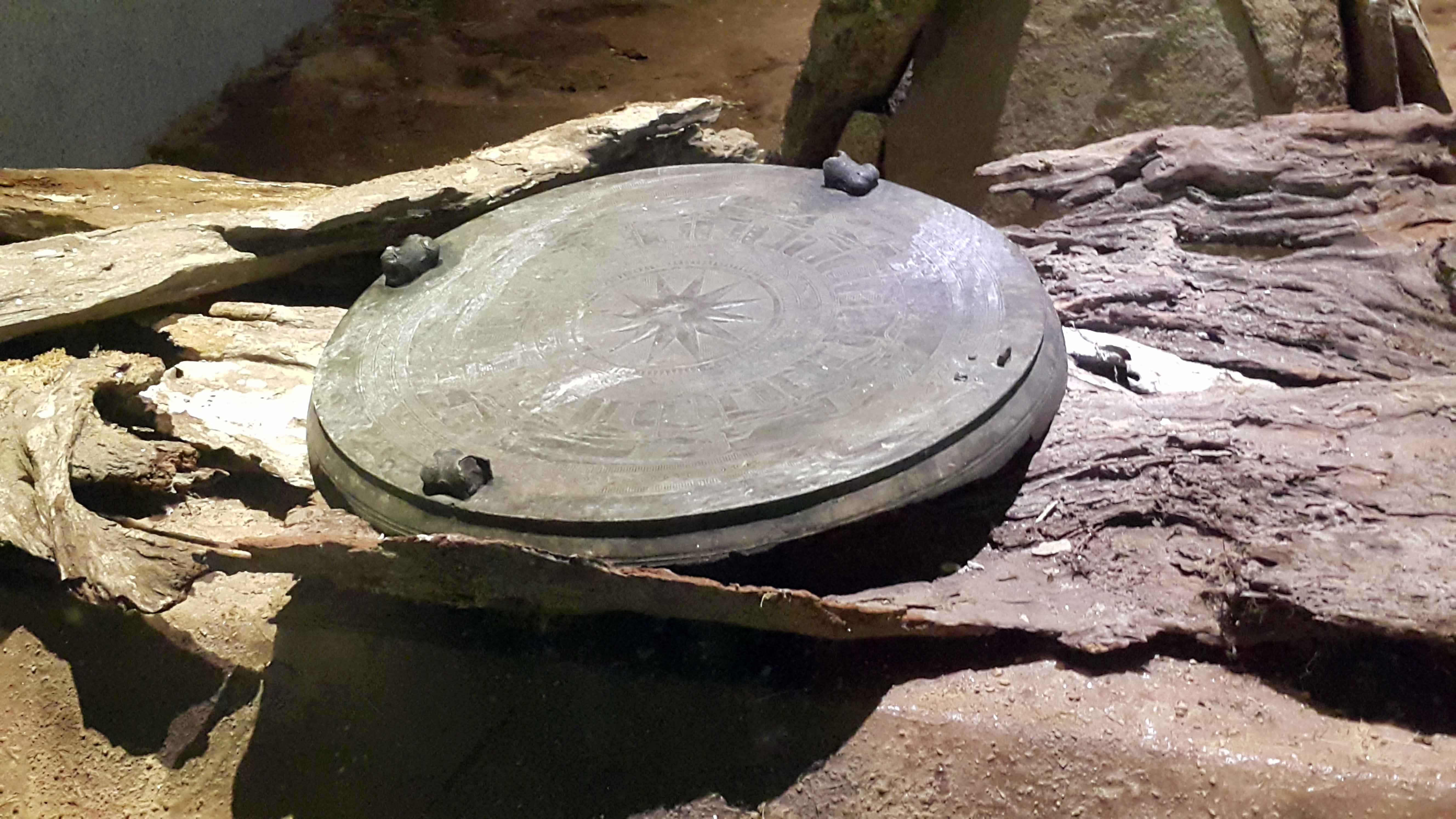
This burial, dating from the South East Asian Bronze Age (around 600 BCE to 200 CE), was discovered in Kampung Sungai Lang in Selangor in the 1960s. It is the only one of its type in Peninsular Malaysia although others of the same kind have been found in other locations around South East Asia. The grave was situated under a mound which had later been covered by mangrove and peat swamp. Eleven earthenware bowls lay between the drums, possibly vessels for food and water. Glass beads were scattered around one cluster of shards. No human remains were uncovered in this burial, probably due to the ravages of animals and the tropical climate.
On display at Gallery A, Muzium Negara
It is generally thought that this grave represents a boat burial because planks of wood at the site are consistent with the same species of wood usually used in boat building. Two drums lay upside down on these planks. In the museum, one has been placed the right way up to reveal the design of geometric shapes, animals and weapons, drawn within concentric circles around a star or a sun motif (depending on the source). This important central design comprises a circle of triangular motifs, possibly representing bamboo shoots, worked in low relief, creating the points of a star that stand out in high relief. The drums originate from the Dong Son people of North Vietnam.
The drums were used to communicate with the spirits in religious ceremonies such as to ask for rain. They belonged to high-ranking people, whose remains were sometimes buried inside, so that they could keep their status in the afterlife. It is thought that the drums were arranged upside down either to show that they were not used as containers for food or suchlike, or maybe to protect the power of the surface (and that is the only thing which still remains intact!). The boat connection suggests that this might be the burial of the head of a riverine village.
The fact that we find these drums all over South East Asia indicates that trade was already widespread in the region at this time. The drums were probably also used to play music for dancers. These drums were still being made in Thailand at the beginning of the 20th century, and are still in use amongst a few tribes of North Vietnam today.
The motifs on Dong Son drums can also still be found from this time on traditional pottery, jewellery and textile designs. It seems that these motifs have retained their power into the modern age. In Indonesia, the Sultan of Yogyakarta was traditionally the only one allowed to wear batik sarongs with large bands of motifs similar to the ones on Dong Son drums.
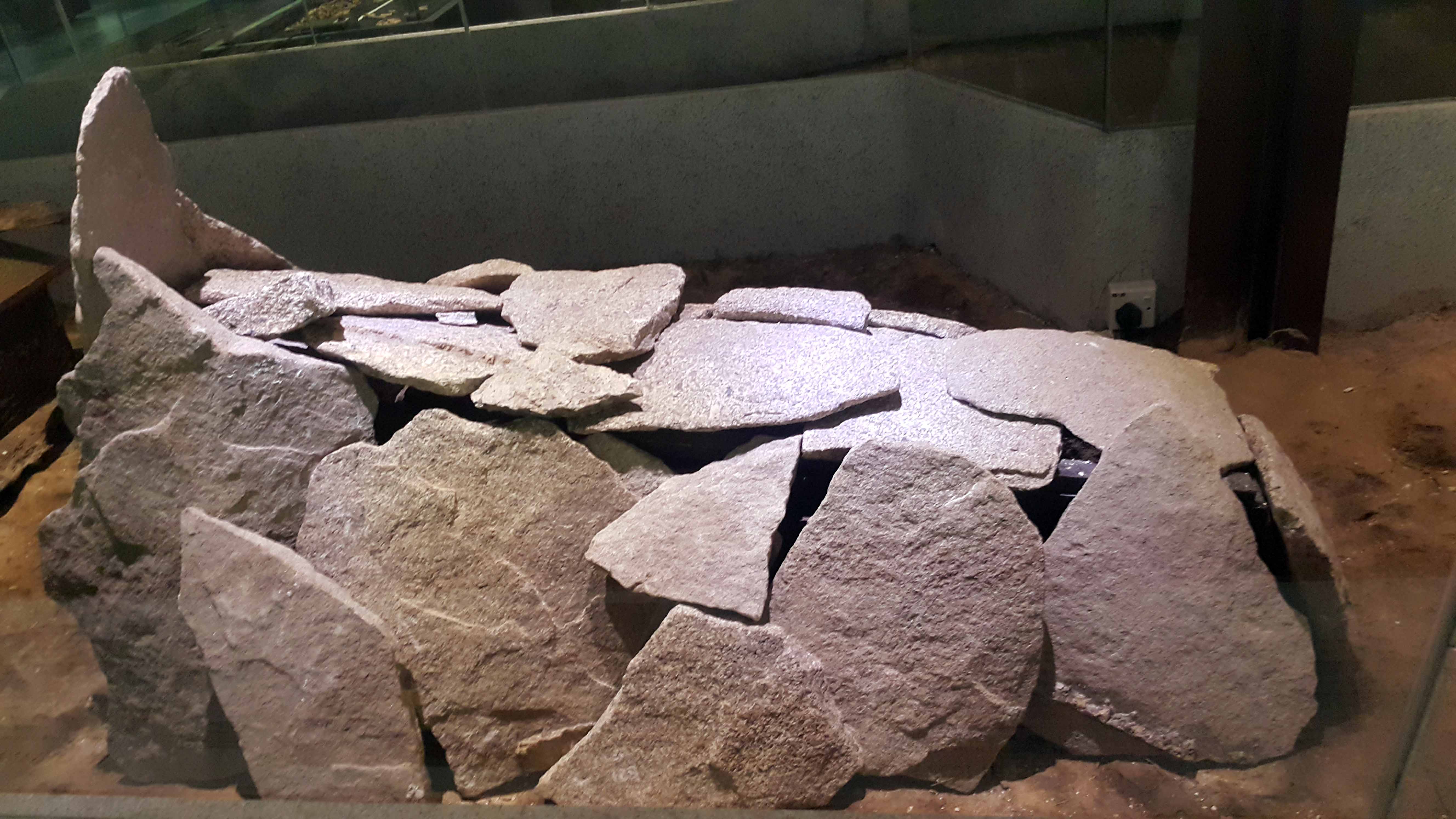
Slab Burials
On display at Gallery A, Muzium Negara
This kind of burial has been found along Perak coastal areas. The slabs are arranged on top of each other with the head area larger than the foot. Although no human remains were found during excavation, the archaeologists did uncover glass beads, earthenware pottery and iron tools. This shows that these burials were used during the Iron Age from around 300CE until the end of the proto-history era, around 1400CE.
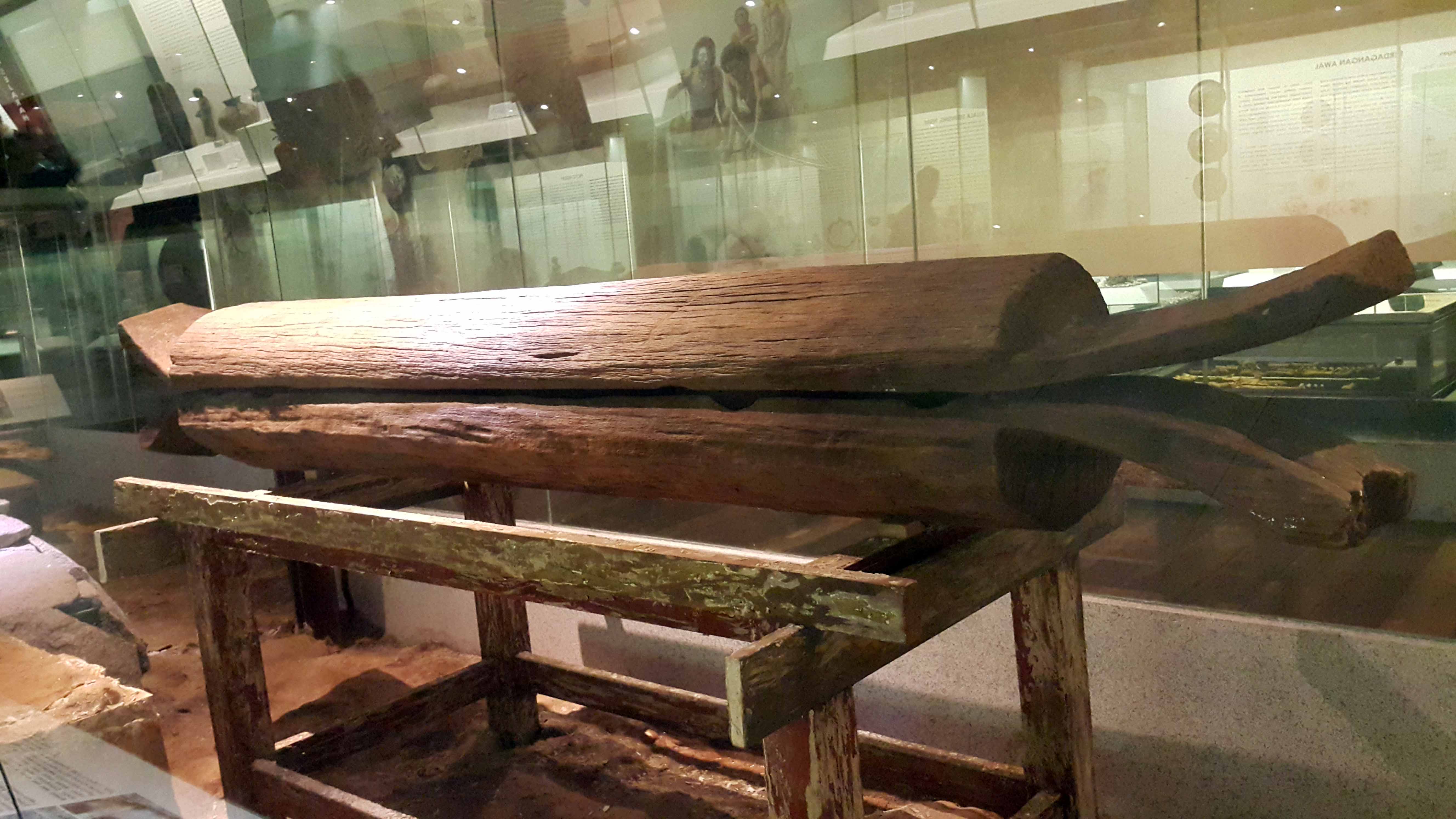
The Trunk Coffin
On display at Gallery A, Muzium Negara
Gallery A shows us that the forest played an essential place in prehistoric daily life. In the past, trees were also important. More than 1000 trunk burials of this type have been found in large limestone caves in Sabah. Carbon 14 dating has revealed that they are 1100 years old. Some similar burials have been found in Thailand, but they are 1000 years older.
The coffin in the museum measures about 2 meters, but coffins of this type may be up to 4 meters in length. The trunks, made of local hardwoods such as iron wood, were cut in half and hollowed out. The handles were simple and were used to carry the coffin into the cave. Some handles were decorated with snake, buffalo, crocodile or bird heads. The coffin was carried up to the cave by slaves who could win their freedom if they arrived safely.
This coffin was probably intended for a person of high status in the community. Weapons and food remains have been found scattered around the coffins. Some indigenous groups of Sabah still use this kind of coffin.
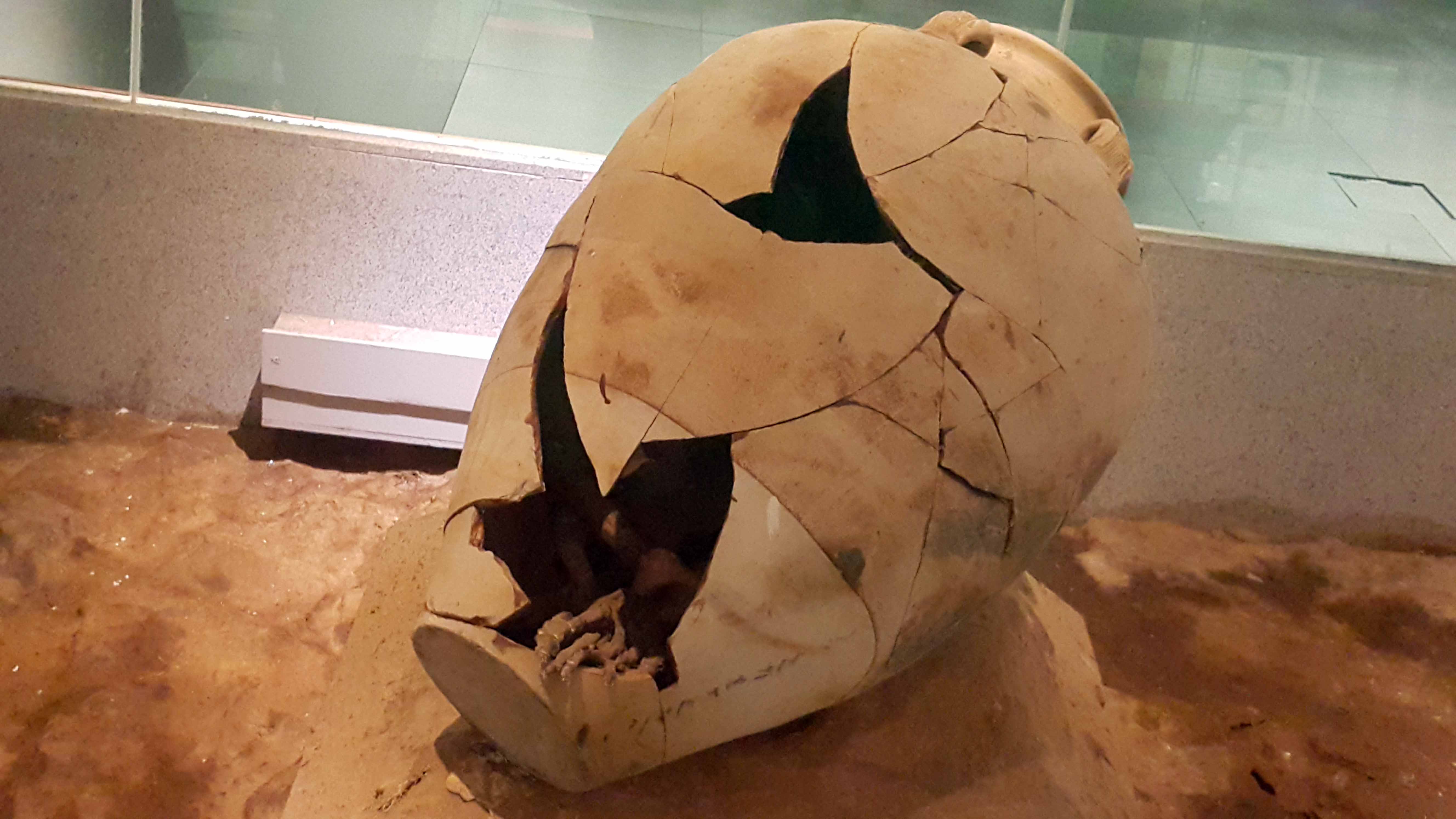
Jar Burials
Skeletal remains can be seen in this jar to illustrate secondary burials. On display at Gallery A, Muzium Negara.
Jar burials, the interment of secondary remains in locally-made terracotta urns, date back to the Metal Age, as can be seen from the discoveries made in the Gua Niah limestone caves in Sarawak by Tom Harrisson (former curator of the Sarawak Museum 1947-66) and his wife in the late 1950s. Other similar jars have been found in Sabah and Terengganu. In Sabah and Sarawak secondary burials in jars with the bones of several people have been uncovered.
Until modern times in Borneo amongst indigenous animist communities, it was the custom to keep the deceased within the house (usually in the upper area) so that family members could pray and meditate around the remains for a period of time, sometimes as long as a year or more. At a later date, when the body had completely decayed, the bones were gathered and put into a jar which was taken either to a high burial platform (salong) deep in the forest or interred in the ground. In some cases the body was originally buried until the family had enough money to carry out the proper rites, when the remains were dug up and transferred to a jar for traditional interment.
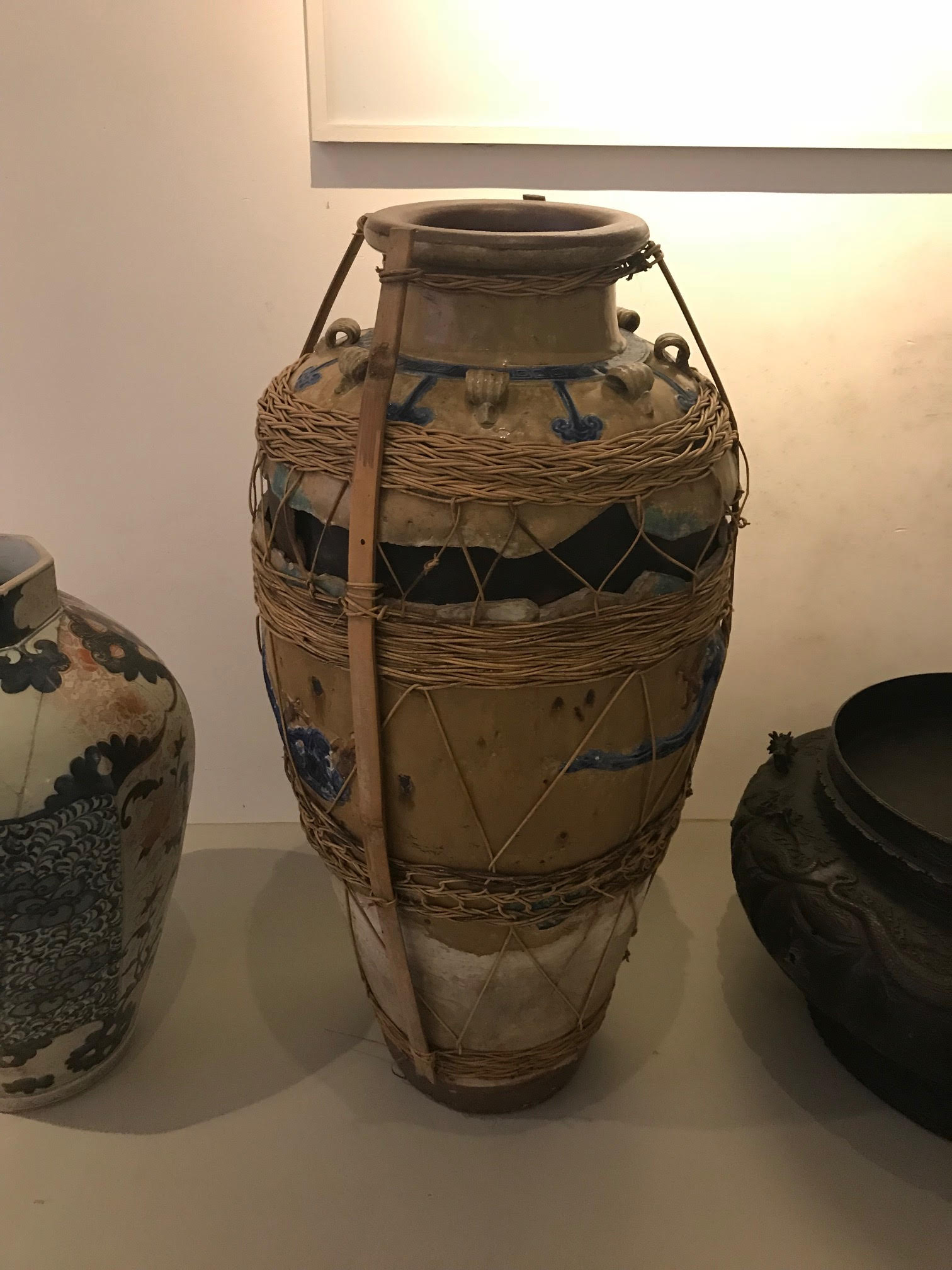
Later burials made use of Chinese jars, often referred to as martabans or tajau (in the local language), which have been be found widespread throughout South East Asia, and also in Korea and Japan. Jars like those featured in Gallery A, would have originated in China or Indo-China. Some tribes from Sarawak left the jars in the forest near megaliths or encased them within klirieng totem poles. Amongst some indigenous groups of Borneo, these jars represent the maternal womb; the bones are the foetus waiting for reincarnation or rebirth.
The Kuching museum contains a fascinating example of one such jar that unusually contained an entire body originally placed in a primary burial. It was found by Harrisson in the 1960s in the Kelabit Highlands of Sarawak at a burial site known as Budak Butal, and has been dated to the 2nd century BCE. An entire corpse was interred in the jar, which had been carefully bisected around the middle to hold the complete body. It was then resealed probably with resin, or local rubber. After a period of time by which time the body would have decomposed completely, the jar was opened so that the ritual for secondary burial could take place. The remains were then re-interred in the burial ground, either in the same vessel, or in another intact jar or coffin. This elaborate- and expensive- practice would have been the preserve of high status members of the community. The rattan casing was added later, most likely for transportation / display purposes – or to protect the fragile vase.
Jar burials of this type do not seem to have occurred elsewhere. The tradition was probably discontinued at least by the 1940s; the Kelabit people have now mostly embraced Christianity.
Martaban jar found by Tom Harrison at Budak Butal. On display at the Sarawak Museum.
A big thank-you to Dr. Borbala Nyiri for details on the Budak Butal burial jar.
Bibliography
A dictionary of archaeology edited by Jan Shaw& Robert Jameson.
The Oxford companion to archaeology edited by Brian M. Fagan.
The encyclopaedia of Malaysian 4: The early history
A guide of the collection national museum Singapore: Archaeology
Co Vat Phu Tho. Edition: the culture & information.



































 Museum Volunteers, JMM