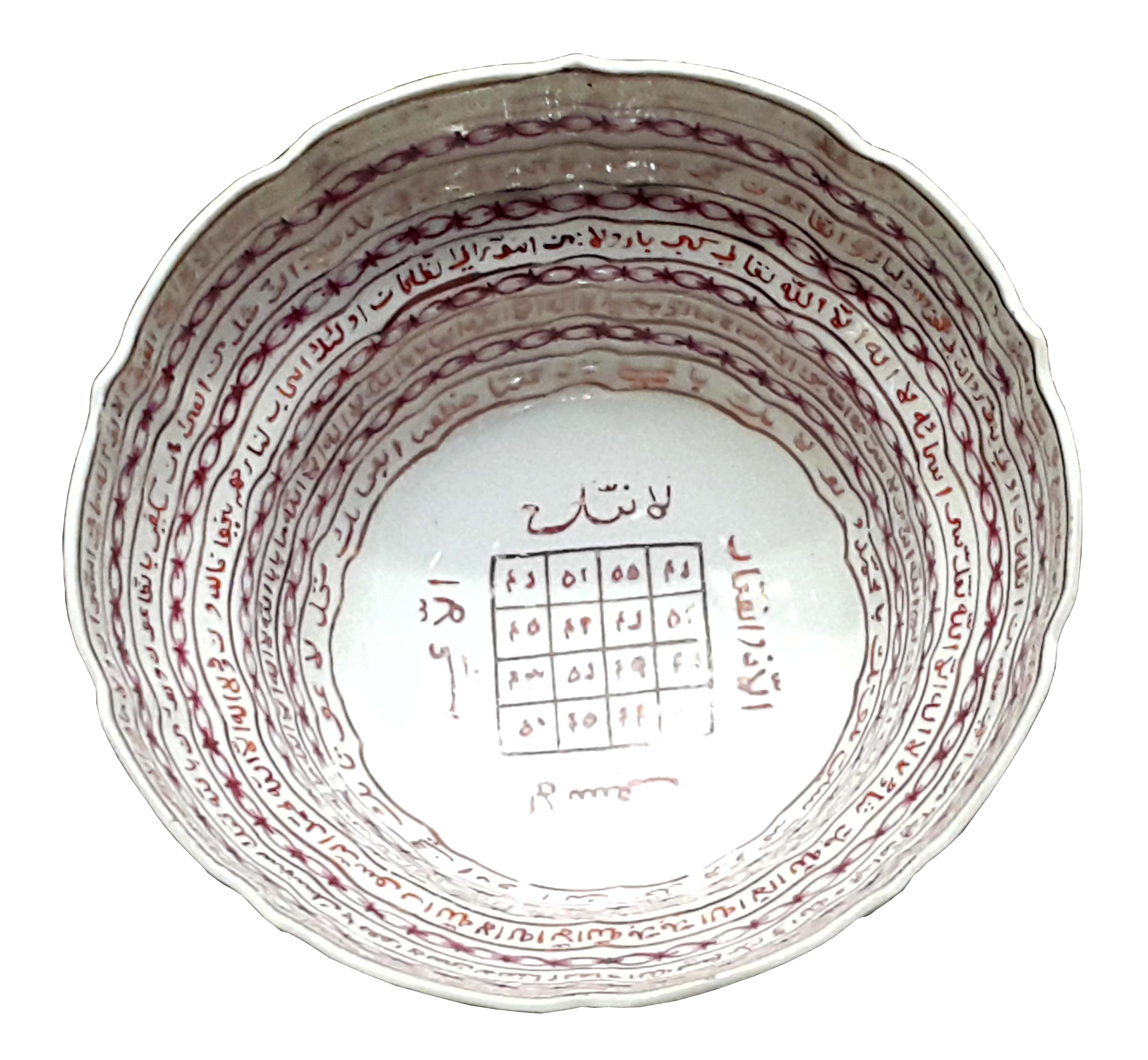
Amidst a number of examples of the Islamic influence on metal and ceramic wares in a showcase in Gallery B, a small bowl can be found with the intriguing description ‘Magic Square Bowl’. It looks like a small Chinese rice bowl but is decorated with Islamic script. On the inside of the bowl is a square consisting of sixteen smaller squares, also containing Islamic writing. Was it used to perform magic, or was it magical in itself?
During the Tang Dynasty (618-907) Chinese ceramics with Islamic script were already produced in China and transported along the maritime trade routes by Arab and Persian traders. After the Tang Dynasty, ceramics with Islamic inscriptions were no longer produced. Only in the early 16th Century did they appear again. The Magic Square Bowl in Gallery B is from the 18th Century Qing Dynasty.
The Magic Square, or Buduh tradition, predates Islam. The early Magic Square is thought to be of Chinese origin and consisted of a 3×3 square with 9 smaller squares. The numbers 1-9, with the number 5 in the centre, add up to 15 in each row, column and the two diagonals. An early version of Sudoku? A Magic Square was used to find love, prevent fears, attacks and poisoning. It helped during childbirth and also in finding lost objects. In short, it could be quite helpful for many occasions. Later, there were Magic Squares of 4×4, 6×6, 7×7, and 10×10, and even 100×100 squares with an arrangement of letters and numerals.
Islamic mathematicians in the Arab world already knew about the Magic Square as early as the 7th Century. This knowledge may have come from India through the study of Indian astronomy and mathematics, or from China. The earliest Magic Squares were written in ‘abjad’ letter-numerals. The four corners of the square were marked with the letters ba’, dal, waw (or u) and ha. Therefore, this particular square was known as the ‘Buduh’ square.
The name ‘Buduh’ itself was so powerful that it was regarded as a most effective talisman, and so was the letter B with its numerical equivalents 2,4,6,8. This arrangement of letters and its corresponding numbers is believed to protect travellers, babies, postal letters and packages. Even today in some Islamic countries, one can find packages marked with the numbers 2,4,6 or 8 in the corners, or just the letter B added under the address to ensure that the items arrive safely. This might be something worth trying out!
Magic Squares were used by Muslims as religious mandalas, meditation devices, talisman, and amulets. They were drawn on a variety of objects, even on skin.
The Arabic letters and numerals in the Magic Square can also be read as one of the ninety-nine names or attributes of God. The numerical value with a certain specific meaning can be obtained by adding the corresponding letters of any of the columns of the Magic Square in a horizontal, vertical or diagonal way.
One wonders what the inscriptions in the Magic Square Bowl in Gallery B represent…
Do they have a religious meaning?
Or are they just meant to bring good luck in any situation?
Bibliography:
Invulnerability, Federation Museum Journal, Volume XVI new series 1971
Arts and Crafts Company, Global Arts and Crafts, Antiques, Design and Art, Kho- antiques ( Singapore)
Islamic Medical Manuscripts at the US National Library of Medicine, Catalogue: Astrology/Divination/Magic, Author: Emilie Savage-Smith PH.D. Senior Associate, The Oriental Institute University of Oxford
A pharmacy may seem an unusual place to look for petrified fossils but palaeontologists in China used to frequent these shops to get leads on possible sites for archaeological digs. This is because farmers coming across ‘dragon’ bones would sell them to medicine shops where they were pounded into a remedy for a wide range of ailments. The palaeontologists recognised that these dragon bones were in actuality fossils of extinct animals. Peking man was discovered through such a lead.
In 1923, Otto Zdansky, an Austrian palaeontologist, unearthed a rich hoard of fossils at Chou Kou Tien (now Zhoukoudian), which is located around 50 kilometres southwest of Peking (now Beijing). The hoard consisted of at least twenty species of animals, majority of which are extinct. This impressive find was made momentous by two small teeth – a molar and a premolar. The teeth were those of a hominid (primitive man) said to have lived around 500,000 years ago (Chinese scientists later revised this to 700,000). The moniker ‘Peking man’ was coined. The importance of Peking man prompted the establishment of a formal programme to continue the exploration at Chou Kou Tien. The programme was led by the Peking Union Medical College (PUMC) and funded by the Rockefeller Foundation.
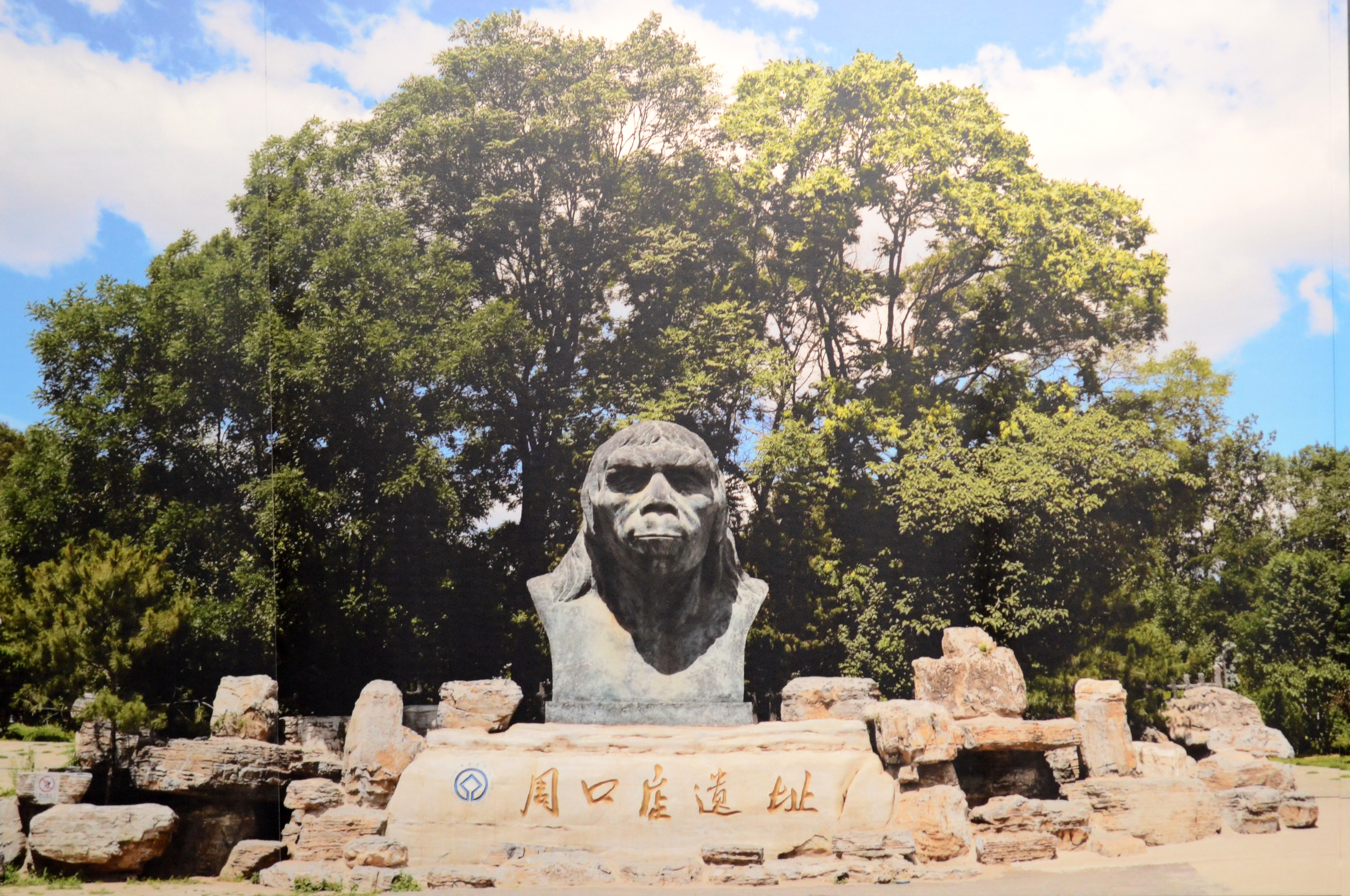
Zhoukoudian site
Further excavations led to more hominid finds. In 1929, Pei Wen Chung found the first complete skull. By 1937, the collection of bones had grown to represent 40 separate individuals – men, women, and children. These individuals were all part of a single population group. Finding an array of bones which represents a single population is very rare and this further illustrates the importance of Chou Kou Tien. Peking man is not so much an individual but rather an epithet used to represent this population. Although initially given a separate genus, Sinanthropus pekinensis, Peking man is now accepted within the genus Homo with the species name Homo erectus Pekinensis.
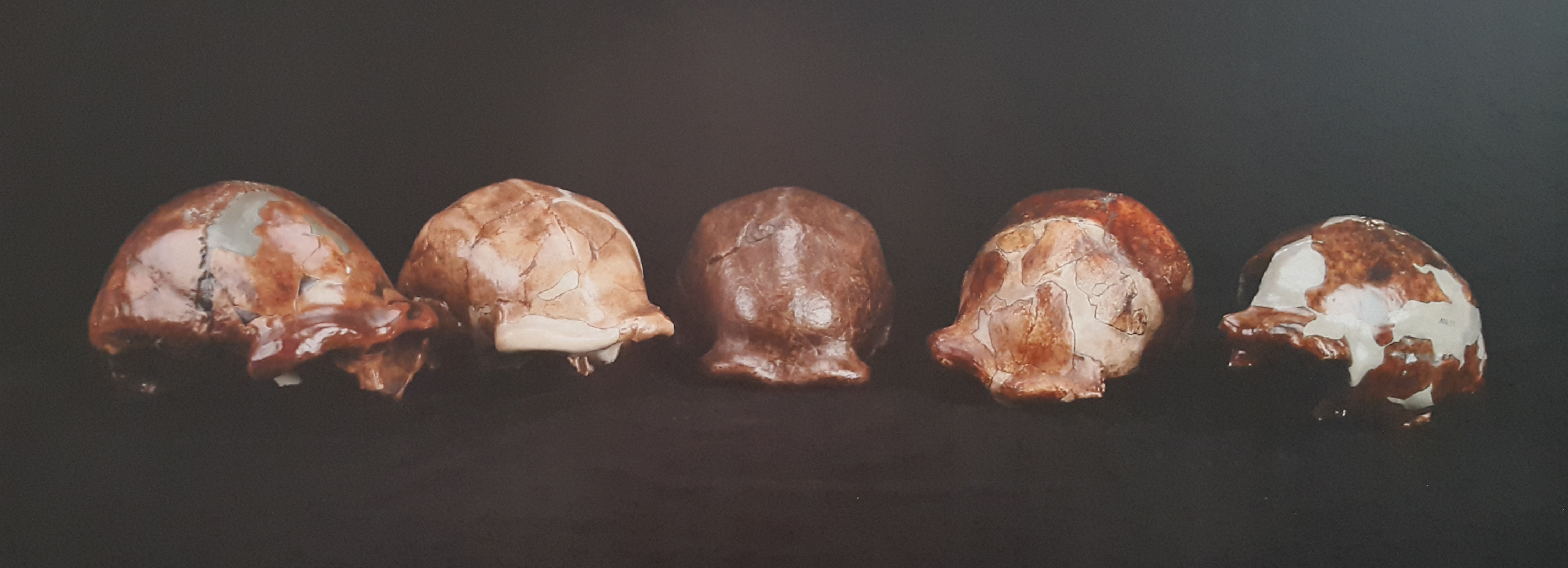
Replica of five skulls found at Chou Kou Tien
Excavations had to be halted in 1937 because of growing tensions between the Chinese and Japanese. The PUMC had so far escaped raids by the Japanese as the institution was American; Japan was not at war with America. However, there was a growing sense of danger and in 1941 this became so pronounced that the Chinese appealed to the Director of PUMC to send Peking man to the US for safekeeping. This, the Director was reluctant to do as the understanding between PUMC and the Rockefeller Foundation was that all finds from Chou Kou Tien would remain in China. However, in August 1941, the Chinese managed to persuade the American ambassador to ship out the fossils.
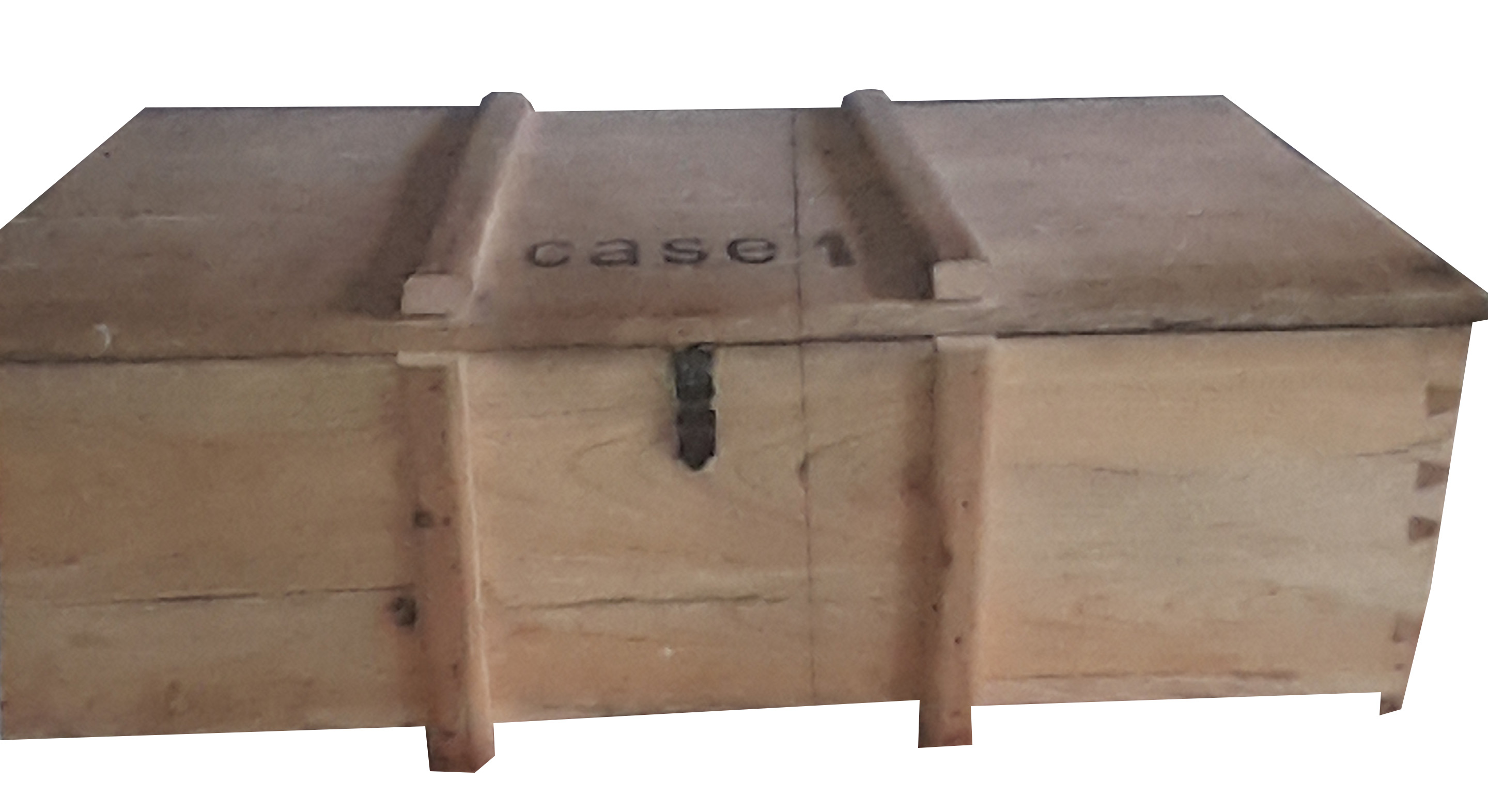
Due to some unknown delay, the fossils were only prepared for shipment in mid-November 1941. They were wrapped in cotton and packed in small boxes. These boxes were then placed in two wooden boxes, similar to the footlockers used by the U.S. Marines for their personal effects. The footlockers were sent to the U.S. Marines barracks in Peking as the marines were entrusted with taking them safely out of China. The marines, though, were not aware of the contents of the footlockers or of their importance.
Replica of a footlocker in which Peking man was packed
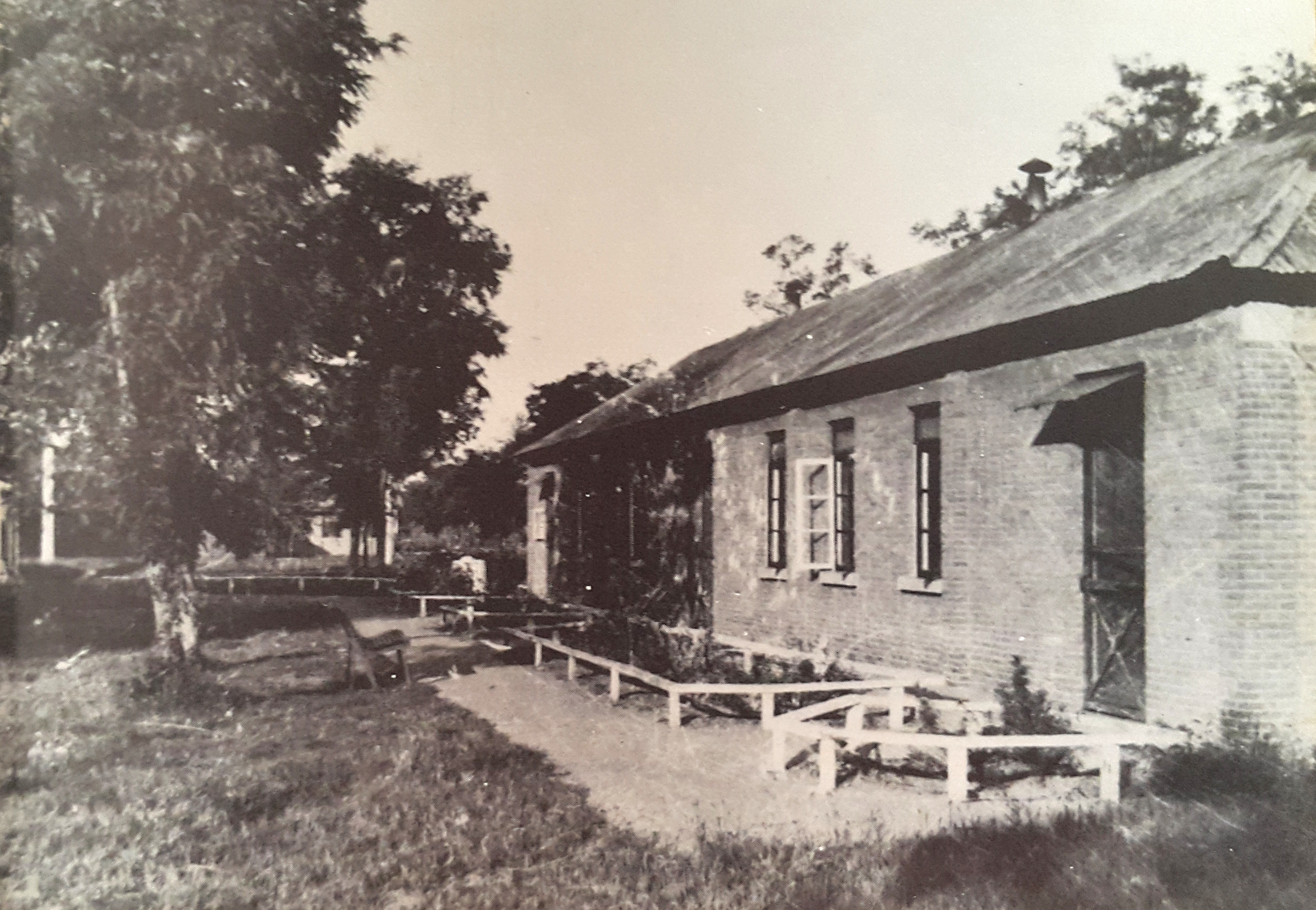
The marines were to rendezvous with the SS President Harrison, which had been commissioned to transport them to Manila and which was due in the port of Chingwangtao (now Qinhuangdao) on 8 December. But time had run out. Japan bombed Pearl Harbour on 7 December and the two countries were now at war. American property and personnel were no longer inviolate. The SS President Harrison, captured by the Japanese near the mouth of the Yangstze River, never made it to Chingwangtao. The footlockers are believed to have reached Camp Holcomb, a U.S. military base in Chingwangtao. However, this camp was taken over by the Japanese on the morning of 8 December. The Peking man fossils disappeared, never to be seen again.
Camp Holcomb, U.S. Marine base, the last know location of Peking man
With the fossils missing, what is being displayed at the ongoing exhibition at Muzium Negara? The team at PUMC had photographed the fossils, made detailed drawings, and created casts. These had been safely taken out of China. The artefacts at Muzium Negara are replicas of the Peking man fossils, recreated from the casts. Also displayed at the exhibition are replicas of skulls from Upper Cave, located southwest of the Peking man site. These are skulls of humans (Homo sapiens) that lived 30,000-10,000 years ago. They were packed together with the Peking man relics and, hence, suffered the same fate. Do visit the exhibition which ends on 16 June 2018. See how Peking man looked like. Learn to differentiate Homo erectus from modern Homo sapiens. Understand the environment in which Peking man lived and the animals with which he shared this environment. Appreciate the tools they made and how they controlled fire. Learn about other archaeological sites in China, from Palaeolithic to Neolithic. Find out the earliest known location where shoes were worn.
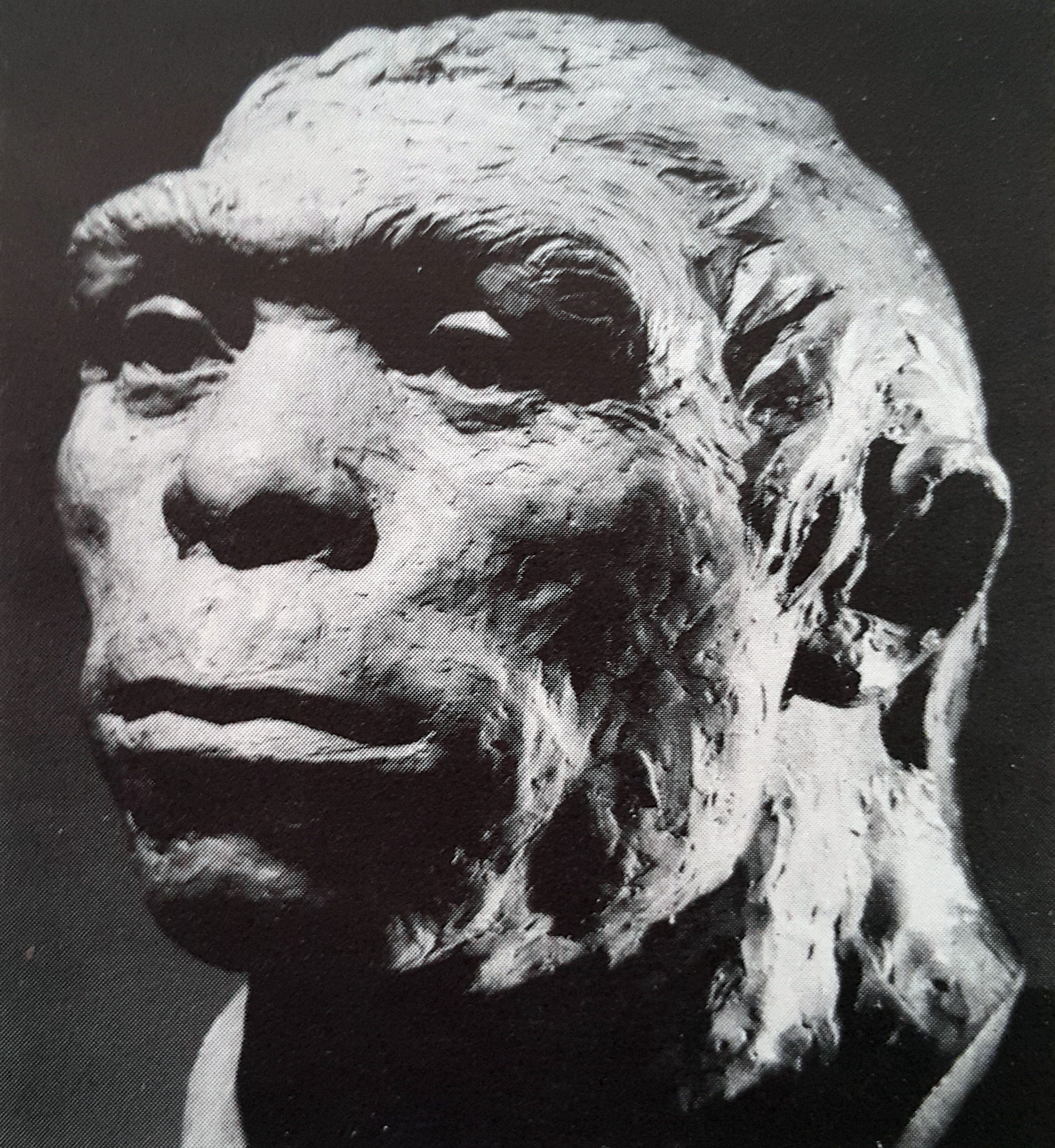
A reconstruction of Peking man by Harry Shapiro. Peking man was short, muscular, and broad-shouldered. He had a low brow which projected prominently just above the eyes. His skull was flat and small compared to modern humans. His neck was thick, almost bull-like. His arms, which reached his knees, were longer than his legs.
In retrospect, it may have been better to have left the fossils in PUMC and allow the Japanese to acquire them. The Japanese were aware of these fossils and came looking for them on the morning of 8 December. Some of the Chou Kou Tien fossils of lesser importance had been left behind and the Japanese confiscated these. After the war, the Americans found these fossils at Tokyo University and returned them to China. The Japanese would not have destroyed Peking man as they had wanted the fossils for their own research and study. If taken by the Japanese, the fossils would have been, in all likelihood, eventually recovered. Over the years, some have claimed to either know the location of the fossils or to have them in their keeping. These claims were made mostly by people seeking huge rewards. The leads were followed up but did not pan out. Among the latest claims is that Peking man is buried under an asphalt parking lot in Qinhuangdao (formerly Chingwangtao).
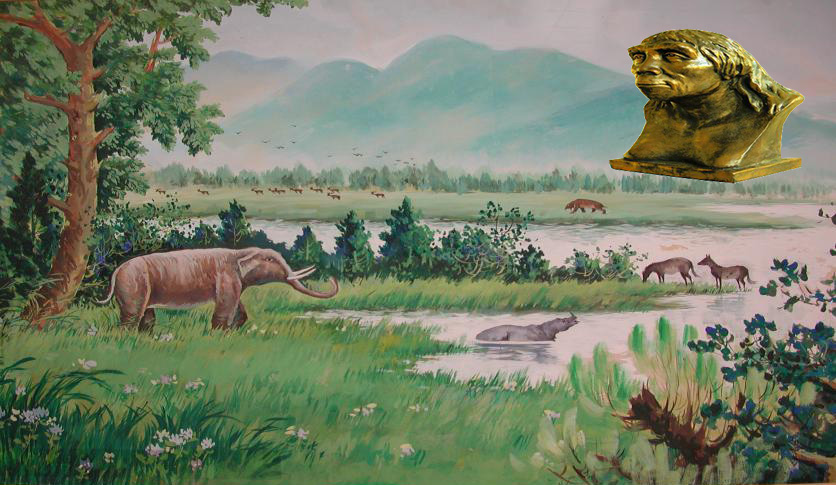
The environment Peking man lived in, shared with animals now extinct
Primary source: Shapiro, Harry L. (1976) Peking Man: The Discovery, Disappearance and Mystery of a Priceless Scientific Treasure, Suffolk: Book Club Associates.
We are all familiar with the legend of Prince Parameswara fleeing from Srivijaya to Temasek and then to a place named after the tree he sat under. Much less is known about the tree itself: the Melaka tree. Phyllanthus emblica, known as the Āmalaka or Āmelaki tree in Sanskrit, is very common in India, Nepal and South-East Asia and has given its name to Melaka city and the Straits. Its common name in English is Emblic myrobalan (Myrobolan emblique in French) and it produces a fruit called the Indian or Nepalese Gooseberry. When dried, the powder is known as ‘amla’. The importance of the Melaka tree is both symbolic and economic.
Myrobalan fruit
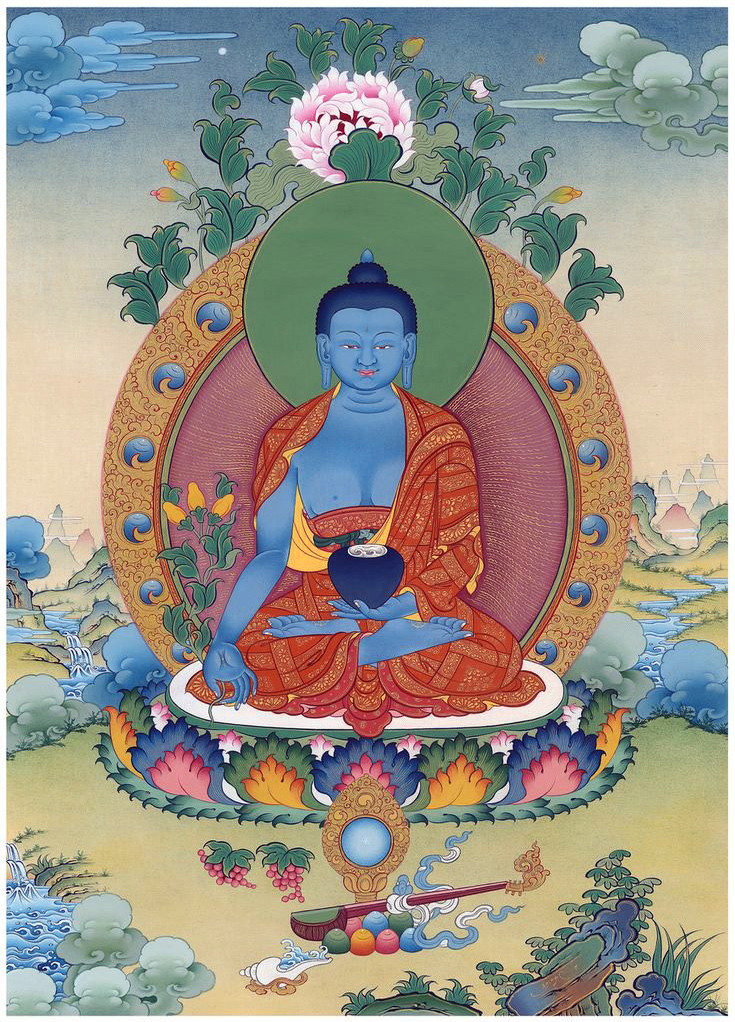
In Buddhist statuary art and sculpture, the Medicine Buddha is depicted, delicately holding the myrobalan plant between his thumb and middle finger. This symbolic gesture stems from the healing properties of the myrobalan. It entered the Persian pharmacopeia from early times: myrobalan is mentioned in the medical handbook of Avicenna (Ibn Sīnā) in the early 11th century. It was also used in Europe. No later than during the Middle Age, it was a valued ingredient which apothecaries prescribed almost as a universal remedy. It should be noted that, apart from its use in traditional and Ayurvedic medicine, amla has recently aroused a growing interest from modern medicine where it is use in diabetic treatments and to prevent cancer, among other properties.
Buddha holding the myrobalan plant
All parts of the Melaka tree are full of tannins[1], which make myrobalan a very useful ingredient. In the natural dyeing process, myrobalan can be used either as a mordant (a substance which helps fix the pigments into the fibres) or as a dye itself, rendering blackish colours. In addition to dyeing, myrobalan has many other applications. It is used both for tanning leather and also in the manufacture of Damascus steel.
It is clear that Prince Parameswara was wise to choose this place and this beneficial tree, to establish his new realm!
[1]Tannins are vegetable substances of the family of polyphenols, most often water-soluble, which have the ability to precipitate proteins and other chemical substances. For trees and flowering plants, this is a chemical defence against pests. Tannins can be found in some drinks such as tea, coffee, beer and wine.
Halleux Robert. Sur la fabrication de l’acier dans l’Antiquité et au Moyen Âge. In: Comptes rendus des séances de l’Académie des Inscriptions et Belles-Lettres, 151ᵉ année, N. 3, 2007. pp. 1301-1319. www.persee.fr/doc/crai_0065-0536_2007_num_151_3_91356
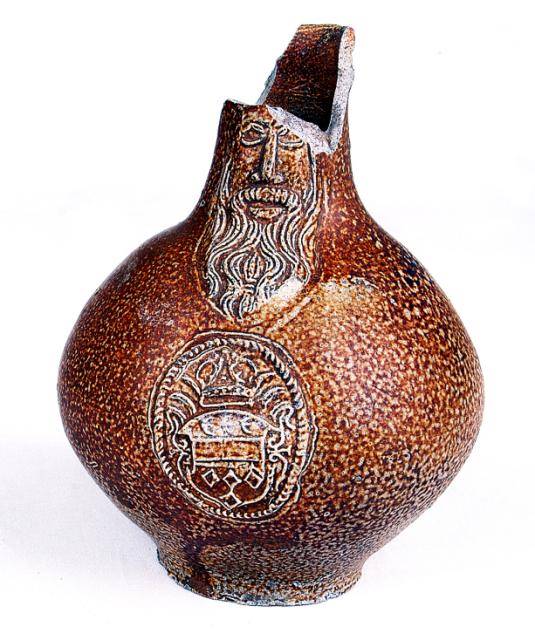
Amongst the detritus of the great explosion that destroyed the Dutch ship ‘Nassau’ at the battle of Tanjong Tuan in 1606, is one small curious flagon, usually referred to as a Bellarmine Jar, that survived the disaster almost unscathed. These jugs are made of brown earthenware with a bulbous body tapering to a long, narrow neck decorated with the face of a rather fierce bearded man. They often also bear a coat-of-arms, as the one featured in the museum, or a floral decoration. Bellarmine Jars were traditionally produced in Germany, particularly in Frechen outside Cologne. This jar is said to date to the early years of the 17th century, although their production in Germany goes back at least to the 14th century, possibly earlier.
In Germany, these jars were first called ‘Bartmann Krug’ (Bearded Man Jugs). The face is reminiscent of the Wild Man of the Woods spirit common across Europe that originated in ancient times and was still worshipped in rural areas even in the staunchly Christian Middle Ages. In Britain, this image was known as ‘The Green Man’, still a popular name for inns and pubs. Similar faces were often carved or etched onto trees, stone structures or wooden panels as a protection against evil spirits. They can even be found adorning the borders of Christian manuscripts and tapestries.
But in 1606, the nickname Bellarmine was newly coined and, in fact, may not have been in general use until later in the century. St. Robert Bellarmine (1542-1621), an influential Roman Catholic theologian and Counter-Reformation cardinal, was very unpopular in the Protestant countries, particularly Germany and Holland. It was Robert Bellarmine who was behind the original accusations against Galileo and who led the Papal attempt to declare Copernicus’s theories heretical. As you can imagine, this rigid and reactionary cardinal also held many other strict views – particularly against the consumption of alcohol. These jars seem to have been named for him in an attempt to humiliate the Cardinal by portraying him as a grotesque bearded old man who frowned on fun and enjoyment. There was also the extra insult that these small flagons would often be used to carry alcohol, something Bellarmine was particularly against. Imagine drinkers wishing each other ‘Cheers’, whilst raising the Cardinal’s face in mock tribute!
Carrying gin and brandy was not their only function. Research from the Nassau and various other shipwrecks of Dutch vessels shows that the jars were often used on long voyages to transport mercury, an important component of various medical treatments. Another more sinister use of Bellarmine jars, which must have further insulted the famous cardinal, was as Witches’ Jars used to store hair clippings, nails -or even human urine -for use in spells and charms. The jars were then buried in secret places to work their magic.
Our little jar spans a thousand years of history and tells of pagan rites, Christian conflicts, magic spells, pharmacological remedies – and an irreverent bottle of gin!
How tin mining struck deep into Malayan soil and left its mark upon a nation
by Muhammad Adib Mohd Faiz
To the average modern person, tin is merely a metal – dead matter fit for industrial purposes. The Malays, however, traditionally believed that tin possesses a soul. The ‘soul of tin’ took the shape of a water buffalo, an animal used to plough the rice fields that were a major source of provision.[1] Whatever our personal beliefs may be, there can be little doubt that tin would plough its way through 19th and early 20th century Malaya, becoming a source of wealth for those involved in its production. The important economic role of tin in this period would have a long-lasting effect on the social, political, and infrastructural landscape of Malaya.
Collection of tin hat and animal money at Muzium Negara (Galleries C and D)
Tin mining had existed amongst the Malays as early as the 15th century, with tin currency going back to at least the time of the Melakan king Sultan Muzaffar Shah (1445-9). Other than the simple method of panning for tin with a dulang, Malays used a combination of pits, dams, sluice boxes, and other components to extract tin ore. This system could produce an amount “sufficient for local use as well as export”.[2] However, the Malay rulers often lacked funds to open these mines and began to rely on Chinese merchants for capital in the early 19th century. The Malay chiefs then used Chinese labour to work the mines, with the Chinese having been involved in tin mining as early as the late eighteenth century. While the initial numbers were small, the rise of the tin canning industry after 1830 and the discovery of rich tin deposits in Selangor and Perak in the 1840s led to a massive influx of Chinese immigrants, swelling the population of the mining towns.[3] It seems likely that the sudden increase in demand would have influenced the decision of Chinese mine owners to switch to new forms of technology such as opencast or lombong mining. For instance, Chinese mine-owners began to use the chin-chia, a chain pump that drained water from the mines more quickly than traditional methods.[4] Yet in spite of the technological changes and diaspora population, tin-mine opening ceremonies remained “purely Malay in character”. A pawang or “mining wizard”, often a Malay and occasionally a Sakai, was often called upon to use a combination of spells and talismans for protection and an auspicious start.[5] This contrast between the old and the new embodies the nature of tin mining in this period: a modern industry in the midst of a traditional world.
An Open Cast Tin Mine in Selangor (KITLV Universiteit Leiden)
The involvement of Chinese merchants and the large influx of Chinese labour had a number of social consequences. While immigrants may have initially intended to be temporary, direct settlement eventually arose, with family structures emerging in the early 20th century in places such as Ipoh. The accounts of an Englishwoman living in Ipoh in 1914 bear witness to the role of female miners, who played central economic and social roles in the town. Waking up before dawn, these women would prepare the day’s meals, chop wood, and “[draw and carry], often from a distance, quantities of water”. Breakfast with their husbands was followed by “very thoroughly” bathing and dressing their “generally numerous” quantities of children. They would then see to the grandfather and grandmother, “who will then look after the babies” as the women work on the tin mines alongside their husbands.[6] This last piece of information clearly indicates the presence of extended families, showing that large social structures existed in mining towns. The ability to raise families was made even more remarkable by the sheer difficulty of the work in question; these people laboured for hours in cold, stagnant water up to their ankles, with the female dulang washers having to bend over to obtain tin ore.
Paraphernalia at the Story Museum, SJK (C) Serdang Baru 1
However, there was a less admirable side to this history of immigration, namely the exploitation connected with the kongsi organizations, the colonial authorities, and the system in general. Though often referred to as “secret societies”, the kongsi had a public political and social role in nineteenth century tin-mining areas. They were cooperative associations that originated from China’s “illegal mining communities and sea-merchant kingdoms”. Theoretically, the kongsi were democratic organizations designed to share profits between members and “[enable] immigrants to pursue their primary purpose of making a living and supporting their families in China”. As Tan Pek Leng notes, the lack of “effective formal governance” caused these societies to act as arbitrators in the midst of disputes, while the “bonds of brotherhood” in a kongsi provided a formidable force against the colonial authorities. However, the ideal form of the kongsi was rarely realized in Malaya, with these powerful organizations exploiting others for personal economic gain. The various kongsi often controlled labourers before they had even left China, with recruiters placing labourer’s names on kongsi membership rolls “without their knowledge”.[7] Once in Malaya, the labourers were totally dependent on the “advancers” for everything from food to opium, all of which had to be bought at the advancer’s price. The colonial authorities were complicit in the exploitation. Though the British had some admirable officials who introduced some regulations, British law courts recognized the fines imposed by advancers. Colonial contradictions could be jarring; although the Perak Government insisted on a “discharge ticket” so labourers could “seek employment elsewhere” upon contract completion, they subjected labourers who absconded to “a fine, flogging or imprisonment, and to have the wages due to them forfeited”. This last detail meant that such workers would have to start from scratch, locking them into their contract for an even longer time. It is difficult to disagree with Ho Tak Ming’s conclusion that this “was no better than a modified form of slavery”.[8]
Paraphernalia at Falim House, Ipoh
Power leads to conflict, and rival kongsi often came into armed conflict with each other “to protect the interests of their towkays and headmen”.[9] In a world mostly centred on kongsi control, these confrontations were effectively civil wars, engulfing whole towns in chaos. The most famous of these were the Larut wars in Perak (1861-74), where the Ghee Hin and Hai San societies engaged in bloody battles over tin mines. With the Malay rulers lacking control of the situation – the Mentri Larut “was forced to side with whichever side was mining at the time” – the British eventually stepped in to settle the disputes. The result was the signing of the Pangkor Treaty in 1874, which forced the rival factions to maintain peace at the expense of a $50,000 penalty and demanded that the Sultan follow the “advice” of a British officer called a “Resident” in all matters except Malay customs and religion. The treaty also stated that British residents would regulate “all revenues and the general administration”.[10] This began a pattern of indirect rule that would spread to other states in Malaya.
Diorama showing the signing of the Pangkor Treaty by Raja Abdullah and Sir Andrew Clarke (representing the British Crown). Photo taken at Pasir Salak Historical Complex.
It was with the introduction of the dredge ship that European power would gain a firm foothold in Malaya’s tin mining industry. In the years after 1915, the earlier sources of tin were gradually depleted. With fewer “easily accessible deposits”, it became necessary to dig deeper into areas that could not be reached through existing methods. Around this time, European companies began introducing new forms of technology that could reach the “deeply buried deposits” that were previously inaccessible.[11] An example of such technology was the dredge or kapal korek, with the example referred to in the National Museum being capable of digging 31.5 meters deep.[12] Moreover, the dredge could do the same work with a far smaller labour force, shifting the tin mines away from labour-intensive methods to capital-intensive methods. Coupled with the increase of British administrative control over Malaya, the dredge and other machines gradually weakened the Chinese hold over the industry.[13] Although they did not have the same societal effect as the Chinese, European economic domination would have a developmental – and environmental – effect. In an attempt to link the economic centres of Malaya together, a system of transportation was eventually devised with trunk roads and railways connecting tin mining areas on the West coast. Yet while Malay transportation systems had been developed in harmony with nature, the new modes of transportation were built with little concern for environmental effects. While seas and rivers had previously served as “natural highways”, railways were an artificial imposition that altered the landscape. While elephants had previously been used to transport goods, wild elephants were now injured by oncoming trains.[14] Though hardly matching the environmental catastrophe that exists in Malaysia today, these early developments may be seen as beginning a venomous trend, namely the love of “progress” with no regard for the earth and its creatures.
Tanjung Tualang Dredge No.5 (TT5), located south of Batu Gajah, was originally operated by the Southern Malaya Tin Dredging company.
The soul of tin turned the soil of Malaya into a dramatic history, with a cast of immigrants, mothers, bullies, and machines. What traces remain of that drama today? The tin mines of Malaya are now mere pools of water, and Malaysia’s economy is a whole other beast. The soul of tin has clearly moved on, perhaps to plough other fields or else to rest in a faraway swamp. Yet in its wake, it has left a furrow filled with the experiences and emotions of an era. Out of that furrow, new crops have grown, surrounding us as a part of our Malaysian experience.
Champion, Marissa. Odyssey: Perspectives on Southeast Asia – Malaysia & Singapore, 1870-197. Singapore: SNP Panpac, 2001.
Ho, Tak Ming. Ipoh: When Tin Was King – Volume 1. Ipoh: Perak Academy, 2014.
Kaur, Amarjit. “The development of railways.” In The Encyclopedia of Malaysia: Early Modern History [1800-1940], edited by Cheah Boon Kheng, 120–1. Singapore: Editions Didier Millet, 2001.
Loh, Francis Kok-Wah. “Chinese immigration and tin mining.” In The Encyclopedia of Malaysia: Early Modern History [1800-1940], edited by Cheah Boon Kheng, 72–3. Singapore: Editions Didier Millet, 2001.
Loh, Francis Kok-Wah. “Early Malay tin mining.” In The Encyclopedia of Malaysia: Early Modern History [1800-1940], edited by Cheah Boon Kheng, 20–1. Singapore: Editions Didier Millet, 2001.
Mrs JG Withycombe. Lady. 1914. As quoted in Ho Tak Ming. Ipoh: When Tin Was King – Volume 1. Ipoh: Perak Academy, 2014.
Skeat, Walter William. Malay Magic: An Introduction to the Folklore and Popular Religion of the Malay Peninsular. London: Frank Cass and Co. Ltd., 1900.
Tan, Pek Leng. “Chinese secret societies.” In The Encyclopedia of Malaysia: Early Modern History [1800-1940], edited by Cheah Boon Kheng, 48–9. Singapore: Editions Didier Millet, 2001.
Tan, Pek Leng. “Long Jaafar and the Chinese tin miners in Larut.” In The Encyclopedia of Malaysia: Early Modern History [1800-1940], edited by Cheah Boon Kheng, 46–7. Singapore: Editions Didier Millet, 2001.
Tin Animal Currency display board, Gallery C, National Museum, Malaysia.
Tin Dredges display board, Gallery C, National Museum, Malaysia.
It was a rainy morning. Armed with raincoats and umbrellas, we gathered at the national museum around 7.45 am. All twenty who had registered for the trip, turned up despite the wet morning.
Sekinchan is a small town located in the state of Selangor in Malaysia, about 102km north of Kuala Lumpur and 28km from Kuala Selangor. In fact, Sekinchan is in the middle of the main rice-bowl area of Selangor, in Sabak Bernam district. It is one of the major rice producing areas in Malaysia.
The bus left around 8.30am. I was excited to see the much talked about paddy fields at Sekinchan. I had looked forward to going out of the city, soaking in the fresh air, and feasting my eyes on the acres of paddy fields. On the bus, Mona and Alvin, who put this trip together, told us what we could expect. We would be visiting the paddy gallery with a guided tour, then a mango orchard where we could purchase sweet juicy mangoes, have lunch, and then visit the Sekinchan Wishing Tree and a beach called Pantai Redang.
Highland Rice Fields of Ifugao (Philippines) – a UNESCO World Heritage Site
We were fortunate to learn more about our staple food as Steven Lim, a UNESCO qualified guide, shared his knowledge with us in the bus.
For more than 2,000 years, the highland rice fields of Ifugao have been planted on the contours of the mountains. The knowledge handed down from one generation to the next, the expression of sacred traditions, and a delicate social balance, have helped to create a landscape of great beauty that expresses the harmony between humankind and the environment.
The Ifugao Rice Terraces are the priceless contribution of Philippine ancestors to humanity, representing an enduring illustration of an ancient civilization that surmounted various challenges and setbacks posed by modernization.
Closer to home, is the unique adan rice or pade dari, popularly known as Bario Rice, found in the highlands of Ba’Kelalan, Long Semadoh, and Bario. It is one of the finest and best rice produced in the highlands of Sarawak. The rice has a soft texture with fine and elongated grains and produces a mild aroma and fantastic taste.
Ifugao (Philippines) rice terraces
Commentary on Sekinchan by Mona Tan
Sekinchan in Chinese mean “village suitable for plantation” as the land and weather are suitable for farming of rice, fruits, and oil palm trees.
The birthplace of Sekinchan was actually at the main fishing area called Bagan back in the 1920s. The early inhabitants were almost all Teow Chew who were also fishermen. Sekinchan gradually grew in size due to population migration into this fertile land and it eventually developed into today’s scale.
In the year of 1953, in order to segregate the villagers from the Malayan Communist Party insurgents, villages were isolated, and hence formed the Site A, B, C, and Bagan. Sekinchan has a unique geographical environment; it is not only famous as a coastal rice planting area, it is also blessed with plenty of fishes. Hence, people named it “Land of Plenty”.
During the British colonial era, the Teow Chew villagers of coastal area called Sekinchan “Ang Mo Gang” as many British stayed there. The total population today is about 20,000 with 60% Chinese, 30% Malay, and 10% made up of other races. The main economic activities are agriculture and fishing. The total farming land for paddy and fruits is about 4,700 acres and this popular fishing village has more than 300 fishing trawlers!
Sekinchan rice fields
Interesting research by Alvin Woon
All of us have been using USB flash drive or pendrive to store data or transfer information not realising that Pua Khein-Seng, who is from Sekinchan, is regarded locally as the “father of pendrive”, arguably one of the inventors of this USB flash drive. The multi-chip pendrive was first invented by M-Systems, an Israeli company, with a patent lodged in 1999. Pua’s claim rests on his being the first to incorporate the single-chip flash controller onto the USB.
Born and bred in Sekinchan, Pua received his undergraduate education in electrical control engineering at the National Chiao Tung University, Taiwan and has since then resided in Taiwan.
Sekinchan Today
Sekinchan’s economy today is based on agriculture, where mechanised farming methods have been introduced to enable high yield of rice; tropical fruits especially mangoes; swiftlet farming; and manufacturing. A number of trendy hotels dot the town offering thematic experience with a touch of ‘zen’ or simply living in a comfort of a ‘container’ and B&B for the budget conscious!
We saw an endless horizon of green paddy fields; truly a sight to behold and no words could describe the breath-taking scenery! There are many inter-connecting roads even from the heart of the paddy fields, connecting small villages to the town. Along the way, you may stumble upon a water path or aqueduct, little bridges, and of course the paddy fields themselves. Sekinchan is also famed for migratory birds watching. Just to name a few, Peaceful Dove, Shorebirds, and the White-breasted Wood Swallow can be spotted here.
This place is also famous for its many fruit orchards with mangoes being one of the favourites. Sekinchan also upholds its reputation as a town with swiftlets nests or more commonly known in the food industry as birds’ nests. Chinese believe that birds’ nests are luxurious food that contains many health benefits. Many customised building structures, home of the swiftlets, sprouted up in the middle of paddy fields as this is a new thriving industry.
Paddy Gallery updates by Elena Shim
We arrived at the paddy gallery around 10am and started the gallery tour around 10.30am. We bought our entry tickets for Rm5.00 and it came with a complimentary packet of rice from the factory. We were brought into a presentation room where our guide, Miss Moon explained how Sekinchan paddy came about. There are four types of rice: glutinous, long grain, short grain, and fragrant rice. Their paddy seeds came from FELCRA and MARDI, both Government agriculture agencies.
There are two plantings in a year, namely February and August. Transplanting is done by machine and this takes 2.5 hours. Water is drained out 3 weeks before harvesting. It takes 110 days before the paddy is ready for harvest. This means harvest time is May-June and November-December when the paddy fields turn honey gold.
In the olden days, it took 7 to 8 people to harvest 1.2 hectares of land within 2-3 days. With machine in the 1.2 hectares of land, transplanting takes only 2.5 hours to complete. Each 1.2 hectares of land produces 10 tons of rice before husking. Currently, their company, PLS Marketing (M) Sdn Bhd, only supplies to 99 Speedmart due to supply constraints. There are nine processes before the rice is sold to the market/public.
Step 1: The paddy husk is collected for reuse as the fuel for firing the boiler, to dry the paddy in the drier.
Step 2: Pressure from the heated boiler intensifies the drying process of the paddy.
Step 3: The dried paddy is then stored in the storage for cooling.
Step 4: The rice huller machine then removes the husk from the paddy through wind force to get the grain rice.
Step 5: The shelled paddy is then directed to the paddy separator, which will separate the unshelled paddy and the rice. The unshelled paddy will roll back into the rice huller machine again.
Step 6: The grain rice will be polished by the rice polisher machine where the rice kernel is also removed from the rice.
Step 7: With the application of the inconsistency principle, the rice-grading machine separates the whole and the broken rice.
Step 8: With the application of wind force, the destones machine then vibrate the rice where stones and broken rice are completely removed from the product.
Step 9: Once that is done, photo electronic technology is used to detect and then remove the black and immature rice completely to make it superior in quality.
Ready to plant saplings
After the paddy gallery, we visited a mango orchard called Mango King where huge sweet and juicy mangoes are sold. Almost everyone bought at least a bag home. They also sell prawn crackers & banana chips and we went back into the bus not empty handed. We stopped by a souvenir shop called ‘Ah Ma House’. It was a wooden house next to the paddy fields. Ah Ma House is a specialty cake and biscuit store in Sekinchan. The main product is Ah Ma Cake which sells traditional biscuit such as pineapple tarts, ‘kuih bangkit’, and ‘kuih kapit’ (Chinese love letters). This establishment received royal patronage on 22nd May 2017.
Bagan Fishing Village
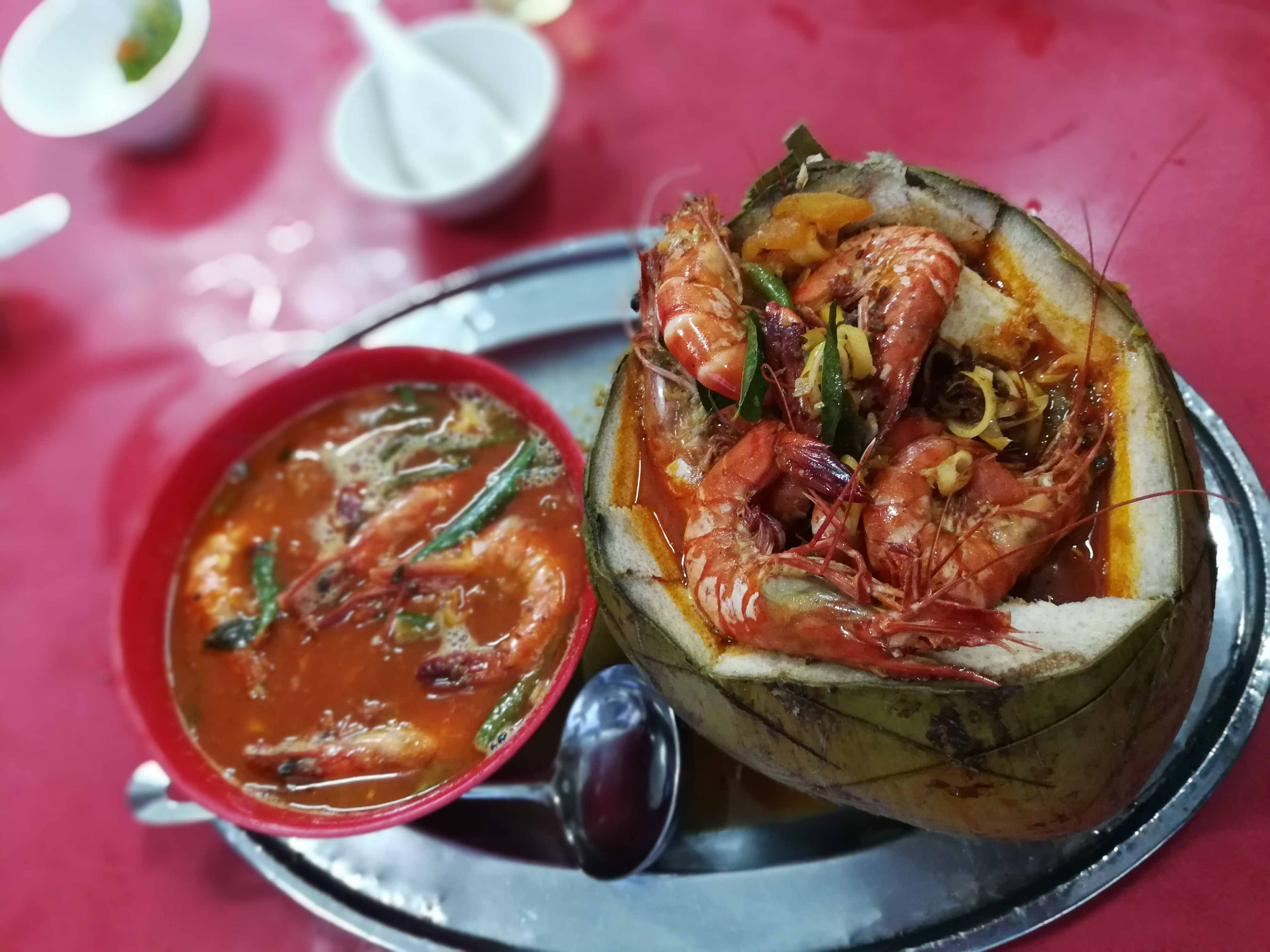
Later, we went to have a hearty seafood lunch at Guan Seng Long Restaurant. It was around noon and everyone was famished as we had an early start to the day. After lunch, we headed over to visit the Sekinchan Wishing Tree next to the Datuk Kong Temple.
As we ventured further towards the shoreline at Pantai Redang, we saw many fishing boats berthing by the river near Bagan, a small seaport towards the south-west of the town. It was an interesting sight as many fishing boats still vividly flashes in our mind.
As an aid to fisheries management and safety at sea, fishing vessels are appropriately marked for identification such as nationality of the vessels, irrespective of size and tonnage, to facilitate search and rescue operations if the need arises.
Julie Chang narrated to us the various licenses on the boat. Each vessel is marked according to its appropriate fishing zone usually in white lettering on black round background. Zone A is less than 10km; Zone B less than 25km; Zones C1 & C2 more than 25km and conducts overnight fishing, usually fully equipped with refrigeration facilities and polystyrene boxes.
The fishermen will venture into the seas in the wee hours around 4.00am returning back around 5.00pm with lots of fresh fishes, prawns, squids, crabs, and etc. In the evening, the whole Bagan springs back into a bustle of activities! Fishermen will be busy unloading their catch for the day to be categorized into types and sizes of fish before being sold to the middlemen or nearby seafood restaurants.
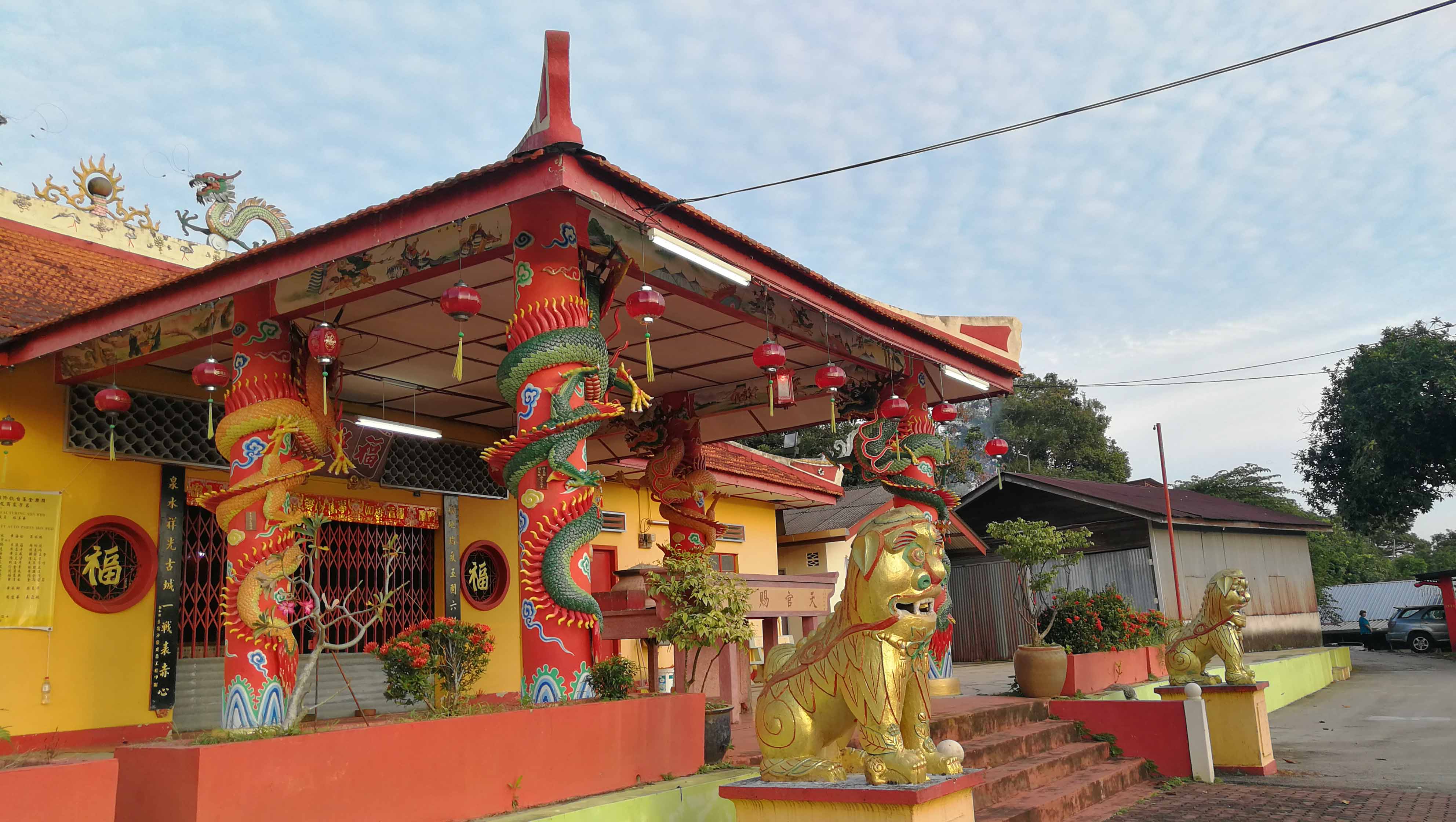
Datuk Kong Temple and the Wishing Tree
Pantai Redang Datuk Kong Temple Chinese temple has become popular among Chinese who come to worship the earth spirit, Datuk Kong, and to toss their wish up the adjacent Wishing Tree. This wooden shed temple is said to be over a hundred years old.
In the past few years, it has become a popular tourist destination particularly within the local Chinese community, after it appeared in the Hong Kong TVB drama ‘Outbound Love.’
The Wishing Tree next to the Datuk Kong temple attracts not only local Chinese but tourists from Hong Kong, China, and Taiwan as well. The beach area of Pantai Redang looks like a fiesta going on full swing, with people flying kites and enjoying food in various makeshift stalls.
Similar to the Pont des Arts Bridge in Paris, we have our very own Sekinchan Wishing Tree. It is said when you throw your ribbon high up into the air and it entangles with the tree, it will bring you good luck and your wishes come true. I watch in awe as some of our friends threw their red ribbons up into the air. It brought laughter and giggles. Some went up really high while some missed and caught a lower part of the trees.
Sekinchan Wishing Tree
We crossed over to the opposite side to walk on the beach. It was hot and we took a group photo near an abandoned fishing boat. We headed back to Kuala Lumpur around 2.30pm and reached the National Museum around 4.00pm.
It was another fun, enjoyable and informative trip to Sekinchan. I was really thankful to the organisers who recce the place prior to the trip and made this a wonderful day trip out of the city.
It was a pleasant day to look forward to as fellow Museum Volunteers (MV) had come together for this trip to the National Education Museum, located within the Sultan Idris Education University or UPSI in Tanjong Malim. We arrived an hour before schedule with the JMM bus from Muzium Negara. There were 25 eager participants in this MV Focus visit including 2 teachers who trained at Kirby College in the 1950-1960s – MV Cze Yan’s mother, Choo Thye, and MV Lily Lim. I could feel how happy Madam Choo Thye was when she was at the gallery on Kirby and Brinsford teachers. Truly brought back fond memories of her younger days as a pioneer in the teaching profession!
Kirby Teachers Training College was established in January 1952
Since all of us are history buffs, let me narrate a little bit about this historical town.
History of Tanjong Malim
Tanjong Malim is an interesting gateway town located at the south of Perak Darul Ridzuan, bordering Selangor Darul Ehsan as well by having the Titiwangsa Range as its background and the Bernam River to its side. Fellow MVs were punctual as usual and our journey of 84 km up north from the National Museum was an hour-plus smooth drive on the JMM bus.
Tanjong Malim town started from a large cape or a high land formed by river erosion and sticking out into the sea; an early settler was an ‘ulamak’ (a religious man), Tuan Haji Mustafa bin Raja Kemala. Sir List, the representative of the Straits Government, and Raja Itam named the town ‘Tanjong’ in conjunction with the location of its large cape, whereas the word ‘Malim’ (mu’alim) was used to indicate the religious commitment of the people in the area at the time.
Initially, the District and Land Office was in Tanjong Malim. However, the Municipal Office was moved to Slim River after the incident on 25 March 1952 in which communist guerrillas killed Sir Michael Codner (the District Officer) and eleven other men in an ambush while they were repairing a sabotaged water pipeline.
Today, Tanjong Malim is known as ‘Education Town’ as it is the location of Universiti Pendidikan Sultan Idris (Sultan Idris Education University) or just UPSI. In fact, this town is also known as Proton City with the construction of Proton’s assembly plant.
Education Museum
Education Museum in its early days
The Suluh Budiman Building, which houses the current Education Museum, was built in August 1919 and its construction was completed in June 1922. This majestic building was designed by Kesteven, a famous architect in the Federated Malay States. It functioned as the famous Sultan Idris Teaching College (SITC) in its early days and had since generated renowned nationalist and intellectuals such as Za’aba, Aminuddin Baki, Ungku Omar, Ungku Abdul Aziz and Tok Kemali; all of them have rendered numerous contributions towards independence and the national education pedagogy.
Renowned nationalists and intellectuals. From left to right: Za’aba, Aminuddin Baki, Ungku Omar, Ungku Abdul Aziz and Tok Kemali
The design of the building has elements of medieval Dutch-Gothic architecture style and it is obvious that the design of the building resembled the Notre-Dame Church in France and Salisbury in England. As we walked into this magnificent building, we observed that the main hall looks like a church. The knowledgeable in-house guide, Mr. Devan, confirmed this as a chapel that it did not materialise. He said the craftsmen who constructed the building were brought in from Java by the British. Skilled Chinese labourers were also used for its construction.
Our guide, Devan, next to the original King Edward VII School emblem established July 1883. ‘Magni Nominis Unbra’ in Latin means ‘Under the shadow of a Great Name’
The upper floor of this building was SITC’s main administration centre, which includes the principal’s office, staff room, meeting room, general office, composing office and library. The ground floor consists of classrooms and a main hall used for the monthly assembly or for official college functions.
The Suluh Budiman Building was gazetted under the National Heritage Act 2005 as a National Heritage Building on February 14, 2009. On August 24 2009, the work of building conservation, gallery construction, and infrastructure installation meeting the requirements of museum practices were performed.
Finally, this floor area of 3,239 square meters was converted into a museum in March 2011. The opening ceremony was held on July 19, 2011, inaugurated by His Majesty the Raja Permaisuri Perak Tuanku Bainun.
Commemorative porcelain set for Sultan Idris Teachers College graduates
Mission, Vision and Objectives
Their mission is to preserve the heritage of national education in the form of tangible and intangible assets through exhibitions, academic activities, research, publications and community service to achieve the country’s vision. This is achieved by maintaining and preserving its history and glory of global changes in the past, present and future through a central source of information, restoring effort through R & D, proliferation of education knowledge through events, seminars, workshops and lectures at home and abroad. Documenting the services of prominent educational figures are commendable and the ability to bring history to live in the form of a time tunnel is poised to create its own unique form of tourist attraction that would ultimately contribute to the country’s tourism industry.
Teaching aids of the Language InstituteTeaching aids for the blind using Braille
Tour to the Galleries
We really had a good time learning and recalling how our national education had progressed until today. “The museum contains one thematic exhibition space just right at the entrance, now featuring on UPSI’s milestone and another 21 galleries or permanent exhibition spaces within this building,” said Devan. We could not believe our ears as we have only four galleries at the National Museum. Actually, classrooms and training rooms used in the early days were converted into well-curated galleries in both Malay and English language. A number of old artefacts were displayed, some dating to the early 1900s. We saw interesting dioramas of early classrooms, uniforms, teaching aids & materials used those days, science & technology, prominent local figures and many more. Below were the Galleries we visited and it took us more than two hours to complete the tour in this elegant building.
Early education in Malaysia
Fundamental and Curriculum
More on Fundamental and Curriculum
Early schools in Malaysia
Teachers Training – Kirby and Brinsford Teachers
Higher Education
Renowned National Education Personalities
Sultan Idris Training College (SITC)
Zainal Abidin Ahmad (Zaaba)
Education and Research
Malaysia Education Ministers
Development of Early Years Children Education
Special Education Development
Education for all
Adult Education
Development of Education Technology
Education Technic and Vocational
Neuron Science Cognitive
E-Learning
Virtual Learning
Science and Technology Education
Musical instruments, used in Penang in the 1980s, and some trophiesOld vinyl records
Research, Conservation and Procurement
We were also told that the ‘Research division’ is one of the core areas of this Museum. Research conducted in the museum consists of history, culture, nature, exhibitions and collections research.
In fact, there are 3 types of research conducted here:
i – Research conducted by the National Education Museum staff
ii – Research carried out in collaboration with other parties
iii – Research conducted by outsiders
Furthermore, the Research division serves to strengthen and develop the field of research, documentation and publication to uphold the museum’s function as a disseminator of knowledge in the field of exhibitions, collections, history, culture and education.
Collection of trophies during the MPSI eraEminent Teachers
The Conservation division performs work on analysis, research, treatment and preservation of museum collections for the purposes of exhibition, storage, education and documentation. This department also carries out damage prevention, restoration of artefacts, monitoring temperature control system, humidity, lighting and pests found in repository and museum galleries.
Finally, the main objective of the Procurement division is to retrieve the national education heritage in the form of artefacts, ecofacts, specimens, and related documents in order to ensure that the collections are saved and available for exhibition.
After a complete walkthrough of the numerous interesting and knowledge enhancing galleries, we had a group photo taken just at the entrance of this magnificent building before we bid farewell and proceeded to lunch, located just in the vicinity, outside this huge Campus.
Group photo of fellow MVs in front of the Education Museum
YIK MUN PAU (Steamed Bread) RESTAURANT
We had a hearty lunch in the ‘Yik Mun Pau Restaurant’, which has been in operations since 1926. The restaurant and some of the food served here retains a nostalgic feel of the Colonial era. Acclaimed as the most famous pau outlet in Tanjong Malim, it is ‘halal’. The restaurant serves soft pau, toast, Hainan noodles; the Hainanese chicken chop, especially, was worth trying. Food served was in large portions and many said to me that it was good. That is why this corner restaurant, painted in red, attracts many patrons from all over Malaysia.
After lunch, we went back to Kuala Lumpur by the JMM bus and reached Muzium Negara at about 2.30pm. It was indeed a memorable Education Museum tour as through its exhibits, we learned to appreciate the importance of education, and how it shapes the Nation!
Cannon was used by Raja Mahadi during the Selangor Civil War against Tengku Kudin in the 19th century
The Indonesian-Malaysian or Borneo confrontation was an undeclared war, from 1962 to 1966, that stemmed from Indonesia’s opposition to the formation of Malaysia. The term ‘Confrontation’ was coined by Indonesia’s Foreign Minister, Dr Subandrio, in January 1963, and has come to refer to Indonesia’s efforts to destabilise the new federation, with a view to breaking it up. The conflict resulted from Indonesia’s President Sukarno’s belief that Malaysia, which became official on 16 September 1963, represented a British attempt to maintain colonial rule behind the cloak of independence granted to its former colonial possessions in the South East Asian region.
Headlines, Sabah Times, Wednesday, September 4, 1963. Photographed at ‘One Malaysia One Story’ exhibition at Muzium Negara in August 2016.
In the late 1950s, the British Government had begun to re-evaluate its force commitment in the Far East. As part of its withdrawal from its South East Asian colonies, Britain moved to combine its colonies in Borneo with the Federation of Malaya (which had become independent from Britain in 1957) and Singapore (which had become self-governing in 1959). In May 1961, the British and Malayan governments proposed a larger federation called Malaysia, encompassing the states of Malaya, Sabah, Sarawak, Brunei and Singapore.
By the close of 1962, Indonesia had achieved a considerable diplomatic victory, which possibly emboldened its self-perception as a notable regional power and thus its ability to extend its dominance over its weaker neighbours in the region. It was in the context of Indonesia’s success in the Netherlands’ West New Guinea dispute that Indonesia cast its attention to the British proposal for the formation Malaysia. Opposition to Malaysia also favoured Sukarno politically by distracting the minds of the Indonesian public from the appalling realities at home as evidenced by gross mismanagement, nationalistic policies that alienated foreign investors and rife corruption. Everyone in Indonesia felt the hardships of high inflation and food shortage. Sukarno also had dreamed of an Indonesia that was like the glorious ancient Srivijaya and Majapahit empires.
The ‘Ganyang Malaysia’ or ‘Crush Malaysia’ campaign was initiated by Sukarno on 27 July 1963.
Sukarno argued that Malaysia was a British puppet state, a neo-colonial experiment contrary to that of revolutionary Indonesia, and that the creation of Malaysia would perpetuate British control rather than ending its colonial domination over the region. He argued that this had serious implications for Indonesia’s national security as a sovereign nation especially in light of the fact that Britain would continue to have military bases in Malaya, Sabah, Sarawak, Brunei and Singapore, which are a stone’s throw away from Indonesia’s backyard.
Similarly, Philippines made a claim to North Borneo or Sabah, arguing that they had been historically linked through the Sulu Sultanate. Manila maintained that the area was once owned by the Sultan of Sulu, and because Sulu is now part of modern Philippines, that area should therefore belong to Philippines through the principle of extension. While Philippines, under President Macapagal, did not engage in armed hostilities with Malaysia unlike Indonesia, diplomatic relation was severed after the former deferred in recognising the latter as the successor nation of Malaya.
As for Brunei, Sultan Omar was undecided on whether he would support joining Malaysia because of the implied reduction of his influence as the head of state and significant amounts of Brunei’s oil revenue being diverted to the federal government in Kuala Lumpur to be shared among the proposed states of Malaysia. Brunei was to be the tenth state of Malaysia, whose sultan would be eligible to be the king of the country on a rotational basis for a five-year tenure and the sultans of Malaya had made it clear that he would have to wait his turn. This did not go down well with him as he could not foresee the prestige of being a king in his lifetime due to his place in line. Furthermore, AM Azahari, a Brunei politician and veteran of Indonesia’s independence movement who was against colonial rule, also opposed joining Malaysia on similar grounds as Indonesia.
In December 1962, Brunei faced a revolt by the North Kalimantan National Army (NKNA), which was backed by Indonesia and was pushing for Brunei’s independence instead of it joining Malaysia. In response to the revolt, the British and other Commonwealth troops were sent from Singapore to Brunei, where they crushed the revolt within days by securing Brunei’s capital and ensured the Sultan’s safety. The insurrection was an abject failure because the poorly trained and ill-equipped guerillas were unable to seize key objectives such as capturing the sultan of Brunei, seize the Brunei oil fields or take any British hostages.
Following NKNA’s military setback in Brunei, small parties of armed insurgents began infiltrating Malaysian territory along the Indonesian border in Borneo on sabotage and propaganda missions. The first recorded incursion of Indonesian troops was in April 1963 when a police station in Tebedu, Sarawak was attacked. After the formation of Malaysia in September 1963, Indonesia declared the ‘Crush Malaysia’ campaign leading to the escalation of cross border incursions into Sabah and Sarawak, which had then ceased to be British territories. Indonesia also began raids in the Malaysian Peninsula and Singapore in 1964. To repulse the infiltrators and prevent their incursions, the British and other Commonwealth troops remained at the request of Malaysia. Together with the Malaysian troops, they engaged in successful offensives against the Indonesian troops.
The intensity of the conflict began to subside following the events of the ‘30 September Movement’ and General Suharto’s rise to power in Indonesia. On the night of 30 September 1965, an attempted coup by the Indonesian Communist Party took place in Jakarta, which was successfully put down by Suharto. In the ensuing confusion, Sukarno agreed to allow Suharto to assume emergency command and control of Jakarta. The train of events that were set off by the failed coup led to Suharto’s power consolidation and Sukarno’s marginalisation, who was placed under house arrest soon after the transfer of power was completed. Peace negotiations were initiated during May 1966 before an agreement was ratified in August 1966 with Indonesia recognising Malaysia and officially ending the conflict. In March 1967, Suharto was able to form a new government in Indonesia that excluded Sukarno.
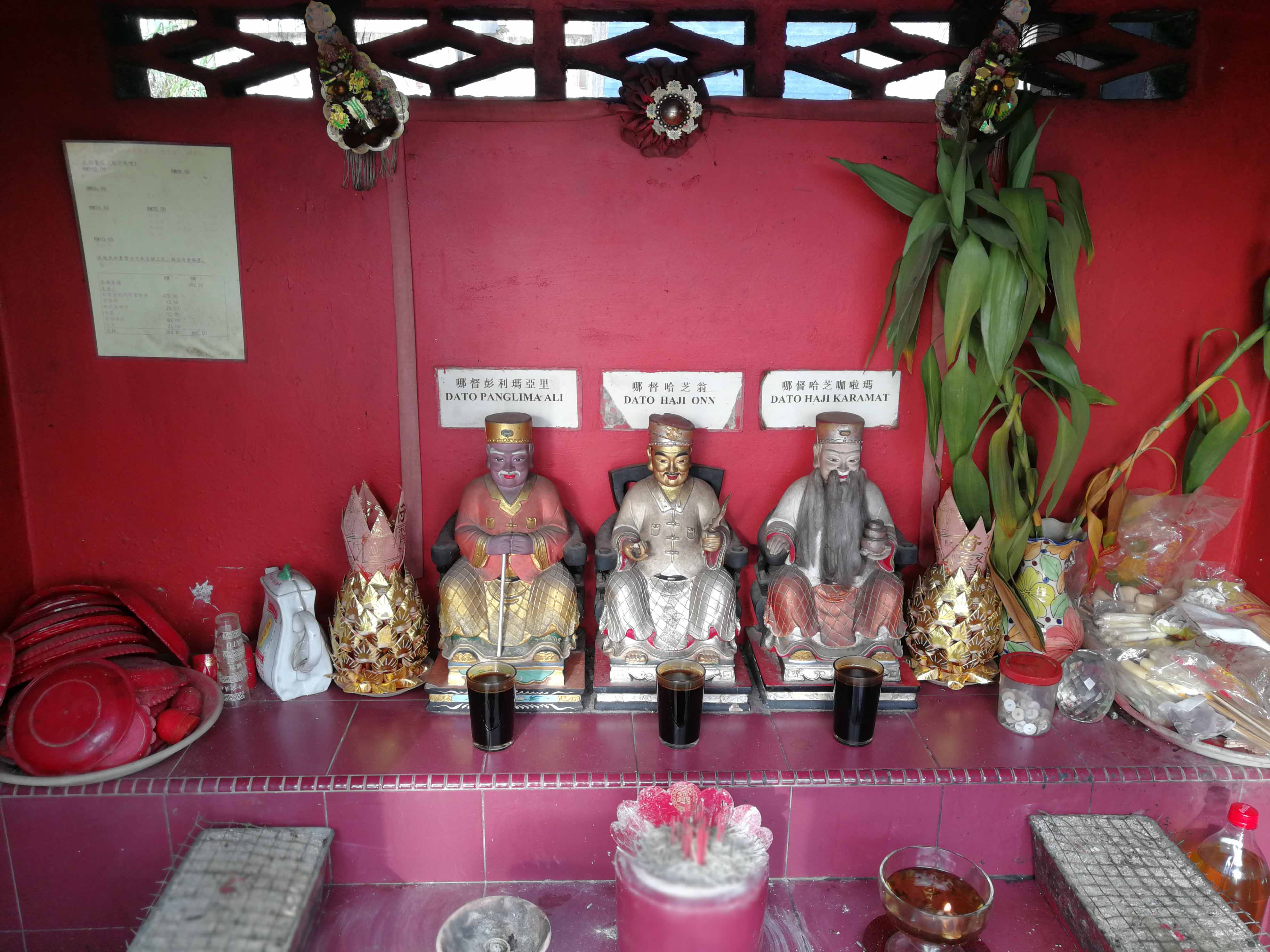
Wherever you go in Malaysia, be it countryside, villages, cities, or golf course, you will often encounter little red shrines on the side of the road, or at the entrance of houses or temples, or at the boundaries of a land plot. Sometimes these shrines are empty with only some inscriptions that, of course, unless you are fluent in Chinese, you will not understand. However, even if the shrine is empty of any statue, offerings are still present, which are witness of a cult to some kind of deity or spirit. Fortunately for the layman, mostly if he is not Chinese, a statue will be present and…surprise! It is clearly a Malay figure. So who is he? How comes a Malay is present and worshipped in a Chinese shrine?
It seems this is a direct legacy of early animism that infused Malay and Chinese religions. Called Dato’, or Datuk, in Malay, often associated with the word keramat, it represents a spirit of the place. Dato’ means ‘grandfather’ in Malay and the earliest presence of this word dates back to Srivijayan times. What does keramat mean? It is related to the miracles accomplished by Muslim Sufi saints or more generally to “high places” (places of worship according to Mr Bellamy in the Selangor Journal, quoted by W. W. Skeats, “kramat may be roughly translated prophet or magician”).
Altogether, the Dato’ can be associated with either early pre-Muslim animism, to Sufi Islam, or to Chinese Taoism, some also relate it to Hindu-Buddhism.
When the first Hakka immigrants arrived in Malaya in the early 15th century, they paid respect to all the ‘earth spirits’ (tree, water spring, rock or hill – the penunggu of early Malay culture) that were worshipped by the locals. This was not far different from the practice of Taoism which, linked to nature, worships its different spirits (the shen). The Dato’ Keramat, either legendary figures once human, or prominent persons, such as famous silat warriors, pious Muslims, or even shamans (bomoh), later become deities. This was very similar to the Taoist practice by which a famous figure may become a shen and worshipped as such (for example Guan Di –general of the Three Kingdoms–, or much later Sin Sze Ya).
Therefore, it was not difficult for the Chinese immigrants to adopt local practices which led to worshipping a Malay-Muslim figure in a typical Chinese shrine.
While the Dato’ Kong (Na To Kong or La To Kong in Chinese), which means ‘great Grandfather’, is generally associated with trees, or more generally is considered the protector of the place where it stands, the tradition of Dato’ Keramat, often also called Datuk Panglima, lists nine of them:
Associating colours with the deities is a legacy of Hinduism, while the Tiger attribute may refer to Shiva; colours could also refer to the five elements and directions in Chinese belief: white=metal/west, red=fire/south, yellow=earth/centre, green=wood/east, black=water/north.
Apart from these, there are numerous Datuk. Some consider that there are 108 Datuk, identifying them with the 108 Ruesi of Hindu-Buddhism, characters who are gifted with spiritual and magical powers (Buddha, as well as Shiva, are considered Ruesi).
At the KDE Golf club in Ampang, there is a Datuk Panglima Hussein shrine. This shrine may be related to Nakhoda Hussin, quoted by W. W. Skeat in Malay Magic as a jin presiding over water, rain, and streams, who has a kramat, or holy place, in Bukit Nyalas (Johor). This would be consistent with the fact that a stream runs across the premises of the club.
Dato’ Kong shrines are generally situated outside buildings, be it a temple or a house. In some cases, it may be placed inside a tower, but often at the entrance of the car park, as is the case with Integra Tower in KL (is this because fortune flows in at the toll barrier?). When the statue of the Dato’ Kong is present in the shrine, which is the most frequent situation, it cannot be mistaken for any other deity, as it has all the attributes of a Malay: he usually wears a songkok or a haji white hat, sometimes a tengkolok, and often holds a keris. This Malay attire does not exclude holding a Chinese gold ingot, to bring the appropriate wealth to the worshippers, or showing the long ears of Buddha as a symbol of wisdom.
In Penang and along the coast of Perak, there are female Datuk, called Nenek.
Offerings may vary (betel leaves, bananas, eggs, chicken…cigars and coffee are much appreciated by Datuk Panglima Harimau), but, of course, pork and alcohol are strictly forbidden!