Jane Chan shares her views on the river cruise that marked the start of the Museum Volunteers’ visit to Kuala Terengganu (19 Apr 2016)
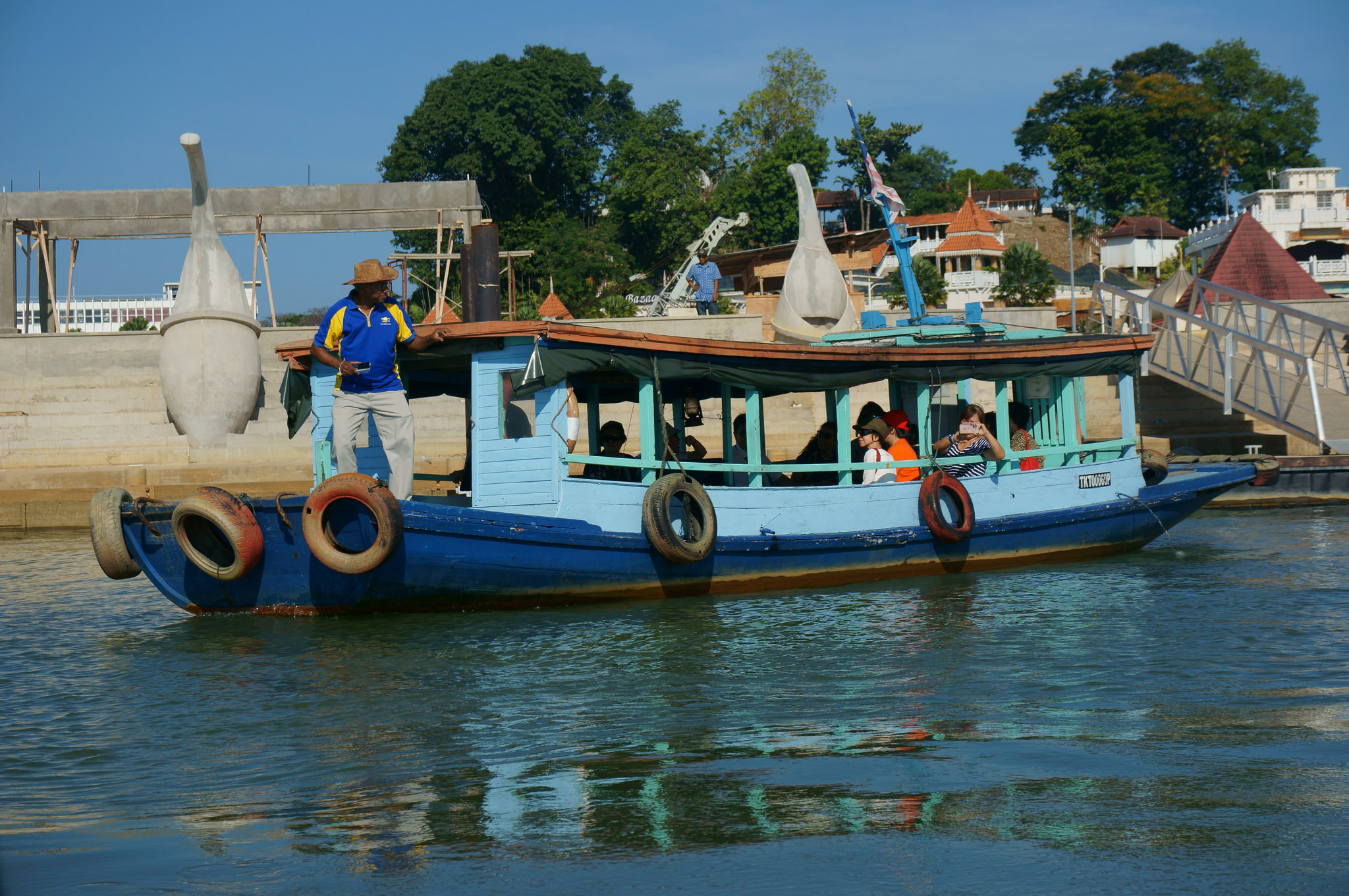
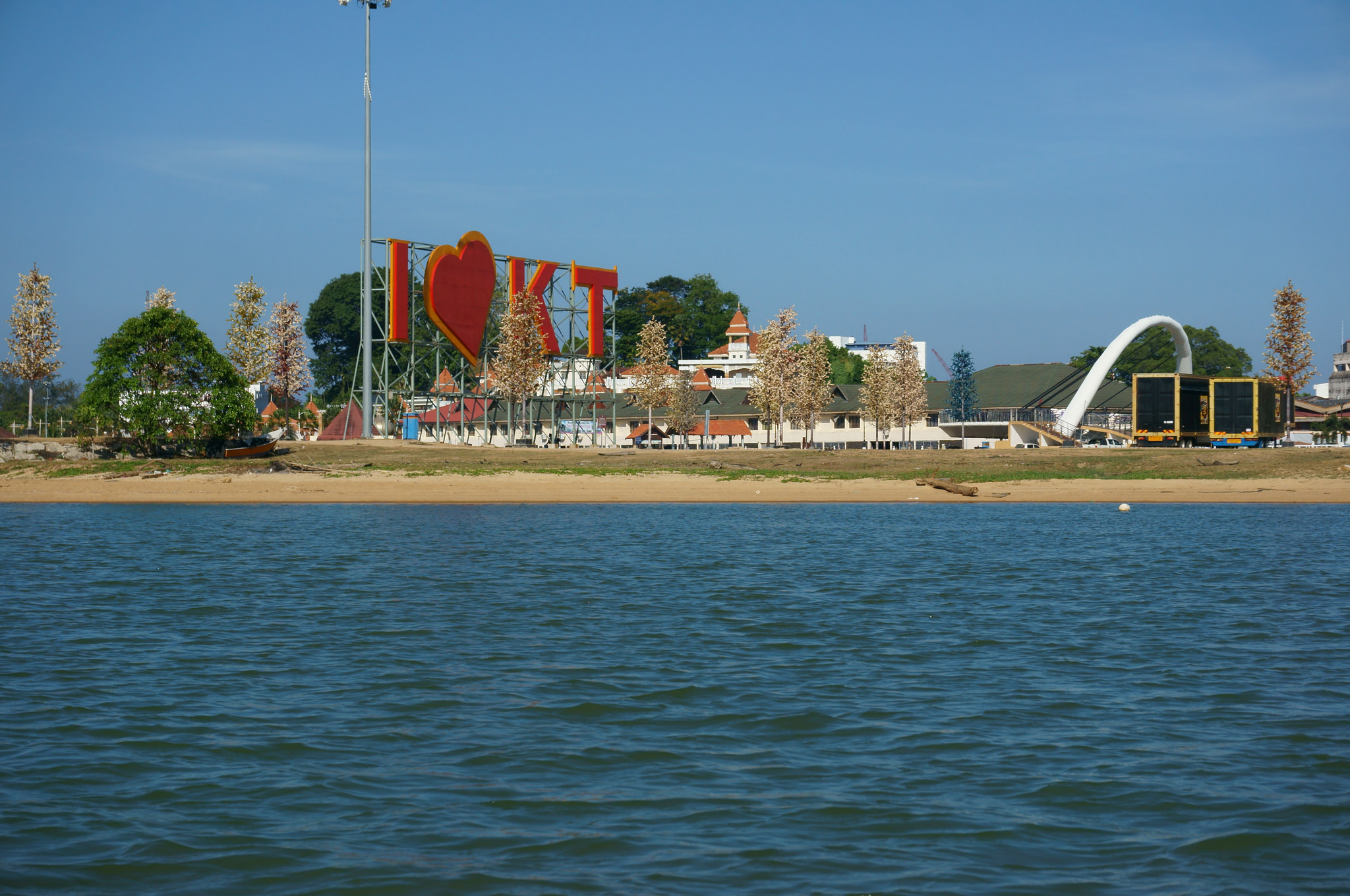
It was hot and sunny when we started the cruise in two fishermen taxis from near Duyong Island (Pulau Duyong). We separated ourselves into two groups, each occupying a taxi boat with a distance of 50m between us so that we will have a calmer sail. As we travelled inland towards the Terengganu State Museum and Islamic Civilization Miniature Centre, we could feel the soft breeze kissing our cheeks giving a cooling effect.
The white constructions in the background resembles the seagulls on the head of a boat aiming to fish
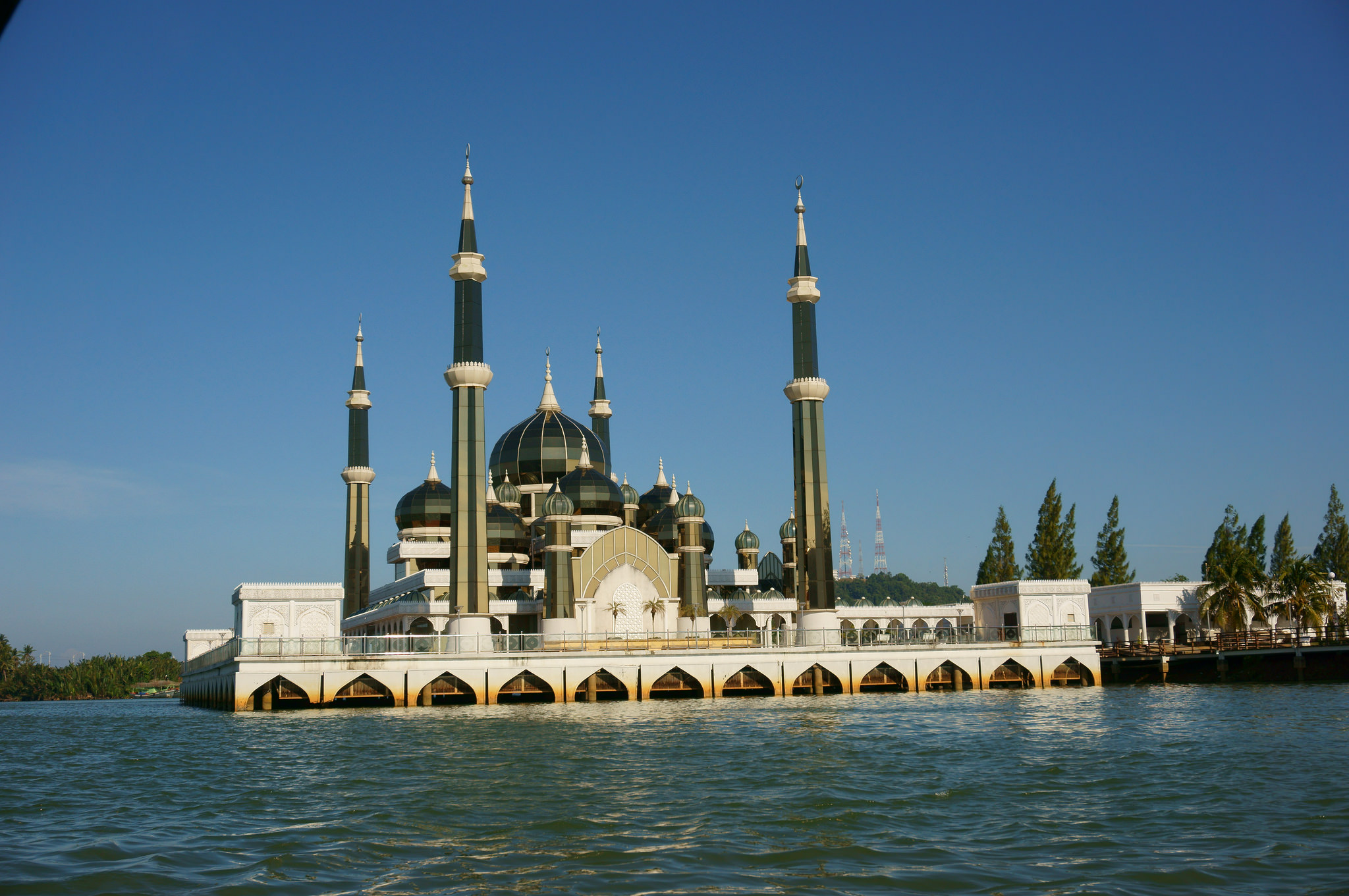
Our local guide was in the same taxi as Elizabeth, Cze Yan, Julie, Mariea, Wai Mun, Yeow, myself, together with few others that left the jetty ahead of the President, Jega, and the rest. Without noticing that we were actually by the open museum marine exposition site, we who sat at the engine corner just concentrated ahead of us towards the Islamic Civilization Centre and Crystal Floating Mosque. It was only on the following day that we realized that we were at the riverbank adjacent to the museum. We also learned that the reason the Crystal Mosque was constructed as such was because the architect wanted to reflect the people of Terengganu living on tilted houses along the river bank.
The beautiful Crystal Mosque
The view of the riverbank is magnificent under the bright sun beam; despite the intense heat with two dry months, the river is not muddy. The money spent to reclaim and beautify the once fishermens’ shoreline is worth more than my words.
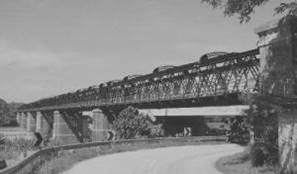
The bridge that links Duyong Island to the mainland
The Museum Volunteers organised a study trip to Kuala Terengganu between 19 – 22 Apr 2016. Chen Poh Leng has the story for Day 2 (20 Apr).
Day 2 of our visit started with a hearty buffet breakfast at the hotel that included delicious local fare such as nasi dagang (rice) with gulai ikan tongkol (fish in gravy), pulut kelapa (coconut covered glutinous rice balls) with salted fish and cucur ikan bilis (fried dough with anchovies). With much stored energy, we headed off to the Terengganu State Museum, the highlight of our trip.
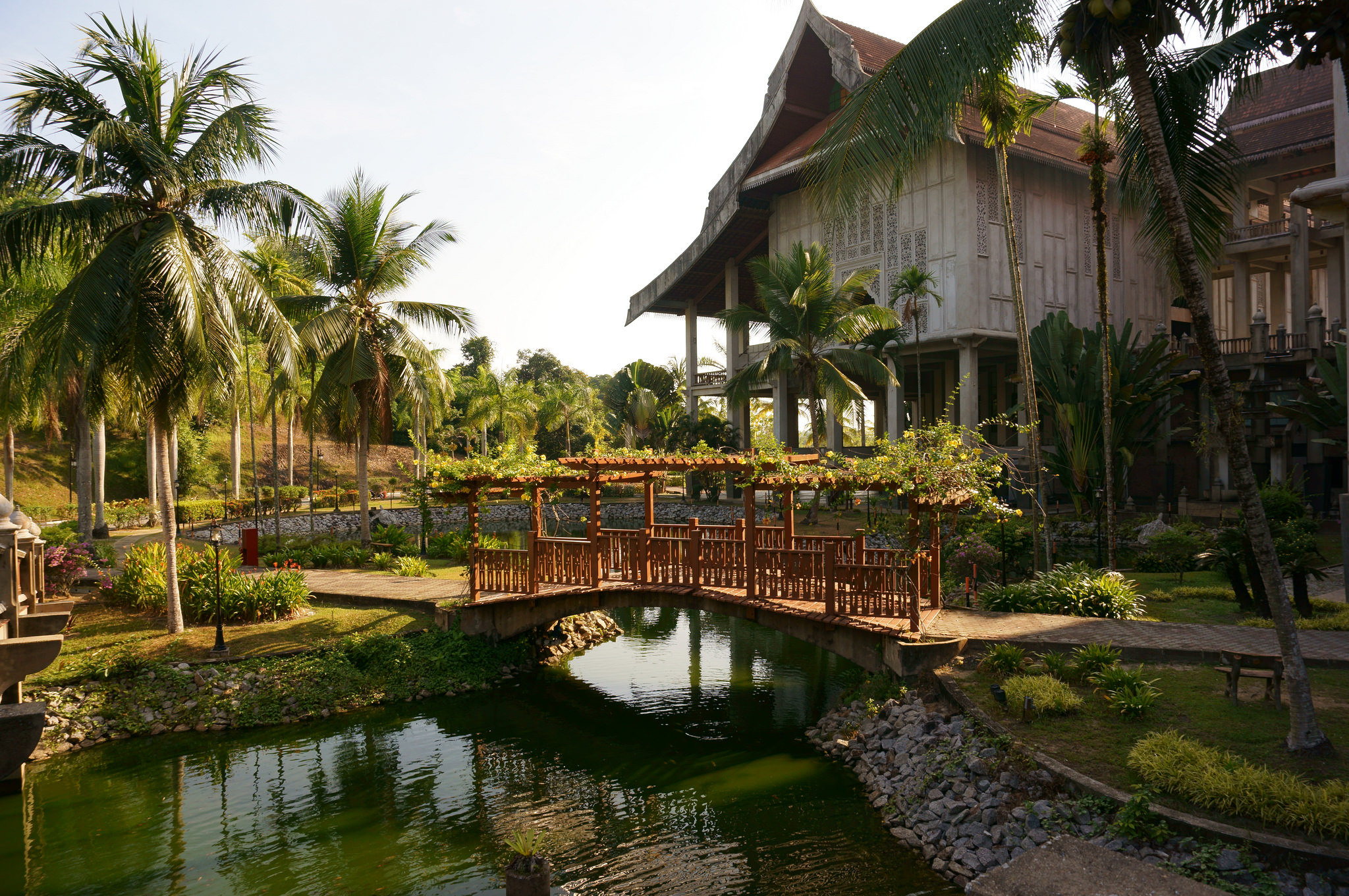
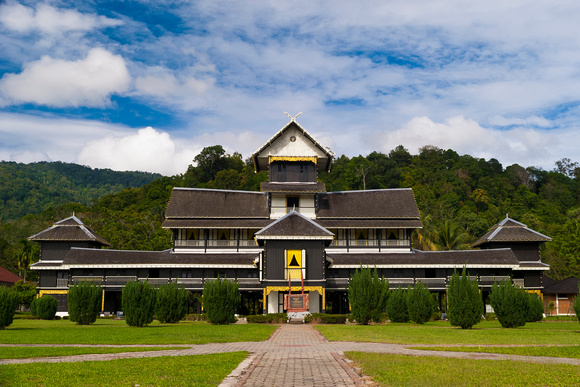
Muzium Negeri Terengganu
We were all awed by the main museum building’s beautiful architecture and the very first thing we did was to take a group photo with this beauty. The architect, Raja Dato’ Kamarul Baharin Shah, incorporated Terengganu’s old palace design into this creation. The museum complex spans over a land area of 27 hectares and consists of a main museum, a fisheries museum, a maritime museum, four traditional houses with herbs and botanic gardens. The grounds of the museum is so beautiful we were told that wedding photography is a common occurrence there. There are a total of 9 galleries covering textiles, royal, Islamic, craft, petroleum, natural history, seafaring and trade and finally, fisheries and marine park.
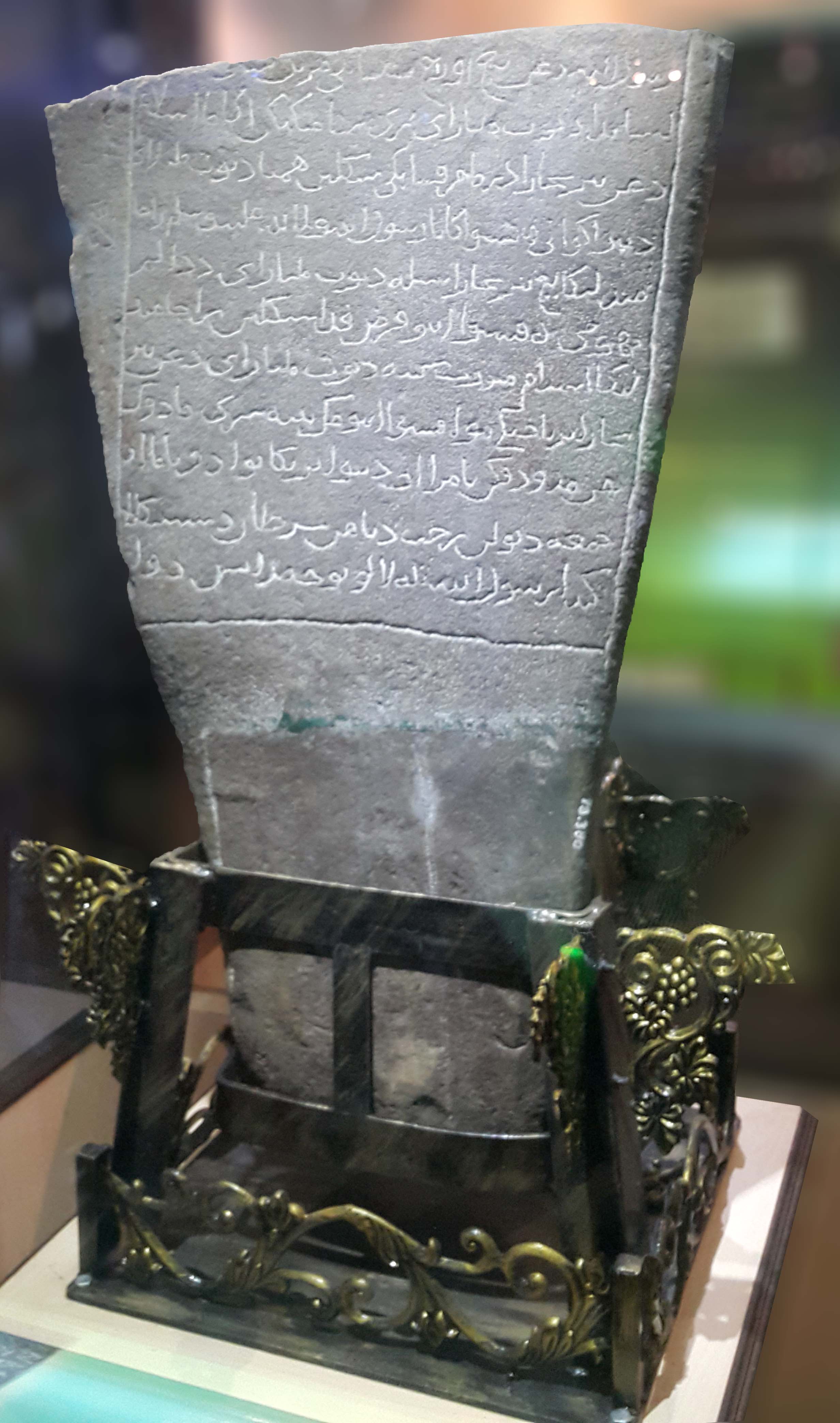
Batu Bersurat Terengganu
We were privileged to be warmly welcomed and guided by the director of the museum, Tuan Haji Mohd Yusof bin Abdullah. He told us that the concept of the architecture was based on the local dwelling concept where houses could easily be extended and connected with corridors as families grew. The houses could just as easily be dismantled. He shared with us that the main purpose of building the state museum had to do with the inscribed stone Batu Bersurat first discovered in 1887 in Terengganu. This is the most famous artefact of the state. It has the Malay language inscribed using Jawi script on dolomite stone. He highlighted that one of the main reasons of the ease of the spreading of Islam in the Malay Archipelago was the writing of the Malay language in Jawi script. According to him, the Malay language had additional 5 Jawi ‘symbols’ or characters compared with the Arabic language.
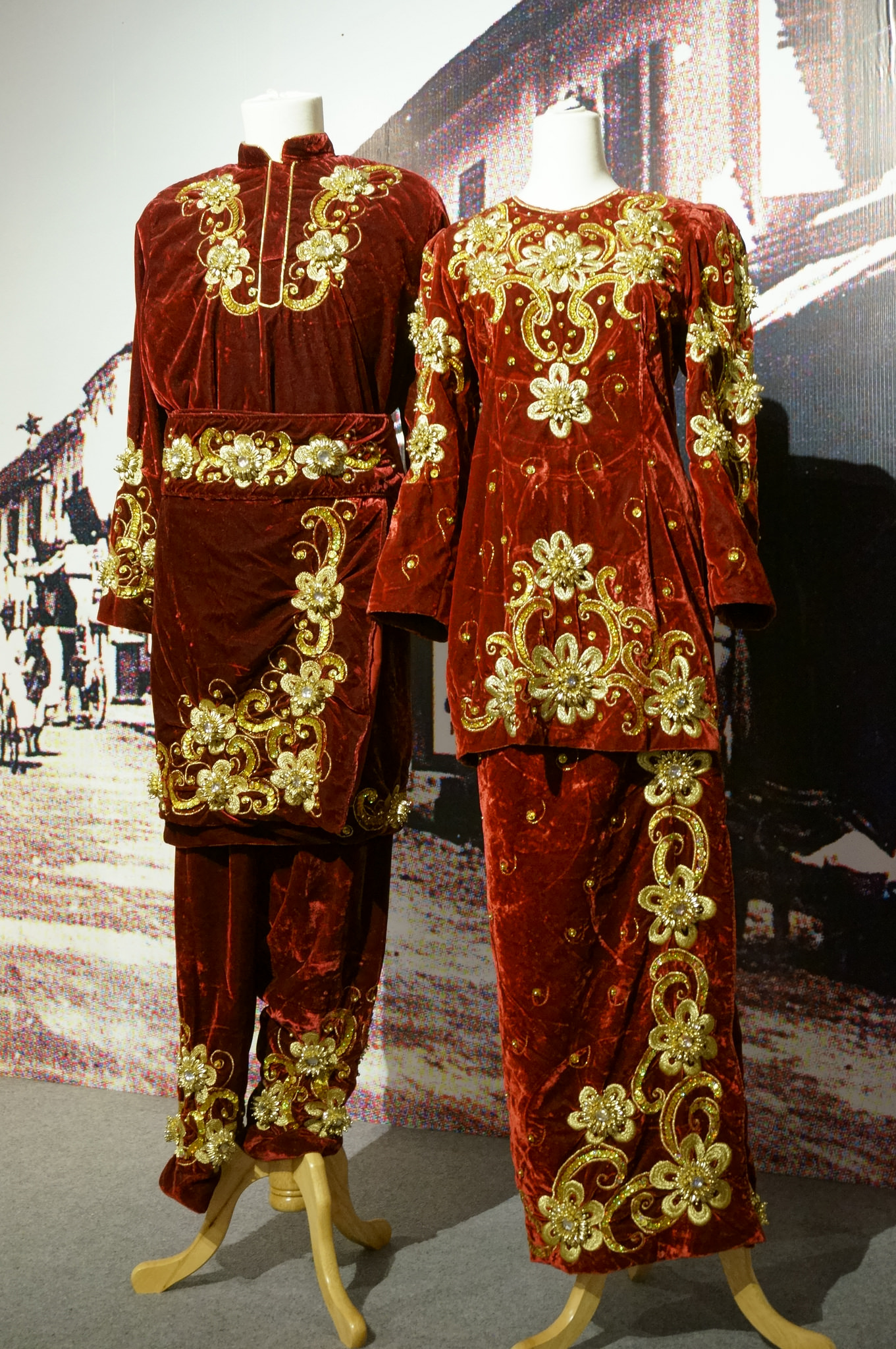
As we moved into the craft gallery, we learned:
the use of natural dye in the making of batik material
Malay traditional cloth weaving, although with a weaving machine, was labour intensive
the use of brass ware in everyday life was common while that of silver ware was less common
In the maritime museum, we climbed into an actual cargo boat on display and were introduced to some sea faring facts within the south east Asian region. We were also introduced to various types and characteristics of different types of perahu (boats), the most famous being perahu payang. We were told that the boat building skill was special in that no plans were drawn. It was all ‘within the head’ passed down from one generation to another.
Walking the museum grounds
As we moved along the grounds we could see many different fertile flora around us. We were introduced to various fruits trees and herbal plants by Tuan Haji Mohd Yusof who shared the benefits of consuming them. He had special interest in this subject and thought preserving these plants would complement the museum complex’s grounds while being environment friendly. Fruit trees we saw included the belimbing, the tropical fig as well as tropical olive trees.
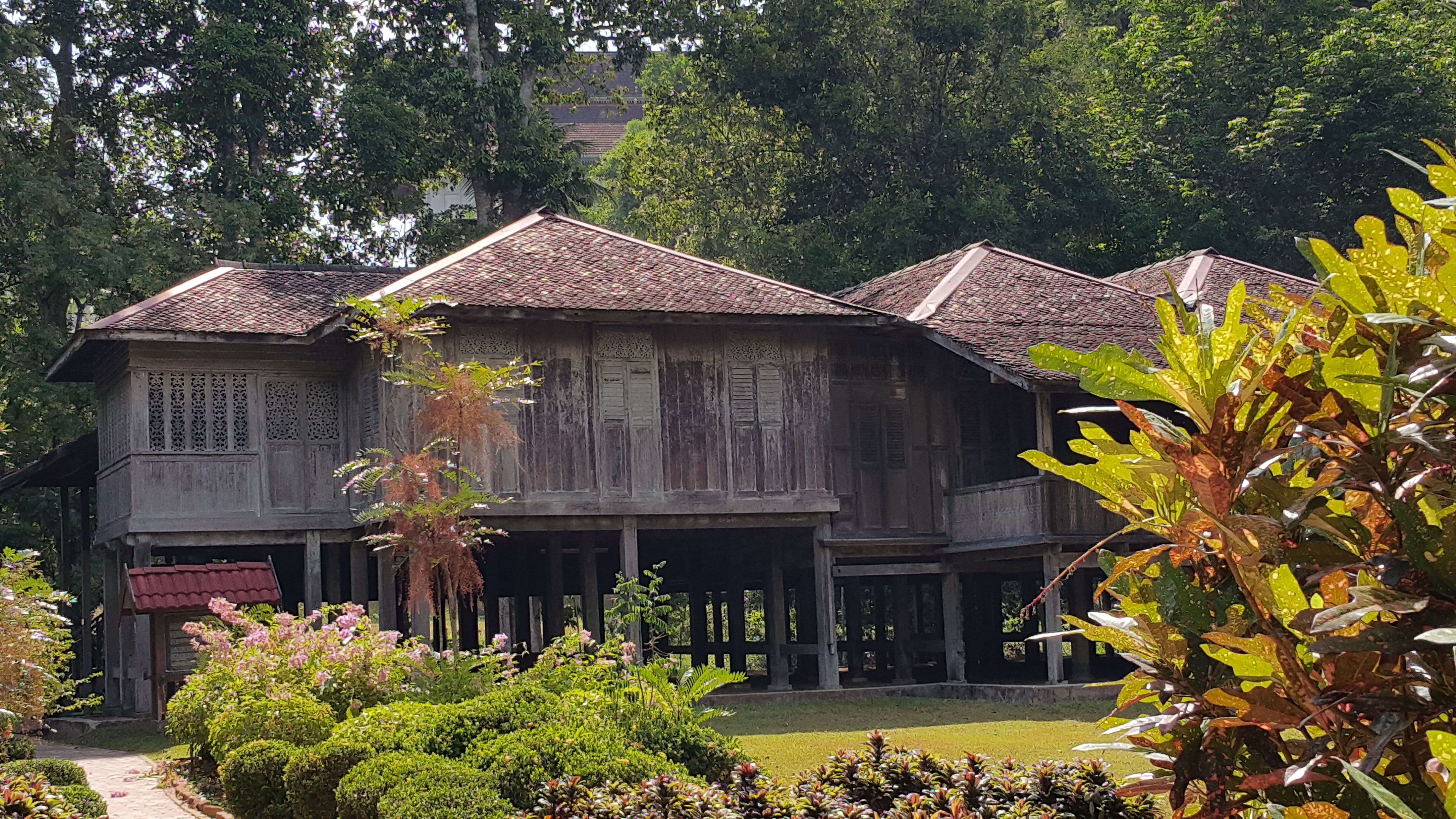
Istana Tengku Long. This traditional house was relocated to the museum’s grounds from its original location at Sungai Besut.
The museum excursion took up the whole morning and by the time we finished, it was time to refill our tummies. The authentic Peranakan lunch we had at On The Way Kopitiam, located in Chinatown, was most enjoyable. Everyone was delighted with the delicious local Peranakan fare. Dishes included, laksa, laksam, rojak as well as lekor (fish cake) served in 2 versions; steamed and fried. The satisfying meal was finished off with a bowl of ice kacang desert which helped cool down our bodies.
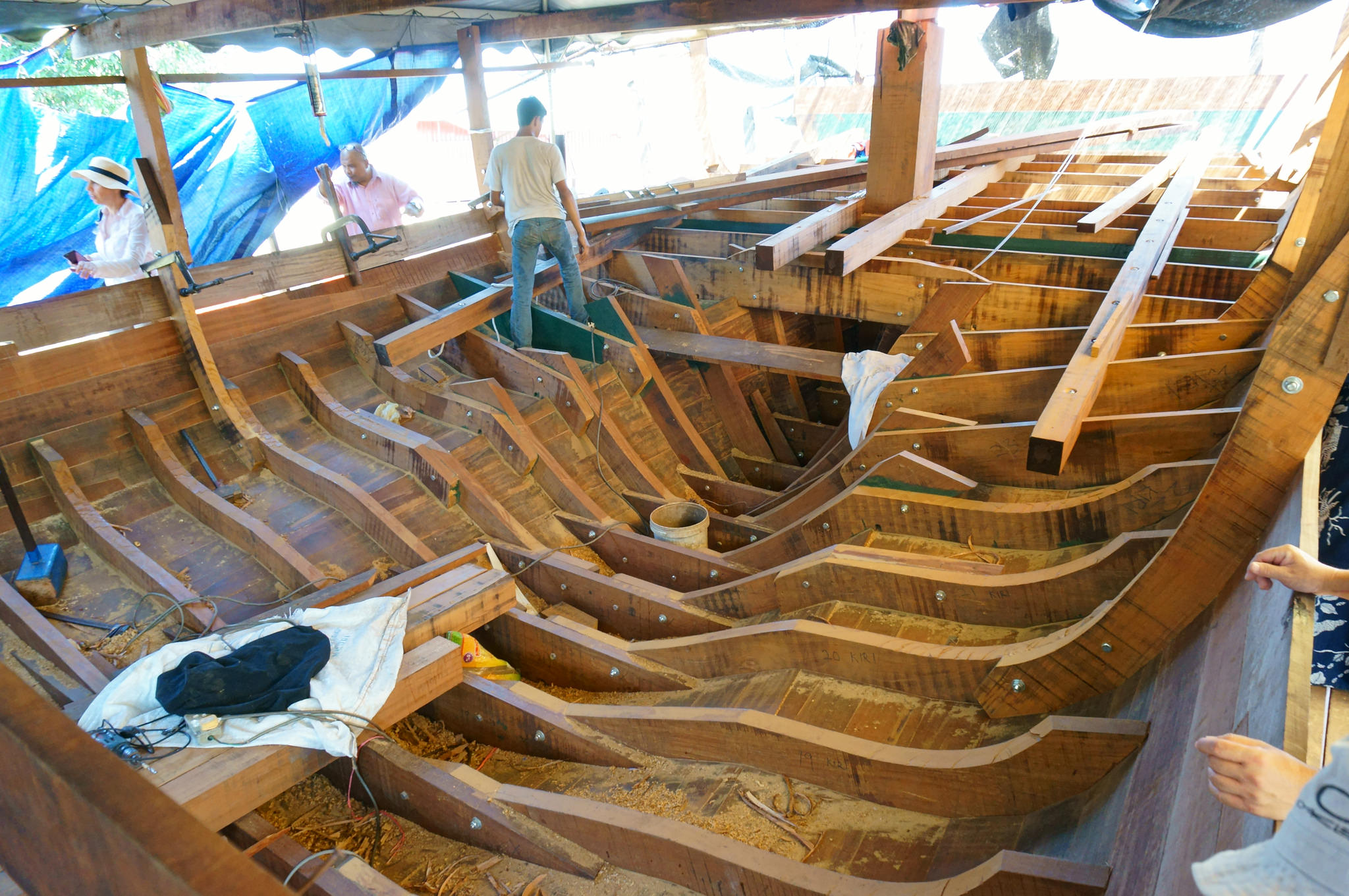
Following lunch, we were led to Pulau Duyung by the museum staff to witness the building of a wooden perahu (boat) the traditional way. The type of wood used was the cengal which is a type of hardwood. The wood type is also used to build Malay houses. The cengal, just like teak wood, is able to withstand harsh weather and does not attract insects. The visit ended with warm appreciation and goodbye wishes extended to the hospitable museum staff from the MV group.
At Pulau Duyung – a boat in the process of being built
Our next stop was that of Masjid Tengku Tengah Zaharah, the floating mosque. It was built by the late Sultan Mahmud Al-Muktafi Billah Shah, father of the current sultan of Terengganu in 1993 and opened in 1995. Named after the mother of the current Sultan, it was yet another beautiful mosque and a photo snapping spot for us.
Masjid Tengku Tengah ZaharahWeaving at Nor Arfa Craft Complex
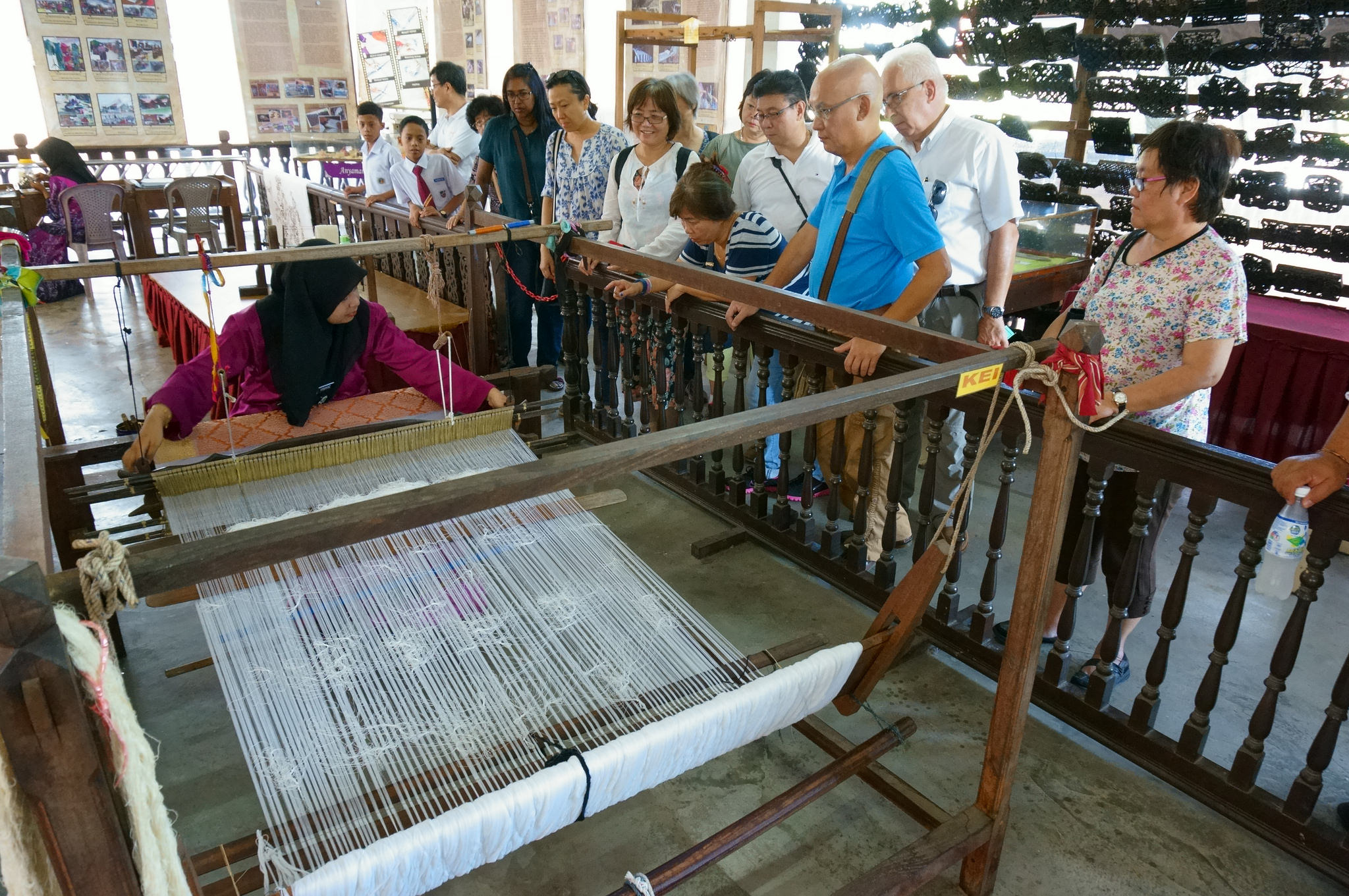
Next on our itinerary was the Nor Arfa Craft Complex where we witnessed 2 demonstrations relating to the cloth industry – the printing of batik as well as the weaving of the songket cloth. After this, our retail therapy commenced. Most of us ended the visit with items to bring home. The combined purchases entitled us to some complimentary items which were then given to the lucky ones resulting from a lucky draw following this visit.
Batik galore!
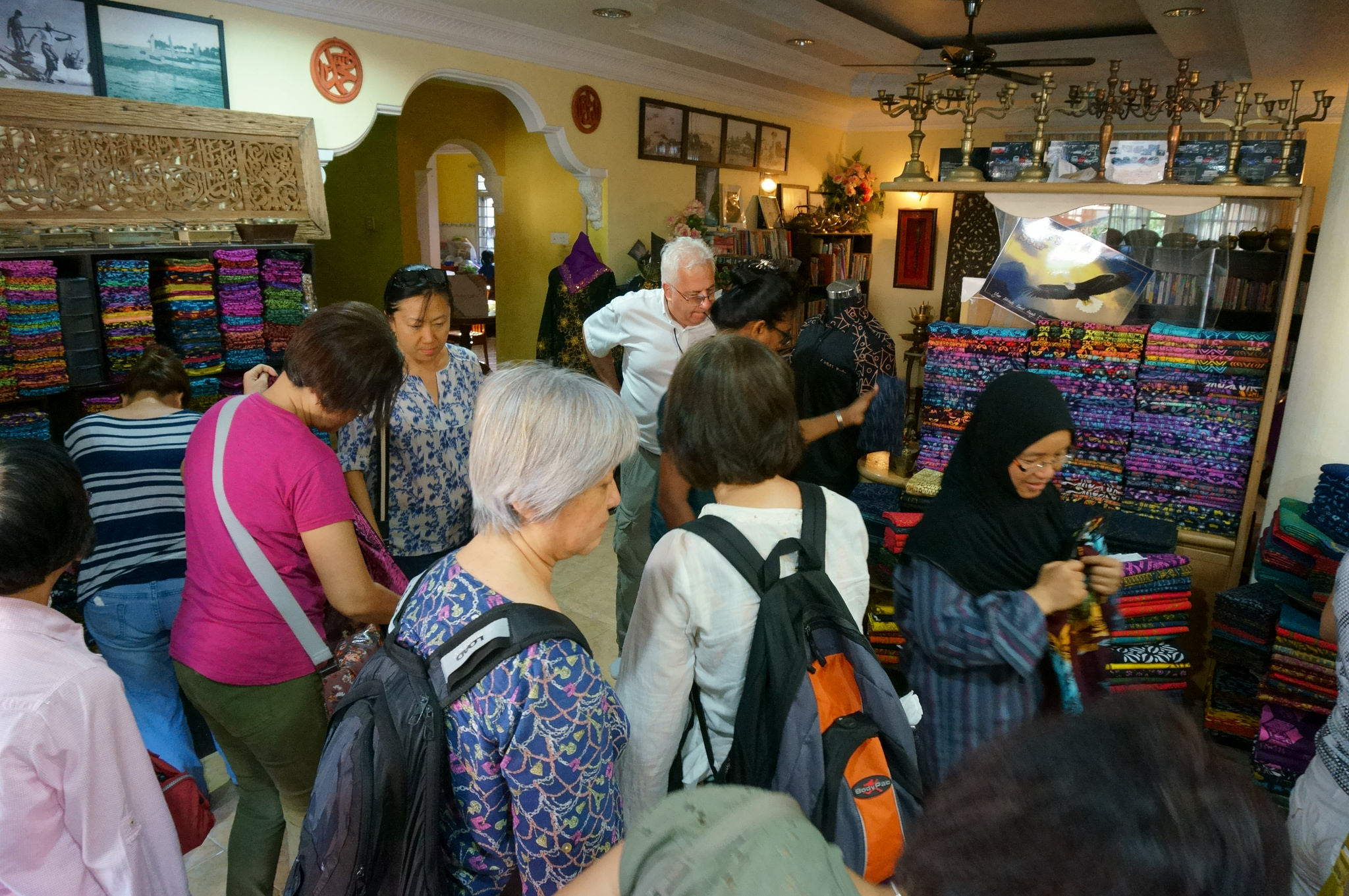
The last visit for the day was to a home family business. This is the home of a young family that is in the batik business. We were welcomed into more retail therapy. This time a warmer welcome as we were served local snacks and drinks. I was impressed with the young children helping out their parents in conducting business.
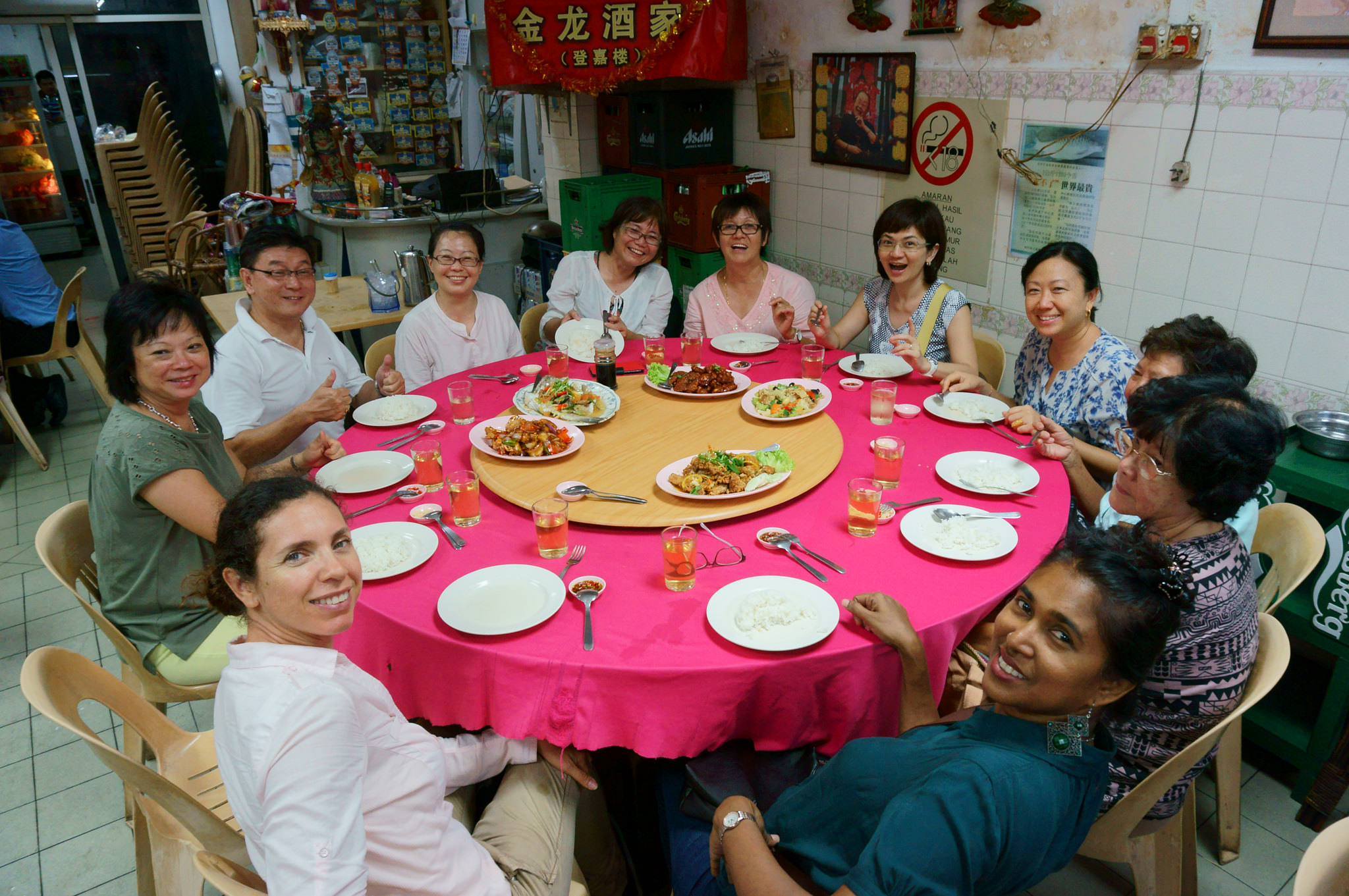
The day ended with yet another but final meal for the day. Our dinner was at the Golden Dragon Restaurant, also in Chinatown, before heading back to the hotel for much a needed shower and a good rest. While it was tiring, the day was indeed enjoyable. We were enriched knowledge wise, experience wise, vitamin D wise (due to the intense sun) but NOT wallet wise, thanks to retail therapy. At day end, we were a happy bunch for sure – a day well spent and money well spent.
The state of Negeri Sembilan lies south of Kuala Lumpur International Airport. Its original founders were ethnic Minangkabau émigrés from Sumatra who probably arrived during the heydays of the Melaka sultanate, which attracted Muslims from around the region to seek their fortune. Negeri Sembilan possibly refers to the people of nine townships of West Sumatra that settled the area. The present sultan and his family are all of Minang ancestry, their culture is matrilineal, and their palace is a grand version of the distinctive bull-horned Minangkabau Rumah Gadang house.
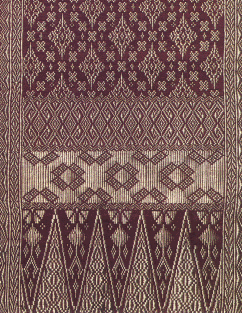
Songket (wikiwand.com)
The Minangkabau ethnic group occupies the province of West Sumatra, famed for its beautiful landscapes of lakes, tropical rainforests, and the Bukit Barisan mountain range. They speak Bahasa Minangkabau, which shares many common features with Malay. Most Minang are farmers; those living in the coastal areas work as fishermen. They are known for their handicrafts such as cane work, silverware, embroidery and most of all, woven traditional textiles, particularly songket cloth.
The Minangkabau embraced Islam early on; they were one of the first conversions in the archipelago, following Aceh. Islam is central to their culture, distinguishing their adat from that of other animist ethnic groups. However, following Islamic law, representations of human forms are not allowed and animals feature only in stylised form. Unlike other ancient cultures of Sumatra, the Minangkabau have been in contact with outside influences for centuries, widely assimilating from cultures with which they came into contact. Arabic, Indian and Chinese influences can be observed in their textiles and arts, particularly those of the coastal areas.
West Sumatra is divided into nagari (negeri or autonomous townships). Their culture is matrilineal, unusual especially within an Islamic community. Kinship and inheritance are passed down through the female line, giving the women of the Minangkabau a unique importance and great respect. The Minangkabau people are also distinguished by their arts and philosophy which are both expressive and dynamic, yet hold closely to their prevailing traditional values and the belief of ‘alam takambang jadi guru’ (nature is mankind’s best teacher), meaning that the natural world should guide their lives.
In a Minangkabau extended family, children belong to the maternal line. It is the responsibility of the mother’s brother to raise them. Throughout his married life, a husband maintains close contact with his own mother’s family, often leaving his work tools and other possessions at her home and helping out his own family in agricultural tasks. After marriage, he gradually moves his belongings to his wife’s home and increases the time spent there only when the marriage seems secure, i.e. after daughters are born. Divorce is common usually instigated by the woman if her husband fails to provide her with a daughter, without which the kinship line would be broken. Men tend to hold little property themselves because of complications arising in inheritance matters, especially after a divorce, when they can lose everything to their wife.
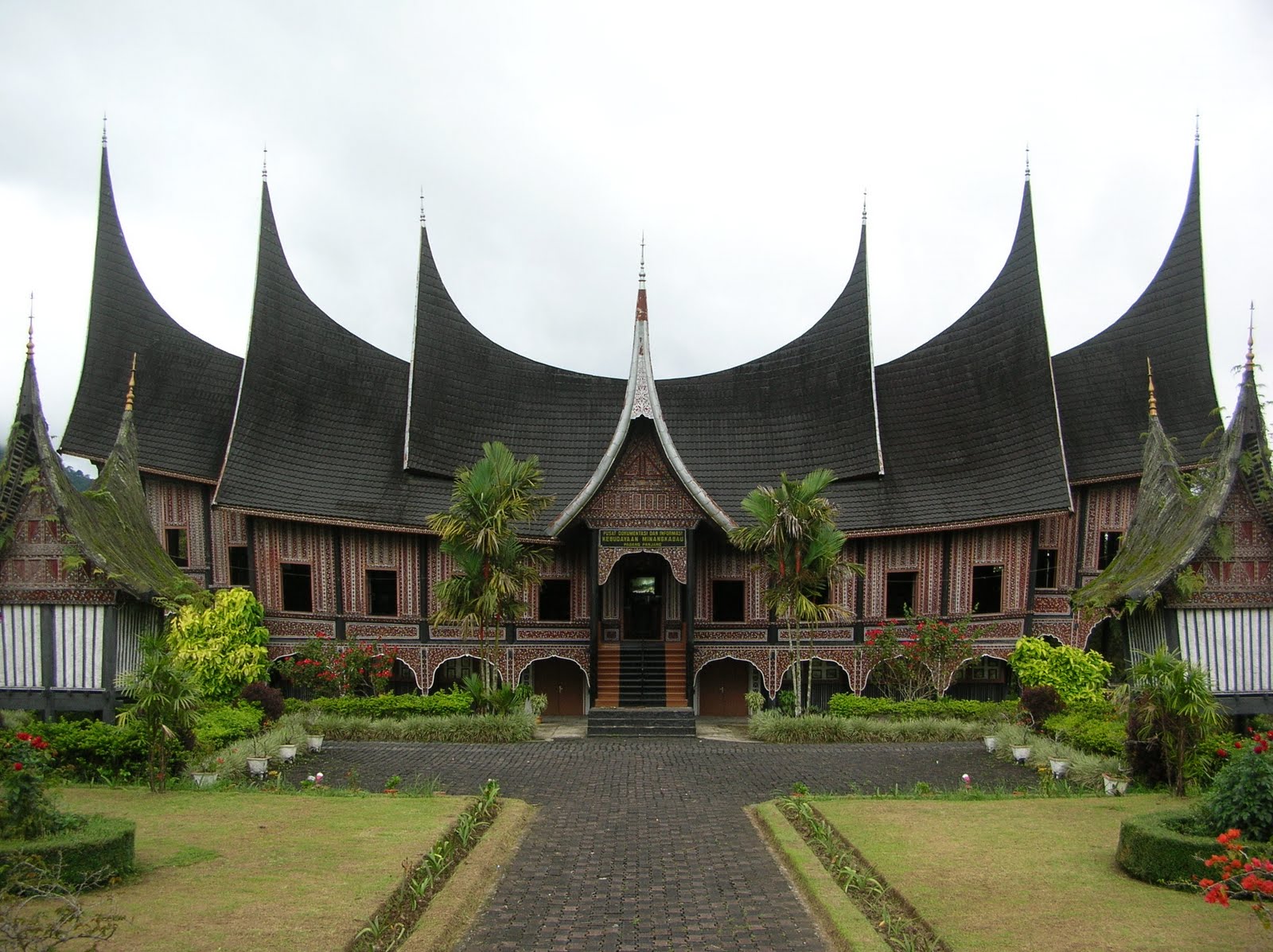
An example of a Rumah Gadang in Sumatra (photo sourced from pinterest.com)
The Rumah Gadang, or Big House, is a communal home shared by the extended matrilineal Minangkabau family. This type of house is often lyrically referred to as gajah menyusu anak (‘elephant suckling her offspring’), referring to the juxtaposition of the large house with its soaring upswept roof and the miniature rice barn nestled in its shade. The unusual roof shape is often compared to a mountain, perhaps reflecting the towering peaks of the surrounding Bukit Barisan range. The ornate wall panels are adorned with richly coloured stylised plant and animal motifs symbolising such qualities as bravery (buffalo), co-operation (duck), alertness (cat), good luck (cicak) taken from the domestic animals that feature in their daily lives, typical of the homespun folklore of the Minang people.
The buffalo horn gonjong decorative feature on the roof is a distinctive element of Minangkabau design, referencing the legend of their origin as well as demonstrating the importance of daughters. The gonjong is associated with women: the traditional female Minang headdress, the tengkuluk tanduk has a similar shape. This is particularly unusual because in most cultures the bullhorn has male connotations. The number of bullhorns on the roof of a Rumah Gadang indicates the number of married daughters belonging to the house.
West Sumatra is regarded as one of the most notable regions for the production of songket cloth; historically Koto Gadang, Payakumbuh and Bukittinggi in the highlands were at the centre of manufacture. The songket from Koto Gadang is considered to be the best quality in terms of technical skills, materials and the various and distinctive motifs that make them difficult to copy.
The uniqueness of songket lies in the supplementary weave of gold and silver thread and the complexity of its designs, rich in motifs of an affirmative and natural theme. Songket weaving is commonly done by women. Motifs on Minangkabau songket conform both to their philosophy of the natural world, and their folklore, steeped in traditional wisdom. The common sense of women is noticeable in the symbolism of their songket designs and in the wearing of the cloth. The male sisamping (Malay: samping), the short sarong, must be tied with a large hanging fold at the front, shaped like a tongue. This is a warning to men to guard what they say in public. One can almost hear the admonitory voice of a wife! Many Minangkabau songket motifs retain delightful meanings that have probably been lost elsewhere. The teluk berantai linked chain motif, known to the Minang as saluak berantai, signifies the strength of a community when its members cooperate and work together. Itiak pulang patang ‘ducks returning home at dusk’ reminds that wherever one travels in life, one always returns to one’s home or traditional values. The ubiquitous triangular pucuak rabuang, or young bamboo shoot, represents the usefulness of bamboo in all its stages just as members of the community should be ‘useful in youth and beneficial in old age’.
Songket patterns: (left to right) Itiak Pulang, Pucuak Rebuang, Saluak Berantai. Sketched by Daniel Gan
The Minang people have a great respect for learning, demonstrating an openness to external ideas and influences that is rare in traditional cultures. One interesting practice is the tradition of merantau, where young men are encouraged to leave their home villages and travel either to other islands, or even further afield. In modern times this has even extended to young women. This temporary exile exposed the young to fresh ideas and new skills, which on their return would benefit the community at large. The Minang are a dynamic culture, and although their population is small, they have made an exponentially large contribution to the archipelago. In Indonesia and Malaysia, many professionals, politicians and intellectuals were traditionally of Minang origin, particularly women of note. Minangkabau communities are to be found all over the archipelago, set up by those who travelled and settled elsewhere, hence the prevalence of Padang food (nasi padang, a speciality of the region) on many other islands. The famous dish beef rendang is arguably of West Sumatran origin although many Malaysians might disagree!
Sri Menanti (virtualmalaysia.com)
The Minangkabau people of Negeri Sembilan maintain a matrilineal customary system unique amongst Malay, called the adat perpatih, Although in Islamic law the husband of the matriarch would be the ultimate authority, amongst the Minangkabau he is considered orang semanda (an outsider). The authority of the family stays firmly with the maternal side, although the husband would support and assist in decision-making. This might appear to be unworkable arrangement but amongst Minangkabaus it becomes a courteous social collaboration that encourages cooperation and discussion between the two families.
In Negeri Sembilan and other parts of Malaysia, one can still see examples of the gonjong or bullhorn finials on upswept roofs in the Minang house style both on private houses and public buildings. A stylised version, known as ‘silang gunting’ or crossed scissors, is more common as can be seen on the gable ends of Sri Menanti, the old palace of the sultans of Negeri Sembilan.
Bunga Suntiang (pinterest.com)
Although songket of fine quality is produced in Malaysia, it is still customary for Malays of Minangkabau descent to source their cloth from the Bukittinggi region, especially for weddings. The Chinese-inspired Minangkabau wedding headdress, bunga suntiang has also become popular for brides.
The matrilineal Minangkabau have made a distinctive mark on Peninsular Malaysia, not the least in the example of female empowerment within a Muslim community. Their dynamic influence has enriched Malay culture until today it has become an integral part of the Malaysian identity.
When European colonists reached the part of the Malay Archipelago consisting of the Malay Peninsula and the island of Singapore, they found that only 2 of the spices that they sought would grow well in this region. These were pepper and gambier, which were then cultivated and became lucrative crops.
PEPPER (Lada)
Pepper known as the “King of Spices”, is one of the oldest and most popular spices in the world. Indigenous to Malabar, West Coast of India, it was already traded during the Roman and Greek period. It was the search for pepper that led early sailors eastward, which influenced the history of Asia Pacific.
The name pepper comes from the Sanskrit word pippali, meaning berry; it is called “lada” in Bahasa Malaysia. Pepper is used to cure meats, as a preservative and to flavour food. It has medicinal uses in Chinese, Indian and certain other communities. In medieval Europe, pepper was worth its weight in gold and often used as currency for rent, dowry and taxes. Indians brought pepper to Java; it then gradually spread throughout the archipelago.
Pepper vines grows best near the equator in moist, hot climate with evenly distributed rainfall of about 100 inches. It requires fertile, flat or gently sloping land, rich in humus with good drainage and light shade. The pepper plant is a perennial woody vine growing up to about 4 metres in height on support poles, trees or trellises. The pepper plant is propagated by cuttings. It starts fruiting at between 3 to 5 years and will continue to do so every 3rd year for up to 40 years. It fruits looks like slim long cluster of berries and harvest is done by hand.
Pepper fruits known as peppercorns are processed to be available in various forms. The 3 most popular being Black Pepper, White Pepper and Green Pepper.
Black pepper (Lada Hitam) is produced from green, unripe drupes (fruit with stone) which are scaled to release its enzymes. The drupes are dried on mats and raked several times a day for a week, until they are wrinkled and black.
White pepper (Lada Puteh) is processed from ripe peppercorns. The red and orange berries are packed in sacks and soaked for a week under slow running water. This rots the outer husks which is then removed by rubbing. The dried husked berries are white peppercorn.
Green pepper (Lada Hijau) is occasionally available fresh, still on its long stem. Green peppercorns are available pickled in brine or vinegar, or freeze dried.
Today Malaysia is one of the largest producer of pepper in the world together with Vietnam, Indonesia, India and Brazil. The main pepper producing area is in the State of Sarawak which accounts for 95% of the total production in Malaysian. Other pepper producing states are Johor and Sabah.
GAMBIER
Gambier is native to the Malay Archipelago and was traded in the 17th century. Interestingly, both pepper and gambier share a symbiotic relationship; they are often grown together and are seen entwined. Gambier leaves compost act as fertiliser for the pepper plants and offers protection for its roots.
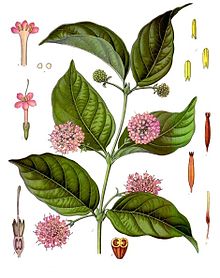
Uncaria gambier. Photo taken from Wikipedia
Gambier is also known Catechu (India), Er Cha or Gou Teng (China) or Cat’s Claw. It is from the Rubiaceae family and the native variety is the Uncaria gambier. Gambier shrubs are climbers of slender woody vines. They grow as bushes up to about 2.5 metres. Gambier is prepared by boiling the young leaves and pressing them to extract its juice. The concentrated juice is dried into a semi solid paste and moulded into cubes, which are then dried in the sun.
In medicine, Gambier has anti-inflammatory and sedative properties. It dilates blood vessels and lowers blood pressure. In Traditional Chinese Medicine (TCM), gambier is used to treat hypertension, dizziness and anxiety. It is also effective to calm wind; to relieve convulsions; calm the liver; and remove (or clear away) heat. Excess consumption can cause diarrhoea, kidney damage, swollen feet and nausea. It is not recommended for long term use.
Gambier is most commonly used today as a condiment in betel nut chewing, tanning of hides and in dyeing where it yields the colour ‘khaki’.
Gambier was first grown in Johor in the late 1840s and exported to China and Europe. The plantations were highly profitable and successful, providing employment to many locals and immigrants. However with the advent of the automobile industry, rubber replaced gambier as the most important cash crop by the turn of the 20th century.
Marie Tseng and Janet Tee reminisce on forming the Museum Volunteers group 10 years ago.
From the first meeting I had in September 2006 with Janet Tee, then Deputy Director of Muzium Negara, we both knew that this was going to be the start of an amazing journey in the field of volunteerism with Muzium Negara, Kuala Lumpur. Malaysia was one of the few countries in South East Asia at that time that did not have a group of museum volunteers; similar groups had already existed for more than 30 years in neighbouring countries, such as Indonesia, Singapore and Thailand. They are also, of course, common throughout Europe and America.
Launching of the Museum Volunteers with the first batch of volunteers
Janet and I wanted to initiate a docent programme at Muzium Negara. By October 2006, we had brought together 10 museum enthusiasts and we forwarded a proposal to the late Dato’ Dr Adi, at that time Director-General of the Department of Museums, Malaysia. We obtained his approval to go ahead with the training programme to prepare volunteers to guide at Muzium Negara. We were very lucky to gain the interest of a group of illustrious people – soon to be known as Batch One – the pioneers of Museum Volunteers.
With the support of the Director-General, the Deputy Director and curators of Muzium Negara, we set up a pro-tem committee to design a three-month training programme. We approached Malaysian scholars, journalists and curators as well as persons active in the preservation of Malaysian heritage to support us and volunteer their time to familiarise the volunteers in the history and culture of Malaysia. The Indonesian Heritage Society and the Friends of the Museum in Singapore were also a great help in sharing with us their experience and expertise.
While training as volunteer guides, we had also to organise and promote our group. We prepared a communications plan, designed a logo and organised a ceremony for our first graduation. By March 2007 we were ready to announce the launch of the Museum Volunteer Programme.
We chose to call ourselves ‘volunteers’ rather than ‘friends’ as we wanted to make it clear to people joining our group that this was about contributing to the activities of the museum and not simply learning by attending interesting lectures. The most important aspect was in giving back and sharing the knowledge that we had acquired by leading guided tours; involvement in school programmes; or undertaking marketing and promotion activities.
From the inception of our project, we met many sceptics who told us that Malaysians do not have a culture of volunteerism. Yet following our first article in The Star newspaper, we received over 100 phone calls from people expressing interest in our project- proving the doubters wrong! In September 2007, we had sufficient numbers to run two training programmes, including a weekend course for working people. The rest is history: since 2007 we have trained over 300 guides. Today, the Museum Volunteers provide guided tours in English from Mondays to Saturdays; in French and Japanese on Tuesdays and Thursdays; and in Malay and Mandarin during Malaysian school holidays. We are also actively involved in school and outreach programmes with the museums.
Volunteers participating in the Raub Heritage Camp activities. Forty-six participants, aged 13 to 17, learned the importance of heritage in this Museum Volunteers programme led by Aurelie Bosc
Success of Museum Volunteer group!
Museums are the keepers of history and identity. For Malaysians, Museum Volunteers (MV) is a unique way to share the history and story of their country; for foreigners, it is an excellent route to understanding our host country and to connecting with Malaysian people and culture.
Voluntary work can sometimes be thankless, but as a Museum Volunteer the reward is intrinsic: the more you give and share, the more you learn and receive! It provides the perfect opportunity to meet, share and exchange with people of similar interests, no matter where they come from. As a foreigner, it as been an amazing opportunity to learn more about a country I now call home, and to make new friends and acquaintances.
We selected the tepak sirih as our logo. The tepak sirih symbolises hospitality and, with this, we welcome visitors to the museum
From Batch One, we would like to acknowledge in particular: Sabrinah Morad, for connecting MV with eminent speakers and scholars, Angela Naylor for organising and running the training sessions; Zahara Shariman and Aurelie Bosc for setting up the school programmes; Wong Siaw Ming and Sylvie Gradeler for organising the first ‘Regards Croisés’ that would later become the ‘Focus’ sessions; and Catherine Bossis for managing our first media communication campaign. It is through their tireless effort and commitment that MV is what it is today. Syabas to all those involved!
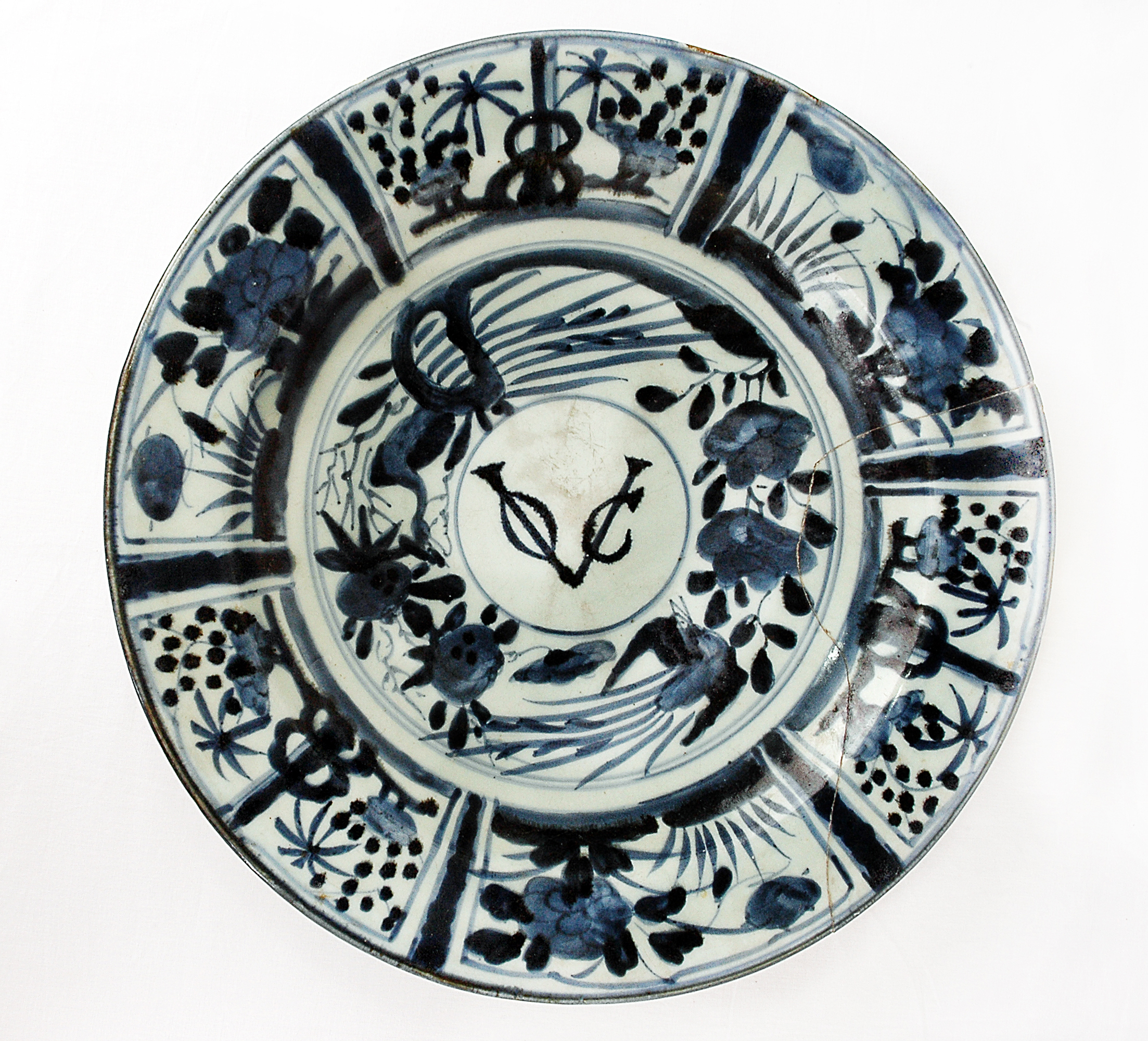
I have to admit I didn’t have the faintest image of Malaysia when my husband asked me whether I would consider moving our family there. Still, I like a new challenge and when the company my husband works for gave us a choice between Singapore and Kuala Lumpur, my vote was for Kuala Lumpur – because it sounded more exotic, more foreign, more unknown. And it is. There’s nothing here to remind you of Holland… or so I thought, until I came to Muzium Negara. On my very first guided tour through the museum, our guide brought us to gallery C, to the Porta di Santiago – and surprised me with the VOC emblem. The VOC? In Malaysia? Why? And when? It might sound ridiculous, but I had never heard of the Dutch being in Malaysia. It is not something you learn about in school in Holland.
Batavia (Jakarta), of course, served as the VOC headquarters in Asia, I knew that much. I’d heard of Jan Pieterszoon Coen and about the Spice Trade. But I never knew that the Dutch only founded Batavia as an alternative to Melaka. I didn’t know that the first plans to capture that strategically and commercially important port were made 13 years before Coen’s founding of Batavia. I never knew that between 1606-1641 there were two large-scale and numerous smaller attacks on Melaka, before captain Minne Willemszoon Kaartekoe finally managed to capture the town. Or that, after having conquered Melaka, the Dutch stayed in Malaysia longer than any of the other European powers. I just didn’t know!
Ceramic dinner plate with an emblem of Melaka
Now – and this might sound a bit strange from a Dutch volunteer guide in a Malaysian museum – I thought it was very embarrassing hearing new things about my country’s history from the mouth of a non-Dutch person. So since then, I’ve tried to get my hands on as many books on the subject as I possibly can. In Dennis De Witt’s ‘History of the Dutch in Malaysia’ I came across many names that sound familiar – but only because the local governments back home had decided to name streets after them: De Houtman, Van Riebeeck and Van Heemskerk, to name a few. Here in Malaysia I came to know the story behind the street signs, 10 000 kilometres away from the towns where they are erected.
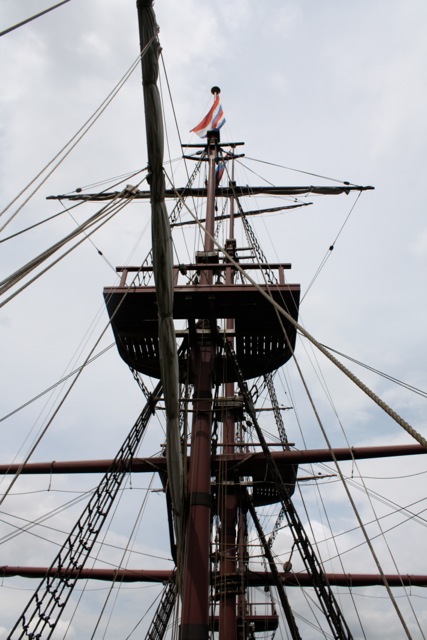
On our home trip, I dragged my husband and children with me to the National Maritime Museum in the old Naval Entrepôt in Amsterdam. The building, designed in 1655 by Daniel Stalpaert, shed a light on all aspects of Holland’s maritime history. In the museum shop I found ‘In pursuit of pepper and tea – The Story of the Dutch East India Company’ by Els M. Jacobs, a beautifully illustrated book on the VOC. We also visited the replica of the Amsterdam, one of the four first Dutch ships to set sail to South East Asia in order to break the Portuguese monopoly of the spice trade, and imagined travelling back to KL in that ship, taking 15 months to reach our destination instead of 13 hours.
My latest quest is to discover what exactly happened before 1824, when the British ‘temporarily’ took care of Dutch overseas possessions. That wasn’t just a Dutch-British affair. It had to do with everything else that was going on in Europe at that time. This time the Internet brought me the solution: Yale University offers free online courses on a wide variety of subjects, history among them. So now I listen to Professor John Merriman, explaining ‘European History from 1648 until 1945’.
Dutch ceramic plate with “VOC” inscribed. On display at Gallery C, Muzium Negara
See what a Museum Volunteer training course can bring about? Well, at least I will have interesting tales to tell when (if ever) we go home- not just about about nasi lemak and mani/pedis, but also about Parameswara and Cornelius Mattelief De Jonge, amongst others! Most of all, however, is the recognition that everything in the world is inter-connected with everything else – no matter how far apart we may seem.
He looked Malay, he spoke Malay, but he is not Malay.
He looked Malay, he spoke an Indian dialect, but he is not Malay.
She looked Indian, she spoke an Indian dialect, but she is not Indian.
They look Indian, they look Malay, they look Chinese, they speak Malay, they speak Indian dialects and they are the Melaka Chitties.
They look mixed, they speak a mix of these languages and they are the Chitties.
When we speak or read of the ‘Peranakan’ community in Malaysia, we firstly think of the descendants of the Chinese who settled in Melaka during the Sultanate days. However, few Malaysians have heard of the Melaka Chitties.
These are the Indian descendants of those who also came to Melaka during the Sultanate days. Many moved on to Singapore and the community in Melaka was reduced. But why is it that most Malaysians do not know about them? Is it because the Chitties did not preserve their own culture too well, but instead dissipated into the other communities they married into? Is it because they did not ‘market’ their culture as did the Peranakan Chinese? This article endeavours to find out how or why the Chitties are not such a well-known community as well as take a peek into their life.
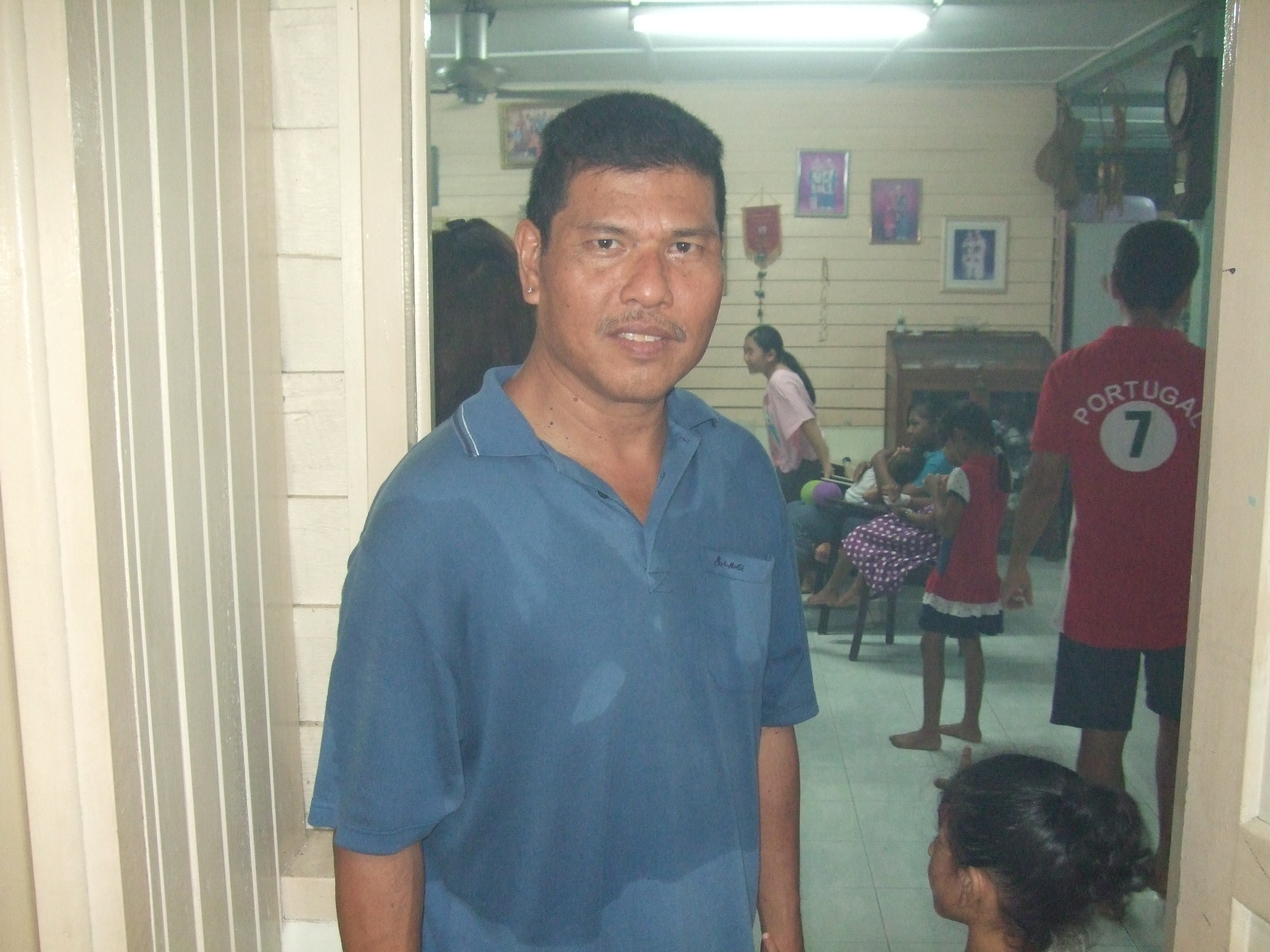
My host, Mr. Nadarajan Raja
There is a fair bit of information on the Chitties today on the web and it is easy to summarise an article from these. But it would not give the spirit and reality, nor satisfy my own curiosity, so the best way was to meet and visit a Chitty family. I got in touch with Mr. Nadarajan Raja, the Chairman of the Chitty Living Gallery. He has also taken the task of being a historian of the Chitties. I had a ‘culture shock’ when I first saw him. I was somehow expecting an Indian looking man and so did not acknowledge this Malay/Chindian looking person who came up to me. Then I was put in place when I realised I was after all meeting a Chitty! “I am a Chitty, not an Indian!” he proudly told me.
He was very kind and helpful and took me to his house where he and his family were preparing for a religious ceremony and yet had the time to talk to me about his community. He is really representative of the Chitties.
He explained why the Chitties are not as well-known as the Peranakan Chinese. Chitties kept a low profile and this is largely due to the contentment of the people. The Peranakan Chinese also achieved success in politics and this may have helped to project them into the limelight. The later migration of Indians saw the Chitties as different and remained separate and did not associate themselves much with the Chitties. Perhaps this is a good thing as it might have made them disappear into the newer generation of Indians.
With tourism a major industry in Melaka as a result of the rich history, the Peranakan Chinese, being part of this history took advantage and created a ‘brand’. The food, which everyone enjoys, was the main attraction and this helped to project their image. They promoted their form of dressing as well and publicised their events.
Furthermore, presently, there are a few members of the Chitty community. In the British days, when they needed personnel to populate Penang and Singapore, many Chitties migrated to these places. This left a small community behind after all these years. Perhaps, intermarriage led to a diversion to the other races.
Family ancestry is not known because, though they bury their dead, only in recent years do graves have names.
While the original Indians who came in the Sultanate days were rich and influential being traders, administrators and even members of the royal court, the years of the foreign rule, has made a change in their status. With lost influence, they moved into farming, fishing and government jobs. In more recent years, many have found work in the private sector as well. Education was a drawback in the past years. Nowadays, they have joined the thirst for further education. In fact, a younger relative of Nadarajan is an economics graduate and is a lecturer in a private university. In time, the Chitties, will move to different occupations and the professions and with this, it may mean many will move away to work elsewhere, returning once or twice a year for festivals. This in turn could have a diminishing effect on the community numbers over time.
Plaque at the entrance of Kampung ChittyThe main road in Kampung Chitty
Presently, there is a Kampong Chitty (Chitty Village) built by the government. Water and electricity are provided free. There are 25 homes in the area, at the entrance of which is a plaque describing their community. There are however, many others who live elsewhere in Melaka and Malaysia. At one end of the settlement is the Angala Parameswari temple built in 1888.
Chitty food has an Indian base. Added on are Malay and Chinese influences to the point a dish is difficult to place. The average Chitty is now an average Malaysian and eats any kind of food, so it is not usual to eat traditional food daily. But on ceremonial occasions, the full range is prepared and laid out. Such food would include kerisik (grated coconut with fish), nasi lemak (milk rice) and lauk pindang, a fish dish. The traditional cakes, or kueh, are Malay. While ordinarily rice is just boiled, for occasions the rice is nasi lemak. Food is eaten with the hands.
Nadarajan and wife’s wedding photo in traditional dress
None of the family members I met were wearing traditional attire, all being in modern clothing. But for formal traditional occasions the ladies would wear the baju kebaya and the men the dhoti. The ladies baju kebaya is a Malay adoption and now common to the Nyonyas as well.
Nadarajan Raja is as current a name as you can imagine. Names have somehow been maintained and not changed over the many years. One would have expected the form and spelling to have changed, but the spelling is quite standard, at least for the current Chitties. The nameplate on his house is Kandasamy Raja, another example.
Among those who have become Christians, many retain their Indian name, such as Alfred Pillai for example. But today, names are found on the internet and tend to be more traditional and Sanskrit based.
Looks of course are diverse. They are Malay looking generally, but differ according to their marriages. One brother told me he has a problem eating lunch in a restaurant each Ramadan because of his Malay looks! Over the years, the original Indians married Chinese and Malays and perhaps Melaka Portuguese. It is not unusual to see very Chinese-looking (and speaking) person introducing himself as Prasanth Veerasamy Chitty! (another friend of mine). Marriage with other races is still common. But Nadarajan feels there are more marrying Indians and this will strengthen the culture.
Pictures of family membersPictures of family members
The spoken language is Malay. But the accent is not the Malay accent as spoken by the Malays. Nadarajan says that since their grandfather’s time, some learnt Tamil and now many speak Tamil. Generally in this family, they speak Malay, Tamil and English interchangeably among themselves.
Language, being what it is, absorbs other words and over time, loses it purity on the one hand but enriches it as well. Even as they speak Malay at home, many words are unused in daily Malay today. For example, crabs are not ketam but kepiting. Box is kepok, not peti. Kopia is a cap. Words have been adopted too. From Chinese we have kuntow for a dustpan, loteng for upstairs and bimpo for handkerchief. They also refer to the grinding stone as batu belingan.
As for religion they are Hindus, following tradition closely. They observe festivals such as the Ponggal (January/February), Deepavali (October/November) and Bhogi Parchu (ancestral worship) in January. Fruit Parchu (Parchu Buah Buahan) is observed for a month between June 15th and July 15th. This is also an ancestral worship and the dates are fixed with local fruits being offered.
Hindus refer to the Hindu almanac for auspicious dates and times as they are crucial to any event. So do the Chitties in the case of weddings, engagements (parasam), moving into a new house and also when the deceased body is to leave the house for burial. They refer to the pandaram, the priest at the temple, who in turn would refer to the almanac.
Temples are many and the most famous is the Sri Poyatha Moorthi Temple dedicated to Vinayagar in Melaka town. This is the oldest temple built in 1780. This is despite the fact that the community came in the 1400’s. It is said that in the very early days, worship was in houses and any temple would have been of wood and so not survive the times.
Food offerings at ceremonies include nasi lemak, pulut inti (glutinous rice with sweetened grated coconut), penggat pisang (banana preparation) and others. Sandalwood ash (beehuthi) is also used with the pottu, the red spot, on the forehead.
Nadarajan was preparing a memorial ceremony for an aunt who had passed away a month ago, at the age of 96. This is the 31st day ceremony. At this ceremony, a large variety of their food was prepared as an offering. It gave me a chance to see this ceremony and as well as partake in the rich food culture.
The 31st day ceremony was the end of earlier ceremonies. They are vegetarians, featuring bitter gourd for the first 8 days after the bereavement. After the 8th day they can eat fish till the 15th day. On the 16th day, they have a cleansing ceremony, the puniathalam. They can then visit the temples. After the 31st day ceremony, meat can then be eaten again. What fascinated me is the ornate layout of the food, fruits and other offerings.
(Photo taken from The Star Online – January 27, 2012)
The food was on banana leaves. There were 14 varieties of curry, some mentioned above, around a serving of nasi lemak. Local fruits like jackfruit and salak were on a platter and another had wet cakes such as kueh lapis, pulut inti and doughnut made of tapioca and crusted with sugar. After the prayers, members of the family gather around the leaves and eat off it. Others would eat similar food at the table.
Nadarajan timed our interview to this 31st day ceremony so that I could observe the event, partake in the food and meet the family. Being a Tamil of a more recent migration, it was an eye opening occasion for me to meet some members of this historical community and be a part of it even for some hours. With traces of similarities, the differences were greater. It dawned on me that perhaps in a hundred years or so, the Indians of today will probably be just like them.
I wish to thank Mr. Nadarajan Raja, as well as his family, for hosting me at their home and making me feel very welcome.
Jugra…..was once the center of the Selangor State Kingdom….it was her 2nd capital…Sultan Abdul Samad resided here till his death in 1898 with his palace, Jugra Palace, built on top of Jugra Hill. It was also where the 5th Sultan, Sultan Sulaiman, had his coronation.
Our journey to Jugra started at 8 am with our coach captain, Pak Man, accompanying 27 museum volunteers and 1 JMM representative. The journey took about an hour’s drive. Since our coach captain was not familiar with the route…our rescuer, Mr Edmund, gave a hand and we managed to reach the first destination in our itinerary, Muzium Insitu Jugra. Insitu is translated as “terletak” in Malay which means to “stay foot” or “on site” or rather “where it begins”.
Upon reaching our destination, we were amazed to see the museum deep in a remote area. We were greeted by Encik Aidy, Puan Farahani and Puan Zita; Encik Aidy became our official guide for the whole tour.
Listening attentively to Encik Aidy at the start of the tour
Museum Insitu Jugra was formerly the Balai Polis (Police Station) built in 1876 by Captain Syers, during the British era. Its construction is said to have been initiated by Tunku Kudin, Sultan Abdul Samad’s son-in-law. During WW2, the building incurred some damages due to bombings but it managed to survive. It was consider the first police station in Selangor before the police station moved to Bukit Aman.
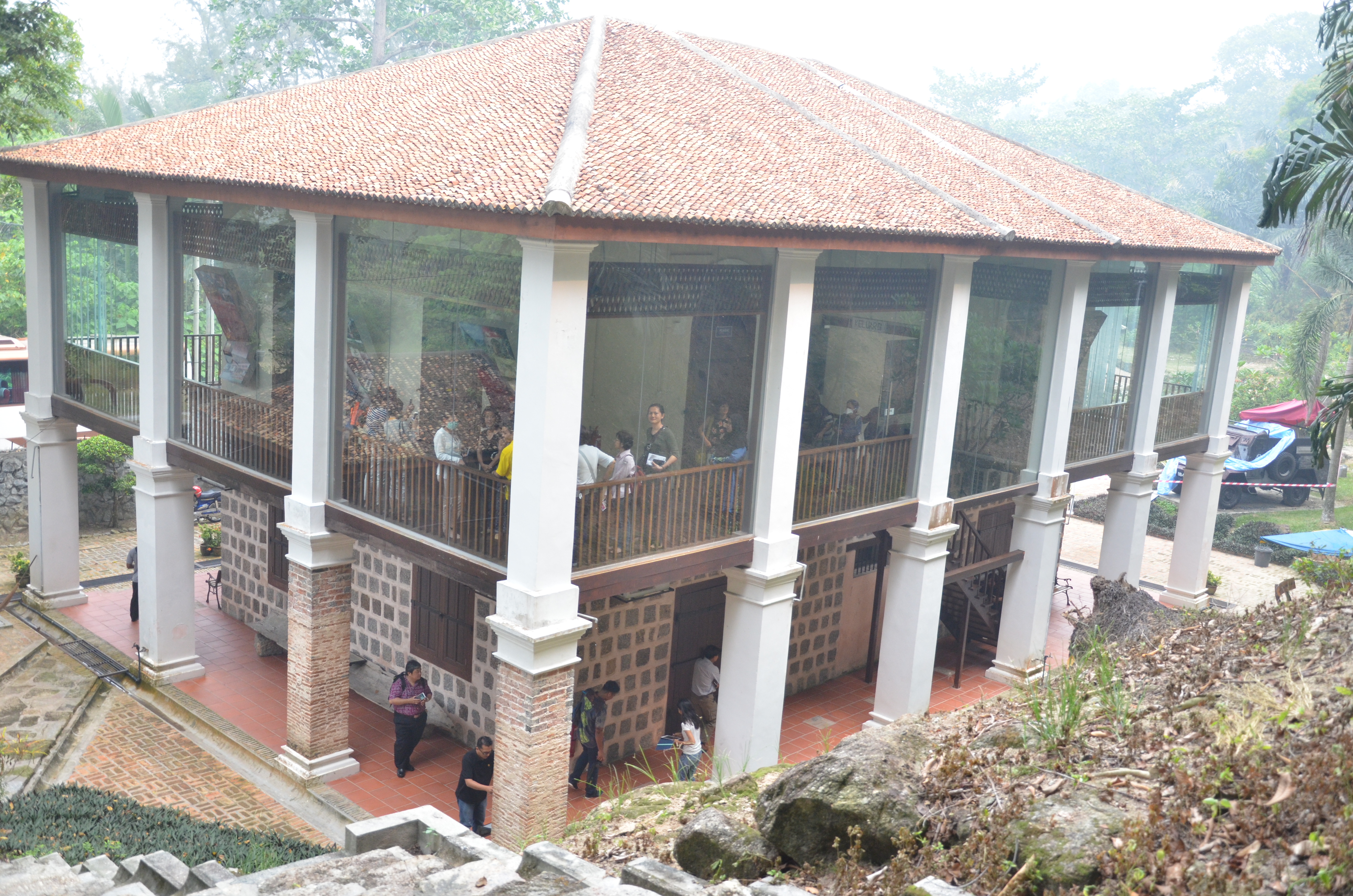
Muzium Insitu Jugra
The museum’s ruins were found during the excavation by the Selangor archaeology team in 2001 and it was opened to the public in 2013, costing more than 1 million RM wholly funded by the State Government. The museum was built using granite said to be found around the area. Glasses were installed on the upper level to reduce the humid conditions in the building and to maintain the conservation works. Original parts of the building can still be seen especially the granite walls, the flooring, 2 pillars left unsealed and the jail house previously used to accommodate 4 to 6 prisoners at any one time during the era. The museum has 3 galleries with Gallery A being the main gallery showcasing Kuala Langat’s history.
Before moving on to our next destination, we were entertained with the “huuu haa” story by Encik Aidy. This relates the story of a mystical iron chest that once belonged to Sultan Abdul Samad. It is better known as the Iron Chest of Istana Jugra. The chest was used to keep Sultan Abdul Samad’s coins and other valuable items. It was said that Sultan Abdul Samad would toss a handful coins daily from his favorite window to the ground for the children to pick these up in the hope of encouraging them to study harder. After his death, the chest was left in the ruins of the Istana Jugra which now sits on privately owned land. In the 1960s, Museum Negara wanted to move the iron chest to Muzium Negara for safe keeping. Despite warnings from the locals, Muzium Negara managed to move the iron chest and this was the start of the nightmare. At nights, strange creepy sounds could be heard coming from the chest and when it was finally opened, it was found to be empty. After many strange happenings, the mystical iron chest was returned to Jugra and is now under the care of one of Sultan Abdul Samad’s descendants, Raja Kassim, but the mystery continues……
The group was then taken to see the ruins of the district office which was at one time used as the court house. The district office’s importance as a court ended when the police station was moved to Bukit Aman, Kuala Lumpur. Over the years, the importance of the district office declined.
Masjid Sultan Sulaiman or Masjid Bandar, a mosque straight out of a fairy tale
Next in the list was Masjid Sultan Sulaiman or Masjid Bandar, known for its yellow or rather mustard colour. But unfortunately for us, the Masjid is currently closed for restoration. This Masjid was built in 1905 by Sultan Sulaiman, the fifth Sultan of Selangor.
The mosque is within a 5 min drive from his Istana, Istana Bandar, built in 1905 with new wings added in 1914. The building was designed by the Sultan and he lived here till his death in 1938. The design of this Istana is said to be inspired by the Sultan Abdul Samad building in Kuala Lumpur. The construction cost was wholly funded by the Sultan. The architecture/layout of the building has Chinese, European and Mughal influences. The Balairong, the court house, the kitchen, and the rooms are still intact.
At Istana Bandar
The 8th Sultan of Selangor, Sultan Salahuddin Hishamuddin, was born at this istana and grew up here. In those days, the royal ladies and children were not allowed out of the compound. They were limited within the garden known as “Taman Larangan” guarded by the panglima or Istana guards.
Sultan Sulaiman was known to his subjects as being a pious Sultan. A penalty of 50 cents (the value was big back in the 1900s) was imposed on those who failed to attend the Friday prayer. The Sultan also read the sermon and became the Imam during the prayers. Istana Bandar is currently being restored by Jabatan Warisan under the supervision of Puan Zita.
Known as Jalan Kecelakaan, this walkway was the route taken by prisoners on the way to be executed.
Before the tour of the Istana, the Museum volunteers were served an excellent lunch in the Istana’s compound enjoying the air (forgetting the haze at that moment!) and the quiet surrounding. Just imagine back then during the era of Sultan Sulaiman, this area was heavily guarded to ensure the safety of the royal family members.
Before heading back to Kuala Lumpur, we stopped over at Ros Kerepek to buy ourselves some goodies. The group safely reached Museum Negara 4.15pm and it was a successful and fruitful tour, another discovery…..
Sir Frank Swettenham, (Malay States High Commissioner and Governor of the Straits Settlements, 1901 to 1904), proposed that the FMS Railway link Singapore to Gemas through the State of Johor. Two proposals were made to Sultan Ibrahim, either for Johor to raise the money to pay the FMS to build the line or for a loan to be made for building the line in exchange for a British ‘Auditor’ being positioned in Johor. The Sultan accepted a loan of $11 million for the construction of the line. However, whilst the terms of the loan were for settlement in 21 years, it was repaid in full after 14 years to demonstrate Johor’s economic independence. The 121 mile long line was leased to the FMS Railway.
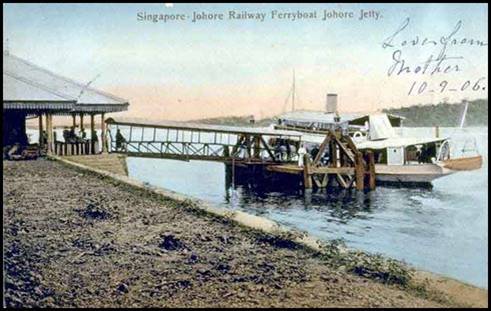
Before the causeway was built, the FMS Railway provided a Wagon Ferry service between Tangga Duke in Johor Baru and Kranji in Singapore. The service used two vessels that could each accommodate five trucks. Passengers disembarked at Woodlands Terminus to cross to Johor via steam launch.
The lock at Johor Bahru. When raised, this structure permitted the passage of small boats to either side of the causeway
A bridge across the Straits had first been suggested in 1904, although this proposal was eventually discarded in favour of a causeway. In 1924, the causeway was opened after four years of construction, when Sir Laurence Guillemard, the Straits Settlements Governor, symbolically deposited two loads of rubble to close the remaining central gap, witnessed by Sultan Ibrahim and the FMS Rulers. The causeway was 60 feet wide and carried twin railway tracks plus a 26 foot roadway. The total length was 3,465 feet, and the greatest depth was 77 feet, with an average depth at low tide of 47 feet. A total of 1,641,712 cubic yards of granite was used in the construction of the causeway.
Tanjong Pagar Railway Station
The design of Tajong Pagar Station was based upon Helsinki’s Central Station. It was built to maximise passenger comfort whilst they waited to embark. The building was planned to be the southern point of an ambitious vision to link Asia with Europe’s vast rail network. It was envisaged that railway lines spanning Asia would eventually connect the Indian and Pacific Oceans, with Singapore serving as the southern gateway.
Whilst it was theoretically possible to link the many railways between Europe and Asia, both its construction and operation would have required unprecedented cooperation between conflicting interests of many states and colonies.
The station was equipped with waiting and refreshment rooms, dining rooms, a hairdresser’s shop and dressing rooms. There was also a telegraph office, a parcel room, plus offices and bedrooms for station staff. Restaurant Cars served excellent breakfast, luncheon and dinner at reasonable prices. Sleeping Saloons with two berth cabins were provided on the night trains, and an ample Buffet Parlour Car was attached to night express trains between Singapore and Kuala Lumpur.
In his speech at the opening of the station in 1932, Sir Cecil Clementi, the Governor of the Straits Settlements, provided an insight into the vision which provided the motivation for building of the station saying: “We stand here at the southernmost tip of the continent of Asia, and, since the Johore Strait is now spanned by a causeway which was opened for traffic in 1924, we may even say that we stand at the southernmost tip of the mainland of Asia. This point is, therefore, a real terminus as well as a natural junction between land-borne and sea-borne traffic; and it is very right that the terminal station of the Malayan railway system should be built at Singapore, the gateway between the Pacific and Indian Oceans and immediately opposite the Tanjong Pagar docks, where every facility will be afforded for interchange between railway and ocean shipping”.
Although timetable variations reflected the locomotive power, pre-WWII journey times from Singapore were nine hours to Kuala Lumpur, twenty two hours to Penang, and twenty nine hours for the 580 miles to Padang Besar on the Siamese border. The Japanese increased train speeds during WWII, and reduced the time to the Siamese border by five hours.
The 1948 Malayan Railway Ordinance was created to manage the railways previously managed under the FMS Railway. The Malayan Railway Administration was later renamed as Keretapi Tanah Melayu (KTM).
Railway development in Malaya differed from that in many other colonies in that it came before the road network. In other colonies, railways followed rough tracks, but Malaya’s tropical jungle was not routinely traversed, as Malays had traditionally found waterways adequate for their transport needs, and the few tracks that existed were often ill-defined.
The building of railways in Malaya was not a simple task. Whilst the British planned a substantial network, the jungle was often unexplored and was often a major barrier to travel. Significant difficulties were frequently encountered during surveying, constructing and subsequently in maintaining the railway system.
Sultan Abu Bakar of Johor had noted railway lines during a visit to England in 1866, and decided to build a line from Johor Baru to Gunung Pulai, where a sanatorium was planned to be built in the cool hill resort. Johor had a plentiful supply of good quality teak, which was used for the six by four inches rails that sat on round sleepers embedded in the earth; (at that time, stone ballast was considered to be unaffordable). The agreed gauge was one metre, which followed the convention for similar railway lines in India. Construction commenced in 1869, and ten miles were in use by 1875. However, the wooden rails and sleepers fell into disrepair, and by 1889, was reported to have been abandoned after a locomotive had fallen into a hole because white ants had eaten the track.
The first successful railway line was constructed from Port Weld to Taiping, and was completed in 1885. Surveyors planned the lines through the virgin jungle to be as straight as practicable. Porters carried all food and supplies for the survey party, who could often only progress at a crawl. The majority of the vast amount of material required to construct the railway line was imported from Britain. The construction party had to follow stakes previously laid out by the surveyors, and substantial roads had to be built to carry the required heavy construction equipment. The roads were continually under threat from torrential rain and vast quantities of ballast were needed to cross unavoidable swamps. A swathe of 100 ft. was cleared on both sides of the track to keep the jungle at bay. The majority of the trees felled were of hard wood varieties, and almost all of the timber was recycled for use either in constructing the line, or stockpiled for subsequent use as fuel for the locomotives (wood eventually became in short supply, which resulted in some trains being converted to run either on newly discovered coal or on oil). The ground was often saturated and embankments were built with effective drainage to safeguard against subsidence. Lallang grass with fibrous roots was planted to bind the unstable earth.
Many rivers had to be crossed, and the bridges were often of a standardised design of 100 ft. length which could be extended in 50 ft. stages. Forty nine such bridges were required between Johor Baru and Seremban, of which nineteen exceeded 100 ft. Victoria Bridge in Karai, Perak is the oldest FMS Railway bridge. The structure passes over Sungai Perak and was completed in 1900; it closed to rail traffic in 2002. The bridge is over one thousand feet long, and rests on six brick piers. At the time, it was the most advanced bridge in the Far East.
The formation of the Federated Malay States in 1896 led to centralised power. Sir Frank Swettenham, the newly appointed Resident General, proposed plans to develop the FMS and Province Wellesley railway networks. Three phases were envisaged, a northward line to connect Selangor with Perak, an extension to Kuala Lipis in Pahang, and a southward line to Sungei Ujong, the whole linking Port Dickson to Prai. The British Colonial Office approved the plan which would support economic diversification and link the FMS with the Straits Settlements. Construction began in 1897 and was completed within six years. Whilst the new railway lines opened up new areas for development, they only served narrow corridors, and it was apparent that a complimentary road network was also required.
Station Hotel, Kuala Lumpur
In 1909, the FMS Railway General Manager wrote to the Federal Secretary with recommendations relating to tenders for the building of Kuala Lumpur Railway Station. The lowest tender was from Kee Sen, ($157,000), which was not recommended as the schedule had not been completed. The second tender was from Messrs J. A. and P.C. Russell, ($ 159.289.36), which was not recommended as P.C. Russell was considered to be too young and to possess insufficient experience.
In August, the Resident General wrote to the High Commissioner and dismissed the tender from Kee Sen as being “only a lump sum suggested by a friend”. With regards to the submission by J. A. and P. C. Russell, significant misgivings were expressed as to whether the younger brother had sufficient knowledge and experience to complete a contract of such importance and magnitude. Ang Seng was acknowledged as being a contractor who had successfully completed previous work for the FMS railway and could be relied upon to carry out the present contract. The Resident General then recommended that the contract be awarded to J. A. and P. C. Russell.
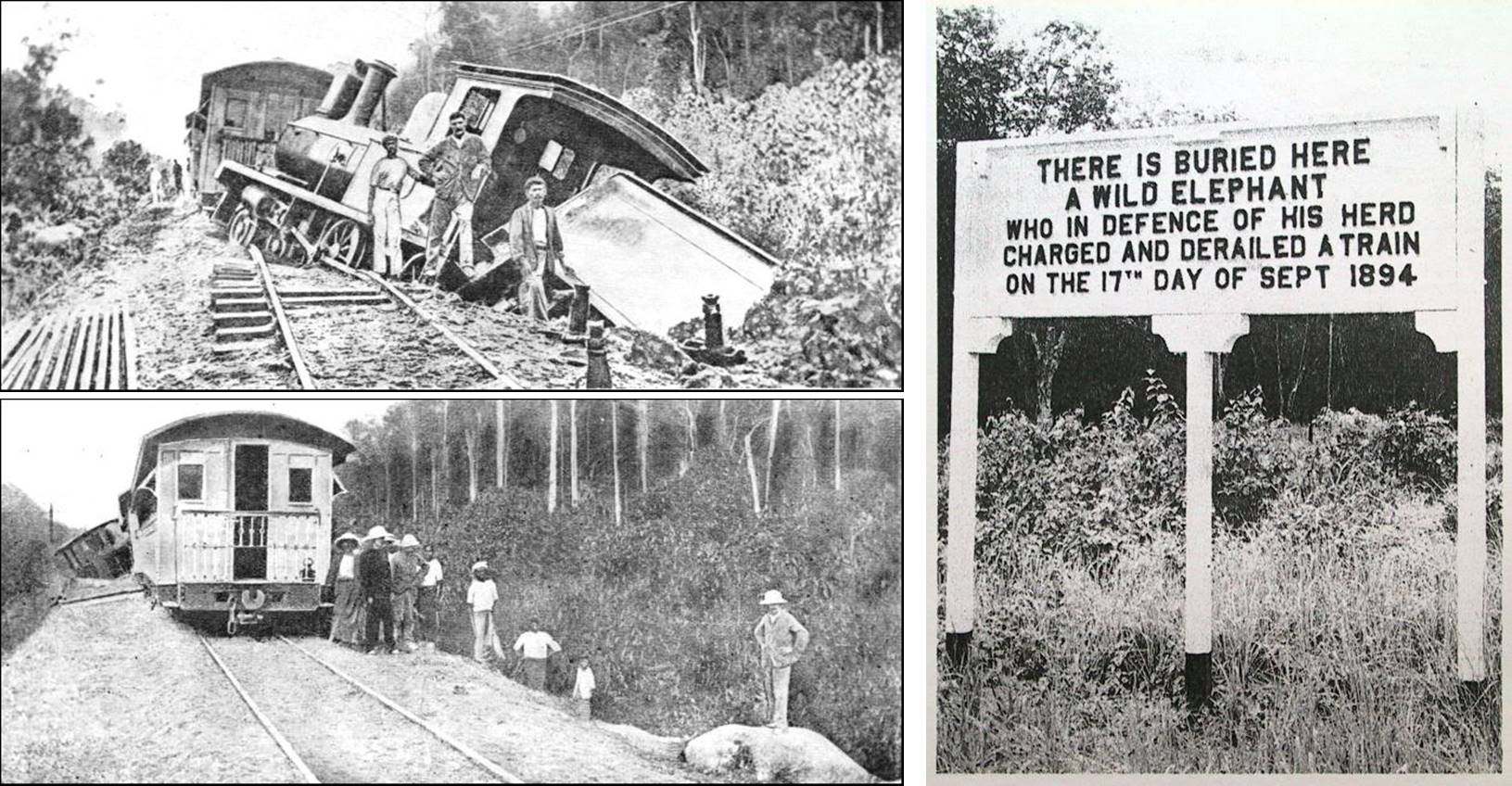
In 1894, a train was derailed by an Elephant at Teluk Intan, and the story put around at the time was that this was in retaliation for the train killing her calf. Tigers used to be numerous around Bukit Intan, and a number were shot during the building of the railway line. After the Station was completed, a tigress and two cubs wandered onto the platform. They rested for a short time under the window of the Booking Office before getting up and wandering back into the jungle.
 It was hot and sunny when we started the cruise in two fishermen taxis from near Duyong Island (Pulau Duyong). We separated ourselves into two groups, each occupying a taxi boat with a distance of 50m between us so that we will have a calmer sail. As we travelled inland towards the Terengganu State Museum and Islamic Civilization Miniature Centre, we could feel the soft breeze kissing our cheeks giving a cooling effect.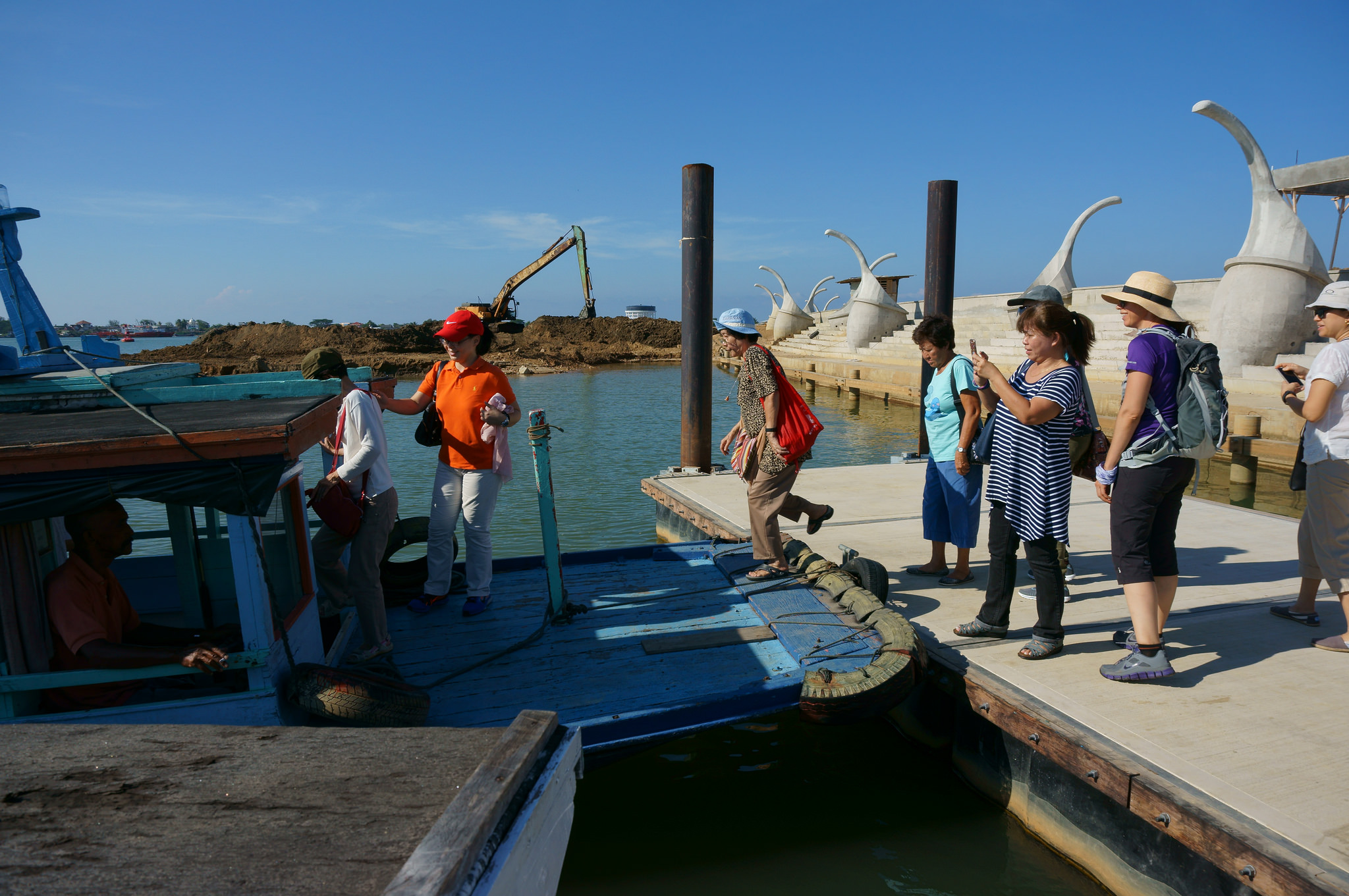
















 railways in Malaya was not a simple task. Whilst the British planned a substantial network, the jungle was often unexplored and was often a major barrier to travel. Significant difficulties were frequently encountered during surveying, constructing and subsequently in maintaining the railway system.

 Museum Volunteers, JMM
