By Junko Mori
When you visit Muzium Negara, you will find ceramics in every gallery from the oldest, Gallery A: Early History to the newest Gallery D: Malaysia Today. This is because ceramic is very durable, even when broken, its shards can survive for a very long time. The oldest ceramics on display at Muzium Negara are earthenware shards from the Neolithic period dating back approximately 4,000 years ago in Malaysia, while the newest is a souvenir commemorating the Independence of the Federation of Malaya in 1957.

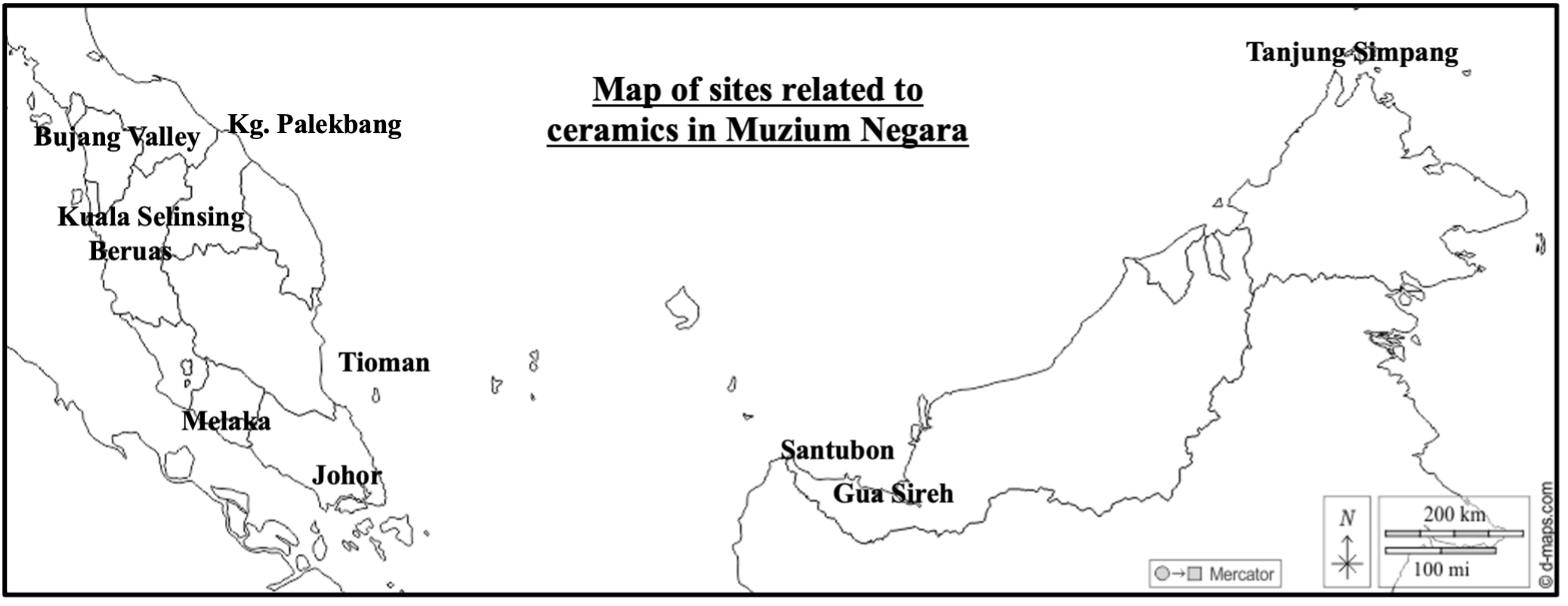
A lot of ceramics, mainly shards, have been found in archaeological sites in Malaysia to this day. Ceramics are very important to archaeologists because shards can tell us a great deal about the people who used the sites. For example, some Neolithic earthenware shards found in Gua Sireh, Sarawak, contain rice husk temper, added to clay to prevent breakage during the firing, evidence that the people who used the site already knew rice. The earthenware from Gua Sireh may date back 3850±260 B.P.
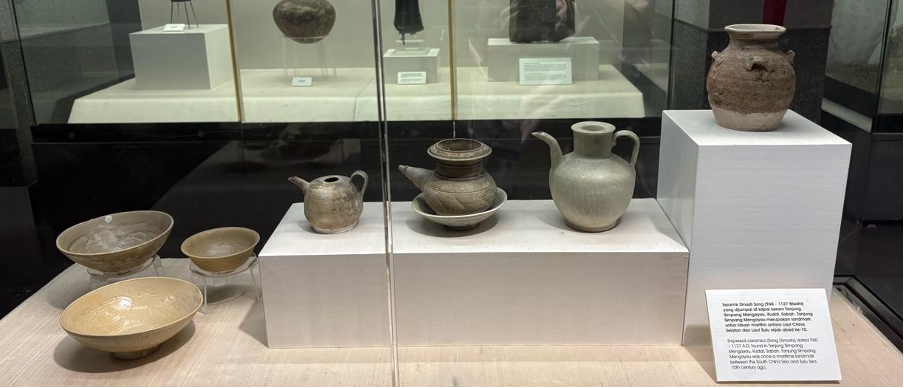
Elsewhere, the shipwreck found at Tanjung Simpang, Mengayak, Kudat, Sabah carried many Chinese ceramics dated to the Song Dynasty era (960–1279), suggesting that Tanjung Simpang was a maritime landmark at that time.
Until modern times, it is believed that no ceramics other than earthenware were produced in the Malay Archipelago; consequently, most non-earthenware ceramics found at archaeological sites in Malaysia are thought to have been trade goods. Earthenware is made from clay fired at low temperature (usually below 1000℃) in open firing and is usually unglazed; its production began in the Neolithic period. Non-earthenware ceramics including stoneware and porcelain developed later, are fired at higher temperature in kilns and are usually glazed. Notable Malaysian sites with abundant trade ceramics are Bujang Valley in Kedah, Beruas in Perak, Melaka, Johor Lama and its surrounding area in Johor, Tioman Island in Pahang and Santubong in Sarawak. Shipwrecks near Malaysia have also yielded large quantities of ceramic cargo.
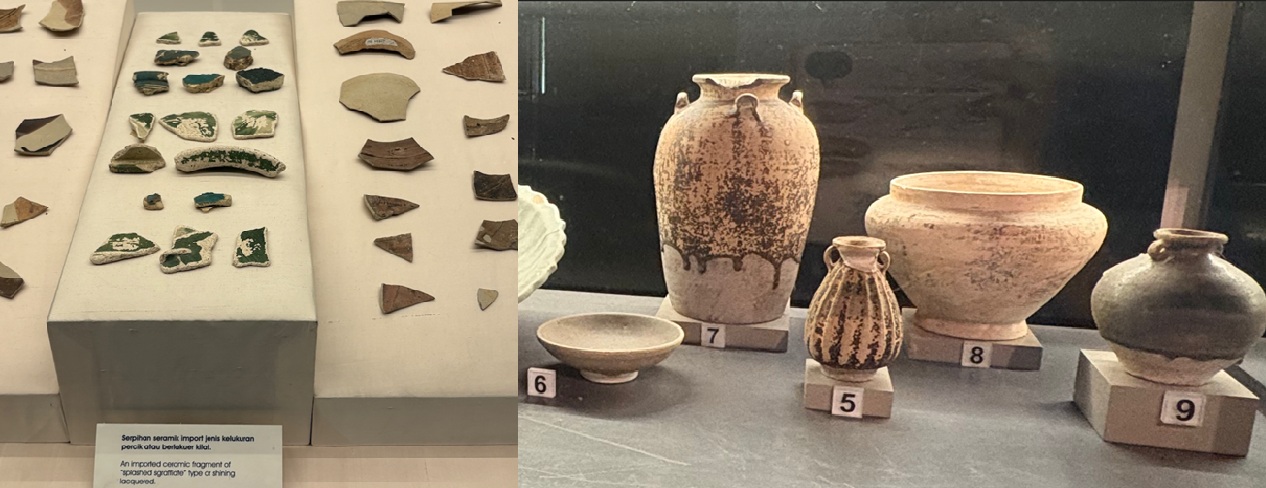
Many of the trade ceramics at Malaysian sites came from China with others from the Middle East, Southeast Asian countries such as Thailand and Vietnam, Europe, and Japan. In Gallery A’s Early Trade section, you can see blue-green glazed old Persian ceramics with a soft, powdery body clay, usually dated to the 9th–11th century. Ceramics of this type have been found not only in the Middle East but also in Southeast Asia, China and Japan, showing us that a trade network linking these regions already existed by around the 9th century.
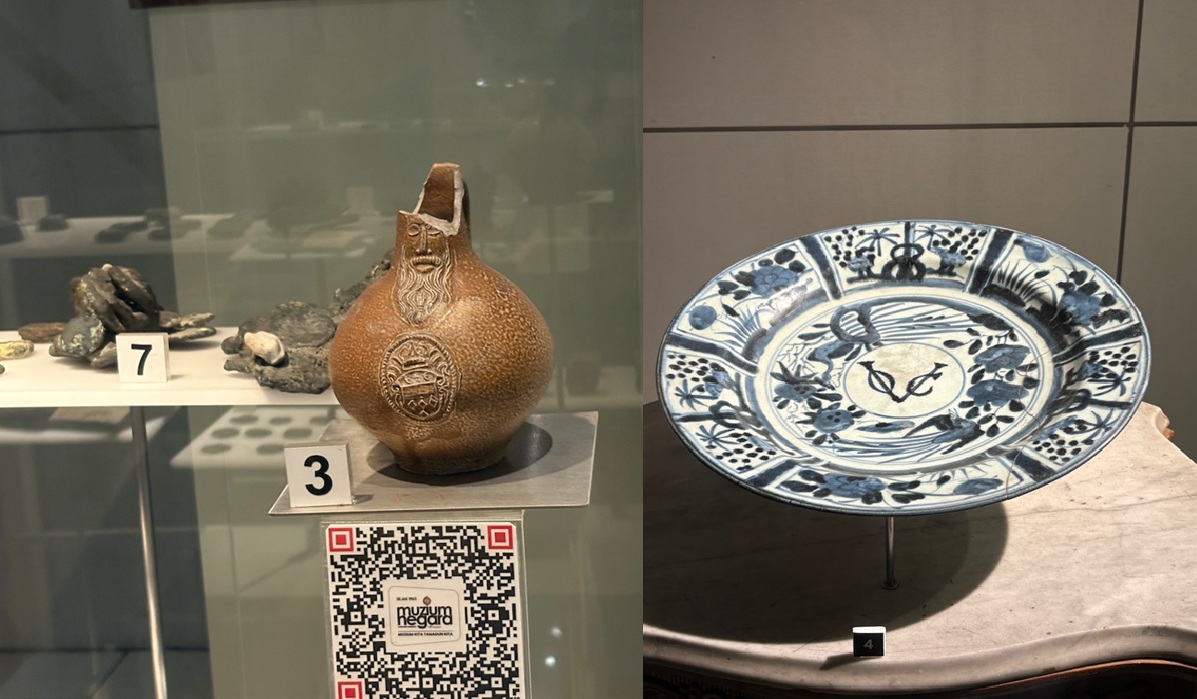
In Gallery B, you will find ceramics from Thailand in the shipwreck section. These ceramics were recovered from the Turiang shipwreck which is dated to around the 14th century. In Gallery C, the Battle of Tanjung Tuan section displays a Bellarmine jar from Germany, found at the wreck of the Nassau, which sank during the battle at Port Dickson, Negeri Sembilan, in 1606. This type of jar was mass-produced in Germany and shipped all over the world. Also in Gallery C, the Dutch Administration section features a blue and white plate bearing the initials “V.O.C” (standing for “Vereenigde Oostindische Compagnie,” the Dutch East India Company). This plate is said to have been made in Japan around the 17th century.
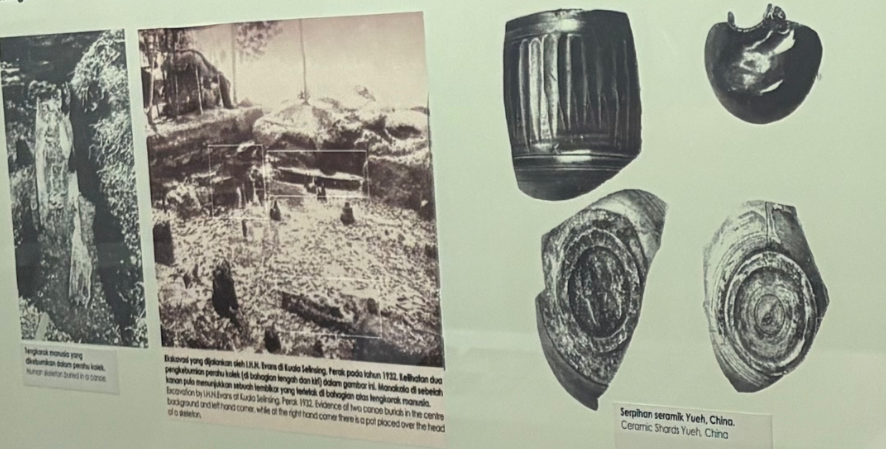
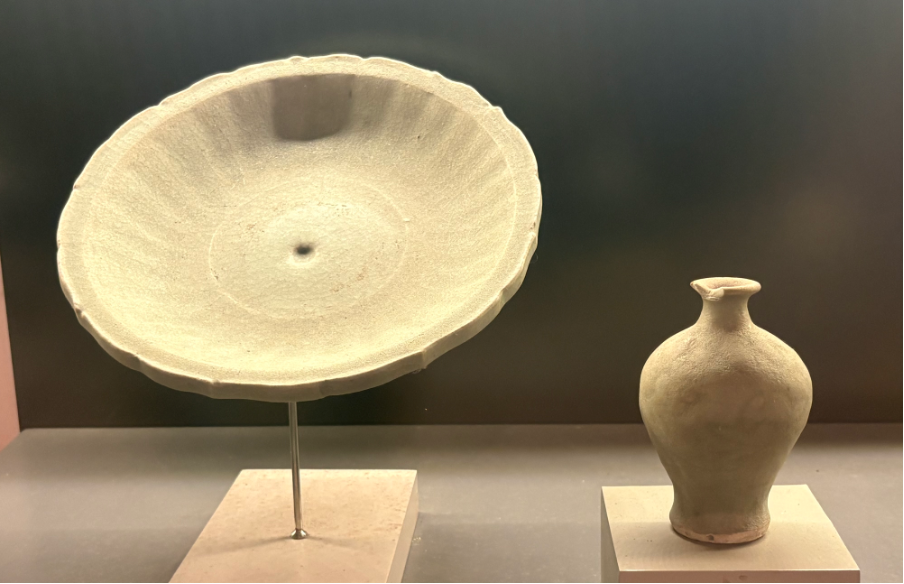
Of course, the most common ceramics found at archaeological sites in Malaysia aside from earthenware are Chinese ceramics. It is believed that ceramics had become one of the major trade goods of China in the Tang Dynasty era (618-907). At the time, celadon, characterized by a blue-green glaze resembling jade, was one of the major types of ceramics traded from China. The most famous celadon in the early times was Yue ware, mainly made in kilns in Zhejiang province. A lot of Yue ware was made in Tang and Song dynasty eras, and its shards had been found in Bujang Valley, Kuala Selinsing, Perak and so on. Later on, celadon from Longquan, Zhenjiang had become more popular, and many Longquan celadons were found in Bujang Valley, Tioman, Melaka and so on. Until blue-and-white ware replaced celadon as the most important trade ceramic from China, a lot of celadon had been produced in China and exported all over the world from East Asia to Africa.
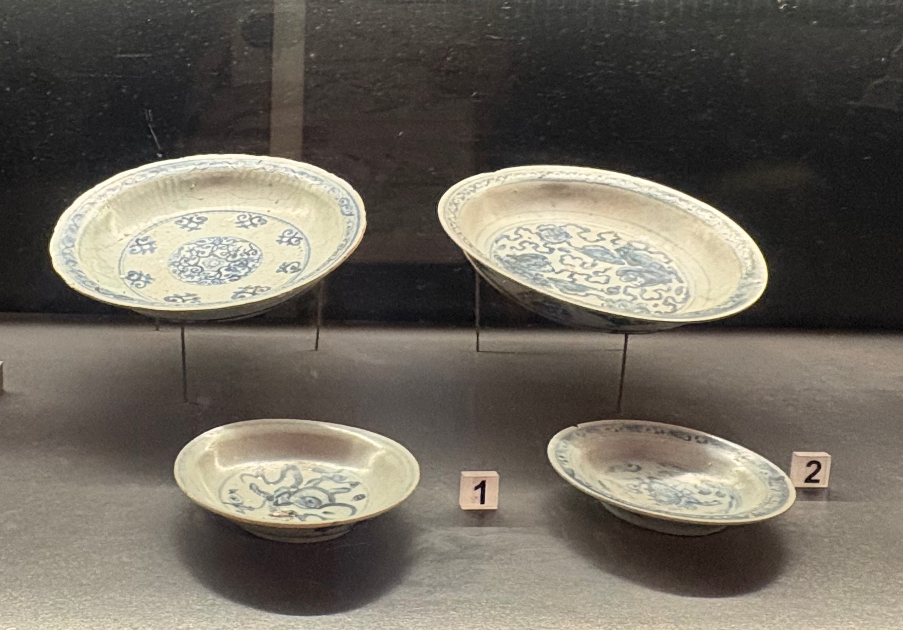
It is believed that China began mass production of blue-and-white ware in the Yuan Dynasty era (1271-1368). White porcelain with cobalt blue motifs was so beautiful that blue-and-white ware became the most popular ceramic item for export. In Melaka and at some shipwreck sites near Peninsula Malaysia, so much blue-and-white ware has been found because China exported millions upon millions of pieces from the Yuan Dynasty era onward. Blue-and-white ware was so popular that it was also produced in places such as Vietnam, Korea, and Japan, though China was the largest producer.
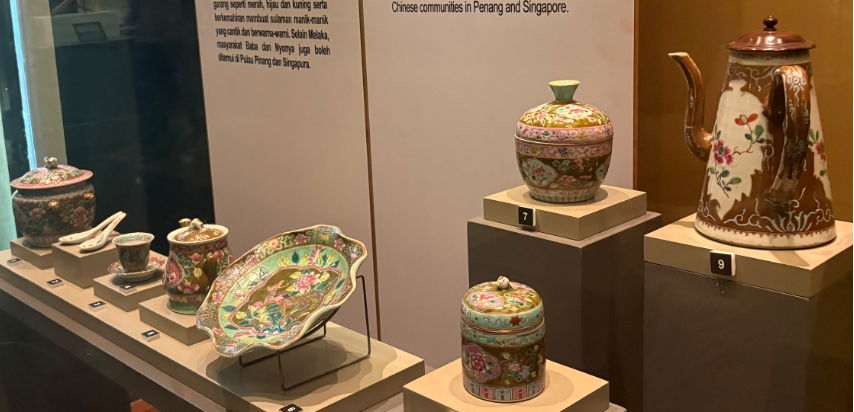
You will also find very colorful ceramics from China in Gallery B. In the Ming Dynasty era, Chinese kilns started mass production of colorful ceramics including ceramics with Islamic influences. It is said that the export of Chinese ceramics with Islamic influence began around the 17th century, and many of them were produced in Fujian province and exported to almost every Islamic country including countries in the Malay Archipelago. On the other hand, colorful and charming ceramics used by the Straits Chinese communities, “Nyonya ware” were produced in Jingdezhen, Jiangxi province, from the 19th century. In the Chinese community in the Straits Settlements under British colonial rule, namely Malacca, Penang, and Singapore, men were called “Baba” and women were called “Nyonya”. Nyonya ware consists of overglazed polychrome enameled porcelains, used mainly for festive occasions and special functions such as weddings, unlike blue-and-white ware, which was for daily use.

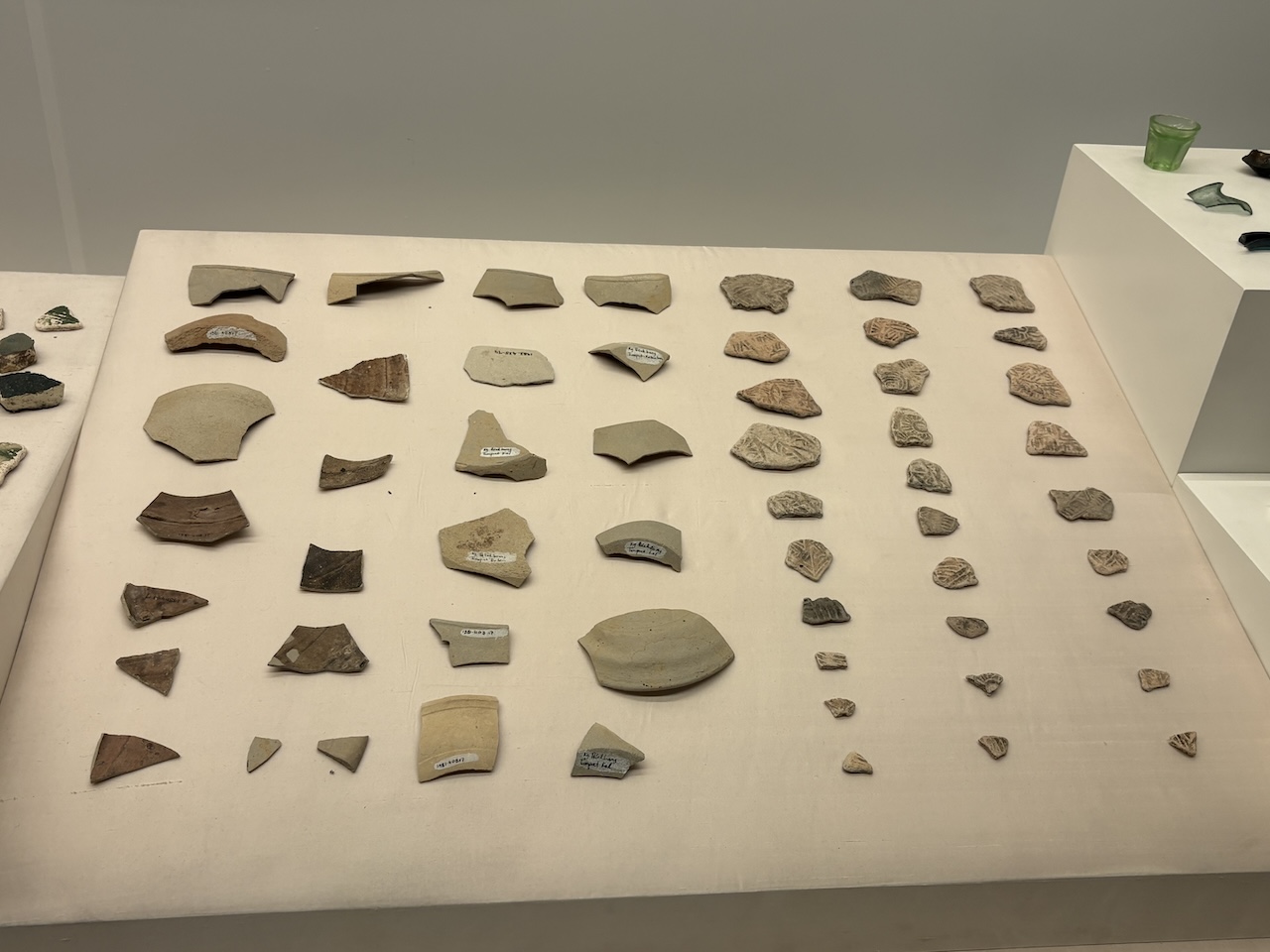
By the way, when you visit the Early Trade section in Gallery A, you will find many shards with some small handwritings. When archaeologists find ceramics at sites, they carefully record information about each piece, including where and when it was found as well as how deep it was found. After this, they photograph the ceramics, collect them, and wash them. Once washed, they write important information onto the shards including their organization’s stock number. For example, a shard marked “Kg. Palekbang” indicates it was found in Kampung Palekbang, Tumpat, Kelantan. Shards sometimes also bear a two- or four-digit number, which usually indicates the year of discovery.
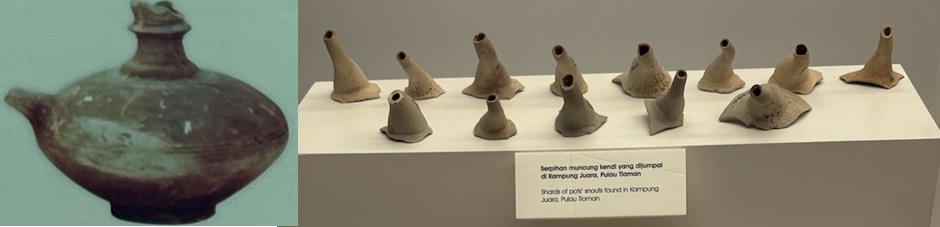
In the same section, you will also find many long, tube-shaped shards, these are spouts of “kendi”. A kendi, a type of spouted vessel used for holding and pouring liquid, was widely used across Southeast Asia since ancient times. Many kendi spouts have been found on Tioman Island.
References
Hasebe Gakuji (ed.) (1999). 世界やきもの史(The concise History of World ceramics). Bijutsu-Syuppan-sya.
Ho Chuimei (1994). ‘The Significance of West Asian ceramics in East and Southeast Asia in 9th -10th century.’ Trade ceramic studies, vol. 14, pp.35-59.
Ito Ikutaro (ed.) (2009). 中国やきもの入門(Introduction to Chinese Ceramics). Heibonsha
Mikami Tsugio (1969). 陶磁の道(The ceramic Road). Iwanami Syoten.
Mori Tatsuya (2015). 中国青瓷の研究(The study of Chinese celadon). Kyuko Shoin. Co., Ltd.
Othman Mohd Yatim (1986). Penggunaan Tembikar dalam Masyarakat Malaysia. United Selangor Press Sdn. Bhd.
Othman Mohd Yatim (1981). Japanese ceramics in the collection of the Muzium Negara. Museum Department Kuala Lumpur.
Othman Mohd Yatim (1986). Guide to the ceramics gallery Muzium Negara. Museum Department Kuala Lumpur.
Paul Beavitt et al. (1996). ‘Confirmation of an Early Date for the Presence of Rice in Borneo’. The Sarawak Museum Journal, vol.71, pp. 67-76.
Pusat Penelitian Arkeokogi National (1996). Buku Panduan Keramik. Pusat Penelitian Arkeokogi National, Indonesia
Sakai Takashi (2002). The Ceramic Consumers in Southeast Asian archipelago. Bulletin of the National Museum of Japanese History, vol.94, pp.159-349.
Photo List
Photo1: Earthenware in Gallery A, Photo1_Earthenware_Gallery_A.jpeg, Photograph by the author Junko Mori. Taken 6 July 2026. Located at Gallery A, Muzium Negara, Kuala Lumpur, Malaysia.
Photo2: The souvenirs to commemorate the Independence of the Federation of Malaya 1957, Photo2_Souvenirs.jpeg, Photograph by the author Junko Mori. Taken 26 June 2026. Located at Gallery D, Muzium Negara, Kuala Lumpur, Malaysia.
Photo3: Ceramics from Tanjung Simpang shipwreck, Photo3_Ceramics_Tanjung_Simpang.jpeg, Photograph by the author Junko Mori. Taken 30 October 2025. Located at Gallery A, Muzium Negara, Kuala Lumpur, Malaysia.
Photo4: Persian ceramics, Photo4_Persian_ceramics.jpeg, Photograph by the author Junko Mori. Taken 24 June 2026. Located at Gallery A, Muzium Negara, Kuala Lumpur, Malaysia.
Photo5: Thai Ceramics, Photo5_Thai_ceramics.jpeg, Photograph by the author Junko Mori. Taken 24 June 2026. Located at Gallery B, Muzium Negara, Kuala Lumpur, Malaysia.
Photo6: Bellarmine jar, Photo6_Bellarmine_jar.jpeg, Photograph by the author Junko Mori. Taken 26 June 2026. Located at Gallery C, Muzium Negara, Kuala Lumpur, Malaysia.
Photo7: Japanese ceramic, Photo7_Japanese_ceramic.jpeg, Photograph by the author Junko Mori. Taken 26 June 2026. Located at Gallery C, Muzium Negara, Kuala Lumpur, Malaysia.
Photo8: Yue ware from Kuala Selinsing, Photo8_ Yue_ware.jpeg, Photograph by the author Junko Mori. Taken 6 July 2026. Located at Gallery A, Muzium Negara, Kuala Lumpur, Malaysia.
Photo9: Longquan ware from the shipwreck near the peninsula Malaysia, Photo9_Longquan_ware.jpeg, Photograph by the author Junko Mori. Taken 24 June 2026. Located at Gallery A, Muzium Negara, Kuala Lumpur, Malaysia.
Photo10: Blue-and-white ware from the shipwreck near the peninsula Malaysia, Photo10_Blue&White.jpeg, Photograph by the author Junko Mori. Taken 24 June 2026. Located at Gallery A, Muzium Negara, Kuala Lumpur, Malaysia.
Photo11: Ceramics with Islamic influence, Photo11_Islamic_ceramics.jpeg, Photograph by the author Junko Mori. Taken 6 July 2026. Located at Gallery A, Muzium Negara, Kuala Lumpur, Malaysia.
Photo12: Nyonya ware, Photo12_Nyonya_ware.jpeg, Photograph by the author Junko Mori. Taken 6 July 2026. Located at Gallery A, Muzium Negara, Kuala Lumpur, Malaysia.
Photo13: Ceramic shards with note, Photo13_Ceramics_with_note.jpeg, Photograph by the author Junko Mori. Taken 24 June 2026. Located at Gallery A, Muzium Negara, Kuala Lumpur, Malaysia.
Photo14: Kendi and spouts shards, Photo14_Kendi.jpeg, Photograph by the author Junko Mori. Taken 24 June 2026. Located at Gallery A, Muzium Negara, Kuala Lumpur, Malaysia.
MAP
Map of sites related to ceramics in Muzium Negara, Made by the author Junko Mori.


