By Jean Leong
Origins
During the dynasties that emerged over the centuries, Chinese opera slowly evolved into the form we see today. From its origins, it can be traced back to ritual activities held in primitive societies, where dance, face paint and animal-skin costumes were accompanied by musical instruments made of stone, metal and string to tell a story through song and dance. Its early form was very different from how Chinese opera is performed today.
Modern Chinese opera constitutes a panorama of components combining dance, music, literature, poetry, song and dialogue, along with acrobatics and martial arts. The players wear heavily ornate costumes and dramatic face makeup. These dramas are spectacular. Today this art form is one of the major treasures of Chinese culture.
Evolution of Chinese opera
Its early roots date from the Qin to the Han Dynasties (221BC to 220CE) in primitive folk performances of ritual, shamanistic chants and harvest dances. Ancient rites were dedicated to the gods when a shaman invites spirits to the mortal world who possess the shaman and speak their words through song and dance. Subsequently, professional actors replaced shamans and performances were enhanced by acrobatics, juggling and comedic elements to amuse the imperial court and the rich elite.
During the Qin period, another type of professional actor known as pantomimist emerged who spoke amusing dialogue and acted comically to entertain the audiences.
Types of Operas
In the Song and Yuan dynasties (960 CE to 1368 CE), a form of opera evolved known as ‘Nanxi’, which developed into the ancient form of Chinese opera. It consisted of a single lengthy performance divided into 20-30 scenes. The roles can be classified into 7 types: Er Sheng (male), Dan (female), Jing (painted face male), Mo (middle aged man), Wai, Tie and Chou (comic figures). The story by performers included acting, singing and narration.
By the Ming and Qing period (1368 CE to 1912 CE) ‘Chuanqi’ theatre became popular in which long dramas developed out of the earlier ‘Nanxi’ plays. This ‘Chuanqi’ style used ‘chapter’. Scripts would range from 30 to 50 chapters with singing performed by all cast members. This format was more flexible as singing could be done by one actor, in duets, or rotating among different roles as a group.
During the Qing period, the reigning Emperor Qianlong, opera troupes came from the provinces to Beijing to perform for his 80th birthday celebrations with specially written pieces in the Hui style, a form of theatre that had originated in the eastern province of Anhui. ‘Hui’ theatre was subsequently absorbed into the other opera elements.
Over the years, the Han and Hui style combined to form a new type of opera originally called ‘Pihuang’ but later renamed ‘Peking Opera’ (now Beijing), using both Xipi and Erhuang singing styles. The Beijing Opera became the best-known tradition all over China and was regarded as ‘The National Opera’.
Chinese opera today is closely related to the historical evolution of modern China, and in 1904, ‘The Big Stage of the Twentieth Century’– the first-ever theatre periodical (published in Shanghai)–called for theatre to ‘reform for the better and shed itself of malpractices; awaken the people’s consciousness; emphasize a national identity and ideology’. Such debates culminated in the famous ‘May the Fourth Literary Movement’ (1919) and the ‘modernisation’ of Chinese opera.
Examples of the genres of operas are as follows:
a. Beijing Opera as described above.
b. Kun Opera, originating in the Kunshan region, Jiangsu Province which is considered the Ancestor of the Opera.
c. Yue Opera, a form of stage dialogue combined with singing, known as ‘floor songbook’, popular in the Sheng area of Zhejiang Province, Shanghai, Jiangsu and Fujian. Originally, it was performed by male actors only and gradually developed into a mixture of male and females and later became all-female casts. Examples of this opera genre which gained international attention in the 50s and 60s are works entitled ‘Butterfly Lovers’, ‘Romance of the Western Chamber’, and ‘A Dream of the Red Chamber’.
(The Butterfly Lovers is a sad story of two lovers, Liang San Bo and Zhu Yingtai, who is the only daughter of a wealthy family and was allowed to be a scholar, disguised as a man. She met Liang Sanbo and they fell in love. However, when he realises Zhu Yingtai was a girl and betrothed to another merchant’s son. Liang Sanbo fell despair and later died. On the wedding day of Zhu Yingtai, her procession passed by his grave, and she begged for the grave to swallow her up so that they could be together! Both their spirits emerged from the grave as butterflies, to be together forever.)
d. Huangmei Opera from the county of Huangmei, Hubei province, was later spread to Jiangxi, Fujian, Zhejiang, Jiangsu, Hong Kong, Taiwan and Southeast Asia, using the Anqing dialect. Famous works include ‘The Heavenly Match’, ‘The Female Consort’ and ‘The Cowherd and the Weaving Lady’.
e. Ping Opera was developed in northern China during the 20th century in Tangshan, Hebei and Beijing. This opera used strong references to daily life; its dialogue and singing are rather informal and conversational which usually reflects reality and modern life.
f. Shaanxi opera originated in the northern Shaanxi Province, developed during late 16th century, is now popular in the north western provinces of Gansu, Qinghai, Ningxia and Xinjiang. It is simple yet dramatic, unrestrained, solemn and agitating, with sentimental, exquisite and gentle elements.
g. Cantonese Opera from the early Qing dynasty, is a popular trend in Guangdong, Guangxi, Taiwan, Hong Kong, Macau and Southeast Asia, wherever overseas Chinese reside.
h. Teochew Opera, evolved during mid Ming period in Guangdong, used Teochew dialect with clear and soft singing style and a variety of more than 10 different clowns’ characters.
i. Gezai Opera of 20th century is very popular from Taiwan, Fujian Province and overseas. It uses a Minnan (Hokkien) dialect with rich melodies and lyrics both happiness to extreme sadness. Recent years, Gezai had also developed with western musical instruments e.g. jazz drums, electronic guitar, saxophone, cello combined with traditional musical instruments.
j. Hainan Opera, a local genre from Hainan province in Hainan dialect, and the repertoire consists mostly of historical and folk stories.
k. Liyuan Opera from Quanzhou during the Song and Yuan period, is one of the most ancient of opera genres. It preserved a wide repertoire of music and plays from the Nanxi tradition and is referred to as the ‘living fossil of ancient Nanxi’.
Characters/ Roles and Makeup in Chinese opera
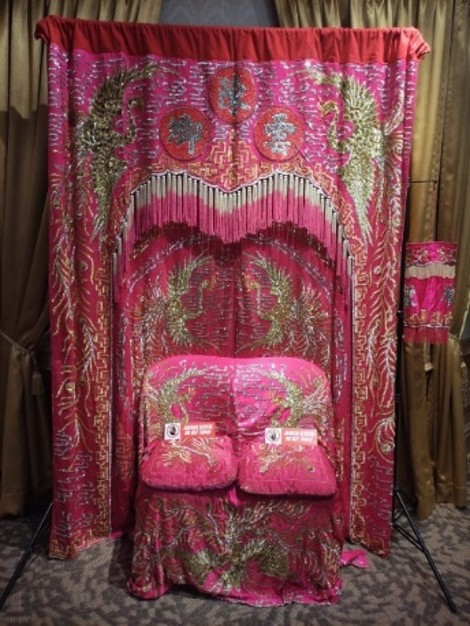
The types of character/roles include those of specific gender, age, status and personality, mainly categorised into Sheng (male), Dan (female), Jing (royal) and Chou (clown) and further subdivided.
The male ‘Sheng’ role can be divided into:
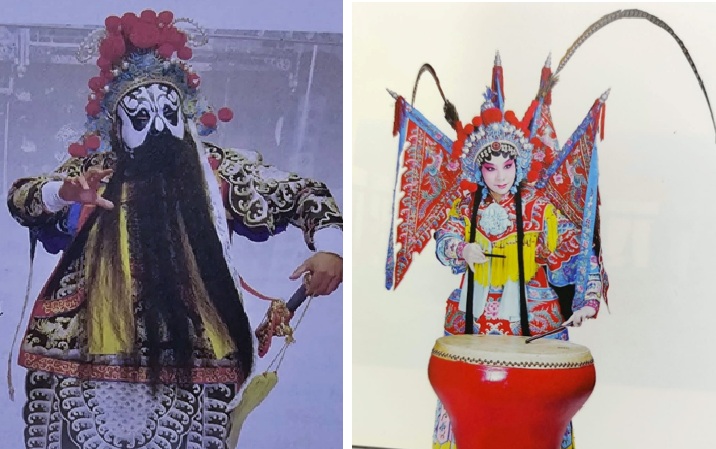
1. ‘Lao sheng’ (old male), with tough and upright personality, usually with a beard or moustache. ‘Xiao sheng’, a young male of presentable appearance but no beard, holds a fan and dresses as a scholar, is romantic, carefree and gentle, but if he wears a headdress decorated with a pair of long pheasants, this means he is well versed in both literary and martial arts. A ‘poor sheng’ would usually don a squarish shawl and a patched costume. ‘Wu sheng’ carries a long sword and wears armour with 4 triangular embroidered flags attached to his shoulders, depicting a military general; the flags enhance the charisma of his character. The child Sheng is normally acted by petite small-sized females.
2. ‘Dan’ are female roles. ‘Qingyi or Gentle Dans’ are young or middle-aged characters, elegant and self-composed, normally plays a mother, virtuous wife or a lady of chastity and moral integrity. Meanwhile the vivacious ‘Fa Dan’ is a young female with a lively or bold personality. She can be a princess, a female general, a humble lady, a village girl or a maid servant. She can be a comedic character known as ‘Cai Dan’.
3. ‘Jing’, is a strong male character, fierce looking with exaggerated facial makeup. Their painted faces characterised the warrior’s particular role, actions to display personal unique style of singing, precise movements focussing on acrobatic and military skills.
4. Chou (clowns) are usually ugly and comical with white faces distinguished by darker eyes, nose and mouth. The ‘Gentle Chou’ (gentle clown); ‘Robe Clown’ dressed in robe and belt is a member of the royal court; or ‘Chayi Clown’ is a low status clown, such as a peddler or innkeeper.
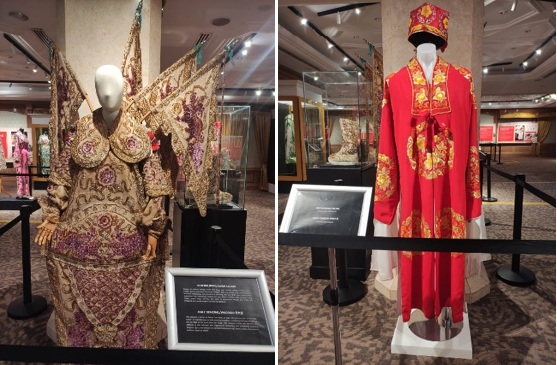
Variety of costumes
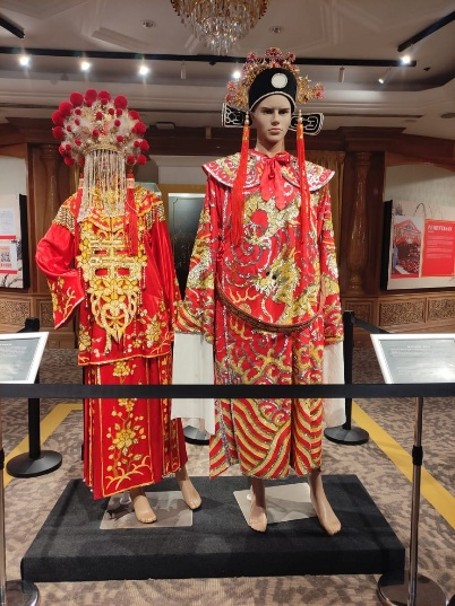
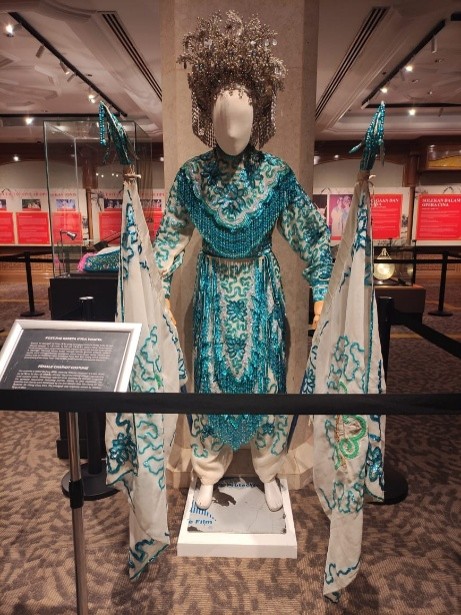
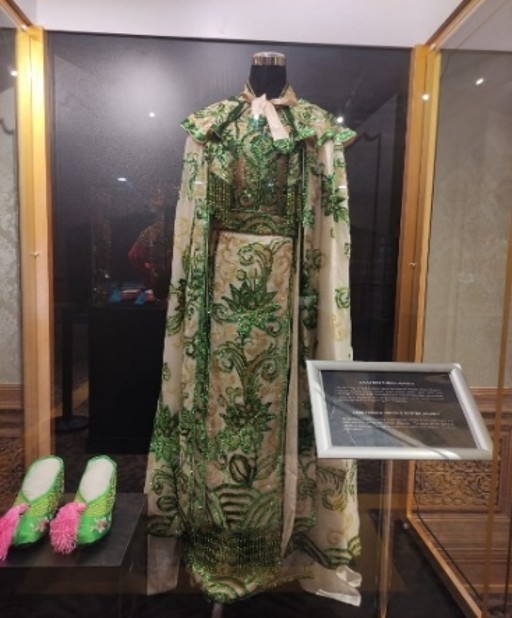
Opera costumes are classified into robes, armours, long robes and informal dresses. Ceremonial/ official/long robes denote emperors, nobility and officials including the empress, rich ladies and female generals. Armour is solely for military officers and generals, while informal dresses, both flowery and plain, are for common people.
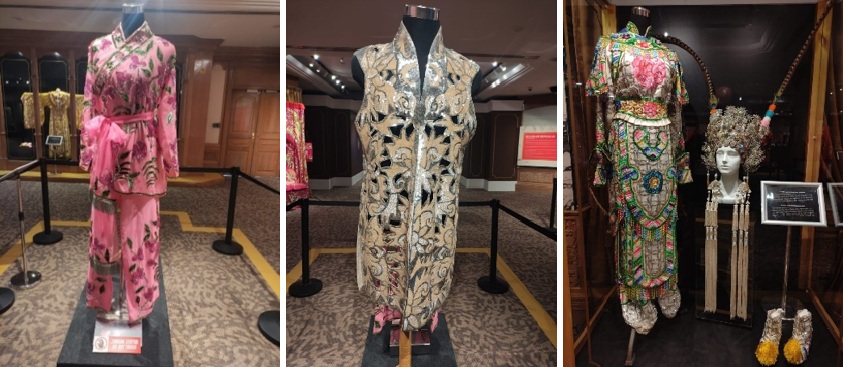
Headdresses/footwears/beards/makeups
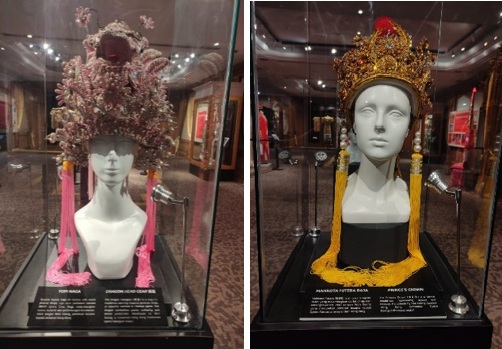
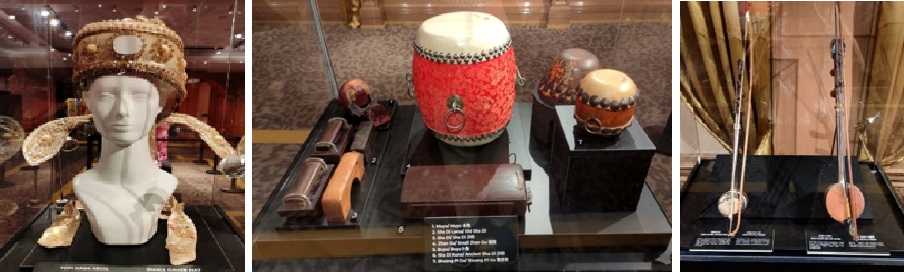
Four types of headdresses are: helmets, head adornments, shawls and hats. Helmets for warriors, head adornments denote emperors or nobles. Shawls as casual wear classified by status: scholar shawls indicate intellectuals and scholars; martial shawls are used for military characters; ducktail shawls represent merchants and shopkeepers; club shawls are worn by young ruffians; councillor shawls for ministers, councillors or village headmen. Both felt and gauze hats indicate working class or local civilian officials respectively. The various types of shoe wears are also according to status and position.
1. Thick sole boots (official boots) with long bootlegs and white platforms, 2 to 3 inches thick are normally worn by actors wearing robes or armours. Thin-sole boots for officials, scholars, eunuchs or roles requiring agile movements.
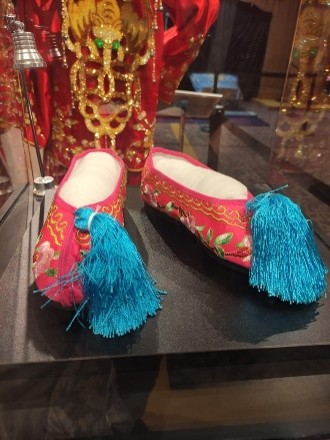
2. Fuzi shoes with embroidered with slight thick soles are for the elderly while colourful embroidery shoes with tassels are for female characters. The ‘flower-pot sole’ with added platforms shaped like inverted flower pots are worn by rich noblewomen.
3. Common black, thin soled martial art shoes are used by soldiers and labourers.
Artificial beards denote different status and characters: the ‘tri-beard’ means a refined sheng character; ‘full beard’, connected on both cheeks means a forthright or deceitful personality. Plaited beards are bold/forthright characters whereas a ‘curled beard’ indicates heroes. Clowns use the ‘eight-character beard or ’hanging beard’.
Decorative headpieces of Dan/female characters are divided into 3 categories, namely ‘silver-plate hair’; ‘artificial diamond hair’ and ‘feather hair’ accessories
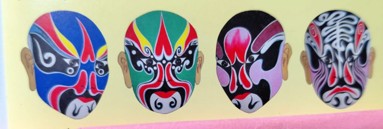
Makeups include ‘charming makeup’, lightly applied facial paint enhancing the beauty and charm of Sheng and Dan characters. However, ‘colourful makeup’ with many colours and facial design motifs in exaggerated manner illustrate the Jing or Chou characters. The colours have these symbolic meanings
a. Red – royal, brave, upright
b. Black – forthright, valiant
c. Watery white – crafty, sinister
d. Oil white – Arrogant, domineering
e. Blue – Unyielding, brave
f. Green – Stubborn, fierce
g. Yellow – calm, vicious
h. Purple – Powerful, straightforward
i. Gold and silver – royalty, gods, spirits
Stages/platforms
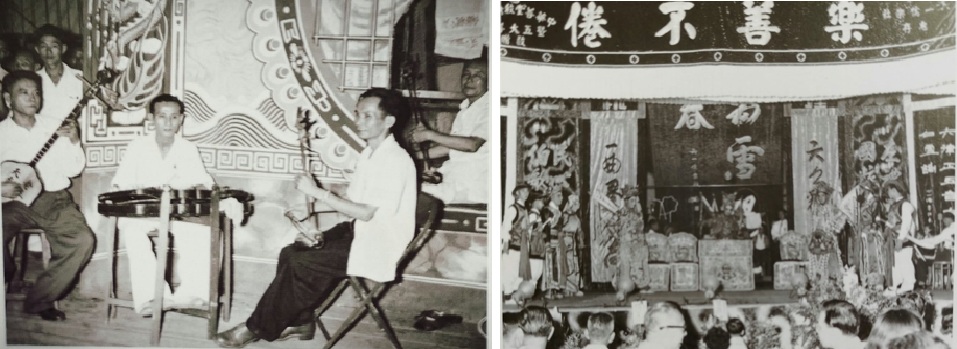
These are ‘temple stage’, ‘washe theatre’, private theatre, ‘opera theatre’ and ‘palace theatre’. The props used on stage had symbolic meanings, such as a whip, representing a horse or an oar, indicates a boat. The orchestra was divided into two: the civil side, represented by stringed instruments, and the military side by percussion. Clappers and drums in the opera orchestra announce characters of authority. The first modern stage was evolved in early 20th century, in Shanghai.
Skilful performers require many years to master the art of singing, acting, reciting, acrobatic fighting and facial expressions, body and steps. The most skilful performer must know how to make use of the virtual and stylish methods, expressing and performing within the limited space allowed, with the correct tactic of swinging their hair, moving their water sleeves or beard to express inner emotions.
In conclusion, Chinese opera are exceptional special interest to those who wish to dive deeper into the history, stories and mystical characters of Chinese tradition.