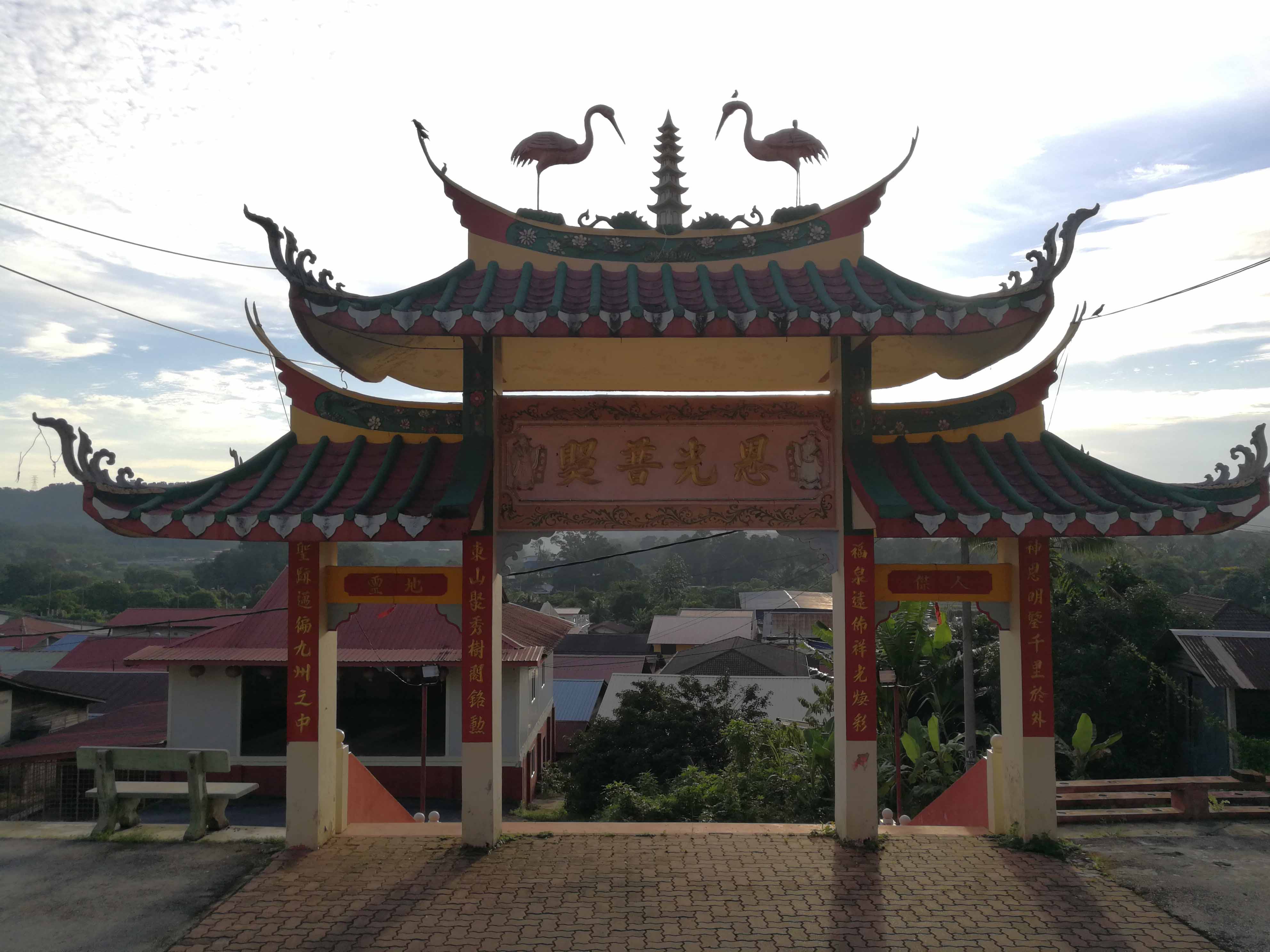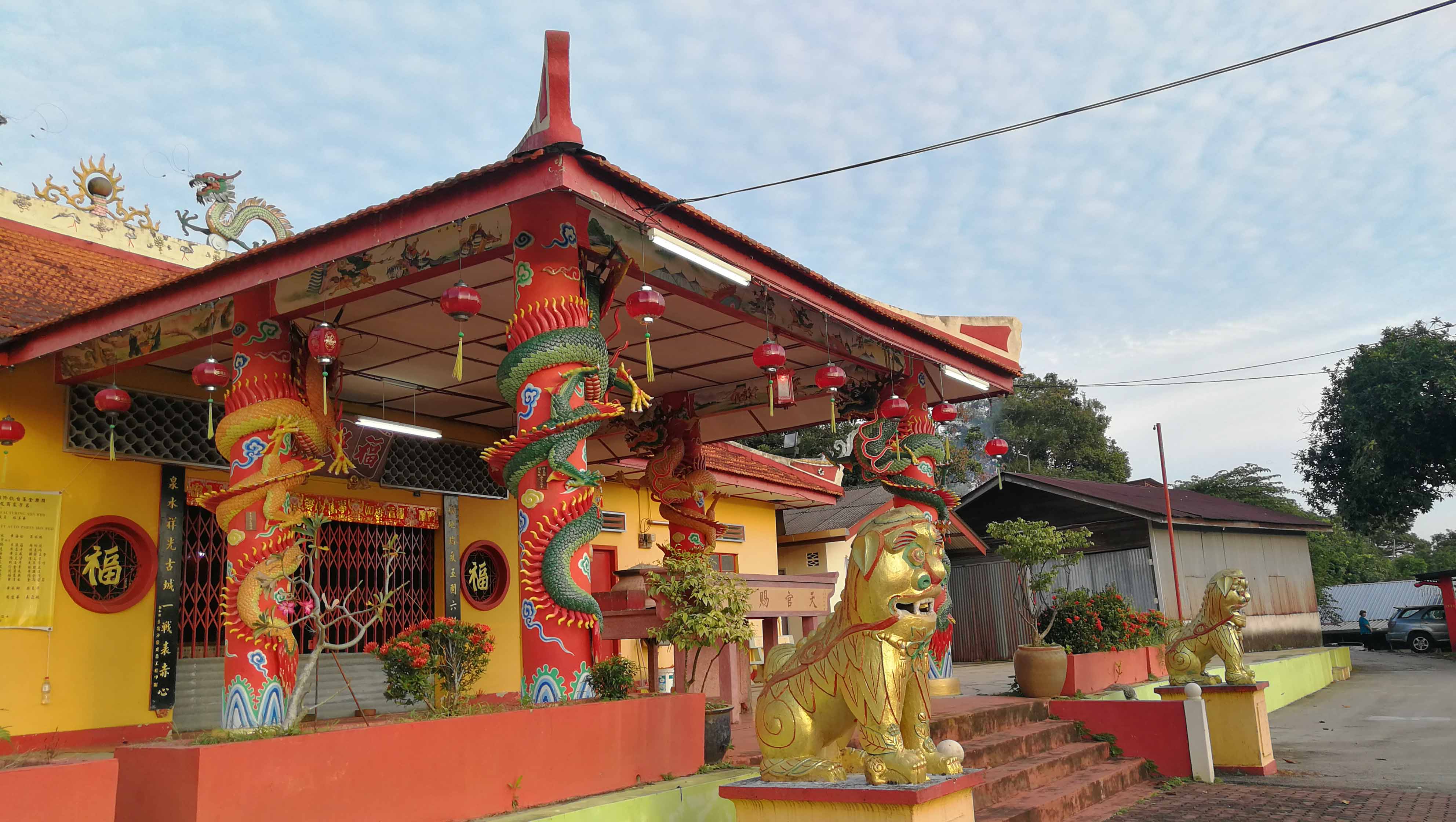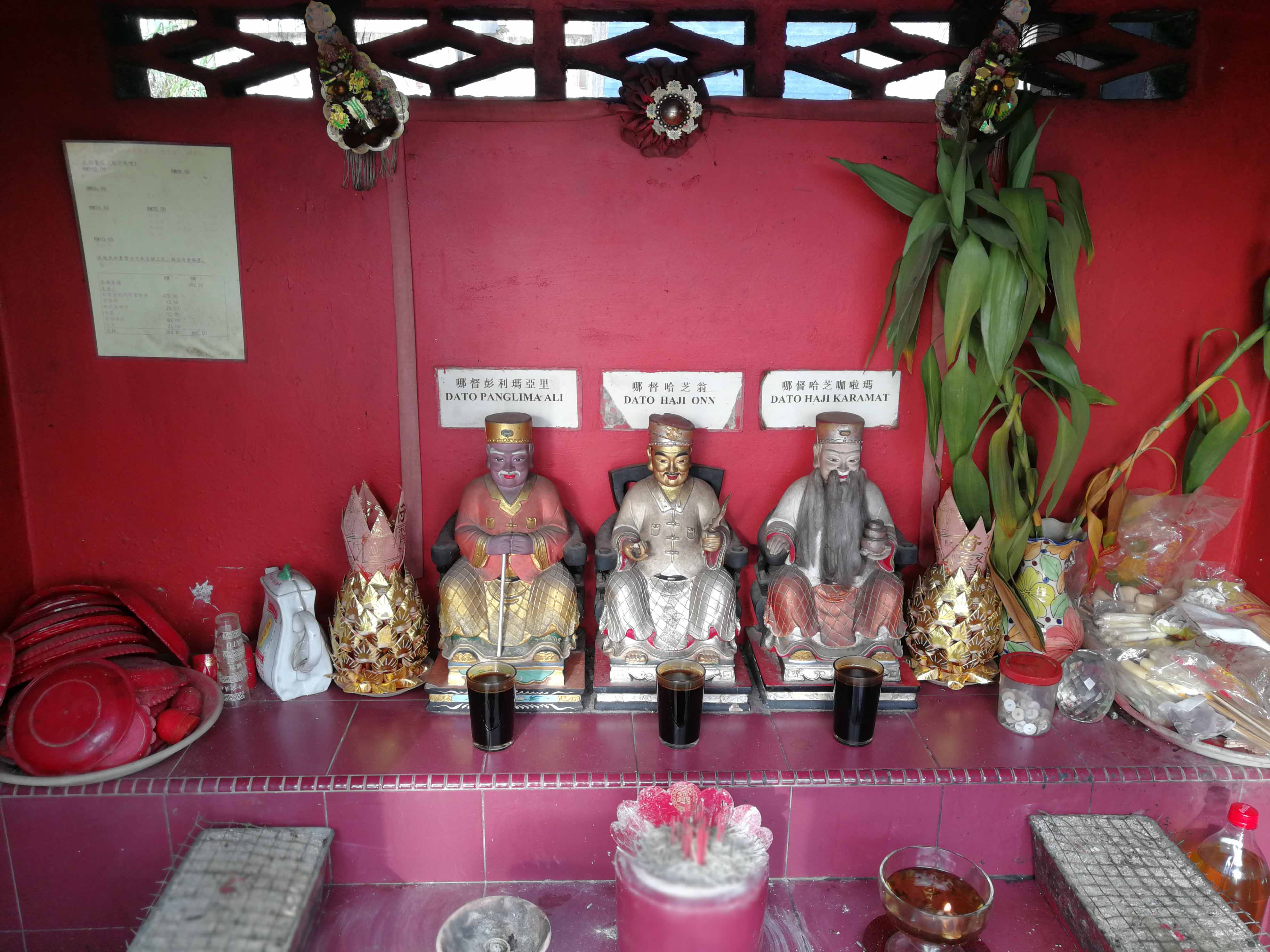
Batang Kali is located along the route to Genting Highlands. It has a dark past being the place where the Seventh Platoon, G Company, 2nd Scots Guard shot dead 24 unarmed villagers. This incident took place in 1948 during the Malayan Emergency at a rubber estate in Sungei Rimoh, Batang Kali.
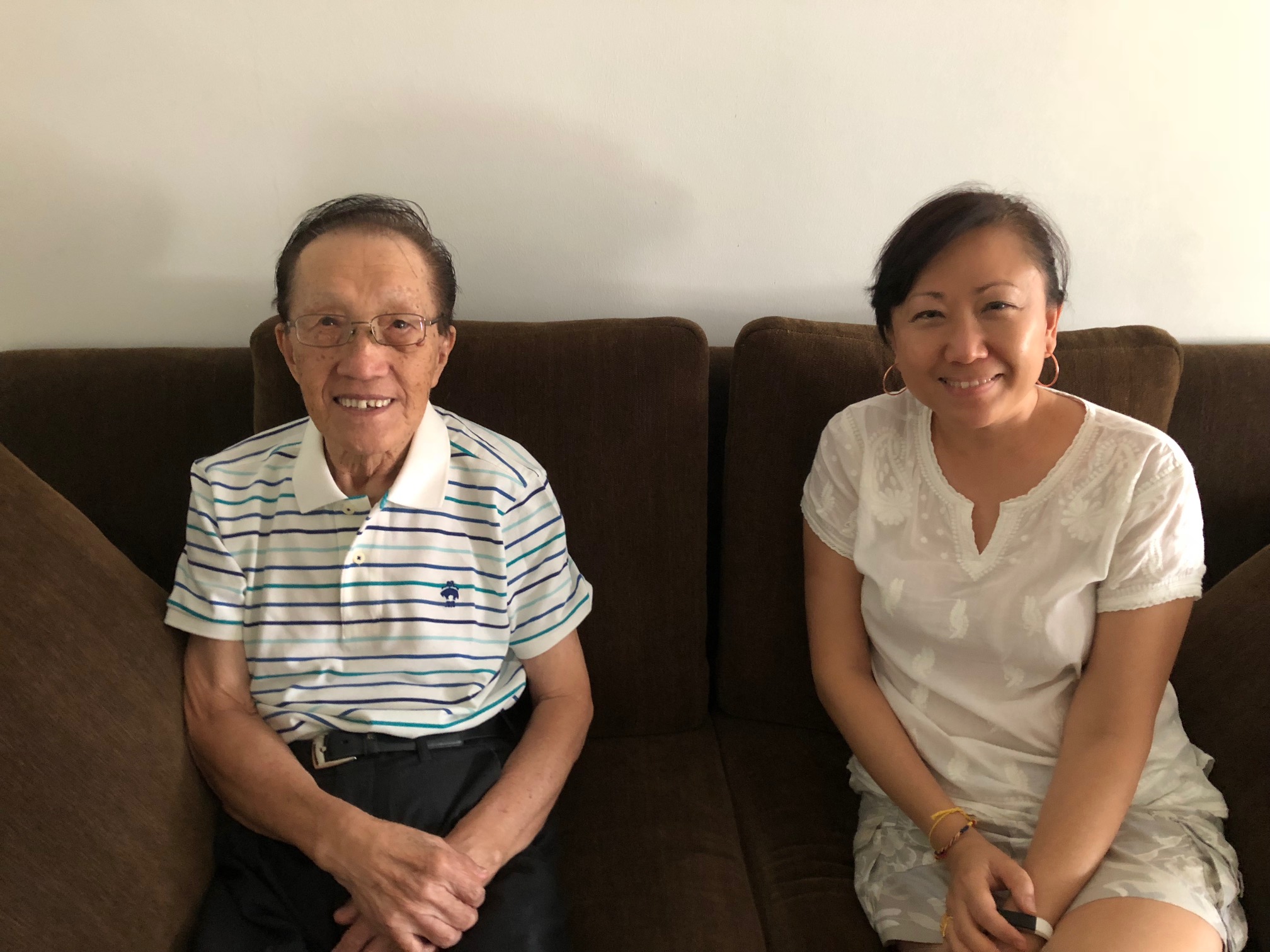
Today, Batang Kali is a quiet place but this predominantly Hokkien town has a unique cultural experience to offer its visitors. I participated in a tour recently through Lokalocal. The tour guide was Tek Eng Seng, a local resident of Batang Kali who is passionate about promoting the town.
The group met at KL Sentral before 10am and we made our way to Batang Kali. After an hour on the road, Eng Seng greeted us at Econsave and he gave us some local cucur udang (prawn fritters) to try. We had a fun-filled educational trip that is best told in photos.
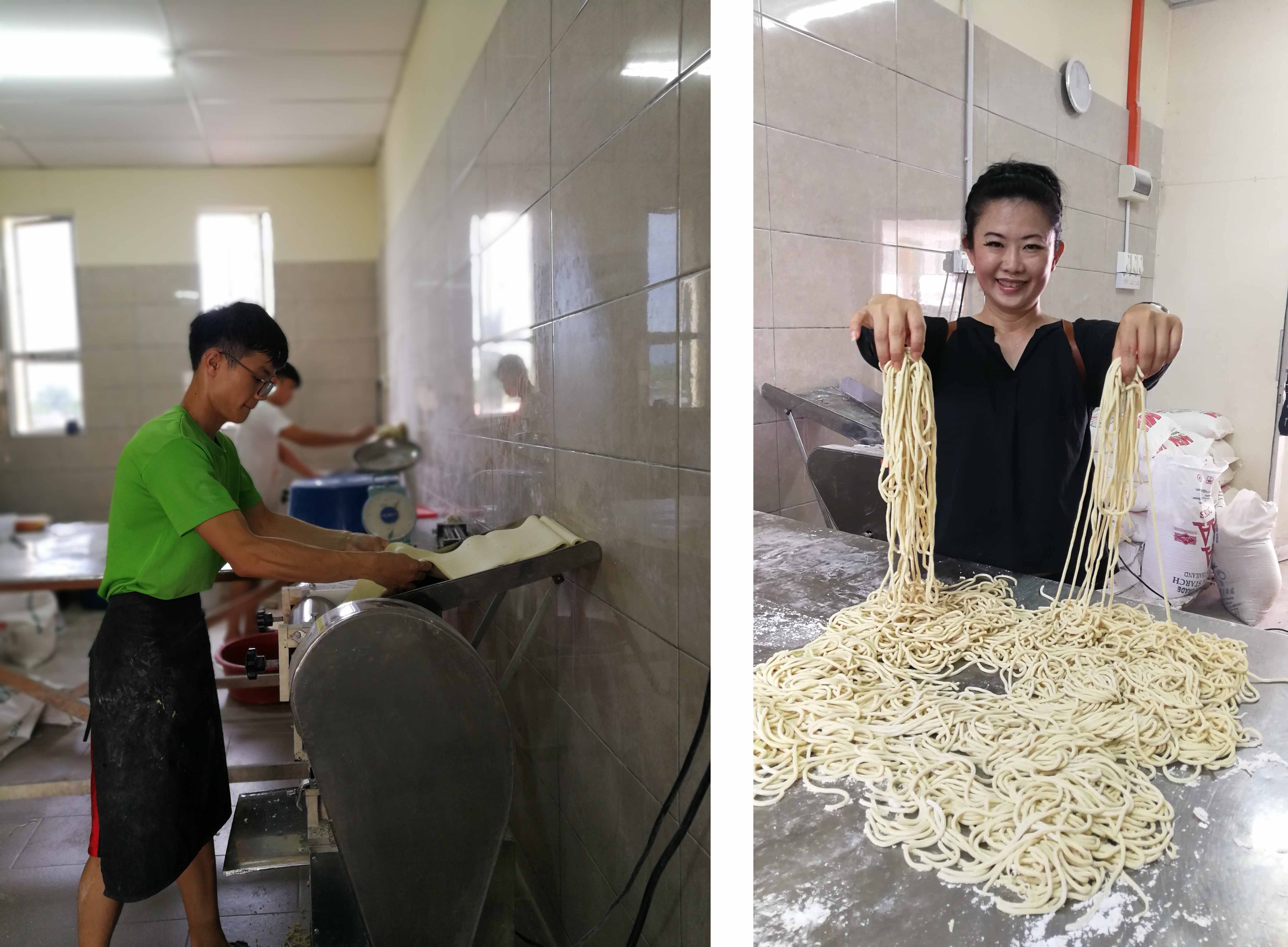
Our first stop was at Five Q Brothers Enterprise where we learned how to make loh mee from scratch. These noodles are a signature dish of Batang Kali and are traditionally cooked in a thick and starchy broth with a touch of black vinegar to give it a zing. Our noodle-making session was followed by a sumptuous lunch of Loh Mee (of course), Hokkien Mee and Lor Bak at the Hokken Town restaurant.
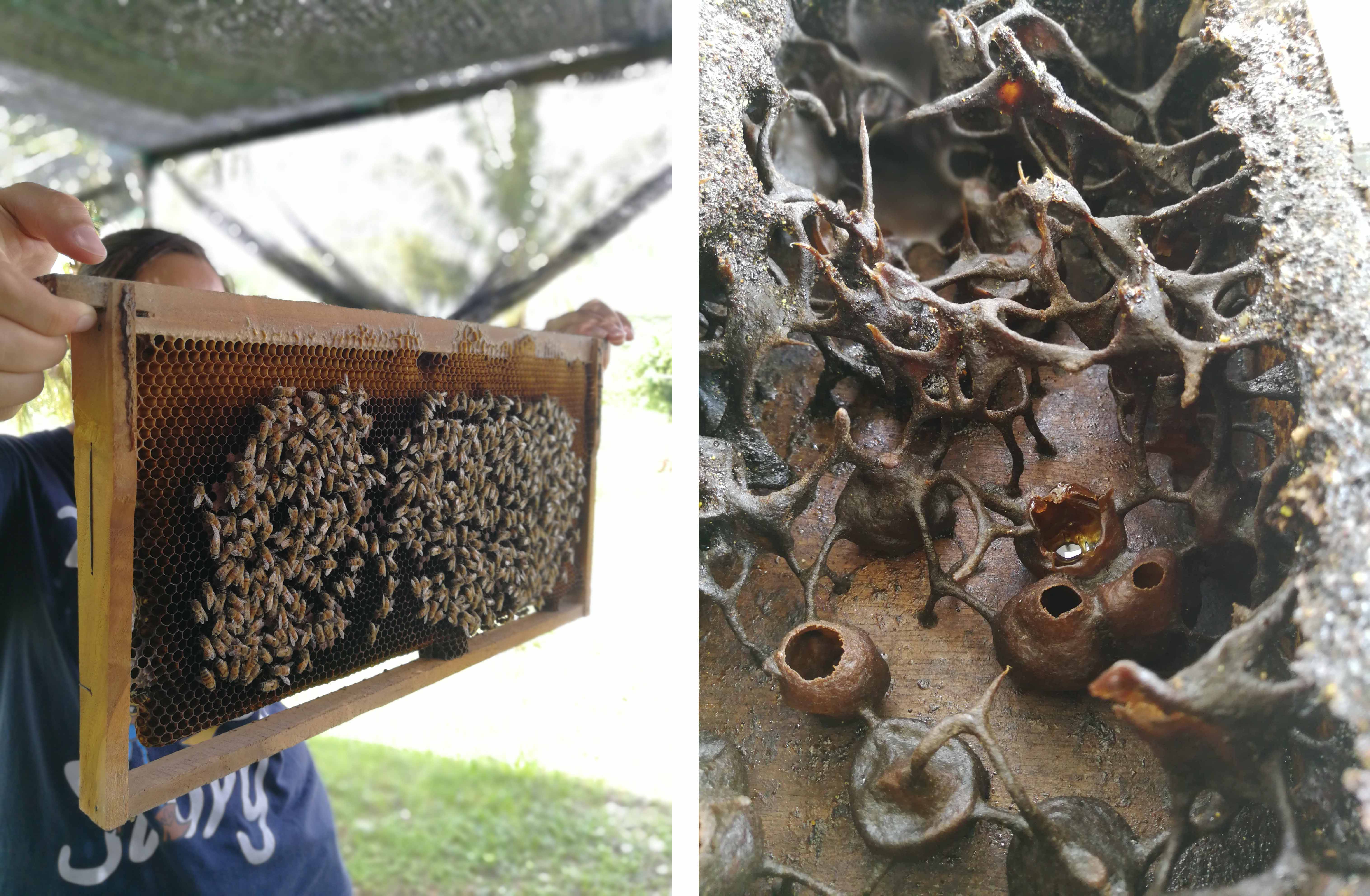
We then made our way to the organic Guava Fruit Farm. There is also a bee farm on the premises and we tried out various types of honey. I bought a box of wax honey.
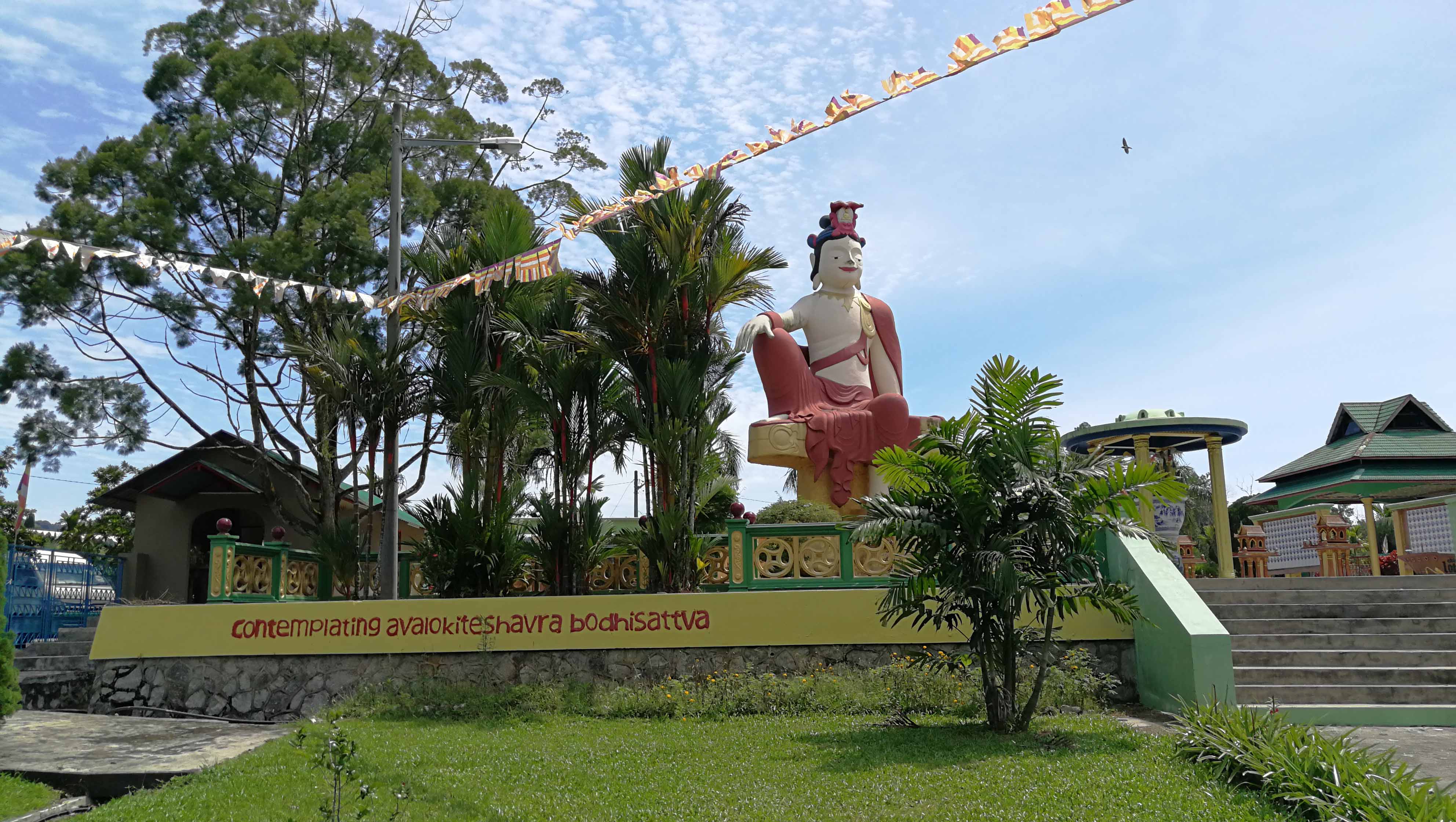
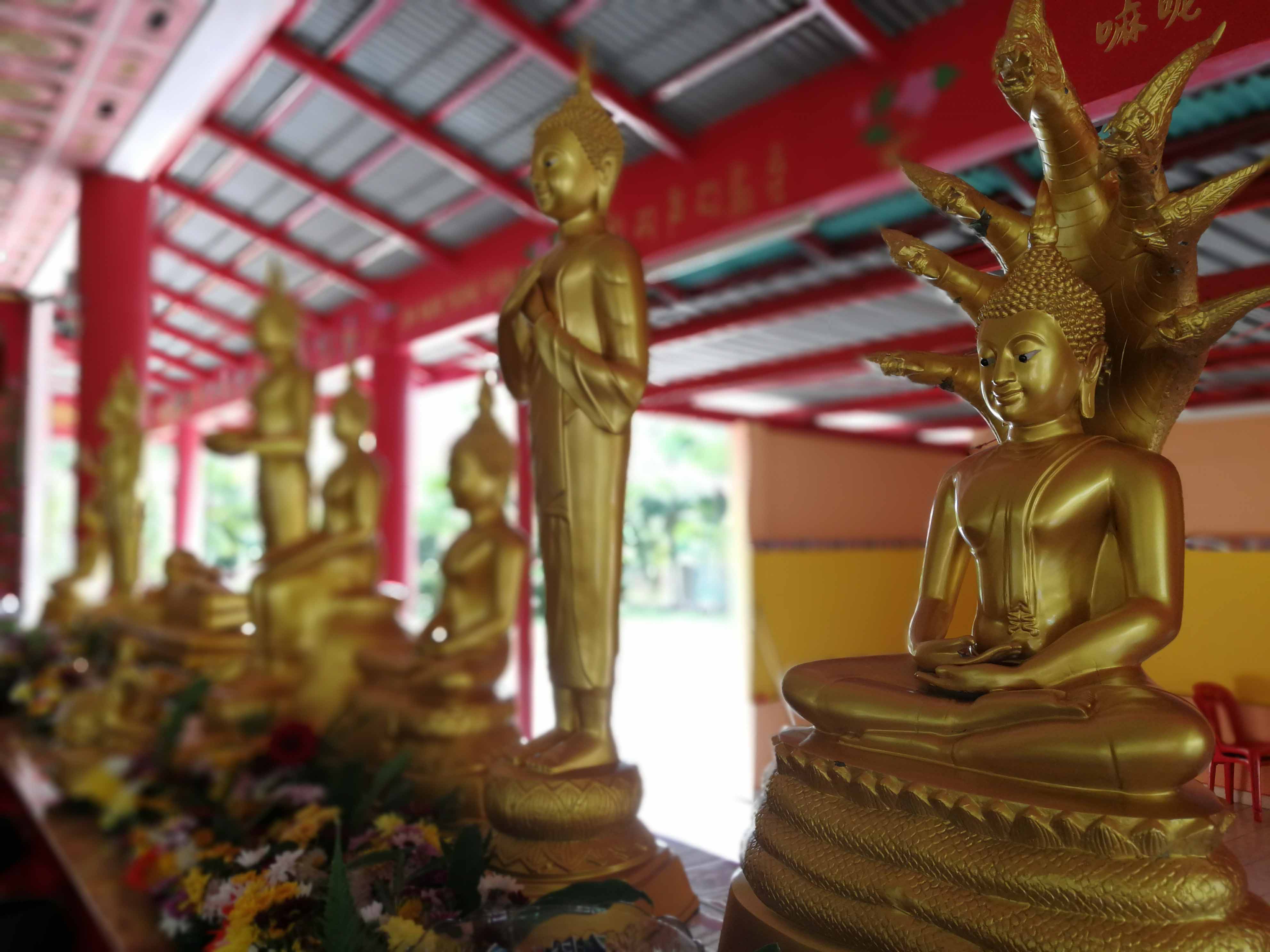
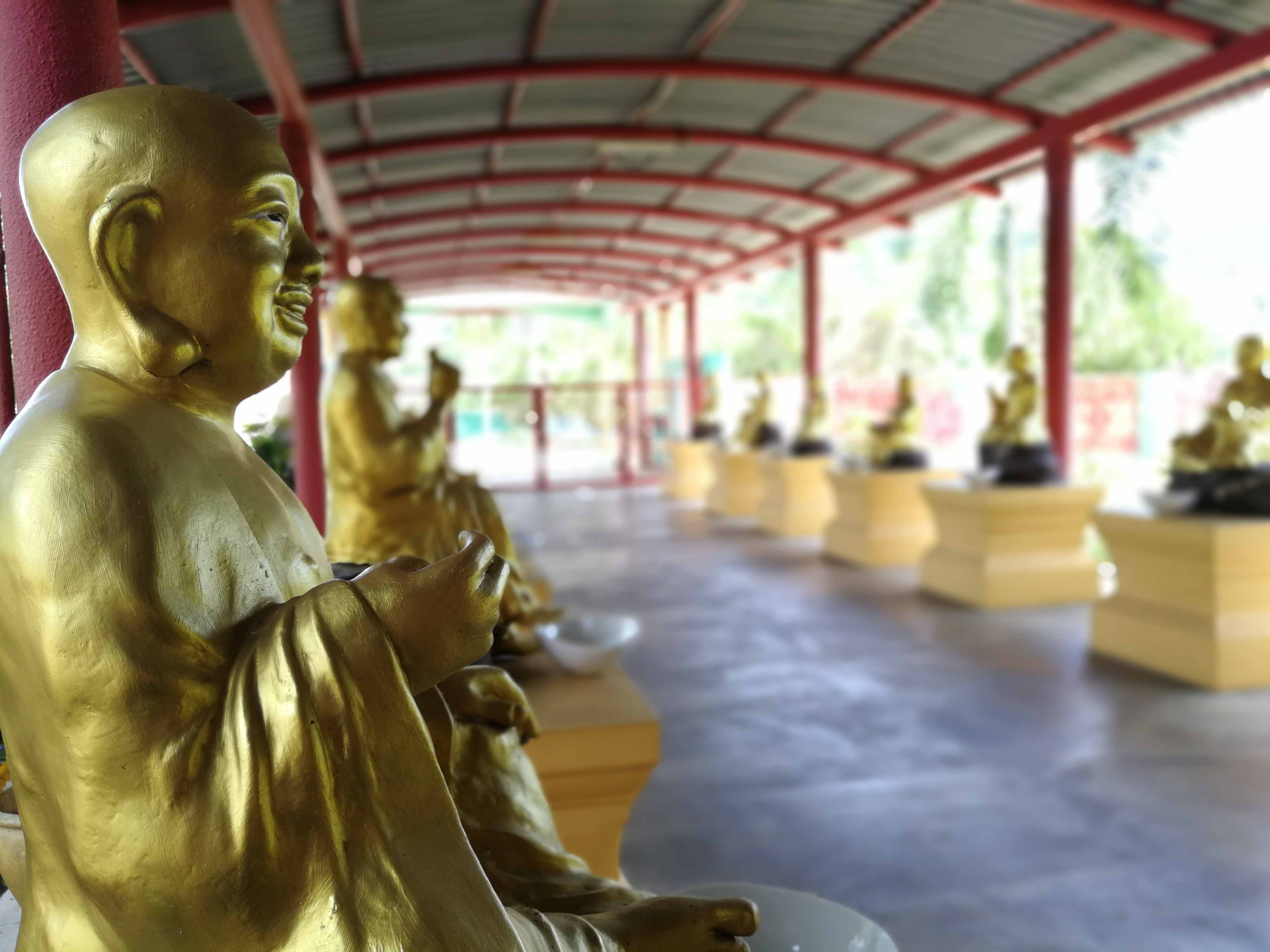
We then went to Kuil Siam Buddha Sakya Tharig Centre, which is actually a Tibetan Buddhist monastery. This was followed by a coffee break at Zhen Zhen Restaurant. Eng Seng bought various type of pau for us to sample.
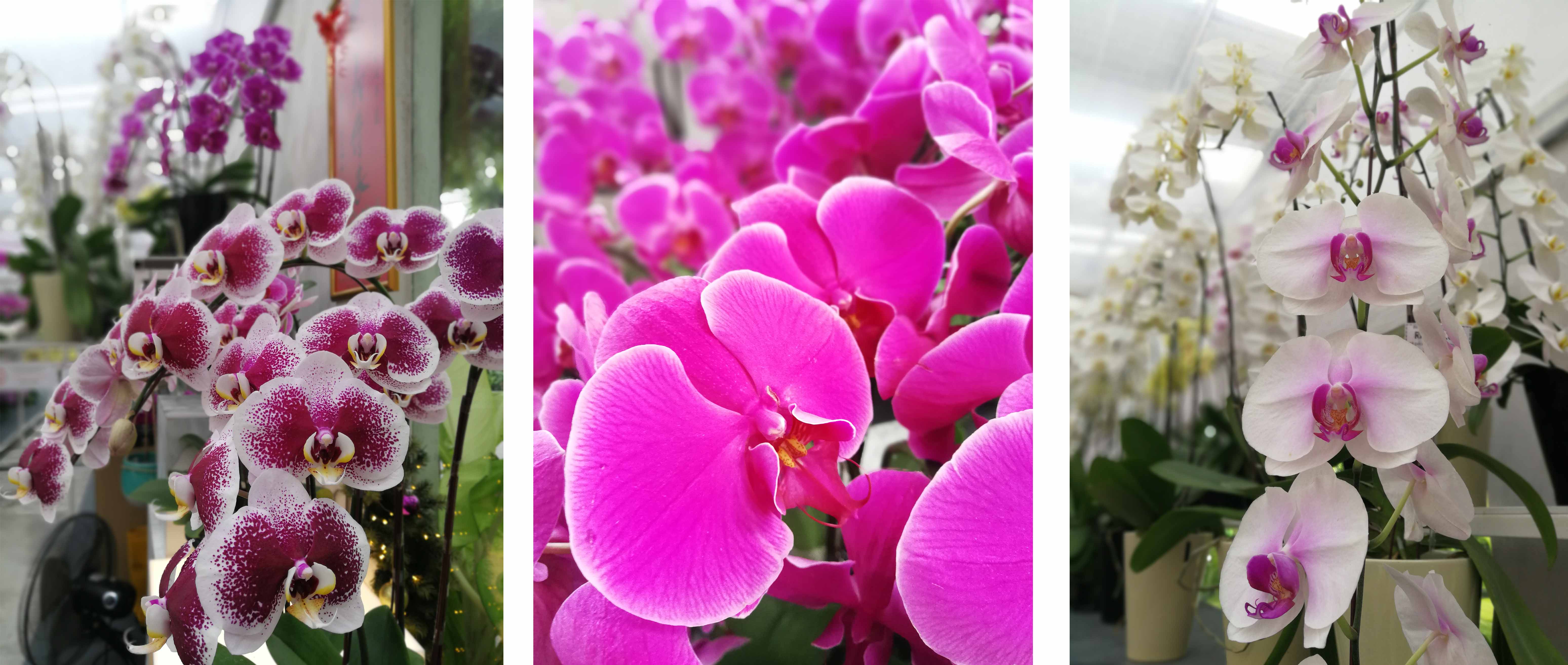
Our next stop was at the World of Phalaenopsis where we took lots of pictures of the orchids. Phalaenopsis is the scientific name for a genus of orchids, known commonly as the moth orchid. Many species of multi colours are grown at the World of Phalaenopsis.
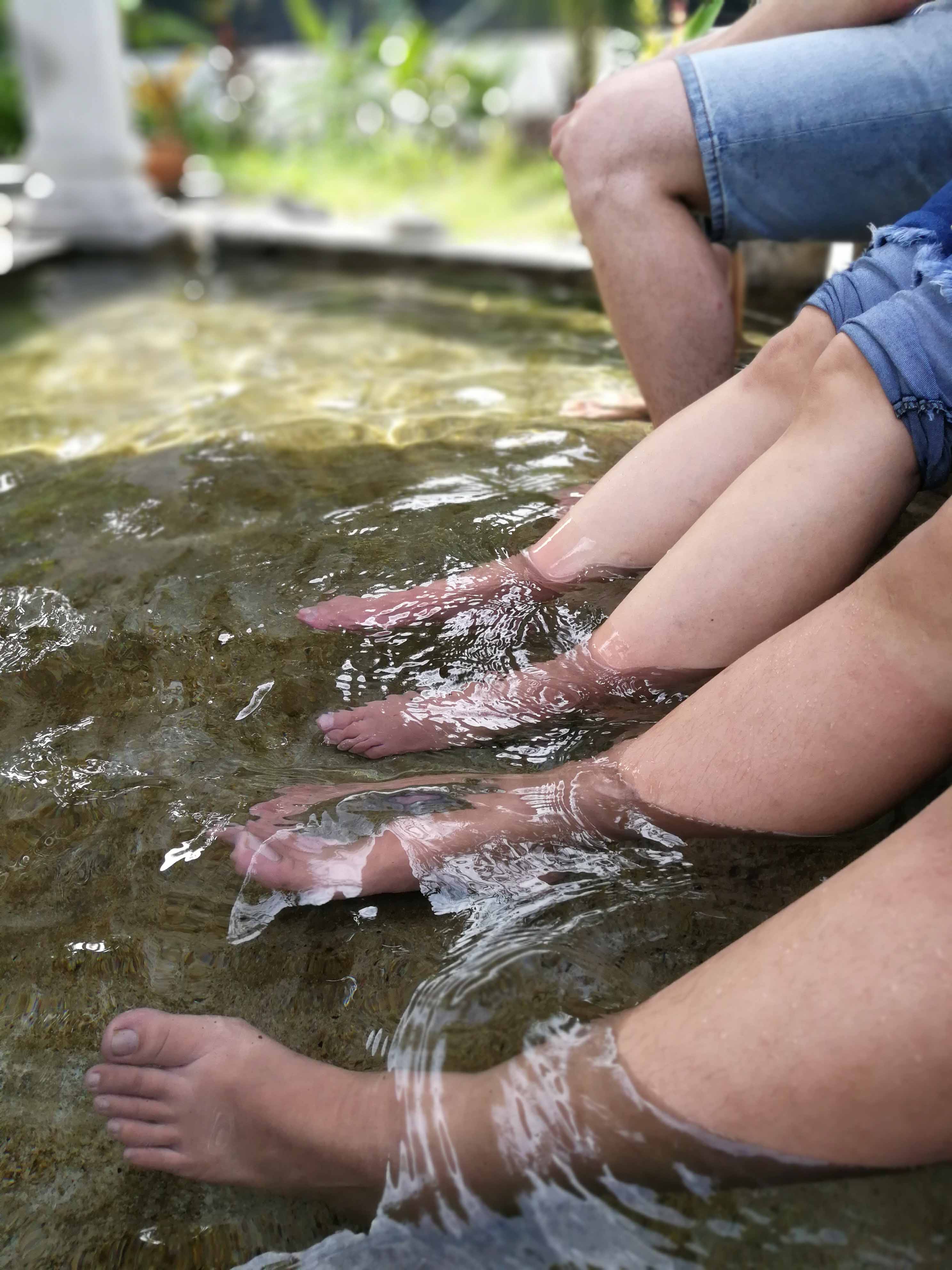
We then soaked our feet in the sulfur ponds at Cholo Cholo Hot Spring. Some of us had lobster feet but it was a good rejuvenation session even though the sulfur gas made my eyes smart. Eng Seng is such a gentleman that he bought me some eye drops.
Next, we visited the Fu Quan temple, which is located on a hill. This is the main temple of Batang Kali. We had quite an adventure here having been got locked out of our van. Luckily a local mechanic came to our rescue.
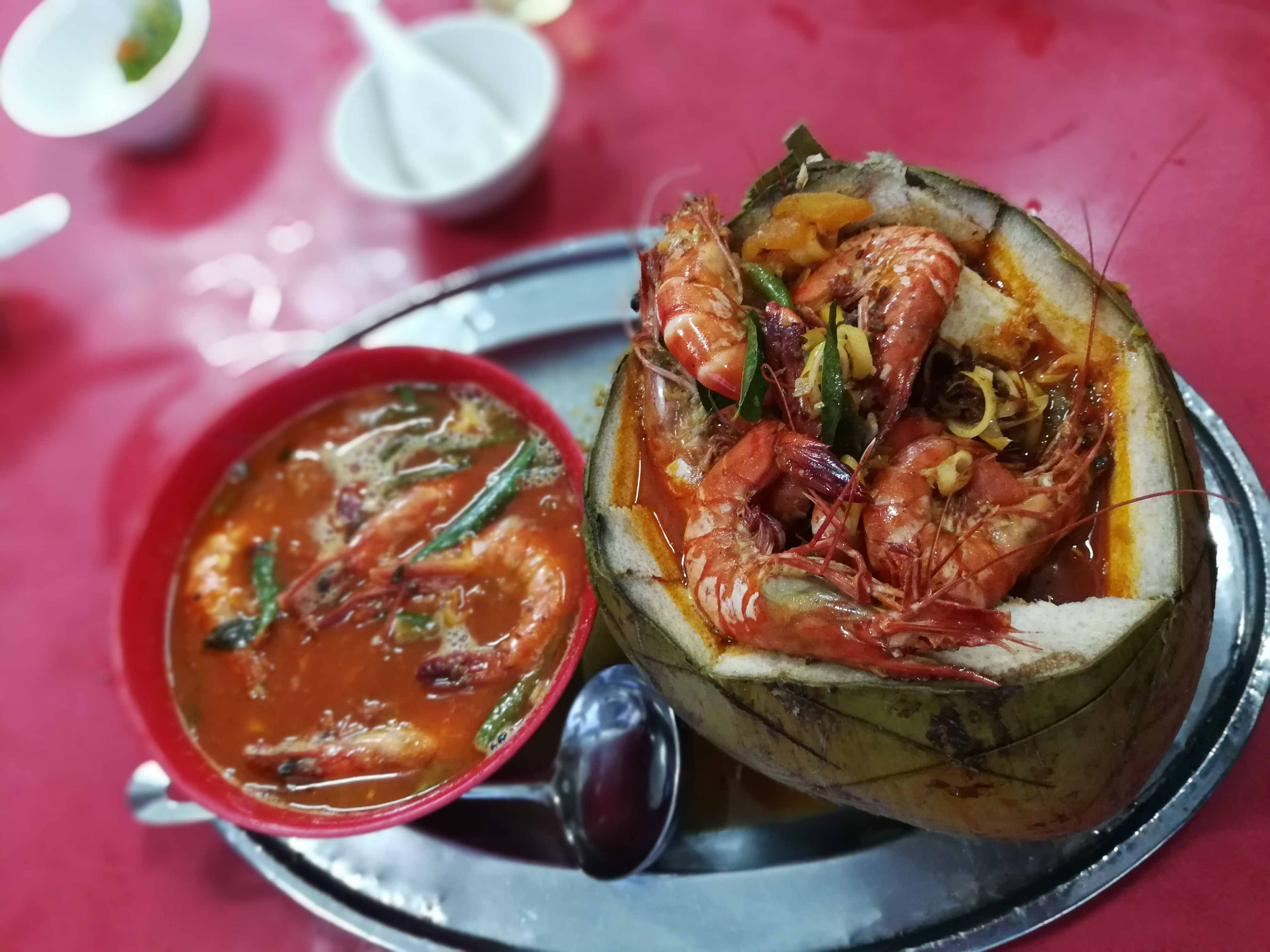
We ended the day with a sumptuous dinner at Hock Lay Restaurant. Eng Seng treated us to a delicious meal of Boned Pork, Fried Tofu, Tom Yum Prawns and Claypot Veggy.
Although other ports on the Malayan Peninsula and in Sumatra existed along the Straits of Malacca, none of these ports could rival Melaka itself in its heyday, with the entrepôt attracting traders from all over the world.[1] Those who look back upon this period often express nostalgia for a “Golden Age”, with Melaka’s power, wealth, and cultural refinement evoking the image of a distant kingdom, imbibed with majesty and magic. But nostalgia can often cast too strong a spell, and Melaka’s legendary status can obscure the actual reasons for the empire’s success. Though Melaka’s success was partly due to its strategic location, it was largely Melaka’s efficient administration that was central to its success as an international trading hub. The term “administration” does not merely refer to a group of officials, but to “the process or activity of running a business, organization, etc.”.[2] Melaka’s efficient administration was the result of two things: a clear system of law and an efficient system of governance. The region also benefited from effective communication and mutual cooperation, points that will be touched on toward the end of this article.
Spices – a source of wealth for the Melaka Sultanate. Photo taken at the Hang Tuah Centre in Melaka
Melaka had an effective legal justice system, which provided a clear framework for the facilitation of trade. Melaka has a clear legal system, with the region having two important legal codes that governed the affairs of the region. The first was the “Laws of Melaka” (Undang-Undang Melaka), a combination of customary and Islamic law that covered the special rights of the ruling family, dignitaries’ duties, government protocol, and both criminal and civil offences. This meant that there was a clear system that determined the state’s internal affairs, providing a stable basis for the day-to-day activities that took place in the area. But Melaka’s system also encompassed matters of trade, with the “Maritime Laws of Melaka” (Undang-Undang Laut Melaka) providing “rules for the proper conduct of trade, rules governing accidents at sea and regulations for boats and ships”. A clear system of taxation, import duties, customs duties, and gifts was outlined, with the details “varying according to the trader’s country of origin”. These laws provided a clear framework for the functioning of trade, minimizing the potential for large disputes with regards to transactions. The laws also applied the same principles governing affairs on land to those at sea, with captains “possessing power and authority akin to that of the ruler on land”.[3] In a world where so much human activity took place aboard ships, these laws greatly reduced the potential for chaos that could disrupt trade. The laws also covered safety regulations, covering “regulations for the safety of a prahu while at sea”. The law even detailed how sailors should deal with cargo in the midst of “a violent storm”, stating that the nakhodah must hold “a general consultation” of the crewmembers and not “indiscriminately” dispose of the cargo.[4] The clarity and detail of these codes meant that traders “understood what kinds of laws governed their trade”, with the “element of arbitrariness” being “removed” from commercial activity.[5] This provided a sense of security that encouraged traders from all over the world to bring their merchandise to Melaka.
However, a legal system is useless without an executive body to implement it, and Melaka possessed a clear system of governance to implement the region’s laws. Melaka had a clear bureaucratic system that managed the affairs of the region. Authority was centred on the sultan, whose sovereignty was not to be challenged. This notion of sovereignty or daulat was the cornerstone of Melaka’s social order: “without a king there could be no kingdom; without a kingdom there could not be ordered social life”. However, the king was at the summit of a larger governmental system, with the task of managing the country being regulated by a larger bureaucratic structure. Beneath the king were four principal officials:
The Bendahara – The Prime Minister or vizier
The Penghulu Bendahari – The state treasurer
The Temenggong – Head of Security and Law and Order
The Laksamana – Admiral of the Navy and chief emissary of the Sultan[6]
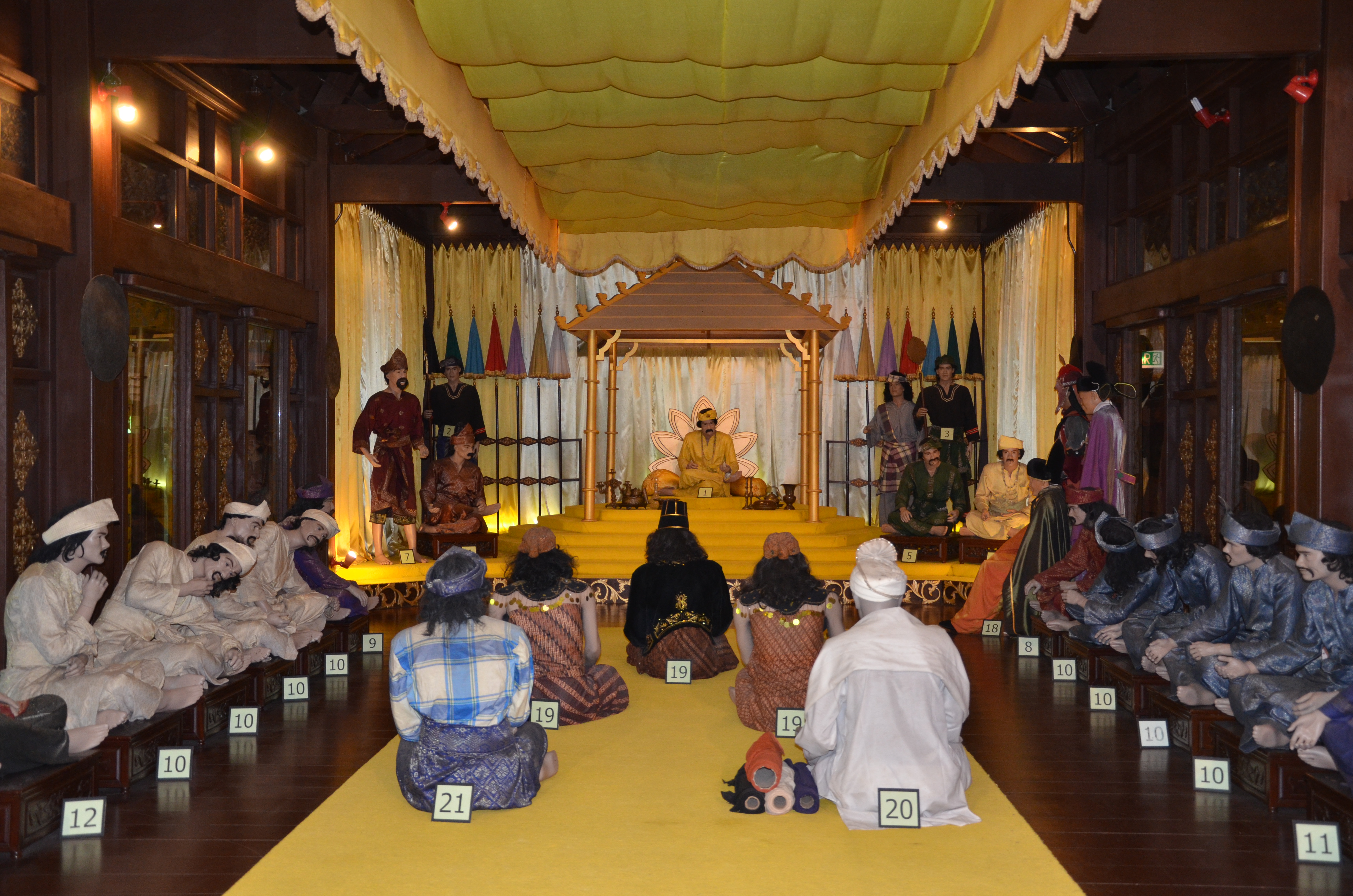
Diorama showing the seating positions of the various officials when paying homage to the Sultan. Positions of the four principal officials: Bendahara (5), Penghulu Bendahari (8), Temenggong (9), Laksamana (4 – seated, next to 7). Photo taken at the Melaka Sultanate Palace museum.
These officials existed with the framework of a larger governmental system called “The Fourfold System of Officials” (Sistem Pembesar Empat Lipatan). Beneath the four principal officials were eight lower-ranking officials, beneath these eight were another sixteen officials, and beneath these sixteen another thirty-two. This created a chain of command for the execution of orders, distributing power across a system akin to a civil service.[7]
The regulation of the traders themselves fell to four harbour masters (shahbandars), each of whom regulated the traders from a particular region such as Gujerat or the Malay Archipelago. The shahbandar was “often a foreign merchant who had acquired the trust of the ruler” who would “mediate between merchants of his home area and the ruler”. They also were responsible for many tasks, such as managing transport and making sure that the weights and measures were accurate. But the Malay rulers along the Straits of Malacca also understood the need for cooperation with the more nomadic elements in the society, who possessed skills important to the region as a whole. For instance, the Malay rulers established an alliance with the Orang Laut, “nomadic boat dwellers” that were a large percentage of the population. By establishing alliances with this group, the Malay rulers were able to maintain the safety of Melaka, with the Orang Laut using their seafaring skills to help “keep piracy within limits”. Similarly, the Malay rulers formed alliances with the hinterland dwellers, “gatherers of forest products” who were the “ancestors of the … Orang Asli”. The “bonds of personal loyalty” forged between these two groups resulted in “commercial and military benefits”.[8]
Justice, efficiency, and a willingness to work with others: these three components were ultimately the underlying factors that determined the overall administration of Melaka. It was this form of administration that ultimately brought about Melaka’s success as an entrepôt, making it a meeting place between cultures and civilizations. As we look back upon this “Golden Age”, the centrality of these principles in the proper functioning of Melaka are worth bearing in mind. For after visiting the kingdoms of the past, we must ultimately return to the shores of the present. And what good is a journey if you don’t return home with something useful?
[4] Raffles’ translation, as quoted in Reddie, 483 & 486.
[5] Syed Farid Al-Attas. “Prof Farid Alatas on Islam and Democracy.” Lecture, Liber TV, Malaysia, July 18, 2014, 2:57, https://www.youtube.com/watch?v=fe6mEbKnMRs (accessed November 3, 2017).
Al-Attas, Syed Farid. “Prof Farid Alatas on Islam and Democracy.” Lecture, Liber TV, Malaysia, July 18, 2014. https://www.youtube.com/watch?v=fe6mEbKnMRs (accessed November 3, 2017).
Miksic, John. “Entrepôts along the Melaka Strait.” In The Encyclopedia of Malaysia: Early History, edited by Prof. Dato’ Dr Nik Hassan Shuhaimi Nik Abdul Rahman, 116–7. Singapore: Editions Didier Millet, 1998.
Osman, Mohd Taib. “Trade and administration.” In The Encyclopedia of Malaysia: The Rulers of Malaysia, editorial advisory board chaired by Tun Ahmad Sarji bin Abdul Hamid, 114–5. Singapore: Editions Didier Millet, 2011.
Velupillay, Jegatheesan. “The Golden Age of Melaka.” In A Malaysian Tapestry: Rich Heritage at the National Museum, edited by Rose Gan and Maganjeet Kaur, 99–109. Kuala Lumpur: Department of Museums Malaysia, 2015.
This may sound more like a ‘Conan Doyle’ story than an article by a Museum Volunteer; so, let’s find out what’s behind this ‘Mystery of the Bunga Mas’.
Everybody will probably be familiar with the Bunga Mas, a reproduction of which is on display in Gallery C of the National Museum. The correct name of this artefact is actually Bunga Mas dan Perak, which, rather than ‘Golden Flower’ means ‘Gold and Silver Flower’. Indeed, it is very likely that such an imposing artefact, weighing several pounds, with a height of about 1.5 m1, would be very fragile had it been made of solid gold. But as the actual name seems to indicate, it was probably made of gold-plated silver.
The gifts of the Bunga Mas were sent to the King of Siam every three years, by the Sultans of the Northern Malay States (Kedah, Terengganu, Kelantan, Patani,…) accompanied with other gifts, such as shields and spears.
These gifts from the Sultans to the King, were probably laden with deep political misunderstanding: while the King of Siam would consider them as a recognition of suzerainty over the Malay Sultanates, the Sultans would simply regard them as a token of friendship. The relationship between the northern Sultanates and the Kingdom of Siam had never been an easy one, as can be seen by the various appeals for ‘protection’ to the different occupying powers, be it the Dutch or later the British. There could occasionally even be exchanges of concealed insults. According to a note found in the Cambridge University Library2 (Archives of the British Association of Malaysia and Singapore), the author mentions that he had seen a letter which was sent to the Sultan of Terengganu by the King of Siam in which the latter reversed the traditional courteous formula: ‘sending a gift from the Head of the Sultan to the feet of the King’, into the insulting reply: ‘from beneath the King’s feet to the crown of the Sultan’s head’.
The last Bunga Mas from Kedah to the King of Siam was sent in 1906. Three years later, another Bunga Mas was ready to be sent. In March 1909, however, before it could be send to Siam, Britain and Siam signed a treaty in which the sovereignty over the northern sultanates of Malaya (with the exception of Patani and Setul) was to be transferred to Britain.
According to the above-mentioned note, the Sultan of Kedah sent this Bunga Mas to King Edward VII instead. In the first report of the British advisor to Kedah, Mr. Maxwell, he noted that during the meeting of the State Council on August 23rd 1909, the question arose whether sending the Bunga Mas to Edward VII was to be regarded as ‘the last of a series relating to a remote past’. The offer was indeed accepted, and Tunku Muhammad Jiwa, who had conveyed the previous Bunga Mas to Bangkok, set off to Singapore. Two Bunga Mas, together with forty-two spears and twenty-four shields, as well as a Bunga Mas from Perlis, and ‘other offerings from Terengganu’, were sent to the Colonial Office, and were personally presented to the King by the Secretary of States to the Colonies.
This is where the mystery begins. Although the Archives of Windsor Castle mention that the gift had been received by King Edward, all of the artefacts have subsequently disappeared. There is no mention of them whatsoever in the Royal Collections. A few months ago, the curator for the Royal Gifts, when questioned by me about these artefacts, told me that they had never been heard of. They are certainly not registered in the current inventory.
Furthermore, it seems that another final gift of Bunga Mas was sent in 1911 to King George V by the Sultan of Kedah on the occasion of the King’s coronation. This too seems to have disappeared!
Now there is food for further research: Kedah Archives, Malaysian National Archives, British Colonial Office Archives…MVs! Get ready!
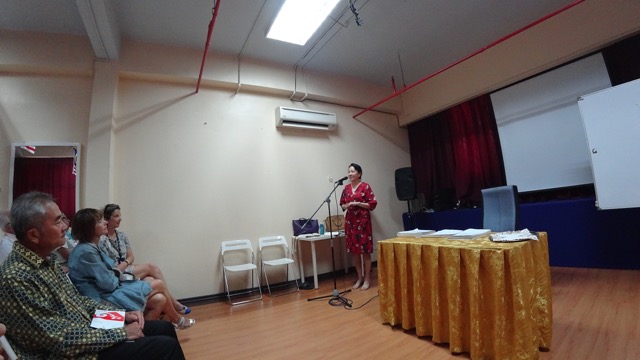
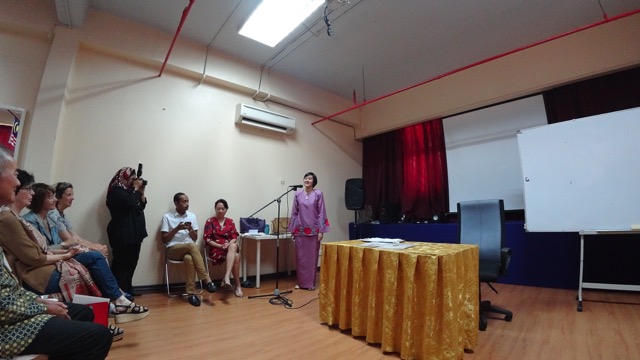
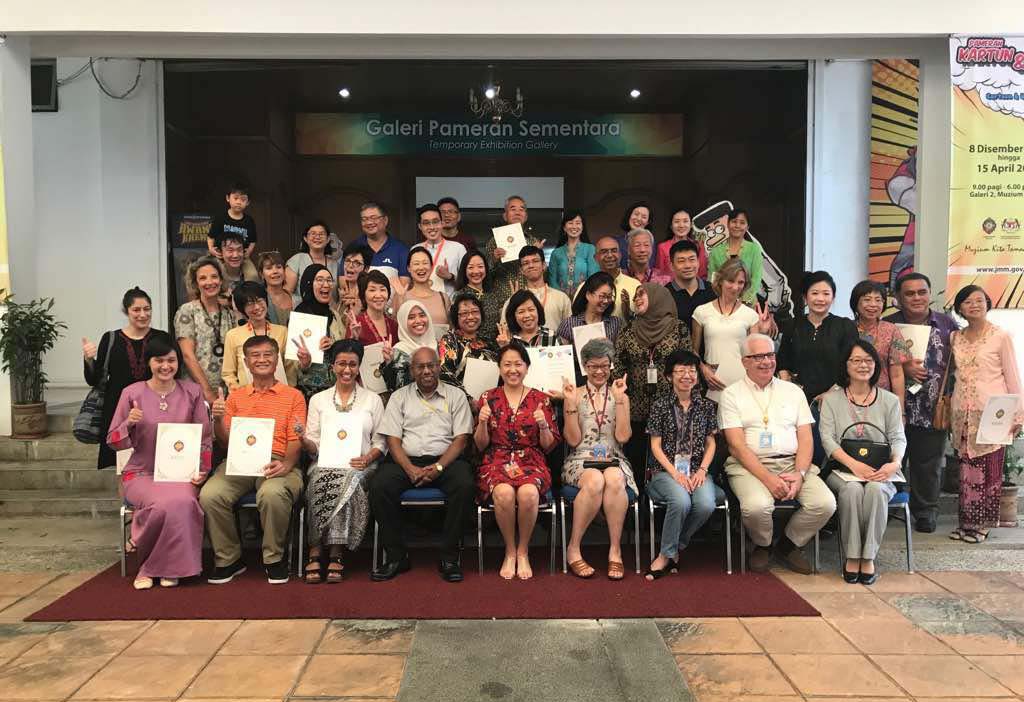
The graduation ceremony for Batches 28 and 29 took place on 10 March. Karen, in her opening speech, was happy to note that a high percentage of trainees graduated this year – 27 out of 30 from Batch 28 and 8 out of 9 from Batch 29. In addition, 16 out of 18 trainees from Batch 30 received their certificate of completion. She also noted that Batches 28 and 29 were the only batches to have trained in February and that the training programme will revert to September this year with Batches 31, 32, and 33. Karen highlighted that the current two-tier graduation will no longer be practised and that Batch 30 will be the last batch to receive course completion certificates. Moving forward, trainees will only receive graduation certificates. Moving forward, JMM has requested more Mandarin-speaking guides. In addition, Karen is looking at the MV extending tours to Muzium Tekstil and Muzium DiRaja.
Karen
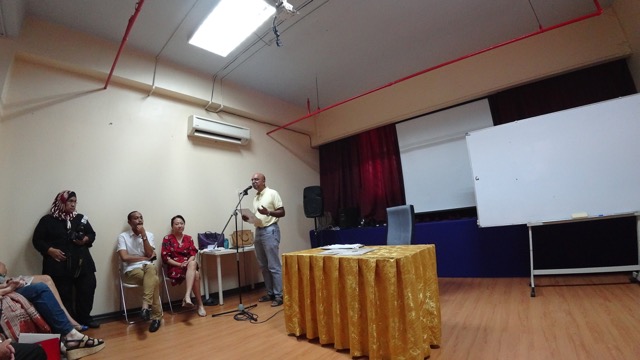
Representatives of the various batches shared their experiences. Below are the speeches made by Rama and Afidah, both from Batch 28.
Ramanathan L Manickavasagan (Batch 28)
Rama
About 14 months ago, on the 21st of January, 2017, the group known as “Batch 28 volunteers” met together for the first time. We were shown the schedule of training which we must attend and we were told what we must fulfil in order to qualify as guides.
We gasped when we heard that we would have to submit written texts and give oral presentations lasting 3 minutes for one artefact, 5 minutes for two artefacts and 15 minutes for a whole gallery. We shuddered when told we had to present without notes.
We were pleased when we learned that we would have mentors who would teach and encourage us. Our pleasure grew over the weeks as we realised how capable our trainers were, just as our anxiety grew because we saw they exhibited such high standards.
On 20th June 2017 we completed our formal training. By then
We had written 3 papers, varying in length from 500 words to 3,000 words
We had communicated often through WhatsApp messages.
We had accompanied at least 3 guides as they conducted public tours.
We had read much both in books and through online research.
We had completed our single gallery, 15 minute presentations and received feedback from our classmates as well as our trainers.
We felt like “maybe we can do this.”
Then we scheduled time with our trainer-mentors for us to do solo guides of the whole museum so they could watch us, give us feedback and decide when we would be ready to be rostered as museum guides.
Today each of us from Batch 28 has conducted at least 3 tours on our own. We have guided visitors from across a wide spectrum of humanity: young, old, eager, passive, aggressive, silent, interrogative, patient, impatient, well-read and unread.
We’ve often had the interaction I again had yesterday when I was guiding:
10 am
Guide: What made you come to the museum?
Visitor: Reading about how much visitors enjoyed the free guided tours.
12 noon (it usually takes 2 hours, not the hoped for 1 hr 20 minutes)
Guide: Did the tour meet your expectations?
Visitor: Oh, it’s even better than I expected.
We reverberate with joy when that happens. The joy comes not only from personal satisfaction. It comes also from the fact that each guide is a member of a community of guides who strive to excel in knowledge, presentation and service.
As I lay in bed last night thinking about the discourse during the morning’s guided tour, I recalled this passages from a book I read some years ago:
History is the study of humans and time, indeed, of humans changing over time. Furthermore, history is the memory of the stories about people changing over a time span. In a certain sense, history would not be possible if it were not for the telling of it. … History untold is not history at all. History … is vital to our human existence. To have no story is, almost, to have no life. People suffering from amnesia can live and function, but they lead pitiable lives because they have lost contact with their own story. (Wells, History Through the Eyes of Faith, page 2)
A year on, I realise we are story tellers, our subject matter is history and our goal is the removal of amnesia.
Becoming a museum guide has made us more thoughtful persons, more careful in what we say and driven to study. This is a day to be celebrated. I thank all of you, trainers and trainees alike, who have made it possible for us to join the ranks of amnesia-removers.
Afidah Zuliana bt Abdul Rahim (Batch 28)
Afidah
It has been my secret ambition to be a museum volunteer for about 22 years now. In 1996, the President of Korea Gas Corporation, Mr. Han Kap-Soo requested a visit to Muzium Negara. As a young Petronas executive, I was assigned to show Mr. Han around the museum. It was a daunting task as I had to rely on my Form 3 Malaysian history to inform this distinguished gentleman. Thankfully, I managed to pull through and surprisingly enjoyed myself, so much so that I secretly wished to be able to do more museum tours. Of course, the MV did not exist then. It was only last year that I finally had the opportunity to sign up as an MV trainee. Thank you Karen and team for making my dream a reality.
It has been a challenging journey for Batch 28 but I am sure you would agree that it has been well worth the effort. Thanks to our inspiring lecturers, MV trainers and librarians, our knowledge of Malaysian history has improved tremendously. Also, our presentation skills have been honed over the past year. Special thanks to my mentor, Jega. Thank you Poh Leng, Jean-Marie and Douglas for your dedication and patience in training us. Thank you to En. Jamil, Fiza & Jane of JMM for hosting us.
This MV training has certainly pushed me out of my comfort zone. Notably, when one of my visitors, having been on my tour, decided to introduce me to a Harvard-trained anthropologist so that we can talk shop! With nerves of steel, I drew upon my MV training to get through our lunch and I am happy to say that we are still in touch. The training also gave me the confidence to seek out a curator from the Asian Civilisations Museum and engage in conversations with Singapore docents.
My world has expanded with this experience. I joined the MV trips to Sin Sze Si Ya temple and Royal Museum – places I had not visited, even as a local. Above all, the MV training has given me a deeper appreciation of Malaysian history and culture. As a Malaysian, I am proud of our rich heritage.
So far, I feel that I have gained more than I have given. Now, it’s payback time! I tell almost everyone I meet about our free guided tours. I look forward to my monthly guiding duty and to future MV events. There is still so much more to learn.
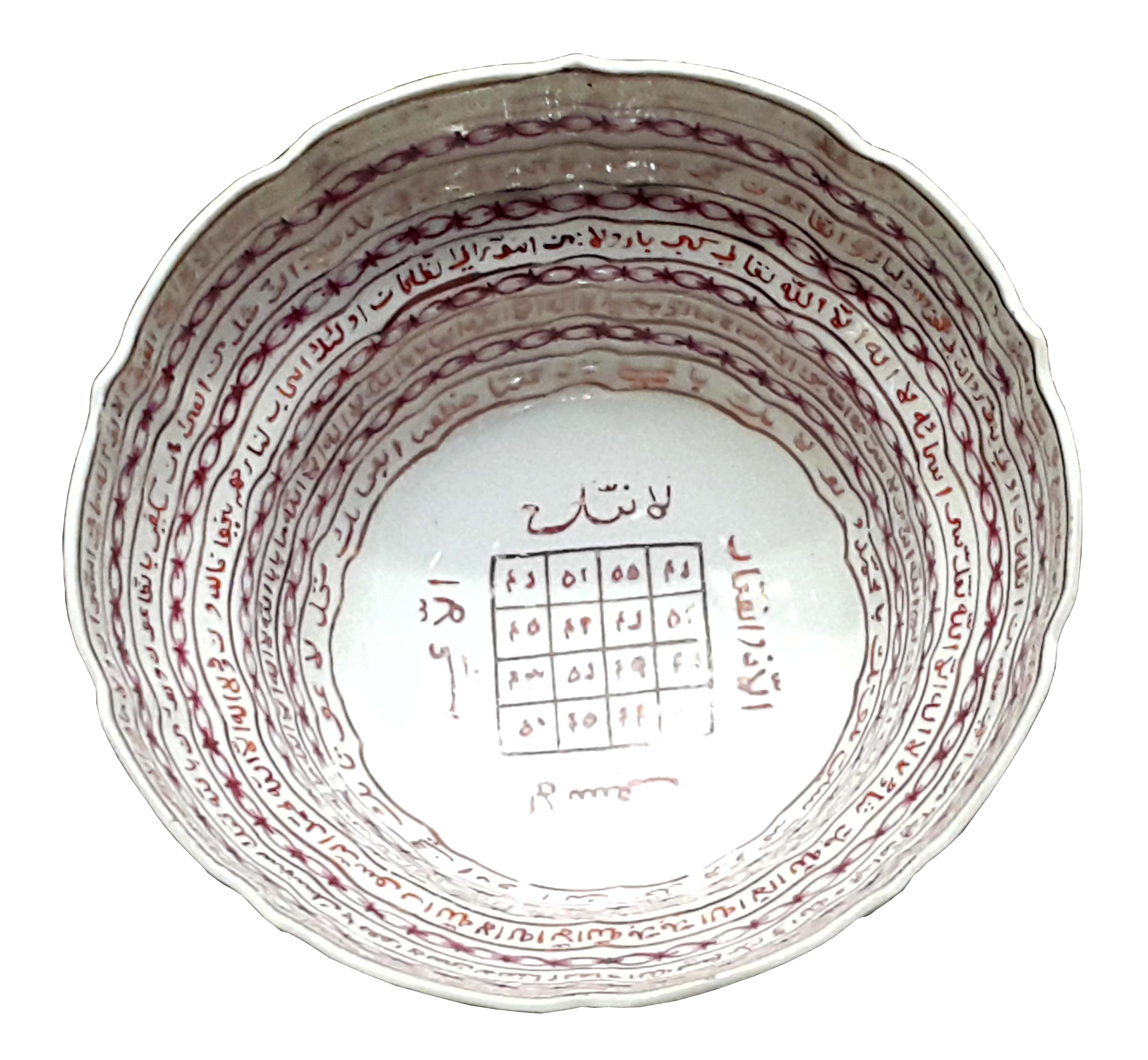
Amidst a number of examples of the Islamic influence on metal and ceramic wares in a showcase in Gallery B, a small bowl can be found with the intriguing description ‘Magic Square Bowl’. It looks like a small Chinese rice bowl but is decorated with Islamic script. On the inside of the bowl is a square consisting of sixteen smaller squares, also containing Islamic writing. Was it used to perform magic, or was it magical in itself?
During the Tang Dynasty (618-907) Chinese ceramics with Islamic script were already produced in China and transported along the maritime trade routes by Arab and Persian traders. After the Tang Dynasty, ceramics with Islamic inscriptions were no longer produced. Only in the early 16th Century did they appear again. The Magic Square Bowl in Gallery B is from the 18th Century Qing Dynasty.
The Magic Square, or Buduh tradition, predates Islam. The early Magic Square is thought to be of Chinese origin and consisted of a 3×3 square with 9 smaller squares. The numbers 1-9, with the number 5 in the centre, add up to 15 in each row, column and the two diagonals. An early version of Sudoku? A Magic Square was used to find love, prevent fears, attacks and poisoning. It helped during childbirth and also in finding lost objects. In short, it could be quite helpful for many occasions. Later, there were Magic Squares of 4×4, 6×6, 7×7, and 10×10, and even 100×100 squares with an arrangement of letters and numerals.
Islamic mathematicians in the Arab world already knew about the Magic Square as early as the 7th Century. This knowledge may have come from India through the study of Indian astronomy and mathematics, or from China. The earliest Magic Squares were written in ‘abjad’ letter-numerals. The four corners of the square were marked with the letters ba’, dal, waw (or u) and ha. Therefore, this particular square was known as the ‘Buduh’ square.
The name ‘Buduh’ itself was so powerful that it was regarded as a most effective talisman, and so was the letter B with its numerical equivalents 2,4,6,8. This arrangement of letters and its corresponding numbers is believed to protect travellers, babies, postal letters and packages. Even today in some Islamic countries, one can find packages marked with the numbers 2,4,6 or 8 in the corners, or just the letter B added under the address to ensure that the items arrive safely. This might be something worth trying out!
Magic Squares were used by Muslims as religious mandalas, meditation devices, talisman, and amulets. They were drawn on a variety of objects, even on skin.
The Arabic letters and numerals in the Magic Square can also be read as one of the ninety-nine names or attributes of God. The numerical value with a certain specific meaning can be obtained by adding the corresponding letters of any of the columns of the Magic Square in a horizontal, vertical or diagonal way.
One wonders what the inscriptions in the Magic Square Bowl in Gallery B represent…
Do they have a religious meaning?
Or are they just meant to bring good luck in any situation?
Bibliography:
Invulnerability, Federation Museum Journal, Volume XVI new series 1971
Arts and Crafts Company, Global Arts and Crafts, Antiques, Design and Art, Kho- antiques ( Singapore)
Islamic Medical Manuscripts at the US National Library of Medicine, Catalogue: Astrology/Divination/Magic, Author: Emilie Savage-Smith PH.D. Senior Associate, The Oriental Institute University of Oxford
A pharmacy may seem an unusual place to look for petrified fossils but palaeontologists in China used to frequent these shops to get leads on possible sites for archaeological digs. This is because farmers coming across ‘dragon’ bones would sell them to medicine shops where they were pounded into a remedy for a wide range of ailments. The palaeontologists recognised that these dragon bones were in actuality fossils of extinct animals. Peking man was discovered through such a lead.
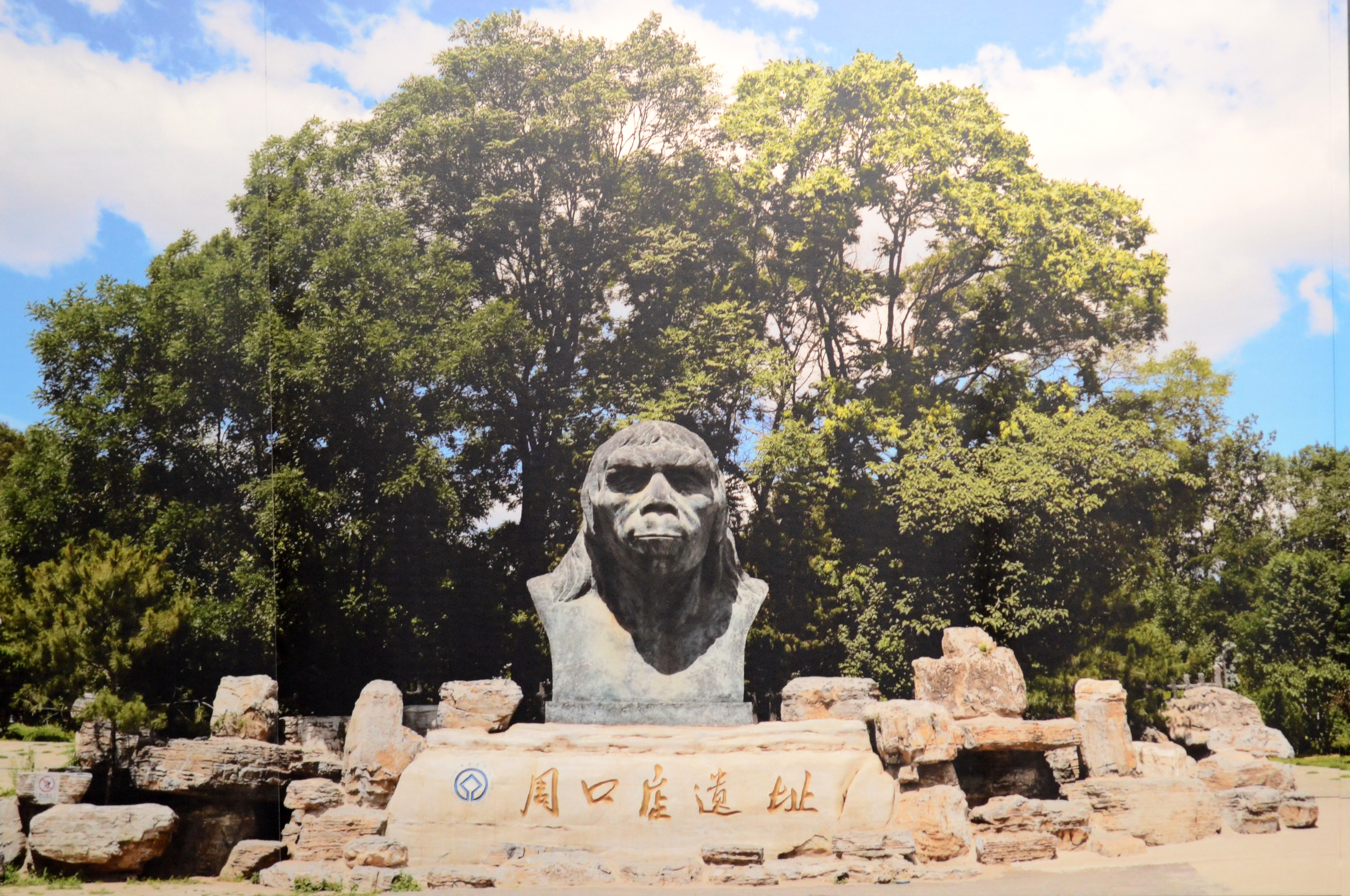
In 1923, Otto Zdansky, an Austrian palaeontologist, unearthed a rich hoard of fossils at Chou Kou Tien (now Zhoukoudian), which is located around 50 kilometres southwest of Peking (now Beijing). The hoard consisted of at least twenty species of animals, majority of which are extinct. This impressive find was made momentous by two small teeth – a molar and a premolar. The teeth were those of a hominid (primitive man) said to have lived around 500,000 years ago (Chinese scientists later revised this to 700,000). The moniker ‘Peking man’ was coined. The importance of Peking man prompted the establishment of a formal programme to continue the exploration at Chou Kou Tien. The programme was led by the Peking Union Medical College (PUMC) and funded by the Rockefeller Foundation.
Zhoukoudian site
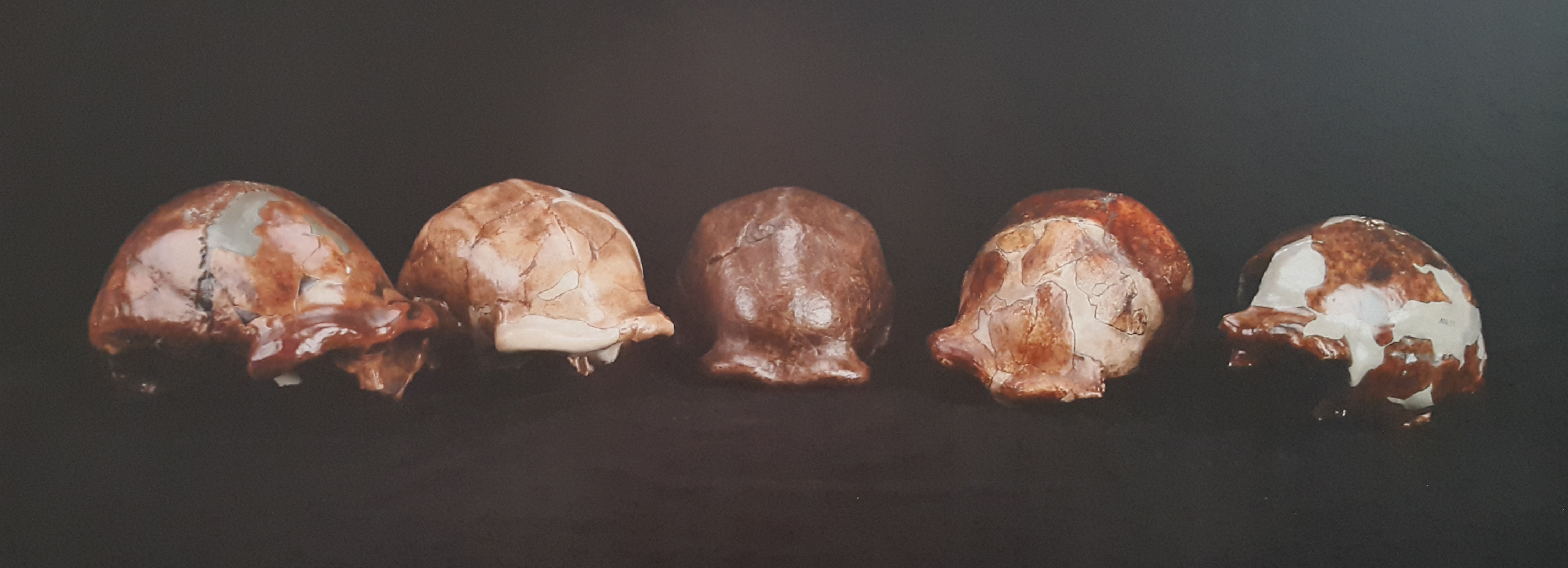
Further excavations led to more hominid finds. In 1929, Pei Wen Chung found the first complete skull. By 1937, the collection of bones had grown to represent 40 separate individuals – men, women, and children. These individuals were all part of a single population group. Finding an array of bones which represents a single population is very rare and this further illustrates the importance of Chou Kou Tien. Peking man is not so much an individual but rather an epithet used to represent this population. Although initially given a separate genus, Sinanthropus pekinensis, Peking man is now accepted within the genus Homo with the species name Homo erectus Pekinensis.
Replica of five skulls found at Chou Kou Tien
Excavations had to be halted in 1937 because of growing tensions between the Chinese and Japanese. The PUMC had so far escaped raids by the Japanese as the institution was American; Japan was not at war with America. However, there was a growing sense of danger and in 1941 this became so pronounced that the Chinese appealed to the Director of PUMC to send Peking man to the US for safekeeping. This, the Director was reluctant to do as the understanding between PUMC and the Rockefeller Foundation was that all finds from Chou Kou Tien would remain in China. However, in August 1941, the Chinese managed to persuade the American ambassador to ship out the fossils.
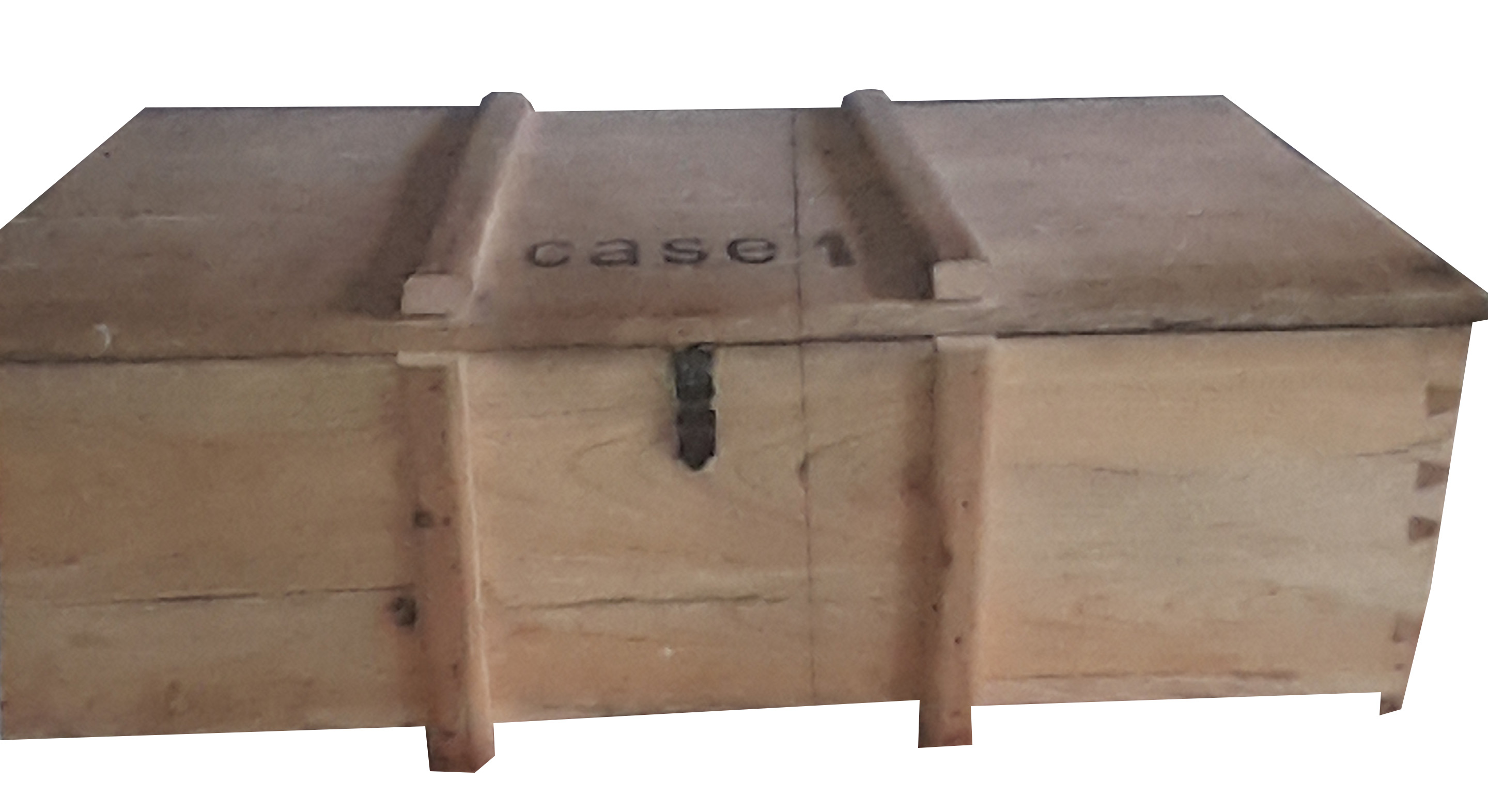
Due to some unknown delay, the fossils were only prepared for shipment in mid-November 1941. They were wrapped in cotton and packed in small boxes. These boxes were then placed in two wooden boxes, similar to the footlockers used by the U.S. Marines for their personal effects. The footlockers were sent to the U.S. Marines barracks in Peking as the marines were entrusted with taking them safely out of China. The marines, though, were not aware of the contents of the footlockers or of their importance.
Replica of a footlocker in which Peking man was packed
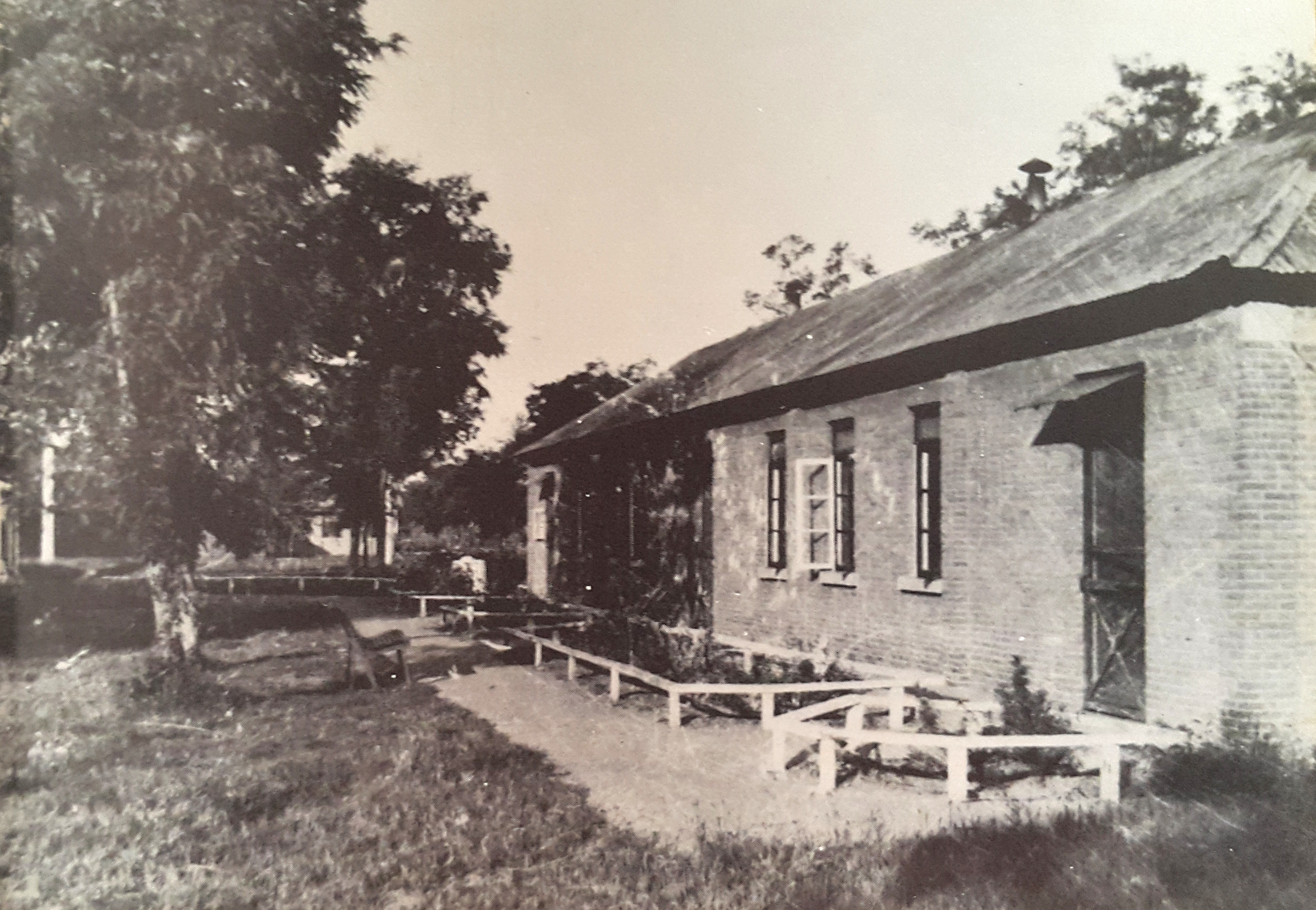
The marines were to rendezvous with the SS President Harrison, which had been commissioned to transport them to Manila and which was due in the port of Chingwangtao (now Qinhuangdao) on 8 December. But time had run out. Japan bombed Pearl Harbour on 7 December and the two countries were now at war. American property and personnel were no longer inviolate. The SS President Harrison, captured by the Japanese near the mouth of the Yangstze River, never made it to Chingwangtao. The footlockers are believed to have reached Camp Holcomb, a U.S. military base in Chingwangtao. However, this camp was taken over by the Japanese on the morning of 8 December. The Peking man fossils disappeared, never to be seen again.
Camp Holcomb, U.S. Marine base, the last know location of Peking man
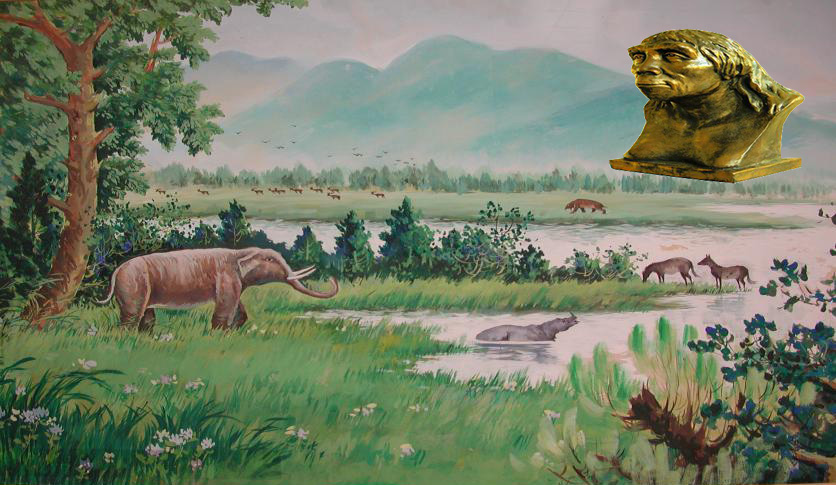
With the fossils missing, what is being displayed at the ongoing exhibition at Muzium Negara? The team at PUMC had photographed the fossils, made detailed drawings, and created casts. These had been safely taken out of China. The artefacts at Muzium Negara are replicas of the Peking man fossils, recreated from the casts. Also displayed at the exhibition are replicas of skulls from Upper Cave, located southwest of the Peking man site. These are skulls of humans (Homo sapiens) that lived 30,000-10,000 years ago. They were packed together with the Peking man relics and, hence, suffered the same fate. Do visit the exhibition which ends on 16 June 2018. See how Peking man looked like. Learn to differentiate Homo erectus from modern Homo sapiens. Understand the environment in which Peking man lived and the animals with which he shared this environment. Appreciate the tools they made and how they controlled fire. Learn about other archaeological sites in China, from Palaeolithic to Neolithic. Find out the earliest known location where shoes were worn.
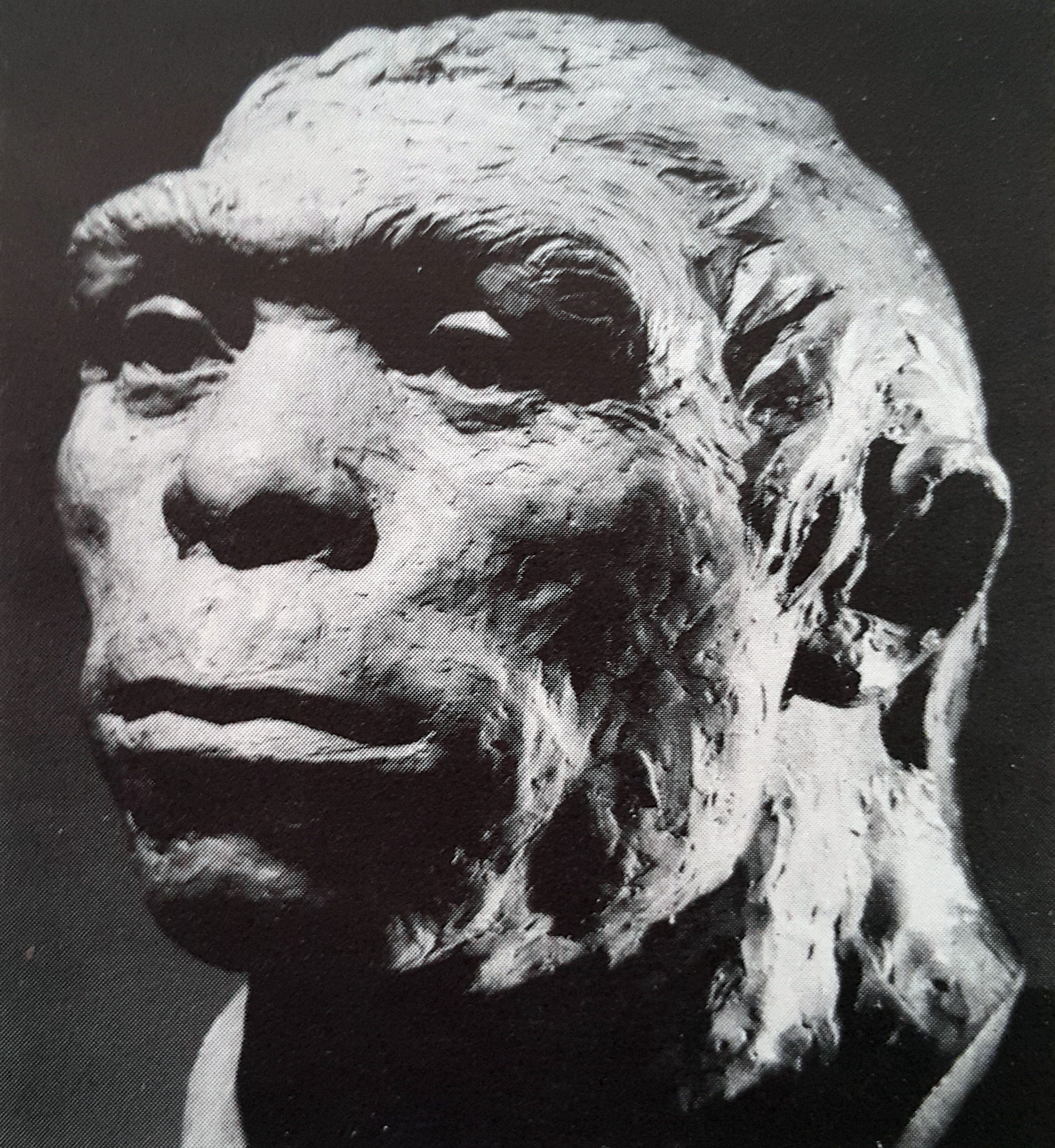
A reconstruction of Peking man by Harry Shapiro. Peking man was short, muscular, and broad-shouldered. He had a low brow which projected prominently just above the eyes. His skull was flat and small compared to modern humans. His neck was thick, almost bull-like. His arms, which reached his knees, were longer than his legs.
In retrospect, it may have been better to have left the fossils in PUMC and allow the Japanese to acquire them. The Japanese were aware of these fossils and came looking for them on the morning of 8 December. Some of the Chou Kou Tien fossils of lesser importance had been left behind and the Japanese confiscated these. After the war, the Americans found these fossils at Tokyo University and returned them to China. The Japanese would not have destroyed Peking man as they had wanted the fossils for their own research and study. If taken by the Japanese, the fossils would have been, in all likelihood, eventually recovered. Over the years, some have claimed to either know the location of the fossils or to have them in their keeping. These claims were made mostly by people seeking huge rewards. The leads were followed up but did not pan out. Among the latest claims is that Peking man is buried under an asphalt parking lot in Qinhuangdao (formerly Chingwangtao).
The environment Peking man lived in, shared with animals now extinct
Primary source: Shapiro, Harry L. (1976) Peking Man: The Discovery, Disappearance and Mystery of a Priceless Scientific Treasure, Suffolk: Book Club Associates.
We are all familiar with the legend of Prince Parameswara fleeing from Srivijaya to Temasek and then to a place named after the tree he sat under. Much less is known about the tree itself: the Melaka tree. Phyllanthus emblica, known as the Āmalaka or Āmelaki tree in Sanskrit, is very common in India, Nepal and South-East Asia and has given its name to Melaka city and the Straits. Its common name in English is Emblic myrobalan (Myrobolan emblique in French) and it produces a fruit called the Indian or Nepalese Gooseberry. When dried, the powder is known as ‘amla’. The importance of the Melaka tree is both symbolic and economic.
Myrobalan fruit
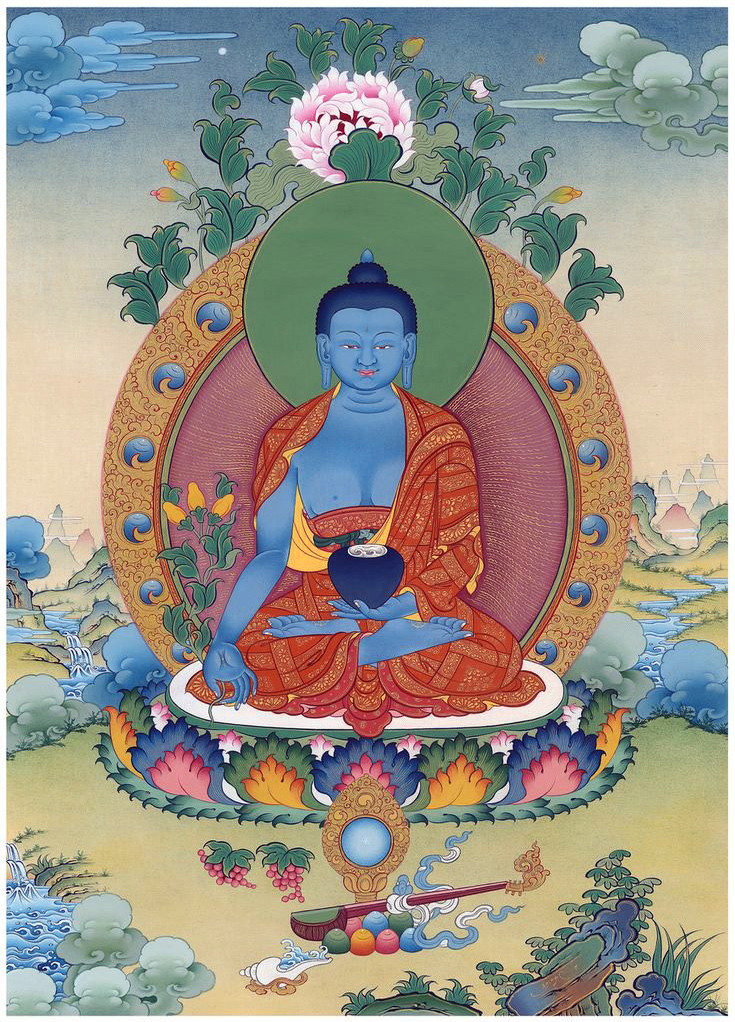
In Buddhist statuary art and sculpture, the Medicine Buddha is depicted, delicately holding the myrobalan plant between his thumb and middle finger. This symbolic gesture stems from the healing properties of the myrobalan. It entered the Persian pharmacopeia from early times: myrobalan is mentioned in the medical handbook of Avicenna (Ibn Sīnā) in the early 11th century. It was also used in Europe. No later than during the Middle Age, it was a valued ingredient which apothecaries prescribed almost as a universal remedy. It should be noted that, apart from its use in traditional and Ayurvedic medicine, amla has recently aroused a growing interest from modern medicine where it is use in diabetic treatments and to prevent cancer, among other properties.
Buddha holding the myrobalan plant
All parts of the Melaka tree are full of tannins[1], which make myrobalan a very useful ingredient. In the natural dyeing process, myrobalan can be used either as a mordant (a substance which helps fix the pigments into the fibres) or as a dye itself, rendering blackish colours. In addition to dyeing, myrobalan has many other applications. It is used both for tanning leather and also in the manufacture of Damascus steel.
It is clear that Prince Parameswara was wise to choose this place and this beneficial tree, to establish his new realm!
[1]Tannins are vegetable substances of the family of polyphenols, most often water-soluble, which have the ability to precipitate proteins and other chemical substances. For trees and flowering plants, this is a chemical defence against pests. Tannins can be found in some drinks such as tea, coffee, beer and wine.
Halleux Robert. Sur la fabrication de l’acier dans l’Antiquité et au Moyen Âge. In: Comptes rendus des séances de l’Académie des Inscriptions et Belles-Lettres, 151ᵉ année, N. 3, 2007. pp. 1301-1319. www.persee.fr/doc/crai_0065-0536_2007_num_151_3_91356
Amongst the detritus of the great explosion that destroyed the Dutch ship ‘Nassau’ at the battle of Tanjong Tuan in 1606, is one small curious flagon, usually referred to as a Bellarmine Jar, that survived the disaster almost unscathed. These jugs are made of brown earthenware with a bulbous body tapering to a long, narrow neck decorated with the face of a rather fierce bearded man. They often also bear a coat-of-arms, as the one featured in the museum, or a floral decoration. Bellarmine Jars were traditionally produced in Germany, particularly in Frechen outside Cologne. This jar is said to date to the early years of the 17th century, although their production in Germany goes back at least to the 14th century, possibly earlier.
In Germany, these jars were first called ‘Bartmann Krug’ (Bearded Man Jugs). The face is reminiscent of the Wild Man of the Woods spirit common across Europe that originated in ancient times and was still worshipped in rural areas even in the staunchly Christian Middle Ages. In Britain, this image was known as ‘The Green Man’, still a popular name for inns and pubs. Similar faces were often carved or etched onto trees, stone structures or wooden panels as a protection against evil spirits. They can even be found adorning the borders of Christian manuscripts and tapestries.
But in 1606, the nickname Bellarmine was newly coined and, in fact, may not have been in general use until later in the century. St. Robert Bellarmine (1542-1621), an influential Roman Catholic theologian and Counter-Reformation cardinal, was very unpopular in the Protestant countries, particularly Germany and Holland. It was Robert Bellarmine who was behind the original accusations against Galileo and who led the Papal attempt to declare Copernicus’s theories heretical. As you can imagine, this rigid and reactionary cardinal also held many other strict views – particularly against the consumption of alcohol. These jars seem to have been named for him in an attempt to humiliate the Cardinal by portraying him as a grotesque bearded old man who frowned on fun and enjoyment. There was also the extra insult that these small flagons would often be used to carry alcohol, something Bellarmine was particularly against. Imagine drinkers wishing each other ‘Cheers’, whilst raising the Cardinal’s face in mock tribute!
Carrying gin and brandy was not their only function. Research from the Nassau and various other shipwrecks of Dutch vessels shows that the jars were often used on long voyages to transport mercury, an important component of various medical treatments. Another more sinister use of Bellarmine jars, which must have further insulted the famous cardinal, was as Witches’ Jars used to store hair clippings, nails -or even human urine -for use in spells and charms. The jars were then buried in secret places to work their magic.
Our little jar spans a thousand years of history and tells of pagan rites, Christian conflicts, magic spells, pharmacological remedies – and an irreverent bottle of gin!
How tin mining struck deep into Malayan soil and left its mark upon a nation
by Muhammad Adib Mohd Faiz
To the average modern person, tin is merely a metal – dead matter fit for industrial purposes. The Malays, however, traditionally believed that tin possesses a soul. The ‘soul of tin’ took the shape of a water buffalo, an animal used to plough the rice fields that were a major source of provision.[1] Whatever our personal beliefs may be, there can be little doubt that tin would plough its way through 19th and early 20th century Malaya, becoming a source of wealth for those involved in its production. The important economic role of tin in this period would have a long-lasting effect on the social, political, and infrastructural landscape of Malaya.
Collection of tin hat and animal money at Muzium Negara (Galleries C and D)
Tin mining had existed amongst the Malays as early as the 15th century, with tin currency going back to at least the time of the Melakan king Sultan Muzaffar Shah (1445-9). Other than the simple method of panning for tin with a dulang, Malays used a combination of pits, dams, sluice boxes, and other components to extract tin ore. This system could produce an amount “sufficient for local use as well as export”.[2] However, the Malay rulers often lacked funds to open these mines and began to rely on Chinese merchants for capital in the early 19th century. The Malay chiefs then used Chinese labour to work the mines, with the Chinese having been involved in tin mining as early as the late eighteenth century. While the initial numbers were small, the rise of the tin canning industry after 1830 and the discovery of rich tin deposits in Selangor and Perak in the 1840s led to a massive influx of Chinese immigrants, swelling the population of the mining towns.[3] It seems likely that the sudden increase in demand would have influenced the decision of Chinese mine owners to switch to new forms of technology such as opencast or lombong mining. For instance, Chinese mine-owners began to use the chin-chia, a chain pump that drained water from the mines more quickly than traditional methods.[4] Yet in spite of the technological changes and diaspora population, tin-mine opening ceremonies remained “purely Malay in character”. A pawang or “mining wizard”, often a Malay and occasionally a Sakai, was often called upon to use a combination of spells and talismans for protection and an auspicious start.[5] This contrast between the old and the new embodies the nature of tin mining in this period: a modern industry in the midst of a traditional world.
An Open Cast Tin Mine in Selangor (KITLV Universiteit Leiden)
The involvement of Chinese merchants and the large influx of Chinese labour had a number of social consequences. While immigrants may have initially intended to be temporary, direct settlement eventually arose, with family structures emerging in the early 20th century in places such as Ipoh. The accounts of an Englishwoman living in Ipoh in 1914 bear witness to the role of female miners, who played central economic and social roles in the town. Waking up before dawn, these women would prepare the day’s meals, chop wood, and “[draw and carry], often from a distance, quantities of water”. Breakfast with their husbands was followed by “very thoroughly” bathing and dressing their “generally numerous” quantities of children. They would then see to the grandfather and grandmother, “who will then look after the babies” as the women work on the tin mines alongside their husbands.[6] This last piece of information clearly indicates the presence of extended families, showing that large social structures existed in mining towns. The ability to raise families was made even more remarkable by the sheer difficulty of the work in question; these people laboured for hours in cold, stagnant water up to their ankles, with the female dulang washers having to bend over to obtain tin ore.
Paraphernalia at the Story Museum, SJK (C) Serdang Baru 1
However, there was a less admirable side to this history of immigration, namely the exploitation connected with the kongsi organizations, the colonial authorities, and the system in general. Though often referred to as “secret societies”, the kongsi had a public political and social role in nineteenth century tin-mining areas. They were cooperative associations that originated from China’s “illegal mining communities and sea-merchant kingdoms”. Theoretically, the kongsi were democratic organizations designed to share profits between members and “[enable] immigrants to pursue their primary purpose of making a living and supporting their families in China”. As Tan Pek Leng notes, the lack of “effective formal governance” caused these societies to act as arbitrators in the midst of disputes, while the “bonds of brotherhood” in a kongsi provided a formidable force against the colonial authorities. However, the ideal form of the kongsi was rarely realized in Malaya, with these powerful organizations exploiting others for personal economic gain. The various kongsi often controlled labourers before they had even left China, with recruiters placing labourer’s names on kongsi membership rolls “without their knowledge”.[7] Once in Malaya, the labourers were totally dependent on the “advancers” for everything from food to opium, all of which had to be bought at the advancer’s price. The colonial authorities were complicit in the exploitation. Though the British had some admirable officials who introduced some regulations, British law courts recognized the fines imposed by advancers. Colonial contradictions could be jarring; although the Perak Government insisted on a “discharge ticket” so labourers could “seek employment elsewhere” upon contract completion, they subjected labourers who absconded to “a fine, flogging or imprisonment, and to have the wages due to them forfeited”. This last detail meant that such workers would have to start from scratch, locking them into their contract for an even longer time. It is difficult to disagree with Ho Tak Ming’s conclusion that this “was no better than a modified form of slavery”.[8]
Paraphernalia at Falim House, Ipoh
Power leads to conflict, and rival kongsi often came into armed conflict with each other “to protect the interests of their towkays and headmen”.[9] In a world mostly centred on kongsi control, these confrontations were effectively civil wars, engulfing whole towns in chaos. The most famous of these were the Larut wars in Perak (1861-74), where the Ghee Hin and Hai San societies engaged in bloody battles over tin mines. With the Malay rulers lacking control of the situation – the Mentri Larut “was forced to side with whichever side was mining at the time” – the British eventually stepped in to settle the disputes. The result was the signing of the Pangkor Treaty in 1874, which forced the rival factions to maintain peace at the expense of a $50,000 penalty and demanded that the Sultan follow the “advice” of a British officer called a “Resident” in all matters except Malay customs and religion. The treaty also stated that British residents would regulate “all revenues and the general administration”.[10] This began a pattern of indirect rule that would spread to other states in Malaya.
Diorama showing the signing of the Pangkor Treaty by Raja Abdullah and Sir Andrew Clarke (representing the British Crown). Photo taken at Pasir Salak Historical Complex.
It was with the introduction of the dredge ship that European power would gain a firm foothold in Malaya’s tin mining industry. In the years after 1915, the earlier sources of tin were gradually depleted. With fewer “easily accessible deposits”, it became necessary to dig deeper into areas that could not be reached through existing methods. Around this time, European companies began introducing new forms of technology that could reach the “deeply buried deposits” that were previously inaccessible.[11] An example of such technology was the dredge or kapal korek, with the example referred to in the National Museum being capable of digging 31.5 meters deep.[12] Moreover, the dredge could do the same work with a far smaller labour force, shifting the tin mines away from labour-intensive methods to capital-intensive methods. Coupled with the increase of British administrative control over Malaya, the dredge and other machines gradually weakened the Chinese hold over the industry.[13] Although they did not have the same societal effect as the Chinese, European economic domination would have a developmental – and environmental – effect. In an attempt to link the economic centres of Malaya together, a system of transportation was eventually devised with trunk roads and railways connecting tin mining areas on the West coast. Yet while Malay transportation systems had been developed in harmony with nature, the new modes of transportation were built with little concern for environmental effects. While seas and rivers had previously served as “natural highways”, railways were an artificial imposition that altered the landscape. While elephants had previously been used to transport goods, wild elephants were now injured by oncoming trains.[14] Though hardly matching the environmental catastrophe that exists in Malaysia today, these early developments may be seen as beginning a venomous trend, namely the love of “progress” with no regard for the earth and its creatures.
Tanjung Tualang Dredge No.5 (TT5), located south of Batu Gajah, was originally operated by the Southern Malaya Tin Dredging company.
The soul of tin turned the soil of Malaya into a dramatic history, with a cast of immigrants, mothers, bullies, and machines. What traces remain of that drama today? The tin mines of Malaya are now mere pools of water, and Malaysia’s economy is a whole other beast. The soul of tin has clearly moved on, perhaps to plough other fields or else to rest in a faraway swamp. Yet in its wake, it has left a furrow filled with the experiences and emotions of an era. Out of that furrow, new crops have grown, surrounding us as a part of our Malaysian experience.
Champion, Marissa. Odyssey: Perspectives on Southeast Asia – Malaysia & Singapore, 1870-197. Singapore: SNP Panpac, 2001.
Ho, Tak Ming. Ipoh: When Tin Was King – Volume 1. Ipoh: Perak Academy, 2014.
Kaur, Amarjit. “The development of railways.” In The Encyclopedia of Malaysia: Early Modern History [1800-1940], edited by Cheah Boon Kheng, 120–1. Singapore: Editions Didier Millet, 2001.
Loh, Francis Kok-Wah. “Chinese immigration and tin mining.” In The Encyclopedia of Malaysia: Early Modern History [1800-1940], edited by Cheah Boon Kheng, 72–3. Singapore: Editions Didier Millet, 2001.
Loh, Francis Kok-Wah. “Early Malay tin mining.” In The Encyclopedia of Malaysia: Early Modern History [1800-1940], edited by Cheah Boon Kheng, 20–1. Singapore: Editions Didier Millet, 2001.
Mrs JG Withycombe. Lady. 1914. As quoted in Ho Tak Ming. Ipoh: When Tin Was King – Volume 1. Ipoh: Perak Academy, 2014.
Skeat, Walter William. Malay Magic: An Introduction to the Folklore and Popular Religion of the Malay Peninsular. London: Frank Cass and Co. Ltd., 1900.
Tan, Pek Leng. “Chinese secret societies.” In The Encyclopedia of Malaysia: Early Modern History [1800-1940], edited by Cheah Boon Kheng, 48–9. Singapore: Editions Didier Millet, 2001.
Tan, Pek Leng. “Long Jaafar and the Chinese tin miners in Larut.” In The Encyclopedia of Malaysia: Early Modern History [1800-1940], edited by Cheah Boon Kheng, 46–7. Singapore: Editions Didier Millet, 2001.
Tin Animal Currency display board, Gallery C, National Museum, Malaysia.
Tin Dredges display board, Gallery C, National Museum, Malaysia.